
外研版初中英语七下Module 3 自学(译文知识点)
M o d u l e 3 单词go over 复习;练习picnic['pɪknɪk] n. 野餐housework ['haʊswɜːk] n. 家务劳动on prep. 在……时候else[els] adv. 其他; 另外nobody['nəʊbədɪ] pron. 没有人atprep. 在……点钟nothing['nʌθɪŋ] pron. 没有什么; 没有东西silly['sɪlɪ] adj. 愚蠢的; 傻气的fantastic[fæn'tæstɪk] adj. 极好的forward ['fɔːwəd] adv. 面向未来的; 向前look forward to盼望fan[fæn] n. 迷; 支持者make friends 交朋友shirt [ʃɜːt] n. 球衣; (男式)衬衫cheer[tʃɪə] v. 为……喝彩player['pleɪə] n. 运动员;选手hope [həʊp]v. 希望win[wɪn] v. ( won ) 赢;获胜enjoy oneself过得愉快myself[maɪ'self; mɪ'self] pron. 我自己during ['djʊərɪŋ+prep. 在.......期间May [meɪ]n. 5月MayDay五一劳动节late [leɪt] adv. 迟 ; 晚adj. 迟的; 晚的walk [wɔːk] n. 步行; 走take a walk散步country['kʌntrɪ]n. 乡下; 乡村second ['sek(ə)nd]num. 第二collect[kə'lekt] v. 收集litter['lɪtə] n. 垃圾fun[fʌn] n. 娱乐; 乐趣summer holiday暑假camp[kæmp] n. 营地;帐篷Australian [ɑ'strelɪən]adj. 澳大利亚的sightseeing ['saɪtsiːɪŋ] n. 观光; 游览gosightseeing观光beach *[biːtʃ] n. 海滨; 海滩early ['ɜːlɪ] adv. 早 ; 提前adj. 早的【对话翻译】贝蒂:大明,周末你打算做什么?大明:在周六上午,我打算查看一下我的电子邮件并做作业。
然后,我打算帮忙做家务活。
你打算做什么,贝蒂?贝蒂:我打算下午去看电影。
你也可以一起来。
大明:当然了!。
有谁去?贝蒂:没有人了。
玲玲打算去上钢琴课,所以她不能和我们一起去。
但是星期天下午,我和玲玲要去野餐,你愿意加入我们吗?大明:是的,我愿意。
我们在这里见面吗?贝蒂:不,不是。
我们打算在一点钟在公园见面。
贝蒂:嗨,大家好!贝蒂:你好,托尼。
这个周末你的计划是什么?托尼:没有事情。
我打算一个人在家待着。
贝蒂:别傻了!你来和我们一起吧。
这将会是一个极好的周末!课文翻译:What are you going to do?你打算做什么?A我期待着明天的足球比赛。
我和我的朋友们打算去观看我们最喜欢的球队比赛。
我们将会见到其他的球迷,并结交一些新朋友。
我们都将穿着队服,并且我们要为队员们喝彩。
我希望他们赢得比赛!——马丁B五一假打算我打算好好的玩一玩。
5月1日早上我要晚点起床,然后读书。
下午我要和家人、朋友一起出去。
我们要去乡村散步。
或者去游泳。
5月2日我们要去朋友家附近的公园捡垃圾。
那将会是一个很棒的假期——忙碌但有趣!——张思佳C通常我在家过暑假,但今年将会完全不同,因为我要参加一个在澳大利亚悉尼举办的夏令营,我将和一个澳大利亚的家庭住在一起,并用英语沟通。
我们还会去观光,并且在海滩上野餐。
——露西Moudle 3 知识梳理【重点短语】1.go over 复习2.see a movie 看电影3.help with the housework 帮忙做家务4.have a piano lesson 上钢琴课5.at the weekend 在周末6.have a picnic 野餐7.on Saturday morning 在周六上午8.join us 加入到我们中来9.in the park 在公园10.do one’s homework 做(某人的)家庭作业11.stay at home alone 独自待在家里12.look forward to 盼望13.get up late 起床晚14.enjoy oneself 过得愉快15.read a book 读书16.May Day(Labor Day) 五一劳动节17.on 2nd May 在五月二日18.go swimming 去游泳19.take a walk 散步20.collect litter in the park 在公园里收集垃圾21.go sightseeing 观光22.spend time with family and friends 与家人和朋友们一起度过时光23.make some new friends 结交一些新朋友24.at home 在家25.in the morning of 1st May 在五月一日的上午26.go on summer camp 去夏令营27.on the beach 在海滩上28.listen to music 听音乐29.travel around the world 环游世界30.play computer games 玩电脑游戏31.stay in bed 待在床上32.make plans 制定计划33.go for a walk 去散步34.have fun 玩得愉快【重点句型】1.What are you going to do at the weekend?=What are your plans for the weekend? 你周末打算做什么?/你周末的计划是什么?2.On Saturday morning, I’m going to check my email and do my homework. 在周六上午,我打算查看我的电子邮件并做作业。
3.Then I’m going to help with the housework. 然后我将帮忙做家务。
4.Who else is going to be there? 还有谁去那里?5.She can’t come with us. 她不能和我们一块(去)。
6.Would you like to join us? 你愿意加入我们吗?7.Are we going to meet here? 我们在这儿见面吗?8.We are going to meet in the park at one o’clock. 我们一点钟在公园见面。
9.I’m going to stay at home alone. 我打算一个人在家呆着。
10.Don’t be silly! 别傻了!11.It’s going to be a fantastic weekend! 那将会是一个极好的周末!12.I’m looking forward to the football match tomorrow. 我正期待着明天的足球比赛。
13.We’re going to meet other fans, and make some new friends. 我们将会遇到其他的球迷,并结交一些新朋友。
14.We’re all going to wear the team shirt. 我们将会穿上我们队的队服。
15.We’re going to cheer the players. 我们将会为球队加油。
16.On the morning of 1st May, I’m going to get up late and then read a book. 五月一日早晨我会晚点起床,然后看书。
17.In the afternoon I’m going out with my family and friends. 下午我打算和家人、朋友一起外出。
18.It’s going to be a great holiday --- busy but good fun! 这将会是一个很棒的假期,忙碌而有趣!ually I spend the summer holiday at home, but this year is going to be very different because I’m going on a summer camp in Sydney, Australia. 通常我都是在家过暑假,但是今年将完全不同,因为我将要参加一个在澳大利亚悉尼举办的夏令营。
20.We’re also going sightseeing and going to have a picnic on the beach. 我们还要好好地游览一番,并且在海滩上用餐。
【用法详解】1.I′m going to +动词原形我将要…2.look forward to +动词ing 形式期待…3.have fun(in)doing 做…很高兴4.go+动词ing 形式去…5.enjoy oneself 过得愉快6.I hope that+句子我希望…7.hope to do sth. 希望做某事8.hope for+名词或名词短语希望…【重点语法】一般将来时(Ⅰ) am/is/are going to +动词原形1.基本结构肯定式:am/is/are going to +动词原形否定式:am/is/are not going to +动词原形一般疑问式:am/is/are +主语+ going to + 动词原形+其他?特殊疑问式:特殊疑问词+一般疑问式?He is going to spend his holidays in London. 他打算在伦敦度假。
Look at the dark clouds. There is going to be a storm.看那乌云,快要下雨了。
Is he going to collect any data for us?他会帮我们收集数据吗?What are you going to do tomorrow? 明天你打算作什么?注意:表示计划到某地去,谓语动词go与going重复,一般只说be going to +地点。
2.基本用法(1)表示事先经过考虑、安排好打算、计划要做某事。
外研英语七年级下 Module 3 语言知识点
You, Mike and I should clean the classroom
enjoy oneself表示“玩得高兴”,相当于have a good time和have fun,其中oneself要与主语保 持人称和数的一致(yīzhì)。 enjoy后可接名词或 动名词作宾语,不能接不定式。如:
Peter is enjoying his dinner now.
皮特正在享受他的晚餐。
精品PPT
中考(zhōnɡ kǎo)链接: 1. —When did your uncle arrive ______ China? —He got to Guangzhou _______the morning of the 16th of April. (2011广东广 州) A. at; in B. in; in C. to; on D. in; on D
精品PPT
7. Don’t be silly! 别傻了!
常见的否定祈使句有以下两种: “Don’t+be+形容词”和“Don’t+行为动 词(dòngcí)原形” 。如:
Don’t be afraid. 不要害怕。 Don’t be late for school again, Jack. 杰克,不要再迟到(chídào)了。 Don’t make a noise. 不要制造噪音。
根据(gēnjù)句意,用else 或other 填空。 1. What ____el_s_e__ can_h_e_r boys?
新版外研七年级下M3知识点
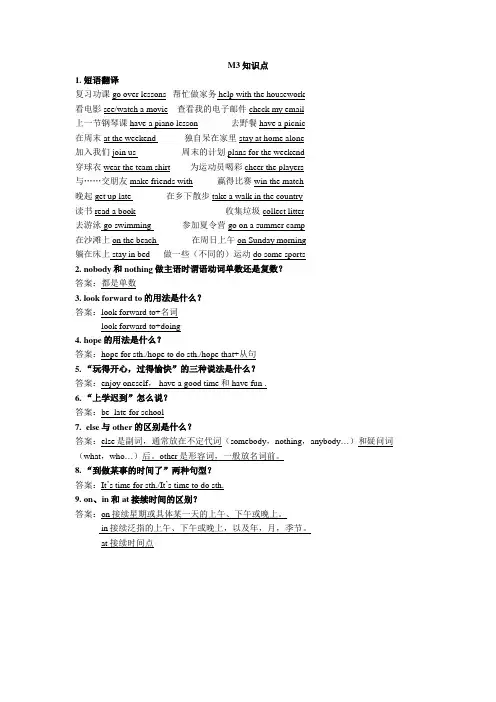
M3知识点1. 短语翻译复习功课go over lessons 帮忙做家务 help with the housework看电影 see/watch a movie 查看我的电子邮件check my email上一节钢琴课have a piano lesson 去野餐have a picnic在周末 at the weekend 独自呆在家里 stay at home alone加入我们 join us 周末的计划 plans for the weekend穿球衣 wear the team shirt 为运动员喝彩 cheer the players与……交朋友 make friends with 赢得比赛 win the match晚起 get up late 在乡下散步 take a walk in the country读书 read a book 收集垃圾collect litter去游泳 go swimming 参加夏令营 go on a summer camp在沙滩上 on the beach 在周日上午on Sunday morning躺在床上 stay in bed 做一些(不同的)运动do some sports2. nobody和nothing做主语时谓语动词单数还是复数?答案:都是单数3. look forward to的用法是什么?答案:look forward to+名词look forward to+doing4. hope的用法是什么?答案:hope for sth./hope to do sth./hope that+从句5. “玩得开心,过得愉快”的三种说法是什么?答案:enjoy oneself, have a good time和 have fun .6. “上学迟到”怎么说?答案:be late for school7. else与other的区别是什么?答案:else是副词,通常放在不定代词(somebody,nothing,anybody…)和疑问词(what,who…)后。
初中英语外研版七年级下册M3U3知识点讲解

七年级英语下册M3U3知识讲解【语法】语法:一般将来时(一)(1)一般将来时:表示自己打算做某事,计划做某事或有意做某事;或表示即将发生某事。
(2)结构:主语 + be going to + 动词原形 + 其它Eg: 肯定句:I am going to visit Beijing tomorrow.我明天要去参观北京。
否定句:I am not going to visit Beijing tomorrow.我明天不会去参观北京。
一般疑问句:Are you going to visit Beijing tomorrow?你明天回去参观北京吗?肯定回答:Yes, I am.否定回答:No, I’m not.特殊疑问句:What are you going to do tomorrow?你明天打算干什么?(3)时间标志词:in + 时间段; tomorrow, the day after tomorrow(后天);next ~; ina week等(4)there be的将来时结构为:There is/ are going to be + 名词 + 地点短语Eg: There is going to be a meeting next week.下周将会有一个会议。
【知识讲解】1.Listen to music 听音乐Eg: She likes listening to music.她喜欢听音乐。
2.Go shopping= do some shopping 去购物Eg: She often goes shopping with her mother on weekends.她经常周末和妈妈去购物。
3.Do some sports 做运动Eg: Many young people in the UK do some sports on Saturday morning.在英国许多年轻人在周六上午做运动。
外研版七年级英语下册 模块3知识点归纳

知识点一:模块 3 的短语
1.have a picnic 去野餐 2.check one’s email 查收某人的邮件 3.go over 复习 4.on Sunday morning 在周日上午 5.see/watch a movie 看电影 6.in the park 在公园里 7.have a piano lesson 上一节钢琴课 8.make friends 交朋友 9.enjoy myself 过得愉快
(某人)做某事的时候了。” 到告诉他真相的时候了。
It’s time for ...
跟的是名词,意为“到…… It’s time for school .
的时间了。”
到上学的时间了。
两者相互转换 eg:It’s time to have breakfast . = It’s time for breakfast. 到了吃早饭的时间了。
2.else adj . 别的,其他的 adv . 另外,其他 else 作形容词时一般用在不定代词(something, anything, nobody, somebody 等)或疑问代词(who, what 等)之后;作副词时一般用在不定副词(somewhere,anywhere 等)或疑问副词(where,how 等)之后。 eg:I’m going to take you somewhere else. 我将要带你去别处。
at 表示在具体的几点钟
on May Day 在五一劳动节; on Sunday afternoon 在周日下午 in 1997 在 1997 年; in May 在五月; in the morning 在早上 at five o’clock 在五点; at half past six 在 6:30; at a quarter past two 在 2:15
外研版七年级英语下册模块3知识点归纳
外研版七年级英语下册模块3知识点归纳Module 3: Making PlansIn this module。
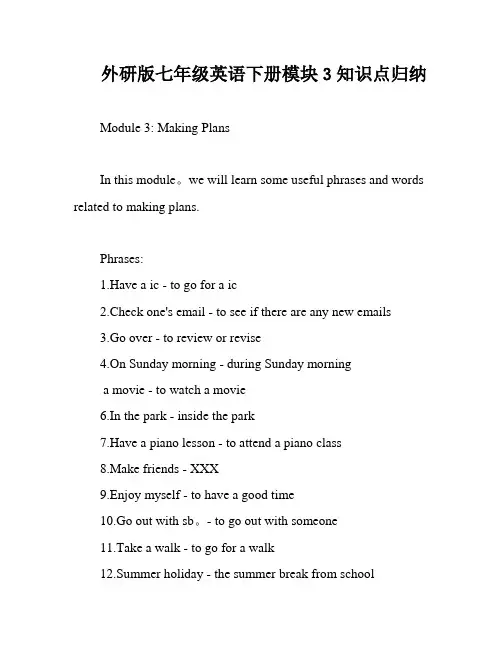
we will learn some useful phrases and words related to making plans.Phrases:1.Have a ic - to go for a ic2.Check one's email - to see if there are any new emails3.Go over - to review or revise4.On Sunday morning - during Sunday morninga movie - to watch a movie6.In the park - inside the park7.Have a piano lesson - to attend a piano class8.Make friends - XXX9.Enjoy myself - to have a good time10.Go out with sb。
- to go out with someone11.Take a walk - to go for a walk12.Summer holiday - the summer break from school13.Go on a summer camp - to attend a summer camp14.Do some sightseeing - to visit tourist ns15.Look forward to sth - to be excited about something16.On the beach - at the beach17.Collect litter - to clean up XXXWords:1.On Saturday morning - during Saturday morning2.Else - other or anotherFor example。
外研版七年级下册英语Module 3 语法知识点

外研版七年级下册英语Module 3 语法知识点Unit 1 知识点精析1.go over 复习go over是固定词组,意为“复习;练习”。
例:-Can you go over your lessons by yourself?你能自己复习功课吗?-Yes,I can.是的,我能。
2.What are you going to do at the weekend, Daming?大明,你打算周末做什么?be going to后跟动词原形,意为“打算(做某事);计划(做某事)”。
例:What are they going to do on Sunday?他们打算星期天做什么?at the weekend意为“在周末”,也可用on the weekend表达。
例:We can fly a kite at/on the weekend.我们可以在周末放风筝。
At/On the weekend I'm going to look for my watch at the lost and found office.周末我要去失物招领处找我的手表。
3. On Saturday morning, I'm going to check my email and do my homework.在星期六上午,我打算查看我的电子邮件并做我的家庭作业。
on Saturday morning意为“在星期六上午”。
如果泛指“在上午/下午/晚上”,介词用in;但是如果在具体的某一天的上午/下午/晚上,介词则要用on。
例:She only works in the morning.她只在上午工作。
See you on Monday morning.星期一上午见。
知识拓展介词on,in和at在表示“时间”时的区别on 表示在具体某天或具体某一天的on Monday在星期一on cold winter afternoon在一个寒冷的冬天的下午in 表示在某年、某月或泛指一天的上in March在三月上午、下午或晚上in the afternoon在下午at 表示在具体的某一时刻。
七年级下外研版m3知识点
七年级下外研版m3知识点七年级下外研版M3的课程涵盖了语法、词汇和听力等多个方面。
本文将针对其中的知识点进行具体讲解。
1. 语法
1.1 一般现在时
一般现在时是指经常、习惯或普遍的动作。
例如,I usually get up at 6 o'clock in the morning. 在一般现在时中,动词一般要加s或es。
1.2 一般过去时
一般过去时是指发生在过去一段时间内的事件。
例如,Yesterday, I went to the park. 在一般过去时中,动词一般要加ed。
1.3 现在进行时
现在进行时是指当前正在进行的动作。
例如,I am studying English now. 在现在进行时中,动词要用be动词加上动词的ing形式。
2. 词汇
2.1 动物
本课程中学习了许多常见的动物,如狗、猫、鸟、鱼等。
需要掌握它们的名称和基本特征。
2.2 食物
本课程中学习了许多常见的食物,如面包、鸡蛋、米饭、蔬菜等。
需要掌握它们的名称、颜色以及基本特征。
3. 听力
3.1 短对话
学习了许多简单的短对话,需要通过听力训练加强对英语语音的理解,并掌握基本的交际用语。
3.2 长对话
学习了一些更长的对话,需要对听力理解能力进行更高程度的训练,并学习如何从对话中获取信息及回答问题。
总结:
七年级下外研版M3主要涵盖了语法、词汇和听力等多个方面的知识点。
通过学习,我们可以掌握基本的英语交流能力,并打下坚实的英语学习基础。
七年级下册英语module3知识点
七年级下册英语module3知识点七年级下册英语Module 3知识点Module 3是七年级下册英语教材的第三个单元,主要围绕“小镇和城市”这一主题展开学习。
在这个单元中,学生将学会询问和回答关于城市和小镇的信息,以及描述和比较城市和小镇的不同之处。
以下是Module 3的几个重要知识点:1.问答句问答句在英语中非常重要,是日常交流中不可缺少的部分。
问答句的特点是句子中将动词提到主语前面,以形成疑问。
例如:“What’s the name of your town?”(你们镇的名字是什么?)2. 介绍自己所住的城市或小镇在介绍自己所住的城市或小镇时,可以使用下面这些祈使句:a. “Come and see…”(来看看……)b. “Don’t miss…”(别错过……)c. “You must visit…”(你一定要去……)例如:“Come and see my school in the center of my town”(来看看我镇中心的学校吧)3.比较城市和小镇当需要比较城市和小镇时,需要使用比较级和最高级。
比较级用于两个事物之间的比较,最高级则用于三个或三个以上事物之间的比较。
比较级和最高级的构成方法是在形容词后加-er或-est。
例如:“My town is smaller than Shanghai, but it’s the most peaceful town I’ve ever seen”(我的镇比上海小,但是它是我见过最和平的镇)4. 询问和回答城市或小镇的信息当需要询问城市或小镇的信息时,可以使用下面这些常见的问句:a. “What’s the name of your town?”b. “How big is your city?”c. “What interesting places are there in your city?”当需要回答这些问题时,需要遵循清晰简洁的原则。
外研版七下英语第三模块知识点
外研版七下英语第三模块知识点Module 3: The world in dangerUnit 1: Changes in the environmentKey Vocabulary:1. pollution: the presence in or introduction into the environment of a substance or thing that has harmful or poisonous effects2. environment: the surroundings or conditions in which a person, animal, or plant lives or operates3. recycling: the process of converting waste into reusable material4. global warming: a gradual increase in the overall temperature of the earth's atmosphere generally attributed to the greenhouse effect5. deforestation: the action of clearing a wide area of treesGrammar:1. Present continuous tense: We use the present continuous tense to talk about things that are happening now or at the moment of speaking.Example: The company is recycling its waste materials.2. Modal verbs: Modal verbs are used to show someone's attitude towards their action or to indicate possibility, obligation, permission, or ability.Example: We must stop polluting the environment.Reading:In this unit, students will read a variety of texts related to changes in the environment. They will learn about different types of pollution, the impact of global warming,and the importance of recycling. They will also read about the effects of deforestation on the environment and wildlife.Listening:Students will listen to conversations and interviews related to environmental changes. They will practicelistening for specific information and inference skills.Speaking:In this unit, students will practice speaking about environmental issues. They will engage in discussions, role-plays, and presentations about pollution, recycling, and global warming. They will also learn how to express their opinions and give reasons for their views.Writing:Students will learn how to write a formal letter expressing their concerns about environmental issues to a local government official or company. They will also practicewriting a persuasive essay on the importance of protecting the environment.Overall, this unit will help students develop their language skills while increasing their awareness of environmental issues and the importance of protecting the world in danger.。
外研版七年级下册英语Module 3 Making plans中英互译
B I’m going to enjoy myself during the May Day holiday.五一期间我将好好地玩一玩。 On the morning of 1st May, I’m going to get up late and then read a book.五月一日早晨我会晚点起床, 然后看书。 In the afternoon I’m going out with my family and friends.下午我打算和家人、朋友一起外出。 We’re going to take a walk in the country or go swimming.我们将在乡村散步,或者游泳。 And on 2nd May we’re going to collect litter in the park near my friend’s house.五月二日我们打算在 我朋友家附近的公园里捡垃圾。 It’s going to be a great holiday--busy but good fun! 这将会是一个很棒的假期,忙碌而有趣!
C Usually I spend the Summer holiday at home, 通常我都是在家过暑假, but this year is going to be very different because I’m going on a summer camp in Sydney, Australia. 但是今年将完全不同,因为我将要参加一个在澳 大利亚悉尼举办的夏令营。 I’m going to stay with an Australian family and speak English.我将和一个澳大利亚家庭住在一起, 并用英语沟通。 We’re also going sightseeing and going to have a picnic on the beach.我们还好好地游览一番,并且 在海滩上用餐。 --Lucy