
货物贸易与服务贸易之间的关系
12服务贸易

自由贸易以后
比较优势成立
第一种情况,“出口”管理要素M,进口可贸 易品X;
第二种情况,出口X,进口M;
中性技术优势
抵消要素价格差别, 只要A国劳动密集型产品价格低于B国,A国
“出口”管理要素M。
国际服务贸易中的基本原则
(一)公平自由原则 (二)平等互利原则 (三)最惠国待遇和国民待遇原则 (四)逐步发展原则 (五)市场准入原则 (六)例外原则
中级服务
仓储、运输、旅游
高级服务
银行、保险、法律、会计、审计、信息
服务贸易发展模式
传统服务贸易
运输、维修、金融、商业批发和零售
要素服务贸易
股票、债券、建筑和工程承包的劳务输出
新兴产业服务贸易
信贷、旅游、信息网络、视听产品、知识产权
迪尔多夫模型
同商品贸易互补的服务贸易
仅仅是货物贸易的派生需求
第二,为使各国逐步放宽服务市场开放的领域,加深市 场开放的程度,最终实现服务贸易自由化,GATS提出 了市场准入原则,即一成员方给予其他成员方服务提供 者的待遇应不低于其在承担义务的计划表中确定的期限、 限制和条件。而且GATS还规定各国在其做出市场准入 承诺的服务部门中,除非在其承担义务的具体承诺表中 列出外,不能维持或采用数量配额、垄断和专营服务提 供者方式;数量配额和要求测定经济需求的方式限制服 务交易或资产的总金额;采用配额或要求测定经济需求 的方式限定服务交易的总数和以数量单位表示的服务提 供的总产出量;采用数量配额或要求测定经济需求方式 限制某一服务部门或服务提供者为提供某一具体服务而 需要雇佣的自然人的总数等不合理措施。
第五,在服务贸易中,由于服务的质量取
决于服务提供者的学历、职称、经验和技术 水平,所以GATS为避免成员方在这些任职条 件上附加限制,构成服务贸易自由化的障碍, 要求各成员方相互予以承认对方国家就教育 程度、经验、符合资格条件所颁发的许可证 及证明,并最终按国际统一准则加以合作。 这对我国具有劳动力成本竞争优势的国家具 有重要的意义。在积极要求其他国家对我开 放服务市场的同时,应和有关国家签订协议, 承认我们的技术职称、学历和其他任职条件, 以便更好地参与国际服务贸易,获得市场准 入机会,取得相应的服务报酬。
服务贸易的概念与内涵

服务贸易的概念与内涵一、什么是服务贸易(Trade in Services)服务贸易概念首次提出是在1972年9月,经济合作与发展组织(OECD)在《高级专家对贸易和有关问题报告》中服务贸易概念。
1974年,美国在其《1974年贸易法》第301条款中使用了“世界服务贸易”的概念。
简单地讲,服务贸易是指一国居民与他国居民间的服务交易。
包括居民与非居民之间的服务贸易和通过外国附属机构实现的服务贸易两种。
贸易一方向另一方提供服务并获得收入的过程称为服务出口或服务输出,购买他人服务的一方称为服务进口或服务输入。
世界贸易组织(WTO)确定的服务贸易的四种模式,成为服务贸易内涵的权威阐述和各国普遍接受的定义。
模式一:跨境提供Cross-border supply服务的提供者在一成员的领土内向另一成员领土内的消费者提供服务。
如法律咨询服务、工程设计等。
模式二:境外消费Consumption abroad服务的提供者在一成员的领土内向另一成员的消费者提供服务。
如旅游、留学等。
模式三:商业存在Commercial presence一成员的服务提供者在另一成员领土内设立商业机构或专业机构,外国直接投资企业。
模式四:自然人移动Presence of natural persons一成员的服务提供者以自然人身份进入另一成员的领土内提供服务。
如外国专家讲学,劳务人员等。
二、服务贸易的分类:WTO将服务贸易(W/120)分为12个服务部门。
包括:商业服务、通信服务、建筑及相关工程服务、分销服务、教育服务、环境服务、金融服务、与健康相关的服务、旅游和旅行相关服务、娱乐、文化和体育服务、运输服务、其他服务。
这12项服务业又可细分为160多项子服务行业。
三、服务贸易的统计由UN、EU、IMF、OECD、UNCTAD、WTO共同制定的《国际服务贸易统计手册》,形成国际服务贸易统计基本框架。
扩展了传统国际服务贸易统计的范围,服务贸易的统计包括以下二个部分:(1)居民与非居民之间的服务贸易(Balance of Payments 简称BOP )(2)通过本国境内的外国附属机构所提供的服务贸易(Foreign Affiliates Trade in Services 简称FATS)四、服务贸易与服务业、第三产业的区别(1)服务业和第三产业是境内服务,而服务贸易是跨境服务。
新疆服务贸易发展问题研究——基于服务贸易与货物贸易相关性的实证分析

基 于 服 务 贸 易 与 货 物 贸 易相 关 性 的 实证 分 析
李
媛 (中 国人民 银行乌鲁木齐中 心支 行)
改革开放 以来 , 我 国大力发展对外贸易 , 尤其是货物贸易 , 使对 外贸易成为我 国国 民经 济增长 的重要推动力 " 随着 当今经济全球化趋势 的加强 , 服务贸易作 为对外 贸易 的重 要组成 部分发展十分迅速 " 近几年 , 新疆凭借地缘优势 , 对外开放程度不断加大 , 服 务贸易呈现 良 好的发展势头 , 在 当前形势下 , 基于新疆服务贸易与货物贸易的相关性 , 探讨货物 贸易对服 务贸易 的拉动作用 , 从而促进新疆服务贸易跨越式发展具有重要意义 "
13 5
氛 奥篆景 评论
,
部分都从 国家层 面考察货 物贸易与服务 贸易的关 系 , 从 国 内某 区域角度 进行研 究相 对较少 , 尤其是 尚未 有学者对新疆 服务 贸易 和货 物 贸易相关性 进行 研究 " 目前 新 疆 涉外 经济快 速 发 展 , 服务 贸易已成为新疆 经济发展 中的一支重 要力量 , 为此本文选择新疆服 务贸易 为研 究对 象 , 探讨其 与货物贸易之 间的相关 性 , 旨在 利用 实证分 析理 清两种 贸 易相 互支 持 和促进 关 系 , 为进一 步促进新疆涉外经济发展提供理论支持 "
二 ! 新 疆 服 务 贸易 总体 发 展 情 况 和特 点
近年来 , 新 疆服 务 贸易获 得快 速发 展 , 20 1 1 年服 务贸 易 总额 比 20 0 7 年增 长 了 4 倍 , 其 中 , 出 口和进 口额均达到历史最高值 ; 与此同时 , 20 1 1 年新疆货物贸易规模达到 22 8 亿美 元 , 比 20 0 7 年 同比增长 6 % " 新疆服务 贸易发展特点主要表现在 以下方 面 : 1. 服务 贸易 占货 物贸易的 比重逐渐增加 , 外 贸结构得 到提升 20 0 7 年 以来 , 新疆服务 贸易进 出 口额与货 物贸易 进 出 口额 占 比逐 年升 高 , 20 1 1 年该 占 比比 20 0 7 年增长 了 2 倍 , 说明新疆服务 贸易处 于 良好快 速 的发展 阶段 , 辖 区整体 外 贸结构 得 到提 升 " 2. 服务贸易 出 口增速高 于进 口 , 贸易结构更加均衡 近年来 , 新疆 服务贸易进 出 口均 呈现增 长态 势 , 20 0 7 一20 1 1 年 , 服务 贸 易进 出 口年 平 均增速均在 10 0 % 以上 , 其 中进 口高于 出口增速约 8 0 个 百分点 , 另外 , 服务贸易进出 口差额 的幅度逐 步收窄 , 20 0 7 年 服务 贸 易进 出 口顺 差 占服 务 贸 易进 出 口额 的 比例 超过 7 0 % , 而 20H 年该差 额为逆差 , 占比降为 4% , 说明辖 区服务贸易进 出 口结 构更加均衡 " 3. 服务贸易结构单一 , 交易项 目高度集 中在转 口贸易 , 技术性服务增长缓慢 新疆辖 区服务 贸易进 出 口高度 集 中在转 口贸易 , 2 0 1 年 , 新疆转 口贸易进 出 口额 对 服 务贸易进 出 口总额 的 占比超 过 8 0 % , 其 次是 运输 和 建筑 ! 安 装及 劳 务 承包 服 务 , 而通 信 ! 保险 ! 金融 ! 计算机 和信息 服务等技术类服务水平较低 , 且增长缓慢 "
我国服务贸易出口与货物出口关系研究

我国服务贸易出口与货物出口关系研究摘要:本文分别对我国1985—2008年服务贸易出口总额,运输、旅游、其他商业服务3个部门出口与货物出口进行图示和最小二乘法回归分析,得出结论:服务贸易出口对货物出口有显著的促进作用,而且三部门服务贸易出口对货物出口也有不同程度的促进作用。
因此,必须加快发展服务贸易出口,特别是三部门中的其他商业服务,进一步优化服务贸易出口结构,促进新兴服务业发展。
关键词:服务贸易;货物出口;出口结构一、引言目前,服务贸易对世界各国的影响越来越大,并成为各国贸易竞争的新领域和世界经济增长的新亮点。
陈宪(2000)认为,货物贸易会带动服务贸易发展,服务贸易特别是生产性服务贸易的发展源于随着货物贸易扩张所引起的服务需求,是货物贸易核心效用的派生效用。
陈兆俊(2001)的实证研究表明,广义的要素服务贸易与货物贸易之间存在互补关系。
邵望予(2005)认为,服务业发展水平的高低可以衡量一个国家的经济发展水平,服务业越发展,其经济发展水平越高。
张亮(2006)认为,服务出口对我国经济发展具有显著的推动作用,其对GDP增长的贡献大于服务贸易总额的贡献。
我国经济发展为服务进口提供了源动力。
我国服务贸易与GDP之间由短期偏离向长期均衡调整的速度很快。
郑吉昌、夏晴(2005),曲风杰(2007)等认为服务贸易为货物贸易升级和转型创造了条件,后者为前者的发展创造需求。
两者存在相互支撑的关系。
庄丽娟、陈翠兰(2009)运用脉冲响应函数法与方差分解法,发现我国货物贸易和服务贸易之间存在相互影响的动态关系。
上述研究主要沿用解释货物贸易的比较优势理论来分析服务贸易,并没有具体分析服务贸易的各个部分与货物贸易的关系。
为此,笔者将利用1985—2008年的数据,一是分析我国服务贸易的出口现状,二是从总体上研究服务贸易出口与货物出口的关系;三是研究服务贸易各部门对货物出口的影响,由此给出结论和建议。
二、我国服务贸易出口现状分析第一,从总量上看,1985—2008年我国服务贸易出口稳步增长,但规模与同期的货物出口相比水平仍很低,服务贸易出口额与同期货物出口额之比平均为14.86%。
国际服务贸易期末考试复习资料
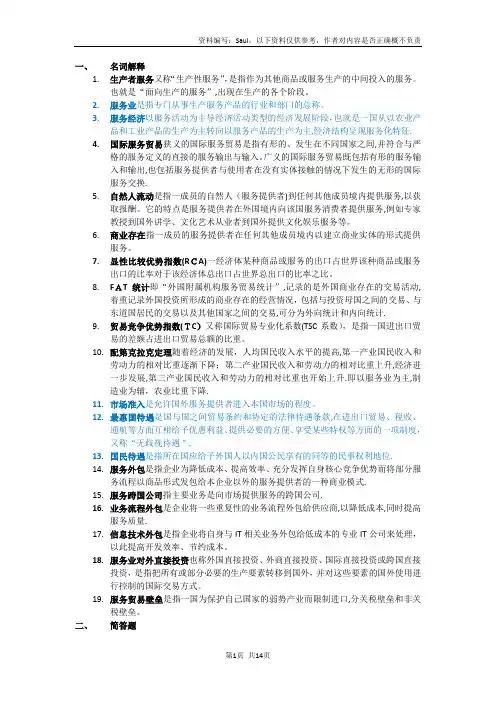
一、名词解释1.生产者服务又称“生产性服务”,是指作为其他商品或服务生产的中间投入的服务。
也就是“面向生产的服务”,出现在生产的各个阶段。
2.服务业是指专门从事生产服务产品的行业和部门的总称。
3.服务经济以服务活动为主导经济活动类型的经济发展阶段,也就是一国从以农业产品和工业产品的生产为主转向以服务产品的生产为主,经济结构呈现服务化特征.4.国际服务贸易狭义的国际服务贸易是指有形的、发生在不同国家之间,并符合与严格的服务定义的直接的服务输出与输入。
广义的国际服务贸易既包括有形的服务输入和输出,也包括服务提供者与使用者在没有实体接触的情况下发生的无形的国际服务交换.5.自然人流动是指一成员的自然人(服务提供者)到任何其他成员境内提供服务,以获取报酬。
它的特点是服务提供者在外国境内向该国服务消费者提供服务,例如专家教授到国外讲学、文化艺术从业者到国外提供文化娱乐服务等。
6.商业存在指一成员的服务提供者在任何其他成员境内以建立商业实体的形式提供服务。
7.显性比较优势指数(RCA)一经济体某种商品或服务的出口占世界该种商品或服务出口的比率对于该经济体总出口占世界总出口的比率之比。
8.FAT统计即“外国附属机构服务贸易统计”,记录的是外国商业存在的交易活动,着重记录外国投资所形成的商业存在的经营情况,包括与投资母国之间的交易、与东道国居民的交易以及其他国家之间的交易,可分为外向统计和内向统计.9.贸易竞争优势指数(TC)又称国际贸易专业化系数(TSC系数),是指一国进出口贸易的差额占进出口贸易总额的比重。
10.配第克拉克定理随着经济的发展,人均国民收入水平的提高,第一产业国民收入和劳动力的相对比重逐渐下降;第二产业国民收入和劳动力的相对比重上升,经济进一步发展,第三产业国民收入和劳动力的相对比重也开始上升.即以服务业为主,制造业为辅,农业比重下降.11.市场准入是允许国外服务提供者进入本国市场的程度。
12.最惠国待遇是国与国之间贸易条约和协定的法律待遇条款,在进出口贸易、税收、通航等方面互相给予优惠利益、提供必要的方便、享受某些特权等方面的一项制度,又称“无歧视待遇".13.国民待遇是指所在国应给予外国人以内国公民享有的同等的民事权利地位.14.服务外包是指企业为降低成本、提高效率、充分发挥自身核心竞争优势而将部分服务流程以商品形式发包给本企业以外的服务提供者的一种商业模式.15.服务跨国公司指主要业务是向市场提供服务的跨国公司.16.业务流程外包是企业将一些重复性的业务流程外包给供应商,以降低成本,同时提高服务质量.17.信息技术外包是指企业将自身与IT相关业务外包给低成本的专业IT公司来处理,以此提高开发效率、节约成本。
服务贸易与货物贸易的差异和互补【外文翻译】
服务贸易与货物贸易的差异和互补【外文翻译】外文翻译原文Trade in Services and Trade in Goods: Differences and Complementarities Material Source: April 2009,The Vienna Institute for International Economic StudiesAuthor: Carolina LennonAbstractDespite the increasing importance of services in national economies (accounting for about 50-70 % of internal product), in global economy (accounting for the 20 % of global trade) and in public opinion (i.e. US Concern about Mexican workers due to migration laws or the case of the “polish plumbers” in France at the time of European Constitution referendum) there is no economic consensus about the way in what services should be considered in trade liberalization analyses. The double purpose of this paper is; first, to empirically determine to what extent trade in services differs from trade in goods and, second, to explore for potential complementarities between bilateral trade in goods and bilateral trade in services. For our first goal we regress a set of equations derived from the gravitational model and for the second we instrument bilateral trade for both services and goods in order to analyses potential causalities of each type of flow in the other. Main results show tha t “bilateral trust and contract enforcement environment”, “networks”, “labor markets” and “technology and technology of communication” have higher impact on service trade than on trade in goods; finally, after incrementing for endogenously, we found that bilateral trade in goods explains bilateral trade in services: theresulting estimated elasticity is close to 1.Reciprocally, though in a lower extent, bilateral trade in services affects positively bilateral trade in goods: a 10% increase in trade in services raises traded goods by 4.6%.1 IntroductionThe services sector is the biggest contributor to a country’s economy, its contribution increases with the level of development of countries, ranging from 47 percent of countries’ GDP in the case of low income countries to a contribution of 70 percent in the case of high income countries. In addition, measured by thebalance of payments (BOP), over the past two decades, growth of trade in services has surpassed growth of trade in goods. Trade in goods has multiplied by 3,5 while T otal services has multiplied by around 5. The growing importance of services in domestic economies and international trade is largely due to an increase in the production of intermediate services (i.e. outsourcing).Firms increasingly delegate costly knowledge-intensive intermediate-stage processing activities to specialized suppliers in order to benefit from lower factor costs. To illustrate this phenomenon we can observe in Figure 2 that trade in “Other Commercial Services”, which cons ists mainly in business to business services or outsourcing services, has experienced a seven-fold increase in its export value over the last twenty years. Besides the economic importance of services activity, in general, and service outsourcing, in particular, this phenomenon has received a huge amount of attention in the media and political circles and the sector has increasingly been included under the framework of current multilateral negotiations (GATS) and regional agreements. Notwithstandingthe economic importance of services sector in national economies and in the globalization process, there is no economic consensus about how trade in services should be considered in trade liberalization analyses. Bhagwati et al.(2004) argue that outsourcing is fundamentally a trade phenomenon, hence, with respect to trade in goods, there is no need to use a different approach to analyze trade liberalization outcomes in the services sector . By contrast Mirza et al (2006) develop a theoretical model that incorporates a special feature in services trade, based on the fact that trade in some services can only occur if inputs from both trading countries are jointly used in the transaction process. Some empirical research on the determinants of the bilateral trade in ser vices has been already carried. Grünfeld et al. (2003), Mirza et al. (2004), and Kimura and Lee (2003) explore for the determinants of bilateral trade in services using a gravity framework, differently to us they rely on aggregate data. Additionally Freund and Weinhold (2002) also use a gravity framework but focus only on the U.S. case and mainly on the impact of the new communication technologies on traded services. Aviat and Coeurdacier (2005) apply also a gravitational framework to explain bilateral trade in financial assets. To control for endogenously and to check for the direction of the causal relationship, they jointly study trade in goods and trade in banking assets in simultaneous gravity equations. The work of Kimura and Lee (2003) is the closest to our analysis, because, similarly to us, they also explore for differences and complementarities between trades in services and trade in goods. The purpose of this paper is double.First, we empirically explore to what extent the determinants of trade in services differs from those of trade in goods and,second, by the use of instrumental variables, we explore for potential complementarities between bilateral trade in goods and bilateral trade in services. All over the analysis we use a gravity framework. We make use of two sets of explanatory variables. The first consists in a set of basic gravity variables, and then, the second adds to the analysis an array of variables we estimate to have an important role in explaining trade in services such as; the “b ilateral trust and contract enforcement environment”, the existence of “Networks”, the regulation and qualification of the “labor markets” and the adoption of “technology and new communication technologies”. Given the lack of disaggregate data, previous analysis have only studied the determinant of trade in total services However it is reasonable to think that the nature of services such as the “Travel” and the “Other commercial services” sector should be highly different, and therefore their determinants might also differ. In this context the present analysis benefits from the new release of the OECD database on bilateral trade in services. The outstanding advantage of this new database is that trade in services has been classified by four sub-sectors: “Travel”, “Transportation”, “Other commercial services” and “Government services”. Moreover focusing on “Other commercial services”, the services sector presenting the highest trade growth rate over the last two decades, we enrich the set of explanatory variables. Finally, as far as we know, this work is the first attempt to explore for potential complementarities between trade in goods and trade in services using bilateral trade data as well as the Instrumental Variable (IV) technique. The paper proceeds as follows. In Section 2, we present a review of special features of the services sector and some potential sources ofcomplementarities between trade in services and trade in goods. In Section 3, we present the gravitational model and the data. In Section 4, we discuss results on the differences between trades in services and trade in goods. Section 5, we present results of the instrumental variable estimations and Section 6 concludes.2 Characteristics of Services and Potential2.1 Service CharacteristicsThe services sector has been considered for a long time as the non-tradable sector of the economy, since a large number of services required physical contacts between producers and consumers in order to allow the transaction to occur, rendering trading cost to remote locations prohibitive. New communication technologies in general and the Internet, in particular, help to overcome suchhistorical barriers as they help to reduce transaction costs from unaffordable to virtually nothing (e.g. call centers and trade in financial assets). Services have a highly heterogeneous nature and they have often been considered as being intangible and non-storable. The heterogeneous nature is drawn from several sources: (1) services often require the suppliers and the consumers to be physically located in the same place in order to fulfill the transaction, therefore they are differentiated by location;(2) several services are customized in order to fit client needs, then, they are differentiated by client firms; In addition, (3) they are highly specialized, in the sense that it is costly (in terms of time and money) to change the type of services offered, accordingly, services production might require expertise gained by education, training or experience . Finally (4) they are heterogeneous in quality because they are labor-intensive. As mentioned in the introduction “Other commercial services”,which consists mainly in business to business services, has been the most dynamic sector of trade in services. This sub-sector has been characterized by Jones and Kierzkowski (2005), Markusen (1989) and Markusen et al. (2000 and 2005) as a sector presenting Increasing Returns to Scale. In particular, Markusen has modeled it as being: (1) a Knowledge-intensive sector requiring a high initial investment in learning (i.e. expertise), (2) a sector that is intensive in skilled labor and (3) which final products are highly differentiated. Because of its intangible character and quality variability, services cannot always be identified by their clients before they are purchased or consumed, this phenomenon, in turn, generates information asymmetries and agency problems. Consequently, the experience of contracting a service can be risky. Finally the fact that services are highly specialized and differentiated implies: (1) that services do not have reference prices and (2) that the efforts involved in searching the suited partner might be significant.2.2 ComplementaritiesSome economists have suggested the existence of complementarities between bilateral trade in goods and bilateral trade in services. In Marku sen’s models, an increase in producer services varieties (varieties of intermediate services) confers a positive technological externality in final goods production, which in turn, makes total factor productivity to increase. Amiti and Wei (2004) use data on US manufacturing industries and find that services outsourcing is positively correlated with labor productivity. Francois and Wooton (2005) analyze the interaction between trade in goods and the level of competitiveness in the “export and retailrelated services” sector (i.e. shipping and logistic services,wholesale and final consumer distribution). They show theoretically and empirically that an uncompetitive domestic services sector can act as an import barrier to trade in goods. In Feenstra et al. (2004) the authors focus on the importance of services intermediaries in reducing informational barriers to international trade in goods. They elaborate a theoretical model where countries benefit from purchasing goods from a remote country (China) by having access to intermediary services located in a third country (Hong Kong).译文服务贸易与货物贸易的差异和互补资料来源:维也纳学院,国际经济研究作者:Carolina Lennon 摘要尽管服务在国民经济中的重要性越来越多(约占50%-70%的内部产品),在全球经济(20%的会计全球贸易)及公众意见(即美国因为移民法对墨西哥工人的关注或法国“波兰管道工”在欧洲宪法公投时的情况)中没有关于应该以何种经济方式来认识服务在贸易自由化情况下的分析。
货物贸易与服务贸易的比较
货物贸易与服务贸易的比较在国际贸易中,货物贸易和服务贸易是两种主要形式。
货物贸易指的是物品的买卖,而服务贸易则涵盖了包括技术、知识、咨询等服务的交易。
本文将比较货物贸易和服务贸易在不同方面的异同点。
一、交易形式货物贸易的交易形式相对简单,主要是实物的买卖。
买卖双方通常通过签订合同来约定交付日期、交货方式、价格等细节。
而服务贸易则需要更多的非实体性交付,如专业服务、咨询和技术支持等。
这些交付通常不涉及实物的运输,而是通过电信、互联网等方式实现。
二、交易价值货物贸易的价值主要体现在物品本身,如商品的价格、质量等。
而服务贸易的价值则更多地体现在服务的专业性、技术含量和高附加值上。
服务贸易的价值取决于提供服务的专业知识和技能,而不仅仅是物质层面的价值。
三、贸易规模从贸易规模上看,货物贸易一直占据着国际贸易的主导地位。
这是因为货物的需求总量巨大,且物品在各国之间相对容易交流和运输。
相比之下,服务贸易的规模较小。
然而,随着信息技术的快速发展和全球化的推动,服务贸易的比重逐渐增加,成为国际贸易中不可忽视的一部分。
四、交易方式货物贸易通常以进口和出口的形式进行,涉及到海关、物流等方面的活动。
在货物贸易中,贸易伙伴之间往往需要建立起较为复杂的物流体系,以确保货物能够按时到达目的地。
而服务贸易的交易方式则更加灵活,可以通过互联网、电话等远程方式进行。
这使得服务贸易的交易成本和时间成本相对较低。
五、国际竞争力货物贸易在国际上的竞争主要来自于价格、质量和物流能力等方面。
由于货物贸易的标准化程度较高,对于大规模生产的物品,制造成本通常较低,因此价格竞争激烈。
而服务贸易的国际竞争力则更多地依赖于专业性、技术水平和创新能力。
服务贸易的竞争优势主要来自于知识经济和技术创新,因此对人才和创新的需求更为突出。
在国际贸易中,货物贸易和服务贸易各有各的特点和优势。
货物贸易以物品的买卖为主,交易形式相对简单,规模庞大,但相对容易受到市场波动等因素的影响。
案例4:服务贸易和货物贸易的区别
服务贸易和货物贸易的区别1.贸易的形态:国际服务贸易的标的一般具有无形性;货物贸易则一般是有形的。
2.贸易商品的可否储存性:国际服务贸易所提供的服务往往是生产、销售与消费同时进行,因此具有同时性、非储存性、非转移性和国际性等特征。
而货物贸易则相反,一般是生产、销售与消费相分离的,贸易商品具有可储存性。
3.贸易数额统计途径:国际服务贸易数额统计的途径广泛,其统计数据在各国国际收支表中显示,而在各国海关进出口统计上没有显示。
而货物贸易数额则可以从海关统计中明确获得。
4.贸易的国家保护方式:服务贸易的保护灵活隐蔽、选择性强,而不是固定公开,统一透明,对其保护不仅以商业利益为目标,还以国家安全政治稳定为目标。
主要壁垒形式包括对服务产品移动、人员流动、资本流动、服务提供者开业权的限制。
其中关键在于,服务贸易保护是以对人(自然人、法人及其他经济组织)的资格与活动的限制为主,而商品贸易保护则是以对商品的数量、质量等为主。
此外,商品贸易的保护措施则主要表现为传统的贸易壁垒(关税、补贴、配额等)以及非关税壁垒(环保、人权等)。
5.贸易保护力度:近年来由于经济全球化趋势的加强以及WTO的运行,商品贸易呈现自由化趋势,保护力度被明显削弱,传统的贸易保护措施受到到限制。
但由于服务业在经济安全、竞争力和就业上的敏感性,服务贸易壁垒仍然高。
这主要体现在:对商业存在和自然人流动的严格限制是市场准入的核心壁垒;承诺的广度和深度依然有限,尤其是“没有限制”的部门所占比例较低。
6.贸易监管方式:国际服务贸易不是通过边境措施,而是通过国内相关立法和规定来进行监管。
货物贸易。
货物贸易则主要是通过关税、许可证、进出口配额等措施进行监管。
国际贸易中的贸易品种分析与研究
国际贸易中的贸易品种分析与研究随着全球化不断推进,国际贸易也逐渐成为国家之间的一项重要的经济活动。
在这个过程中,贸易品种的选择成为了一个关键的问题。
不同的贸易品种可能会对贸易关系产生不同的影响。
本文将从贸易品种的角度,对国际贸易进行分析与研究。
一、贸易品种的分类贸易品种主要分为货物贸易和服务贸易两类。
其中,货物贸易指的是以实物商品作为交易的主要形式,在货物贸易中,主要交易的物品都是一些能够生产和再生产的商品,包括原材料、加工品和成品,而其中的成品要素较多,产品种类较少。
服务贸易是指通过提供服务来进行扩大贸易的行为。
不同于货物贸易,服务贸易是基于人的活动而运作的商品的买卖。
主要包括知识、技术、专业和教育等服务活动。
二、国际贸易中的主要贸易品种1. 消费品消费品是指为普通人消费而生产的商品,其主要特点是需求量大、用途广泛、销售领域广阔,其价格又相对较低,比如服装、日用品和食品等。
消费品通常是国际贸易中的主要贸易品种。
2. 原材料原材料是生产企业生产商品所必须的基础物资,其主要的来源是自然资源,比如石油、天然气、煤炭、铁矿石等。
原材料价格的波动会对生产成本以及商品价格产生影响,因此原材料的稀缺性和价格变动都会给国际贸易带来一定的影响。
3. 加工品加工品是相对于原材料而言的商品,主要是通过对原材料进行加工、加工、制造而成的。
加工品比原材料和消费品有更高的附加值,也就是成本和商品价格之间的差异。
从供给侧来看,加工品反映出了国家的制造水平和竞争力。
因此,加工品也是国际贸易的主要贸易品种。
4. 技术、知识和服务技术、知识和服务比物质商品更为抽象,在国际贸易中又称为知识经济。
随着全球化的深入,技术、知识和服务在国际贸易中的地位越来越重要。
特别是高科技领域、文化、教育和旅游等领域的知识、技术和服务已成为国际贸易中的新兴热点。
三、国际贸易中贸易品种的作用国际贸易中,不同的贸易品种有着不同的作用。
1. 发展贸易发展贸易是国际贸易的一种形式,它旨在增加处于经济不发达地区的国家和地区的进口额,鼓励其逐步融入国际贸易体系。
我国国际服务贸易与国际货物贸易的比较研究
我国国际服务贸易与国际货物贸易的比较研究国际服务贸易和国际货物贸易是两种不同的贸易形式,它们的区别在于交易的商品或服务。
国际货物贸易是以物品作为交易的对象,其中包括各种原材料、工业品、资本货物和消费品等,而国际服务贸易则是以服务作为交易的对象,包括各种技术性服务、金融服务、运输服务、文化服务等。
两者虽然交易对象不同,但都是国际贸易的重要形式,对于不同国家的经济发展和国际贸易合作都具有重要的意义。
首先,国际服务贸易和国际货物贸易的贸易规模和增长趋势有所不同。
根据WTO统计数据,截至2019年,全球货物贸易总额为18.895万亿美元,而全球服务贸易总额为6.172万亿美元,货物贸易占比超过三倍。
但是,在近年来,国际服务贸易的增长速度要远远快于国际货物贸易。
我们从我国的贸易情况上可以看出,我国自2001年加入WTO以来,出口货物和服务一直呈现上升趋势,但是其服务出口增速持续高于货物出口增速。
数据显示,我国2019年出口货物总额2.5万亿美元,同比增长0.5%,服务出口总额为2.851万亿元,同比增长5%。
这一趋势说明了国际服务贸易的开展对于中国乃至全球贸易发展水平的提高具有不可替代的作用。
其次,国际服务贸易和国际货物贸易在贸易方式上也存在差异。
国际货物贸易通常是在两国之间进行物品的实体进出口,物质交换,而国际服务贸易则更多的是通过跨国投资、跨国并购、技术转让、海外分支机构等方式来开展。
举例来说,我国手机企业华为在海外市场拥有超过180个分支机构,依托自主创新以及与全球各地合作伙伴的广泛合作,通过跨国合作实现了手机销售和售后服务的全球化覆盖。
这就是典型的国际服务贸易案例。
从贸易方式上来说,与货物贸易相比,国际服务贸易更强调自身产生的效应。
最后,国际服务贸易和国际货物贸易的差异还包括贸易的性质。
国际货物贸易通常与生产相关,而国际服务贸易则更多地与知识产权和技术创新密切相关。
因为服务产品比起货物产品更加依赖技术水平,这限制了服务商的国际扩张和出口。