
ASTM D1683-04 seam strength
Designation:D1683–04
StandardTestMethodfor
FailureinSewnSeamsofWovenApparelFabrics1
ThisstandardisissuedunderthefixeddesignationD1683;thenumberimmediatelyfollowingthedesignationindicatestheyearoforiginaladoptionor,inthecaseofrevision,theyearoflastrevision.Anumberinparenthesesindicatestheyearoflastreapproval.Asuperscriptepsilon(e)indicatesaneditorialchangesincethelastrevisionorreapproval.
1.Scope
1.1Thistestmethodmeasuresthesewnseamstrengthin
wovenfabricsbyapplyingaforceperpendiculartothesewn
seams.
NOTE1—ThegrabtestprocedureinTestMethodD5034shallbeusedtodetermineanycharacteristicinfabricthatcanaffectthemeasurementofsewnseamstrength.
1.1.1Thistestmethodisapplicabletosewnseamsobtained
fromapreviouslysewnarticleorseamssewnwithfabric
samplesusingeitheraspecificseamassembly(seeTable1),or
productionseamassemblies.
1.2Thistestmethodisusedwhenabreakingforceto
rupture,aminimumelongation,orbotharerequiredto
determinethesewnseamstrength,seamslippage,orseam
integrityofaparticularfabricforaspecifiedenduse.
NOTE2—ThistestmethodisusedinconjunctionwithTestMethodD5034,whichisusedtomeasurebreakingforceandelongationoftextilefabrics.Sewnseamsinwovenfabricscanfailduetorupture,slippage,oranycombinationthereof.Rupturecanbefurthercategorizedasfailureorfabric,orsewingthread,orseamslippage.
1.3Thistestmethoddoesnotpredictactualwearperfor-
manceofaseam.
1.4Thevaluesstatedineitheracceptablemetricunits(SI)
orinotherunitsshallberegardedseparatelyasstandard.The
valuesexpressedineachsystemmaynotbeexactequivalents;
thereforeeachsystemmustbeusedindependentlyoftheother,
withoutcombiningvaluesinanyway.
1.5Thisstandarddoesnotpurporttoaddressallofthe
safetyconcerns,ifany,associatedwithitsuse.Itisthe
responsibilityoftheuserofthisstandardtoestablishappro-
priatesafetyandhealthpracticesanddeterminetheapplica-
bilityofregulatorylimitationspriortouse.
2.ReferencedDocuments
2.1ASTMStandards:2
D76SpecificationforTensileTestingMachinesforTextilesD123TerminologyRelatingtoTextiles
D434TestMethodforResistancetoSlippageofYarnsin
WovenFabricsUsingaStandardSeam
D1776PracticeforConditioningTextilesforTestingand
TestingTextiles
D5034TestMethodforBreakingStrengthandElongation
ofTextileFabrics(GrabTest)
D6193PracticeforStitchesandSeams
3.Terminology
3.1Definitions:
3.1.1needledamage,n—insewnfabrics,thepartialor
completeyarnseveranceorfiberfusingcausedbyaneedle
passingthroughafabricduringsewing.
3.1.2seamallowance,n—insewnfabrics,thedistancefrom
theedgeofafabrictotheparallelstitchlinefurthestfromthat
edge.
3.1.3seamassembly,n—thecompositestructureobtained
whenfabric(s)arejoinedbymeansofaseam.
3.1.3.1Discussion—Aseamassemblymaybedescribedin
termsoffabricorientation,seamdirection,seamtype,stitch
type,seamallowance,sewingthreadtexnumber(s)andtype(s)
stitchdensity,stitchgage,androwsofstitching.
3.1.4seameffıciency,n—insewnfabrics,theratio,ex-
pressedasapercentage,ofthebreakingforcerequiredto
ruptureasewnseamtothatrequiredtorupturethefabric.
3.1.5seamengineering,n—insewnfabrics,theprocedures
usedtoselectaspecificcombinationofsewingthread,stitch
type,seamtype,andstitchdensitytoachievethemaximum
sewnseamstrengthforaparticularfabrictype.
3.1.6seamfailure,n—insewnfabrics,thatpointatwhich
anexternalforce(1)rupturesthesewingthread,(2)ruptures
thefabric,(3)causesexcessiveyarnslippageadjacenttothe
stitches,or(4)causesanycombinationoftheseunacceptable
conditions.
3.1.6.1Discussion—Despitethelackofrupture,excessive
seamslippagewilleithersignificantlyreduceseamefficiency,
or,resultinanunsightlyappearancethuscreatingseamfailure.
3.1.7seamslippage,n—insewnfabrics,amodeoffailure
inproductionseams.
3.1.7.1Discussion—Shownasatransverseratioofjunction
strengthtofabricstrengthincludingtheratioofelongationof
fabrictotheratioofelongationatthejunction.Seamslippage,
occurswhenfabricyarnsparalleltothestitchlinemove
away1ThistestmethodisunderthejurisdictionofASTMCommitteeD13onTextilesandisthedirectresponsibilityofSubcommitteeD13.54onSubassemblies.CurrenteditionapprovedMarch1,2004.PublishedApril2004.Originallyapprovedin1990.Discontinuedin1999andreinstatedin2004asD1683–04.2ForreferencedASTMstandards,visittheASTMwebsite,www.astm.org,orcontactASTMCustomerServiceatservice@astm.org.ForAnnualBookofASTMStandardsvolumeinformation,refertothestandard’sDocumentSummarypageontheASTMwebsite.
1Copyright©ASTMInternational,100BarrHarborDrive,POBoxC700,WestConshohocken,PA19428-2959,UnitedStates.
ASTM D2344_D2344M_美国材料和实验协会标准
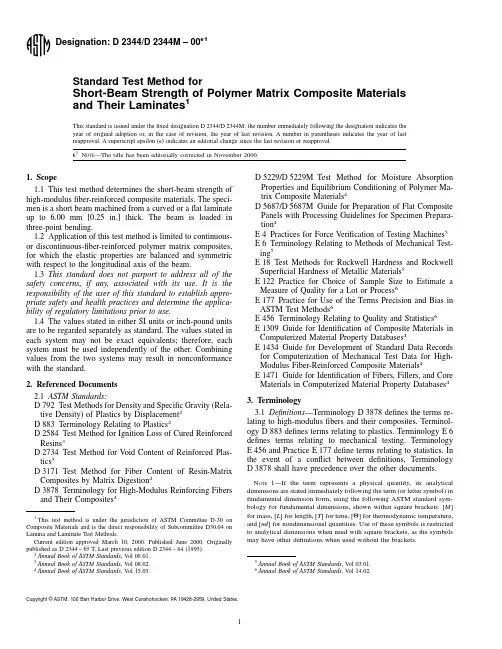
3.2DefinitionsofTermsSpecifictoThisStandard:3.2.1balancedlaminate,n—acontinuousfiber-reinforcedlaminateinwhicheach+ulamina,measuredwithrespecttothelaminatereferenceaxis,isbalancedbya–ulaminaofthesamematerial(forexample,[0/+45/–45/+45/–45/0]).3.2.2short-beamstrength,n—theshearstressascalculatedinEq1,developedatthespecimenmid-planeatthefailureeventspecifiedin11.6.3.2.2.1Discussion—Althoughshearisthedominantappliedloadinginthistestmethod,theinternalstressesarecomplexandavarietyoffailuremodescanoccur.ElasticitysolutionsbyBergetal(1)7,Whitney(2),andSullivanandVanOene(3)havealldemonstratedinadequaciesinclassicalbeamtheoryindefiningthestressstateintheshort-beamconfiguration.Thesesolutionsshowthattheparabolicshear-stressdistributionaspredictedbyEq1onlyoccurs,andthennotexactly,onplanesmidwaybetweentheloadingnoseandsupportpoints.Awayfromtheseplanes,thestressdistributionsbecomeskewed,withpeakstressesoccurringneartheloadingnoseandsupportpoints.Ofparticularsignificanceisthestressstatelocaltotheloadingnoseinwhichthesevereshear-stressconcentrationcombinedwithtransverseandin-planecompressivestresseshasbeenshowntoinitiatefailure.However,forthemoreductilematrices,plasticyieldingmayalleviatethesituationundertheloadingnose(1)andallowotherfailuremodestooccursuchasbottomsurfacefibertension(2).Consequently,unlessmid-planeinterlaminarfailurehasbeenclearlyob-served,theshort-beamstrengthdeterminedfromthistestmethodcannotbeattributedtoashearproperty,andtheuseofEq1willnotyieldanaccuratevalueforshearstrength.3.2.3symmetriclaminate,n—acontinuousfiber-reinforcedlaminateinwhicheachplyabovethemid-planeisidenticallymatched(intermsofposition,orientation,andmechanicalproperties)withonebelowthemid-plane.3.3Symbols:b—specimenwidth.CV—samplecoefficientofvariation(inpercent).Fsbs—short-beamstrength.h—specimenthickness.n—numberofspecimens.Pm—maximumloadobservedduringthetest.xi—measuredorderivedpropertyforanindividualspecimenfromthesamplepopulation.x¯—samplemean(average).4.SummaryofTestMethod4.1Theshort-beamtestspecimens(Figs.1-4)arecenter-loadedasshowninFigs.5and6.Thespecimenendsrestontwosupportsthatallowlateralmotion,theloadbeingappliedbymeansofaloadingnosedirectlycenteredonthemidpointofthetestspecimen.5.SignificanceandUse5.1Inmostcases,becauseofthecomplexityofinternalstressesandthevarietyoffailuremodesthatcanoccurinthisspecimen,itisnotgenerallypossibletorelatetheshort-beamstrengthtoanyonematerialproperty.However,failuresarenormallydominatedbyresinandinterlaminarproperties,andthetestresultshavebeenfoundtoberepeatableforagivenspecimengeometry,materialsystem,andstackingsequence(4).5.2Short-beamstrengthdeterminedbythistestmethodcanbeusedforqualitycontrolandprocessspecificationpurposes.Itcanalsobeusedforcomparativetestingofcompositematerials,providedthatfailuresoccurconsistentlyinthesamemode(5).5.3ThistestmethodisnotlimitedtospecimenswithintherangespecifiedinSection8,butislimitedtotheuseofaloadingspanlength-to-specimenthicknessratioof4.0andaminimumspecimenthicknessof2.0mm[0.08in.].6.Interferences6.1Accuratereportingofobservedfailuremodesisessen-tialformeaningfuldatainterpretation,inparticular,thedetec-tionofinitialdamagemodes.7.Apparatus7.1TestingMachine,properlycalibrated,whichcanbeoperatedataconstantrateofcrossheadmotion,andwhichtheerrorintheloadingsystemshallnotexceed61%.Theload-indicatingmechanismshallbeessentiallyfreeofinertia7Boldfacenumbersinparenthesesrefertothelistofreferencesattheendofthis
美国工程学会ASTM胶黏行业标准总汇

ASTM胶黏行业标准总汇
10 标准试验方法汇集
10.1 老化
(1)ASTM D1183-70(1981) ——胶粘剂耐循环实验室老化条件的标准试验方法。
(2)ASTM D1581-60(1984) ——玻璃瓶标签用水基或溶剂、可溶液体胶粘剂粘接耐久性的标准试验方法。
(3)ASTMD1713-65(1981)——自动装置密封顶盖纤维板试件用水基或溶剂、可溶液体胶粘剂粘接耐久性的标准试验方法。
(4)ASTM D3632-77(1982)——用氧压法对粘接接头进行加速老化的试验方法。
10.2 淀粉物质
ASTM D1488-60(1981) 胶粘剂中的淀粉物质的标准试验方法。
10.3 灰分含量
美联邦试验方法标准175B,4032.1 法——胶粘剂的灰分含量。
10.4 生物降解
(1)ASTM D1382-64(1981)——胶膜对蟑螂侵袭敏感性的标准试方法。
(2)ASTM D1383-64(1981)——干胶膜对实验室小鼠侵袭敏感性标准试验方法。
(3)ASTM D1877-77——在霉菌条件下多层板胶粘剂粘接接头耐久性标准试验方法。
(4)ASTM D4299-84——细菌污染对胶粘剂制备和胶膜影响的标准试验方法。
(5)ASTM D4300-84——霉菌污染对胶粘剂制备和胶膜耐久性影响的标准试验方法。
10.5 粘连点
ASTM D1146-53(1981) ——潜性胶层粘连点的标准试验方法。
10.6 性能鉴定
ARP 1610——物理化学定性方法,环氧胶粘剂和预测树脂体系。
10.7 化学试剂
ASTM D896-84 ——粘接接头耐化学试剂的标准试验方法。
10.8 劈裂
ASTM D1062-78(1983) ——金属对金属粘接劈裂强度的标准试验方法。
10.9 劈裂/剥离强度
ASTM美国材料与试验协会标准目录(3)
序号编号中文名称
4001ASTM C1677-2009使用橡胶垫圈的混凝土箱用连接件的标准规范
4002ASTM C1677-2011使用橡胶垫圈的混凝土箱用连接件的标准规格
4003ASTM C1677-2011a以橡胶垫圈连接的混凝土箱接头的标准规格
4004ASTM C1678-2010陶瓷和玻璃中的断裂镜面尺寸的断裂面显微镜图像分析的标准实施规程
4005ASTM C1679-2009采用等温热量测定法测量液压水泥混合物水化反应动力的标准实施规程
4006ASTM C1679-2013采用等温热量测定法测量液压水泥混合物水化反应动力的标准实施规程
4007ASTM C1681-2009评定恒应变下密封剂抗扯性的标准试验方法
4008ASTM C168-2010隔热材料有关的标准术语
4009ASTM C168-2013与隔热材料相关的标准术语
4010ASTM C1682-2009核废料支援地学处置贮藏库的特性描述标准指南
4011ASTM C1683-2008e1高级陶瓷用Weibull统计拉伸强度的尺寸缩放比例用标准实施规程
4012ASTM C1683-2010高级陶瓷用Weibull统计拉伸强度的尺寸缩放比例用标准实施规程
4013ASTM C1684-2008环境温度下高级陶瓷抗弯强度标准试验方法.圆柱杆强度
4014ASTM C1684-2013室温下高级陶瓷抗弯强度标准试验方法.圆柱杆强度
4015ASTM C1684-2013e1室温下高级陶瓷抗弯强度标准试验方法.圆柱杆强度
4016ASTM C1685-2008工业用途的气动高温纤维隔热的标准规范
4017ASTM C1686-2009增强热压加气混凝土(AAC)构件的安装和试验标准规程
4018ASTM C1688/C1688M-2010新拌透水混凝土密度和孔隙量标准试验方法
4019ASTM C1688/C1688M-2010a新拌透水混凝土密度和孔隙量的标准试验方法
涂料检测国标
涂料检测国标
涂料及其产品
序号标准号标准名称
1 GB/T1720-1979(1989) 漆膜附着力测定法
2 GB/T1721-2008 清漆、清油及稀释剂外观和透明度测定法
3 GB/T1722-1992 清漆、清油及稀释剂颜色测定法
4 GB/T1723-1993 涂料粘度测定法
5 GB/T1724-1979(1989) 涂料细度测定法
6 GB/T1725-200
7 色漆、清漆和塑料不挥发物含量的测定
7 GB/T1726-1979(1989) 涂料遮盖力测定法
8 GB/T1727-1992 漆膜一般制备法
9 GB/T1728-1979(1989) 漆膜、腻子膜干燥时间测定法
10 GB/T1730-2007 色漆和清漆摆杆阻尼试验
11 GB/T1731-1993 漆膜柔韧性测定法
12 GB/T1732-1993 漆膜耐冲击测定法
13 GB/T1733-1993 漆膜耐水性测定法
14 GB/T1735-1979(1989) 漆膜耐热性测定法
15 GB/T1740-2007 漆膜耐湿热测定法
16 GB/T1741-2007 漆膜耐霉菌测定法
17 GB/T1747.2-2008 色漆和清漆颜料含量的测定第2部分:灰化法
18 GB/T1748-1979(1989) 腻子膜柔韧性测定法
19 GB/T1749-1979(1989) 厚漆、腻子稠度测定法
20 GB/T1762-1980(1989) 漆膜回粘性测定法
21 GB/T1765-1979(1989) 测定耐湿热、耐盐雾、耐候性(人工加速)的漆膜制备法
22 GB/T1766-2008 色漆和清漆?涂层老化的评级方法
23 GB/T1768-2006 漆膜耐磨性测定法 24 GB/T1770-2008 涂膜、腻子膜打磨性测定法??
25 GB/T1771-2007 色漆和清漆?耐中性盐雾性能的测定
26 GB/T1865-1997 色漆和清漆人工气候老化和人工辐射暴露(滤过的氙弧辐射)
美国无损检测
美国无损检测 ASTM 标准目录
ASTM A20/A20M-99a 一般要求的压力容器钢板规范(A-1,UT,MT)
ASTM A21-94 铁路用热处理与非热处理碳钢轮轴规范(A-1,UT)
ASTM A25-89 电力铁道用锻造钢车轮规范(A-1,UT,MT)1993年撤销
ASTM A27/A27M-95 一般用途碳素钢铸件规范(A-1,RT,MT)
ASTM A105/A105M-98 用于管道零件的碳钢锻件规范(A-1,MT,PT)
ASTM A125-96 经热处理的钢螺旋弹簧规范(A-1,MT)
ASTM A135-97a 电阻焊钢管规范(A-1,UT,ET)
ASTM
A148/A148M-93b(1998) 构件用高强度钢铸件规范(A-1,RT,MT)
ASTM A178/A178M-95 电阻焊碳钢和碳锰钢锅炉管和过热器管规范
ASTM
A182/A182M-98a 高温使用的锻造或轧制合金钢管道法兰盘、锻造接头及阀门和部件规范(A-1,MT,PT)
ASTM A217/A217M-99 高温马氏体不锈钢和合金钢承压铸件规范(A-1,PT,MT)
ASTM A266/A266M-96 压力容器部件用碳钢锻件规范
ASTM A288-91 涡轮发电机磁性扣环碳钢和合金钢锻件标准规范(A-1,UT,MT)
ASTM A289-88(93) 发电机非磁性扣环合金钢锻件标准规范(A-1,UT,PT)
ASTM A290-95 减速器齿轮环的碳钢和合金钢锻件规范(A-1,UT,MT)
ASTM A291-95 减速器齿轮传动装置游星齿轮和齿轮用的碳钢和合金钢锻件规范(A-1,UT)
ASTM A350/A350M-99 需作切口韧性试验的管道部件碳钢和低合金钢锻件规范(A-1,MT,PT)
ASTM
A352/A352M-93(1998) 适用于低温承压铁素体和马氏体钢铸件规范(A1,MT,RT)
ASTMD 3786 2001薄膜法测定纺织品的顶破强力
ASTMD 3786-01 薄膜法测定纺织品的鼓破强力 破裂强度试验机 爆破
发布时间:2014-03-14 11:50
1. 范围
1.1 本方法采用液压鼓破测试仪测定纺织品的鼓破强力,本方法适应于大部分的纺织产品。
1.2 本方法也适合弹性机织物或用于工业上抗膨胀机织物。
1.3 测试结果以S•I制作为标准单位。备注1:采用弹子顶破装置测定鼓破强力,请参照ASTMD 3787。
1.4 本本标准没有涉及到安全方面的介绍。但希望在操作本标准前,应该建立一些与安全卫生关的管理文件。
2.参考文献
ASTM D123纺织品的相关术语;
ASTM D1776纺织品测试的调湿
ASTM D5034测定纺织品的拉伸强力及其断裂伸长率
ASTM D3787弹子顶破法测试针织物的鼓破强力(CRT型)
3. 术语
3.1 定义
3.1.1 鼓破强力:在一定条件下,对一平面织物在一合适的角度上旋加一扩张性的膨胀力,直至其破裂为止。
3.1.2 针织品:由纱线或类似的原料通过一圈一圈互相穿套而成。
3.1.3 无纺布:通过机械、化学、热处理、溶解等办法将纤维粘合、交联而成的一种纺织结构物。备注:无纺布不包含纸或机织、针织等。
3.1.4 机织物:由至少两组纱线按预先设计的花型交织而成,一般其中一组纱线沿仪器方向,并平行于布的方向。
3.1.5 弹性机织物:在机织物中,经纱或纬纱或同时至少含有20%的弹力纱,并如在一定载重下伸长,但释放载重后几乎全部能恢复到原状。 3.2 本方法用到的其他术语,请参照ASTM D123。
4. 原理
4.1 样品被夹在一膨胀的膜片上,由于液压的作用使得膜片膨胀直至试样破裂为止,使得样品破裂所需的压力与使得膜片膨胀所需的压力差,作为鼓破强力。
5. 意义和应用
5.1 采用本方法测定针织物、无纺布、机织物的鼓破强力,可应用于纺织工业来评定不同最终用途面料强力的差异。
5.2 如果采用ASTM D3786 测试结果与实际性能不一致时。由于ASTM D3786被广泛应用于贸易可接受的测试,所以可作为商业货运上用于纺织品鼓破强力的符合要求的测试。一旦买卖双方由于采用ASTM D3786 得到不同的测试结果而引起争执时,买卖双方实验室应对同一类型样品随机抽样进行对比测试,以进行系统统计以查清偏差。
齿轮钢中英文标准版本
湖北新冶钢有限公司 技术标准
HUBEI
XINYEGANG CO.,LTD Technical
standard
湖北新冶钢有限公司企业标准
Enterpise standard of HUBEI XINYEGANG CO.,LTD
XYGW****-2008
齿轮钢***
Gear steel ***
2008-1-1批准 2008-1-2实施
湖北新冶钢有限公司
HUBEI XINYEGANG CO.,LTD
湖北新冶钢有限公司 技术标准
HUBEI XINYEGANG CO.,LTD Technical
standard
XYGW****-2008
前 言
Foreword
本标准由湖北新冶钢有限公司提出
The standard is proposed and issued by HUBEI XINYEGANG CO.,LTD.
本标准由湖北新冶钢有限公司技术部归口
The standard is archived by Technology Department of HUBEI XINYEGANG CO.,LTD.
本标准主要起草人:(签字)李博鹏
Drawn up by :(signature)Li BoPeng
本标准主要审核人:(签字)
Audited by:(signature)
PTFE标准都有哪些
深圳市丹凯科技有限公司 聚四氟乙烯(Poly tetra fluoroethylene,简写为PTFE),一般称作“不粘涂层”或“易清洁物料”。这种材料具有抗酸抗碱、抗各种有机溶剂的特点,几乎不溶于所有的溶剂。同时,聚四氟乙烯具有耐高温的特点,它的摩擦系数极低,所以可作润滑作用之余,亦成为了易清洁水管内层的理想涂料。国内外PTFE标准都有哪些?我们一起了解一下.
标准号 标准名称 英文名称
ASTM D1675-03(2011) 聚四氟乙烯管的试验方法 Test Methods for Polytetrafluoroethylene Tubing
ASTM D2686-06(2012) 聚四氟乙烯压敏电绝缘胶带规范 Specification for Polytetrafluoroethylene-backed
Pressure-Sensitive Electrical Insulating Tape
ASTM D1710-08 聚四氟乙烯(PTFE)基本型材,棒材和厚壁管材 Polytetrafluoroethylene (PTFE) Basic Shapes, Rod
and Heavy-Walled Tubing
ASTM
D3295-06(2011) 聚四氟乙烯管 Standard Specification for PTFE Tubing, Miniature
Beading and Spiral Cut Tubing
ASTM D3369-01 聚四氟乙烯树脂浇铸薄膜 Polytetrafluoroethylene (PTFE) Resin Cast Film
ASTM
D4441-04(2010) 聚四氟乙烯的水分散体规范 Standard Specification for Aqueous Dispersions of
Polytetrafluoroethylene
ASTM D4745-11 聚四氟乙烯模压和挤出材料的填充化合物 Standard Specification for Filled Compounds of
ASTM G14-04钢制管道涂层抗冲击性的试验方法(落锤试验)
Designation:G14–04
StandardTestMethodfor
ImpactResistanceofPipelineCoatings(FallingWeight
Test)1
ThisstandardisissuedunderthefixeddesignationG14;thenumberimmediatelyfollowingthedesignationindicatestheyearoforiginaladoptionor,inthecaseofrevision,theyearoflastrevision.Anumberinparenthesesindicatestheyearoflastreapproval.Asuperscriptepsilon(e)indicatesaneditorialchangesincethelastrevisionorreapproval.
1.Scope
1.1Thistestmethodcoversthedeterminationoftheenergy
requiredtorupturecoatingsappliedtopipeunderspecified
conditionsofimpactfromafallingweight.
1.2ThevaluesstatedinSIunitstothreesignificantdeci-
malsaretoberegardedasthestandard.Thevaluesgivenin
parenthesesareforinformationonly.
1.3Thisstandarddoesnotpurporttoaddressallofthe
safetyconcerns,ifany,associatedwithitsuse.Itisthe
responsibilityoftheuserofthisstandardtoestablishappro-
ASTM标准.G系列
标准号中文名称
G1-03腐蚀试样的制备,清洗和评定
G2-88(2002)在750°F蒸汽中或在680°F水中锆,铪
及其合金产品腐蚀检验法
G2M-88(1996)e1在673°K蒸汽中或在633°K水中锆,铪
及其合金产品腐蚀检验的方法(米制)
G3-89(1999)腐蚀检验中用的电化测量的常规方法
G4-01在工厂设备中进行腐蚀试验指南
G5-94(1999)e1作静电位标记和动电位阳极极化测量的
基准测试方法
G6-88(1998)管道涂层耐磨性的试验方法
G7-97非金属材料的大气环境曝光检测
G8-96(203)管道涂层阴极剥离的试验方法
G9-87(1998)管道涂层渗水性的试验方法
G10-83(2002)管道涂层比可弯性的试验方法
G11-88(1996)e1管道涂层受室外气候影响的试验方法
G12-83(1998)钢制管道涂层厚度无损测量的试验方法
G14-88(1996)e1钢制管道涂层抗冲击性的试验方法(落
锤试验)
G15-04与腐蚀及腐蚀测试有关的标准术语
G16-95(2004)用统计作腐蚀数据分析
G17-88(1998)管道涂层抗穿透性的试验方法(钝头杆)
G18-88(1998)镀层管道连接件,配件及搭接板的试验
方法
G19-88(1996)e1用直接土埋法对管道涂层抗剥落特性的
试验方法
G20-88(2002)管道涂层抗化学药物腐蚀性的试验方法
G21-96(2002)合成聚合材料防霉性的测定
G24-97自然光透过玻璃进行曝光
G28-02煅制高镍铬轴承合金晶间腐蚀敏感性的
检查用测试方法
G29-96(2002)塑料膜抗藻类腐蚀性的测定
G30-97(2003)制作和使用U形弯曲应力腐蚀试样ASTM标
G31-72(2004)金属的实验室浸渍腐蚀试验
G32-03使用振动装置对气蚀侵蚀的试验方法
G33-99金属镀层钢样品对大气腐蚀检测数据的
记录
G34-012XXX和7XXX系列铝合金剥落腐蚀敏感
性的试验方法(EXCO 试验)