
BobDylan诺贝尔文学奖得奖致辞(中英)教程文件
B o b D y l a n诺贝尔文学奖得奖致辞(中英)Good evening, everyone. I extend my warmest greetings to the members of the Swedish Academy and to all of the other distinguished guests in attendance tonight.各位晚上好。
我向瑞典学院的成员和今晚所有出席宴会的尊贵来宾致以最热烈的问候。
I'm sorry I can't be with you in person, but please know that I am most definitely with you in spirit and honored to be receiving such a prestigious prize. Being awarded the Nobel Prize for Literature is something I never could have imagined or seen coming.很抱歉我没能到现场与诸位共享此刻,但请相信,在精神上,我绝对与你们同在,我深感荣幸能获得如此声望卓著的奖项。
被授予诺贝尔文学奖,是我从未想象过也没有预见到的事情。
From an early age, I've been familiar with and reading and absorbing the works of those who were deemed worthy of such a distinction: Kipling, Shaw, Thomas Mann, Pearl Buck, Albert Camus, Hemingway. These giants of literature whose works are taught in the schoolroom, housed in libraries around the world and spoken of in reverent tones have always made a deep impression. That I now join the names on such a list is truly beyond words.从小,我就熟悉、阅读并充分汲取那些被认为值得获得该项殊荣的人的作品,如吉卜林、萧伯纳、托马斯·曼、赛珍珠、加缪、海明威。
这些文学巨匠的著作在学堂上被讲授、在世界各地图书馆中陈列、被被人们虔诚地谈论着,它们给我留下了深刻的印象。
如今能加入这样的名列,我的心情无以言表。
I don't know if these men and women ever thought of the Nobel honor for themselves, but I suppose that anyone writing a book, or a poem, or a play anywhere in the world might harbor that secret dream deep down inside. It's probably buried so deep that they don't even know it's there.我不知道,这些作家是否想过自己能获得诺奖,但我猜想世界上任何一个著书写诗、或创作戏剧的人,内心深处都怀揣着这个秘密的梦想。
这梦想埋藏得如此之深以至于他们自己都没意识到它的存在。
If someone had ever told me that I had the slightest chance of winning the Nobel Prize, I would have to think that I'd have about the same odds as standing on the moon. In fact, during the year I was born and for a few years after, there wasn't anyone in the world who was considered good enough to win this Nobel Prize. So, I recognize that I am in very rare company, to say the least.如果有人告诉我,我有那么一丝希望能获得诺奖,那我会认为这跟我能站在月球上的概率差不多。
事实上,我出生的那一年和随后的那些年,世界上几乎没有人是完全值得诺贝尔奖的,所以,我想,至少可以说我现在属于一个非常少数的群体。
I was out on the road when I received this surprising news, and it took me more than a few minutes to properly process it. I began to think about William Shakespeare, the great literary figure. I would reckon he thought of himself as a dramatist. The thought that he was writing literature couldn't have entered his head. His words were written for the stage. Meant to be spoken not read.我是在世界巡演的过程中得知这一令人惊讶的消息的,我花了好一会儿去消化它。
然后,我联想到了莎士比亚这位文学伟人。
我想他是把自己当一个写剧本的来看待的,他怎么也不会想到自己是在创作文学。
他的文字是为舞台而生的,是为了言说而不是阅读。
When he was writing Hamlet, I'm sure he was thinking about a lot of different things: "Who're the right actors for these roles?" "How should this be staged?" "Do I really want to set this in Denmark?" His creative vision and ambitions were no doubt at the forefront of his mind, but there were also more mundane matters to consider and deal with. "Is the financing in place?" "Are there enough good seats for my patrons?" "Where am I going to get a human skull?" I would bet that the farthest thing from Shakespeare's mind was the question "Is this literature?"在写《哈姆雷特》的时候,他一定在想这些问题,“谁适合演这些角色?”“这段要怎么在舞台上展现出来?”“故事背景真的要设在丹麦吗?”他富于创造的想象与野心毫无疑问是他思维最活跃的部分,但也有很多世俗琐事要考虑和处理。
“资金到位了吗?”“赞助人都能安排到好座位吗?”“到哪里能弄到人的头骨啊?”我打赌莎士比亚最不可能思考的问题就是:“这是文学吗?”When I started writing songs as a teenager, and even as I started to achieve some renown for my abilities, my aspirations for these songs only went so far. I thought they could be heard in coffee houses or bars, maybe later in places like Carnegie Hall, the London Palladium. If I was really dreaming big, maybe I could imagine getting to make a record and then hearing my songs on the radio. That was really the big prize in my mind. Making records and hearing your songs on the radio meant that you were reaching a big audience and that you might get to keep doing what you had set out to do.我少年时代开始写歌时,甚至当我因自己的才能而小有知名度时,我对这些歌曲的期待都十分很有限。
我希望它们能在咖啡厅或酒吧被人听到,或者将来能在卡内基音乐厅,伦敦帕拉斯剧院这些地方被演唱。
如果梦做得再大胆些,我希望我的音乐能被制作成唱片在电台播放,这真是我心目中最好的奖赏了。
录唱片在电台播放意味着你能接触到更庞大的听众群体,而你也能按照自己的理想继续走下去。
Well, I've been doing what I set out to do for a long time, now. I've made dozens of records and played thousands of concerts all around the world. But it's my songs that are at the vital center of almost everything I do. They seemed to have found a place in the lives of many people throughout many different cultures and I'm grateful for that.现在,我已经朝着自己规划的路走了很久了。
诺贝尔文学奖颁奖词
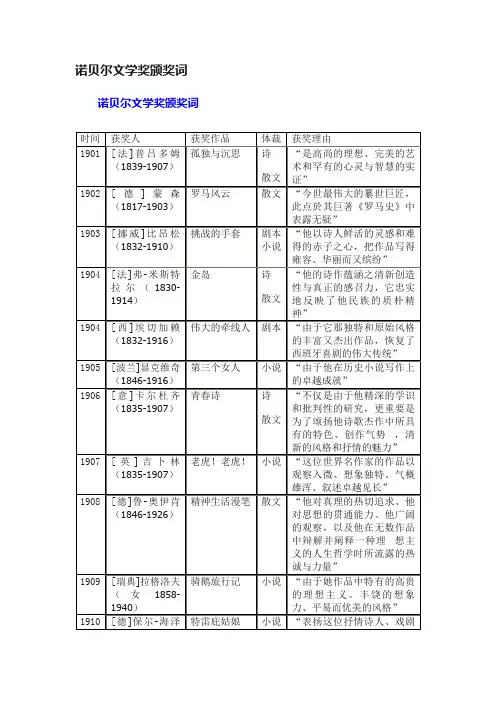
小说
“因为他在他的小说中剖析了人生的戏剧,对心灵的深刻观察和紧凑的艺术”
1953
[英]温-丘吉尔(1874-1965)
不需要的战争
散文
“由于他在描述历史与传记方面的造诣,同时由于他那捍卫崇高的人的价值的光辉演说。”
1954
[美]海明威(1899-1961)
老人与海
小说
“因为他精通于叙事艺术,突出地表现在其近著《老人与海》之中;同时也因为他对当代 文体风格之影响”
1975
[意]埃-蒙塔莱(1896-1981)
生活之恶
诗
散文
“由于他杰出的诗歌拥有伟大的艺术性,在不适合幻想的人生里,诠释了人类的价值”
1976
[美]索尔-贝娄(1915-)
赫索格
小说
“由于他的作品对人性的了解,以及对当代文化的敏锐透视”
1977
[西]阿莱克桑德雷(1898-)
天堂的影子
诗
散文
“他的作品继承了西班牙抒情诗的传统和吸取了现在流派的风格,描述了人在宇宙和当今社会中的状况 ”
1919
[瑞士]施皮特勒(1845-1924)
奥林比亚的春天
诗
小说
“特别推崇他在史诗《奥林帕斯之春》的优异表现”
1920
[挪威]汉姆生(1859-1952)
大地硕果-畜牧曲
小说
“为了他划时代的巨著《土地的成长》”
1921
[法]法朗士(1844-1924)
苔依丝
小说
“他辉煌的文学成就,乃在于他高尚的文体、宽闵的人道同情、迷人的魅力,以及一个 真正法国性情所形成的特质”
局外人-鼠疫
小说散文
“由于他重要的著作,在这著作中他以明察而热切的眼光照亮了我们这时代人类良心的种种问题”
莫言诺贝尔文学奖演讲(中英文对照)
莫言诺贝尔文学奖演讲北京时间2012年12月8日0时30分,诺贝尔文学奖获得者莫言在瑞典学院发表演讲,以下为演讲实录,英文由Howard Goldblatt翻译:尊敬的瑞典学院各位院士,女士们、先生们:Distinguished members of the Swedish Academy, Ladies and Gentlemen:通过电视或网络,我想在座的各位,对遥远的高密东北乡,已经有了或多或少的了解。
你们也许看到了我的九十岁的老父亲,看到了我的哥哥姐姐我的妻子女儿和我的一岁零四个月的外孙子,但是有一个此刻我最想念的人,我的母亲,你们永远无法看到了。
我获奖后,很多人分享了我的光荣,但我的母亲却无法分享了。
Through the mediums of television and the Internet, I imagine that everyone here has at least a nodding acquaintance with far-off Northeast Gaomi Township. You may have seen my ninety-year-old father, as well as my brothers, my sister, my wife and my daughter, even my granddaughter, now a year and four months old. But the person who is most on my mind at this moment, my mother, is someone you will never see. Many people have shared in the honor of winning this prize, everyone but her. 我母亲生于1922年,卒于1994年。
演讲致辞-莫言在瑞典诺贝尔颁奖典礼上的英语演讲稿 精品
莫言在瑞典诺贝尔颁奖典礼上的英语演讲稿莫言在诺贝尔晚宴上的答谢词(准备稿)XX年12月10日(当地时间)mo yans prepared banquet speech at the nobel banquet10 december XX尊敬的国王陛下、王后陛下,女士们,先生们:your majesties, your royal highnesses, ladies and gentlemen,我,一个来自遥远的中国山东高密东北乡的农民的儿子,站在这个举世瞩目的殿堂上,领取了诺贝尔文学奖,这很像一个童话,但却是不容置疑的现实。
for me, a farm boy from gaomis northeast township in far-away china, standing here in this world-famous hall after having received the nobel prize in literature feels like a fairy tale, but of course it is true.获奖后一个多月的经历,使我认识到了诺贝尔文学奖巨大的影响和不可撼动的尊严。
我一直在冷眼旁观着这段时间里发生的一切,这是千载难逢的认识人世的机会,更是一个认清自我的机会。
my experiences during the months since the announcement have made me aware of the enormous impact of the nobel prize and the unquestionable respect it enjoys. i have tried to view what has happened during this period in a cool, detached way. it has been a golden opportunity for me to learn about the world and, even more so, an opportunity for me to learn about myself.我深知世界上有许多作家有资格甚至比我更有资格获得这个奖项;我相信,只要他们坚持写下去,只要他们相信文学是人的光荣也是上帝赋予人的权利,那么,“他必将华冠加在你头上,把荣冕交给你。
演讲致辞-莫言诺贝尔文学奖致辞英文演讲稿 精品

莫言诺贝尔文学奖致辞英文演讲稿以下这篇演讲稿是中国当代著名作家莫言XX年获得诺贝尔文学奖时在瑞典学院发表的领奖演讲《讲故事的人》(storyteller),莫言在这次演讲中追忆了自己的母亲,回顾了文学创作之路,并与听众分享了三个意味深长的“故事”,讲述了自己如何成为一个用笔来讲故事的人的过程。
莫言表示,自己今后还要继续讲自己的故事。
distinguished members of the swedish academy, ladies andgentlemen:through the mediums of television and the internet, i imaginethat everyone here has at least a nodding acquaintance with far-offnortheast gaomi township. you may have seen my ninety-year-old father, as well as my brothers, my sister, my wife and my daughter, even my granddaughter, now a year and four months old. but the person who is moston my mind at this moment, my mother, is someone you will never see. many people have shared in the honor of winning this prize, everyone but her.尊敬的瑞典学院各位院士,女士们、先生们:通过电视或网络,我想在座的各位,对遥远的高密东北乡,已经有了或多或少的了解。
你们也许看到了我的九十岁的老父亲,看到了我的哥哥姐姐我的妻子女儿和我的一岁零四个月的外孙子,但是有一个此刻我最想念的人,我的母亲,你们永远无法看到了。
鲍勃·迪伦的缺席演讲:我为什么不来瑞典?
鲍勃·迪伦的缺席演讲:我为什么不来瑞典?编译:厢泉鲍勃·迪伦的宴会演讲是美国驻瑞典大使馆的Azita Raji送来的,2016年12月10日。
晚上好,各位,我向瑞典学院的各位成员以及今晚的各位贵宾致以我最热情的问候。
我非常抱歉我本人今天不能来,但是在精神上与你们同在,收到这么一个有名望的奖项对我来说很荣幸,获得诺贝尔文学家是我从来不敢想象的一件事情。
在很久以前,我阅读过Kipling, Shaw, Thomas Mann, Pearl Buck, Albert Camus, Hemingway这些杰出人士的著作,被他们的作品所吸引。
这些文学巨匠的作品在学校里被当作教材,并且呈列在全世界的图书馆中,被读者们用虔诚的语调阅读着,给我留下了很深的印象。
现在我的名字与这些人的名字列在一起,这种感觉真的无法用言语来形容。
我不知道这些巨匠有没有想过他们自己有一天会获得诺贝尔奖,但我猜想,世界上任何一个地方的作家,当他写一本书,一首诗或者一部剧本的时候,都可能将这个秘密的梦想深藏在自己内心。
可能藏的太深了,以至于他们自己都不知道。
如果有人告诉我,我是以非常微弱的优势获得了诺贝尔奖,我不得不去想,我的胜算大概就和我能站在月球上的概率一样低。
事实上,在我刚出生的那几年之后,这个世界上没有任何人被认为足够优秀可以获得诺贝尔奖。
所以,我想我的获奖优势是最低的。
当我收到这个惊人的消息的时候正在路上,接着我花了好几分钟的时间来认真的思考。
我开始想到了伟大的文学巨匠William Shakespeare,我认为他把他自己当作是一个剧作家。
他在作品中的想法不能进入他的大脑,他的文字是为舞台而写的。
这意味着他的文字要被演员说出来,而不是被读者阅读。
当他写“哈姆雷特”的时候,我觉得他在思考非常多不同的事情:“谁是最适合这些角色的演员?”“这些在舞台上表演出来是什么样的?”“我一定要把这个情节设定在丹麦吗?”他这些创造性的视野和理想,毋庸置疑都是他最前沿的想法,但是,还有更多前沿的问题需要去思考和处理。
鲍勃迪伦诺贝尔文学奖歌曲

鲍勃迪伦诺贝尔文学奖歌曲2016年,美国民谣歌手鲍勃·迪伦获得了诺贝尔文学奖,以表彰他对于现代音乐和诗歌的重要贡献。
他创作的许多歌曲被认为是现代诗歌的典范,其中最著名的一首歌曲是《Blowin' in the Wind》。
这首歌曲被认为是20世纪60年代民权运动的代表歌曲之一,歌词中提出了一系列关于和平、自由、平等和正义的问题,并试图回答这些问题。
以下是歌曲的歌词:How many roads must a man walk downBefore you can call him a man?How many seas must a white dove sailBefore she sleeps in the sand?Yes, and how many times must the cannonballs flyBefore they're forever banned?The answer, my friend, is blowin' in the windThe answer is blowin' in the wind.How many times must a man look upBefore he can see the sky?How many ears must one man haveBefore he can hear people cry?Yes, and how many deaths will it takeTill he knows that too many people have died? The answer, my friend, is blowin' in the wind The answer is blowin' in the wind.How many years can a mountain existBefore it's washed to the sea?Yes, and how many years can some people exist Before they're allowed to be free?Yes, and how many times can a man turn his head And pretend that he just doesn't see?The answer, my friend, is blowin' in the wind The answer is blowin' in the wind.。
莫言诺贝尔文学奖致辞英文演讲稿
莫言诺贝尔文学奖致辞英文演讲稿莫言诺贝尔文学奖致辞英文演讲稿以下这篇演讲稿是中国当代著名作家莫言2012年获得诺贝尔文学奖时在瑞典学院发表的领奖演讲《讲故事的人》(storyteller),莫言在这次演讲中追忆了自己的母亲,回顾了文学创作之路,并与听众分享了三个意味深长的“故事”,讲述了自己如何成为一个用笔来讲故事的人的过程,。
莫言表示,自己今后还要继续讲自己的故事。
Distinguished members of the Swedish Academy, Ladies and Gentlemen:Through the mediums of television and the Internet, I imagine that everyone here has at least a nodding acquaintance with far-off Northeast Gaomi Township. You may have seen my ninety-year-old father, as well as my brothers, my sister, my wife and my daughter, even my granddaughter, now a year and four months old. But the person who is most on my mind at this moment, my mother, is someone you will never see. Many people have shared in the honor of winning this prize, everyone but her.尊敬的瑞典学院各位院士,女士们、先生们:通过电视或网络,我想在座的各位,对遥远的高密东北乡,已经有了或多或少的了解。
你们也许看到了我的九十岁的老父亲,看到了我的哥哥姐姐我的妻子女儿和我的一岁零四个月的外孙子,但是有一个此刻我最想念的人,我的母亲,你们永远无法看到了。
1993年诺贝尔文学奖得主托尼·莫里森的获奖演说(中英文)
1993年诺贝尔文学奖得主托尼·莫里森的获奖演说(中英文)当我走进这间大厅时我的脑子里萦回着那些在我之前走进这里的人士的身影。
我能和那些桂冠文人为伍使我感到畏怯和欢悦,因为在那个行列中的一些名家的力作曾把整个世界展现在我的面前。
他们那挥洒自如与别具风格的笔触,以其真知灼见之清晰和勇气使我有时感动得为之心碎。
他们在写作中所显示的惊人才华对我又是挑战、又是培育。
我对他们的感激正如我对瑞典学院把我挑选出来参加到这显赫的行列中来的深切感激正好相似。
早在十月间,一位艺术界的朋友给我一个留言,被我储存在留言机里好几个星期。
我不时反复把它重放,只是为了再聆听一次她由于高兴而有些颤抖的音调和那道出真情的语句:"你获得的大奖也是我们大家的;你是再合适不过的人选了。
"她在这句话里流露的大功告成的欢悦和崇高的信任代替我纪念了这难忘的今日。
但当我离开这间大厅时,我将带着比我走进时更为新鲜、更加高兴的心情,那是一种将与今后的桂冠才人站在同一行列的欢悦心情。
甚至就在我讲话的此刻,他们正在挖掘、筛选、润色着他们的作品语言,以便来照亮我们这里谁都还未曾梦想到的世界。
但是,不管在他们当中有谁能获得这个圣殿中的一个席位,这个作家群将会越聚越多则是肯定无疑的。
他们的声音将会道出已逝和未来的种种文明;他们站在高高的悬崖上所作的幻想的凝视将会吸引住我们大家的目光;而他们将目不转睛、决不回避。
因此,我是在牢记我们前辈的才华、我的姐妹们的祝福并在迎接着未来的作家的出现的心情中接受瑞典学院赋予我的荣誉的,并请诸位和我来同享这光彩的一刻。
Nobel Lecture by Toni Morrison Nobel Prize in Literature 1993 December 8, 1993 at at Stockholm Concert Hall, Stockholm, Sweden "Once upon a time there was an old woman. Blind but wise." Or was it an old man? Aguru, perhaps. Or a griot soothing restless children. I have heard this story, or one exactly likeit, in the lore of several cultures. "Once upon a time there was an old woman. Blind. Wise." In the version I know the woman is the daughter of slaves, black, American, and livesalone in a small house outside of town. Her reputation for wisdom is without peer andwithout question. Among her people she is both the law and its transgression. T he honor sheis paid and the awe in which she is held reach beyond her neighborhood to places far away;to the city where the intelligence of rural prophets is the source of much amusement. One day the woman is visited by some young people who seem to be bent on disprovingher clairvoyance and showing her up for the fraud they believe she is. T heir plan is simple:they enter her house and ask the one question the answer to which rides solely on herdifference from them, a difference they regard as a profound disability: her blindness. T heystand before her, and one of them says, "Old woman, I hold in my hand a bird. Tell mewhether it is living or dead." She does not answer, and the question is repeated. "Is the bird I am holding living ordead?" Still she doesn't answer. She is blind and cannot see her visitors, let alone what is in theirhands. She does not know their color, gender or homeland. She only knows their motive. The old woman's silence is so long, the young people have trouble holding their laughter. Finally she speaks and her voice is soft but stern. "I don't know", she says. "I don't knowwhether the bird you are holding is dead or alive, but what I do know is that it is in your hands.It is in your hands." Her answer can be taken to mean: if it is dead, you have either found it that way or youhave killed it. If it is alive, you can still kill it. Whether it is to stay alive, it is your decision.Whatever the case, it is your responsibility. For parading their power and her helplessness, the young visitors are reprimanded, told they are responsible not only for the act of mockery but also for the small bundle of life sacrificed to achieve its aims. T he blind woman shifts attention away from assertions of power to the instrument through which that power is exercised. Speculation on what (other than its own frail body) that bird-in-the-hand might signify has always been attractive to me, but especially so now thinking, as I have been, about the work I do that has brought me to this company. So I choose to read the bird as language and the woman as a practiced writer. She is worried about how the language she dreams in, given to her at birth, is handled, put into service, even withheld from her for certain nefarious purposes. Being a writer she thingks of language partly as a system, partly as a living thing over which one has control, but mostly as agency--as an act with consequences. So the question the children put to her: "Is it living or dead?" is not unrea1 because she thinks of language as susceptible to death, erasure; certainly imperiled and salvageable only by an effort of the will. She believes that if the bird in the hands of her visitors is dead the custodians are responsible for the corpse. For her a dead language is not only one no longer spoken or written, it is unyielding language content to admire its own paralysis. Like statist language, censored and censoring. Ruthless in its policing duties, it has no desire or purpose other than maintaining the free range of its own narcotic narcissism, its own exclusivity and dominance. However moribund, it is not without effect for it actively thwarts the intellect, stalls conscience, suppresses human potential. Unreceptive to interrogation, it cannot form or tolerate new ideas, shape other thoughts, tell another story, fill baffling silences. Official language smitheryed to sanction ignorance and preserve privilege is a suit of armor polished to shocking glitter, a husk from which the knight departed long ago. Yet there it is: dumb, predatory, sentimental. Exciting reverence in schoolchildren, providing shelter for despots, summoning false memories of stability, harmony among the public. She is convinced that when language dies, out of carelessness, disuse, indifference and absence of esteem, or killed by fiat, not only she herself, but all users and makers are accountable for its demise. In her country children have bitten their tongues off and use bullets instead to iterate the voice of speechlessness, of disabled and disabling language, of language adults have abandoned altogether as a device for grappling with meaning, providing guidance, or expressing love. But she knows tongue-suicide is not only the choice of children. It is common among the infantile heads of state and power merchants whose evacuated language leaves them with no access to what is left of their human instincts for they speak only to those who obey, or in order to force obedience. T he systematic looting of language can be recognized by the tendency of its users to forgo its nuanced, complex, mid-wifery properties for menace and subjugation. Oppressive language does more than represent violence; it is violence; does more than represent the limits of knowledge; it limits knowledge. Whether it is obscuring state language or the faux-language of mindless media; whether it is the proud but calcified language of the academy or the commodity driven language of science; whether it is the malign language of law-without-ethics, or language designed for the estrangement of minorities, hiding its racist plunder in its literary cheek--it must be rejected, altered and exposed. It is the language that drinks blood, laps vulnerabilities, tucks its fascist boots under crinolines of respectability and patriotism as it moves relentlessly toward the bottom line and the bottomed-out mind. Sexist language, racist language, theistic language--all are typical of the policing languages of mastery, and cannot, do not permit new knowledge or encourage the mutual exchange of ideas. T he old woman is keenly aware that no intellectual mercenary, nor insatiable dictator, no paid-for politician or demagogue; no counterfeit journalist would be persuaded by her thoughts. T here is and will be rousing language to keep citizens armed and arming; slaughtered and slaughtering in the malls, courthouses, post offices, playgrounds, bedrooms and boulevards; stirring, memorializing language to mask the pity and waste of needless death. T here will be more diplomatic language to countenance rape, torture, assassination. T here is and will be more seductive, mutant language designed to throttle women, to pack their throats like paté-producing geese with their own unsayable, transgressive words; there will be more of the language of surveillance disguised as research; of politics and history calculated to render the suffering of millions mute; language glamorized to thrill the dissatisfied and bereft into assaulting their neighbors; arrogant pseudo-empirical language crafted to lock creative people into cages of inferiority and hopelessness. Underneath the eloquence, the glamor, the scholarly associations, however stirring or seductive, the heart of such language is languishing, or perhaps not beating at all--if the bird is already dead. She has thought about what could have been the intellectual history of any discipline if it had not insisted upon, or been forced into, the waste of time and life that rationalizations for and representations of dominance required--lethal discourses of exclusion blocking access to cognition for both the excluder and the excluded. T he conventional wisdom of the Tower of Babel story is that the collapse was a misfortune. T hat it was the distraction, or the weight of many languages that precipitated the tower's failed architecture. T hat one monolithic language would have expedited the building and heaven would have been reached. Whose heaven, she wonders? And what kind? Perhaps the achievement of Paradise was premature, a little hasty if no one could take the time to understand other languages, other views, other narratives period. Had they, the heaven they imagined might have been found at their feet. Complicated, demanding, yes, but a view of heaven as life; not heaven as post-life. She would not want to leave her young visitors with the impression that language should be forced to stay alive merely to be. The vitality of language lies in its ability to limn the actual, imagined and possible lives of its speakers, readers, writers. Although its poise is sometimes in displacing experience it is not a substitute for it. It arcs toward the place where meaning may lie. When a President of the United States thought about the graveyard his country had become, and said, "T he world will little note nor long remember what we say here. But it will never forget what they did here," his simple words are exhilarating in their life-sustaining properties because they refused to encapsulate the reality of 600, 000 dead men in a cataclysmic race war. Refusing to monumentalize, disdaining the "final word", the precise "summing up", acknowledging their "poor power to add or detract", his words signal deference to the uncapturability of the life it mourns. It is the deference that moves her, that recognition that language can never live up to life once and for all. Nor should it. Language can never "pin down" slavery, genocide, war. Nor should it yearn for the arrogance to be able to do so. Its force, its felicity is in its reach toward the ineffable. Be it grand or slender, burrowing, blasting, or refusing to sanctify; whether it laughs out loud or is a cry without an alphabet, the choice word, the chosen silence, unmolested language surges toward knowledge, not its destruction. But who does not know of literature banned because it is interrogative; discredited because it is critical; erased because alternate? And how many are outraged by the thought of a self-ravaged tongue? Word-work is sublime, she thinks, because it is generative; it makes meaning that secures our difference, our human difference--the way in which we are like no other life. We die. T hat may be the meaning of life. But we do language. T hat may be the measure of our lives. "Once upon a time, . . ." visitors ask an old woman a question. Who are they, these children? What did they make of that encounter? What did they hear in those final words: "T he bird is in your hands"? A sentence that gestures towards possibility or one that drops a latch? Perhaps what the children heard was "It's not my problem. I am old, female, black, blind. What wisdom I have now is in knowing I cannot help you. The future of language is yours." T hey stand there. Suppose nothing was in their hands? Suppose the visit was only a ruse, a trick to get to be spoken to, taken seriously as they have not been before? A chance to interrupt, to violate the adult world, its miasma of discourse about them, for them, but never to them? Urgent questions are at stake, including the one they have asked: "Is the bird we hold living or dead?" Perhaps the question meant: "Could someone tell us what is life? What is death?" No trick at all; no silliness. A straightforward question worthy of the attention of a wise one. An old one. And if the old and wise who have lived life and faced death cannot describe either, who can? But she does not; she keeps her secret; her good opinion of herself; her gnomic pronouncements; her art without commitment. She keeps her distance, enforces it and retreats into the singularity of isolation, in sophisticated, privileged space. Nothing, no word follows her declaration of transfer. T hat silence is deep, deeper than the meaning available in the words she has spoken. It shivers, this silence, and the children, annoyed, fill it with language invented on the spot. "Is there no speech," they ask her, "no words you can give us that helps us break through your dossier of failures? T hrough the education you have just given us that is no education at all because we are paying close attention to what you have done as well as to what youhave said? To the barrier you have erected between generosity and wisdom? "We have no bird in our hands, living or dead. We have only you and our important question. Is the nothing in our hands something you could not bear to contemplate, to even guess? Don't you remember being young when language was magic without meaning? When what you could say, could not mean? When the invisible was what imagination strove to see? When questions and demands for answers burned so brightly you trembled with fury at not knowing? "Do we have to begin consciousness with a battle heroines and heroes like you have already fought and lost leaving us with nothing in our hands except what you have imagined is there? Your answer is artful, but its artfulness embarrasses us and ought to embarrass you. Your answer is indecent in its self-congratulation. A made-for-television script that makes no sense if there is nothing in our hands. "Why didn't you reach out, touch us with your soft fingers, delay the sound bite, the lesson, until you knew who we were? Did you so despise our trick, our modus operandi you could not see that we were baffled about how to get your attention? We are young. Unripe. We have heard all our short lives that we have to be responsible. What could that possibly mean in the catastrophe this world has become; where, as a poet said, "nothing needs to be exposed since it is already barefaced." Our inheritance is an affront. You want us to have your old, blank eyes and see only cruelty and mediocrity. Do you think we are stupid enough to perjure ourselves again and again with the fiction of nationhood? How dare you talk to us of duty when we stand waist deep in the toxin of your past? "You trivialize us and trivialize the bird that is not in our hands. Is there no context for our lives? No song, no literature, no poem full of vitamins, no history connected to experience that you can pass along to help us start strong? You are an adult. T he old one, the wise one. Stop thinking about saving your face. T hink of our lives and tell us your particularized world. Make up a story. Narrative is radical, creating us at the very moment it is being created. We will not blame you if your reach exceeds your grasp; if love so ignites your words they go down in flames and nothing is left but their scald. Or if, with the reticence of a surgeon's hands, your words suture only the places where blood might flow. We know you can never do it properly--once and for all. Passion is never enough; neither is skill. But try. For our sake and yours forget your name in the street; tell us what the world has been to you in the dark places and in the light. Don't tell us what to believe, what to fear. Show us belief s wide skirt and the stitch that unravels fear's caul. You, old woman, blessed with blindness, can speak the language that tells us what only language can: how to see without pictures. Language alone protects us from the scariness of things with no names. Language alone is meditation. "Tell us what it is to be a woman so that we may know what it is to be a man. What moves at the margin. What it is to have no home in this place. To be set adrift from the one you knew. What it is to live at the edge of towns that cannot bear your company. "Tell us about ships turned away from shorelines at Easter, placenta in a field. Tell us about a wagonload of slaves, how they sang so softly their breath was indistinguishable from the falling snow. How they knew from the hunch of the nearest shoulder that the next stop would be their last. How, with hands prayered in their sex, they thought of heat, then sun. Lifting their faces as though is was there for the taking. Turning as though there for the taking. T hey stop at an inn. T he driver and his mate go in with the lamp leaving them humming in the dark. T he horse's void steams into the snow beneath its hooves and its hiss and melt are the envy of the freezing slaves. "T he inn door opens: a girl and a boy step away from its light. T hey climb into the wagon bed. T he boy will have a gun in three years, but now he carries a lamp and a jug of warm cider. T hey pass it from mouth to mouth. T he girl offers bread, pieces of meat and something more: a glance into the eyes of the one she serves. One helping for each man, two for each woman. And a look. T hey look back. T he next stop will be their last. But not this one. T his one is warmed." It's quiet again when the children finish speaking, until the woman breaks into the silence. "Finally", she says, "I trust you now. I trust you with the bird that is not in your hands because you have truly caught it. Look. How lovely it is, this thing we have done--together."。
诺贝尔文学奖|鲍勃·迪伦!
诺贝尔文学奖|鲍勃·迪伦!诺贝尔奖评委称,鲍勃·迪伦获得诺奖是因为他“在美国的诗歌传统内创造了新的诗性表达”。
瑞典学院常务秘书长莎拉·丹纽尔(Sara Danius)对媒体说,迪伦是“过去54年里,迪伦都在从事伟大的音乐事业,并且不断地重塑自己。
”一个抱着吉他疯狂喊叫的人,却同时戴着诗人的桂冠,这多少让我们对他侧目相看。
然而就是他,三次被提名诺贝尔文学奖。
诺贝尔奖委员会这样评价他:“他把诗歌的形式以及关注社会问题的思想融入到音乐当中,这一点就足以获得诺贝尔的关注。
他的歌充满激情地表达了对民权、世界和平、环境保护以及其他严重的全球问题的关注。
”《像一块滚石》Like A Rolling StoneOnce upon a time you dressed so fine有那么个时候,你曾经衣着光鲜You threw the bums a dime in your prime, didn't you?你扔了个钢嘣儿给那些要饭的玩儿,带着优越感,有那么回事儿吧?People'd call, say, 'Beware doll, you're bound to fall'人家跟你说, '嘿, 小妞儿, 你早晚会栽跟头的'You thought they were all kiddin' you你以为他们都是在跟你开玩笑You used to laugh about你总是笑着应对Everybody that was hangin' out那些在街上无所事事的人Now you don't talk so loud现在呢, 现在你说话不那么大声了吧?Now you don't seem so proud现在你看起来也不比他们值得骄傲,About having to be scrounging for your next meal.那些沿街行乞, 为了下一顿饭挣扎的人。
莫言诺贝尔奖颁奖典礼 中英文对照版
诺贝尔奖颁奖典礼上,文学委员会主席帕瓦斯特伯格介绍了莫言的作品,阐述了授予他诺贝尔文学奖的原因。
瓦斯特伯格的颁奖辞全文如下:Mo Yan is a poet who tears down stereotypical propaganda posters, elevating the individual from an anonymous human mass. Using ridicule and sarcasm Mo Yan attacks history and its falsifications as well as deprivation and political hypocrisy. Playfully and with ill-disguised delight, he reveals the murkiest aspects of human existence, almost inadvertently finding images of strong symbolic weight.莫言是一个撕下程序化宣传海报,将凡夫俗子一个个推上台面的诗人。
他以冷嘲热讽的笔致抨击历史及其作伪,以及剥夺的行为和政治伪装。
他戏谑地揭示了人生境遇中最阴暗的方面,漫不经心地摸索出极富象征力的形象。
North-eastern Gaomi county embodies China’s folk tales and history. Few real journeys can surpass these to a realm where the clamour of donkeys and pigs drowns out the voices of the people’s commissars and where both love and evil assume supernatural proportions.高密县东北乡体现了中国的民间故事和历史,不通过此类故事,你几乎很难脚踏实地地进入一个驴吼猪叫淹没了声音的国度,在那里,爱和恶的呈现已达到超自然的程度。