
比较级
(1)表示第一个人比不上第二个人时,使用句型:
主语(第一个人物) + 谓语动词(否定式) + as / so + 形容词/副词原级 + as + 第二个人物
+„.
如:He is not so / as excited as his younger sister.(他没他妹妹那么兴奋) /
Lily did not ride her bike so / as slowly as an old lady. (莉莉骑车不像老太太那样慢) /
They didn’t pick so / as many apples as the farmers (did). (他们摘的苹果不如农民多)
(2) 讲述两者有差异,第一个人物超过第二个人物时,用比较
级。基本句型:
主语(‘A’)+谓语动词+(much/a little/even/still)+形容词/副词比较级+than+第二个人物
(‘B’)+„.
如:A modern train is much faster than a car.(现代的火车比轿车快多了) /
This book didn’t cost me more than that one.(这本书花费我的钱不比那本多)
(3) 讲述两者有差异,第一个人物不及第二个人物时,用比
较级。句型是:
主语(‘A’) + 谓语动词 + less+ (多音节形/副)比较级 + than + 第二个人物(‘B’) +„.
如:I think English is less difficult than maths.(我认为英语不比数学难)/
Do you think it less important to learn a foreign language?(你认为学外语不那么重要吗?)
(4)讲述某人/物是一群之中最突出的一个时,用最高级。句型
是:
主语(sb./sth) + 谓语动词 +(the) +形容词/副词最高级 +in / of „.
如:The Changjiang River is the longest in China.(长江是中国最长的河流) /
He jumped (the) highest of the three (boys).(三个男生中他跳得最高)
关于比较等级的重要注释:
1、 以上句型中,如果动词是及物或不及物动词,则后面用副词;如果后面是连系动词,则后面
用形容词。
如:This car is the fastest of the four.(形容词)(这辆汽车是四辆之中最快的)/
This car runs (the) fastest of the four.(副词)(这辆汽车是四辆之中跑得最快的)
2、“比较级+and+比较级”表示“越来越„„”。如:The weather is getting warmer and
warmer.(天越来越温暖了)
3、“the+比较级„,the+比较级„”表示“越„就越„”。如:The more trees we plant,the better
it will be.(我们栽的树越多,情况就会越好)/ The harder you try,the greater your progress is.(你越
是努力,进步就越大)
4、一般的形容词或副词的比较级前面可以加much/a little/even/still,而表示数量的more之
前还可以加some/ any/ no/ one/ two/ many/ several/ a lot等词。
如:It is much colder today than yesterday.(今天比昨天冷多了)/
Would you like some more coffee?(你还要些咖啡吗?)
/He did not eat any more.(他没有再吃)
5、more than / less than分别可以理解为“多于/少于”,相当于副词,more than=over; less
than=under.
如:I lived in New York for more than four months.(我在纽约生活了四个多月)
6、“one of the +最高级+名词(复数)”整个短语为单数含义,谓语要用单数形式。
如:One of the oldest houses has been burnt in a fire.(最古老的一幢房子在一场大火中被烧毁
了)
7、“Which / Who+动词+形/副,□,□or□?”句型中,如果有两个选项,形/副用比较级,如果有
三个选项,形/副用最高级。
如:Who has more books, Lin Tao or Han Mei?(林涛和韩梅谁的书最多?)
/ Which is the heaviest,a pig,a horse or an elephant?(猪、马、象哪个最重?)
8、上下文中含有both/either/neither/two/twins等表示两个事物的词时,用比较级,而且往往还
要加the;含有all/none/no one/ every 等表示三个或三个以上事物时,用最高级。
如: --Do you like the smaller one?—Neither.(小一点的那个你喜欢吗?一个都不喜欢)/
--Which do you like best? –All of them!(你最喜欢哪个?全部。)
比较级的用法
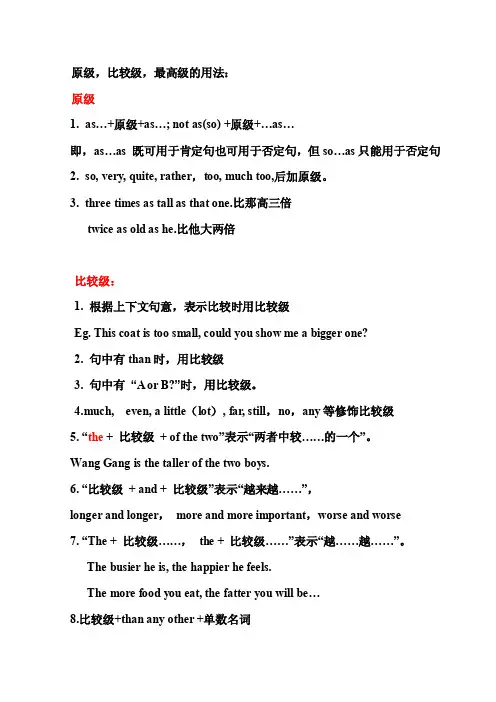
原级,比较级,最高级的用法:原级1.as…+原级+as…; not as(so) +原级+…as…即,as…as 既可用于肯定句也可用于否定句,但so…as只能用于否定句2.so, very, quite, rather,too, much too,后加原级。
3.three times as tall as that one.比那高三倍twice as old as he.比他大两倍比较级:1.根据上下文句意,表示比较时用比较级Eg. This coat is too small, could you show me a bigger one?2.句中有than时,用比较级3.句中有“A or B?”时,用比较级。
4.much, even, a little(lot), far, still,no,any等修饰比较级5. “the + 比较级+ of the two”表示“两者中较……的一个”。
Wang Gang is the taller of the two boys.6. “比较级+ and + 比较级”表示“越来越……”,longer and longer,more and more important,worse and worse7. “The + 比较级……,the + 比较级……”表示“越……越……”。
The busier he is, the happier he feels.The more food you eat, the fatter you will be…8.比较级+than any other +单数名词=比较级+than the other +复数名词=最高级+范围Y ejun is taller than any other boy in his class.Y ejun is taller than the other boys in his class.Y ejun is the tallest boy in his class最高级:1. 句中有“A ,B or C?”时,用最高级。
比较级
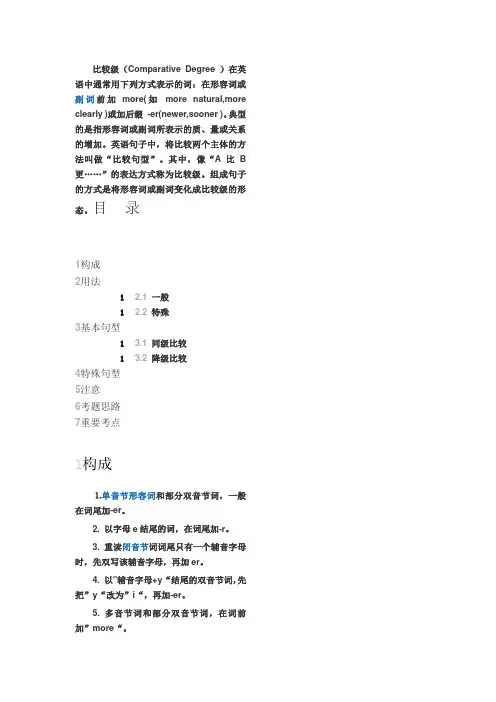
比较级(Comparative Degree )在英语中通常用下列方式表示的词:在形容词或副词前加more(如more natural,more clearly )或加后缀-er(newer,sooner )。
典型的是指形容词或副词所表示的质、量或关系的增加。
英语句子中,将比较两个主体的方法叫做“比较句型”。
其中,像“A比B 更……”的表达方式称为比较级。
组成句子的方式是将形容词或副词变化成比较级的形态。
目录1构成2用法1 2.1 一般1 2.2 特殊3基本句型1 3.1 同级比较1 3.2 降级比较4特殊句型5注意6考题思路7重要考点1构成⒈单音节形容词和部分双音节词,一般在词尾加-er。
2. 以字母e结尾的词,在词尾加-r。
3. 重读闭音节词词尾只有一个辅音字母时,先双写该辅音字母,再加er。
4. 以"辅音字母+y“结尾的双音节词,先把”y“改为”i“,再加-er。
5. 多音节词和部分双音节词,在词前加”more“。
6. 部分形容词和副词的比较级是不规则的,如:good/well-better,bad/badly-worse。
7. 由“动词+后缀-ing/-ed”构成的形容词,在词前加more构成比较级。
如:interesting-more interesting,bored-more bored。
8. 由“形容词+后缀-ly”构成的副词,在该副词前加more构成比较级。
如:slowly-more slowly,happily- more happily。
2用法一般1. 表示"比...更", 用比较级形容词+than+比较成分, than后主词的述语动词往往省略, 非正式用法的than后的人称代名词可用受格。
He is younger than me.他比我年轻。
I am a better swimmer than he(him).我游泳比他好。
2. 表示"较...低; 不及..."用less+原级形容词+than+比较成分。
比较级的用法比较级如何使用
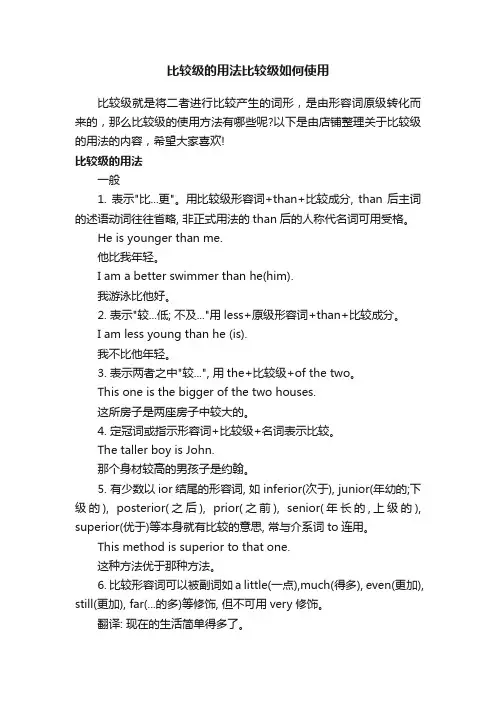
比较级的用法比较级如何使用比较级就是将二者进行比较产生的词形,是由形容词原级转化而来的,那么比较级的使用方法有哪些呢?以下是由店铺整理关于比较级的用法的内容,希望大家喜欢!比较级的用法一般1. 表示"比...更"。
用比较级形容词+than+比较成分, than后主词的述语动词往往省略, 非正式用法的than后的人称代名词可用受格。
He is younger than me.他比我年轻。
I am a better swimmer than he(him).我游泳比他好。
2. 表示"较...低; 不及..."用less+原级形容词+than+比较成分。
I am less young than he (is).我不比他年轻。
3. 表示两者之中"较...", 用the+比较级+of the two。
This one is the bigger of the two houses.这所房子是两座房子中较大的。
4. 定冠词或指示形容词+比较级+名词表示比较。
The taller boy is John.那个身材较高的男孩子是约翰。
5. 有少数以ior结尾的形容词, 如inferior(次于), junior(年幼的;下级的), posterior(之后), prior(之前), senior(年长的,上级的), superior(优于)等本身就有比较的意思, 常与介系词to连用。
This method is superior to that one.这种方法优于那种方法。
6. 比较形容词可以被副词如a little(一点),much(得多), even(更加), still(更加), far(...的多)等修饰, 但不可用very修饰。
翻译: 现在的生活简单得多了。
(误)Life is very easier than it was twenty years ago.(正)Life is very much easier than it was twenty years ago.特殊1. no more… than… 与……一样不……not more…than… 没有……那样……,不如……not less… than… 不亚于……2.more than… 不止,仅仅,非常,极其This more than satisfied me.3.more than a little 非常4.not more than 不多于 no (not any) more than不过,仅仅5.no less than 有……之多,多达 not less than 至少,不下于6.neither more nor less than 恰好,不多不少,简直,和……完全一样7.better than 多于,超过 It is better than 20 km to the station.8.(in) less than no time 立即,一会儿9.(be) little/no better than 实际上,简直就是10.nothing less than 完全是,和……一模一样11.all the more 越发,更加12. any (the) less 较小/更小一些,小的13. all the better 更好,更加14. so much the better/worse (for sb./sth.) 甚至更好/更坏15. go one better (than sb./sth.) 胜过……一筹16. more…than… 与其说……不如说……17. would sooner/rather…than 与其……宁愿18. (be) more like…than 不像……倒像19. rather…than…/rather than 宁可……而不20. other than 除了……,除……之外。
比较级与最高级的区别
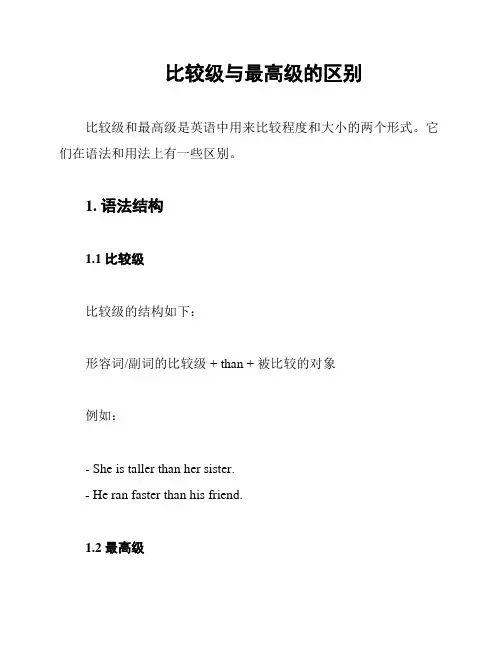
比较级与最高级的区别比较级和最高级是英语中用来比较程度和大小的两个形式。
它们在语法和用法上有一些区别。
1. 语法结构1.1 比较级比较级的结构如下:形容词/副词的比较级 + than + 被比较的对象例如:- She is taller than her sister.- He ran faster than his friend.1.2 最高级最高级的结构如下:the + 形容词/副词的最高级 + 名词 + in/of + 其他成分例如:- This is the tallest building in the city.- He is the smartest student in the class.2. 意义和功能2.1 比较级比较级用来比较两个或多个事物之间的差异,以表达一个相对的程度或大小。
例如:- She is taller than her sister.(她比她姐姐高。
)- This book is more interesting than that one.(这本书比那本书更有趣。
)2.2 最高级最高级用来表达某事物在同类中达到了最高程度或最小。
例如:- This is the tallest building in the city.(这是城里最高的建筑。
)- He is the smartest student in the class.(他是班上最聪明的学生。
)3. 形容词和副词的变化规则3.1 形容词一般情况下,形容词的比较级是在词尾加上-er,最高级是在词尾加上-est。
例如:- big (大) - bigger (更大) - biggest (最大)- fast (快) - faster (更快) - fastest (最快)但是,有些形容词的变化规则有一些特殊的情况,需要特别记住。
例如:- good (好) - better (更好) - best (最好)- bad (差) - worse (更差) - worst (最差)3.2 副词大多数副词的比较级和最高级形式是在词尾加上-er和-est。
比较级的特殊用法
7. more…than…
对同一对象的两个方面进行比较:若是对 同一个人或物在不同方面进行取舍时,意 为“与其说……倒不如……”,此时,不论 形容词或副词是单音节、双音节还是多音 节,一律用more…than…。 E.g. He is more hungry than tired. 与其说他累了,倒不如说他饿了。
3.no more…than与not more…than
Ex:他和我都读不懂西班牙语。 He’s no more able to read Spanish than I am. 这本书不比那本书更难。 This book is not more difficult than that one.
2. no more than与not more than
30年来,他只干了他需要干的工作。 For thirty years, he had done no more than he had needed to.
3.no more…than与not more…than
两者均可用于比较,前者no more…than表示对两者都否定,意为 “同……一样不”(=neither ... nor); E.g. He is no more a writer than a painter. 他不是画家,也不是作家。(= He is neither a painter nor a writer.)
1. not +比较级+ than no +比较级+ than
E.g.他英语不如我 。 His English is not better than mine. 我俩英语都好差。 His English is no better than mine.
比较级(完整版)

比较级(完整版)XXXXXXXXXXXXthe worst形容词比较级和最高级形容词比较级和最高级用于描述物品、人或事物的大小、高度、强度、重量、年龄、智力等方面的差异。
下面是一些常用的形容词比较级和最高级。
原级快的 - fast高的 - XXX强 - strong高的 - high大的 - big胖的 - fat长的 - long重 - heavy干燥 - dry热的 - hot温暖 - warm年轻 - young懒惰 - lazy早的 - early美 - pretty好的 - nice许多 - many/much 比较级更快的 - faster更高的 - XXX更强的 - stronger 更高的 - higher更大的 - bigger更胖的 - fatter更长的 - longer更重的 - XXX更干燥的 - XXX 更热的 - hotter更温暖的 - warmer 更年轻的 - younger 更懒惰的 - lazier 更早的 - XXX更美的 - XXX更好的 - nicer更多的 - more更近的 - nearer更少的 - less更好的 - better最高级最快的 - the fastest最高的 - XXX最强的 - the strongest 最高的 - XXX最大的 - the biggest最胖的 - the fattest最长的 - the longest最重的 - XXX最干燥的 - XXX最热的 - the hottest最温暖的 - the warmest 最年轻的 - the youngest 最懒惰的 - the laziest 最早的 - XXX最美的 - the prettiest最好的 - the nicest最多的 - the most最近的 - the nearest最少的 - least最好的 - the best除此之外,还有一些其他的形容词比较级和最高级,比如慢的 - slow,短的 - short,虚弱的 - weak,低的 - low,小的 - small,瘦的 - thin,宽的 - wide,轻的 - light,潮湿的 - wet,寒冷的 - cold,凉的 - cool,老的 - old,聪明的 - smart,晚的 - late,聪明的 - clever,可爱的 - cute,深入的 - further/farther,远的 - far,少的 - few,坏的 - worse。
比较级的基本用法
比较级的基本用法:①两者相比较,“比较级+than”She is taller than me.②两者相比较“…,A or B?”Who is more beautiful , A or B?③much, a little, a lot, even, far, a bit +比较级She is much taller than me.④“the+比较级+(n.)+of+the two …”表示“两者之间较…的”,He is the taller of the two boys.She is the older girl of the two girls.⑤“比较级+and+比较级”结构,译作“越来越…”I am getting taller and taller.China is becoming more and more beautiful.⑥“the +比较级,the +比较级”译为“越,就越…”。
The more you eat, the heavier you will be.The more you study , the more you know.⑦“倍数+as+原级+as”或“倍数+比较级+than”译为“.几倍”。
Our classroom is twice as large as yours.My ruler is three times longer than yours.⑧Tom is six years older than you.⑨用比较级表最高级意义的句型:…比较级+than+any other+单数名词…比较级+than+the other+复数名词Ann is cleverer than any other student in her class.=Ann is cleverer than the other students in her class.= Ann is the cleverest student in her class.⑩“less+原级+than”译为“…不如…”。
英语比较级的用法总结
英语比较级的用法总结1.一般比较级的形式一般比较级是用来比较两个事物的程度或级别。
在形容词或副词前加上-er或-more来形成一般比较级形式。
例如:taller(更高的)、smarter(更聪明的)、faster(更快的)、more beautiful(更美丽的)等。
2.以辅音字母+y结尾的形容词以辅音字母+y结尾的形容词,在变成比较级时,需将+y改为+i,再加上-er。
例如:funny(有趣的)变为funnier(更有趣的)、happy(快乐的)变为happier(更快乐的)等。
3.以重读闭音节结尾的形容词以重读闭音节结尾的形容词,在变成比较级时,需将末尾的辅音字母双写,并加上-er。
例如:big(大的)变为bigger(更大的)、hot(热的)变为hotter(更热的)等。
4.不规则的比较级形式一些形容词和副词的比较级形式是不规则的,需要记住这些特殊的形式。
例如:good(好的)变为better(更好的)、bad(坏的)变为worse(更差的)、far(远的)变为farther/further(更远的)等。
5. as...as句型as...as句型是用于表示两个或多个事物在其中一方面的程度相等。
在这种结构中,用as...as将两个事物相连,并且在as后面加上形容词或副词的原级形式。
例如:She is as tall as her sister.(她和她妹妹一样高)6.比较级的用法比较级可以用来表达两个人或事物之间的差异或相似之处。
在句子中,比较级常常与than连用,表达一个事物在其中一方面比另一个事物更好或更差。
例如:He is taller than his brother.(他比他的兄弟更高)7.比较级的表示方法除了使用形容词或副词的比较级形式之外,还可以使用more或less加上形容词或副词的原级形式来表示比较级。
例如:He is more intelligent than his classmates.(他比他的同学更聪明)8.最高级的形式最高级是用来比较三个或三个以上人或物之间的级别或程度的形式。
英语比较级最高级变法
英语比较级最高级变法important 重要 less important 较不重要 least important 最不重要tired 累的 more tired 更累的 most tired 最累的形容词比较级的用法:形容词的比较级用于两个人或事物的比较,其结构形式如下:主语+谓语(系动词)+ 形容词比较级+than+ 对比成分。
也就是, 含有形容词比较级的主句+than+从句。
注意从句常常省去意义上和主句相同的部分, 而只剩下对比的成分。
Our teacher is taller than we are.我们老师的个子比我们的高。
It is warmer today than it was yesterday.今天的天气比昨天暖和。
This picture is more beautiful than that one.这张照片比那张照片漂亮。
This meeting is less important than that one.这次会议不如那次会议重要。
The sun is much bigger than the moon.太阳比月亮大得多。
形容词最高级的用法:形容词最高级用于两个以上的人和物进行比较, 其结构形式为:主语+谓语(系动词)+the+形容词最高级+名词+表示范围的短语或从句。
She is the best student in her class.她是班上最好的学生。
Shanghai is one of the biggest cities in China.上海是中国最大城市之一。
This is the biggest apple I have ever met.这是我见到的最大的苹果。
Tom is the tallest boy in his basketball team.汤姆是他们篮球队中个子最高的孩子。
几个特殊用法:most 同形容词连用而不用 the,表示 "极,很,非常, 十分"。
比较级知识点
引言:比较级是英语中用于表达两者之间相对程度的一种语法结构。
了解比较级的知识点能够帮助学习者更好地使用英语进行比较和描述。
本文将详细介绍比较级的用法和变化规则,并提供一些常见的比较级表达方式,旨在帮助读者提升自己的英语表达能力。
概述:比较级是英语中用于比较两个事物或人的相对程度的一种形式。
通过比较级,我们可以表达出两者在某个方面上相对优势或劣势。
比较级主要通过在形容词或副词前加上“er”或“more”来构成。
正文内容:1.比较级的构成1.1形容词比较级的构成1.2副词比较级的构成1.3不规则比较级的构成1.4数量词的比较级构成1.5长度和时间的比较级构成2.比较级的用法2.1表示两者之间的比较2.2表示与他人或事物之间的比较2.3表示程度上的差异2.4表示递进关系2.5表示两者之间的对比3.比较级的变化规则3.1一般规则的变化3.2以“e”结尾的形容词和副词的变化3.3以辅音字母+y结尾的形容词和副词的变化3.4以重读闭音节结尾的形容词和副词的变化3.5不规则比较级的变化4.常见的比较级表达方式4.1使用“than”进行比较4.2使用“er”进行比较4.3使用“more”进行比较4.4使用“less”进行比较4.5使用倍数进行比较5.注意事项和常见错误5.1注意形容词和副词的使用5.2注意数量词和单位的使用5.3注意连续比较的表达方式5.4注意比较级的修饰语的使用5.5避免比较级的双重否定总结:比较级是英语中一种普遍使用的语法结构,用于比较两个事物或人的相对程度。
掌握比较级的构成和用法能够帮助学习者更准确地表达自己的观点和意见。
通过本文的详细介绍和举例解释,相信读者对比较级的知识点有了更深入的了解,并能够在实际应用中灵活运用。
在学习英语的过程中,继续积累和巩固比较级的用法是非常重要的,通过不断练习和实践,相信你的英语表达能力会得到提升。