
2014年博士研究生入学考试英语试题样题
1 天津大学博士研究生入学考试非英语专业考试大纲样题(2014) Part I. Listening Comprehension (10 %) Directions: In this section, you will hear 10 short conversations. At the end of each conversation, a question will be asked about what was said.Both the conversation and the questions will be spoken only once. After each question there will be a pause. During the pause, you must read the four choices marked A), B),C) and D), and decide which is the best answer. Then mark the corresponding letter on Answer Sheet with a single line through the centre. 1. A) He has proved to be a better reader than the woman. B) He has difficulty understanding the book. C) He cannot get access to the assigned book. D) He cannot finish his assignment before the deadline. 2. A) She will drive the man to the supermarket. B) The man should buy a car of his own. C) The man needn't go shopping every week. D) She can pick the man up at the grocery store.
Part IV Banked Cloze (10 %) Directions: Fill in the blanks in the following passage by selecting suitable words from the Word Bank. You may not use any of the words more than once. You have seen a friend succeed. No doubt you feel joy at this.You love your friend,and maybe you even helped him accomplish his goal. ____1____, there is another feeling, a dark feeling, within you. You begin to wish that it was you who was enjoying success, and you begin to even dislike your friend. At first this envious feeling starts off like a tiny seed. But then, like a seed, it grows. It threatens to ____2____ you.
Of course you feel bad about your feelings, as they have become a(n) ____3____ to your friendship. Still, there doesn't seem to be anything that you can do. Facing your friend invariably leads to more ____4____ between you. Avoiding him just seems to ____5____ the gulf between you.
Instead of feeling ____6____ about your envy or hating your friend, you should take a different ____7___. Use your friend's success as a challenge. He has succeeded. This means that you can succeed as well. By thingking this way, you are ____8____ your feelings and redirecting them into a course of action that won't ruin your friendship.
Remember that friendships can ____9_____ friendly competitiion. You cannot, however, maintain your friendship if you ____10____ envy.
A) approach B) goal C) tension D) harbor E) remain F) survive G) harnessing H) widen I) overwhelm J) overtake K) establish L) still M) guilty N) responsible O) handicap 2
Part III. Reading Comprehension (40%) Part A. Directions: In this part there are three passages followed by questions or unfinished statements, each with four suggested answers marked A, B, C and D. Choose the one that you think is the correct answer.
(1) Questions 1 to 5 are based on the following passage:
A report consistently brought back by visitors to the US is how friendly, courteous and helpful most Americans were to them. To be fair, this observation is also frequently made of Canada and Canadians, and should best be considered North American. There are, of course, exceptions. Small-minded officials, rude waiters, and ill-mannered taxi drivers are hardly unknown in the US. Yet it is an observation made so frequently that it deserves comment. For a long period of time and in many parts of the country, a traveler was a welcome break in an otherwise dull existence.
Dullness and loneliness were common problems of the families who generally lived distant from one another. Strangers and travelers were welcome sources of diversion, and brought news of the outside world. The harsh realities of the frontier also shaped this tradition of hospitality.
Someone traveling alone, if hungry, injured, or ill, often had nowhere to turn except to the nearest cabin or settlement. It was not a matter of choice for the traveler or merely a charitable impulse on the part of the settlers. It reflected the harshness of daily life: if you didn’t take in the stranger and take care of him, there was no one else who would. And someday, remember, you might be in the same situation. Today there are many charitable organizations which specialize in helping the weary traveler. Yet, the old tradition of hospitality to strangers is still very strong in the US, especially in the smaller cities and towns away from the busy tourist trails. "I was just traveling through, got talking with this American, and pretty soon he invited me home for dinner—amazing." Such observations reported by visitors to the US are not uncommon, but are not always understood properly.
2014年浙江大学英语考博真题和参考答案
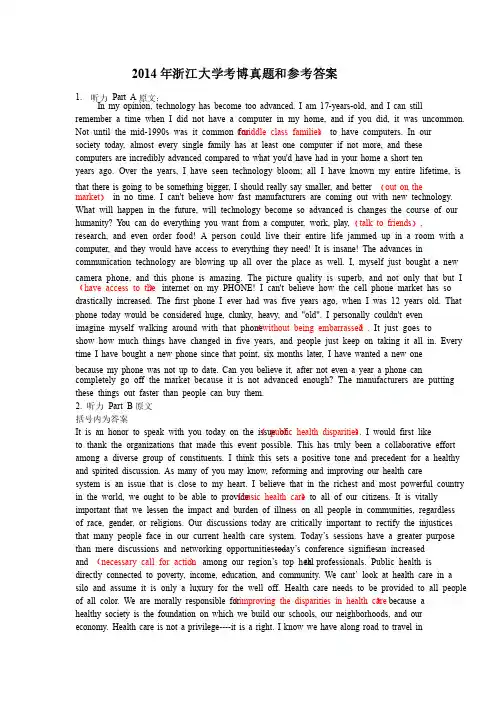
2014年浙江大学考博真题和参考答案1. 听力听力 Part A 原文:原文: In In my my my opinion, opinion, opinion, technology technology technology has has has become become become too too too advanced. advanced. advanced. I I I am am am 17-years-old, 17-years-old, 17-years-old, and and and I I I can can can still still remember a time when I did not have a computer in my home, and if you did, it was uncommon. Not until the mid-1990s was it common for (middle class families ) to have computers. In our society society today, today, today, almost almost almost every every every single single single family family family has has has at at at least least least one one one computer computer computer if if if not not not more, more, more, and and and these these computers computers are are are incredibly incredibly incredibly advanced advanced advanced compared compared compared to to to what what what you'd you'd you'd have have have had had in in your your your home home home a a short short ten ten years ago. Over the years, I have seen technology bloom; all I have known my entire lifetime, is that that there there there is is going going to to to be be be something something something bigger, bigger, bigger, I I I should should should really really really say say say smaller, smaller, smaller, and and better (out on the market ) in no time. I can't believe how fast manufacturers are coming out with new technology. What will happen in the future, will technology become so advanced is changes the course of our humanity? humanity? Y ou Y ou can can can do do do everything everything everything you you you want want want from from from a a a computer, computer, computer, work, work, work, play,play,(talk to friends ), research, and even order food! A person could live their entire life jammed up in a room with a computer, computer, and and and they they they would would would have have have access access access to to to everything everything everything they they they need! need! need! It It It is is is insane! insane! insane! The The The advances advances advances in in communication technology are blowing up all over the place as well. I, myself just bought a new camera phone, and this phone is amazing. The picture quality is superb, and not only that but I (have access to the ) internet on my PHONE! I can't believe how the cell phone market has so drastically increased. The first phone I ever had was five years ago, when I was 12 years old. That phone phone today today today would would would be be be considered considered considered huge, huge, huge, clunky, clunky, clunky, heavy, heavy, heavy, and and and "old". "old". "old". I I I personally personally personally couldn't couldn't couldn't even even imagine myself walking around with that phone (without being embarrassed ). It just goes to show how much things have changed in five years, and people just keep on taking it all in. Every time time I I I have have have bought bought bought a a a new new new phone phone phone since since since that that that point, point, point, six six six months months months later, later, later, I I I have have have wanted wanted wanted a a a new new new one one because because my my my phone phone phone was was was not not not up up up to to to date. date. date. Can Can Can you you you believe believe believe it, it, it, after after after not not not even even even a a a year year year a a a phone phone phone can can completely go off the market because it is not advanced enough? The manufacturers are putting these things out faster than people can buy them. 2. 听力听力 Part B 原文原文括号内为答案括号内为答案It is an honor to speak with you today on the issue of ( public health disparities ). I would first like to thank the organizations that made this event possible. This has truly been a collaborative effort among a diverse group of constituents. I think this sets a positive tone and precedent for a healthy and and spirited spirited spirited discussion. discussion. discussion. As As As many many many of of of you you you may may may know, know, know, reforming reforming reforming and and and improving improving improving our our our health health health care care system is an issue that is close to my heart. I believe that in the richest and most powerful country in the world, we ought to be able to provide (basic health care )to all of our citizens. It is vitally important that we lessen the impact and burden of illness on all people in communities, regardless of race, gender, or religions. Our discussions today are critically important to rectify the injustices that many people face in our current health care system. Today’s sessions have a greater purpose than mere discussions and networking opportunities----today’s conference signifies a n increased an increased and (necessary call for action ) among our region’s top health professionals. Public health is directly connected to poverty, income, education, and community. We cant’ look at health care in a silo and assume it is only a luxury for the well off. Health care needs to be provided to all people of all color. We are morally responsible for (improving the disparities in health care ) because a healthy healthy society society society is is is the the the foundation foundation foundation on on on which which which we we we build build build our our our schools, schools, schools, our our our neighborhoods, neighborhoods, neighborhoods, and and and our our economy. economy. Health Health Health care care care is is not not a a privilege----it privilege----it is is is a a right. right. I I I know know know we we we have have have along along along road road road to to to travel travel travel in in achieving equality in health status. I know that everyone here knows this. And I am hopeful that perhaps more people than ever are (finally waking up to this reality ). Part C1 原文原文 3个选择题个选择题There were very few places in the world that Jules Verne, the writer,, did not visit. He went round the world a hundred times or more. Once he did it in eighty days, unheard of in the nineteenth century. He voyaged sixty thousand miles under the sea, toured around the moon, exploded the center of the earth, and chatted with natives in Australia. Jules Verne, the man, was a stay-at-home. He was more likely to be tired from writing than from traveling. He did make a few visits to Europe and North Africa. And he made one six-week tour of New York State. But that was all. He spent less than one of his seventy-seven years really traveling. Yet he was the world’s most extraordinary tourist. H is books are crowded with hunting and fishing expeditions. Jules actually His books are crowded with hunting and fishing expeditions. Jules actually went hunting only once. Then he raised his gun and shot off the guard’s hat! He neve r held a test tube in his hand. But he was an inspiration to the scientist in the laboratory. Long before radio was invented, he had TV working in his books. His name for it was phono-telephoto. He had helicopters fifty years before the Wright brothers flew their first plane at Kitty Hawk. In fact, there were few wonders of the twentieth century that this man of the nineteenth century did not foresee. In his stories you can read about neon lights, moving sidewalks, air-conditioners, sky-scrapers, guided missiles, tanks, electrically operated submarines, and air-planes,and so on. 第一个问题第一个问题 问这个人是干什么的问这个人是干什么的 选the writer Part C2 Part C2 原文原文原文 第2篇 3个选择题个选择题Very old people do raise moral problems for almost everyone who comes in contactwith them. Their values values—this —this can’t be repeated too often—often—are are not necessarily ourvalues. Physical comfort, cleanness and order are not necessarily the most importantthings. The social services from time to time find themselves faced with a flat withdecaying food covered by small worms, and an old person lying alone in bed, takingno notice of the worms. But is it interfering with personal freedom to insist thatthey go to live with some of their relatives so that they might be taken better careof? Some social workers, the ones who clear up the worms, think we are in dangerof carrying this concept of personal freedom to the point where serious risks arebeing taken with the health and safety of the old. Indeed, the old can be easilyhurt or harmed. The body is like a car, it needs more mechanical maintenance as itgets older. You can carry this comparison right through to the provision of spareparts. But But never never forget that such operations operations are are painful experiences, experiences, however however goodthe results will be. And at what point should you stop to treat the old body? Isit morally right to try to push off death by seeking the development of drugs toexcite the forgetful old mind and to activate the old body, knowing that it isdesigned to die? You can’t ask doctors or scientists to decide, because so longas they can see the technical opportunities, they will feel bound to give them atry, on t try, on the principle that while there’s life, there’s hope.he principle that while there’s life, there’s hope.he principle that while there’s life, there’s hope.第三篇第三篇Animals do not possess a language in the true sense of the word. In the highervertebrates, as also in insects, particularly in the socially living species of bothgreat great groups, groups, groups, every every every individual individual individual has has has a a a certain certain certain number number number of of of inmate inmate inmate movements movements movements and and and sounds soundsfor expressing feelings. It has also innate ways of reacting to these signalswhenever it sees or hears hears them them them in in a fellow-member fellow-member of of the species. species. The The highly socialspecies of birds such as the jackdaw or the graylag goose, have a complicated codeof such signals which are uttered and understood by every bird without any previousexperience. The perfect co-ordination of social behaviour which is brought aboutby these actions and reactions conveys to the human observer the impression thatthe birds are talking and understanding a language of the own. Of course, this purelyinnate signal signal code code of of an an animal species species differs differs fundamentally fundamentally from from human human language, language,every word of which must be learned laboriously by the human child. Moreover, beinga genetically fixed character of the species a genetically fixed character of the species——just as much as any bodilycharacter character——this so-called language is, for every individual animal species,ubiquitous in its distribution. Obvious though this fact may seem, it was,nevertheless, with something akin to nevertheless, with something akin to naïve naïve naïve surprise that I heard the jackdaws in surprise that I heard the jackdaws innorthern Russia “talk talk”” exactly the same, familiar “dialect dialect”” as my birds at homein Altenberg. The superficial similarity between these animal utterances and humanlanguages diminishes further as it becomes gradually clear to the observer that theanimal, in all these sounds and movements expressing its emotions, has in no waythe conscious intention of influencing a fellow member of its species. This is provedby the fact that even geese or jackdaws reared and kept singly make all these signalsas soon as the corresponding mood overtakes them. Under these circumstances theautomatic and even mechanical character of these signals becomes strikingly apparentand reveals them as entirely different from human words.二.(15题,15分)单选题(顺序打乱了)分)单选题(顺序打乱了)The two friends sat in a corner and __B__ away to each other about the weather .a .talked b .chatted c .muttered d .whispered He is going to __D__ the meeting on the subject of war and peace in a minute .a .speak b .talk c .remark d .address Although not an economist himself, Dr. Smith has long been a severe critic of the government's ___A___ policies. a. economic b. economical b. economical c. economy d. economics d. economics There are not many teachers who are strong _C_of traditional methods in English teaching. a. sponsors b. contributors b. contributors c. advocates c. advocates d. performers A friendship may be ___B___ , casual, situational or deep and lasting. a. identical b. superficial b. superficial c. critical d. original d. original Nobody Nobody yet yet yet knows knows knows how how how long long long and and and how how how seriously seriously seriously the the the shakiness shakiness shakiness in in in the the the financial financial financial system system system will will will _C_ _C_ down the economy. a. put b. settle b. settle c. drag d. knock d. knock We are _D_ to the idea, but we doubt whether the time is ripe to put it into force. a. equal b. adequate b. adequate c. considerate d. sympathetic People People were were were surprised surprised surprised to to to find find find that that that Mr. Mr. Mr. Johnson Johnson Johnson had had had the the the ability ability ability to to to ___B__ ___B__ ___B__ everything everything everything he he he was was involved in. a. Prevail b. dominate c. preside c. preside d. instruct You can do it if you want to, but in my opinion it’s not worth the __D__ it in volves. a. force b. trial b. trial c. attempt d. effort The manager gave one of the salesgirls an accusing look for __D__ her attitude toward customers. a. straightforward b. partial b. partial c. favorable d. hostile You must pack plenty of food for the journey. __D__, you will need warm clothes, so pack them too. a. Equally b. Incidentally c. Inevitably c. Inevitably d. Likewise d. Likewise This __B_ was conducted to find out how many people prefer rice. a. examination b. survey b. survey c. inspection d. test As a defense against air-pollution damage, many plants and animals __B__ a substance to absorb harmful chemicals a. relieve b. release b. release c. dismiss c. dismiss d. discard He said that very clearly so that nobody was in any___B__ about what was meant. a. wonder b. doubt c. question d. consideration 三.完形填空(20题 20分)分)Throughout history man has had to accept the fact that all living things must die. But people now live longer than they (1) . Yet, all living things still show the (2) of aging, which will eventually (3) death. Aging is not a disease, (4)as a person passes maturity, the cells of the body and the (5) they form do not function as well as they did in childhood and teenage years. The body provides less (6) against disease and is more (7) to have accident. A number of related causes may (8) aging. Some cells of the body have a (9) long life, but they are not (10) when they die. As a person ages, (11) of brain cells and muscle cells decreases. Other body cells die and are (12)by new cells. In an aging person the new cells may not be as workable or as capable (13) growth as those of a young young person. person. person. Another Another Another (14) (14) (14) in in in aging aging aging may may may be be be changes within changes within the the cells(15). cells(15). cells(15). Some Some Some of of the the protein protein chemicals in cells are known to change with age and become less elastic. This is (16) the skin of old people wrinkles and hangs loose. This is also the reason why old people (17) in height. There may be other more important chemical changes in the cells. Some complex cell chemicals, (18)DNA DNA and and and RNA, RNA, RNA, store store store and and and (19) (19) (19) information information information that that that the the the cells cells cells need.Aging need.Aging need.Aging may may may affect affect affect this this this (20) (20) (20) and and change the informationcarrying molecules so that they do not transmit the information as well. 1.C A A .would B B .be used to C .used to D . used 2.B A A .function B .effect C C .affect D D . sign 3.D A A .lead in B .give in C C .run into D . result in 4.but 5.D A A .hands B B .feet C C .heart D . organs 6.B A A .energy B .protection C .vigor D . power 7.A A A .likely B B .probable C .possible D . alike 8.B A A .attend to B B .contribute to C C .add to D . devote to 9.fairly 10.A A A .replaced B .reborn C .recovered D . surrendered 11.C A .a number B B .the amount C .the number D . a great deal 12.replaced 13.C A .to B .for C .of D . in 14.A A .factor B B .effect C C .reason D . element 15.C A .for themselves B .of themselves C .themselves D .on their own 16.why 17.B A .increase B .shrink C C .lengthen D . decrease 18.such as 19.D A .pass away B B .pass by C C .pass off D D . pass on 20.D A .improvement B .procession C .approach D . process 四阅读(4篇,20分)分)阅读第一篇阅读第一篇In the same way that a child must be able to move his arms and legs before he can learn to walk, the the child child child must must must physiologically physiologically physiologically be be be capable capable capable of of of producing producing producing and and and experiencing experiencing experiencing particular particular particular emotions emotions before these emotions can be modified through learning. psychologists have found that there are two two basic basic basic processes processes processes by by by which which which learning learning learning takes takes takes place. place. place. one one one kind kind kind of of of learning learning learning is is is called called called "classical "classical conditioning". this occurs when one event or stimulus is consistently paired with, or followed by, a reward reward or or or punishment, punishment, punishment, it it it is is is through through through classical classical classical conditioning conditioning conditioning that that that a a a child child child learns learns learns to to to associate associate associate his his mother's face and voice with happiness and love, for he learns that this person provides food and comfort. negative emotions are learned in a similar fashion. The second kind of learning is called "operant conditioning." this occurs when an individual learns to to do do do things things things that that that produce produce produce rewards rewards rewards in in in his his his environment environment environment and and and learns learns learns not not not to to to do do do things things things that that that produce produce punishments. for example, if a mother always attends to her baby when he cries and cuddles him until he is quiet, she may teach him that if he cries he will get attention from mother. thus, the baby will learn to increase his crying in order to have his mother more. Every Every day, day, we we grow grow grow and and and have have have new new new experiences. experiences. experiences. we we we constantly constantly constantly learn learn learn by by by reading, reading, reading, watching watching television, interacting with some people, and so forth. this learning affects our emotions. why is it that we learn to like some people and dislike others? if a person is nice to us, cares about us, we learn to associate this person with positive feelings, such as joy, happiness, and friendliness. on the other hand, if a person is mean to us, does not care about us, and even deliberately does things to harm us, we learn to associate this person with negative feelings, such as unhappiness, discomfort, and anger. 1. the author's main purpose in writing the passage is to _B_. a) teach children how to learn to produce and experience certain emotion b) give the general reader an account of two basic kinds of learning c) give parents some advice on how to modify their children's emotions through learning d) discuss with psychologist how positive and negative feelings are produced 2.if 2.if your your your jokes jokes jokes often often often find find find already already already echo echo echo in in in a a a person, person, person, you you you will will will learn learn learn though though though _B_ _B_ _B_ that that that telling telling jokes to this person is fun, and you will try with greater efforts to be humorous in his presence. a) classical conditioning b) operant conditioning c) neither of them d) some other sorts of conditioning 3. 3. if if if a a a child child child is is is bitten bitten bitten or or or startled startled startled several several several times times times by by by a a a dog, dog, dog, he he he may may may learn learn learn to to to associate associate associate furry furry animals with pain or startle and thus develop a fear of furry animals. this is a typical example of learning through _A_. a) classical conditioning b) operant conditioning c) both of them d) neither of them 4. in the third paragraph, the author is _D_. a) discussing how we grow and have new experiences every day b) talking about learning to modify emotions through operant conditioning c) concentrating on learning by reading, watching television, interacting with people, and so on d) using examples to further illustrate learning through classical conditioning 5. in the following paragraphs the author will most probably go on to discuss __C_. a) definitions of positive feelings and negative feelings b) the third kind of learning c) further examples of learning through operant conditioning d) none of the above 阅读第2篇,篇,Do we need laws that prevent us from running risks with our lives? If so, then perhaps laws are needed prohibiting the sale of cigarettes and alcoholic drinks. Both products have been known to kill kill people. people. people. The The The hazards hazards hazards of of of drinking drinking drinking too too too much much much alcohol alcohol alcohol are are are as as as bad bad or or worse worse worse than than than the the the hazards hazards hazards of of smiking too many cigarettes. All right then, let's pass a law closing the liquor stores and the bars in this country. Let's put an end once and for all to the ruinous disease from which as many as 10 million Americans currently suffer--alcoholism. But wait. We've already tried that. For 13 years, between 1920 and 1933, there were no liquor stores stores anywhere anywhere anywhere in in in the the the United United United States. States. States. They They They were were were shut shut shut down down down abilished abilished abilished by by by an an an amendment amendment amendment to to to the the Constitution and by a law of Congress. After January 20, 1920, there was supposed to be no more manyfacturing, selling, or transporting of "intoxicating liquors". Without any more liquor, people could not drink it. And if they did not drink it, how could they get drunk? There would be no more dangers to the public welfare from drunkenness and alcoholism. It was all bery logical. And yet prohibition of liquor, beer, and wine did not work. Why? Because, law or no law, millions of people still liked to drink alcohol. And they were willing to take risks to get it. They were not about to change their tastes and habits just because of a change in the law. And gans of liquor smugglers millions of gallons of the outlawed beverages across the Canadian and Mexican borders. Drinkers were licky to know of an illegal bar that served Mexican or or Canadian Canadian Canadian liquor. liquor. Crime Crime and and and drunkenness drunkenness drunkenness were were were both both both supposed supposed supposed to to to decline decline decline as as as a a a rusult rusult rusult of of prohibition. Instead, people drank nore alcohol than ever-often poisoned alcohol. 1. Which of the following was NOT characteristic reason for the proposal of the 18th Amendment to the Constitution and the V olstead Act? A a) There would be no further danger to the public from alcoholism. b) There would be a rise in the cost of alcoholic beverages. c) Without liquor, people would not drink. d) People would not become drunk of create a public nuisance. 2. During Prohibition, illegal alcohol was_C___. a) sold openly b) no longer a temptation c) a major factor in the passage of the V olstead Act d) brought across the Mexican and Canadian borders 3. During Prohibition, people__B__. a) lived in fear of the law b) were willing to risk arrest for the pleasure of liquor c) recklessly endangered their comunities d) were respectful of the legal sanctions placed on them 4. When enacting the prohibition law, government officials assumend that__D__. a) every American would buy alcohol illegally b) all criminal activities would cease c) patrols of the Canadian border would halt the sale of alcohol d) the social threat from drunkerness would decline 5. It can be inferred from the passage that__A__. a) the Congress was wise to repeal Prohibition b) the Prohibition Era was characterized by a decrease in crime and drunkenness c) during Prohibition, most Americans stopped drinking d) laws should be passed to ban the sale of alcoholic beverages 第三篇第三篇As people continue to grow and age, our body systems continue to change. At a certain point in your life, your body system began to weaken. Your joint may become stiff. It may become more difficult for you to see and hear. The slow change of aging causes our bodies to lose some of their ability ability to bounce back from disease and injury. In order to live longer, we have always tried to to bounce back from disease and injury. In order to live longer, we have always tried to slow or stop this process that leads us toward the end of our lives. Many factors contribute to your health. A well-balanced diet plays an important role. The amount and type of exercises you get is another factor. Your living environment and the amount of stress you you are are are under under under is is yet yet another. another. another. But But But scientists scientists scientists studying studying studying senescence senescence senescence want want want to to to know: know: know: Why Why Why do do people grow old? They hope that by examining the aging process on a cellular level medical science may be able to extend the length of life. There is nothing to be afraid of as old age approaches. Many consider the later portions of life to be the best time for living. Physical activity may lessen, but often you gain a broader understanding of yourself and the world. What What we we we consider consider consider old old old age age age now now now may may may only only only be be be middle-aged middle-aged middle-aged someday someday someday soon. soon. soon. Who Who Who knows knows knows with with with so so many advances in medical science happening so quickly, life spans may one day be measured in centuries, rather than in years! 1. When people become aging, they will lose some of their ability to bounce back from disease and injury, “bounce back” here means __A__.A. to improve in health after one ‟s disease and injury B . to run fast C. to recover from disease and injury D. to jump after recovering 2. In order to live longer, ___A___. 。
2014年全国医学考博英语试题

2014MD全国医学博士外语统一考试英语试卷答题须知1.请考生首先将自己的姓名、所在考点、准考证号在试卷一答题纸和试卷二标准答题卡上认真填写清楚,并按“考场指令”要求,将准考证号在标准答题卡上划好。
2.试卷一(Paper One)答案和试卷二(Paper Two)答案都作答在标准答题卡上,不要做在试卷上。
3.试卷一答题时必须使用2B铅笔,将所选答案按要求在相应位置涂黑;如要更正,先用橡皮擦干净。
书面表达一定要用黑色签字笔或钢笔写在标准答题卡上指定区域。
4.标准答题卡不可折叠,同时答题卡须保持平整干净,以利评分。
5.听力考试只放一遍录音,每道题后有15秒左右的答题时间。
国家医学考试中心PAPER ONEPart 1 :Listening comprehension(30%)Section ADirections:In this section you will hear fifteen short conversations between two speakers, At the end of each conversation, you will hear a question aboutwhat is said, The question will be read only once, After you hear thequestion, read the four possible answers marked A, B, C, and D. Choosethe best answers and mark the letter of your choice on the ANSWERSHEET.Listen to the following exampleYou will hearWoman: I feel faint.Man: No wonder. You haven’t had a bite all day.Question: What’s the matter with the woman?You will read:A. She is sick.B. She was bitten by an ant.C. She is hungry.D. She spilled her paint.Here C is the right answer.Sample AnswerA B C DNow let’s begin with question Number 1.1. A. About 12 pints B. About 3 pintsC. About 4 pintsD. About 7 pints2. A. Take a holiday from work. B. Worry less about work.C. Take some sleeping pills.D. Work harder to forget all her troubles.3. A. He has no complaints about the doctor.B. He won’t complain anything.C. He is in good condition.D. He couldn’t be worse.4. A. She is kidding.B. She will get a raise.C. The man will get a raise.D. The man will get a promotion.5. A. Her daughter likes ball games.B. Her daughter is an exciting child.C. She and her daughter are good friends.D. She and her daughter don’t always understand each other.6. A. She hurt her uncle.B. She hurt her ankle.C. She has a swollen toe.D. She needs a minor surgery.7. A. John likes gambling.B. John is very fond of his new boss.C. John has ups and downs in the new company.D. John has a promising future in the new company.8. A. She will get some advice from the front desk.B. She will undergo some lab tests.C. She will arrange an appointment.D. She will get the test results.9. A. She’s an odd character.B. She is very picky.C. She is easy-going.D. She likes fashions.10.A. At a street corner.B. In a local shop.C. In a ward.D. In a clinic.11.A. Sea food. B. Dairy products.C. Vegetables and fruits.D. Heavy foods.12.A. He is having a good time.B. He very much likes his old bicycle.C. He will buy a new bicycle right away.D. He would rather buy a new bicycle later.13.A. It is only a cough.B. It’s a minor illness.C. It started two weeks ago.D. It’s extremely serious.14.A. The woman is too optimistic about the stock market.B. The woman will even lose more money at the stock market.C. The stock market bubble will continue to grow.D. The stock market bubble will soon meet its demise.15.A. The small pills should be taken once a day before sleep.B. The yellow pills should be taken once a day before supper.C. The white pills should be taken once a day before breakfast.D. The large round pills should be taken three times a day after meals.Section BDirection:In this section you will hear one conversation and two passages, after each of which, you will hear five questions. After each question, read thefour possible answers marked A, B, C and D, Choose the best answerand mark the letter of your choice on the ANSWER SHEET.Dialogue16.A. Because he had difficulty swallowing it.B. Because it was upsetting his stomach.C. Because he was allergic to it.D. Because it was too expensive.17.A. He can’t play soccer any more.B. He has a serious foot problem.C. He needs an operation.D. He has cancer.18.A. A blood transfusion.B. An allergy test.C. A urine test.D. A biopsy.19.A. To see if he has cancer. B. To see if he has depression.C. To see if he requires surgery.D. To see if he has a food allergyproblem.20.A. Relieved.B. Anxious.C. Angry.D. Depressed.Passage One21.A. The cause of COPD.B. Harmful effects of smoking.C. Men more susceptible to harmful effects of smoking.D. Women more susceptible to harmful effects of smoking.22.A. 954.B. 955.C. 1909.D. 1955.23.A. On May 18 in San Diego. B. On May 25 in San Diego.C. On May 18 in San Francisco.D. On May 25 in San Francisco.24.A. When smoking exposure is high.B. When smoking exposure is low.C. When the subjects received medication.D. When the subjects stopped smoking.25.A. Hormone differences in men and women.B. Genetic differences between men and women.C. Women’s active metabolic rate.D. Women’s smaller airways.Passage Two26.A. About 90,000.B. About 100,000.C. Several hundreds.D. About 5,000.27.A. Warning from Goddard Space Flight Center.B. Warning from the Kenyan health ministry.C. Experience gained from the 1997 outbreak.D. Proper and prompt Aid from NASA.28.A. Distributing mosquito nets.B. Persuading people not to slaughter animals.C. Urging people not to eat animals.D. Dispatching doctors to the epidemic-stricken area.29.A. The higher surface temperatures in the equatorial part of the Indian Ocean.B. The short-lived mosquitoes that were the hosts of the viruses.C. The warm and dry weather in the Horn of Africa.D. The heavy but intermittent rains.30.A. Warning from NASA.B. How to treat Rift Valley fever.C. The disastrous effects of Rift Valley fever.D. Satellites and global health – remote diagnosis.Part II Vocabulary (10%)Section ADirection:In this section, all the sentences are incomplete. Four words or phrases, marked A B C and D .are given beneath each of them. You are to choosethe word or phrase that best completes the sentence. Then mark youranswer on the ANSWER SHEET.31.A good night’s sleep is believed to help slow the stomach’s emptying, produce asmoother, less abrupt absorption of sugar, and will better __________ brain metabolism.A. regulateB. activateC. retainD. consolidate32.The explosion and the oil spill below the surface of the Gulf of Mexico left my mindin such a ________ that I couldn’t get to sleep.A. catastropheB. boycottC. turmoilD. mentality33.Coronary heart attacks occur more commonly in those with high blood pressure, inthe obese, in cigarette smokers, and in those _________ to prolonged emotional and mental strain.A. sympatheticB. ascribedC. preferableD. subjected34.Most colds are acquired by children in school and then ___________ to adults.A. conveyedB. transmittedC. attributedD. relayed35.Several of the most populous nations in the world ________ at the lower end of thetable of real GDP per capita last year.A. fluctuatedB. languishedC. retardedD. vibrated36.Presently this kind of anti-depressant is still in clinical _______, even though theconcept has been around since 1900s.A. trialsB. applicationsC. implicationsD. endeavors37.Studies revealed that exposure to low-level radiation for a long time may weakenthe immune system, ________ aging, and cause cancer.A. haltB. postponeC. retardD. accelerate38.The mayor candidate’s personality traits, being modest and generous, _______people in his favor before the election.A. predisposedB. presumedC. presidedD. pressured39.With its graceful movements and salubrious effects on health, Tai Chi has a strong________ to a vast multitude of people.A. flavorB. thrillC. appealD. implication40.If you are catching a train, it is always better to be _______ early than even afraction of a minute too late.A. infinitelyB. temporarilyC. comfortablyD. favorably Section BDirections:Each of the following sentences has a word or phrase underlined. There are four words or phrases beneath each sentence, Choose the word orphrase which can best keep the meaning of the original sentence if it issubstituted for the underlined part, Mark your answer on the ANSWERSHEET.41.All Nobel Prize winners’ success is a process of long-term accumulation, in whichlasting efforts are indispensable.A. irresistibleB. cherishedC. inseparableD. requisite42.The Queen’s presence imparted an air of elegance to the drinks reception atBuckingham Palace in London.A. bestowedB. exhibitedC. imposedD. emitted43.Physicians are clear that thyroid dysfunction is manifest in growing children in theform of mental and physical retardation.A. intensifiedB. apparentC. representativeD. insidious44.The mechanism that the eye can accommodate itself to different distances has beenapplied to automatic camera, which marks a revolutionary technique advance.A. yieldB. amplifyC. adaptD. cast45.Differences among believers are common; however, it was the pressure of religiouspersecution that exacerbated their conflicts and created the split of the union.A. eradicatedB. deterioratedC. vanquishedD. averted46.When Picasso was particularly poor, he might have tried to obliterate the originalcomposition by painting over it on canvases.A. duplicateB. eliminateC. substituteD. compile47.For the sake of animal protection, environmentalists deplored the constructionprogram of a nuclear power station.A. disapprovedB. despisedC. demolishedD. decomposed48.Political figures in particular are held to very strict standards of marital fidelity.A. loyaltyB. moralityC. qualityD. stability49.The patient complained that his doctor had been negligent in not giving him a fullexamination.A. prudentB. ardentC. carelessD. brutal50.She has been handling all the complaints without wrath for a whole morning.A. furyB. chaosC. despairD. agonyPart III Cloze (10%)Directions: In this section there is a passage with ten numbered blanks. For each blank, there are four choices marked A, B, C, and D on the right side.Choose the best answer and mark the letter of your choice on theANSWER SHEET.For years, scientists have been warning us that the radiation from mobile phones is detrimental to our health, without actually having any evidence to back these __51__ up.However, research now suggests that mobile phone radiation has at least one positive side effect: it can help prevent Alzheimer’s, __52__ in the mice that acted as test subjects.It’s been suspected, though never proven, that heavy use of mobile phones is bad for your health. It’s thought that walking around with a cellphone permanently attached to the side of your head is almost sure to be __53__ your brain. And that may well be true, but I’d rather wait until it’s proven before giving up that part of my daily life.But what has now been proven, in a very perfunctory manner, is that mobile phone radiation can have an effect on your brain. __54__ in this case it was a positive rather than negative effect.According to BBC news, the Florida Alzheimer’s Disease Research Center conducted a study on 96 mice to see if the radiation given off by mobile phones could affect the onset ofAlzheimer’s.Some of the mice were “genetically altered to develop beta-amyloid plaques in their brains”__55__ they aged. These are a marker of Alzheimer’s. all 96 mice were then “exposed to the electro-magnetic __56__ generated by a standard phone for two one-hour periods each day for seven to nine months.” The lucky things.__57__ the experiment showed that the mice altered to be predisposed to dementia were protected from the disease if exposed before the onset of the illness. Their cognitive abilities were so unimpaired as to be virtually __58__ to the mice not genetically altered in any way.Unfortunately, although the results are positive, the scientists don’t actually know why exposure to mobile phone radiation has this effect. But it’s hoped that further study and testing could result in a non-invasive __59__ for preventing and treating Alzheimer’s disease.Autopsies carried out on the mice also concluded no ill-effects of their exposure to the radiation. However, the fact that the radiation prevented Alzheimer’s means mobile phones __60__ our brains and bodies in ways not yet explored. And it’s sure there are negative as well as this one positive.51. A. devicesB. risksC. phenomenaD. claims52. A. at leastB. at mostC. as ifD. as well53. A. blockingB. cookingC. exhaustingD. cooling54. A. ExceptB. EvenC. DespiteD. Besides55. A. untilB. whenC. asD. unless56. A. rangeB. continuumC. spectrumD. field57. A. ReasonablyB. ConsequentlyC. AmazinglyD. Undoubtedly58. A. identicalB. beneficialC. preferableD. susceptible59. A. effortB. methodC. huntD. account60. A. do affectB. did affectC. is affectingD. could have affectedPart IV Reading Comprehension (30%)Directions:In this part there are six passages, each of which is followed by five questions. For each question there are four possible answers marked A, B,C, and D. Choose the best answer and mark the letter of your choice onthe ANSWER SHEET.Passage oneI have just returned from Mexico, where I visited a factory making medical masks. Faced with fierce competition, the owner has cut his costs by outsourcing some of his production. Scores of people work for him in their homes, threading elastic into masks by hand. They are paid below the minimum wage, with no job security and no healthcare provision.Users of medical masks and other laboratory gear probably give little thought to where their equipment comes from. That needs to change. A significant proportion of these products are made in the developing world by low-paid people with inadequate labor rights. This leads to human misery on a tremendous scale.Take lab coats. Many are made in India, where most cotton farmers are paid an unfair price for their crops and factory employees work illegal hours for poor pay.One-fifth of the world’s surgical instruments are made in northern Pakistan. When I visited the area a couple of years ago I found most workers toiling 12 hours a day, seven days a week, for less than a dollar a day, exposed to noise, metal dust and toxic chemicals. Thousands of children, some as young as 7, work in the industry.To win international contracts, factory owners must offer rock-bottom prices, and consequently drive down wages and labor conditions as far as they can. We laboratory scientists in the developed world may unwittingly be encouraging this: we ask how much our equipment will cost, but which of us asks who made it and how much they were paid?This is no small matter. Science is supposed to benefit humanity, but because of the conditions under which their tools are made, may scientists may actually be causing harm.What can be done? A knee-jerk boycott of unethical goods is not the answer; it would just make things worse for workers in those manufacturing zones. What we need is to start asking suppliers to be transparent about where and how their products are manufactured and urge them to improve their manufacturing practices.It can be done. Many universities are committed to fair trade in the form of ethically sourced tea, coffee or bananas. That model should be extended to laboratory goods.There are signs that things are moving. Over the past few years I have worked with health services in the UK and in Sweden. Both have recently instituted ethical procurement practices. If science is truly going to help humanity, it needs to follow suit.61. From the medical masks to lab coats, the author is trying to tell us ________.A. the practice of occupational protection in the developing worldB. the developing countries plagued by poverty and disease.C. the cheapest labor in the developing countries.D. the human misery behind them.62. The concerning phenomenon the author has observed, according to the passage,________.A. is nothing but the repetition of the miserable history.B. could have been even exaggerated.C. is unfamiliar to the wealthy west.D. is prevailing across the world.63. The author argues that when researchers in the wealthy west buy the tools oftheir trade, they should ___________.A. have the same concern with the developing countries.B. be blind to their sources for the sake of humanityC. pursue good bargains in the international market.D. spare a thought for how they were made.64. A proper course of action suggested by the author is ___________.A. to refuse to import the unethical goods from the developing world.B. to ask scientists to tell the truth as the prime value of their work.C. to urge the manufacturers to address the immoral issues.D. to improve the transparency of international contracts.65. By saying at the end of the passage that if science is truly going to help humanity, it needs to follow suit, the author means that ___________.A. the scientific community should stand up for all humanityB. the prime value of scientists’ work is to tell the truth.C. laboratory goods also need to be ethically sourced.D. because of science, there is hope for humanity.Passage twoA little information is a dangerous thing. A lot of information, if it’s inaccurate or confusing, even more so. This is a problem for anyone trying to spend or invest in an environmentally sustainable way. Investors are barraged with indexes purporting to describe companies’ eco-credentials, some of dubious quality. Green labels on consumer products are ubiquitous, but their claims are hard to verify.The confusion is evident form New Scientist’s analysis of whether public perceptions of companies’green credentials reflect reality. It shows that many companies considered “green” have done little to earn that reputation, while others do not get sufficient credit for their efforts to reduce their environmental impact. Obtaining better information is crucial, because decisions by consumers and big investors will help propel us towards a green economy.At present, it is too easy to make unverified claims. Take disclosure of greenhouse gas emissions, for example. There are voluntary schemes such as the Carbon Disclosure Project, but little scrutiny of the figures companies submit, which means investors may be misled.Measurements can be difficult to interpret, too, like those for water sue. In this case, context is crucial: a little from rain-soaked Ireland is not the same as a little drawn from the Arizona desert.Similar problems bedevil “green” labels attached to individual products. Here, the computer equipment rating system developed by the Green Electronics Council shows the way forward. Its criteria come from the IEEE, the world’s leading professional association for technology/Other schemes, such as the “sustainability index”planned by US retail giant Walmart, are broader. Developing rigorous standards for a large number of different types of product will be tough, placing a huge burden on the academic-led consortium that is doing the underlying scientific work.Our investigation also reveals that many companies choose not to disclose data. Some will want to keep it that way. This is why we need legal requirements for full disclosure of environmental information, with the clear message that the polluter will eventually be required to pay. Then market forces will drive companies to clean up their acts.Let’s hope we can rise to this challenge. Before we can have a green economy we need a green information economy – and it’s the quality of information, as well as its quantity, that will count.66. “The confusion” at the beginning of the 2nd paragraph refers to ________.A. where to spend or invest in a sustainable wayB. an array of consumer products to chooseC. a fog of unreliable green informationD. little information on eco-credibility67. From the New Scientist’s analysis it can be inferred that in many cases ________.A. eco-credibility is abusedB. a green economy is crucialC. an environmental impact is lessenedD. green credentials promote green economy68. From unverified claims to difficult measurements and then to individual products, the author argues that ________.A. eco-credibility is a game between scientists and manufacturesB. neither scientists nor manufactures are honestC. it is vital to build a green economyD. better information is critical69. To address the issue, the author is crying for ________.A. transparent corporate managementB. establishing sustainability indexesC. tough academic-led surveillanceD. strict legal weapons70. Which of the following can be the best inference from the last paragraph?A. The toughest challenge is the best opportunity.B. It is time for another green revolution.C. Information should be free for all.D. No quantity, no quality.Passage ThreePeople are extraordinarily skilled at spotting cheats –much better than they are detecting rule-breaking that does not involve cheating. A study showing just how goodwe are at this adds weight to the theory that our exceptional brainpower arose through evolutionary pressures to acquire specific cognitive skills.The still-controversial idea that humans have specialized decision-making systems in addition to generalized reasoning has been around for decades. Its advocates point out that the ability to identify untrustworthy people should be favored evolutionarily, since cheats risk undermining the social interactions in which people trade goods or services for mutual benefit.The test whether we have a special ability to reason about cheating, Leda Cosmides, an evolutionary psychologist at the University of California, Santa Barbara, and her colleagues used a standard psychological test called the Wason selection task, which tests volunteers’ ability to reason about “if/then” statements.The researchers set up scenarios in which they asked undergraduate volunteers to imagine they were supervising workers sorting appliances for admission to two schools;a good one in a district where school taxes are high, and a poor one in an equally wealthy, but lightly taxed district. The hypothetical workers were supposed to follow a rule that specified “if a student is admitted to the good school”, they must live in the highly taxed district.Half the time, the test subjects were told that the workers had children of their own applying to the schools, thus having a motive to cheat; the rest of the time they were told the workers were merely absent-minded and sometimes made innocent errors. Then the test subjects were asked how they would verify that the workers were not breaking the rule.Cosmides found that when the “supervisors”thought they were checking for innocent errors, just 9 of 33, or 27 percent, got the right answer – looking for a student admitted to the good school who did not live in the highly taxed district. In contrast, when the supervisors thought they were watching for cheats, they did much better, with 23 of 34, or 68 percent, getting the right answer.This suggests that people are, indeed, more adept at spotting cheat than at detecting mere rule-breaking, Cosmides said. “Any cues that it’s just an innocent mistake actually inactivate the detection mechanism.”Other psychologists remain skeptical of this conclusion. “If you want to conclude that therefore there’s a module in the mind for detecting cheaters, I see zero evidence for that,” says Steven Sloman, a cognitive scientists at Brown University in Province, Rhode Island. “It’s certainly possible that it’s something we learned through experience. There’s no evident that it’s anything innate.”71. The findings of the study were in favor of ____________.A. the highly developed skills of cheating at schoolB. the relation between intelligence and evolutionC. the phenomenon of cheating at schoolD. the human innate ability to cheat72. The test “supervisors” appeared to be more adept at ________.A. spotting cheats than detecting mere rule-breakingB. detecting mere rule-breaking than spotting cheatsC. spotting their own children cheating than others doing itD. detecting cheats in the highly taxed district than in the lightly taxed one73. When she says that …that can’t be the only thing going on in the mind, Cosmides most probably implies that ________.A. cheating is highly motivated in the social interactionsB. our specific cognitive skills can serve an evolutionary purposeC. there is no such a mental thing as a specialized decision-making systemD. the ability to identify untrustworthy people should be favored evolutionary74. In response to Cosmides’ claim, Sloman would say that ________.A. it was of great possibilityB. it could be misleadingC. it was unbelievableD. it’s acquired75. Which of the following can be the best title for the passage?A. Cheating at SchoolB. Cheating as the Human NatureC. Imaginary Intelligence and CheatingD. Intelligence Evolved to Root Out CheatsPassage FourFor many environmentalists, all human influence on the planet is bad. Many natural scientists implicitly share this outlook. This is not unscientific, but it can create the impression that greens and environmental scientists are authoritarian tree-huggers who value nature above people. That doesn’t play well with mainstream society, as the apparent backlash against climate science reveals.Environmentalists need to find a new story to tell. Like it or not, we now live in the anthropocene (人类世) – an age in which humans are perturbing many of the planet’s natural systems, from the water cycle to the acidity of the oceans. We cannot wish that away; we must recognize it and manage our impacts.Johan Rockstrom, head of the Stockholm Environment Institute in Sweden, and colleagues have distilled recent research on how Earth systems work into a list of nine “planetary boundaries”that we must stay within to live sustainably. It is preliminary work, and many will disagree with where the boundaries are set. But the point is to offer a new way of thinking about our relationship with the environment – a science-based picture that accepts a certain level of human impact and even allows us some room to expand. The result is a breath of fresh air: though we are already well past three of the boundaries, we haven’t trashed the place yet.It is in the same spirit that we also probe the basis for key claims in the Intergovernmental Panel on Climate Change’s 2007 report on climate impacts. This report has been much discussed since our revelations about its unsubstantiated statement on melting Himalayan glaciers. Why return to the topic? Because there is a sense that the IPCC shares the same anti-human agenda and, as a result, is too credulous of unverified numbers. While the majority of the report is assuredly rigorous, there is no escaping the fact that parts of it make claims that go beyond the science.For example, the chapter on Africa exaggerates a claim about crashes in farm yields, and also highlights projections of increased water stress in some regions while ignoring projections in the same study that point to reduced water stress in other regions. There errors are not trifling. They are among the report’s headline conclusions.Above all, we need a dispassionate view of the state of the planet and our likely future impact on it. There’s no room for complacency: Rockstrom’s analysis shows us that we face real dangers, but exaggerating our problems is not the way to solve them. 76. As the first paragraph implies, there is between environmentalists and mainstream society _____________.A. a misunderstandingB. a confrontation。
2014年北京师范大学博士入学英语试题与答案详解

北京师范大学 2014 年 3 月考博英语真题与答案详解第一部分:试题Part I :Reading ComprehensionDirections: There are six passages in this part. Each of the passages is followed by five questions or unfinished statements. For each of them there are four choices marked A, B, C and D. Choose the best one and mark your answer on the ANSER SHEET.Passage 1Taken together, income, occupation, and education are good measures of people‟s social standing. Using a layered model of stratification, most sociologists describe the class system in the United States as divided into several classes: upper, upper middle, middle, lower middle, and lower class. Each class is defined by characteristics such as income, occupational prestige, and educational attainment. The different groups are arrayed along a continuum with those with the most money, education, and prestige at the top and those with the least at the bottom.In the United States, the upper class owns the major share of corporate and personal wealth; it includes those who have held wealth for generations as well as those who have recently become rich. Only a very small proportion of people actually constitute the upper class, but they control vast amounts of wealth and power in the United States. They exercise enormous control throughout society. Most of their wealth is inherited.Despite social myths to the contrary, the best predictor of future wealth is the family into which you are born. Each year, the business magazine Forbes publishes a list of the “Forbes 400”-the four hundred wealthiest families and individuals in the country. Of all the wealth represented on the Forbes 400 list, more than half is inherited. Those on the list who could be called “self-made” were not typically of modest origins; most inherited significant assets (Forbes, 1997; Sklar and Collins, 1997). Those in the upper class with newly acquired wealth are known as the nouveau niche. Although they may have vast amounts of money, they are often not acceptedinto “old rich” circles.The upper middle class includes those with high incomes and high social prestige. They tend to be well-educated professionals or business executives. Their earnings can be quite high indeed-successful business executives can earn millions of dollars a year. It is difficult to estimate exactly how many people fall into this group because of the difficulty of drawing lines between the upper, upper middle, and middle class. Indeed, the upper middle class is often thought of as “middle class” because their lifestyle sets the standard to which many aspire, but this lifestyle is simply beyond the means of a majority of people in the United States.The middle class is hard to define; in part, being “middle class” is more than just economic position. By far the majority of Americans identity themselves as middle class even though they vary widely in lifestyle and in resources at their though they vary widely in lifestyle and in resources at their disposal. But the idea that the United States is an open-class system leads many to think that the majority have a middle-class lifestyle because, in general, people tend not to want to recognize class distinctions in the United States. Thus, the middle class becomes the ubiquitous norm even though many who call themselves middle class have a tenuous hold on this class position.In the hierarchy of social class, the lower middle class includes workers in the skilled trades and low-income bureaucratic workers, many of whom may actually define themselves as middle class. Examples are blue-collar workers (those in skilled trades who do manual labor) and many service workers, such as secretaries, hairdressers, waitresses, police, and firefighters. Medium to low income, education, and occupational prestige define the lower middle class relative to the class groups above it. The term “lower” in this class designation refers to the relative position of the group in the stratification system, but it has a pejorative sound to many people, especially to people who are members of this class.The lower class is composed primarily of the displaced and poor. People in this class have little formal education and are often unemployed or working inminimum-wage jobs. Forty percent of the poor work; 1 0 percent work year-round and full time—a proportion that has generally increased over time. Recently, the concept of the underclass has been added to the lower class. The underclass includes those who have been left behind by contemporary economic developments. Rejected from the economic system, those in the underclass may become dependent on public assistance or illegal activities.1. Why does the author mention the "Forbes 400" in paragraph 3?A. To explain the meaning of the listing that appears every yearB. To cast doubt on the claim that family income predicts individual wealthC. To give examples of successful people who have modest family connectionsD. To support the statement that most wealthy people inherit their money2. The author states that business and professional people with educational advantages are most often members of the_____.A. lower middle classB. upper middle classC. nouveau richeD. upper class3. Why do most people identify themselves as middle class in the United States?A. They have about the same lifestyle as everyone else in the countryB. They don‟t really know how to define their status because it is unclearC. They prefer not to admit that there are class distinctions in the United StatesD. They identify themselves with the majority who have normal lifestyles4. What can be inferred about poor people in the United States?A. They are not able to find entry-level jobsB. They work in jobs that require little educationC. They are service workers and manual laborersD. They do not try to find employment5. According to paragraph 7, why has the underclass emerged?A. The new term was necessary because the lower class enjoyed a higher lifestyle than it had previously.B. The increase in crime has supported a new class of people who live by engaging in illegal activities.C. Changes in the economy have caused an entire class of people to survive by welfare or crime.D. Minimum-wage jobs no longer support a class of people at a standard level in the economic system.Passage 2“The word …protection‟ is no longer taboo”. This short sentence, uttered by French President Nicolas Sarkozy late last month, may have launched a new era in economic history. Why? For decades, Western leaders have believed that lowering trade barriers and tariffs was a natural good. Doing so, they reasoned, would lead to greater economic efficiency and productivity, which in turn would improve human welfare. Championing free trade thus became a moral, not just an economic, cause.These leaders, of course, weren‟t acting out of unself ishness. They knew their economics were the most competitive, so they‟d profit most from liberalization. And developing countries feared that their economics would be swamped by superior Western productivity. Today, however, the tables have turned-though few acknowledge it. The west continues to preach free trade, but practices it less and less. Asia, meanwhile, continues to plead for special protection but practices more and more free trade.That‟s why Sarkozy‟s word were so important: he finally inj ected some honesty into the trade debate. The truth is that large parts of the West are losing faith in free trade, though few leaders admit it. Some economists are more honest. Paul Krug man is one of the few willing to losers will be in the West. Economists in the developed world used to love quoting Joseph Schumpeter, who said that “creative destruction” was an essential part of capitalist growth. But they always assumed that destruction would happen over there. When Western workers began losing jobs, suddenly their leaders began to lose faith in their principles. Things have yet to reverse completely. But there‟s clearly a negative trend in Western theory and practice.A little hypocrisy is not in itself a serious problem. The real problem is that Western governments continue to insist that they retain control of the key globaleconomic and financial institutions while drifting away from global liberalization. Look at what‟s happening at the IMF (International Monetary Fund). The Europeans have demanded that they keep the post of managing director. But all too often, Western officials put their own interests above everyone else‟s when they dominate these global institutions.The time has therefore come for the Asians-who are clearly the new winners in today‟s global economy- to provide more intellectual leadership in supporting free trade, Sadly, they have yet to do so. Unless Asians speak out, however, there‟s a real danger that Adam Smith‟s principles, which have brought so much good to the world, could gradually die. And that would leave all of us worse off, in one way or another.6. It can be inferred that “protection” (Line1, Para.1) means ______.A. improving economic efficiencyB. ending the free-trade practiceC. lowering moral standardD. raising trade tariffs7. The Western leaders preach free trade because ______.A. it is beneficial to their economicsB. it is supported by developing countriesC. it makes them keep faith in their principlesD. it is advocated by Joseph Schumpeter and Adam Smith8. By “the tables have turned” (Line 3-4, Para.2) the author implies that ______.A. the Western leaders have turned self-centeredB. the Asian leaders have become advocates of free tradeC. the developed economics have turned less competitiveD. the developing economics have become more independent9. The Western economists used to like the idea of “creative destruction” because it ______.A. set a long-term rather than short-term goalB. was an essential part of capitalist developmentC. entailed a positive rather than negative mentalityD. was meant to be the destruction of developing economics10. The author uses “IMF” as an example to illustrate the point that ______.A. European leaders are reluctant to admit they are hypocriticalB. there is an inconsistency between Western theory and practiceC. global institutions are not being led by true globalization advocatesD. European countries‟ interests are being ignored by economic leadersPassage 3Growth, reproduction, and daily metabolism all require an organism to expend energy. The expenditure of energy is essentially a process of budgeting, just as finances are budgeted. If all of one‟s money is spent on clothes, there may be none left to buy food or go to the movies. Similarly, a plant or animal cannot squander all its energy on growing a big body if none would be left over for reproduction, for this is the surest way to extinction.All organisms, therefore, allocate energy to growth, reproduction, maintenance, and storage. No choice is involved; this allocation comes as part of the genetic package from the parents. Maintenance for a given body design of an organism is relatively constant. Storage is important, but ultimately that energy will be used for maintenance, reproduction, or growth. Therefore the principal differences in energy allocation are likely to be between growth and reproduction.Almost all of an organism‟s energy can be diverted to reproduction, with very little allocated to building the body. Organ isms at this extreme are “opportunists.” At the other extreme are “competitors,” almost all of whose resources are invested in building a huge body, with a bare minimum allocated to reproduction.Dandelions are good examples of opportunists. Their seed heads raised just high enough above the ground to catch the wind, the plants are no bigger than they need be, their stems are hollow, and all the rigidity comes from their water content. Thus, a minimum investment has been made in the body that becomes a platform for seed dispersal. These very short-lived plants reproduce prolifically; that is to say they provide a constant rain of seed in the neighborhood of parent plants. A new plant will spring up wherever a seed falls on a suitable soil surface, but because they do notbuild big bodies, they cannot compete with other plants for space, water, or sunlight. These plants are termed opportunists because they rely on their seeds‟ falling into settings where competing plants have been removed by natural processes, such as along an eroding riverbank, on landslips, or where a tree falls and creates a gap in the forest canopy.Opportunists must constantly invade new areas to compensate for being displaced by more competitive species. Human landscapes of lawns, fields, or flowerbeds provide settings with bare soil and a lack of competitors that are perfect habitats for colonization by opportunists. Hence, many of the strongly opportunistic plants are the common weeds of fields and gardens.Because each individual is short-lived, the population of an opportunist species is likely to be adversely affected by drought, bad winters, or floods. If their population is tracked through time, it will be seen to be particularly unstable—soaring and plummeting in irregular cycles.The opposite of an opportunist is a competitor. These organisms tend to have big bodies, are long-lived, and spend relatively little effort each year on reproduction. An oak tree is a good example of a competitor. A massive oak claims its ground for 200 years or more, outcompeting all other would-be canopy trees by casting a dense shade and drawing up any free water in the soil. The leaves of an oak tree taste foul because they are rich in tannins, a chemical that renders them distasteful or indigestible to many organisms. The tannins are part of the defense mechanism that is essential to longevity. Although oaks produce thousands of acorns, the investment in a crop of acorns is small compared with the energy spent on building leaves, trunk, and roots. Once an oak tree becomes established, it is likely to survive minor cycles of drought and even fire. A population of oaks is likely to be relatively stable through time, and its survival is likely to depend more on its ability to withstand the pressures of competition or predation than on its ability to take advantage of chance events. It should be noted, however, that the pure opportunist or pure competitor is rare in nature, as most species fall between the extremes of a continuum, exhibiting a blendof some opportunistic and some competitive characteristics.11. The word squander in the passage is closest in meaning to____.A. extendB. transformC. activateD. waste12. According to the passage, the classification of organisms as “opportunists” o r “competitors” is determined by_____.A. how the genetic information of an organism is store and maintainedB. the way in which the organism invests its energy resourcesC. whether the climate to which the organism lives is mild or extremeD. the variety of natural resources the organism consumes in its environment13. All of the following are mentioned in paragraph 7 as contribution to the longevity of oak tree EXCEPT____.A. the capacity to create shadeB. leaves containing tanninC. the ability to withstand mild droughts and firesD. the large number of acorns the tree produces14. According to the passage, oak trees are considered competitors becauseA. they grow in areas free of opportunitiesB. they spend more energy on their leaves, trunks and roots than on their acornsC. their population tends to increase or decrease irregular cyclesD. unlike other organisms, they do not need much water or sunlight15. In paragraph 7, the author suggests that most species of organismsA. are primarily opportunistsB. are primarily competitorsC. begin as opportunists and evolved into competitorsD. have some characteristics of opportunists and some of competitorsPassage 4Many literary detectives have pored over a great puzzle concerning the writer Marcel Proust: what happened in 1909? How did Contre Saint-Beuve, an essay attacking the methods of the critic Saint Beuve, turn into the start of the novelRemembrance of Things Past? A recently published letter from Proust to the editor Vallette confirms that Fallois, the editor of the 1954 edition of Contre Saint-Beuve, made an essentially correct guess about the relationship of the essay to the novel. Fallois proposed that Proust had tried to begin a novel in 1908, abandoned it for what was to be a long demonstration of Saint-Beuve‟s blindness to the real nature of great writing, found the essay giving rise to personal memories and fictional developments, and allowed these to take over in a steadily developing novel.Draft passages in Proust‟s 1909 notebooks indicate that the transition from essay to novel began in Contre Saint-Beuve, when Proust introduced several examples to show the powerful influence that involuntary memory exerts over the creative imagination. In effect, in trying to demonstrate that the imagination is more profound and less submissive to the intellect than Saint-Beuve assumed, Proust elicited vital memories of his own and, finding subtle connections between them, began to amass the material for Remembrance. By August, Proust was writing to Vallette, informing him of his intention to develop the material as a novel. Maurice Bardeche, in Marcel Proust, romancier, has shown the importance in the drafts of Remembrance of spontaneous and apparently random associations of Proust‟s su bconscious. As incidents and reflections occurred to Proust, he continually inserted new passages altering and expanding his narrative. But he found it difficult to control the drift of his inspiration. The very richness and complexity of the meaningful relationships that kept presenting and rearranging themselves on all levels, from abstract intelligence to profound dreamy feelings, made it difficult for Proust to set them out coherently. The beginning of control came when he saw how to connect the beginning and the end of his novel.Intrigued by Proust‟s claim that he had “begun and finished” Remembrance at the same time, Henri Bonnet discovered that parts of Remembrance‟s last book were actually started in 1909. Already in that year, Proust had drafted descriptions of his novel‟s characters in their old age that would appear in the final book of Remembrance, where the permanence of art is set against the ravages of time. Theletter to Vallette, drafts of the essay and novel, and Bonnet‟s researches estab lish in broad outline the process by which Proust generated his novel out of the ruins of his essay. But those of us who hoped, with Kolb, that Kolb‟s newly published complete edition of Proust‟s correspondence for 1909 would document the process in greate r detail are disappointed. For until Proust was confident that he was at last in sight of a viable structure for Remembrance, he told few correspondents that he was producing anything more ambitious than Contre Saint-Beuve.16. The passage is primarily concerned with ______.A. the role of involuntary memory in Proust‟s writing.B. evidence concerning the genesis of Proust‟s novel Remembrance of Things Past.C. conflicting scholarly opinions about the value of studying the drafts of Remembrance of Things Past.D. Proust‟s correspondence and what it reveals about Remembrance of Things Past.17. It can be inferred from the passage that all of the following are literary detectives who havetried, by means of either scholarship or criticism, to help solve t he “great puzzle” mentioned in lines 1-2 EXCEPT ______.A. BardecheB. BonnetC. FalloisD. Vallette18. According to the passage, in drafts of Contre Saint Beuve Proust set out to show thatSaint-Beuve made which of the following mistakes as a critic?I. Saint-Beuve made no effort to study the development of a novel through its drafts and revisions.II. Saint-Beuve assigned too great a role in the creative process to a writer‟s conscious intellect.III. Saint-Beuve concentrated too much on plots and not enough on imagery and other elements ofstyle.A. II onlyB. III onlyC. I and II onlyD. I, II, and III19. Which of the following best states the author‟s attitude toward the information that scholarshave gathered about Proust‟s writi ng in 1909?A. The author is disappointed that no new documents have come to light since Fallois‟s speculations.B. The author is dissatisfied because there are too many gaps and inconsistencies in the drafts.C. The author is confident that Fallois‟s 1954 guess has been proved largely correct, but regrets that still more detailed documentation concerning Proust‟s transition from the essay to the novel has not emerged.D. The author is satisfied that Fallois‟s judgment was largely correct, but feels tha t Proust‟s early work in designing and writing the novel was probably far more deliberate than Fallois‟s description of the process would suggest.20. The author of the passage implies that which of the following would be the LEAST usefulsource of informat ion about Proust‟s transition from working on Contre Saint-Beuve to having a viable structure for Remembrance of Things Past?A. Fallois‟s comments in the 1954 edition of Contre Saint-BeuveB. Proust‟s 1909 notebooks, including the drafts of Remembrance of Things PastC. Proust‟s 1909 correspondence, excluding the letter to ValletteD. Bardeche‟s Marcel Proust, romancierPassage 5Why do some desert plants grow tall and thin like organ pipes? Why do most trees in the tropics keep their leaves year round? Why in the Arctic tundra are there no trees at all? After many years without convincing general answers, we now know much about what sets the fashion in plant design.Using terminology more characteristic of a thermal engineer than of a botanist, we can think of plants as mechanisms that must balance their heat budgets. A plant by day is staked out under the Sun with no way of sheltering itself. All day long it absorbs heat. If it did not lose as much heat as it gained, then eventually it would die: Plants get rid of their heat by warming the air around them, by evaporating water, and by radiating heat to the atmosphere and the cold, black reaches of space temperature is tolerable for the processes of life.Plants in the Arctic tundra lie close to the ground in the thin layer of still air that clings there. A foot or two above the ground are the winds of Arctic cold. Tundra plants absorb heat from the Sun and tend to warm up; they probably balance most of their heat budgets by radiating heat to space, but also by warming the still air hat is trapped among them. As long as Arctic plants are close to the ground, they can balance their heat budgets. But if they should stretch up as a tree does, they would lift their working parts, their leaves, into the streaming Arctic winds. Then it is likely that the plants could not absorb enough heat from the Sun to avoid being cooled below a critical temperature. Your heat budget does not balance if you stand tall in the Arctic.Such thinking also helps explain other characteristics of plant design. A desert plant faces the opposite problem from that of an Arctic plant the danger of overheating. It is short of water and so cannot cool itself by evaporation without dehydrating. The familiar sticklike shape of desert plants represents one of the solutions to this problem: the shape exposes the smallest possible surface to incoming solar radiation and provides the largest possible surface from which the plant can radiate heat. In tropical rain forests, by way of contrast, the scorching Sun is not a problem for plants because there is sufficient water.This working model allows us to connect the general characteristics of the forms of plants indifferent habitats with factors such as temperature, availability of water, and presence or absence of seasonal differences. Our Earth is covered with a patchwork quilt of meteorological conditions, and the patterns of this patchwork are faithfully reflected by the plants.21. The passage primarily focuses on which of the following characteristics of plants?A. Their ability to grow equally well in all environmentsB. Their effects on the Earth's atmosphereC. Their ability to store water for dry periodsD. Their ability to balance heat intake and output22. According to the passage, which of the following is most responsible for preventing trees from growing tall in the Arctic?A. The hard, frozen groundB. The small amount of available sunshineC. The cold, destructive windsD. The large amount of snow that falls each year23. The author suggests that the "sticklike shape of desert plants" lines 3-5(paragraph4)can be attributed to the______.A. inability of the plants to radiate heat to the air around themB. presence of irregular seasonal differences in the desertC. large surface area that the plants must expose to the SunD. extreme heat and aridity of the habitatPassage 6To conduct some forms of sleep research, we have to find a way to track sleepiness over the day. Some people might believe that measuring sleepiness is a fairly trivial task. Couldn‟t you, for instance, simply count the number of times a person yawns during any given hour or so?In most people‟s minds, yawning--that slow, exaggerated mouth opening with the long, deep inhalation of air, followed by a briefer exhalation--is the most obvious sign of sleepiness. It is a common behavior shared by many animals, including our pet dogs and cats but also crocodiles, snakes, birds, and even some fish. It is certainly true that sleepy people tend to yawn more than wide-awake people. It is also true that people who say they are bored by what is happening at the moment will tend to yawn more frequently. However, whether yawning is a sign that you are getting ready for sleep or that you are successfully fighting off sleep is not known. Simply stretching your body, as you might do if you have been siring in the same position for a long period of time, will often trigger a yawn.Unfortunately, yawns don‟t just indicate sleepiness. In some animals, yawning is a sign of stress. When a dog trainer sees a dog yawning in a dog obedience class, it is usually a sign that the animal is under a good deal of pressure. Perhaps the handler is pushing too hard or moving too fast for the dog to feel in control of the situation. A moment or two of play and then turning to another activity is usually enough to banish yawning for quite a while.Yawning can also be a sign of stress in humans. Once, when observing airborne troops about to take their first parachute jump, I noticed that several of the soldiers were sitting in the plane and yawning. It was l0 A.M., just after a coffee break, and I doubted that they were tired;I knew for a fact that they were far too nervous to be bored. When I asked about this, the officer in charge laughed and said it was really quite a common behavior, especially on the first jump.There is also a social aspect to yawning. Psychologists have placed actors in crowded rooms and auditoriums and had them deliberately yawn. Within moments, there is usually an increase in yawning by everyone else in the room. Similarly, people who watch films or videos of others yawning are more likely to yawn. Even just reading about yawning tends to stimulate people to yawn.The truth of the matter is that we rea lly don‟t know what purpose yawning serves. Scientists originally thought that the purpose of yawning was to increase the amount of oxygen in the blood or to release some accumulated carbon dioxide. We now know that this is not true, since increasing the concentration of carbon dioxide in the air seems not to make people more likely to yawn but to make them breathe faster to try to bring in more oxygen. On the other hand, breathing 100 percent pure oxygen does not seem to reduce the likelihood of yawning.Since yawning seems to be associated with a lot more than the need for sleep, we obviously have to find some other measure of sleepiness. Some researchers have simply tried to ask people how sleepy they feel at any time using some sort of self-rating scale. There are, however, problems with getting people to make these types of judgments. Sometimes people simply lie to the researchers when asked about how sleepy they are. This occurs because in many areas of society admitting that one is fatigued and sleepy is considered a mark of weakness or lack of ambition and drive. In other instances, people may admit they need four cups of coffee to make it through the morning, but it may never occur to them that this might be due to the fact that they are so sleepy that they need stimulation from caffeine to be able to do their required tasks. For these reasons, many researchers have developed an。
2014年中国矿业大学考博英语真题试卷(题后含答案及解析)
2014年中国矿业大学考博英语真题试卷(题后含答案及解析)题型有:1. Reading Comprehension 2. Cloze 3. English-Chinese Translation 4. Chinese-English Translation 5. WritingReading ComprehensionAbout six years ago I was eating lunch in a restaurant in New York City when a woman and a young boy sat down at the next table, I couldn’t help overhearing parts of their conversation. At one point the woman asked: “So, how have you been?” And the boy —who could not have been more than seven or eight years old—replied. “Frankly, I’ve been feeling a little depressed lately.”This incident stuck in my mind because it confirmed my growing belief that children are changing. As far as I can remember, my friends and I didn’t find out we were “depressed” until we were in high school. The evidence of a change in children has increased steadily in recent years. Children don’t seem childlike anymore. Children speak more like adults, dress more like adults and behave more like adults than they used to. Whether this is good or bad is difficult to say, but it certainly is different. Childhood as it once was no longer exists, why? Human development is based not only on innate biological states, but also on patterns of access to social knowledge. Movement from one social role to another usually involves learning the secrets of the new status. Children have always been taught adult secrets, but slowly and in stages: traditionally, we tell sixth graders things we keep hidden from fifth graders. In the last 30 years, however, a secret-revelation (揭示) machine has been installed in 98 percent of American homes. It is called television. Television passes information, and indiscriminately, to all viewers alike, be they children or adults. Unable to resist the temptation, many children turn their attention from printed texts to the less challenging, more vivid moving pictures. Communication through print, as a matter of fact, allows for a great deal of control over the social information to which children have access. Reading and writing involve a complex code of symbols that must be memorized and practices. Children must read simple books before they can read complex materials.1.According to the author, feeling depressed is______.A.a mental scale present in all humans, including childrenB.a sure sign of a psychological problem in a childC.an inevitable part of children’s mental developmentD.something hardly to be expected in a young child正确答案:D解析:本题细节定位于第二段第二句话“As far as I can remember, my friends and I didn’t find out we were‘depressed’until we were in high school”。
山东大学考博英语2014年真题.doc

山东大学考博英语2014年真题(总分:95.00,做题时间:90分钟)一、Part Ⅰ Grammar and V(总题数:30,分数:15.00)1.Most good writers use every means at their ______ to make the reader"s way smooth and easy.(分数:0.50)A.willB.disposalC.requestD.convenience2.John was so ______ in his book that he did not hear the doorbell ring.(分数:0.50)A.engagedB.occupiedC.absorbedD.concentrated3.Too much ______ to X-rays can cause skin burns, cancer or other damage to the body.(分数:0.50)A.exposureB.disclosureC.contactD.connection4.And we maintain a reflexive, ______ affection for Uncle Ralph, the boring fellow with interminable stories of a time we never knew.(分数:0.50)A.hatefulB.distancedC.lovingD.close glaring5.______ a delay, the train will arrive in Shanghai at 6:30 a.m.(分数:0.50)A.ExceptB.BarringC.Apart fromD.On account of6.If something very substantial is not done next month, he cannot ______ his office.(分数:0.50)A.obtainB.secureC.haveD.retain7.Stores and supermarkets have been ______ with each other to attract customers.(分数:0.50)A.strivingB.vyingC.conqueringD.sprouting8.The boy was very naughty, his mother ______ punishment to make him obey.(分数:0.50)A.took advantageB.made useC.resorted toD.turned for9.If the heavy rain had ______ an extreme high tide, serious flooding would have resulted.(分数:0.50)A.happened toB.occurred toC.coincided withD.turned out10.The criminal was told he would be ______ from punishment if he said what he knew about the murder.(分数:0.50)A.immuneB.immigrantC.imminentD.infallible11.It is hard to tell whether we are going to have a ______ in the economy or a recession.(分数:0.50)A.concessionB.boomC.transmissionD.submission12.There is no ______ evidence that the diplomatic relations will be restored to normal between these two countries.(分数:0.50)A.tangibleB.touchableC.noticeableD.inevitable13.The mountain peak is ______ on the horizon.(分数:0.50)A.straddlingB.overlookingC.toweringD.dominant14.14, All the investors in stocks must be ______ to the risks in such investment.(分数:0.50)A.realisticB.alertC.accessibleD.awake15.The excursion will give you an even deeper ______ into our language and culture.(分数:0.50)A.inquiryB.investigationC.inputD.insight16.The Prime Minister denied that the president ______ any information about the transfer and transaction of the nuclear weapons in North Korea.(分数:0.50)A.kept silent aboutB.was privy toC.was knowledgeable aboutD.had a stake in17.______ there was not a soul around except some cars passing occasionally.(分数:0.50)A.Over nightB.At duskC.In the dead of nightD.Fortnight18.With facilities worth 30 to 50 billion dollars and 9,000 miles of roads in the national ______ park system alone, keeping up with needed repairs is.(分数:0.50)A.overwhelmingB.appallingC.dominantD.appealing19.The career I have chosen ______ opportunities yet it is fraught with heartbreak, despair and hardship.(分数:0.50)A.is laden withB.is lack ofC.is burdened withD.is in want of20.Science is based on experiment, on a willingness to ______ old dogma, on an openness to see the universe as it really is.(分数:0.50)A.encounterB.convertC.challengeD.formulate21.In the process of development we should ______ heart that social life is based on exchange.(分数:0.50)A.take fromB.take toC.take forD.take in22.What makes basketball the most ______ of sports is how these styles do not necessarily clash.(分数:0.50)A.aspiringB.intriguingC.conspiringD.famous23.She is too shy to ask a stranger the time, ______ speak to a room of people.(分数:0.50)A.much lessB.much moreC.still moreD.more or less24.A balance used for weighing drugs or jewels must be a ______ instrument, but this would be quite unsuitable for weighing coal, sand or blocks of stone.(分数:0.50)A.distinctionB.correctionC.precautionD.precision25.Motorcyclists should wear helmets to ______ them from injury.(分数:0.50)A.saveB.shieldC.shelterD.defend26.______ what has been said, it is unlike that population growth will be halted, either in the developed or in the undeveloped world.(分数:0.50)A.In view ofB.On behalf ofC.For the sake ofD.With the exception of27.This new book has received several reviews since its publication; but none of them have madea just ______ of the book.(分数:0.50)A.calculationB.evaluationC.profitD.register28.The spy gave General Washington a ______ report on enemy activities.(分数:0.50)A.confidentB.influentialC.confidentialD.substantial29.Henry"s news report covering the conference was so ______ that nothing had been omitted.(分数:0.50)prehensiveprehensibleC.understandingD.understandable30.In Scotland, as in the rest of the United Kingdom, ______ schooling begins at age 5 and ends at age 16.(分数:0.50)pellingB.forcedC.obligedpulsory二、Part Ⅱ Cloze(总题数:1,分数:10.00)The government is to ban payments to witnesses by newspapers seeking to buy up people involved in prominent cases 1 the trial of Rosemary West. In a significant 2 of legal controls over the press, Lord Irvine, the Lord Chancellor, will introduce a 3 bill that will propose making payments to witnesses 4 and will strictly control the amount of 5 that can be given to a case 6 a trial begins. In a letter to Gerald Kaufman, chairman of the House of Commons media select committee, Lord Irvine said he 7 with a committee report this year which said that self regulation did not 8 sufficient control. 9 of the letter came two days after Lord Irvine caused a 10 of media protest when he said the 11 of privacy controls contained in European legislation would be left to judges 12 to parliament. The Lord Chancellor said introduction of the Human Rights Bill, which 13 the European convention on Human Rights legally 14 in Britain, laid down that everybody was 15 to privacy and that public figures could go to court to protect themselves and their families. "Press freedoms will be in safe hands 16 our British judges," he said. Witness payments became an 17 after West was sentenced to 10 life sentences in 1995. Up to 19 witnesses were 18 to have received payments for telling their stories to newspapers. Concerns were raised 19 witnesses might be encouraged to exaggerate their stories in court to 20 guilty verdicts.(分数:10.00)A.as toB.for instanceC.in particularD.such asA.tighteningB.intensifyingD.fasteningA.sketchB.roughC.preliminaryD.draftA.illogicalB.illegalC.improbableD.improperA.publicityB.penaltyC.popularityD.peculiarityA.sinceB.ifC.beforeD.asA.sidedB.sharedpliedD.agreedA.presentB.offerC.manifestD.indicateA.ReleaseB.PublicationC.PrintingD.ExposureA.stormB.rageC.flareD.flashA.translationB.interpretationC.exhibitionD.demonstrationA.better thanB.other thanC.rather thanD.sooner thanA.changesB.makesC.setsD.turnsA.bindingB.convincingC.restrainingA.authorizedB.creditedC.entitledD.qualifiedA.withB.toC.fromD.byA.impactB.incidentC.inferenceD.issueA.statedB.remarkedC.saidD.toldA.whatB.whenC.whichD.thatA.assureB.confideC.ensureD.guarantee三、Part Ⅲ Reading Compr(总题数:0,分数:0.00)四、Passage One(总题数:1,分数:7.50)When we worry about who might be spying on our private lives, we usually think about the Federal agents. But the private sector outdoes the government every time. It"s Linda Tripp, not the FBI, who is facing charges under Maryland"s laws against secret telephone taping. It"s our banks, not the Internal Revenue Service (IRS), that pass our private financial data to telemarketing firms. Consumer activists are pressing Congress for better privacy laws without much result so far. The legislators lean toward letting business people track our financial habits virtually at will. As an example of what"s going on, consider U.S. Bancorp, which was recently sued for deceptive practices by the state of Minnesota. According to the lawsuit, the bank supplied a telemarketer called MemberWorks with sensitive customer data such as names, phone numbers, bank-account and credit-card numbers, Social Security numbers, account balances and credit limits.With these customer lists in hand, MemberWorks started dialing for dollars-selling dental plans, videogames, computer software and other products and services. Customers who accepted a "free trial offer" had 30 days to cancel. If the deadline passed, they were charged automatically through their bank or credit-card accounts. U.S. Bancorp collected a share of the revenues. Customers were doubly deceived, the lawsuit claims. They, didn"t know that the bank was giving account numbers to MemberWorks. And if customers asked, they were led to think the answer was no.The state sued MemberWorks separately for deceptive selling. The company denies that it did anything wrong. For its part, U. S. Bancorp settled without admitting any mistakes. But it agreed to stop exposing its customers to nonfinancial products sold by outside firms. A few top banks decided to do the same. Many other banks will still do business with MemberWorks and similar firms. And banks will still be mining data from your account in order to sell you financial products,including things of little value, such as credit insurance and credit-card protection plans. You have almost no protection from businesses that use your personal accounts for profit. For example, no federal law shields "transaction and experience" information—mainly the details of your bank and credit-card accounts. Social Security numbers are for sale by private firms. They"ve generally agreed not to sell to the public. But to businesses, the numbers are an open book. Self-regulation doesn"t work. A firm might publish a privacy-protection policy, but who enforces it?Take U.S. Bancorp again. Customers were told, in writing, that "all personal information you supply to us will be considered confidential". Then it sold your data to MemberWorks. The bank even claims that it doesn"t "sell" your data at all. It merely "shares" it and reaps a profit. Now you know.(分数:7.50)(1).Contrary to popular belief, the author finds that spying on people"s privacy ______.(分数:1.50)A.is practiced exclusively by the FBIB.is more prevalent in business circlesC.has been intensified with the help of the IRSD.is mainly carried out by means of secret taping(2).We know from the passage that ______.(分数:1.50)A.the state of Minnesota is considering drawing up laws to protect private informationB.most states are turning a blind eye to the deceptive practices of private businessesC.legislators are acting to pass a law to provide better privacy protectionwmakers are inclined to give a free hand to businesses to inquire into customers" buying habits(3).When the "free trial" deadline is over, you"ll be charged without notice for a product or service if ______.(分数:1.50)A.you happen to reveal your credit card numberB.you fail to cancel it within the specified periodC.you fail to apply for extension of the deadlineD.you find the product or service unsatisfactory(4).Businesses do not regard information concerning personal bank accounts as private because ______.(分数:1.50)A.it is considered "transaction and experience" information unprotected by lawB.it has always been considered an open secret by the general publicC.its sale can be brought under control through self-regulationD.its revelation will do no harm to consumers under the current protection policy(5).We can infer from the passage that ______.(分数:1.50)A.banks will have to change their ways of doing businessB."free trial" practice will eventually be bannedC.privacy protection laws will soon be enforcedD.consumers" privacy will continue to be invaded五、Passage Two(总题数:1,分数:2.50)Whether the eyes are "the windows of the soul" is debatable, that they are intensely important in interpersonal communication is a fact. During the first two months of a baby"s life, the stimulus that produces a smile is a pair of eyes. The eyes need not be real: a mask with two dots will produce a smile. Significantly, a real human face with eyes covered will not motivate a smile, nor will the sight of only one eye when the face is presented in profile. This attraction to eyes as opposed to the nose or mouth continues as the baby matures. In one study, when American four-year-olds were asked to draw people, 75 percent of them drew people with mouths, but 99 percent of them drew people with eyes. In Japan, however, where babies are carried on their mother"s back,infants do not acquire as much attachment to eyes as they do in other cultures. As a result, Japanese adults make little use of the face either to encode or decode meaning. In fact, Argyle reveals that the "proper place to focus one"s gaze during a conversation in Japan is on the neck of one"s conversation partner".The role of eye contact in a conversational exchange between two Americans is well defined: speakers make contact with the eyes of their listener for about one second, then glance away as they talk; in a few moments they re-establish eye contact with the listener or reassure themselves that their audience is still attentive, then shift their gaze away once more. Listeners, meanwhile, keep their eyes on the face of the speaker, allowing themselves to glance away only briefly. It is important that they be looking at the speaker at the precise moment when the speaker reestablishes eye contact: if they are not looking, the speaker assumes that they are disinterested and either will pause until eye contact is resumed or will terminate the conversation. Just how critical this eye maneuvering is to the maintenance of conversational flow becomes evident when two speakers are wearing dark glasses: there may be a sort of traffic jam of words caused by interruption, false starts, and unpredictable pauses.(分数:2.50)(1).The author is convinced that the eyes are ______.(分数:0.50)A.of extreme importance in expressing feelings and exchanging ideasB.something through which one can see a person"s inner worldC.of considerable significance in making conversations interestingD.something the value of which is largely a matter of long debate(2).Babies will not be stimulated to smile by a person ______.(分数:0.50)A.whose front view is fully perceivedB.whose face is covered with a maskC.whose face is seen from the sideD.whose face is free of any covering(3).According to the passage, the Japanese fix their gaze on their conversation partner"s neck because ______.(分数:0.50)A.they don"t like to keep their eyes on the face of the speakerB.they need not communicate through eye contactC.they don"t think it polite to have eye contactD.they didn"t have much opportunity to communicate through eye contact in babyhood(4).According to the passage, a conversation between two Americans may break down due to ______.(分数:0.50)A.one temporarily glancing away from the otherB.eye contact of more than one secondC.improperly-timed ceasing of eye contactD.constant adjustment of eye contact(5).To keep a conversation flowing smoothly, it is better for the participants ______.(分数:0.50)A.not to wear dark spectaclesB.not to make any interruptionsC.not to glance away from each otherD.not to make unpredictable pauses六、Passage Three(总题数:1,分数:7.50)A few common misconceptions. Beauty is only skin-deep. One"s physical assets and liabilities don"t count all that much in a managerial career. A woman should always try to look her best. Over the last 30 years, social scientists have conducted more than 1,000 studies of how we react to beautiful and not-so-beautiful people. The virtually unanimous conclusion: Looks do matter, more than most of us realize. The data suggest, for example, that physically attractive individualsare more likely to be treated well by their parents, sought out as friends, and pursued romantically. With the possible exception of women seeking managerial jobs, they are also more likely to be hired, paid well, and promoted.Once again, the scientists have caught us mouthing pieties (虔诚) while acting just the contrary. Their typical experiment works something like this. They give each member of a group-college students, or teachers or corporate personnel mangers—a piece of paper relating an individual"s accomplishments. Attached to the paper is a photograph. While the papers all say exactly the same thing the pictures are different. Some show a strikingly attractive person, some anaverage-looking character, and some an unusually unattractive human being. Group members are asked to rate the individual on certain attributes, anything from personal warmth to the likelihood that he or she will be promoted.Almost invariably, the better looking the person in the picture, the higher the person is rated. In the phrase, borrowed from Sappho, that the social scientists use to sum up the common perception, what is beautiful is good.In business, however, good looks cut both ways for women, and deeper than for men. A Utah State University professor, who is an authority on the subject, explains: In terms of their careers, the impact of physical attractiveness on males is only modest. But its potential impact on females can be tremendous, making it easier, for example, for the more attractive to get jobs where they are in the public eye. On another note, though, there is enough literature now for us to conclude that attractive women who aspire (追求) to managerial positions do not get on as well as women who may be less attractive.(分数:7.50)(1).According to the passage, people often wrongly believe that in pursuing a career as a manager ______.(分数:1.50)A.a person"s property or debts do not matter muchB.a person"s outward appearance is not a critical qualificationC.women should always dress fashionablyD.women should not only be attractive but also high-minded(2).The result of research carried out by social scientists show that ______.(分数:1.50)A.people do not realize the importance of looking one"s bestB.women in pursuit of managerial jobs are not likely to be paid wellC.goodlooking women aspire to managerial positionsD.attractive people generally have an advantage over those who are not(3).Experiments by scientists have shown that when people evaluate individuals on certain attributes ______.(分数:1.50)A.they observe the principle that beauty is only skin-deepB.they do not usually act according to the views they supportC.they give ordinary-looking persons the lowest ratingsD.they tend to base their judgment on the individual"s accomplishments(4)."Good looks cut both ways for women" (Line 1, Para. 5) means that ______.(分数:1.50)A.attractive women have tremendous potential impact on public jobsB.goodlooking women always get the best of everythingC.being attractive is not always an advantage for womenD.attractive women do not do as well as unattractive women in managerial positions(5).It can be inferred from the passage that in the business world ______.(分数:1.50)A.handsome men are not affected as much by their looks as attractive women areB.physically attractive women who are in the public eye usually do quite wellC.physically attractive men and women who are in the public eye usually get along quite wellD.good looks are important for women as they are for men七、Passage Four(总题数:1,分数:7.50)Reebok executives do not like to hear their stylish athletic shoes called "footwear for yuppies (雅皮士,少壮高薪职业人士)". They contend that Reebok shoes appeal to diverse market segments, especially now that the company offers basketball and children"s shoes for the under-18 set and walking shoes for older customers not interested in aerobics(健身操) or running. The executives also point out that through recent acquisitions they have added hiking boots, dress and casual shoes, and high-performance athletic footwear to their product lines, all of which should attract new and varied groups of customers.Still, despite its emphasis on new markets, Reebok plans few changes in the upmarket (高档消费人群) retailing network that helped push sales to $1 billion annually, ahead of all other sports shoe marketers. Reebok shoes, which are priced from $27 to $85, will continue to be sold only in better specialty, sporting goods, and department stores, in accordance with the company"s view that consumers judge the quality of the brand by the quality of its distribution.In the past few years, the Massachusetts-based company has imposed limits on the number of its distributors (and the number of shoes supplied to stores), partly out of necessity. At times the unexpected demand for Reebok"s exceeded supply, and the company could barely keep up with orders from the dealers it already had. These fulfillment problems seem to be under control now, but the company is still selective about its distributors. At present, Reebok shoes are available in about five thousand retail stores in the United States.Reebok has already anticipated that walking shoes will be the next fitness-related craze, replacing aerobics shoes the same way its brightly colored, soft leather exercise footwear replaced conventional running shoes." Through product diversification and careful market research, Reebok hopes to avoid the distribution problems Nike came across several years ago, when Nike misjudged the strength of the aerobics shoe craze and was forced to unload huge inventories of running shoes through discount stores.(分数:7.50)(1).One reason why Reebok"s managerial personnel don"t like their shoes to be called "footwear for yuppies" is that ______.(分数:1.50)A.they believe that their shoes are popular with people of different age groupsB.new production lines have been added to produce inexpensive shoesC."yuppies" usually evokes a negative imageD.the term makes people think of prohibitive prices(2).Reebok"s view that "consumers judge the quality of the brand by the quality of its distribution" (Line 5, Para. 2) implies that ______.(分数:1.50)A.the quality of a brand is measured by the service quality of the store selling itB.the quality of a product determines the quality of its distributorsC.the popularity of a brand is determined by the stores that sell itD.consumers believe that first-rate products are only sold by high-quality stores(3).Reebok once had to limit the number of its distributors because ______.(分数:1.50)A.its supply of products fell short of demandB.too many distributors would cut into its profitsC.the reduction of distributors could increase its share of the marketD.it wanted to enhance consumer confidence in its products(4).Although the Reebok Company has solved the problem of fulfilling its orders, it ______.(分数:1.50)A.does not want to further expand its retailing networkB.still limits the number of shoes supplied to storesC.is still particular about who sells its productsD.still carefully chooses the manufacturers of its products(5).What lesson has Reebok learned from Nike"s distribution problems?(分数:1.50)A.A company should not sell its high quality shoes in discount storesB.A company should not limit its distribution networkC.A company should do follow-up surveys of its productsD.A company should correctly evaluate the impact of a new craze on the market八、Part Ⅳ Use of Langua(总题数:1,分数:10.00)On the north bank of the Ohio river sits Evansville, Ind., home of David Williams, 52, and of a riverboat casino (a place where gambling games are played). During several years of gambling in that casino, Williams, a state auditor earning $ 35,000 a year, lost approximately $175,000. He had never gambled before the casino sent him a coupon for $20 worth of gambling.He visited the casino, lost the $20 and left. On his second visit he lost $800. The casino issued to him, as a good customer, a "Fun Card", which when used in the casino earns points for meals and drinks, and enables the casino to track the user"s gambling activities. For Williams, those activities become what he calls "electronic heroin".1 . In 1997 he lost $21,000 to one slot machine in two days. In March 1997 he lost $72,186. He sometimes played two slot machines at a time, all night, until the boat docked at 5 a.m., then went back aboard when the casino opened at 9 a.m. Now he is suing the casino, charging that it should have refused his patronage because it knew he was addicted. It did know he had a problem. In March 1998 a friend of Williams"s got him involuntarily confined to a treatment center for addictions, and wrote to inform the casino of Williams"s gambling problem. The casino included a photo of Williams among those of banned gamblers, and wrote to him a "cease admissions" letter. Noting the medical/psychological nature of problem gambling behavior, the letter said that before being readmitted to the casino he would have to present medical/psychological information demonstrating that patronizing the casino would pose no threat to his safety or well-being.2 .The Wall Street Journal reports that the casino has 24 signs warning: "Enjoy the fun... and always bet with your head, not over it." Every entrance ticket lists a toll-free number for counseling from the Indiana Department of Mental Health. Nevertheless, Williams"s suit charges that the casino, knowing he was "helplessly addicted to gambling", intentionally worked to "lure" him to "engage in conduct against his will". Well.3 .The fourth edition of the Diagnostic and Statistical Manual of Mental Disorders says "pathological gambling" involves persistent, recurring and uncontrollable pursuit less of money than of thrill of taking risks in quest of a windfall.4 . Pushed by science, or what claims to be science, society is reclassifying what once were considered character flaws or moral failings as personality disorders akin to physical disabilities.5 .Forty-four states have lotteries, 29 have casinos, and most of these states are to varying degrees dependent on—you might say addicted to—revenues from wagering. And since the first Internet gambling site was created in 1995, competition for gamblers" dollars has become intense. The Oct.28 issue of Newsweek reported that 2 million gamblers patronize 1,800 virtual casinos every week. With $3.5 billion being lost on Internet wagers this year, gambling has passed pornography as the Web"s most profitable business.A. Although no such evidence was presented, the casino"s marketing department continued to pepper him with mailings. And he entered the casino and used his Fun Card without being detected.B. It is unclear what luring was required, given his compulsive behavior. And in what sense was his will operative?C. By the time he had lost $5,000 he said to himself that if he could get back to even, he would quit. One night he won $5,500, but he did not quit.D. Gambling has been a common feature of American life forever, but for a long time it was broadly。
2014年湖北省考博英语真题试卷(题后含答案及解析)
2014年湖北省考博英语真题试卷(题后含答案及解析)题型有:1. Reading Comprehension 2. Cloze 3. English-Chinese Translation 4. Chinese-English Translation 5. WritingReading ComprehensionI am writing this at home because last week my ergonomic(符合人体工程学的)chair at the office fell apart, unable any longer to bear my weight. I am writing it on a computer that is propped on top of two thick books, because otherwise my neck would be cricked as I peered at the screen. At 1. 93m and weighing. . . well, I’m not going to say what I weigh, but think second-row rugby union forward. . . I am not built for this world. We therefore welcome a new report from Professor Tim Hatton at the University of Essex, demonstrating that the average height of men in Europe has increased by 4 inches in the past century and in the UK by a whopping 5 inches. A similar increase is likely to have occurred among women:but, because the study is based in part on military records, evidence is thinner on the ground. The problem, as Hatton observes, is that the world hasn’t kept pace with our increased height. I long ago abandoned buses—levering myself into a narrow seat was impossible. Air travel is also challenging. I was in the back row of an easyjet plane recently, which has even less space than an ordinary seat, and would have ended up with a severe backache had it not been for some thoughtful passenger not turning up, allowing me to relocate to an aisle seat where the only danger is being hit by the trolley. Small cars are impossible—I have to drive with my head through the sunroof. West End theaters are hopelessly cramped. As before in cricket grounds: I would under no circumstances pay £80 for a plastic bucket seat at a Test match, where I would be wedged uneasily between two loud, red-trousered merchant bankers sipping warm champagne. As for those appalling pine beds with footboards, usually found in absurdly small hotel rooms where I invariably get stuck in the toilet because the door won’t open with me inside, they should be banned immediately. Our extra height generally means extra weight. US data show that baseball players are on average 3 inches taller and 2 stones heavier than they were a century ago—and these are the superfit guys. Other data suggest ordinary Americans have added 2. 54 cm and 12. 6 kg in the past 50 years alone. We are all giants now—or will be soon. As a representative of this new breed, I would say just one thing: beware garden furniture. It appears to be made for gnomes. I routinely remove pleasant-looking but wholly impractical cane chairs, and once, while interviewing the actress Jenny Seagrove, snapped the strings of a hammock-type chair in her garden. It is not easy to get your interviewee to take you seriously after your I am writing this at home because last week my ergonomic(符合人体工程学的)chair at the office fell apart, unable any longer to bear my weight. I am writing it on a computer that is propped on top of two thick books, because otherwise my neck would be cricked as I peered at the screen. At 1. 93m and weighing. . . well, I’m not going to say what I weigh, but think second-row rugbyunion forward. . . I am not built for this world. We therefore welcome a new report from Professor Tim Hatton at the University of Essex, demonstrating that the average height of men in Europe has increased by 4 inches in the past century and in the UK by a whopping 5 inches. A similar increase is likely to have occurred among women:but, because the study is based in part on military records, evidence is thinner on the ground. The problem, as Hatton observes, is that the world hasn’t kept pace with our increased height. I long ago abandoned buses—levering myself into a narrow seat was impossible. Air travel is also challenging. I was in the back row of an easyjet plane recently, which has even less space than an ordinary seat, and would have ended up with a severe backache had it not been for some thoughtful passenger not turning up, allowing me to relocate to an aisle seat where the only danger is being hit by the trolley. Small cars are impossible—I have to drive with my head through the sunroof. West End theaters are hopelessly cramped. As before in cricket grounds: I would under no circumstances pay £80 for a plastic bucket seat at a Test match, where I would be wedged uneasily between two loud, red-trousered merchant bankers sipping warm champagne. As for those appalling pine beds with footboards, usually found in absurdly small hotel rooms where I invariably get stuck in the toilet because the door won’t open with me inside, they should be banned immediately. Our extra height generally means extra weight. US data show that baseball players are on average 3 inches taller and 2 stones heavier than they were a century ago—and these are the superfit guys. Other data suggest ordinary Americans have added 2. 54 cm and 12. 6 kg in the past 50 years alone. We are all giants now—or will be soon. As a representative of this new breed, I would say just one thing: beware garden furniture. It appears to be made for gnomes. I routinely remove pleasant-looking but wholly impractical cane chairs, and once, while interviewing the actress Jenny Seagrove, snapped the strings of a hammock-type chair in her garden. It is not easy to get your interviewee to take you seriously after your vast bulk has been plunged suddenly on to their manicured lawn.1.The best title of this passage might be______.A.Poor Quality of ChairsB.Trouble with Being TallC.Embarrassment of Being RejectedD.Difficulties in Taking Planes and Buses正确答案:B解析:本文的最佳标题也许是:高个子带来的麻烦。
南开大学2014年考博英语真题
南开大学2014年考博英语真题Section ADirections: Read the following four passages. Answer the questions below each passage by choosing A, B,C or D. Mark your answers on the ANSWER SHEET. (40 points,2 points each)Passage OneI recently conducted a survey to see what people thought and knew about Martin Luther King, Jr. I did this by bringing up the subject of MLK Day in casual conversations with people and gauging their reaction. (The sampling was 23 friends, colleagues, and strangers; 10 Black, 9 White, 3 Hispanic,1 Asian; 4 were between the ages 42 -35 and 19 were 34 -20. ) All knew King as the famous black civil rights leader who was killed, but few knew much more. The majority of people under 30— regardless of race—knew little more, in fact. How is it that Jill (black, 27, college educated) did not know that MLK was a Nobel Peace Prize recipient? Or that Tim (white, 31,college educated) was clueless about King’s nonviolent approach to civil rights activism?Darlene (black, 23) thought she should have the day off to sleep in. She had no idea the MLK day is really about doing something to inspire others.What is the point of having a day to mark the man if we do not understand the significance of his life? How is it that not only one of the greatest Americans, but one of the most influential humans in the history of our planet is not better known in this country? Had King been a football player or a musician, he may have registered better with the present generation. Martin Luther King, Jr. was more than just an inspirational black leader. His desire and ability to rise above his own failings and those of fellow humans uplifted us all—both those who were living at the time and those who have come after. Even if we do not know it, our world is a better place because of his light.Dr. King’s life was extinguished more than 30 years ago, but not his light. It is still here for each of us to carry, and to illuminate even brighter with our own unique creativity and contributions. Martin Luther King, Jr. was bom on January 15,1929 in Atlanta, Georgia. After graduating from Morehouse College and becoming a minister, he made his way to Montgomery, Alabama in 1954. This was an important decision for it was in the same city that, on December 1 of the following year, Rosa Parks refused to give up her bus seat to a white man. King was elected president of the Montgomery Improvement Association and led a boycott of Montgomery buses throughout 1956, which brought him national recognition.King’s legacy of non-violent activism was influenced by the teachings of Jesus and Gandhi. King reinforced and expanded his Biblical convictions during a visit to India in 1959, where he studied Gandhi’s methods of non-violent protests during the early 1960’s.A gifted orator, King ignited the world and a generation in the cause for American civil rights with his “I Have a Dream” speech on Aug 28 1963 to a crowd of 250 000 in Washington, D. C. “We must forever conduct our struggle on the high plane of dignity and discipline. We must not allow our creative protests to degenerate into physical violence. Again and again we must rise to the majestic heights of meeting physical force with soul force” ...“I have a dream that one day this nation will rise up and live out the true meaning of its creed: We hold these truths to be self-evident: that all men are created equal. ’’ ...“When we let freedom ring, when we let it ring from every village and every hamlet, from every state and every city, we will be able to speed up that day when all of God’s children, black men and white men, Jews and Gentiles, Protestants and Catholics, will be able to join hands and sing in the words of the old Negro spiritual, ‘ Free at last! Free at last! Thank God Almighty, we are free at last!,”Dr. King received the Nobel Peace Prize and was named Time magazine’s u Person of the Year” in 1964. In his Nobel Prize acceptance speech, he said, “ Non-violence is the answer to the crucial political and moral questions of our time: the need for man to overcome oppression and violence without resorting to oppression and violence. Man must evolve for all human conflicts a method which rejects revenge, aggression and retaliation. The foundation of such a method is love. ’’ King was one of the most extraordinary humans to ever grace our planet. He was a man who methate and hopeless with love and inspiration. He used non-violence to point out the obscenity of violence. Martin Luther King was gunned down at the Lorraine Motel in Memphis on April 4, 1968. Some call it irony. I choose to think of it as his final lesson to us.1. The Purpose of the author in writing the passage is to .A. condemn the terrorist action of Martin Luther King, Jr.,s assassinationB. honor Martin Luther King, Jr. since MLK Day is drawing nearC. criticize the present generations for their ignorance of Dr. KingD. highlight the significance of the beliefs and spirit of Dr. King2. “Had King been a football player or a musician, he may have registered better with the present generation. ’’ (Para. 4) can be best interpreted as “”.A. King is not remembered by the present generation as a football player or a musicianB. The present generation is ignorant of King who gave his life for the peoples of the worldC. If King had turned to music or sports he would have been more successfulD. It is meaningless to have a day to mark King since he is not famous enough3. According to Dr. King, what is the solution to major political and moral problems?A. Non-violence.B. Armed struggle.C. Violent activism.D. Believing in God.4. Which of the following statements about Martin Luther King, Jr. is true?A. His Nobel Prize acceptance speech was the famous “I Have a Dream” speech.B. He was the first one who adopted a non-violent approach in political struggle.C. He had a firm belief in God, which helped to form his non-violent activism.D. He was named 4< Person of the Year” because of his w I Have a Dreamv speech.5. The overall tone of the article can be best summarized as .A. emotionalB. furiousC. indifferentD. matter-of-factPassage TwoA few decades ago, it was still possible to leave home and go somewhere else: the architecture was different, the landscape was different, the language, lifestyle, dress, and values were different. That was a time when we could speak of cultural diversity. But with economic globalization, diversity is fast disappearing. The goal of the global economy is that all countries should be homogenized. When global hotel chains advertise to tourists that all their rooms in every city of the world are identical, they don’t mention that the cities are becoming identical too: cars, noise, smog, corporate high-rises, violence, fast food, McDonalds, Nikes, Levis, Barbie Dolls, American TV and film. What,s the point of leaving home?There are many causes for this dreary turn of events, but one is central: economic globalization and institutions like the World Bank and the WTO promote a specifickind of homogenizing development that frees the largest corporations in the world to invest and operate in every market, everywhere. For these agencies and corporation, diversity is not a primary value: efficiency is. Diversity is an enemy because it requires differentiated sales appeal. What corporations love is creating the same values,the same tastes, using the same advertising, selling the same products, and driving out small local competitors. Mass marketers prefer homogenized consumers. They also prefer places with low wages, cheap resources, and the least restrictive environmental and labor laws. The new rules of global trade are primarily set by the ultra-secretive World Trade Organization (WTO), which now rivals the International Monetary Fund (IMF) as the most powerful, yet undemocratic body in the world. Its rules are specifically designed to serve global corporate expansion and the homogenization process. They make it nearly impossible for nation-states to prevent certain harmful forms of corporate development, no matter what problems they bring. So we find that European bankers can dominate Third World economies ; Asian companies can cut down Canadian and Brazilian forests ;American corporations can dominate the whole world’s farmers and food supply ;Disney can homogenize consciousness and McDonalds can homogenize tastes, globally. Every country loses while global corporations win.Corporate invasions into diverse cultures often occur over vigorous protests by local governments and populations that try to protect local business, culture, health, food safety, and local livelihoods. Not everyone wants to become like everyone else. ( More than one million of India’s small farmers protested against the entry of industrial agriculture, specifically Cargill Corporation and Kentucky Fried Chicken. ) Millions of others have protested against the invasion and promotion of genetically engineered foods which are destroying local livelihoods and threatening public health. But whencountries try to slow down these corporate invasions—or create laws that protect local resources, or jobs, or health standards一they may find the laws challenged at the WTO as illegal restrictions against foreign investment. In fact, a recently proposed addition to the WTO would make it nearly impossible for any country to prevent imports of biotech food products—despite public concern over health aspects. Meanwhile, all places are starting to merge. In rural France, local cheese farms are sucked up by giant agribusiness. In England, small towns in the countryside have high-speed freeways and trucks jamming through them despite mass opposition. Rice paddies in Bali are turned into hotel resorts. Small farms in Japan become executive golf courses. Small businesses and retail shops everywhere, including the U. S. , are being driven under by untaxed e-commerce, which the WTO may soon codify. Nepalese villages have Sylvester Stallone on their billboards, Barbie in their stores, and Jay Leno on their TV sets.Every place is becoming everyplace else: monoculture. “Get there before it’sruined. ” Is this a familiar phrase? Is this a system you want?If globalization homogenizes cultures, its effect on Nature is just as bad. With every country pressured to open up its forests, minerals, water, and land to global corporations, the few pristine places are disappearing fast. So are the native people who live in them. So are the animals, plants and biota …the biodiversity of the planet. ( Brazil, for example, recently suspended its environmental laws, so that Amazon forests can be cut down faster to help the country pay off IMF debts.) Meanwhile, industrial forestry practices, like clear-cutting, produce landscapes so barren that it’s hard to know if it’s the Amazon or Oregon ; landscapes of tree stumps look alike wherever they are. This is monoculture too. Biodiversity is disappearing as fast as cultural diversity. Here’s the rationale for all this: By serving the needs of global business, everyone benefits. “A rising tide lifts all boats. ’’ Is this true? While CEO salaries for global corporations are rising —some make $ 50 - 500 million annually—worldwide, real wages for most people are falling. According to the U. N. , the gaps between rich and poor within countries and among countries, has grown because of the inequities of global trade. Even in the U. S. , the median wage of factory workers has fallen by 10% in the last two decades. And, England now advertises that its workers are the lowest paid in Europe. Low wages are suddenly virtuous. Apparently, the rising tide lifts mainly yachts.The global economy is designed to benefit the largest corporations in the world, who are getting rapidly larger and more dominant. Already some corporations are bigger in economic terms than most nation states. Mitsubishi is the 22nd largest economy in the world. General Motors is 26th. Ford is 31st. They are larger than Denmark, Thailand, Turkey, Norway, Greece, Chile, Brazil, New Zealand and dozens of others. What can we do? Dozens of good organizations are working on these issues. This year, most are focused on the World Trade Organization Ministerial Meeting in Seattle, Washington, two weeks from now. Most groups are demanding a halt to all WTO expansion and a full public reassessment of its activities.6. From the first paragraph,we know that .A. the author is describing both the good and bad impacts of economic globalizationB. globalization is reducing the differences between the rich and the poorC. the author is unhappy with the consequences of globalizationD. globalization is good for both the rich and the poor7. The main purpose of the author in writing this passage is .A. to discuss what’s good and what’s bad in economic globalizationB. to blame the WTO and other large global corporations for their wrongdoingsC. to justify his worries about the disappearance of cultural diversityD. to refute the rationale of globalization and show his objection to global monoculture8. According to the passage, which of the following is NOT true about a homogenized world?A. Every place will become exactly the same as every place else.B. Cultural diversity and biodiversity will not be ruined.C. People’s value orientation is sure to be identical gradually.D. People can buy the same goods and may have the same tastes.9. Who should be blamed for the Brazilian forests,being down?A. The International Monetary fund.B. The World Trade Organization.C. Large global corporations such as Mitsubishi.D. The Brazilian government.10. We can infer from the passage that vigorous protests occurred in India because •A. the Indians didn’t like the rules of the World Trade OrganizationB. global corporations promoted the sale of genetically engineered foods thereC. the international corporations have destroyed the local people’s livelihood and healthD. the Indians didn’t want to follow the new rules of global tradePassage ThreeUnless you lived through the Eisenhower era, it may be hard to imagine the impactof the on- screen sight of sneering high-school students challenging adults with switch-blades. But in 1950s America, killing was still seen as something rare and horrible, something done by soldiers in battle, by lawmen, by gangsters, or by the occasional psychopath. Homicides in movies, even those considered violent, were infrequent. Those films presented juvenile delinquency more as the thread of rebellion and disobedience than of outright violence.The idea of American teenagers as killers was beyond compression. The change in 1957 when a wave of teen-street-gang killing in New York City (22 in the first six months of the year) spurred the emergency deployment of six hundred Police Academy cadets in a war on teen street crime. Though teen violence soon lost its place in news headlines to other crises, it did not go away.Thirty-five years later America is in the grip of a violence epidemic that has transformed the country into one of the most dangerous nations on earth. The national homicide rate, corrected for population growth, increased almost exactly 100 percent from 1950 to 1990. In major cities the increase has been much higher. In Los Angeles County the 1953 homicide total was 82. In 1992, with a population almost doubled, the total was 2, 512一an increase of over 1, 000 percent. These are staggering increase by any measure, with the one-year toll for L. A. County exceeding the deaths in over fifteen years of conflict in Northern Ireland. Youth crime accounts for a disproportionate number of these killings. That’s more than twice the number recorded a decade earlier, reflecting the fact, according to FBI reports, that the number of youths who committed murder with guns was up 79 percent in one decade. Clearly something has gone horribly wrong. In looking for a root cause, one of the most obvious differences in the social and cultural fabric between post-World War II and pre-World War II America is the massive and pervasive exposure of American youth to television. Since the 1950s, behavioral scientists and medical researchers have been examining screen violence as a possible causative element in America’s spiraling violent crime rate. There is compelling evidence of a direct, demonstrable link. Homicide has become the second leading cause among African-American youth. In 1992 the US surgeon general cited violence as the leading cause of injury to women aged 15 to 44, and the US Centers for Disease Control consider violence a public health issue, to be treated as an epidemic.11. From the passage we can infer that .A. from the 1950s on high-school students have been a threat to the safety of adultsB. in the 1950s only some gun-men used gun as weaponsC. it was in the late 1950s that violence was frequentD. youth crime began in the 1950s12. Which of the following is not true?A. There were more than 22 killings of teenagers in New York, in 1957.B. The wave of teen murder urged policemen to take a quick action.C. Violence was so emergent that even six hundred students of Police Academy were turned to for help.D. Six hundred students of Police Academy were involved in the street crime.13. A major reason for youth crime increase is .A. population grows too muchB. young people are exposed too much to screen violenceC. violence is a public issueD. the economic background14. It is a fact, in 1992, that .A. population in Los Angeles was of 2, 512 peopleB. homicide totaled 352 in Los AngelesC. homicide rose up to 2, 512 in Los AngelesD. population in Los Angeles was over 1, 51215. The word “spiraling”(Para.5) is close in meaning to .A. movingB. changingC. risingD. fallingPassage FourMy mother raised me as best as she could, taking on odd jobs in the neighborhood for money. Still without a father to tell me how to act and what was expected of me, I felt lost. I wandered for years and got involved with tough guys on the East Side of New York. They would fight madly over adropped coin. They would steal to get what they wanted. I wanted to be like them.It was lucky for me that I left the city and entered a world of discipline, after following my mother’s advice. During three years of military service, I had time to rethink my life, and my thoughts often ran to my mother. I realized suddenly just how much of a heartache I must have been to her, how little I had noticed her suffering. When my father left this world, my mother was completely alone. To support us, my mother cleaned apartments and took in washing and ironing from the neighbors. And as she worked hard at this labor, she kept her head high. Each week she would bring a pile of books home from the library and read to us. My mother had wanted nothing more than for me to turn into an honest responsible man. But I had acted against her. Finally, almost too late I had the sense to feel shame. Ten years passed and I returned to the apartment on the East Side. I knew I wouldn’t fall back in with the wrong people, although I still wasn’t sure where I was heading. My mother, I could tell was worried about me. In my neighborhood, to become a police officer or a firefighter was a mark of significant social success and achievement. For me it was an opportunity for a real start in life. I wondered if I was up to it, but I knew that it was time to try. When I found myself in the big hall raising my hands to take the firefighter’s oath of office, my mother was sitting a few rows behind with a smile of relief. She knew that at last I was off on life’s road and moving steadily. Her smile said, “My job is finally done. ”16. From this story, we may guess that the East Side of New York must be a area.A. commercialB. richC. poorD. distant17. The author used to behave himself •A. oddlyB. toughlyC. remarkablyD. badly18. From the context, we understand that “odd jobs” in the first paragraph refer to jobsA. of cleaning, washing and ironingB. which are not regular or fixedC. which one can make extra money withD. with house work19. In the first sentence of the second paragraph, the author says “It was lucky for me that...”The lucky experience he talks about here is his experience of .A. the three years of military serviceB. leaving a world of disciplineC. leaving the city and his motherD. fighting with tough guys20. What is NOT true according to the passage?A. After her husband died, his mother did all available jobs to support the family.B. The author was surprised that he was accepted as a firefighter.C. The author finally realized that his mother always wanted him to be an honest and responsible man.D. In face of poverty, his mother never lowered her head. She bravely struggled on.Section B Replacing the Removed SentencesDirections: In the following text, some sentences have been removed. For Questions 21 - 25, choose the most suitable one from the list A - G to fit into each of the numbered blanks. There are two extra choices,which do not fit in any of the blanks. Mark your answers on the ANSWER SHEET. (10points, 2 points each) Honesty no longer seems to be the best policy with telling of lies becoming a common part of our daily lives. A new research by a psychologist has revealed that most people lie in everyday conversation when they are trying to appear likable and competent.21. “ People tell a considerable number of lies in everyday conversation. It wasa very surprising result. We didn’t expect lying to be such a part of daily conversation,’’ said Robert Feldman.The study also found that lies told by men and women differ in content, though not in quantity.22. “Women were more likely to lie to make the person they were talking to feel good, while men lied most often to make themselves look better,” Feldman noted.As part of the study, a group of 121 pairs of undergraduate students were recruited to participate. 23. Participants were unaware that the session was being videotaped. At the end of the session, the students were then asked to watch the video of them and identify any inaccuracies in what they had said during the conversation. They were encouraged to identify all lies, no matter how big or small.Feldman said the students who participated in the study were surprised at their own results. “When they were watching themselves on videotape, people found themselves lying much more than they thought they had,” Feldman said. The lies the students told varied considerably. 24. Others were more extreme,such as falsely claiming to be the star of a rock band. “It’s so easy to lie,” Feldman said. “We teach our children to be honest, but we also tell them it’s polite to pretendthey like a birthday gift they’ve been given. ”A. The results showed that men do not lie more than women or vice versa, but they lie in different ways.B. Kids get a very mixed message regarding the practical aspects of lying, and it has an impact on how they behave as adults.C. Some were relatively minor, such as agreeing with the person that they liked someone when they did not.D. They were told that the purpose of the study was to examine how people interact when they meet someone new.E. We are told it is a fact that both adults and children lie many times a day.F. The study, published in the Journal of Basic and Applied Social Psychology, found that 60 percent of people lied at least once during a 10-minute conversation and told an average of two to three lies.G. Anyway, the knowledge that we are all capable of lying makes it really hard to trust people when they tell you things.Part D VocabularyDirections: There are 40 incomplete sentences in this part. For each sentence there are four choices marked A, B, C and D. Choose the ONE that best completes the sentence. Then mark your answers on the ANSWER SHEET. (20 points,0. 5 point each)25. Jack came to the party with a young woman, whom I to be his girl friend.A. pretendedB. supposedC. resumedD. granted26. I took someone else’s book mistake.A. inB. forC. withD. by27. Henry looked very much when he was caught cheating in the biology exam.A. discouragedB. embarrassedC. disappointedD. bewildered28. The problem has simply because you didn’t follow my instruction.A. raisedB. risenC. arisenD. aroused29. Recently the newspapers have reported several on the boundaries of Israel and Jordan.A. accidentsB. incidentsC. eventsD. happenings30. The actual cost of the building was much higher than our original •A. considerationB. judgmentC. estimateD. plan31. The building collapsed because its foundation was not strong enough to the weight of the building.A. idealizeB. subsideC. initiateD. sustain32.The torch was by a famous athlete at the opening of the sports meeting.A. deceivedB. ignitedC. implementedD. designated33.The bad and damp weather in the hot area would enable the plants to get quickly.A. decomposedB. denouncedC. detachedD. deduced34.Mary didn’t openly attack the plan, but her opposition was in her failure to say anything in support of it.A. explicitB. implicitC. internalD. immortal35.His heart with excitement as he was waiting for the reception by the leaders.A. flappedB. flourishedC. flushedD. fluttered36.The doctors are very much worried about the of the patient’s condition after operation.A. dispositionB. deliberationC. deterioration37.The discussion was so prolonged and exhausting that refreshments.A. at largeB. at easeC. at randomD. at intervals38.The company will to its agreement, no matter how costly the process may be.A. retainB. alterC. adhereD. abandon39.You are not allowed to take a second job your employer gives you permission.A. unlessB. so long asC. otherwiseD. whereas40.The manufacturer was forced to return the money to the consumers under of law.A. guidelineB. definitionC. constraintD. identity41.If you don’t want to talk to him,I’ll speak to him ,A. on your behalfB. on your accountC. for your part42.Difficult as it is, English study is in the long run to a learner in his or her career development.A. rewardingB. advantageousC. profitableD. earning43.Cosmic rays of various kinds come through the air from outer space,but enormous quantities of radiation from the sun are off.A. avoidedB. excludedC. separatedD. screened44.The famous inventor was awarded an doctorate by the university.A. honorableB. honoraryC. honoredD. honorific45.The senator agrees that his support of the action would his chances for reelection.A. obscureB. mystifyC. jeopardizeD. distinguish46.We can rely on William to carry out this mission, for his judgment is always •A. inexplicableB. healthyC. soundD. straight47.When she entered the room, the smell of her perfume immediately the room.A. distributedB. penetratedC. pervadedD. perished48.It goes without saying that people who refuse to with the law will be punished.A. complyB. concealC. consentD. abide49.Plastic bags are useful for holding many kinds of food, their cleanness,toughness, and low cost.A. in addition toB. by virtue ofC. as opposed to50.The book might well have had it been less expensive.A. worked outB. gone throughC. fitted in51.When there are not enough volunteers for the armed forces,D. for the sake of52.caught on the government additional men.A. revisesB. suspendsC. conscriptsD. encourages53.There are differences between theory and practice.A. legibleB. radicalC. medievalD. laden54.She once with another musician to compose a piece of pop music.A. mergedB. coincidedC. constitutedD. collaborated55.It took a lot of imagination to come up with such an plan.A. inherentB. ingeniousC. infectiousD. indulgent56.A man has to make for his old age by putting aside enough to live on when old.A. supplyB. assuranceC. provisionD. adjustment57.They had planned to go outing this weekend, but they finally had to it because of the rainy weather.A. cancelB. eliminateC. delayD. prolong58.Nobody knows what triggered the event, which a million cubic meters of water per second, obliterating the barrier between Britain and France.A. relievedB. releasedC. restoredD. retained。
2014年全国医学考博英语精彩试题
2014年全国医学考博英语精彩试题2014MD全国医学博士外语统一考试英语试卷答题须知1.请考生首先将自己的姓名、所在考点、准考证号在试卷一答题纸和试卷二标准答题卡上认真填写清楚,并按“考场指令”要求,将准考证号在标准答题卡上划好。
2.试卷一(Paper One)答案和试卷二(Paper Two)答案都作答在标准答题卡上,不要做在试卷上。
3.试卷一答题时必须使用2B铅笔,将所选答案按要求在相应位置涂黑;如要更正,先用橡皮擦干净。
书面表达一定要用黑色签字笔或钢笔写在标准答题卡上指定区域。
4.标准答题卡不可折叠,同时答题卡须保持平整干净,以利评分。
5.听力考试只放一遍录音,每道题后有15秒左右的答题时间。
国家医学考试中心PAPER ONEPart 1 :Listening comprehension(30%)Section ADirections: In this section you will hear fifteen short conversations between two speakers, At the end of each conversation, youwill hear a question about what is said, The question willbe read only once, After you hear the question, read the four possible answers marked A, B, C, and D. Choose the bestanswers and mark the letter of your choice on the ANSWERSHEET.Listen to the following exampleYou will hearWoman: I feel faint.Man: No wonder. You haven’t had a bite all day. Question: What’s the matter with the woman?You will read:A. She is sick.B. She was bitten by an ant.C. She is hungry.D. She spilled her paint.Here C is the right answer.Sample AnswerA B C DNow let’s begin with question Number 1.1.A. About 12 pints B. About 3 pintsC. About 4 pintsD. About 7 pints2.A. Take a holiday from work. B. Worry less about work.C. Take some sleeping pills.D. Work harder to forget all hertroubles.3.A. He has no complaints about the doctor.B. He won’t complain anything.C. He is in good condition.D. He couldn’t be worse.4.A. She is kidding.B. She will get a raise.C. The man will get a raise.D. The man will get a promotion.5.A. Her daughter likes ball games.B. Her daughter is an exciting child.C. She and her daughter are good friends.D. She and her daughter don’t always understand each other.6.A. She hurt her uncle.B. She hurt her ankle.C. She has a swollen toe.D. She needs a minor surgery.7.A. John likes gambling.B. John is very fond of his new boss.C. John has ups and downs in the new company.D. John has a promising future in the new company.8.A. She will get some advice from the front desk.B. She will undergo some lab tests.C. She will arrange an appointment.D. She will get the test results.9.A. She’s an odd character.B. She is very picky.C. She is easy-going.D. She likes fashions.10.A. At a street corner.B. In a local shop.C. In a ward.D. In a clinic.11.A. Sea food. B. Dairy products.C. Vegetables and fruits.D. Heavy foods.12.A. He is having a good time.B. He very much likes his old bicycle.C. He will buy a new bicycle right away.D. He would rather buy a new bicycle later.13.A. It is only a cough.B. It’s a minor illness.C. It started two weeks ago.D. It’s extremely serious.14.A. The woman is too optimistic about the stock market.B. The woman will even lose more money at the stock market.C. The stock market bubble will continue to grow.D. The stock market bubble will soon meet its demise.15.A. The small pills should be taken once a day before sleep.B. The yellow pills should be taken once a day before supper.C. The white pills should be taken once a day before breakfast.D. The large round pills should be taken three times a day after meals.Section BDirection: In this section you will hear one conversation and two passages, after each of which, you will hear five questions.After each question, read the four possible answers marked A, B, C and D, Choose the best answer and mark the letter of your choice on the ANSWER SHEET.Dialogue16.A. Because he had difficulty swallowing it.B. Because it was upsetting his stomach.C. Because he was allergic to it.D. Because it was too expensive.17.A. He can’t play soccer any more.B. He has a serious foot problem.C. He needs an operation.D. He has cancer.18.A. A blood transfusion.B. An allergy test.C. A urine test.D. A biopsy.19.A. To see if he has cancer. B. T o see if hehas depression.C. To see if he requires surgery.D. To see if hehas a food allergy problem.20.A. Relieved.B. Anxious.C. Angry.D. Depressed.Passage One21.A. The cause of COPD.B. Harmful effects of smoking.C. Men more susceptible to harmful effects of smoking.D. Women more susceptible to harmful effects of smoking.22.A. 954.B. 955.C. 1909.D. 1955.23.A. On May 18 in San Diego. B. On May 25 in San Diego.C. On May 18 in San Francisco.D. On May 25 in San Francisco.24.A. When smoking exposure is high.B. When smoking exposure is low.C. When the subjects received medication.D. When the subjects stopped smoking.25.A. Hormone differences in men and women.B. Genetic differences between men and women.C. Women’s active metabolic rate.D. Women’s smaller airways.Passage Two26.A. About 90,000.B. About 100,000.C. Several hundreds.D. About 5,000.27.A. Warning from Goddard Space Flight Center.B. Warning from the Kenyan health ministry.C. Experience gained from the 1997 outbreak.D. Proper and prompt Aid from NASA.28.A. Distributing mosquito nets.B. Persuading people not to slaughter animals.C. Urging people not to eat animals.D. Dispatching doctors to the epidemic-stricken area.29.A. The higher surface temperatures in the equatorial part of the IndianOcean.B. The short-lived mosquitoes that were the hosts of the viruses.C. The warm and dry weather in the Horn of Africa.D. The heavy but intermittent rains.30.A. Warning from NASA.B. How to treat Rift Valley fever.C. The disastrous effects of Rift Valley fever.D. Satellites and global health – remote diagnosis.Part II Vocabulary (10%)Section ADirection: In this section, all the sentences are incomplete. Four words or phrases, marked A B C and D .are given beneath each of them.You are to choose the word or phrase that best completes thesentence. Then mark your answer on the ANSWER SHEET.31.A good night’s sleep is believed to help slow the stomach’s emptying,produce a smoother, less abrupt absorption of sugar, and will better __________ brain metabolism.A. regulateB. activateC. retainD.consolidate32.The explosion and the oil spill below the surface of the Gulf of Mexicoleft my mind in such a ________ that I couldn’t get to sleep.A. catastropheB. boycottC. turmoilD. mentality33.Coronary heart attacks occur more commonly in those with high bloodpressure, in the obese, in cigarette smokers, and in those _________ to prolonged emotional and mental strain.A. sympatheticB. ascribedC. preferableD.subjected34.Most colds are acquired by children in school and then ___________ toadults.A. conveyedB. transmittedC. attributedD.relayed35.Several of the most populous nations in the world ________ at the lowerend of the table of real GDP per capita last year.A. fluctuatedB. languishedC. retardedD.vibrated36.Presently this kind of anti-depressant is still in clinical _______,even though the concept has been around since 1900s.A. trialsB. applicationsC. implicationsD.endeavors37.Studies revealed that exposure to low-level radiation fora long timemay weaken the immune system, ________ aging, and cause cancer.A. haltB. postponeC. retardD. accelerate38.The mayor candidate’s personality traits, being modest and generous,_______ people in his favor before the election.A. predisposedB. presumedC. presidedD. pressured39.With its graceful movements and salubrious effects on health, Tai Chihas a strong ________ to a vast multitude of people.A. flavorB. thrillC. appealD.implication40.If you are catching a train, it is always better to be _______ earlythan even a fraction of a minute too late.A. infinitelyB. temporarilyC. comfortablyD.favorablySection BDirections:Each of the following sentences has a word or phrase underlined. There are four words or phrases beneath each sentence, Choose the word or phrase which can best keepthemeaning of the original sentence if it is substituted for the underlined part, Mark your answer on the ANSWER SHEET.41.All Nobel Prize winners’success is a process of long-termaccumulation, in which lasting efforts are indispensable.A. irresistibleB. cherishedC. inseparableD. requisite42.The Queen’s presence imparted an ai r of elegance to the drinksreception at Buckingham Palace in London.A. bestowedB. exhibitedC. imposedD.emitted43.Physicians are clear that thyroid dysfunction is manifest in growingchildren in the form of mental and physical retardation.A. intensifiedB. apparentC. representativeD. insidious44.The mechanism that the eye can accommodate itself to differentdistances has been applied to automatic camera, which marks a revolutionary technique advance.A. yieldB. amplifyD. cast45.Differences among believers are common; however, it was the pressureof religious persecution that exacerbated their conflicts and created the split of the union.A. eradicatedB. deterioratedC. vanquishedD. averted46.When Picasso was particularly poor, he might have tried to obliteratethe original composition by painting over it on canvases.A. duplicateB. eliminateC. substituteD. compile47.For the sake of animal protection, environmentalists deplored theconstruction program of a nuclear power station.A. disapprovedB. despisedC. demolishedD.decomposed48.Political figures in particular are held to very strict standards ofmarital fidelity.A. loyaltyB. moralityD.stability49.The patient complained that his doctor had been negligent in not givinghim a full examination.A. prudentB. ardentC. carelessD.brutal50.She has been handling all the complaints without wrath for a wholemorning.A. furyB. chaosC. despairD. agonyPart III Cloze (10%)Directions: In this section there is a passage with ten numbered blanks. For each blank, there are four choices marked A, B,C, and D on the right side. Choose the best answer and mark the letter of your choice on the ANSWER SHEET.For years, scientists have been warning us that the radiation from mobile phones is detrimental to our health, without actually having any evidence to back these __51__ up. However, research now suggests that mobile phone radiation has at least one positive side effect: it can help prevent Alzheimer’s, __52__ in the mice that acted as test subjects.It’s been suspected, though never proven, that heavy use of mobile phones is bad for your health. It’s thought that walking around with a cellphone permanently attached to the side of your head is almost sure to be __53__ your brain. And that may well be true, but I’d rather wait until it’s proven before giving up that part of my daily life.But what has now been proven, in a very perfunctory manner, is that mobile phone radiation can have an effect on your brain. __54__ in this case it was a positive rather than negative effect.According to BBC news, the Florida Alzheimer’s Disease Research Center conducted a study on 96 mice to see if the radiation given off by mobile phones could affect the onset of Alzheimer’s.Some of the mice were “genetically altered to develop beta-amyloid plaques in their brains” __55__ they aged. These are a marker of Alzheimer’s. all 96 mice were then “exposed to the electro-magnetic __56__ generated by a standard phone for two one-hour periods each day for seven to nine months.” The lucky things.__57__ the experiment showed that the mice altered to be predisposed to dementia were protected from the disease if exposed before the onset of the illness. Theircognitive abilities were so unimpaired as to be virtually __58__ to the mice not genetically altered in any way.Unfortunately, although the results are positive, the scientists don’t actually know why exposure to mobile phone radiation has this effect. But it’s hoped that further study and testing could result in a non-invasive __59__ for preventing and treating Alzheimer’s disease.Autopsies carried out on the mice also concluded no ill-effects of their exposure to the radiation. However, the fact that the radiation prevented Alzheimer’s means mobile phones __60__ our brains and bodies in ways not yet explored. And it’s sure there are negative as well as this one positive.51. A. devicesB. risksC. phenomenaD. claims52. A. at leastB. at mostC. as ifD. as well53. A. blockingB. cookingC. exhaustingD. cooling54. A. ExceptB. EvenC. DespiteD. Besides55. A. untilB. whenC. asD. unless56. A. rangeB. continuumC. spectrumD. field57. A. ReasonablyB. ConsequentlyC. AmazinglyD. Undoubtedly58. A. identicalB. beneficialC. preferableD. susceptible59. A. effortB. methodC. huntD. account60. A. do affectB. did affectC. is affectingD. could have affectedPart IV Reading Comprehension (30%)Directions:In this part there are six passages, each of which is followed by five questions. For each question there are four possible answers marked A, B, C, and D. Choose the best answerand mark the letter of your choice on the ANSWER SHEET.Passage oneI have just returned from Mexico, where I visited a factory makingmedical masks. Faced with fierce competition, the owner has cut his costs by outsourcing some of his production. Scores of people work for him in their homes, threading elastic into masks by hand. They are paid below the minimum wage, with no job security and no healthcare provision.Users of medical masks and other laboratory gear probably give little thought to where their equipment comes from. Thatneeds to change. A significant proportion of these products are made in the developing world by low-paid people with inadequate labor rights. This leads to human misery on a tremendous scale.Take lab coats. Many are made in India, where most cotton farmers are paid an unfair price for their crops and factory employees work illegal hours for poor pay.One-fifth of the world’s surgical instruments are made in northern Pakistan. When I visited the area a couple of years ago I found most workers toiling 12 hours a day, seven days a week, for less than a dollar a day, exposed to noise, metal dust and toxic chemicals. Thousands of children, some as young as 7, work in the industry.To win international contracts, factory owners must offer rock-bottom prices, and consequently drive down wages and labor conditions as far as they can. We laboratory scientists in the developed world may unwittingly be encouraging this: we ask how much our equipment will cost, but which of us asks who made it and how much they were paid?This is no small matter. Science is supposed to benefit humanity, but because of the conditions under which their tools are made, may scientists may actually be causing harm.What can be done? A knee-jerk boycott of unethical goods is not the answer; it would just make things worse for workers in those manufacturingzones. What we need is to start asking suppliers to be transparent about where and how their products are manufactured and urge them to improve their manufacturing practices.It can be done. Many universities are committed to fair tradein the form of ethically sourced tea, coffee or bananas. That model should be extended to laboratory goods.There are signs that things are moving. Over the past few years I have worked with health services in the UK and in Sweden. Both have recently instituted ethical procurement practices. If science is truly going to help humanity, it needs to follow suit.61. From the medical masks to lab coats, the author is trying to tell us ________.A. the practice of occupational protection in the developing worldB. the developing countries plagued by poverty and disease.C. the cheapest labor in the developing countries.D. the human misery behind them.62. The concerning phenomenon the author has observed, according to thepassage, ________.A. is nothing but the repetition of the miserable history.B. could have been even exaggerated.C. is unfamiliar to the wealthy west.D. is prevailing across the world.63. The author argues that when researchers in the wealthy west buy thetools of their trade, they should ___________.A. have the same concern with the developing countries.B. be blind to their sources for the sake of humanityC. pursue good bargains in the international market.D. spare a thought for how they were made.64. A proper course of action suggested by the author is ___________.A. to refuse to import the unethical goods from thedeveloping world.B. to ask scientists to tell the truth as the prime value of their work.C. to urge the manufacturers to address the immoral issues.D. to improve the transparency of international contracts.65. By saying at the end of the passage that if science is truly going to help humanity, it needs to follow suit, the author means that ___________.A. the scientific community should stand up for all humanityB. the prime value of scientists’ work is to tell the truth.C. laboratory goods also need to be ethically sourced.D. because of science, there is hope for humanity.Passage twoA little information is a dangerous thing. A lot of information, if it’s inaccurate or confusing, even more so. This is a problem for anyone trying to spend or invest in an environmentally sustainable way. Investors are barraged with indexes purporting to describe companies’ eco-credentials, some of dubious quality. Green labels on consumer products are ubiquitous, but their claims are hard to verify.The confusion is evident form New Scientist’s analysis of whether public perceptions of compani es’ green credentials reflect reality. It shows that many companies considered “green” have done little to earn that reputation, while others do not get sufficient credit for their efforts to reduce their environmental impact. Obtaining better information is crucial, because decisions by consumers and big investors will help propel us towards a green economy.At present, it is too easy to make unverified claims. Take disclosure of greenhouse gas emissions, for example. There arevoluntary schemes such as the Carbon Disclosure Project, but little scrutiny of the figures companies submit, which means investors may be misled.Measurements can be difficult to interpret, too, like those for water sue. In this case, context is crucial: a little from rain-soaked Ireland is not the same as a little drawn from the Arizona desert.Similar problems bedevil “green”labels attached to individual products. Here, the computer equipment rating system developed by the Green Electronics Council shows the way forward. Its criter ia come from the IEEE, the world’s leading professional association for technology/ Other schemes, such as the “sustainability index” planned by US retail giant Walmart, are broader. Developing rigorous standards for a large number of different types of product will be tough, placing a huge burden on the academic-led consortium that is doing the underlying scientific work.Our investigation also reveals that many companies choose not to disclose data. Some will want to keep it that way. This is why we need legal requirements for full disclosure of environmental information, with the clear message that the polluter will eventually be required to pay. Then market forces will drive companies to clean up their acts.Let’s hope we can rise to this challenge. Befo re we can have a green economy we need a green information economy – and it’s the quality of information, as well as its quantity, that will count.66. “The confusion” at the beginning of the 2nd paragraph refers to ________.A. where to spend or invest in a sustainable wayB. an array of consumer products to chooseC. a fog of unreliable green informationD. little information on eco-credibility67. From the New Scientist’s analysis it can be inferred that in many cases ________.A. eco-credibility is abusedB. a green economy is crucialC. an environmental impact is lessenedD. green credentials promote green economy68. From unverified claims to difficult measurements and then to individual products, the author argues that ________.A. eco-credibility is a game between scientists and manufacturesB. neither scientists nor manufactures are honestC. it is vital to build a green economyD. better information is critical69. To address the issue, the author is crying for ________.A. transparent corporate managementB. establishing sustainability indexesC. tough academic-led surveillanceD. strict legal weapons70. Which of the following can be the best inference from the last paragraph?A. The toughest challenge is the best opportunity.B. It is time for another green revolution.C. Information should be free for all.D. No quantity, no quality.Passage ThreePeople are extraordinarily skilled at spotting cheats – much better than they are detecting rule-breaking that does not involve cheating. A study showing just how good we are at thisadds weight to the theory that our exceptional brainpower arose through evolutionary pressures to acquire specific cognitive skills.The still-controversial idea that humans have specialized decision-making systems in addition to generalized reasoning has been around for decades. Its advocates point out that the ability to identify untrustworthy people should be favored evolutionarily, since cheats risk undermining the social interactions in which people trade goods or services for mutual benefit.The test whether we have a special ability to reason about cheating, Leda Cosmides, an evolutionary psychologist at the University of California,Santa Barbara, and her colleagues used a standard psychological test called the Wason selection task, which tests volunteers’ ability to reason about “if/then” statements.The researchers set up scenarios in which they asked undergraduate volunteers to imagine they were supervising workers sorting appliances for admission to two schools; a good one in a district where school taxes are high, and a poor one in an equally wealthy, but lightly taxed district. The hypothetical workers were supposed to follow a rule that specified “if a student is admitted to the good school”, they must live in t he highly taxed district.Half the time, the test subjects were told that the workers had children of their own applying to the schools, thus having a motive to cheat; the rest of the time they were told the workers were merely absent-minded and sometimes made innocent errors. Then the test subjects were asked how they would verify that the workers were not breaking the rule.Cosmides found that when the “supervisors” thought theywere checking for innocent errors, just 9 of 33, or 27 percent, got the right answer –looking for a student admitted to the good school who did not live in the highly taxed district. In contrast, when the supervisors thought they were watching for cheats, they did much better, with 23 of 34, or 68 percent, getting the right answer.This suggests that people are, indeed, more adept at spotting cheat than at detecting mere rule-breaking, Cosmides said. “Any cues that it’s just an innocent mistake actually inactivate the detection mechanism.”Other psychologists remain skeptical of thi s conclusion. “If you want to conclude that therefore there’s a module in the mind for detecting cheaters, I see zero evidence for that,” says Steven Sloman, a cognitive scientists at Brown University in Province, Rhode Island. “It’s certainly possible that it’s something we learned through experience. There’s no evident that it’s anything innate.”71. The findings of the study were in favor of ____________.A. the highly developed skills of cheating at schoolB. the relation between intelligence and evolutionC. the phenomenon of cheating at schoolD. the human innate ability to cheat72. The test “supervisors” appeared to be more adept at ________.A. spotting cheats than detecting mere rule-breakingB. detecting mere rule-breaking than spotting cheatsC. spotting their own children cheating than others doing itD. detecting cheats in the highly taxed district than in the lightly taxed one73. When she says that …that can’t be the only thing goingon in themind, Cosmides most probably implies that ________.A. cheating is highly motivated in the social interactionsB. our specific cognitive skills can serve an evolutionary purposeC. there is no such a mental thing as a specialized decision-making systemD. the ability to identify untrustworthy people should be favored evolutionary74. In response to Cosmides’ claim, Sloman would say that ________.A. it was of great possibilityB. it could be misleadingC. it was unbelievableD. it’s acquired75. Which of the following can be the best title for the passage?A. Cheating at SchoolB. Cheating as the Human NatureC. Imaginary Intelligence and CheatingD. Intelligence Evolved to Root Out CheatsPassage FourFor many environmentalists, all human influence on the planet is bad. Many natural scientists implicitly share this outlook. This is not unscientific, but it can create the impression that greens and environmental scientists are authoritarian tree-huggers who value nature above people. That doesn’t play well with mainstream society, as the apparent backlash against climate science reveals.Environmentalists need to find a new story to tell. Like it ornot, we now live in the anthropocene (人类世) – an age in which humans are perturbing many of the planet’s natural systems, from the water cycle to the acidity of the oceans. We cannot wish that away; we must recognize it and manage our impacts.Johan Rockstrom, head of the Stockholm Environment Institute in Sweden, and colleagues have distilled recent research on how Earth systems work into a list of nine “planetary boundaries” that we must stay within to live sustainably. It is preliminary work, and many will disagree with where the boundaries are set. But the point is to offer a new way of thinking about our relationship with the environment – a science-based picture that accepts a certain level of human impact and even allows us some room to expand. The result is a breath of fresh air: though we are already well past three of the boundaries, we haven’t trashed the place yet.It is in the same spirit that we also probe the basis for key claims in the Intergovernmental Panel on Climate Change’s 2007 report on climate impacts. This report has been much discussed since our revelations about its unsubstantiated statement on melting Himalayan glaciers. Why return to the topic? Because there is a sense that the IPCC shares the same anti-human agenda and, as a result, is too credulous of unverified numbers. While the majority of the report is assuredly rigorous, there is no escaping the fact that parts of it make claims that go beyond the science.For example, the chapter on Africa exaggerates a claim about crashes in farm yields, and also highlights projections of increased water stress in some regions while ignoring projections in the same study that point to reduced water stress in other regions. There errors are not trifling. They are among the。
2014年南京大学考博英语真题试卷(题后含答案及解析)
2014年南京大学考博英语真题试卷(题后含答案及解析)题型有:1. Structure and V ocabulary 2. Cloze 3. Reading Comprehension 4. English-Chinese Translation 5. Chinese-English TranslationStructure and V ocabulary1.Hunting is thought to be______for the extinction of some wildlife.A.responsibleB.blamedC.chargedD.denounced正确答案:A解析:形容词词义辨析。
句意:狩猎被认为导致了一些野生动物的灭绝。
选项中可以与be…for搭配的只有选项A和选项B,responsible“负责任的”,短语搭配为be responsible for;B选项blame与for连用时,通常结构为to be blame for,主动结构表被动意义,不能使用blamed被动形式;becharged with为固定搭配,意为“被控告”;denounce“公然抨击”与语境不符。
故答案为A。
2.The American students came to our school in November, and we then made a______visit to theirs.A.reciprocalB.bilateralC.considerateD.rewarding正确答案:A解析:近义词辨析。
bilateral着重双边的、双方的关系。
reciprocal表示“互惠的,相应的”,强调有来有往和行为上有共同点。
句中提及在美国学生参观了我们学校之后,我们也要去参观他们的。
语境强调有来有往的互访,bilateral更合适。
considerate“体贴的,考虑周到的”;rewarding“有益的”不符合句意。
2014年黑龙江哈尔滨工业大学考博英语真题
2014年黑龙江哈尔滨工业大学考博英语真题General English Admission Test For Non-English MajorPh.D. program(Harbin Institute of Technology)Part I Reading Comprehension (40 points) Passage 1Questions 1 ------ 5 are bashed on the following passage.The planet’s last intact expanses of forest are under siege. Eight thousand years ago, forests covered more than 23 million square miles, or about 40 percent of Earth’s land surface. Today, almost half of those forests have fallen to the ax, the chain saw, the matchstick, or the bulldozer.A map unveiled in March by the Washington-based World Resources Institute not only shows the locations of former forests, but also assesses the condition of today’s forests worldwide. Institute researchers developed the map with the help of the World Conservation Monitoring Center, the World Wildlife Fund, and 90 forest experts at a variety of universities, government organizations, and environmental groups.Only one-fifth of the remaining forests are still “frontier forests,”defined as relatively undisturbed natural forests large enough to support all of their native species. Frontier forests offer a number of benefits: They generate and maintainbiodiversity, protect watersheds, prevent flooding and soil erosion, and stabilize climate.Many large areas that have traditionally been classified as forest land don’t qualify as “frontier” because of human influences such as fire suppression and a patchwork of logging. “There’s surprisingly little intact forest left,” says research associate Dirk Bryant,the principal author of the report that accompanies the new map.In the report, Bryant, Daniel Nielsen, and Laura Tangley divide the world into four groups:76 countries that have lost all of their frontier forest; 11 nations that are “on the edge”; 28 countries with “not much time”; and onlyeight----including Canada, Russia, and Brazil-----that still have a “great opportunity” to keep most of their original forest. The United States is among the nations said to berunning out of time: In the lower 48 states, says Bryant, “great opportunity” to keep most of their original forest. The United States is among the nations said to be running out of time: In the lower48 states, says Bryant, “only 1 percent of the forest that was once there as frontier forest qualifies today.”Logging poses the biggest single threat to remaining frontier forests. “Our results suggest that 70 percent of frontier forests under threat are threatened by logging,” says Bryant. The practice of cutting timber also creates roads that cause erosion and open the forest to hunting, mining, firewood gathering, and land clearing for farms.What can protect frontier forests? The researchers recommend combining preservation with sustainable land use practices such as tourism and selective timber extraction. “I t’s possible to restore frontiers,” says Bryant, “but the cost and time required to do so would suggest that the smart approach is to husband the remaining frontier forest before it’s gone.”1.What is the main idea of the passage?A.The present situation of frontier forest on Earth.B.The history of ecology.C.The forest map in the past.D.Beautiful forests in different parts of the world.2.The word “unveiled” in paragraph 2 is closest in meaning to _.A. evaluatedB. decoratedC. designedD. made public3.Frontier forests have which of the following benefits?A.They keep climate stable.B.They enhance timber industry.C.They provide people with unique scenery.D.They are of various types.4.The phrase “on the edge” in Paragraph 5 probably means .A surrounded by frontier forestB near frontier forestC about to lose their frontier forestD under pressure5.According to the passage, roads created by timber-cutting make it possible for people to.A travel to other places through the short –cut Bexploit more forest landC find directions easily Dprotect former forestsPassage 2Questions 6 ------ 10 are based on the following passage.To get a chocolate out of a box requires a considerable amount of unpacking: the box hasto be taken out of the paper bag in which it arrived the cellophane wrapper has to be torn off, the lip opened and removed; the lid opened and the paper removed; the chocolate itself then has to be unwrapped from its own piece of paper. But this insane amount of wrapping isnot confined to luxuries: it is now becoming increasingly difficult to buy anything that isnot done up in cellophane, polythene, or paper.The package itself is of no interest to the shopper, who usually throws it away immediately. Useless wrapping accounts for much of the refuse put our by the average London household each week. So why is it done? Some of it, like the cellophane on meat, is necessary, but most ofthe rest is simply competitive selling. This is absurd. Packaging is using up scarce energy and resources and messing up the environment.Little research is being carried out on the costs of alternative types ofpackaging. Just how possible is it, for instance, for local authorities to salvage paper, pulp it, and recycle it as egg-boxes? Would it be cheaper to plant another forest? Paper is the material most used for packaging ----------------------------- 20 million paper bagsare apparently used in Great Britain each day ----------- but very little is salvaged.A machine has been developed that pulps paper, and then processes it into packaging, e.g. egg-boxes and cartons. This could be easily adapted for local authority use. It would mean that people would have to separate their refuse into paper and non-paper, with a different dustbin for each. Paper is, in fact, probably the material that can be most easily recycled; and now, with massive increases in paper prices, the time has come at which collection by local authorities could be profitable.Recycling of this kind is already happening with milk bottles, which are returned tothe dairies, and it has been estimated that if all the milk bottles necessary were madeof plastic, then British dairies would be producing the equivalent of enough plastictubing to encircle the earth every five or six days!The trouble with plastic is that it does not rot. Some environmentalists argue that the only solution to the problem of ever growing mounds of plastic containers is to do away with plastic altogether in the shops, a suggestion unacceptable to many manufacturers who say there is no alternative to their handy plastic packs. It is evident that more research is needed into the recovery and reuse of various materials and into the cost of collecting and recycling containers as opposed to producing new ones. Unnecessary packaging, intendedto be used just once, and making things look better so more people will buy them, is clearly becoming increasingly absurd. But it is not so much a question of doing away with packaging as resources for what is, after all, a relatively unimportant function.6.The sentence “This insane amount of wrapping is not confined to luxuries” means that.A not enough wrapping is used for luxuriesB more wrapping is used for luxuries than for ordinary productsC it is not only for luxury products that too much wrapping is usedD thewrapping used for luxury products is unnecessary7.The local authorities are .A the Town CouncilB the policeC the paper manufacturersD the most influential citizens8 .If paper is to be recycled, .A more forests will have to be plantedB the use of paper bags will have to be restrictedC people will have to use different dustbins for their rubbishD thelocal authorities will have to reduce the price of paper9.British dairies are .A producing enough plastic tubing to go round the world in less than a weekB giving up the use of glass bottlesC increasing the production of plastic bottles Dreusing their old glass bottles10.The environmentalists think that .A more plastic packaging should be usedB plastic is the most convenient form of packagingC toomuch plastic is wastedD shops should stop using plastic containersPassage 3Questions11 ------- 18 are based on the following passage.The tragic impact of the modern city on the human being has killed his sense of aesthetics, the material benefits of an affluent society have diverted his attention from aesthetics,the material benefits of an affluent society have diverted his attention from his city andits cultural potentials to the products of science and technology: washing machines,central heating, automatic cookers, television sets, computers and fitted carpets, He is,at the moment, drunk with democracy, well-to-do, a car driver, and has never had it so good.He is reluctant to walk. Statistics reveal that the distance he is prepared to walk from his parking place to his shopping center is very short. As there are no adequate off-street parking facilities, the cities are littered with kerb-parked cars and parking meters rear themselves everywhere. Congestion has become the predominant factor in his environment, and statistics suggest that two cars perhousehold system may soon make matters worse.In the meantime, insult is added to injury by “land value”. The value of land results from its use: its income and its value increase. “Putting land to its highest and best use”becomes the principal economic standard in urban growth. This speculative approach and the pressure of increasing population lead to the “vertical” growth of cities with the result that people are forced to adjust themselves to congestion in order to maintain these relatively artificial land values. Paradoxically the remedy for removing congestion is to create no re of it.Partial decentralization, or rather, pseudo-decentralization, in the form of large development units away from the traditional town centers, only shifts the disease round the anatomy of the town, if it is not combined with remodeling of the town’s transportation system, it does not cure it. Here the engineering solutions are strongly affected by the necessity for complicated intersections, which in turn, are frustrated by the extravagant cost of land.It is within our power to build better cities and revive the civic pride of their citizens, but we shall have to stop operating on the fringe of the problem. We shall haveto radically to replan them to achieve a rational densities of population we have to provide in them what can be called minimum “psychological elbow room”. One of the ingredients of this will be proper transportation plans. These will have to be an integral part of the overall planning process which in itself is a scientific process where facts are essential. We must collect, in an organized manner, all and complete information about the city or the town, if we want toplan effectively.The principal unit in this process is “IM”(one man). We must not forget that cities are built by people, and that their form and shape should be subject to the will of the people. Scientific methods of data collection and analysis will indicate trends, but they will not direct action. Scientific methods are only an instrument. The “man-educated” man, the human, will have to set the target, and using the results obtained by science and his own engineering skill, take upon himself the final shaping of his environment. He will have to use his high moral sense of responsibility to the community and to future generations.11.The main concern of this passage is with .A city cultureBland value in citiesC city congestionD decentralization12.I t can be inferred from the first paragraph that people in old times .A paid more attention to material benefitsB had a stronger sense of beautyC were more desirous about the development of science and technologyD enjoyed more freedom and democracy13.T he highly-developed technology has made man .A increasingly industriousB free from inconvenienceC excessively dependent on external aidsD ableto save his physical strength14 The drastic increase of land value in the city .A is the good result of economic developmentB offers more opportunities to land dealersC isannoyingly artificial and meaninglessD fortunately leads to the “vertical” growth of cities15. The expansion of big cities to the distant suburban areas may .A solve the problem of city congestionB result in the remodeling of the town’s transportation systemC bringthe same congestion to the suburban areasD need less investment on land16the main purpose of the author is to . .A point out a problem and criticize itB advocate that all cities need to be re-planned and remodeledC pointout the significance of solving the problemD criticize a problem and try to find a solution to it17the author suggests that the remodeling of cities must .A put priority to the benefit of the future generationsB be focused on people rather than on economy.C beeconomically profitable to land ownersD resort to scientific methods18who will probably like to read articles of this kind/A businessmenB economistsC urban peopleD rural peoplePassage 4Questions 19 ------ 25 are based on the following passage.The two claws of the mature American lobster are decidedly different from each other. The crusher claw is short and stout: the cutter claw is long and slender.Such bilateral asymmetry, in which the right side of the body is, in all other respects, a mirror image of the left side, is not unlike handedness in humans. But where the majority of humans are right-handed, in lobsters the crusher claw appears with equal probability oneither the right or left side of the body.Bilateral asymmetry of the claws comes about gradually. In the juvenile fourth and fifth stages of development, the paired claws are symmetrical and cutter-like. Asymmetry begins to appear in the juvenile sixth stage of development, and the paired claws further diverge toward well-defined cutter and crusher claws during succeeding stages. An intriguing aspectof this development was discovered by Victor Emmel. He found that if one of the paired claws is removed during the fourth of fifth stage, the intact claw invariably becomes a crusher, while the regenerated claw becomes a cutter. Removal of a claw during a laterjuvenile stage or during adulthood, when asymmetry is present, does not alter the asymmetry, the intact and the regenerated claws retain their original structures.These observations indicate that the conditions tat trigger differentiation must operate in a random manner when the paired claws are intact but in anonrandom manner when one of the claws is lost. One possible explanation is thatdifferential use of the claws determine their asymmetry. Perhaps the claw that is used more becomes the crusher. This would explain why, when one of the claws is missing during the fourth or fifth stage, the intact claw always becomes a crusher. With two intact claws,initial use of one claw might prompt the animal to use it more than the other throughout the juvenile fourth and fifth stages, causing it to become a crusher.To test this hypothesis, researchers raised lobsters in the juvenile fourth and fifth stages of development in a laboratory environment in which the lobsters could manipulate oyster chips. (Not coincidentally, at this stage of development lobsters typically change from a habitat where they drift passively to the ocean floor where they have the opportunity to be more active by burrowing in the substratum.) Under these conditions, the lobsters developed asymmetric slaws, half with crusher claws on the left, and half with crusher claws on the right. In contrast, when juvenile lobsters were reared in a smooth tank without the oyster chips, the majority developed two cutter claws. This unusual configuration of symmetrical cutter claws did not change when the lobsters were subsequently placed in a manipulatable environment or when they lost and regenerated one or both claws.19the passage is primarily concerned with .A drawing an analogy between asymmetry in lobsters and handedness in humansB developing a method for predicting whether crusher claws in lobsters will appear onthe left or right sideC explaining differences between lobsters’crusher claws and cutter clawsD discussing a possible explanation for the bilateral asymmetry in lobsters 20 each ofthe following statements about the development of a lobster’s crusher claw is supported by information in the passage except .A It can be stopped on one side and begin on the other after the juvenile sixth stage.B It occurs gradually over a number of stages.C It is initially apparent in the juvenile sixth stage.D It can occur even when a prospective crusher claw is removed in the juvenile sixth stage. 21which of the following experimental results, if observed, would most clearlycontradict the findings of Victor Emmel?A.A left cutter-like claw is removed in the fifth stage and a crusher claw develops on the right side.B.A left cutter-like claw is removed in the sixth stage and a crusher claw develops on the right side.C.A left cutter-like claws are removed in the fifth stage and a crusher clawdevelops on the lift side.D.Both cutter-like claws are removed in the fifth stage and a crusher claw developson the left side.22It can be inferred that of the two laboratory environments mentioned in the passage,the one with oyster ships was designed to .A prove that the presence of oyster chips was not necessary for the development of a crusher clawB prove that the relative length of time that the lobsters were exposed to the oyster-chip environment had little impact on the development of a crusher clawC eliminate the environment as a possible influence in the development of a crusher clawD simulate the conditions that lobsters encounter in their natural environment 23 It canbe inferred from the passage that one difference between lobsters in the earlier stagesof development and those in the juvenile fourth and fifth stages is that lobsters in the early stages are .A likely to be less activeB likely to be less symmetrical Cmore likely to lose a clawD more likely to regenerate a lost claw24which of the following conditions does the passage suggest is a possible cause for the failure of a lobster to develop a crusher claw?A the loss of a claw during the third or earlier stage of developmentB theloss of a claw during the fourth or fifth stage of development C the loss ofa claw during the sixth stage of developmentD Development in an environment short of material that can be manipulated25the author regards the idea that differentiation is triggered randomly when pairedclaws remain intact as .A irrefutable considering the authoritative nature of Emmel’s observationsB likelyin view of present evidenceC contradictory to conventional thinking on lobster-claw differentiationD purelyspeculative because it is based on scattered research and experimentationPassage 5Questions 26 ------ 33 are based on the following passage.It has always been difficult for the philosopher or scientist to fit time into his view of the universe. Prior to Einsteinian physics. However, even the Einsteinian formulation is not perhaps totally adequate to the job of fitting time into the proper relationship with the other dimensions, as they are called, of space. The primary problem arises in relationship to things which might be going faster than the speed of light ,or have other strange properties.Examination of the Lorenta-Fitzgerald formulas yields the interesting speculation that if something did actually exceed the speed of light it would have its mass expressed as an imaginary number and would seem to be going backward in time. The barrier to exceeding the speed of light is the apparent need to have an infinite quantity of mass moved at exactlythe speed of light. If this situation could be leaped over in a large quantum jump---------------------------------------------------------------------- which seemshighly unlikely for masses that are large in normal circumstances ------------- then theother side may be achievable.There have been, in fact, some observations of particle chambers which have led some scientists to speculate that a particle called the tachyon may exist with the trans-light properties we have just discussed.One difficulty of imagining and coping with these potential implications of our mathematical models points out the importance of studying alternative methods of notation for advanced physics. Professor Zuckerkandl, in his book “Sound and Symbol”, hypothesizes that it might be better to express the relationships found in quantum mechanics through the use of a notation derived from musical notations. To oversimplify greatly, he argues that music has always given time a special relationship to other factors or parameters or dimensions. Therefore, it might be a more useful language in which to express the relationships in physics where time again has a special role to play, and cannot be treated as just another dimension.The point of this, or any other alternative to the current methods of describing basic physical processes, is that time does not appear ----------- either by commonexperience or sophisticated scientific understanding ----------- to be the same sort of dimension or parameter as physical dimensions, and is deserving of completely special treatment, in a system of notation designed to accomplish that goal.One approach would be to consider time to be a field effect governed by the application of energy to mass -------------------- t hat is to say, by the interaction of differentforms of energy, if you wish to keep in mind the equivalence of mass and energy. The movement of any normal sort of mass is bound to produce a field effect that we call positive time. An imaginary mass would produce a negative time field.This is not at variance with Einstein’s theories, since the “faster’ a give mass moves the more the more energy was applied to it and the greater would be the field effect. The time effects predicted by Einstein and the greater would be the field effect. The time effects predicted by Einstein and confirmed by experience are, it seems, consonant with this concept.26the “sound” in the title of professor Zukerkand1’s book probably refers to .A the music of the spheres Bmusic in the abstractC musical notationD the seemingly musical sounds produced by tachyons 27 Thepassage supports the inference that .A. Einstein’s theory of relativity is wrongB the Lorenta-Fitzgerald formulas contradict Einstein’s theoriesC tachyons do not have the same sort of mass as any other particlesD it isimpossible to travel at precisely the speed of light28. The tone of the passage is .A critical but hopefulB hopeful but suspiciousC suspicious but speculative Dspeculative but hopeful29 the central idea of the passage can be best described as which of the following?A.Irregularities in theoretical physics notation permit intriguing hypotheses and indicate the need for refined notation of time dimension.B.New observations require the development of new theories and new methods of describing the theories.C.Einsteinian physics can be much improved on in its treatment of tachyons.D.Zuckerkandl’s theories of tachyon formulation are preferable to Einstein’s. 30 According to the author, it is too soon to .A adopt proposals such as Zuckerkand1’sB planfor time travelC study particle chambers for tachyon traces Dattempt to improve current notation31it can be inferred that the author sees Zuckerkand1 as believing thatmathematicsis a .A languageB musical notationC great hindrance to full understanding of physics Ddifficult field of study32in the first sentence, the author refers to “philosopher” as well as to“scientist”because .A he wants to show his respect for themB philosophers study all things in the worldC the study of the methods of any field is both a philosophical and scientific questionD the nature of time is a basic question in philosophy as well as physics33when the passage says the “particle called the tachyon may exist”, the reader may infer that .A the tachyon was named before it existedB tachyons are imaginary in existence as well as massC the tachyon was probably named when its existence was predicted by theory but its existence was not yet known.D many scientific ideas may not exist in fact.Passage 6Questions 34 ------- 40 are based on the following passage.The term “remote sensing’’refers to the techniques of measurement and interpretation of phenomena from a distance. Prior to the mid-1960s the interpretation of film images was the primary means for remote sensing of the earth’s geologic features. With the development of the optomechanical scanner, scientists began to construct digital multispectral images using data beyond the sensitivity range of visible light photography. These images are constructed bymechanically aligning pictorial representations of such phenomena as the reflection of light waves outside the visible spectrum, the refraction of radio waves, and the daily changes in temperature in areas on the Earth’s surface. Digital multispectral imaging has now become the basic tool in geologic remote sensing from satellites.The advantage of digital over photographic imaging is evident: the resulting numerical data are precisely known, and digital data are not subject to the vagaries of difficult-to-control chemical processing. With digital processing, it is possible to combine a large number of spectral images. The acquisition of the first mutispectral digital dada set from the multispectral scanner(MSS)aboard the satellite Landsat in 1972 consequently attractedthe attention of the entire geologic community. Landsat MSS data are now being applied to a variety of geologic problems that are difficult to solve by conventional methods alone. These include specific problems in mineral and energy resource exploration and thecharting of glaciers and shallow seas.A more fundamental application of remote sensing is to augment conventional methods for geologic mapping of large areas. Regional maps present compositional, structural, and chronological information for reconstructing geologic revolution. Such reconstructions have important practical applications because the conditions under which rock units and other structural features are formed influence the occurrence of ore and petroleum deposits and affect the thickness and integrity of the geologic media in which the deposits are found.Geological maps incorporate a large, varied body of specific field and laboratory measurements, but the maps must be interpretative because field measurements are always limited by rock exposure, accessibility, and labor resources. With remote-sensing techniques, it is possible to obtain much geologic information more efficiently than it can be obtained on the ground. These techniques also facilitate overall interpretation. Since detailed geologic mapping is generally conducted in small areas, the continuity of regional features that had intermittent and variable expressions is often not recognized, but in the comprehensive views of Landsat images these continuities are apparent.However, some critical information cannot be obtained through remote sensing, and several characteristics of the Landsat MSS impose limitations on the acquisition of diagnostic data. Some of these limitations can be overcome by designing satellite systems specially for geologic purposes; but, to be most effective, remote sensing data must still be combinedwith data from field surveys, laboratory tests, and the techniques of the earlier twentieth century.34which of the following can be measured by the optomechanical scanner but not byvisible light photography?A.The amount of visible light reflected from oceans.B.Daily temperature changes of areas on the Earth’s surface.C.The degree of radioactivity emitted by exposed rocks on the earth’s surface.D.Atmospheric conditions over large landmasses.。