
2008全国医学博士考试英语真题+答案详解+听力原文+MP3
2008年高考英语试卷听力+原文+答案(全国卷Ⅰ、Ⅱ)[001]
![2008年高考英语试卷听力+原文+答案(全国卷Ⅰ、Ⅱ)[001]](https://360docs-1393072327.cos.ap-beijing.myqcloud.com/b5ff1b26a2161479171128f0.webp)
2008年全国统一高考英语试卷(全国卷I)听力试题第一部分听力(共两节,满分30分)做题时,先将答案标在试卷上,录音结束后,你将有两分钟的时间将试卷上的答案转涂到答题卡上。
第一节(共5小题,每小题1.5分,满分7.5分)听下面5段对话。
每段对话后有一个小题,从题中所给的A、B、C三个选项中选出最佳答案。
听完每段对话后,你都有10秒钟的时间来回答有关小题和阅读下一小题。
每段对话仅读一遍。
例: How much is the shirt?A. £ 19.15.B. £9.18.C. £9.15.答案是C.1. What is the weather like?A. It’s raining.B. It’s cloudy.C. It’s sunny.2. Who will go to China next month?A. Lucy.B. Alice.C. Richard.3. What are the speakers talking about?A. The man’s sister.B. A film.C. An actor.4. Where will the speakers meet?A. In Room 340.B. In Room 314.C. In Room 223.5. Where does the conversation most probably take place?A. In a restaurant.B. In an office.C. At home.第二节(共15小题;每小题1.5分,满分22.5分)听下面5段对话或独白,每段对话或独白后面有几个小题,从题中所给的A、B、C三个选项中选出最佳选项,并标在试卷的相应位置。
听每段对话或独白前,你将有时间阅读各小题,每小题5秒钟;听完后,各小题将给出5秒钟的作答时间。
每段对话或独白读两遍。
听第6段材料,回答第6至8题。
医学博士考试01-06试题 加详解

2000FA TMD医学博士研究生入学外语考试――英语参考答案(部分)PAPER TWO31.A 32.B 33.C 34.D 35.A 36.B 37.C 38.C 39.A 40.B 41.C 42.C 43.C 44.D 45.B46.D 47.C 48.B 49.A 50.C51.C 52.B 53.D 54.A55.C 56.D 57.D 58.C59.C 60.C 61.D 62.D63.A 64.B 65.D 66.D67.C 68.B 69.C 70.A71.C 72.C 73.C 74.D 75.D2001FA TMD医学博士研究生入学外语考试――英语参考答案(部分)PAPER ONE1.A2.C3.D4.B5.A6.A7.C8.A9.D 10.C 11. PAPER TWO1.C2.C3.A4.B5.C6.D7.B8.D9.C 10.D 11.D 12.A 13.A 14.B 15.B 16.C 17.C 18.A 19.D 20.D 21.D 22.C 23.A 24.C 25.C 26.C 27.A 28.B 29.A 30.A31.C 32.A 33.B 34.A 35.A 36.B 37.C 38.C 39.D 40.B 41.C 42.C 43.A 44.B 45.B46.C 47.D 48.B 49.D 50.A51.C 52.A 53.A 54.D55.D 56.C 57.A 58.A59.C 60.C 61.D 62.A63.B 64.D 65.D 66.C67.A 68.A 69.D 70.D71.C 72.A 73.C 74.D 75.A2002FA TMD医学博士研究生入学外语考试――英语参考答案(部分)1.B2.C3.C4.A5.D6.B7.C8.C9.B 10.C 11.C 12.D 13.D 14.C 15.B16.A 17.C 18.B 19.B 20.A 21.D 22.D 23.C 24.C 25.C 26.A 27.D 28.A 29.C 30.B31.B 32.C 33.A 34.C 35.D 36.C 37.C 38.C 39.D40.D41.B 42.D 43.D 44.B 45.C 46.D 47.A 48.B 49.A50.B51.B 52.C 53.D 54.A 55.C 56.C 57.C 58.C 59.A60.A61.A 62.D 63.D 64.B 65.A 66.D 67.D 68.A 69.C70.C71.B 72.A 73.A 74.A 75.A 76.B 77.C 78.B 79.C80.D81.C 82.B 83.D 84.D 85.D 86.A 87.B 88.C 89.A 90.D2003FA TMD医学博士研究生入学外语考试――英语参考答案(部分)1.D 2.D 3.B 4.A 5.B 6.D 7.C 8.D 9.B 10.D 11.B 12.D 13.D 14.A 15.A16.C 17.A 18.D 19.D 20.D 21.C 22.D 23.D 24.A 25.C 26.D 27.D 28.B 29.C 30.D31.A 32.B 33.D 34.C 35.A 36.D 37.A 38.C 39.C 40.A 41.A 42.C 43.C 44.D 45.D 46.B 47.D 48.D 49.C 50.A51.B 52.A 53.C 54.A 55.C 56.B 57.A 58.C 59.B60.A61.C 62.B 63.C 64.B 65.C 66.C 67.B 68.D 69.A70.B71.D 72.A 73.D 74.C 75.D 76.B 77.D 78.C 79.C80.A81.A 82.A 83.D 84.C 85.B 86.B 87.C 88.A 89.D 90.B2004年全国医学考博英语试题答案(仅供参考)1.A2.B3.C4.C5.C6.B7.D8.A9.D 10.D11.A 12.B 13.C 14.C 15.D 16.D 17.A 18.C 19.B 20.A21.A 22.B 23.D 24.C 25.D 26.A 27.D 28.C 29.B 30.C31.B 32.A 33.D 34.A 35.B 36.B 37.A 38.B 39.C 40.B41.A 42.C 43.B 44.D 45.C 46.D 47.C 48.A 49.D 50.A51.A 52.B 53.D 54.A 55.B 56.C 57.A 58.A 59.B 60.C61.D 62.C 63.B 64.D 65.C 66.D 67.D 68.C 69.D 70.B71.B 72.D 73.B 74.C 75.B 76.B 77.A 78.D 79.A 80.B81.B 82.D 83.C 84.C 85.A 86.B 87.D 88.A 89.A 90.D2005年全国医学博士外语统一考试英语试卷答案1-5CACDA6-10CDBCB11-15CADBA16-20DDBCB21-25ABCBD26-30CCDAD31-35CABAA36-40CADAD41-45BACBA46-50ABDCC51-55BACBA56-60ACBCB61-65BCBBC66-70BDABC71-75CACBB76-80CACBB81-85CBACD86-90ADBCC2006年全国医学博士外语统一考试英语试卷答案31-40 CDCCB BCBDA41-50 ACACA ACDDB51-60 BCACA AADBC61-70 DDDDA ACABD71-80ACCCC BCAAD81-90DBDBD DDBBC2001part III vocabulary(15%)1.we are all overwhelmed with more facts and information than we can possibly____A.feedB.maintainC.absorbD.consume2.pleasure,or joy, is vital to ____health. vital.生死攸关的, 重大的, 生命的, 生机的, 至关重要的, 所必需的A.optimistic pessimistic悲观的B.optional可选择的, 随意的C.optimal最佳的, 最理想的near optimal近似最佳D.operational3.A ____ effort is required to achieve health.mitted 承担义务的;忠于既定立场的;坚定的B.restrictedposed镇静的, 沉着的D.sophisticated诡辩的, 久经世故的4.A person’s belief ____ and colors his experience.A.contradicts vt.同...矛盾, 同...抵触contradict a statement驳斥一项声明contradict oneself自相矛盾B.shapes shape the destiny of决定...的命运C.summarizes概述, 总结, 摘要而言D.exchanges交换, 调换, 兑换, 交流, 交易.exchange experience 交流经验5.Many professors encourage students to question and ____ their idearsA.convey vt.搬运, 传达, 转让I can't convey my feelings in words.我的情感难以言表。
2008年医学博士外语真题试卷.doc

2008年医学博士外语真题试卷(总分:206.00,做题时间:90分钟)1.Section A(分数:10.00)__________________________________________________________________________________________A.It was called off unexpectedly.B.It raised more money than expected.C.It received fewer people than expected.D.It disappointed the woman for the man" s absence.A.A thoracic case.B.A nervous disorder.C.A stomach problem.D.A psychiatric condition.A.In the housing office on campus.B.In the downtown hotel.C.At the rental agency.D.In the nursing home.A.Thrilled.B.Refreshed.C.Exhausted.D.Depressed.A.To travel with his parents.B.To organize a picnic in the country.C.To cruise, even without his friends.D.To take a flight to the Maldives instead.A.He" s got a revert.B.He" s got nausea.C.He" s got diarrhea.D.He" s got a runny nose.A.To suture the man" s wound.B.To remove the bits of glass.C.To disinfect the man" s wound.D.To take a closer look at the man" s wound.A.Mr. Lindley had got injured.B.Mr. Lindley had fallen asleep.C.Mr. Lindley had fallen off his chair.D.Mr. Lindley had lost consciousness.A.She will apply to Duke University.B.She will probably attend the University of Texas.C.She made up her mind to give up school for work.D.She chose Duke University over the University of Texas.A.Her boyfriend broke up with her.B.She was almost run over by a truck.C.One of her friends was emotionally hurt.D.She dumped her boyfriend" s truck in the river.A.The patient will not accept the doctor" s recommendation.B.The doctor lost control of the allergic reaction.C.The doctor finds it hard to decide what to do.D.The medicine is not available to the patient.A.It was more expensive than the original price.B.It was given to the woman as a gift.C.It was the last article on sale.D.It was a good bargain.A.Excited.B.Impatient.C.Indifferent.D.Concerned.A.She regrets buying the car.B.The car just arrived yesterday.C.She will certainly not buy the ear.D.This is the car she has been wanting.A.He is seriously ill.B.His work is a mess.C.The weather is lousy this week.D.He has been working under pressure.2.Section B(分数:10.00)__________________________________________________________________________________________A.He has got bowel cancerB.He has got heart disease.C.He has got bone cancer.D.He has got heartburn.A.To have a colonoscopy.B.To seek a second opinionC.To be put on chemotherapy.D.To have his bowel removed.A.A pretty minor surgery.B.A normal life ahead of him.C.A miracle in his coming years.D.A life without any inconveniences.A.Thankful.B.Admiring.C.Resentful.D.Respectful.A.It was based on the symptoms the man had described.B.It was prescribed considering possible complications.C.it was given according to the man" s actual condition.D.it was effective because of a proper intervention.A.Smoking and lung Cancer.B.Lung cancer and the sexes.C.How to quit Smoking.D.How to prevent lung cancer.A.Current smokers exclusively.B.Second-hand smokers.C.With a lung problem.D.At age 40 or over.A.156.B.269.C.7498D.9427A.Smoking is the culprit in causing lung cancerB.Women are more vulnerable in lung cancer than men.C.Women are found to be more addicted to smoking than men.D.When struck by lung cancer, men seem to live longer than women.A.Lung cancer can be early detected.B.Lung cancer is deadly but preventable.C.Lung cancer is fatal and unpredictable.D.Smoking affects the lungs of men and women differently.A.A hobby.B.The whole world.C.A learning experience.D.A career to earn a riving.A.Her legs were broken.B.Her arms were broken.C.Her shoulders were severely injured.D.Her cervical vertebrae were seriously injured.A.She learned a foreign language.B.She learned to make friendsC.She learned to be a teacher.D.She learned living skills.A.She worked as skiing coach.B.She was a college instructor.C.She was a social worker in the clinic.D.She worked as elementary school teacher.A.Optimistic and hard-bitten.B.Pessimistic and cynical.C.Humorous and funny.D.Kind and reliable.3.Section A(分数:2.00)__________________________________________________________________________________________4.I am afraid that you" 11 have to______the deterioration of the condition.(分数:2.00)A.account forB.call forC.look forD.make for5.Twelve hours a week seemed a generous______of your time to the nursing home.(分数:2.00)A.afflictionB.alternativeC.allocationD.alliance6.Every product is______tested before being put into the market.(分数:2.00)A.expensivelyB.exceptionallyC.exhaustivelyD.exclusively7.Having clean hands is one of the______rules when preparing food.(分数:2.00)A.potentB.conditionalC.inseparableD.cardinal8.The educators should try hard to develop the______abilities of children.(分数:2.00)A.cohesiveB.cognitiveC.collectiveic9.Mortgage______had risen in the last year because the number of low-income families was on the increase.(分数:2.00)A.defectsB.deficitsC.defaultsD.deceptions10.The symptoms may be______by certain drugs.(分数:2.00)A.exaggeratedB.exacerbatedC.exceededD.exhibited11.Her story was a complete______from start to finish, so nobody believed in her.(分数:2.00)A.facilityB.fascinationC.fabricationD.faculty12.The police investigating the traffic accident have not ruled out______.(分数:2.00)A.salvageB.safeguardC.sabotageD.sacrifice13.The government always______on the background of employees who are hired for sensitive military projects.(分数:2.00)A.takes upB.cheeks upC.works outD.looks into14.Section B(分数:2.00)__________________________________________________________________________________________ 15.The 19 th century physiology was dominated by the study of the transformations of food energy into body mass and activity.(分数:2.00)A.boostedernedC.clarifiedD.pioneered16.Surely, it would be sensible to get a second opinion before taking any further action.(分数:2.00)A.realisticB.sensitiveC.reasonableD.sensational17.The Chinese people hold their ancestors in great veneration .(分数:2.00)A.recognitionB.sincerityC.heritageD.honor18.I worked to develop the requisite skill for a managerial .(分数:2.00)A.perfectB.exquisiteC.uniqueD.necessary19.If exercise is a bodily maintenance activity and an index of physiological age, the lack of sufficient exercise may either cause or hasten aging.(分数:2.00)A.instanceB.indicatorC.appearanceD.option20.The doctor advised Ken to avoid strenuous exercise.(分数:2.00)A.arduousB.demandingC.potentD.continuous21.The hospital should be held accountable for the quality of care it delivers.(分数:2.00)A.practicableB.reliableC.flexibleD.responsible22.Greenpeace has been invited to appraise the environment costs of such an operation.(分数:2.00)A.esteemB.appreciateC.evaluateD.approve23.The company still hopes to find a buyer, but the future looks bleak .(分数:2.00)A.chillyB.dismalC.promisingD.fanatic24.These were vital decisions that bore upon the happiness of everybody.(分数:2.00)A.ensuredB.minedC.achievedD.influenced五、PartⅢ Cloze(总题数:1,分数:20.00)Are some people born clever and others born stupid? Or is intelligence developed by our environment and our experiences? Strangely【C1】______, the answer to both these questions is yes. To some extent our intelligence is given us at birth, and no amount of special education can make a genius 【C2】______a child born with low intelligence. On the other hand, a child who lives in boring environment will develop his intelligence less than the one who lives in rich and varied surroundings. Thus the【C3】______of a person" s intelligence are fixed at birth, but whetheror not he reaches those limits will depend on his【C4】______This view, not held by most experts, can be supported in a number of ways. It is easy to show that intelligence is to some extent 【C5】______we are born with. The closer the blood relationship between two people, the closer they are likely to be in intelligence. Thus if we take two unrelated people【C6】______, it is likely that their degrees of intelligence will be completely different. If on the other hand we take two identical twins they will likely be as intelligent as each other. Relations like brothers and sisters, parents and children, usually have【C7】______intelligence and this clearly suggests that intelligence depends on birth. 【C8】______now that we take identical twins and put them in different environments. We might send one, for example to a university and the other to a factory where the work is boring. We would soon find differences in intelligence developing, and this indicates that environment【C9】______birth plays a part. This conclusion is also suggested by the【C10】______that people who live in close contact with each other,but who are not related at all, are likely to have similar degrees of intelligence.(分数:20.00)(1).【C1】(分数:2.00)A.quiteB.enoughC.sureD.so(2).【C2】(分数:2.00)A.out ofB.intoC.from withinD.off(3).【C3】(分数:2.00)A.amountsB.qualitiesC.limitsD.scores(4).【C4】(分数:2.00)A.dispositionB.perceptionC.endowmentD.environment(5).【C5】(分数:2.00)A.anythingB.somethingC.nothingD.everything(6).【C6】(分数:2.00)A.in advanceB.for effectC.at randomD.under way(7).【C7】(分数:2.00)A.similarB.variousC.appropriateD.inborn(8).【C8】(分数:2.00)A.LookB.BelieveC.SuggestD.Imagine(9).【C9】(分数:2.00)A.andB.or ratherC.as well asD.but for(10).【C10】(分数:2.00)A.factB.eventC.conditionD.environment六、PartⅣ Reading Compre(总题数:6,分数:60.00)Fourteen-year-old Sean MeCallum lay in a hospital bed waiting for a new heart. Without it, Scan would die. Sean" s case is not unusual. Everyday many people die because there just aren" t enough human organs to go around. Now scientists say they can alter the genetic make-up of certain animals so that their organs may be acceptable to humans. With this gene-altering technique to overcome our immune rejection to foreign organs, scientists hope to use pig hearts for transplants by the year 2008. That prospect, however, has stirred up strong opposition among animal fight activists. They protest that the whole idea of using animal organs is cruel and unjust; some scientists also fear such transplants may transform unknown diseases to humans. Others believe transplanting animal organs into humans is unnecessary. Millions of dollars spent on breeding pigs for their organs could be better spent on health education programs. They believe seventy-five percent of the heart disease cases that lead to a need for organ transplant are preventable. The key is to convince people to eat healthfully, and not to smoke or drink alcohol. Scientists could also use research funds to improve artificial organs. Still others believe that though new inventions and prevention programs may help, spending money to encourage more people to donate their organs is an even better idea. If enough people were educated about organ donations, everyone who needed an organ could be taken off the waiting list in a year.(分数:10.00)(1).What is the problem the passage begins with?(分数:2.00)A.High mortality rate of immune rejectionB.A malpractice in heart transplantation.C.An unusual case of organ transplantD.A shortage of human organs(2).Not only is the gene-altering technique a technical issue, according to the passage but also it______.(分数:2.00)A.introduces an issue of inhumanityB.raises the issue of justice in medicineC.presents a significant threat to the human natureD.pushes the practice of organ transplant to the limits(3).Doubtful of the necessity of using animal organs, some scientists______.(分数:2.00)A.are to narrow the scope of organ transplantsB.switch to the development of artificial organse up with alternatives to the current problemD.set out to pursue better ways of treating heart disease(4).It can be inferred from the concluding paragraph of the passage that______.(分数:2.00)A.the gene-altering technique will help those waiting for organ transplantsB.the present supply of human organs still has potential to be exploredC.people prefer the use of animal organs for medical purposesD.the gene-altering technique leaves much to believed(5).The information the passage carries is______.(分数:2.00)A.enlighteningB.unbelievableC.imaginativeD.factualThere is a great irony of 21st-century global health: While many hundreds of millions of people lack adequate food as a result of economic inequities, political corruption, or warfare, many hundreds of millions more are overweight to the point of increased risk for diet-related chronic diseases. Obesity is a worldwide phenomenon, affecting children as well as adults and forcing all but the poorest countries to divert scarce resources away from food security to take care of people with preventable heart disease and diabetes. To reverse the obesity epidemic, we must address the fundamental causes. Overweight comes from consuming more food energy than is expended in activity. The cause of this imbalance also is ironic: improved prosperity. People use extra income to eat more and be less physically active. Market economies encourage this. They make people with expendable income into consumers of aggressively marketed foods that are high in energy but low in nutritional value, and of cars, televisions set. And computers that promote sedentary behavior. Gaining weight are good business. Food is particularly big business because everyone eats. Moreover, food is so overproduced that many countries, especially the rich ones that far more than they need, another irony, than the United States, to take an extreme example, most adults —-of all ages, incomes, educational levels, and census categories—are overweight. The U. S. food supply provides 3800 kilocalories per person per day, nearly twice as much as required by many a-dults. Overabundant food forces companies to compete for sales through advertising, health claims, new products, larger portions, and campaigns directed toward children. Food marketing promotes weight gain. Indeed, it is difficult to think of any major industry that might benefit if people ate! Less food; certainly not the agriculture, food product, grocery, restaurant, diet or drug industries. All flourish when people eat more. And all employ armies of Lobbyists to discourage governments from doing anything to inhibit overeating.(分数:10.00)(1).The great irony of 21st century global public health refers to______.(分数:2.00)A.the cause of obesity and its counteractive measuresB.the insufficient and superfluous consumption of foodC.the seas natural resource and the green of food sourceD.the consumption of food and the increased risk for diet-related diseases(2).To address the fundamental cause of the obesity epidemic, according to the passage, is______.(分数:2.00)A.to improve political and economic managementB.to cope with the energy imbalance issueC.to combat diet-related chronic diseasesD.to increase investment in global health(3).As we can learn from the passage, the second irony refers to______.(分数:2.00)A.affluence and obesityB.food energy and nutritional valueC.food business and economic prosperityD.diseases of civilization and pathology of inactivity(4).As a result of the third irony, people______.(分数:2.00)A.consume 3800 kilocalories on a daily basisplain about food overproductionC.have to raise their food expensesD.are driven towards weight gain(5).Which of the following can be excluded as we can understand based on the passage?(分数:2.00)A.The economic dimension.B.The political dimension.C.The humane dimension.D.The dietary dimension.Women find a masculine face—with a large jaw and a prominent brow—-more attractive when they are most likely to attractive, according to a study published in the June 24 NATURE. Before, during, and use after menstruation, however, they seem to be drawn to less angular, more "feminine" male faces, the researchers report. " Other studies of female preference, mainly for odors, show changes across the menstrual cycle ," says lead author Ian Penton-Voak of the University of St. Andrews in Scotland. " We thought it would be interesting to look at visual preferences and see if they changed also". The researchers showed 39 Japanese women composite male faces that emphasized masculine or feminine facial features to differing degrees. The women preferred images with more masculine features when they were in the fertile phase of their menses but favored more feminine features during their less fertile phase. The type of face women find attractive also seems to depend on the kind of relationship they wish to pursue, according to another experiment. The cyclic preference for muscular faces was evident among 23 British women asked to choose the most attractive face for a short-term relationship, Penton-Voak says. The 26 women asked to choose an attractive face for a long-term relationship, however, preferred the more feminine features throughout their menstrual cycle. Another 22 women who were using oral contraceptives did not show monthly changes in the faces they preferred even for short-term relationships, indicating that hormones might play a role in determining attractiveness, Penton-Voak says. Men whose faces have some feminine softness are perceived as " kinder" men who may make better husbands and partners, he adds, while macho features may be associated with higher testosterone(睾丸素)levels and good genes. He cautions, however, that research hasn"t yet shown a link between a woman" s preferences in such tests and her actual behavior.(分数:10.00)(1).The researchers made a study on______.(分数:2.00)A.women" s menstrual cycleB.men" s preferred female imagesC.women" s visual preferences of menD.men" s masculine and feminine features(2).Women are drawn to a masculine face, according to the researchers, when they______.(分数:2.00)A.grow to be more feminineB.are on oral contraceptivesC.are ready for conceptionD.are on menstruation(3).It was found in Britain that women" s preferred male images were influenced by______.(分数:2.00)A.their family planningB.the years of marriage they hadC.the length of their menstrual cycleD.the term or relationship they seek(4).Just because the studies of female preferences show changes across the menstrual cycle, as Pen-ton-Voak implies, does not mean that______.(分数:2.00)A.visual preferences do existB.a woman acts this way is realityC.a man will buy into the phenomenonD.men and women prefer the same image(5).Which of the following can be the best title for the passage?(分数:2.00)A.Does a woman judge from a man" s appearance?B.Is there such a thing as beauty in the world?C.Are women more emotional than men?D.Is beauty more than meets the eye?WELL—do they or don"t they? For years, controversy has raged over whether the electromagnetic fields produced by power lines could cause cancer especially leukemia in young children. But in Britain last week confusion reached new heights. One team from Bristol announced that it had evidence to back a controversial but plausible theory which would explain how power lines might cause cancer(electric fields attract airborne pollutants). Only to be followed by the release of results by another group in London which suggested there is nothing to worry about. What is going on? Actually, the confusion may be more apparent than real. There can be no doubt that the effects of power lines on water droplets, pollutants and naturally occurring radon uncovered by the Bristol team are real and interning. But to suggest that they have anything to do with leukemia in children is premature. The extra exposure to pollution for a child living near power lines would be tiny, and it is not obvious why radon, a gas normally associated with lung cancer—would cause leukemia in children. The second study, which drew reassuring blank, is the world" s biggest ever probe of the statistical link between childhood cancers and magnetic fields of the sort produced by power lines and electrical appliances. It is one of several recent studies that have failed to find a link. Unlike earlier research, these newer studies involved going into homes to measure the electromagnetic fields. The fields they measured included input from major power lines if they were. Which is not to say the research is perfectly. Critics argue that Britain" s childhood cancer study, for example, has not yet taken into account the surges in exposure that might come from, say, switching appliances on and off. And some people might wonder why measurements of the electric fields that are also produced by power lines did not figure in last week" s study. But neither criticism amounts to a fatal blow. Electrical fields cannot penetrate the body significantly, for example. A more serious concern is whether the British research provides an all-clear signal for such countries as the US where power lines carry more current and therefore produce higher magnetic fields. Pedants(书呆子)would conclude that it doesn" t. But these counties will not have long to wait for answers from a major Japanese study. In Britain the latest epidemiological study can be taken as the final word on the matter. If the electromagnetic fields in British homes can in some unforeseen way increase the risk of cancer, we can now be as certain as science allows that the increase is too tiny to measure.(分数:10.00)(1).Both the question "Well—do they or don"t they?" and the question "What is going on?" suggest ______.(分数:2.00)A.the high incidence of LeukemiaB.the advent of bewilderment among peopleC.the warning of the worsening air pollutionD.the tense relation between Bristol and London(2).What would the author say of the results of the first study?(分数:2.00)A.Enlightening.B.Insignificant.C.Reassuring.D.Apparent.(3).What can be suggested from the results of the second study?(分数:2.00)A.There does exist a danger zone near power lines.B.There is much to be improved in terms of design.C.There is nothing to worry about as to power lines.D.There is no link between the first and second study.(4).It can be inferred from the passage that the British outcomes______.(分数:2.00)A.are expected to convince nobody but pedantsB.were found to have left much room for doubtC.could have implications in such countries as the USD.will be consistent with the Japanese ones in the near future(5).To conclude, the author______.(分数:2.00)A.reassures us of the reliability of the latest research in BritainB.asks for improved measurements for such an investigationC.points out the drawbacks of the latest research in BritainD.urges further investigations on the issueSmoking causes wrinkles by upsetting the body" s mechanism for renewing skin, say scientists in Japan. Dermatologists say the finding confirms the long-held view that smoking ages skin prematurely. Skin stays healthy and young-looking because of a fine balance between two processes that are constantly at work. The first breaks-down old skin while the second makes new skin. The body breaks down the old skin with enzymes called matrix metalloproteinases, or MMPs, They chop up the fibers that form collagen(胶原质)—the connective tissue that makes up around 80 percent of normal skin. Akimichi Morita and his colleagues at Nagoya City University Medical School suspected that smoking disrupted the body" s natural process of breaking down old skin and renewing it. To test their idea, they first made a solution of cigarette smoke by pumping smoke through a saline(盐的)solution. Smoke was sucked from cigarettes for two seconds every minute. Tiny drops of this smoke solution were added to dishes of human fibroblasts, the skin cells that produce collagen. After a day in contact with smoke solution, the researchers tested the skin cells, to see how much collagen-degrading MMP they were making. Morita found that cells exposed to cigarette smoke had produced far more MMP than normal skin cells. Morita also tested the skin cells to see how much new collagen they were producing. He found that the smoke caused a drop in the production of fresh collagen by up to 40 percent. He says that this combined effect of degrading collagen more rapidly and producing less new collagen is probably what causes premature skin ageing in smokers, in both cases, the more concentrated the smoke solution the greater the effect on collagen. " This suggests the amount of collagen is important for skin ageing," he says. "It looks like less collagen means more wrinkle formation". Morita doesn" t know if this is the whole story of why smokers have more wrinkles. But he plans to confirm his findings by testing skin samples from smokers and non-smokers of various ages to see if the smoking has the same effect on collagen. "So far we" ve only done this in the lab. " he says. " We don"t know exactly what happens in the body yet that might take some time. " Other dermatologists are impressed by file work. "This is fascinating," says Lawrence Parish. Director of the Centre for International Dermatology at Thomas Jefferson University Hospital in Philadelphia. This confirms scientifically what we"ve long expected, he says. "Tobacco smoke is injurious to skin. "(分数:10.00)(1).Healthy skin lies in______.(分数:2.00)A.a well-kept balance between two working processesB.the two processes of breaking down skin cellsC.a fine balance in the number of cigarettesD.the two steps of forming collagen(2).For the Japanese scientists, to test their idea is______.(分数:2.00)A.to verify the aging of human beingsB.to find out the mechanism of renewing skinC.to prove the two processes of wrinkle formationD.to confirm the hazards of smoking proven otherwise(3).The Japanese scientists tested their idea using______.(分数:2.00)A.MMPs to form fresh collagenB.cigarette smoke to contaminate skin cellsC.human fibroblasts to produce fresh collagenD.non-smokers to be exposed to cigarette smoke(4).As inferred from Morita" s results, smoking______.(分数:2.00)A.could stimulate tile production of fresh collagenB.is unlikely to promote the production of MMPC.tends to cause skin to age prematurelyD.may cause collagen to die by 60%(5).Monrita implies that his findings______.(分数:2.00)A.took less time than expectedB.were hard to accept in dermatologyC.were not exclusively based on the labD.need to be further verified in the human bodyToday, I sit in a surgical ICU beside my favorite Jack as he recovers from a five-hour operation to repair a massive aortic aneurysm. For me it has been a journey into the medical system as an inexperienced consumer rather than in my usual position as a seasoned provider. This journey to an urban referral center has produced some disappointing surprises for Dad, and especially for me. For the past two days, my beloved Jack has been called "Harold"(his first name; Jack is his middle name). Of course, there is nothing wrong with "Harold"—it was what he was called in the army—but Dad never has been "Harold" except to those who really don"t know him. Telephone callers at our family home who asked for "Harold" were always red flags that the caller was a telemarketer or insurance salesperson. Dad doesn" t correct his physicians or the office receptionists—he is from the old school, where it is impolite to question or correct your physician. Once he was an almost ideal "Jack," strong, athletic, quietly confident and imminently trustworthy, but his recent renal failure and dialysis treatments , his stroke and his constant tremor have robbed him of his strength, mobility, and golf game, but not of his will or love of his family, part of the reason he agreed to undertake this risky operation at his advanced age was because his wife and sisters still need his protective support. With so much at risk, he faced thislife-threatening challenge in a city far away from his home and friends and in a place where he is greeted as "Harold. "(分数:10.00)(1).The author relates the story______.(分数:2.00)A.from a consumer" s point of viewB.with a view to punctuating patient rightsC.according to his own standards of health careD.based on his own unpleasant medical treatment(2).Apparently the author" s father______.(分数:2.00)A.did not like to be called by the first nameB.was not well taken care of as expectedC.was mistaken for somebody elseD.was treated like a businessman(3).As the author implies his father______.(分数:2.00)A.encountered so many impolite physiciansB.did nothing but kept quiet in the hospitalC.accepted the way he was greetedD.had his diagnosis made wrongly。
2008年英语听力(全国卷Ⅰ)听力原文

2008年普通高等学校招生全国统一考试(全国一)答案: 1.B 2.A 3.C 4.A 5.B 6.A 7.C 8.C 9.A 10.A11.C 12.C 13.B 14.B 15.C 16.A 17.B 18.B 19.A 20.C(Text 1)M: I think it’s going to rain.W: I guess so. The skies are dark and cloudy.(Text 2)M: Lucy is going back to China next month, Alice.W: Oh, really?M: And she will not meet Richer this time.(Text 3)W: I hate to say it. But Jacky isn’t doing well in the film.M: Well. I think he’s only playing a different type of role. My sister thinks he is still the best.(Text 4)M: Professor Miners, could I talk to you about my paper?W: Sure. Come to my office between two to three. It’s Room 340.(Text 5)W: OK. Time to go home.M: I can’t. I haven’t finished the report about the newly opened restaurant.W: Well. If you carry on working like that, you’ll make yourself ill.(Text 6)M: I haven’t seen you for a long time. Where have you been?W: I went to New York to visit my sister and stayed there for two months. Actually, I really went to meet my new nephew.M: That’s great! How old is he?W: Well. He was five months old when I got there. And he could possibly be the most beautiful baby I have ever seen.M: What did you do in your sister’s home?W: I helped the baby and played with him a lot, which was nice. But what I enjoyed most was feeding him.(Text 7)M: Air pollution is so bad in this city. I think the government should stop people from driving cars on certain days.W: You have a point. Air pollution is a problem. But not letting people drive on certain days is a bad idea. People have to go to work by car.M: I’m afraid I don’t agree with you there. Reducing air pollution is really important. People are so used to driving that they don’t think about ways to do things. If we stop them from driving on certain days, maybe they could think of new ways to get around.W: I see your point. But I still think it wouldn’t be possible to stop people from driving.(Text 8)M: Let’s go and have lunch together.W: OK!M: By the way, I’m thinking of going to New Zealand aro und Christmas for three weeks. It’s such a beautiful country. I’ve never been there before.W: Have you booked the flight?M: Not yet. I’m planning to book my flight in two weeks’ timeW: Book your flight right now.M: Why?W: Because the longer you leave it, the more expensive it will be. As a matter of fact, the prices may double at Christmas time. New Zealanders usually go home for Christmas.M: Then I’m going to book my flight tomorrow morning.(Text 9)M: Hello!W: Hello, Mike! This is Jane.M: Oh. Hello, Jane!W: Listen, Mike! I’ve got a real problem.M: What is it?W: The car’s broken down.M: Oh, not again.W: Yeah. I checked the oil and I checked almost everything. It’s just not starting at all.M: You have to get rid of it, you know.W:I know ,Ikno w. But look, the thing is, I’ve got to pick Tom up at the airport. Can I……?M: Use my car? Yes, of course.W: That’ll be great! It’s very kind of you.M: Come on when you like. I don’t need it till tonight.W: OK! I’ll be around in about an hour. Thanks a lot!M: It’s all right. See you then!W: See you!(Text 10)W: OK! When we met last week, we talked about different kinds of short stories and somewell-known short story writers. I remember that many of you said you liked the American writer Earnest Hemingway, right? I hope you all followed my advice and finished reading his story “ A day’s wait”, because as I said, we’re going to study it together in today’s lesson. Now since you’re supposed to have read this story, let’s have some discussion. Please look at the four questions on the blackboard. First, when and where does the story take place? Second, what does the boy read for in the story and what kind of person does he show himself to be? Third, what kind of person is the boy’s father? Four, what is the writer’s main purpose of writing the story? I’d like you to work in groups of four or five and present your answers in ten minutes. Is everything clear?。
2008医博统考听力题解析原文
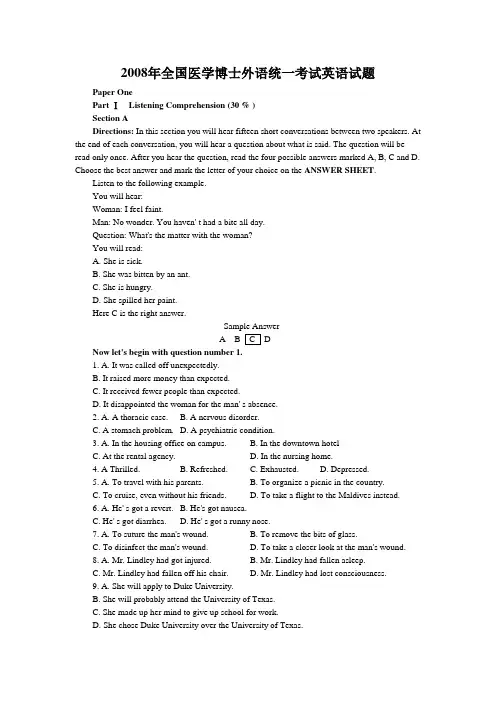
2008年全国医学博士外语统一考试英语试题Paper OnePart ⅠListening Comprehension (30 % )Section ADirections: In this section you will hear fifteen short conversations between two speakers. At the end of each conversation, you will hear a question about what is said. The question will be read only once. After you hear the question, read the four possible answers marked A, B, C and D. Choose the best answer and mark the letter of your choice on the ANSWER SHEET.Listen to the following example.You will hear:Woman: I feel faint.Man: No wonder. You haven' t had a bite all day.Question: What's the matter with the woman?You will read:A. She is sick.B. She was bitten by an ant.C. She is hungry.D. She spilled her paint.Here C is the right answer.Sample AnswerA B DNow let's begin with question number 1.1. A. It was called off unexpectedly.B. It raised more money than expected.C. It received fewer people than expected.D. It disappointed the woman for the man' s absence.2. A. A thoracic case. B. A nervous disorder.C. A stomach problem.D. A psychiatric condition.3. A. In the housing office on campus. B. In the downtown hotelC. At the rental agency.D. In the nursing home.4. A Thrilled. B. Refreshed. C. Exhausted. D. Depressed.5. A. To travel with his parents. B. To organize a picnic in the country.C. To cruise, even without his friends.D. To take a flight to the Maldives instead.6. A. He' s got a revert. B. He's got nausea.C. He' s got diarrhea.D. He' s got a runny nose.7. A. To suture the man's wound. B. To remove the bits of glass.C. To disinfect the man's wound.D. To take a closer look at the man's wound.8. A. Mr. Lindley had got injured. B. Mr. Lindley had fallen asleep.C. Mr. Lindley had fallen off his chair.D. Mr. Lindley had lost consciousness.9. A. She will apply to Duke University.B. She will probably attend the University of Texas.C. She made up her mind to give up school for work.D. She chose Duke University over the University of Texas.10. A. Her boyfriend broke up with her.B. She was almost run over by a truck.C. One of her friends was emotionally hurt.D. She dumped her boyfriend's truck in the river.11. A. The patient will not accept the doctor's recommendation.B. The doctor lost control of the allergic reaction.C. The doctor finds it hard to decide what to do.D. The medicine is not available to the patient.12. A. It was more expensive than the original price. B. It was given to the woman as a gift.C. It was the last article on sale.D. It was a good bargain.13. A. Excited. B. Impatient. C. Indifferent. D. Concerned,14. A. She regrets buying the car. B. The car just arrived yesterday.C. She will certainly not buy the ear.D. This is the car she has been wanting.15. A. He is seriously ill. B. His work is a mess.C. The weather is lousy this week.D. He has been working under pressure.Section BDirections: In this part you will hear three passages. After each one, you will hear five questions. After each question, read the four possible answers marked A, B, C and D. Choose the best answer and mark the letter of your choice on the ANSWER SHEET.Passage One16. A. He has got bowel cancer B. He has got heart disease.C. He has got bone cancer.D. He has got heartburn.17. A. To have a colonoscopy. B. To seek a second opinionC. To be put on chemotherapy.D. To have his bowel removed.18. A. A pretty minor surgery. B. A normal life ahead of him.C. A miracle in his coming years.D. A life without any inconveniences.19. A. Thankful. B. Admiring. C. Resentful. D. Respectful.20. A. It was based on the symptoms the man had described.B. It was prescribed considering possible complications.C. it was given according to the man' s actual condition.D. it was effective because of a proper intervention.Passage Two21. A. Smoking and lung Cancer. B. Lung cancer and the sexes.C. How to quit Smoking.D. How to prevent lung cancer.22. A. Current smokers exclusively. B. Second-hand smokers.C. With a lung problem.D. At age 40 or over.23. A. 156. B. 269. C. 7498. D. 9427.24. A. Smoking is the culprit in causing lung cancerB. Women are more vulnerable in lung cancer than men.C. Women are found to be more addicted to smoking than men.D. When struck by lung cancer, men seem to live longer than women.25. A. Lung cancer can be early detected.B. Lung cancer is deadly but preventable.C. Lung cancer is fatal and unpredictable.D. Smoking affects the lungs of men and women differently.Passage Three26. A. A hobby. B. The whole world.C. A learning experience.D. A career to earn a living.27. A. Her legs were broken.B. Her arms were broken.C. Her shoulders were severely injured.D. Her cervical vertebrae were seriously injured.28. A. She learned a foreign language, B. She learned to make friendsC. She learned to be a teacher.D. She learned living skills.29. A. She worked as skiing coach. B. She was a college instructor.C. She was a social worker in the clinic.D. She worked as elementary school teacher.30. A. Optimistic and hard-bitten. B. Pessimistic and cynical.C. Humorous and funny.D. Kind and reliable.Paper OnePart ⅠListening Comprehension(30%)Section A1. C 根据男士的话Fewer people came than we had expected,可知募捐仪式来的人比预料的少。
医学考博英语 听力原文 历年
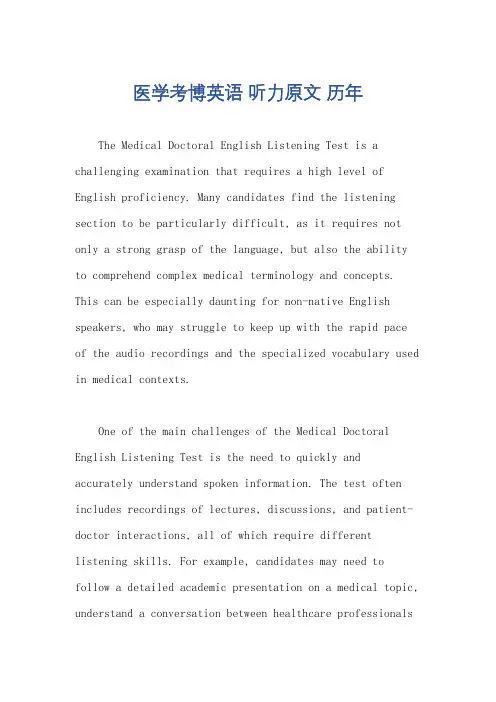
医学考博英语听力原文历年The Medical Doctoral English Listening Test is a challenging examination that requires a high level of English proficiency. Many candidates find the listening section to be particularly difficult, as it requires not only a strong grasp of the language, but also the ability to comprehend complex medical terminology and concepts. This can be especially daunting for non-native English speakers, who may struggle to keep up with the rapid pace of the audio recordings and the specialized vocabulary used in medical contexts.One of the main challenges of the Medical Doctoral English Listening Test is the need to quickly and accurately understand spoken information. The test often includes recordings of lectures, discussions, and patient-doctor interactions, all of which require different listening skills. For example, candidates may need tofollow a detailed academic presentation on a medical topic, understand a conversation between healthcare professionalsdiscussing a patient's condition, or interpret a dialogue between a doctor and a patient. Each of these scenarios demands a different set of listening abilities, including the capacity to identify key points, understand nuanced language, and infer meaning from context.In addition to the linguistic demands of the test, candidates must also possess a strong foundation in medical knowledge and terminology. This is because the listening passages often cover a wide range of medical subjects, from anatomy and physiology to pharmacology and patient care. Understanding the specialized vocabulary and concepts related to these areas is crucial for accurately interpreting the information presented in the audio recordings. For non-native English speakers, this adds an extra layer of complexity to an already challenging task, as they must not only comprehend the English language, but also the medical content being discussed.Furthermore, the time constraints of the test can also pose a significant obstacle for many candidates. The listening section typically consists of a series ofrecordings, each followed by a set of questions that must be answered within a specific time frame. This means that candidates must not only understand the information being presented, but also do so quickly and efficiently in order to have enough time to answer the accompanying questions. For non-native English speakers, who may need extra time to process and comprehend the spoken language, this can be particularly challenging.Another aspect of the Medical Doctoral English Listening Test that many candidates find difficult is the need to maintain focus and concentration throughout the duration of the test. The listening section can be mentally taxing, as candidates are required to listen attentively to detailed and often complex information for an extended period of time. This can be especially challenging for those who struggle with attention or concentration, as well as for non-native English speakers who may find it more difficult to sustain their focus while listening in a second language.Finally, the pressure of the test itself can alsocontribute to the difficulty of the listening section. The Medical Doctoral English Listening Test is a high-stakes examination that can have a significant impact on a candidate's future career prospects. As a result, many candidates experience heightened anxiety and stress during the test, which can negatively affect their ability to perform well, particularly in a challenging section like the listening component. This is especially true for non-native English speakers, who may already feel additional pressure due to the language barrier.In conclusion, the Medical Doctoral English Listening Test presents a range of challenges for candidates, particularly non-native English speakers. From the need to quickly and accurately understand spoken information to the demand for a strong foundation in medical knowledge and terminology, the listening section requires a high level of linguistic and cognitive abilities. Additionally, the time constraints, the need for sustained focus, and the pressure of the test itself can further complicate the listening experience. As such, it is important for candidates to prepare thoroughly for this section of the examination, andto develop strategies for managing the various challenges it presents.。
全国医学博士外语统一考试英语试题参考答案及解析
2008年全国医学博士外语统一考试英语试题参考答案及解析Paper OnePart ⅠListening Comprehension(30%)Section A1. C 根据男士的话Fewer people came than we had expected,可知募捐仪式来的人比预料的少。
2. C 根据男士的话allowing acid content to flow into the esophagus(让酸性物质流进食道)可知这是关于胃的疾病。
3. A 根据女士的话I understand that this office helps students with housing,is that fight 可知这是校园内公寓管理办公室。
4. C 根据文中we've acted for hours,Let's get something to eat,We'd be able to feel better with a little nutrition(我们吃点东西就会好子)可知他们是筋疲力尽了。
5. C 根据文中you and some friends are organizing a cruise to Maldives以及Alone if I have to可知即使是没有朋友,他也会自己一个人去航行。
6. C 根据男士的话I'm afraid to have the runs(恐怕我拉肚子了)以及女士的话Are you going to the toilet often(你经常上厕所吗)可知男士的病是腹泻。
diarrhea腹泻。
revert返祖现象。
nausea恶心。
a running nose流鼻涕。
7. A 根据对话,女士已检查过男士的伤口,并清除了玻璃片,给伤口消过毒,根据女士的话The next thingI should do is to stitch you up可知下一件事是缝合男士的伤口。
2008年高考英语试卷听力+原文+答案(全国卷Ⅰ、Ⅱ)
2008年全国统一高考英语试卷(全国卷I)听力试题第一部分听力(共两节,满分30分)做题时,先将答案标在试卷上,录音结束后,你将有两分钟的时间将试卷上的答案转涂到答题卡上。
第一节(共5小题,每小题1.5分,满分7.5分)听下面5段对话。
每段对话后有一个小题,从题中所给的A、B、C三个选项中选出最佳答案。
听完每段对话后,你都有10秒钟的时间来回答有关小题和阅读下一小题。
每段对话仅读一遍。
例: How much is the shirt?A. £ 19.15.B. £9.18.C. £9.15.答案是C.1. What is the weather like?A. It’s raining.B. It’s cloudy.C. It’s sunny.2. Who will go to China next month?A. Lucy.B. Alice.C. Richard.3. What are the speakers talking about?A. The man’s sister.B. A film.C. An actor.4. Where will the speakers meet?A. In Room 340.B. In Room 314.C. In Room 223.5. Where does the conversation most probably take place?A. In a restaurant.B. In an office.C. At home.第二节(共15小题;每小题1.5分,满分22.5分)听下面5段对话或独白,每段对话或独白后面有几个小题,从题中所给的A、B、C三个选项中选出最佳选项,并标在试卷的相应位置。
听每段对话或独白前,你将有时间阅读各小题,每小题5秒钟;听完后,各小题将给出5秒钟的作答时间。
每段对话或独白读两遍。
听第6段材料,回答第6至8题。
2008年博士生入学考试英语试卷(非英语专业类)
English Test for Doctoral Candidates (A卷)Dec. 28, 2008Part I Listening Comprehension (20%)Section ADirections:In this section, you will hear 10 short conversations. At the end of each conversation, a question will be asked about what was said. Both the conversation and question will be spoken only once. After each question, there will be a pause. During the pause, you must read the four choices marked A, B, C and D, and decide which is the best answer. Then mark the corresponding letter on your Answer Sheet I with a single line through the center.1. A. Touch all his friends.B. Write a lot.C. Have a lot of time.D. Have a lot of friends.2. A. To work for a small company.B. To start a large company.C. To be independent.D. To graduate.3. A. Buy a new car.B. Go to a new store.C. Find a new repair shop.D. Take a different bus.4. A. 36 dollars.B. 15 dollars.C. 12 dollars.D. 4 dollars.5. A. One hour.B. Two hours.C. Three hours.D. Four hours.6. A. Perston's sister is going abroad.B. The man is probably reading a newspaper.C. The news today is very unusual.D. The Prime Minister is warmly welcomed.7. A. She likes Mexican food.B. She expected a better dinner.C. The dinner was expensive.D. She enjoyed the food more than the man did.8. A. 6 hours.B. 1 hour.C. 10 hours.D. 4 hours.9. A. In order to obtain a visa.B. To prove she is a foreign visitor.C. As identification to cash a check.D. The man is an immigration official.10. A. Bus-conductor and passenger.B. Lawyer and client.C. Doctor and patient.D. Teacher and student.Section BDirections: In this section, you will hear 2 short passages. At the end of each passage, you will hear some questions. Both the passage and the questions will be spoken only once. After you hear a question, you must choose the best answer from the four choices marked A, B, C and D, and then mark the corresponding letter on your Answer Sheet I with a single line through the center.Passage 111. A. In 1954.B. In 1953.C. In 1955.D. In 1960.12. A. Adventureland.B. Tomorrowland.C. Fantasyland.D. Mianstreet, U.S.A.13. A. It would take you several days at Disneyland to see everything.B. Adventureland shows the jungles of Asia and Africa.C. Walt Disney World was built in Florida.D. Disneyland is deeply loved by children as well as adults.Passage 214. A. At college level.B. In primary school.C. In high school.D. After they graduate.15. A. The Use of Computers in Education.B. How Computers Are Used in Teaching.C. On Computers.D. Computers and Management.Section CDirections:In this part, you are going to hear a short passage. It will be spoken three times. After you hear the passage, please write a summary of it in about 60 words on your Answer Sheet II.Part II Cloze (10%)Directions:There are 20 blanks in the following passage. For each blank there arefour choices marked A, B, C and D. Then mark the corresponding letter on your Answer Sheet I with a single line through the center.There are many definitions of social movements and revolutions, but they all have some common points. Social movements are organized, 16 attempts by individuals to produce social change. These attempts are usually resisted by powerful people who 17 from the status quo, 18 it is often difficult for social movement participants to use the accepted and 19 means of producing social change (such as the courts and political institutions). 20 , social movement participants often 21 disruptive street their only means of action. The antiwar movement in the 1960s, the 22 Rights Movement that emerged strongly in the 1950s, and the antiabortion movement of the 1980s are all examples of social movement in America that have 23 both legal and illegal activities to 24 their goals. In fairness to social movement participants, 25 , their powerful opponents are just as likely to use illegal activities and violence to 26 the social movement.Although there are 27 over the definition of revolution, there is a 28 view that revolutions are successful social movements on a much grander 29 , that is, involving more people and much more social change. Although social movements like the U.S. Civil Rights Movement may be working to 30 some law or produce some reform in the society, revolutions like the Chinese Revolution are aimed at 31 social change. The goals of revolutions are commonly the overthrow of a government, basic change in the political and economic system, 32 more generally a basic change in the stratification system in the country. Because of the extent of change 33 , revolutions are always accompanied by extensive violence. The 34 are so high that opponents will kill to prevent the revolution, and revolutionaries must be 35 to kill to achieve their goals.16. A. purposeful B. idealized C. empirical D. reciprocal17. A. acquire B. profit C. prohibit D. succeed18. A. and B. but C. because D. though19. A. cultural B. legal C. educational D. industrial20. A. However B. Still C. Thus D. Nevertheless21. A. regard B. find C. treat D. use22. A. Civil B. Liberty C. Humanity D. Privacy23. A. engaged B. involved C. employed D. initiated24. A. achieve B. accelerate C. complete D. strive25. A. moreover B. however C. furthermore D. therefore26. A. stop B. promote C. advocate D. avoid27. A. diversities B. discrepancies C. inconsistencies D. disagreements28. A. conform B. regular C. specified D. standard29. A. level B. scale C. degree D. range30. A. enable B. enact C. enlarge D. envelop31. A. main B. principal C. major D. primary32. A. and B. nor C. also D. or33. A. sought B. aimed C. strove D. endeavored34. A. stakes B. dangers C. odds D. risks35. A. resentful B. ready C. reluctant D. relievedPart III Reading Comprehension (30%)Section ADirections:There are 5 passages in this part. Each passage is followed by some questions or unfinished statements. For each of them there are four choices marked A, B, C and D. You should decide on the best choice and mark the corresponding letter on your Answer Sheet I with a single line through the center.Passage OneWater shortage on Earth? It seems impossible. Images of our planet from outer space show vast oceans, lakes as big as small countries, and wide rivers flowing with incredible volumes. How can there not be enough water? But the fact is that the world is facing the prospect of water shortages caused by population growth, uneven supplies of water, pollution, and other factors. The United Nations (UN) predicts that water shortages could retard the economic growth of some countries and lead to food shortages and, even possibly, to international conflicts.Humans use water for three basic purposes: agriculture, industry, and domestic and municipal use (water for drinking, cooking, cleaning, and so forth). And the amount of water available to each person decreases as the population grows, raising the possibility of water shortages. Water shortages will not come all at once in every part of the world, just as the world's population is unevenly distributed by region, so is the annual supply of renewable water. Rainfall and snowfall are determined by uneven weather patterns and landscape, and as a result, some areas of the world get more precipitation than others. This leads the uneven distribution of water all over the world.Natural water scarcity has prompted many nations to try to increase their water supplies by building dams to catch water that otherwise would escape to the sea, or by sinking more and deeper wells. But these efforts can have negative side effects that can contribute to water scarcity. Instead of building dams, some countries choose to increase their access to groundwater. But this practice increases the risk of overpumping aquifers.Pollution also affects the water supply, reducing the available water by making it toxic or otherwise unfit for human use.Water shortage could also lead to international conflicts as countries compete for limited water resources. Political tensions over water often appear when different nations lay claim to the same river, lake, or aquifer. According to the UN, more than 300 river basins and aquifers worldwide cross national boundaries, creating the potential for conflicts.36. Which of the following is NOT a factor that would cause water shortage?A. Population growth.B. Uneven supplies of water.C. Industrial pollution.D. Global warming.37. Water shortages could lead to all the following EXCEPT _______.A. economic growthB. food shortageC. over-pumping of the underground waterD. international conflicts38. Which of the following statements is NOT TRUE according to the passage?A. Humans use water for crop growing, industrial production and domesticconsuming.B. The annual supply of renewable water is unevenly distributed over the world.C. Pollution can reduce the available water by making it toxic.D. Building dams to catch river water could best solve the problem of watershortages.39. How can water shortages lead to international conflicts?A. Countries cannot agree with each other on water price.B. Countries compete for limited water resources.C. Countries pollute each other's water.D. Countries steal each other's water.40. Which of the following best describe the author's tone in this passage?A. Optimistic.B. Ironic.C. Objective.D. Arbitrary.Passage TwoWhy is stage fright so universal when it does not pose a physical threat?Our ego and self-esteem are threatened, evidently to a significant degree. No normal person wants to look like a fool. Consequently, a speaking situation does involve peril, not physical but psychological. The brain instructs the body to react exactly the way it would at times of physical danger. In essence, the brain tells the body, "get ready to fight off the danger or to run away from it."When the danger signals reach the brain, the brain instructs the adrenal gland (肾上腺) to start secreting (分泌) adrenal fluid into the bloodstream. The adrenal fluid brings about specific bodily reactions.First, our senses become more keen because we will have to rely on them to help us fight or run. Blood goes away from the muscles of the stomach and intestines. The sudden rush of blood from the digestive system causes the sensation known as "butterflies in the stomach." The large muscles of the arms and legs become most important in the "fight or flight" reaction, as they must do the punching and kicking.The extra blood and the oxygen it contains get the muscles so tense that they must function strongly. Our hands shake, our knees knock, and we feel tension in the larger muscles of the body. We experience a dry, cottony mouth, sometimes to the point where good articulation becomes impossible.41. The author's purpose in writing this passage is to describe _______.A. types of physical and psychological dangerB. cures for stage frightC. the biochemistry of the brainD. the physical reaction that might result from state fright42. It can be inferred from the passage that psychological reactions _______.A. are more serious than stage frightB. diminish our ability to speakC. diminish our ability to fightD. cause anxiety43. According to the passage, "butterflies in the stomach" are produced by _______.A. hunger painsB. the egoC. blood leaving the digestive systemD. poor articulation44. The passage mentions all of the following reactions EXCEPT _______.A. tremblingB. tensionC. dryness in the mouthD. blushing45. According to the passage, a speaking situation may result in _______.A. physical perilB. brain damageC. forgetfulnessD. psychological perilPassage ThreeA satellite is usually launched by a rocket. Once the satellite is in orbit, the plane of the orbit is relatively fixed in space. However, as the satellite goes around the earth, the earth spins on its axis beneath it. Thus on each circuit the satellite passes over a different part of the earth's surface.The orbit of a satellite is usually not a circle. During launching, variations from the calculations of elevation, altitude, and speed are impossible to eliminate. The orbit is then elliptical. Scientists deliberately plan for a satellite to enter an elliptical orbit so that it will probe a range of altitudes. An elliptical path can bring a satellite into the upper atmosphere. The friction of the atmosphere on the satellite causes its speed to decrease. It is then drawn closer to the earth, and may be heated ultimately to incandescence (白热,白炽) and be vaporized as it enters the lower portion of the eqarth's atmosphere.A satellite which has been given an initial horizontal speed of 30,000 km/hr orbits about the earth in a circular path at an altitude of about 500 km. If this horizontal speed is raised to 40,000 km/hr, the space vehicle leaves the earth's orbit and goes into orbit around the sun. The velocity at which this happens is called escape velocity. 46. According to the passage, an elliptical orbit may cause the satellite to vaporize dueto _______.A. the vibration of the enginesB. friction with the atmosphereC. the heat of the sunD. the earth spinning on its axis47. According to the passage, which speed will produce an elliptical orbit of a satellitearound the earth?A. 5,000 km/hr.B. 15,000 km/hr.C. 30,000 km/hr.D. 35,000 km/hr.48. The passage states that an elliptical orbit is beneficial because it allows thesatellite to _______.A. probe a range of altitudesB. orbit the sunC. vaporizeD. stay above the same point on earth49. The author's style can best be described as _______.A. argumentativeB. explanatoryC. humorousD. rhetorical50. According to the passage, satellite orbits are usually not circular because _______.A. there is friction in the atmosphereB. the earth spins on its axisC. variations from precise calculations are difficult to eliminateD. too great a speed is needed for circular orbitsPassage FourFor most of us, the work is the central, dominating fact of life. We spend more than half our conscious hours at work, preparing for work, traveling to and from work. What we do there largely determines our standard of living and to a considerable extent the status we are accorded by our fellow citizens as well. It is sometimes said that because leisure has become more important the indignities and injustices of work can be pushed into a corner, that because most work is pretty intolerable, the people who do it should compensate for its boredom, frustrations and humiliations by concentrating their hopes on the other parts of their lives. I reject that as a counsel of despair. For the foreseeable future the material and psychological rewards which work can provide, and the conditions in which work is done, will continue to play a vital part in determining the satisfaction that life can offer. Yet only a small minority can control the pace at which they work or the conditions in which their work is done; only for a small minority does work offer scope for creativity, imagination, or initiative.Inequality at work and in work is still one of the cruelest and most glaring forms of inequality in our society. We cannot hope to solve the more obvious problems of industrial life, many of which arise directly or indirectly from the frustrations createdby inequality at work, unless we tackle it head-on; still less can we hope to create a decent and humane society.The most glaring inequality is that between managers and the rest. For most managers, work is an opportunity and a challenge. Their jobs engage their interest and allow them to develop their abilities. They are constantly learning; they are able to exercise responsibility; they have a considerable degree of control over their own and others' working lives. Most important of all, they have opportunity to initiate. By contrast, for most manual workers, and for a growing number of white-collar workers, work is a boring, dull, even painful experience. They spend all their working lives in conditions which would be regarded as intolerable—for themselves—by those who take the decisions which let such conditions continue. The majority have little control over their work; it provides them with no opportunity for personal development. Often production is so designed that workers are simply part of the technology. In offices, many jobs are so routine that workers justifiably feel themselves to be mere cogs in the bureaucratic machine; as a direct consequence of their work experience, many workers feel alienated from their work and their firm, whether it is in public or in private ownership.51. In the author's opinion, people tend to judge others _______.A. completely by where they workB. absolutely by their amount of moneyC. to a great extent by the type of work they doD. slightly by their amount of money52. Why does the author take for a counsel of despair the opinion that workers shouldturn their attention from intolerable work to other parts of life?A. Because work is the sole focus of people's life.B. Because work has always been important in deciding the satisfaction in life.C. Because people are not interested in other parts of life.D. Because other parts of life are similarly intolerable.53. What may be the cause of the more obvious problems of industrial life?A. The frustrations in other parts of life.B. The frustrations resulting from inequality at work.C. The indecency and inhumanity of society.D. The cruelty of most managers.54. What does work mean to most managers and workers respectively?A. Work means opportunity and challenge to both managers and workers.B. Work means responsibility to workers only and control to managers.C. Work means a monotonous experience to both workers and managers.D. Work may be intolerable to workers and challenging to managers.55. Why do many workers feel alienated from their work?A. Because they have no control over their work.B. Because they feel themselves to be mere cogs in the bureaucratic machine.C. Because they are considered part of the technology.D. Because they spend most of their life working hard.Passage FiveUntil recently, hunting for treasure from shipwrecks was mostly fantasy; but with recent technological advances, the search for sunken treasure is becoming more popular as a legitimate endeavor. One team of salvagers has searched the wreck of the RMS Republic, which sank in 1909, 55 miles southeast of Boston harbor. The search party, using side-scan sonar, a device which projects sound waves across the ocean bottom and produces a profile of the sea floor, located the wreck in just two-and-a-half days. Before the use of this new technology, searches could take months or years. The team of 45 divers searched the wreck for two months, finding silver tea services, crystal dinnerware, and thousands of bottles of wine; but they did not find the five-an-a-half tons of American Gold Eagle coins they were searching for. Whether or not the team finds the gold, their mission has already sparked more debate between preservationists and treasure hunters over the spoils.While a shipwreck's treasure may not have a high monetary value, it can be an invaluable source of historic artifacts preserved in nearly mint condition. Maritime archaeologists worry that the success of salvagers will attract more treasure-hunting expeditions and thus threaten remaining, undiscovered wrecks. Once a salvage team has scoured a site, much of the archaeological value is lost. Preservationists are lobbying their state lawmakers to legally restrict underwater searches and unregulated salvages. On the other hand, the treasure hunters argue that without the lure of gold and million-dollar treasures, the wrecks and their historical artifacts would never be recovered.56. What is the main ideal of this passage?A. Searching for wrecks is now much easier due to new technologies like side-scan sonar.B. Maritime archaeologists are concerned over the unregulated searching ofwrecks.C. The search of the RMS Republic is causing further debate betweenpreservatinists and salvagers over searching wrecks.D. Treasure hunting on underwater wrecks threatens the archaeological value ofthe site.57. The word "sunken" in line 2 is closest in meaning to which of the following words?A. Broken.B. Underwater.C. Ancient.D. Hollow.58. The second paragraph is an example of _______.A. chronological orderB. explanationC. specific to generalD. definition59. What enabled the search team to find the RMS Republic quickly?A. Sea floor profiles.B. A team of 45 divers.C. Side-scan sonar.D. Sound waves.60. Which of the following people would most likely be a preservationist?A. A treasure-hunter.B. A diver.C. A lawmaker.D. A maritime archaeologist.Section BDirections:In this section, there is a short passage with five questions or incomplete statements. Read the passage carefully. Then answer the questions or complete the statements in the fewest possible words. Put your answer on your Answer Sheet II.People can be addicted (上瘾的) to different things, e.g. alcohol, drugs, certain foods, or even television. People who have such an addiction are compulsive; i.e., they have a very powerful psychological need that they feel they must satisfy. According to psychologists, many people are compulsive spenders; they feel that they must spend money. This compulsion, like most others, is irrational—impossible to explain reasonably. For compulsive spenders who buy on credit, charge accounts are even more exciting than money. Their pleasure in spending enormous amounts is actually greater than the pleasure that they get from the things they buy.There is even a special psychology of bargain hunting. To save money, of course, most people look for sales, low prices, and discounts. Compulsive bargain hunters, however, often buy things that they don't need just because they are cheap. They want to believe that they are helping their budgets, but they are really playing an exciting game. When they can buy something for less than other people, they feel that they are winning. Most people, experts claim, have two reasons for their behavior: a good reason for the things that they do and the real reason.It is not only scientists, of course, who understand the psychology of spending habits, but also business people. Stores, companies, and advertisers use psychology to increase business: they consider people's needs for love, power, or influence, their basic value, their beliefs and opinions, and so on in their advertising and sales methods.Psychologists often use a method called "behavior therapy" to help individuals solve their personality problems. In the same way, they can help people who feel that they have problems with money.1. Compulsive spenders get more pleasure in _______.2. Most people look for sales and discounts because _______.3. The problem with compulsive bargain hunters is that _______.4. Companies and advertisers often make use of comsumers' psychology to _______.5. What's the main idea of this passage?Part IV Translation (20%)Section ADirections: Put the following into Chinese and write your Chinese version on your Answer Sheet II.Equality between women and men is no longer a negotiable issue. As long as women remain unequal they can't have access to resources, they can never participate in political decision-making, they can't make their own choices in life. That is the bottom line. Women around the world are all concerned about equality. In developing countries, in states emerging as industrial powers, in the countries of the West, women are looking for action, action they sometimes call a revolution. [选自《新世纪博士生综合英语》Unit 1, Exercise Section 3 Translation I]Women's health needs have in the past often been overlooked, or assumed to be the same as men's. At the Cairo conference last year it was agreed that the consequence of unsafe abortions is part of overall health care. The public has to recognize that women have specific health needs which must be understood, and that women must have full access to adequate health-care services. [选自《新世纪博士生综合英语》Unit 1, Exercise Section 3 Translation II-6]Section BDirections:Put the following into English and write your English version on your Answer Sheet II.1993年国家对五万名初、高中生进行的调查显示中学生中吸食大麻的人数明显上升。
2008年全国统一高考英语试卷听力+原文+答案(全国卷Ⅰ、Ⅱ)
2008年全国统一高考英语试卷(全国卷I)听力试题第一部分听力(共两节,满分30分)做题时,先将答案标在试卷上,录音结束后,你将有两分钟的时间将试卷上的答案转涂到答题卡上。
第一节(共5小题,每小题1.5分,满分7.5分)听下面5段对话。
每段对话后有一个小题,从题中所给的A、B、C三个选项中选出最佳答案。
听完每段对话后,你都有10秒钟的时间来回答有关小题和阅读下一小题。
每段对话仅读一遍。
例: How much is the shirt?A. £ 19.15.B. £9.18.C. £9.15.答案是C.1. What is the weather like?A. It’s raining.B. It’s cloudy.C. It’s sunny.2. Who will go to China next month?A. Lucy.B. Alice.C. Richard.3. What are the speakers talking about?A. The man’s sister.B. A film.C. An actor.4. Where will the speakers meet?A. In Room 340.B. In Room 314.C. In Room 223.5. Where does the conversation most probably take place?A. In a restaurant.B. In an office.C. At home.第二节(共15小题;每小题1.5分,满分22.5分)听下面5段对话或独白,每段对话或独白后面有几个小题,从题中所给的A、B、C三个选项中选出最佳选项,并标在试卷的相应位置。
听每段对话或独白前,你将有时间阅读各小题,每小题5秒钟;听完后,各小题将给出5秒钟的作答时间。
每段对话或独白读两遍。
听第6段材料,回答第6至8题。