
一般现在时、一般过去时、现在进行时、一般将来时语法讲练
一般现在时、一般过去时、现在进行时、一般将来时语法讲练
1 / 12
__________________________________________________________________________________
__________________________________________________________________________________
熟练掌握四种时态
一般现在时态
一般现在时: 表示现阶段经常或习惯性发生的动作或存在的状态,或说明主语的特征。
1)常用时间状语:often 经常,usually通常,always 总是,every每个,sometimes 有时,at …在几点钟, once / twice a week 一周一次/两次
They go to the Palace Museum once a year. 他们每年去一次故宫。
They often discuss business in the evening . 他们经常在晚上谈生意。
2)表示客观真理,事实,人得技能或存在的状态。 如:
The earth goes around the sun. 地球绕着太阳转。
3)表示十分确定会发生(或安排好的事情)或按照时间表进行的事情,用一般现在表示将来,句子中可以有表示将来的时间状语。如:
The train for Hankou leaves at 8:00 in the morning.
去往汉口的列车上午8点开。
现在进行时 . 一般现在时、一般过去时、现在进行时、一般将来时语法讲练
2 / 12 现在进行时的定义:现在进行时表示现在或当前一般时间正在进行的动作.可以表示有计划的未来.
现在进行时的基本用法:
A. 表示现在( 指说话人说话时) 正在发生的事情.
例:We are waiting for you.
B. 习惯进行:表示长期的或重复性的动作,说话时动作未必正在进行.
例:Mr. Green is writing another novel.
(说话时并未在写,只处于写作的状态.)
例:She is learning piano under Mr. Smith.
C.已经确定或安排好的将来活动
I'm leaving for a trek in Nepal next week.(已经安排了)
we're flying to Paris tomorrow.(票已经拿到了)
【No. 1】现在进行时的应用
在实际运用时,现在进行时常用以下几种情况:
(1)当句子中有now时,常表示动作正在进行,这时要用现在进行时.如:
They are playing basketball now.现在他们正在打篮球.
(2)以look, listen开头的句子,提示我们动作正进行,这时要用现在进行时.如:
Listen!She is singing an English song.听,她正在唱英语歌.
(3)表示当前一段时间或现阶段正在进行的动作,且此时有this week, these days等时间状语,这时常用现在进行时.如:
We are making model planes these days.这些天我们在做飞机模型.
(4)描述图片中的人物的动作,也为了表达更生动.此时也常用现在进行时.如:
Look at the picture. The children are flying kites in the park.看这幅图,那些孩子正在公园放风筝.
一般将来时态
一般将来时:表示在将来某个时间要发生的动作或存在的状态。
一般将来时的基本用法:
1. 表示“纯粹的将来”:
①表示将要发生的动作或情况,常带有表示将来的时间状语,如 tomorrow, next week, in two days,
from now on 等。如: It will be fine tomorrow. 明天天气晴朗。
②表示预料将要发生的动作或情况。如:
You will feel better after having this medicine.
吃了这药,你就会感觉好些的。
③表示由于习惯倾向而会经常发生的动作,本用法中的 will 要重读。如:
Boys will be boys. 〔谚语〕男孩毕竟是男孩。
2. 表示“带有情态意义的将来”,用来表示意图,用 will 来表示。如: I will be more careful next time.
下次我要更加小心。
I won't go shopping this afternoon, but she will.
今天下午我不想去购物,但她想去。
一般将来时的其它几种表示法:
1. 用 be going to 表示:
be going to 相当于一个助动词,与其后的动词原形一起构成句子的谓语,表示近期将要发生的动作或存在的状态。
如: I'm going to see a film this afternoon. 今天下午我想去看电影。 一般现在时、一般过去时、现在进行时、一般将来时语法讲练
3 / 12 ①“ be going to +动词原形”表示主观上打算在将来某个时间要做某事。如: Her mother is going to
buy her a new bike. 她妈妈要给她买辆新自行车。
②“ be going to +动词原形”还可以表示说话人根据已有的迹象认为将要发生的事。如: It's going to
rain. 快要下雨了。
2. 用一般现在时表示将来意义
句中的动词是一般现在时,但所表示的意义却是一般将来时。如: Are you free tomorrow? = Are you
going to be free tomorrow? 你明天有空吗?
在时间 / 条件状语从句中,如果主句是一般将来时,从句习惯上用一般现在时表示将来的意义。如:
Please tell him to go when he comes. 他来时,就让他去。
3. 用位置移动的行为动词的现在进行时表示将来意义:
这些动词有 come, go, leave, begin, arrive, start 等。如:
We are leaving tomorrow 。我们明天要走了
一般动词的过去时
一般过去时: 表示过去某时发生的动作或存在的状态,这种动作或状态可能是一次性的,也可能是经常发生的。
1) 表示过去某一具体时刻发生的一次性动作时, 时间状语有:at six yesterday morning , at eight this
morning 等以及when 引导的时间状语从句。 如:
I got up at 6:00 this morning. 我今天早上6点钟起床。
2) 表示过去一段时间内不知何时发生的一次性动作,时间状语有: yesterday, last ...( year / week) ,
in 1998 等。 如:
He came to our city in 2000. 他2000年来到我们市。
3) 表示过去某一阶段经常发生的事情时。如:
Mr Jackson usually went to evening schools when he was young .
杰克逊先生在年轻的时候经常去上夜校。
4)讲故事,回忆过去经历的,讲述双方都明白的过去的事情等时一般用过去时,而且经常省略时间状语。如:
I happened to meet Lucy in the street . 我碰巧在街上遇见了露西。
1. I have been to Shanghai . I _______ there last month .
A. go B. went
C. have gone D. will go
2. -May I speak to the headmaster?
- He _____ a meeting now . Can I take a message ? 一般现在时、一般过去时、现在进行时、一般将来时语法讲练
4 / 12 A. is having B. had
C. has D. will have
3. I ______ TV when you phoned me last night .
A. watch B. will watch
C. was watching D. watches
4. My sister ______ dancing while I am good at ______ the piano .
A. like, play B. likes, plays
C. likes, playing D.like, playing
5. It’s going to _______ . Don’t forget to take an umbrella .
A. rain B. raining
C. to rain D. rained
解析:
1. 本题考查一般过去式的用法。 由last month 可知用一般过去式,故选B。
2. 本题考查现在进行时用法,一结合本题场景及now可知,他现在正在开会,故选A。
3. 本题考查过去进行时, 由last night可知用过去式,结合本题场景,你给我打电话时,我正在看电视,故为过去进行时,故选C。
4. 本题考查一般现在时动词三单形式,及 固定搭配, be good at doing sth ,擅长做某事,.故选C。
5. 本题考查一般将来时态,be going to 后加动词原形。故选A。
基础演练
用所给词的正确形式填空。
A
1. Tom always ______( get ) up at seven in the morning .
2. Lynn seldom _______ ( play ) the guitar because she is good at _______ ( dance )
3. Listen ! Who is _______ ( sing ) in the classroom ? 4. The pen ________ ( look ) nice .
一般现在时、现在进行时、一般过去时及一般将来时四种时态语言点归纳总结
1 一般现在时、现在进行时与一般过去时三种时态的比较及一般将来时态
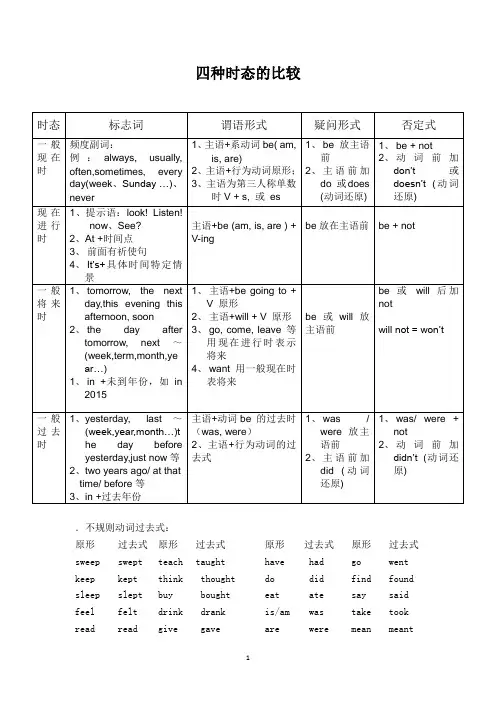
我们在学习英语时,经常要提到一般现在时、现在进行时和一般过去时等,它们都是指谓语动词的时态。什么是时态呢?在英语中,表示不同时间发生的动作或存在的状态,需用不同的动词形式,这种不同的动词形式称为时态。我们也可以简单地理解为:“时”就是谓语动词所发生的时间,“态”就是谓语动词所用的形态。在汉语中不管动作是什么时候发生的,动词形式基本上没有什么变化,例如:1、我经常打篮球。2、我正在打篮球。3、我昨天下午打篮球。在这三句话中,虽然动作发生的时间不相同,但用的是相同的动词“打”。他们对应的英语却是:1、I often play basketball. 2、I am playing basketball now.
3、I played basketball yesterday afternoon.在这三句话中,虽然动作都是“打”,但这些动作发生的时间不同,第一句说的是经常的或习惯性的动作,属于一般现在时,所以谓语动词用原形play,第二句说的是现在正在进行的动作,属于现在进行时,所以谓语动词用助动词am和现在分词playing.第三句说的动作是发生在昨天下午,属于一般过去时,所以谓语动词用过去时形式played.因此,当我们用英语说每一句话的时候,我们首先要考虑时态问题,谓语动词要用适当的时态形式。
一、三种时态所表示的意义不同:
1、一般现在时表示现在的状态。如:She is at home. 她现在在家。 2 一般现在时也表示经常的或习惯性的动作。如:He often plays
basketball.他时常打篮球。
2、现在进行时表示现在进行时表示现在(说话瞬间)正在进行或发生的动作。
如:He is playing basketball now.他正在打篮球。
3、一般过去时表示表示过去某个时间存在的状态。
如:She was at home yesterday.她昨天在家。
(完整版)小学一般现在时-过去式-现在进行时-将来时讲解
1
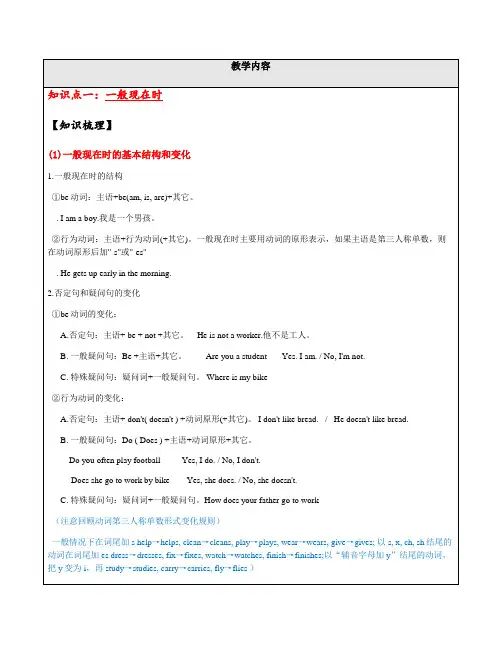
四种时态的比较
时态 标志词 谓语形式 疑问形式 否定式
一般现在时 频度副词:
例:always, usually,
often,sometimes, every
day(week、Sunday …)、never 1、主语+系动词be( am,
is, are)
2、主语+行为动词原形;
3、主语为第三人称单数时V + s, 或 es 1、 be 放主语前
2、 主语前加do 或does
(动词还原) 1、 be + not
2、 动词前加
don’t 或doesn’t (动词还原)
现在进行时 1、提示语:look! Listen!
now、See?
2、At +时间点
3、 前面有祈使句
4、 It’s+具体时间特定情景
主语+be (am, is, are ) +
V-ing
be放在主语前
be + not
一般将来时 1、 tomorrow, the next
day,this evening this
afternoon, soon
2、 the day after
tomorrow, next ~(week,term,month,year…)
1、 in +未到年份,如in
2015 1、 主语+be going to +
V 原形
2、 主语+will + V 原形
3、 go, come, leave 等用现在进行时表示将来
4、 want 用一般现在时表将来
be 或will 放主语前 be 或 will 后加
not
will not = won’t
一般过去时 1、yesterday, last~
(week,year,month…)the day before
yesterday,just now等
2、two years ago/ at that
time/ before等
3、in +过去年份 主语+动词be 的过去时(was, were)
2、主语+行为动词的过去式 1、 was /
一般现在时一般过去时一般将来时
教学内容
知识点一:一般现在时
【知识梳理】
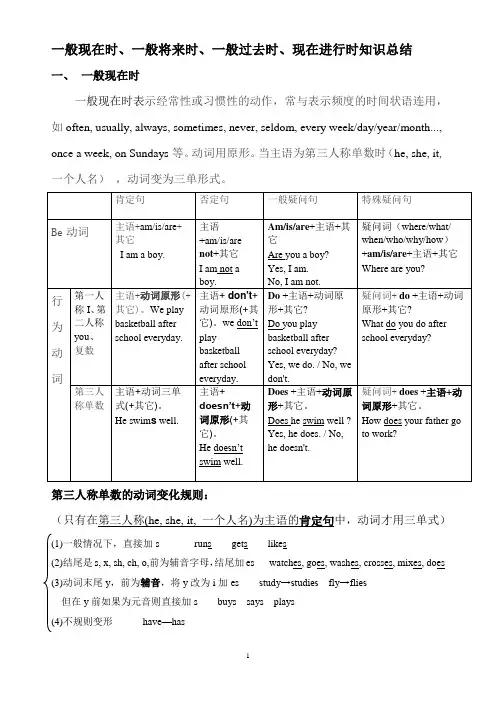
(1)一般现在时的基本结构和变化
1.一般现在时的结构
①be动词:主语+be(am, is, are)+其它。
. I am a boy.我是一个男孩。
②行为动词:主语+行为动词(+其它)。一般现在时主要用动词的原形表示,如果主语是第三人称单数,则在动词原形后加"-s"或"-es"
. He gets up early in the morning.
2.否定句和疑问句的变化
①be动词的变化:
A.否定句:主语+ be + not +其它。 He is not a worker.他不是工人。
B. 一般疑问句:Be +主语+其它。 ---Are you a student ---Yes. I am. / No, I'm not.
C. 特殊疑问句:疑问词+一般疑问句。 Where is my bike
②行为动词的变化:
A.否定句:主语+ don't( doesn't ) +动词原形(+其它)。 I don't like bread. / He doesn't like bread.
B. 一般疑问句:Do ( Does ) +主语+动词原形+其它。
---Do you often play football --- Yes, I do. / No, I don't.
--- Does she go to work by bike --- Yes, she does. / No, she doesn't.
C. 特殊疑问句:疑问词+一般疑问句。How does your father go to work
(注意回顾动词第三人称单数形式变化规则)
一般情况下在词尾加s help→helps, clean→cleans, play→plays, wear→wears, give→gives; 以s, x, ch, sh结尾的动词在词尾加es dress→dresses, fix→fixes, watch→watches, finish→finishes;以“辅音字母加y”结尾的动词,把y变为i,再study→studies, carry→carries, fly→flies ) (2)一般现在时的用法
一般现在时、现在进行时、一般将来时、一般过去时知识点总结
1 一般现在时、一般将来时、一般过去时、现在进行时知识总结
一、 一般现在时
一般现在时表示经常性或习惯性的动作,常与表示频度的时间状语连用,如often, usually, always, sometimes, never, seldom, every week/day/year/month...,
once a week, on Sundays等。动词用原形。当主语为第三人称单数时(he, she, it,
一个人名) ,动词变为三单形式。
肯定句 否定句 一般疑问句 特殊疑问句
Be动词 主语+am/is/are+其它
I am a boy. 主语+am/is/are
not+其它
I am not a
boy.
Am/is/are+主语+其它
Are you a boy?
Yes, I am.
No, I am not. 疑问词(where/what/
when/who/why/how)+am/is/are+主语+其它
Where are you?
行为动词 第一人称I、第二人称you、
复数 主语+动词原形(+其它)。We play
basketball after
school everyday. 主语+ don't+动词原形(+其它)。we don’t
play
basketball
after school
everyday. Do +主语+动词原形+其它?
Do you play
basketball after
school everyday?
Yes, we do. / No, we
don't. 疑问词+ do +主语+动词原形+其它?
What do you do after
school everyday?
第三人称单数 主语+动词三单式(+其它)。
He swims well.
主语+
doesn’t+动词原形(+其它)。
He doesn’t
语法:1-3一般现在时、过去时、将来时讲析与练习

奥鹏个性化辅导初中英语讲义
1 1.一般现在时态及第三人称单数(do/does)
第三人称单数问题
一般现在时中,当主语是第三人称单数时,即常在动词原形后加-s或-es。
第三人称单数变化,现归纳总结如下:
1.人称代词he, she, it是第三人称单数。如:
He likes watching TV.他喜欢看电视。
She has lunch at twelve.她十二点吃午餐。
It looks like a cat.它看起来像只猫。
2.单个人名、地名或称呼作主语;用第三人称单数。如:
①Han Mei looks like her mother.韩梅看起来像她的母亲。
②Beijing is in China.北京在中国。
③Uncle Wang often makes cakes.王叔叔经常做蛋糕。
3.单数可数名词或"this / that / the/ a +单数可数名词"作主语时,是第三人称单数。如:
①A horse is a useful animal.马是有用的动物。 ②This book is yours.这本书是你的。
③That car is red.那辆小汽车是红色的。 ④The cat is Lucy's.这只猫是露茜的。
4.不定代词someone, somebody, nobody, everything, something等及指示代词this, that作主语时,第三人称单数。
①Everyone is here.大家到齐了。 ②There is something wrong with the
watch.这块手表有毛病。
③This is a pen.这是一支钢笔。 ④That is an eraser.那是一块橡皮擦。
5.不可数名词作主语时为第三人称单数。如: ①The milk is in the glass. ②The
bread is very small.
六年级英语语法之一般现在时、过去时、将来时,现在进行时
六年级英语语法之⼀般现在时、过去时、将来时,现在进⾏时
1. ⼀般现在时
(1)⼀般现在时中的be动词:⼀般⽤原形:am is are。am⽤于第⼀⼈称单数(I);is⽤于第三⼈称单数(he she it和其他⼈名或称谓,如:Ben hissister等);are⽤于第⼆⼈称单数(you)和所有复数(包括第⼀⼈称复数we、第⼆⼈称复数you;第三⼈称复数they和其他复数,如the children 、 his parents等)。
例如:I am a boy 。She is a good student。
You are the best。
They are aplle,pear and banana。
(2)⼀般现在时中的动词:
①主语是第三⼈称单数(he she it 和其他,如Helen 、her cousin 等),动词后⼀般加s或es。
例如:She goes to school from Monday to Friday。He likes to play basketball。
②主语不是第三⼈称单数,动词都⽤原形。
例如:I like milk。They do homework together。
注意:⼀般现在时判断依据:
①be动词是am、is、are;
②动词⽤原形或加s、es;
③没有时间状语或有usually、often、everyday、sometimes等不是具体的时间;
2、⼀般过去时
(1)⼀般过去时中的be动词:
⼀般⽤过去式:was werewas⽤于第⼀⼈称单数(I)和第三⼈称单数(he she it和其他⼈名或称谓,如:Ben 、 hissister等);were⽤于第⼆⼈称单数(you)和所有复数(包括第⼀⼈称复数we、第⼆⼈称复数you;第三⼈称复数they和其他复数,如the children 、 his parents等)。
例如:I was at school just now。They were on the farm a moment ago。
一般现在时现在进行时一般将来时一般过去时知识点总结
一般现在时现在进行时一般将来时一般过去时知识点总结
一般现在时、一般将来时、一般过去时、现在进行时知识总结一、一般现在时
一般现在时表示经常性或惯性的动作,常与表示频度的时间状语连用,如often, usually, always, sometimes, never, seldom,
every week/day/year/month...,once a week, on Sundays等。动词用原形。当主语为第三人称单数时(he, she, it,一个人名),动词变为三单形式。
Be动词
肯定句
主语+am/is/are+
其它
I am a boy.
否定句一般疑问句
Am/is/are+主语+其
它 Are you a boy?
Yes, I am.
No, I am not.
Do+主语+动词原
形+其它?
Do you play
basketball after
school everyday?
Yes, we do. / No, we
don't.
Does+主语+动词原
形+其它。
Does he swim well ?
Yes, he does. / No,
XXX't.
非凡疑问句
疑问词(where/what/
when/who/why/how)
+am/is/are+主语+别的
Where are you? 疑问词+do+主语+动词
真相+别的?
What do you do after
school everyday?
主语
+am/is/are
not+别的
I am not a
XXX.
第一人主语+动词原形(+主语+don't+
行
称I、第其它)。We play动词原形(+其
它)。wedon’t
为
二人称basketball after
you、XXX.play
basketball动复数
after school XXX.词
第三人主语+动词三单主语+
称单数式(+别的)。doesn’t+动
初中英语语法总结动词的六种时态
初中英语语法总结动词的六种时态
动词有六种时态:一般现在时、一般过去时、一般将来时、现在进行时、过去进行时和将来进行时。
1. 一般现在时(Simple Present Tense):表示目前的状态、习惯、经常发生的事情或普遍真理。
-肯定句:主语+动词原形(第三人称单数形式加-s)
- 否定句:主语+do(does)+not+动词原形
- 疑问句:Do(Does)+主语+动词原形?
2. 一般过去时(Simple Past Tense):表示过去发生的动作或状态。
-肯定句:主语+动词过去式
- 否定句:主语+did+not+动词原形
- 疑问句:Did+主语+动词原形?
3. 一般将来时(Simple Future Tense):表示将来要发生的动作或情况。
- 肯定句:主语+will+动词原形
- 否定句:主语+will+not+动词原形
- 疑问句:Will+主语+动词原形?
4. 现在进行时(Present Continuous Tense):表示当前正在进行的动作或情况。
- 肯定句:主语+am/is/are+动词-ing形式 - 否定句:主语+am/is/are+not+动词-ing形式
- 疑问句:Am/Is/Are+主语+动词-ing形式?
5. 过去进行时(Past Continuous Tense):表示过去一些时间点正在进行的动作或情况。
- 肯定句:主语+was/were+动词-ing形式
- 否定句:主语+was/were+not+动词-ing形式
- 疑问句:Was/Were+主语+动词-ing形式?
6. 将来进行时(Future Continuous Tense):表示将来一些时间点会继续进行的动作或情况。
- 肯定句:主语+will be+动词-ing形式
- 否定句:主语+will not be+动词-ing形式
- 疑问句:Will+主语+be+动词-ing形式?
时态混合:一般现在、一般过去和一般将来时、现在进行时(学生版)
1
知识图谱
一般现在时
知识精讲
一、一般现在时
表示通常性、规律性、习惯性、真理性的状态或者动作有时间规律发生的事件的一种时间状态。
二、句子结构
主语(第一/二人称/第三人称复数)+do (动词原形)
主语(第三人称单数)+does (动词三单形式)
主语+am/ is /are
三、基本用法
用法 示例
表示经常性或习惯性的动作 We get up at six every morning.
我们每天早上六点钟起床。
表示现在的状态、能力、性格 Mr. Wang writes good English but he doesn’t speak well.
王先生的英文写得很好但他说不好。
表示格言或警句 Pride goes before a fall.
2 骄者必败。
表示永恒的客观真理 The earth moves around the sun.
地球绕着太阳转。
四、时间状语
1. 表示频率的副词: always, usually, often, sometimes, never, hardly, seldom…
2. every/once+名词: every day/ week/ year, once a week/ month …
3. 表示时间的短语: twice a day, on weekends, on Mondays…
(完整版)一般将来时、一般现在时、一般过去时、正在进行时练习题
(完满版)一般将来时、一般现在时、一般过去时、正在进行时练习题
一般现在时、一般过去时、现在进行时、一般将来时 专题训练一、单项选择
( )1. Look at these clouds, it _______________
A. will be raining B. is going to rain C. rains D. is to rain
( )2. If you don ’ t mind, I __________ off the TV set.
A. will turn B. am turning C. would turn D. had turned
( )3. Shall I call a taxi for you?
No, thanks. __________ one myself
A. I call B. I ’ll callC. I ’d callD. I called
( ) 4. She ________ him a lovely dog on his next birthday.
A. gives B. gave C. will giving D. is going to give
( ) 5. He ________ in four days.
A. coming back B. came back
C. will come back D. is going to coming back
( ) 6. We ________ the homework this way next time.
A. do B. will do C. going to do D. will doing
( ) 7. Tomorrow he ________ a kite, and then ________ boating.
A. will fly; will go B. will fly; goes