
一般现在时、一般过去时、现在进行时、一般将来时语法讲练
_________________________________________ ___________________________________________________________________________________________________________________________熟练掌握四种时态一般现在时态一般现在时: 表示现阶段经常或习惯性发生的动作或存在的状态,或说明主语的特征。
1)常用时间状语:often 经常,usually通常,always 总是,every每个,sometimes 有时,at …在几点钟,once / twice a week 一周一次/两次They go to the Palace Museum once a year. 他们每年去一次故宫。
They often discuss business in the evening . 他们经常在晚上谈生意。
2)表示客观真理,事实,人得技能或存在的状态。
如:The earth goes around the sun. 地球绕着太阳转。
3)表示十分确定会发生(或安排好的事情)或按照时间表进行的事情,用一般现在表示将来,句子中可以有表示将来的时间状语。
如:The train for Hankou leaves at 8:00 in the morning.去往汉口的列车上午8点开。
现在进行时.现在进行时的定义:现在进行时表示现在或当前一般时间正在进行的动作.可以表示有计划的未来. 现在进行时的基本用法:A. 表示现在( 指说话人说话时) 正在发生的事情.例:We are waiting for you.B. 习惯进行:表示长期的或重复性的动作,说话时动作未必正在进行.例:Mr. Green is writing another novel.(说话时并未在写,只处于写作的状态.)例:She is learning piano under Mr. Smith.C.已经确定或安排好的将来活动I'm leaving for a trek in Nepal next week.(已经安排了)we're flying to Paris tomorrow.(票已经拿到了)【No. 1】现在进行时的应用在实际运用时,现在进行时常用以下几种情况:(1)当句子中有now时,常表示动作正在进行,这时要用现在进行时.如:They are playing basketball now.现在他们正在打篮球.(2)以look,listen开头的句子,提示我们动作正进行,这时要用现在进行时.如:Listen!She is singing an English song.听,她正在唱英语歌.(3)表示当前一段时间或现阶段正在进行的动作,且此时有this week,these days等时间状语,这时常用现在进行时.如:We are making model planes these days.这些天我们在做飞机模型.(4)描述图片中的人物的动作,也为了表达更生动.此时也常用现在进行时.如:Look at the picture. The children are flying kites in the park.看这幅图,那些孩子正在公园放风筝.一般将来时态一般将来时:表示在将来某个时间要发生的动作或存在的状态。
一般将来时的基本用法:1. 表示“纯粹的将来”:①表示将要发生的动作或情况,常带有表示将来的时间状语,如tomorrow,next week,in two days,from now on 等。
如:It will be fine tomorrow. 明天天气晴朗。
①表示预料将要发生的动作或情况。
如:You will feel better after having this medicine.吃了这药,你就会感觉好些的。
①表示由于习惯倾向而会经常发生的动作,本用法中的will 要重读。
如:Boys will be boys. 〔谚语〕男孩毕竟是男孩。
2. 表示“带有情态意义的将来”,用来表示意图,用will 来表示。
如:I will be more careful next time. 下次我要更加小心。
I won't go shopping this afternoon,but she will.今天下午我不想去购物,但她想去。
一般将来时的其它几种表示法:1. 用be going to 表示:be going to 相当于一个助动词,与其后的动词原形一起构成句子的谓语,表示近期将要发生的动作或存在的状态。
如:I'm going to see a film this afternoon. 今天下午我想去看电影。
①“ be going to +动词原形”表示主观上打算在将来某个时间要做某事。
如:Her mother is going to buy her a new bike. 她妈妈要给她买辆新自行车。
①“ be going to +动词原形”还可以表示说话人根据已有的迹象认为将要发生的事。
如:It's going to rain. 快要下雨了。
2. 用一般现在时表示将来意义句中的动词是一般现在时,但所表示的意义却是一般将来时。
如:Are you free tomorrow? =Are you going to be free tomorrow? 你明天有空吗?在时间/ 条件状语从句中,如果主句是一般将来时,从句习惯上用一般现在时表示将来的意义。
如:Please tell him to go when he comes. 他来时,就让他去。
3. 用位置移动的行为动词的现在进行时表示将来意义:这些动词有come,go,leave,begin,arrive,start 等。
如:We are leaving tomorrow 。
我们明天要走了一般动词的过去时一般过去时:表示过去某时发生的动作或存在的状态,这种动作或状态可能是一次性的,也可能是经常发生的。
1)表示过去某一具体时刻发生的一次性动作时,时间状语有:at six yesterday morning ,at eight this morning 等以及when 引导的时间状语从句。
如:I got up at 6:00 this morning. 我今天早上6点钟起床。
2)表示过去一段时间内不知何时发生的一次性动作,时间状语有:yesterday,last ...( year / week) ,in 2019 等。
如:He came to our city in 2019. 他2019年来到我们市。
3)表示过去某一阶段经常发生的事情时。
如:Mr Jackson usually went to evening schools when he was young .杰克逊先生在年轻的时候经常去上夜校。
4)讲故事,回忆过去经历的,讲述双方都明白的过去的事情等时一般用过去时,而且经常省略时间状语。
如:I happened to meet Lucy in the street . 我碰巧在街上遇见了露西。
1.I have been to Shanghai . I _______ there last month .A. goB. wentC. have goneD. will go2.-May I speak to the headmaster?- He _____ a meeting now . Can I take a message ?A. is havingB. hadC. hasD. will have3.I ______ TV when you phoned me last night .A. watchB. will watchC. was watchingD. watches4.My sister ______ dancing while I am good at ______ the piano .A. like,playB. likes,playsC. likes,playingD.like,playing5.It’s going to _______ . Don’t forget to take an umbrella .A. rainB. rainingC. to rainD. rained解析:1.本题考查一般过去式的用法。
由last month 可知用一般过去式,故选B。
2.本题考查现在进行时用法,一结合本题场景及now可知,他现在正在开会,故选A。
3.本题考查过去进行时,由last night可知用过去式,结合本题场景,你给我打电话时,我正在看电视,故为过去进行时,故选C。
4.本题考查一般现在时动词三单形式,及固定搭配,be good at doing sth ,擅长做某事,.故选C。
5.本题考查一般将来时态,be going to 后加动词原形。
故选A。
基础演练用所给词的正确形式填空。
A1. Tom always ______( get ) up at seven in the morning .2. Lynn seldom _______ ( play ) the guitar because she is good at _______ ( dance )3. Listen ! Who is _______ ( sing ) in the classroom ?4. The pen ________ ( look ) nice .5. The girl in red skirt is my classmate . _______ ( her / she / his ) mother is _______ ( we / our / me ) English teacher .答案:1.gets 2. plays,dancing 3. singing 4. looks 5. Her ,ourB1. The boys like to listen to music when they do ________ (they) homework.2. I usually ________(play) sports at 4:303. She often _________(go) shopping on the weekend .4. We would brush our _______ (tooth) twice a day.5. He is_______ (write) a letter now.6. I'm going to __________(visit)my grandparents tomorrow.7. Janet ______ (get) up at 7:30 a.m. every day,so she is always late for school.8. I think the ______ (four) lesson is the most difficult in this book.9.Teachers’Day is _______(in/ on ) September.10. We_________ (go) a part last weekend.答案:1. their 2. play 3. goes 4. teeth 5. writing 6. visit7. gets,8. fourth 9. in 10. went巩固提高选择恰当的答案。
(完整版)小学一般现在时-过去式-现在进行时-将来时讲解
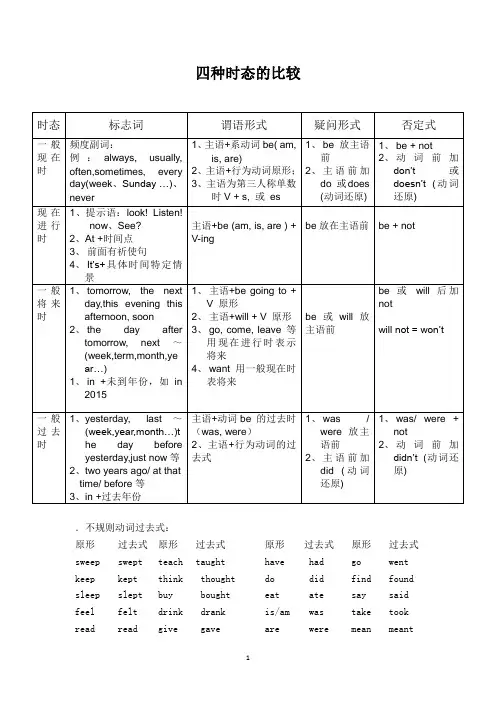
四种时态的比较.不规则动词过去式:原形过去式原形过去式原形过去式原形过去式sweep swept teach taught have had go went keep kept think thought do did find found sleep slept buy bought eat ate say said feel felt drink drank is/am was take took read read give gave are were mean meantput put sing sang drive drove meet met cut cut begin began speak spoke make made let let ring rang write wrote see saw fly flew run ran ride rode come came draw drew sit sat hear heard tell toldgrow grew learn learned/learntget got know knew一、用动词的适当形式填空1. My parents _______ (come) from Shandong.2. Sam _______(not like) playing computer games.3. The beautiful girl _______(wear) glasses.4. The Zhang family _______(live) in a flat in Nanjing.5. My father likes _______(read) newspapers after work.6. What _______her classmates _______(call) her teacher?7. _______ you _______(love) each other in your family?8. _______(be) your cousin very clever at maths?9. She is good at dancing. She ________ (sing) very well, too.11. Amy ________(take) her dog for a walk every afternoon.12. Mr. Li ________(not teach) us maths this term. (学期)13. Mr. Chen ________(not like) tea. He ________(enjoy) drinking coffee.14. ________ your father often ________(play) tennis ?No, he loves ________(read) newspapers.15. Everyone in our class ________(like) P.E. a lot.16. Who else ________(want) to come to Millie’s party? I ________.17. Many of them ________(work) hard at their lessons. They _____ (be) cl ever at them.18. What _______ Mary _______(have) for breakfast ?She _______(have) an egg and a glass of milk.19. Our school ________(be) a big nice school. And our teacher ______(be ) a good teacher.20. Simon and Daniel ________(be) American.二、句型转换。
初中一般现在时-一般过去时-一般将来时-现在进行时总结练习
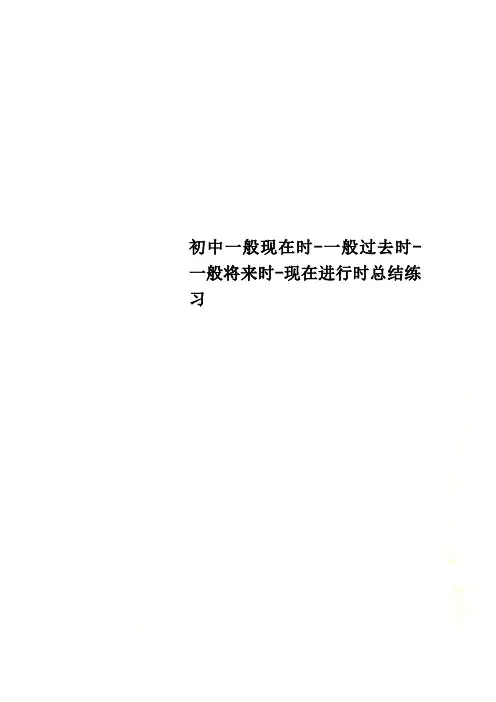
初中一般现在时-一般过去时-一般将来时-现在进行时总结练习( ) 5. Look! The cousins _____ new sweaters.A. are wearingB. wearingC. are wearD. is wearing一般现在时一、概述一般现在时表示习惯性、经常性、反复性的动作或存在的状态。
“习惯性、经常性、反复性”是一般现在时的三大特性,它不表示特定时间内发生的事。
二、一般现在时的结构1.句中有be动词时,用is,am,are2.句中无be动词时,用动词原形。
若主语为第三人称单数,动词变成单三。
三、动词第三人称单数变化规则1. 一般在词尾加-s。
2. 以-o, -s, -x, -sh, -ch结尾的加-es。
3. 以辅音字母加y结尾的,变y为i,再加-es。
四、标志频度副词,every day,every week,every year…1.写出下列动词的三单形式go__________ catch_________ brush(刷)_____ wash___________do________ like________have___________ watch________drink ___________ fly___________ say_______ learn ___________eat___________ read___________sing___________ buy__________study_______ stay __________ make__________ look ____ buy__________pass__________ carry ____come__________plant(种植)______ teach_______ 2.用括号内动词的适当形式填空。
1. We often___________(play) in the playground.2. He _________(get) up at six o’clock.3.__________you_________(brush) your teeth every morning.4. What________ (do) he usually______ (do) after school?5.Danny_______(study)English,Chinese,Maths,Science and Art at school.6. Mike sometimes __________(go) to the park with his sister.7. At eight at night, she often__________(watch) TV with his parents.8. ________ Mike________(read) English every day?9.How many lessons_________yourclassmate________(have) on Monday?10. What time_________his mother_________(do) the housework?3.选择题( )1. I ________to school at 7:00 in the morning.A. goB. goingC. goes( )2. They _______books every day in the library.A.readsB. readC. reading ( )3. The monkey________ eating bananas very much.A.likeB. likesC. liking( )4. My father ________to read newspaper after supper every day.A.likeB. likesC. liking( )5. I like watching TV, but my mother_________like it.A. don’tB. doesn’tC. does ( )6. ____________ your father drink milk every day?A.doB. areC. does()7. We will go shopping if it____ tomorrow.A. don't rainB. didn't rainC.doesn't rainD. isn't rain()8. He said the sun ____in the east and ____in the west.A rose; setB rises; setsC rises, setD rise; sets()9.Wang Mei ____ music and often ____ tomusic.A like; listenB likes; listensC like; are listeningD liking ; listen()10. Jenny____ English every evening.A has studyB studiesC studyD studied4.改错(划出错误的地方,将正确的写在横线上)1. Is your brother speak English?__________________2. Does he likes going fishing? __________________3. He likes play games after class.__________________4. Mr. Wu teachs us English. __________________5. She don't do her homework on Sundays._________________5.把下列句子变成一般疑问句(并作肯定和否定回答)、否定句1.My friends like playing soccer.2.They speak English every day.3.Daniel watches TV every evening4.John is from Canada.5.Tom does his homework at home.6.My dog runs fast.7.Amy likes playing computer games.8.She can play the piano well.一般将来时1.定义:表示将来发生的事或动作。
牛津上海版8A语法时态综合讲解及练习(有答案)

语法:时态语态综合初中阶段考查8种时态,分别是一般现在时、一般过去时、一般将来时、现在进行时、过去进行时、现在完成时、过去完成时和过去将来时。
今天我们涉及6个时态,分别是一般现在时、一般过去时、一般将来时、现在进行时、过去进行时和现在完成时。
英语的语态分为主动语态和被动语态,主动语态表示主语是动作的执行者。
被动语态表示主语是动作的承受者,目前中考主要考查一般现在时、一般过去时、一般将来时和现在完成时这四种时态的被动语态以及含情态动词的被动语态。
只有及物动词才有被动语态。
它的基本结构为:be动词+及物动词的过去分词。
所有的时态变化在be动词上。
动词时态:动词语态注意以下几种被动语态的特殊情况:一.被动语态中不定式要还原Let/make/see/hear/watch sb. do sth.----- sb. be let/made/seen/heard/watched to do sth.My mother made me look after the little sister yesterday.----I was made to look after the little sister by my mother yesterday.二.有些动词没有被动语态。
(及物动词才有被动语态)1) 不及物动词或动词短语无被动语态:appear, die,disappear, end (vi. 结束), fail, happen, last, lie, remain, sit, spread, stand break out, come true, fall asleep, keep silence, lose heart, take place.2) 系动词无被动语态:appear, be,become, fall, feel, get, grow, keep, look, remain, seem, smell, sound, stay, taste, turn3) 不能用于被动语态的及物动词或动词短语:fit, have, hold, marry, own, wish, cost, notice, watch,agree with, arrive at / in, shake hands with, succeed in, suffer from, happen to, take part in, walk into, belong to4) 系动词无被动语态:appear, be,become, fall, feel, get, grow, keep, look, remain, seem, smell, sound, stay, taste, turn5) 当宾语是不定式时,很少用于被动语态。
小学一般现在时-过去式-现在进行时-将来时讲解

四种时态的比较一般过去时1.一般过去时表示过去某个时间发生的动作或存在的状态,常和表示过去的时间状语连用。
一般过去时也表示过去经常或反复发生的动作。
2.Be动词在一般过去时中的变化:⑴am 和is在一般过去时中变为was。
(was not=wasn’t)⑵are在一般过去时中变为were。
(were not=weren’t)⑶带有was或were的句子,其否定、疑问的变化和is, am, are一样,即否定句在was或were后加not,一般疑问句把was或were调到句首。
3.句中没有be动词的一般过去时的句子否定句:didn’t +动词原形,如:Jim didn’t go home yesterday.一般疑问句:在句首加did,句子中的动词过去式变回原形。
如:Did Jim go home yesterday?特殊疑问句:⑴疑问词+did+主语+动词原形?如:What did Jim do yesterday?⑵疑问词当主语时:疑问词+动词过去式?如:Who went to home yesterday?4、规则动词的变化:5.不规则动词过去式:原形过去式原形过去式原形过去式原形过去式sweep swept teach taught have had go went keep kept think thought do did find found sleep slept buy bought eat ate say said feel felt drink drank is/am was take took read read give gave are were mean meant put put sing sang drive drove meet met cut cut begin began speak spoke make made let let ring rang write wrote see saw fly flew run ran ride rode come came draw drew sit sat hear heard tell told grow grew learn learned/ learnt get got know knew 【练习巩固】( )1.The two __________in the same class last year.A. areB. wasC. wereD. be( )2.---Where______ you______ ?----I went to buy some food for supper.A.are … goB.did … goC.do … goD. will … go( )3. "Why _______ she _______ angry?" "Because he _____ at him just now. A. did… get, shouted B. has…got…shoutedC. did… get… has shoutedD. has…got…has shouted( )4.__________ that worker __________in a shoe factory a year ago?A. Do, workB. Did, workedC. Did, workD. Does work ( )5_____ you ______ the film before ? Where ____ you _____ it ?A. Have… seen… did… seeB. Did…see…die…watchC. Have…seen… have… seenD. Did…see…have…seen二、填空1.Tom _______ (visit) a farm last week.2. The twins _______ (water) the flowers in the garden yesterday morning.3. I _______ (watch) a film with my friend last Friday.4. My father _______ (be) in London last year.5. What_______ (do) you do three days ago?6. _______ (be) there any parks here in 1950?7. What_________(do) you do just now? I __________ (wash) my clothes.三.按要求改写句子。
一般将来时、一般现在时、一般过去时、正在进行时练习题

一般现在时、一般过去时、现在进行时、一般将来时专题训练复习七年级已经学过的时态(一)一般现在时、现在进行时、一般将来时、一般过去时重难点讲解:1. 一般现在时:用法:表示经常发生的事情或经常存在的状态。
常与表示频度的时间状语连用。
It often rains in summer.表示预定的行为/事情;The class begins at 9 a.m..描述客观真理/存在;The sun is bigger than the moon.表内心活动、感情等;I think that’s a good idea.用于表将来的从句。
If it is fine tomorrow, we will go.注意:(1)第三人称单数。
(2)频度副词的位置及使用。
alwa ys, usually, often, sometimes, seldom, never I’ll never forget the day when I met him.2. 现在进行时:表达现在正在发生的事情或正在进行的行为They are having a meeting now.表示现阶段正在进行的事情。
He is writing a book these months.注意:(1)表示来或去的动词:如go, come, leave, arrive等的现在进行时表示将要发生的动作。
Tomorrow I’m leaving for Shanghai.(2)时间状语:now, 具体某一时间点3. 一般过去时:表达过去发生的事情、行为或存在状态It was 11 o’ clock when I went to bed last night.表达过去经常发生的事情。
He got up very early when he was in middle school.注意:动词的过去式时间状语:yesterday, last week, an hour ago, the other day, in 1982,just now等。
一般现在时,一般过去时,一般将来时及现在进行时

动词时态一(一般现在时,一般过去时,一般将来时及现在进行时)【用法讲解】考试要求:英语的动词的时态共有十六种,但是中考常考的主要有八种,一般现在时、一般过去时、一般将来时、现在进行时、现在完成时、过去进行时、过去将来时,过去完成时等时态的构成和用法。
本节先讲述一下一般现在时,一般过去时、一般将来时和现在进行时。
1. 一般现在时一般现在时的构成:一般现在时主要用动词原形表示,如果主语是第三人称单数,一般在动词原形后加-s或-es。
例如:I have breakfast at 7 every morning. 我每天早晨7点吃早餐。
He goes swimming on Sundays. 每周日他都去游泳。
一般现在时的用法:(1)表示经常发生的动作或者经常存在的状态。
经常和表示时间的状语often,always,usually,sometimes,every day等连用。
例如:My sister usually goes to school on foot.我姐姐经常步行去上学。
We often come to school at six in the morning.我们经常在早上六点到学校。
(2)表示某种习惯或者能力,也可以表示职业、特征等。
例如:My mother often gets up very early in the morning.我的妈妈经常在早上起床很早。
This kind of car runs very fast.这种小汽车跑得非常快。
(3)表示客观事实、客观规律或者客观真理。
例如:This kind of trees never grows in the desert.这种树从来不在沙漠里生长。
Do you know that knowledge is power?你知道知识就是力量吗?(4)在时间、条件、让步等状语从句中,表示将来的动作。
例如:They’ll be so happy when I tell them.我告诉他们时,他们会很高兴的。
语法:1-3一般现在时、过去时、将来时讲析与练习
1.一般现在时态及第三人称单数(do/does)第三人称单数问题一般现在时中,当主语是第三人称单数时,即常在动词原形后加-s或-es。
第三人称单数变化,现归纳总结如下:1.人称代词he, she, it是第三人称单数。
如:He likes watching TV.他喜欢看电视。
She has lunch at twelve.她十二点吃午餐。
It looks like a cat.它看起来像只猫。
2.单个人名、地名或称呼作主语;用第三人称单数。
如:①Han Mei looks like her mother.韩梅看起来像她的母亲。
②Beijing is in China.北京在中国。
③Uncle Wang often makes cakes.王叔叔经常做蛋糕。
3.单数可数名词或"this / that / the/ a +单数可数名词"作主语时,是第三人称单数。
如:①A horse is a useful animal.马是有用的动物。
②This book is yours.这本书是你的。
③That car is red.那辆小汽车是红色的。
④The cat is Lu cy's.这只猫是露茜的。
4.不定代词someone, somebody, nobody, everything, something等及指示代词this, that作主语时,第三人称单数。
①Everyone is here.大家到齐了。
②There is something wrong with the watch.这块手表有毛病。
③This is a pen.这是一支钢笔。
④That is an eraser.那是一块橡皮擦。
5.不可数名词作主语时为第三人称单数。
如:①The milk is in the glass. ②The bread is very small.6.当数字或字母作主语时,看作第三人称单数。
初中英语语法一般现在时、将来时、过去时讲解及练习题
一般现在时知识精讲一、一般现在时表示通常性、规律性、习惯性、真理性的状态或者动作有时间规律发生的事件的一种时间状态。
二、句子结构主语(第一/二人称/第三人称复数)+do (动词原形)主语(第三人称单数)+does (动词三单形式)主语+am/ is /are三、基本用法四、时间状语1. 表示频率的副词: always, usually, often, sometimes, never, hardly, seldom…2. every/once+名词: every day/ week/ year, once a week/ month …3. 表示时间的短语: twice a day, on weekends, on Mondays…五、一般现在时动词三单的变化规律六、相关句式三点剖析一、考点:时态是英语学习中的核心内容之一,是英语学习的基础。
自然,时态考查是各种英语考试尤其是中考时的座上宾。
动作发生的时间决定时态,时态决定动词的形式,而考卷中的时态题通常没有给出明确的时间标志词,考试需领悟所提供的语境来做出判断。
只有推断出动作发出的正确时间,才可能正确答题,这就要求考生在熟练掌握时态结构、用法并牢记常用的时间状语的基础上,要充分利用上下文中隐含的信息来捕捉时间,找准答题的突破口。
二、重难点:一般现在时在考试中的重难点是:句子结构、基本用法、标志时间状语、动词三单的变化规则及相关句式的变化。
三、补充点:1. 表示按计划或安排好的,或将要发生的动作,可用一般现在时表将来。
但只限于start, begin, leave, go, come, arrive, return, take place等。
例:My train leaves at 7:00 this afternoon.我乘坐的火车将在今天下午7点离开。
2. 在复合句中,当主句是一般将来时,时间或条件状语从句的谓语动词只能用一般现在时来表示将来要发生的动作。
初中英语语法专项复习英语动词时态和语态讲解和练习题
初中英语语法专项复习:英语各个时态和语态讲解及练习题初中英语有16种时态,但是常用的只有9种:一般现在时、一般过去时、一般将来时、现在进行时、过去进行时、现在完成时、过去完成时、过去将来时、现在完成进行时;下面分别介绍;1、一般现在时的用法1 一般现在时表示经常性、习惯性的动作;表示现在的状态、特征和真理;句中常用always,usually,often,sometimes,seldom,rarely,never,every daymorning,Monday,week,...etc.,every there years,once a weekday,month,...etc.,...等时间状语;例如:a. He goes to school every day.b. He is very happy.earth moves around the sun.2 在时间状语从句和条件状语从句中,用一般现在时表示将来;例如:a. If you come this afternoon, we’ll have a meeting.b. When I graduate, I’ll go to countryside.2.一般过去时的用法1 表示过去某时间发生的事、存在的状态或过反复发生的动作;常和:last weeknight,Monday,month,year,...etc.four years agodays,month,...etc.before1980three,liberation,从句,...etc.the day before yesterday,the day before last,the year before last,just now,a monent ago,yesterday,yesterday morning,this morning,at first,at last,in the end,finally,then,..a. He saw Mr. Wang yesterday.b. He worked in a factory in 1986.2表示过去经常发生的动作, 也可用“used to “ 和“would + 动词原形”; I used to smoke. During the vacation I wouldm in the sea.注:”used to “ 表示过去常发生而现在不再发生的动作或存在的状态;a. I am used to the climate here.b. He is used tomming in winter.3.一般将来时的用法一般将来时表示将来的动作或状态;其表达形式除了“ will 或shall + 动词原形”表示即将发生的或最近打算进行的事;常和:next weekMonday,month,year,...etc.in three daysan hour,...etc.tomorrow,tomorrow morning,the day after tomorrow,the day after next,the year after next,tonight,in 20102016...etc.this evening,this Saturday,after Wednesday,soon,sometime next week,one day in futuer,sooner or later,...1be going to do 结构It is going to rain.We are going to have a meeting today.2 “be about to + 动词原形” 表示即将发生的动作,意为be ready to do sth. 后面一般不跟时间状语; We are about to leave.3 go , come , start, move, leave, arrive ,stay 等可用进行时态表示按计划即将发生的动作;I’m leaving for Beijing.4.现在进行时的用法1 现在进行时表示现在正在进行的动作,由“ be + 现在分词” 构成;常和:now,these daysweeks,months,...etc. this monthweek,...etc.Look,Listen,...另外, “系动词+ 介词或副词” 也表示进行时的意义;What are you doingThe bridge is under construction.2 表示感觉、愿望和状态的某些动词如have, be , here, se, like 等一般不用进行;5.过去进行时的用法1 过去进行时过去某一时刻、某一阶段正进行的动作,由“ was were + 现在分词”构成;常和:this time yesterday,this time last Friday,in those days,at nine last night,from one to three yesterday afternoon,...In 1980 he was studying in a university.He was reading a novel when I came in.6.现在完成时的用法现在完成时由“have/has + 过去分词.其使用有两种情况:1 现在完成时所表示的动作在说话之前已完成,但对现在有影响;句中没有具体时间状语;常和:just,alreadly,yet,never,ever,now,before,this week,today,these days,once,twice,three times,...He has gone to Fuzhou.He has been to Fuzhou.2 现在完成时所表示的动作开始于过去,持续到现在,也许还会持续下去常用for 和since表示一段时间的状语或since then1949,last Monday,two o'clock,从句...,etc.,ever since then,for three daysa long time,two hours,...etc.so far , now, today, this wek month, year 等表示包括现在内的状语;He has studied English for 5 years.He has studied English since 1985.Now I have finished the work..注意:表示短暂时间动作的词如come, go , die, marry, buy 等的完成时不能与for, since 等表示一般时间的词连用;正确:I have bought the book already.错误:I have bought the book for two years.改:I have had the bookl for two years.7.过去完成时的用法1 过去完成时由“had + 过去分词”构成;过去完成时的动作表示过去某一时刻或某一时刻或某一动作之前完成的动作或状态;句中常用by then1977,yesterday,eight last night,the time we got there,...etc.by the end of last termweek,year,month,...etc..by, before, until, when 等词引导的时间状语;By the end of last year we had built five new houses.I had learnt 5000 words before I entered the university.2过去完成时的动词还可表示过去某一时刻之前发生的动作或状态持续到过去某个时间或持续下去;Before he slept, he had worked for 12 hours.8.过去将来时的用法过去将来时表示从过去的某个时间看来将要发生的动作或存在的状态;过去将来时由“should 或would + 动词原形” 构成;第一人称用should, 其他人称用would. ;常和:They were sure that they would succeed.二动词语态1.当句子的主语是动作的执行者时, 谓语的形式叫主动语态;句子的主语是动作承受者时,谓语的形式叫被动作语态;被动语态由助动词be + 过去分词构成,时态通过be 表现出来;1 一般现在时:You are required to do this.2 一般过去时:The story was told by her.3 一般将来时:The problem will be discussed tomorrow.4 现在进行时:The road is being widened.5 过去进行时:The new tool was being made.6 现在完成时:The novel has been read.7 过去完成时:He said that the work had been finished.8 过去将来时:He said that the trees would be planted soon.2. 一些特殊的被动结构1 带情态动词的被动结构:The problem must be solved soon.2 带不定式的被动结构:The room is going to be painted.The homework needs to be done with care.3 短语动词的被动:a.不及物动词+介词:若这类短语动词是及物性的,则可用于被动语态中,如:laugh at, look after, talk about, think of 等;若这类短语动词是不及物性的则不可用于被动语态中,如:book up, look down. 等b.及物动词+副词:bring about, carry out, find out, make out, put away, put off, take up, turn down, turn out, wipe out 等c. 动词+副词+介词:do away with, face up to, give into ,look down upon, make up with等d. 动词+名词+介词:catch sight of, keep on eye on, make a fool of , pay attention to , put an end to , set fire/light to , take notice of 等4 带复合宾语的动词在改为被动语态时,一般把主动结构中的宾语改为主语,宾语补足语保留在谓语后面;We always keep the classroom clean.比较:The classroom is always kept clean.5主动形式表示被动意义的词;常见的有:a.主动形式,这时动名词同句中的主语有动宾关系;The children need looking after.The windows wants /requires repairing.This point deserves mentioning.练习题1. It is a fine day. The sun __________shine brightly.2. They ___________visit the Science Museum next Sunday.3. Mr Brown________live in Beijing since he came to China.4. Mr Wang ________teach us English two years ago.5. The Smiths _______________ watch TV at this time last night.6. We __________learn about ten English songs by the end of last term.7. Father said that he ____________buy a new bike for me the next Friday.8. Bill isn¡¯t here. He ___________chat with his friends in the classroom.9. The teacher said that the moon __________go round the earth.10. The Young Pioneers will go to the zoo if it ____________not rain this Sunday.11. Listen They __________talk about the new film.12. Jim asked us what ___________happen in China in 1976.13. My mobile phone ___________steal on a bus last week.14. The host ____________interview the little boy just now.15. The Greens __________watch TV now.16. He said that he _____________ring me up when he got there.17. We ____________learn English for about three years.18. My brother_____________join the League in 1997.19. The farmers __________pick apples when I saw them.20. The red skirt __________cost the girl forty yuan.21. The film ____________begin when I got to the cinema.22. The girl told me that she wanted to be an English teacher when she _____grow up.23. My sister is a student and she _____________study at a middle school nearby.24. Mr Green __________travel to several places in South China since he came here.25. You _________catch the early bus if you get up early.26. _______you been________wear glasses all the time27. I’ll go home as soon as I _______finish my homework.29. Most science books are ______write in English.30. I ____________stay there for two months last year.31. Tell Lily to call me as soon as she _______.A. will arriveB. gets thereC. has goneD. reach here32. ----Hi, Kate. You look tired. What’s the matter ----I ______ well last night.A. didn’t sleepB. don’t sleepC. haven’t sleptD. won’t sleep33. ----Excuse me, look at the sign over there, please. Could you stop smoking----Sorry, I ____ that.A. didn’t seeB. don’t seeC. won’t seeD. can’t see34. ----Well, I found this. I think it must be yours. ----My watch Thank you. Where _____itA. do you findB. had you foundC. were you findingD. did you find35. ----Don you know when Dr White ____ for dinner this evening----No, but I think he ____ when he is free.A. will come; comesB. will come; will comeC. comes; comesD. comes; will come36. Look at those black clouds. It _____ rain. Let’s hurry. A. maybe B. would C. has D. is going to37. ----Jimmy is leaving for a holiday. ----Really Where ____ he ____A. has; goneB. will; goC. did; goD. does; go38. ----Shall we go shopping now ---Sorry, I can't. I ____ my shirts.A. washB. washesC. washedD. am washing39. ----I called you yesterday evening, but there was no answer.----Oh, I am sorry. I ___ dinner at my friend's home.A. haveB. hadC. was havingD. have had40. The Oriental Pearl TV Tower ____ thousands of visitors since 1995.A. attractedB. attractsC. has attractedD. will attract46. ----Why didn't you go to the cinema yesterday -----Because I ____ the film before.A. had seenB. have seenC. have watchedD. has watched47. I don't think John saw me. He ____ a book at that moment.A. just readB. has just readC. was just readingD. had just read48. Mr Smith ____ a book about China last year but I don't know whether he has finished it.A. has writtenB. wroteC. had writtenD. was writing49. Mr White ____ the newspaper while his daughter ____TV.A. has read; was watchingB. was reading; watchedC. was reading; was watchingD. reading; watched50. ---- I ____ you at the meeting. Why ----I was ill. A. saw B. have seen C. not see D. didn't see51. The 29th Olympic Games ____ in Beijing in 2008. A. hold B. will hold C. will be held D. held52. Hurry up The play ____ for ten minutes. A. has been on B. has begun C. had begun D. began53. ----May I speak to Mr Smith ----Sorry, he ____ Australia. But he ____ in two days.A. has been to; will come backB. has gone to; will be backC. has been in; would come backD. is leaving for; doesn't come back54. I can't go to the theater tonight because I ____ my ticket.A. have lostB. had lostC. will loseD. was losing55. ----What a nice bike How long ____ you ____ it ----Just two weeks.A. have; boughtB. did; buyC. have; hadD. are; having56. ----I'm sorry to have kept you waiting. ----Oh, not at all. I ____ here only for a few minutes.A. have comeB. had beenC. wasD. have been57. ----____ my dictionary anywhere ---- Yes. I saw it on your desk a moment ago.A. Did you seeB. If you seeC. Had you seenD. Would you see58. We were all surprised when he mad it clear that he ____ office soon.A. leavesB. would leaveC. will leaveD. had left答案:I. 1. shines/ is shining 2. are going to/ will visit 3. has lived 4. taught5. were watching6. had learned7. would buy8. is chatting9. goes 10.doesn't rain 11. are talking 12. happened 13. was stolen 14. interviewed15. are watching16. would ring 17. have learned 18. joined 19. were picking 20. cost21. had begun 22. grew 23. studies 24. has traveled 25. will catch26. Have; wearing 27. finish 28. haven't heard 29. written 30. stayedII. 31--35 BAADB 36--40 DBDCC 41--45 ACBAC 46--50 ACDCD51--55 CABAC 56--60 DABDA 61--65 BDBAB 66-70 BDABC 71--75 BCADD。
时态复习精讲(一般现在时、现在进行时、将来时、过去式)
过去进行时
昨晚八点钟他在做作业。 (He was doing homework at 8 o'clock last night.)
一般将来时
明天下午我将有空。 (I will be free tomorrow afternoon.)
将来进行时
后天上午他们将在办公室工作。 (They will be working in the office the next morning.)
"be+动词-ing形式"
表示将来某个时间正在进行的动作,例如"She is coming to visit us next month."。
注意事项与常见错误
注意时态一致性:在复合句中,主句和从句的时态应 保持一致,不要混淆时态。
区分"will/shall"与"be going to"的用法:虽然两者 都可用于表示将来时,但"will/shall"强调的是意愿或 可能性,而"be going to"强调的是计划或预测。
常见句型结构
"will/shall+动词原形"
表示将来某个时间发生的动作或存在的状态,例如"I will go to the party tomorrow."。
"be going to+动词原形"
表示计划或预测将来发生的动作,例如"We are going to meet at the park next week."。
注意事项与常见错误
动词ing形式的正确使用
注意动词ing形式的拼写和语法,如 “running”而不是“runing”。