
译林版英语六年级下册_Unit5_第1课时教学设计
1 / 8
Unit5 第1课时教学设计
【内容来源】译林版(五年级)下册Unit5
【主 题】A party
【课 时】第1课时:Story time;Fun time
一、板块介绍
本部分由两个场景构成。场景一呈现了Su Hai 发烧了去看医生的情景,场景二呈现了Mike牙痛去看牙医的情景。两组对话的主要内容是如何简单描述病情和提供建议。
二、教学目标
1. 能听懂、会说、会读、会写balloons, drinks, fruit, snacks, toys等。
2. 能听懂、会说、会读Story time中的故事。
3. 句型:—What … you going to …?
—… going to …
—Are … going to …?
—Yes, …/No, …
三、教学重难点
1. 词汇:balloons, drinks, fruit, snacks, toys
2. 句型:—What … you going to …?
—… going to …
—Are … going to …?
—Yes, …/No, …
四、教学准备
教学课件(教师可以在优教平台直接调用或下载)、课文录音、动画、教材图片)
五、教学过程
Step 1: Warm-up/Lead-in
1. 新授歌曲,导入话题和语法
教师可带领学生欣赏歌曲Will you join me? (《牛津小学英语》6B Unit 6),然后就歌词和学生进行问答,逐步引入话题和目标语法。如:
T: What’s the girl going to do?
S1: She’s going to have a picnic. 2 / 8
S2: She’s going to see a play.
S3: She’s going to have a concert.
T: How about you? What are you going to do this Sunday?
S4: I’m going to...
S5: I’m going to...
T: Guess, what am I going to do? I’m going to have a party.
2. 分享视频或图片,导入话题和词汇
教师可以展示一些节日、生日聚会的图片或视频,与学生一起分享,引入本单元话题。如:
T: Halloween is an interesting holiday in the West. It’s on the 31st of October. People
in the UK and the US usually wear fancy clothes and go to dressing parties. Here are
some pictures of Halloween parties. Do you like parties? What do you usually prepare
for a party?
3. 问答活动,复习节日话题
教师与学生进行问答活动,复习五年级下册Unit 7中节日的相关知识,要求他们说一说最喜欢的节日,引出Children’s Day。如:
T: What festivals or holidays do you like?
S1: I like the Mid-Autumn Festival.
S2: I like the Dragon Boat Festival.
S3: I like the Spring Festival.
T: When’s the ... Festival? What do people usually do at this festival? What do you
usually do at this festival?
...
4. “连连看”游戏
教师可利用课件呈现已经学过的节日的名称、相关图片或动词短语,要求学生快速配对,复习相关节日,导入本单元目标词汇。如:
T: Eat moon cakes.
S1: The Mid-Autumn Festival.
T: Watch dragon boat races.
S2: The Dragon Boat Festival. 3 / 8
...
Step 2: Presentation & Practice
Story time
1. 利用游戏,教授目标词汇
教师可以和学生玩猜谜游戏,教授目标词汇balloon, down。如:
T: It’s a toy. When we blow it, it’ll get bigger and rounder. It’s like a ball, but it’s very
light. What is it?
S1: Is it a balloon?
T: Yes, you’re right. It’s a balloon.
Ss: Balloon.
T: They look funny. They have a large red nose and a funny face. They wear funny
clothes. They make people laugh. What are they?
Ss: ...
T: They’re clowns. Here’s a picture of a clown.
Ss: Clown.
2. 小组竞赛,归类词汇
教师先给出饮料类、水果类、小吃类和玩具类词汇各一个,然后要求学生小组活
动,列出更多同类词汇。列出最多词汇的小组获胜。小组活动后,教师引导学生用drinks, fruit, snacks和toys概括这四类词。
3. 问答活动,教授目标句型
教师和学生进行问答活动,讨论National Day和Mother’s Day,从而引出Children’s
Day,然后询问他们的儿童节计划和安排,教授目标句型be going to结构的疑问句。如:
T: When’s National Day?
Ss: It’s on the first of October.
T: Right. National Day is a very important holiday. There’s a holiday for mothers.
What is it?
Ss: It’s Mother’s Day.
T: Is there a day for children?
Ss: Yes. It’s Childen’s Day. 4 / 8
T: When’s Children’s Day?
Ss: It’s on the first of June.
T: What did you do last Children’s Day?
S1: I watched a film with my friends.
T: Are you going to watch a film this Children’s Day?
S1: No.
T: What are you going to do this Children’s Day?
S1: I’m going to have a picnic with my friends.
4. 游戏活动(超级对对碰),操练目标句型
教师将全班分为四组,每两组的学生面对面坐好,运用Are you going to … this
Sunday? 和What are you going to do this Sunday? 询问对方的周日计划。每隔20秒钟,教师示意全体学生顺时针方向向前挪动一个座位,然后面对新朋友继续之前的问答活动。学生可以边交流边记录,最后向全班汇报。
5. 听录音,理解课文大意
教师播放课文录音或动画,要求学生捕捉关键信息,理解课文大意,并回答以下问题:
• When are the children going to have the party?
• Where are they going to have the party?
• Who is going to take part in the party?
• Who is the clown?
6. 分步学习,完成表格
教师安排学生阅读课文第一部分,找出Su Hai, Wang Bing, Yang Ling等人为聚会
准备的物品,填入表格:
A party
When Children’s Day/Sunday morning
Where Mike’s house
Who SuHai Wang Bing Yang Ling Liu Tao
What snacks & drink fruit toys ?
教师然后安排学生自读课文第二部分,找出Liu Tao为聚会准备的物品,并完成 5 / 8
下面练习:
Read and choose
• It is ______.
a. Saturday morning b. Sunday morning c. Sunday afternoon
• The clown is ______.
a. Mike b. Mike’s cousin c. Liu Tao
• Liu Tao brings ______ to her party.
a. some toys b. some balloons c. some vegetables
• The children are going to ______ first.
a. play with the toys b. eat the food c. some vegetables
7. 梳理课文,完成邀请函
教师和学生一起梳理全文,归纳聚会的要素,即when, where, who和what等问题,然后要求学生根据课文或新授活动6的表格,完成儿童节聚会的邀请函。
Fun time
本板块是一个“说一说,做一做”的活动,要求学生小组活动,筹划一个聚会,并通过讨论确定聚会的时间、地点和要准备的物品,最后制作聚会邀请函。教师可以要求学生课前准备彩色卡纸,彩笔等制作材料。
1. 复习月份及序数词
教师组织学生以男女生接龙的形式说出十二个月份的单词,然后教师说基数词,让学生快速说出相应的序数词。
2. 小组讨论,筹划聚会
教师安排学生四人一组,筹划聚会。教师要求各小组仿照步骤一,进行问答活动,
Welcome
to the party Invitation
Date: __________
Time: __________
Place: __________
With ____, drinks and ___.
Come and have fun!
牛津译林版五年级英语下册5BUnit6第2课时教学设计

1 / 4
Unit6 第2课时教学设计
【内容来源】译林版(五年级)下册Unit6
【主 题】In the kitchen
【课 时】第2课时:Grammar time; Checkout time
一、板块介绍
本板块呈现了现在进行时的一般疑问句及其回答,同时用there be句型呈现了可数名词和不可数名词的用法。教师在教学中可将重点放在可数名词和不可数名词的操练上。
二、教学目标
教授学生熟知并运用现在进行时的一般疑问句及其答语。
三、教学重难点
句型:现在进行时的一般疑问句合理运用。
四、教学准备
教学课件(教师可以在优教平台直接调用或下载)
五、教学过程
Step 1: Warm-up/Lead-in
朗读句子,认知句型
教师将学生分成两组,分别朗读第一个表格中的问句和第二、三个表格中的答句,
理解现在进行时一般疑问句的构成。
Step 2: Presentation & Practice
1. 朗读句子,认识可数名词和不可数名词 2 / 4
教师要求学生自读第四个表格中的句子,理解可数名词和不可数名词的区别。然
后,教师呈现以前学过的名词,要求学生识别哪些是可数名词,哪些是不可数名
词。教师也可以要求学生列举一些可数名词和不可数名词。
2. 看图说话,操练可数名词和不可数名词
教师准备两张场景一致的图片,但里面的物品有所不同,然后让学生用there be句型描述两张图片的不同之处。如:
S1: There’s a football in picture 1.
S2: There’s some bread on the table in picture 1. There are three potatoes on the table
in picture 2.
…
3. 看图写话
教师安排学生独立完成学生用书第67页Checkout time中的Look and write,然后邀请若干学生口述完整的句子,核对答案。
译林英语六年级下册英语第五单元课时练习、单元测试卷(含答案)sc
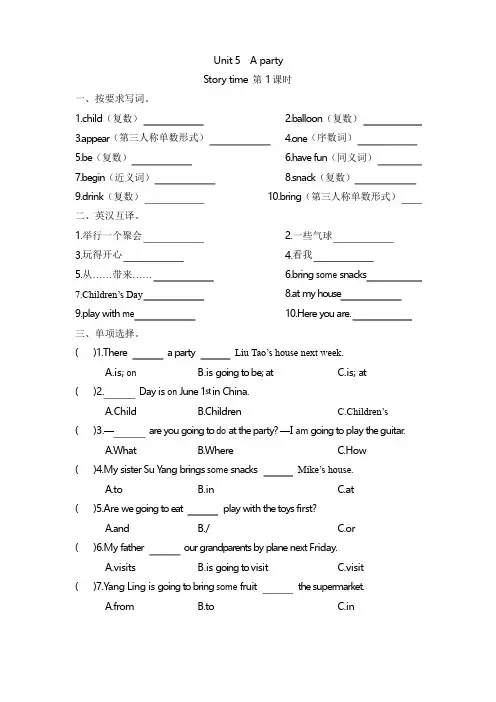
Unit 5 A party
Story time 第 1 课时
一、按要求写词。
1.child(复数) 2.balloon(复数)
3.appear(第三人称单数形式) 4.one(序数词)
5.be(复数) 6.have fun(同义词)
7.begin(近义词)
9.drink(复数)
二、英汉互译。
1.举行一个聚会
3.玩得开心
5.从……带来……
7.Children’s Day
9.play with me 8.snack(复数)
10.bring(第三人称单数形式)
2.一些气球
4.看我
6.bring some snacks
8.at my house
10.Here you are.
三、单项选择。
( )1.There a party Liu Tao’s house next week.
A.is; on B.is going to be; at C.is; at
( )2. Day is on June 1st in China.
A.Child B.Children C.Children’s
( )3.— are you going to do at the party? —I am going to play the guitar.
A.What B.Where C.How
( )4.My sister Su Yang brings some snacks Mike’s house.
A.to B.in C.at
( )5.Are we going to eat play with the toys first?
A.and B./ C.or
( )6.My father our grandparents by plane next Friday.
A.visits B.is going to visit C.visit
( )7.Yang Ling is going to bring some fruit the supermarket.
人教版六年级英语下册Unit1 第4课时教学设计

Unit1第4课时教学设计
教学目标
1、能够听、说、读、写形容词比较级形式:heavier, stronger, thinner,
bigger和smaller.
2、能够灵活准确地运用以上形容词比较描述人物和动物特征差异。
3、能够完成Let’s play部分活动并在活动中相应语言正确表达。
4、欣赏英文歌曲<>。
教学重点
重点是四会掌握五个形容词比较形式。
教学难点
难点是掌握以下形容词比较级构成方式:heavy—heavier, thin—thinner, big—bigger.
教学准备
课件、图片、录音机 单词卡片
教学过程
一、热身导入
(1)问好。
(2)唱歌曲<>
二、任务呈现
1、明确本节课学习单词bigger smaller stronger heavier
thinner
2、呈现match and say
三、课文学习
(1)由图片展示,出示词卡stronger,smaller教学单词。
(2)强调thinner, bigger变化规律
(3)heavy—heavier变化规律,将y变为i再加er。举例funny---funnier并总结规律。
(4)带读单词
(5)将句型How old are you ? 引入并提问学生。替换为How tall
are you ?请学生上台量身高并回答该句子。
(6)再次替换heavy,讲解How heavy are you ?并示范作答I’m
48kg.
四、训练巩固
(1)教师提问,学生回答,操练句型。
Dis heavier than C.
C is heavier than B.
B is heavier than A.
How heavy are you?
A is thinner than B.
译林版英语七年级下册教学课件Unit 6 第6课时 Task (1)
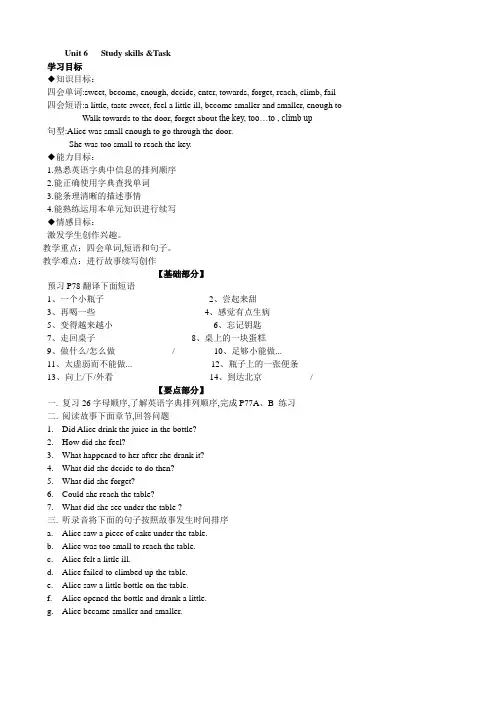
Unit 6 Study skills &Task
学习目标
◆知识目标:
四会单词:sweet, become, enough, decide, enter, towards, forget, reach, climb, fail
四会短语:a little, taste sweet, feel a little ill, become smaller and smaller, enough to
Walk towards to the door, forget about the key, too…to , climb up
句型:Alice was small enough to go through the door.
She was too small to reach the key.
◆能力目标:
1.熟悉英语字典中信息的排列顺序
2.能正确使用字典查找单词
3.能条理清晰的描述事情
4.能熟练运用本单元知识进行续写
◆情感目标:
激发学生创作兴趣。
教学重点:四会单词,短语和句子。
教学难点:进行故事续写创作
【基础部分】
预习P78翻译下面短语
1、一个小瓶子________________________2、尝起来甜___________________________
3、再喝一些_________________________4、感觉有点生病__________________________
5、变得越来越小_______________________6、忘记钥匙___________________________
7、走回桌子______________________8、桌上的一块蛋糕___________________________
9、做什么/怎么做_____________/_________10、足够小能做..._____________________
新牛津译林版五年级英语下册Unit6 第1课时教案
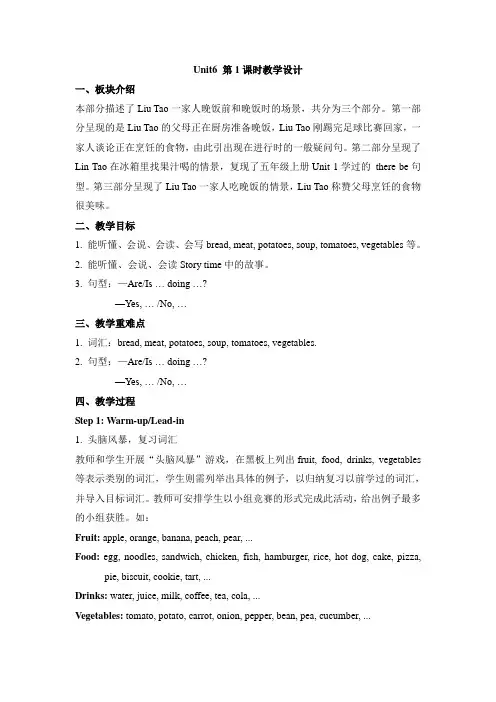
Unit6 第1课时教学设计
一、板块介绍
本部分描述了Liu Tao一家人晚饭前和晚饭时的场景,共分为三个部分。第一部分呈现的是Liu Tao的父母正在厨房准备晚饭,Liu Tao刚踢完足球比赛回家,一家人谈论正在烹饪的食物,由此引出现在进行时的一般疑问句。第二部分呈现了Lin Tao在冰箱里找果汁喝的情景,复现了五年级上册Unit 1学过的 there be句型。第三部分呈现了Liu Tao一家人吃晚饭的情景,Liu Tao称赞父母烹饪的食物
很美味。
二、教学目标
1. 能听懂、会说、会读、会写bread, meat, potatoes, soup, tomatoes, vegetables等。
2. 能听懂、会说、会读Story time中的故事。
3. 句型:—Are/Is … doing …?
—Yes, … /No, …
三、教学重难点
1. 词汇:bread, meat, potatoes, soup, tomatoes, vegetables.
2. 句型:—Are/Is … doing …?
—Yes, … /No, …
四、教学过程
Step 1: Warm-up/Lead-in
1. 头脑风暴,复习词汇
教师和学生开展“头脑风暴”游戏,在黑板上列出fruit, food, drinks, vegetables等表示类别的词汇,学生则需列举出具体的例子,以归纳复习以前学过的词汇,并导入目标词汇。教师可安排学生以小组竞赛的形式完成此活动,给出例子最多的小组获胜。如:
Fruit: apple, orange, banana, peach, pear, ...
Food: egg, noodles, sandwich, chicken, fish, hamburger, rice, hot dog, cake, pizza,
pie, biscuit, cookie, tart, ...
小学英语译林版六年级下册Unit5 Period1 课时训练
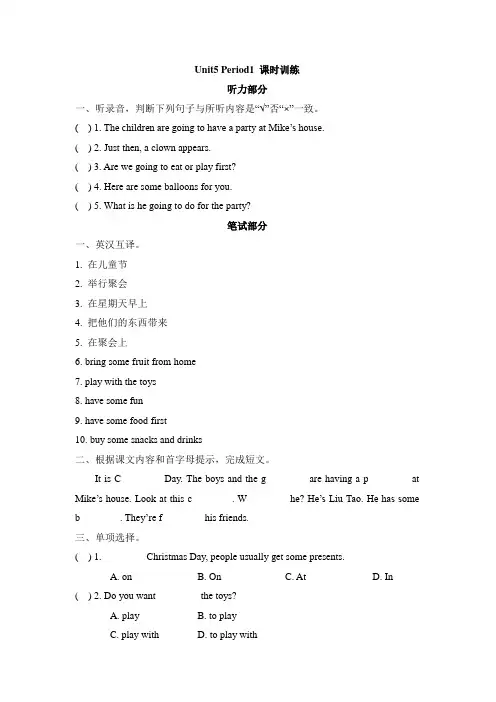
Unit5 Period1 课时训练
听力部分
一、听录音,判断下列句子与所听内容是“√”否“×”一致。
( ) 1. The children are going to have a party at Mike’s house.
( ) 2. Just then, a clown appears.
( ) 3. Are we going to eat or play first?
( ) 4. Here are some balloons for you.
( ) 5. What is he going to do for the party?
笔试部分
一、英汉互译。
1. 在儿童节 __________
2. 举行聚会 __________
3. 在星期天早上 __________
4. 把他们的东西带来 __________
5. 在聚会上 __________
6. bring some fruit from home __________
7. play with the toys __________
8. have some fun __________
9. have some food first __________
10. buy some snacks and drinks __________
二、根据课文内容和首字母提示,完成短文。
It is C________ Day. The boys and the g________ are having a p________ at
Mike’s house. Look at this c________. W________ he? He’s Liu Tao. He has some
b________. They’re f________ his friends.
三、单项选择。
( ) 1. ________ Christmas Day, people usually get some presents.
陕旅版英语六年级下册英语Unit5_What_Is_He_like_第1课时教学设计
Unit5 What Is He like 第1课时教学设计
【内容来源】陕旅教育出版社六年级下册 Unit5
【主 题】Warming-up: Listen and do, Let’s learn, Let’s guess
【课 时】第1课时
一、教学目标
1. 能听、说、读、写单词:clever, outgoing, shy, kind, friendly, hard-working,
serious, lazy。
2. 能运用上述词汇借助简单的对话描述人物性格。
二、教学准备
1. 教师准备:
(1) Let’s learn部分的单词教学卡片或课件。
(2) Let’s learn部分的教学音频。
2. 学生准备:各自家庭成员或朋友的照片。
三、教学方法建议
课程导入(Leading In)
(1)课前热身 Part A Warming-up: Listen and do
教师通过Part A Warming-up部分中的第一个活动Listen and do环节的Simon
says游戏首先将学生自然地引入英语学习氛围,继而复习身体部位的词汇。教师可这样引入:
T: Let’s play a game: Simon says,“Touch your nose / face / ear / eye / hair / head
/... ”(用简单的语言重申游戏规则)Simon is a king. We should follow his order. He
says “Touch your ...” and we will do the action. If no “Simon says” ,we don’t do the
action.
之后,要求学生全体起立进入游戏,通过这项引导学生复习以往学过的身体部位名称。考虑到六年级学生的年龄和认知水平,此游戏可能较为简单,为了引起他们足够的兴趣,教师可要求以组为单位进行比赛,做错动作和反应慢的要坐到座位上,坐下的学生可以当“小警察”监督其他学生的动作,避免他们感到尴尬或单方面终止游戏学习活动,最后站着人最多的小组获胜。
PEP六年级下英语Unit 1 第5课时教学设计
1 / 4 Unit 1 How tall are you?
课时5
Main scene & Let's check & Story time
教学目标:
1. Go through Main sceneP2_3
2. 能读懂Story time 中的故事。
教学重点:
Go through Main sceneP2_3
教学难点:
借助图片能读懂Story time 中的故事。
教学过程:
Step1: Warm-up
Main scene
1. Turn to page2 and page3.Try to read and translate these sentences.
2. T: show the meaning of these sentences.
3. Read after the tape twice.
4.学生理解句子:I'm 21 meters tall. I'm the tallest. It's 5 tons.
提示常用单位:长度:meter(m) centimeter(cm) :重量:ton(t)
kilogram(kg)gram(g)
Step 2: Presentation
1. Finish Let's check: Listen and write the answers.
2. Finish Let's wrap it up. (可在黑板上重新排列) 2 / 4 (A) taller shorter younger older longer smaller stronger
(B) heavy-heavier angry-angrier sun-sunnier funny-funnier
happy-happier windy-windier
(C) thin- thinner big-bigger hot-hotter sad-sadder
苏教牛津版六年级英语下册说课稿 Unit 5(1)
………………………………………………………………………
~小学英语精品资源~ (苏教牛津版)六年级英语下册说课稿
Unit 5 The seasons
本课是牛津小学英语六年级下学期(6B)中的Unit 5 The seasons的教学内容。本课的核心内容是“季节”。所涉及的主要句型有:What’s the weather like in…(seasons)?
It’s… What do you usually do in…(seasons)? I …本课主要学习四会单词会:warm, cool,
cloudy, rainy, windy, snowman。本课的内容比较贴近学生的实际生活,语言运用情景也比较真实。
在本课时教学中主要运用预习条件下的英语教学模式,通过预习作业的布置与完成,有效降低学生学习的难度。在课堂教学中,努力创设各种真实或半真实的语言情境来更好地呈现、操练和巩固新知,利用各种形式激发学生的兴趣,提高学生参与语言的积极性,并引导学生在日常生活中灵活运用所学知识。
在整个教学中,教师是引导者、协调者;学生是活动的主体,学生的学习任务是开放的。
1.从谈话入手,引出新知
学习语言的目的是会用语言,我用Free talk 的形式给学生使用语言的机会,温故而知新What date is it today? What’s the weather like today?自然将学生的思路引入到本课“weather”的学习中,导入新课。
2.联系生活,学习新知
在预习的前提下,由画有天气特征的图片引出新词语的学习,在趣味性的学习活动中,掌握新内容,并进行有效巩固, 自然而且生动,使教学内容更贴近学生的生活。有效吸引学生的注意力,引起他们的学习兴趣。然后再进行Say a rhyme, Listen and write,
Write and talk等活动来巩固新知。通过这个活动一方面可以丰富学生的自然知识,另一方面,可以有效巩固所学内容。使英语课程的内涵更加丰富。
人教版(新起点)英语六年级下册Unit5《NatureandCulture》(Lesson1)教学设计
Unit5 Lesson1教学设计
【内容来源】人民教育出版社(一起点)六年级下册 Unit5
【主 题】Nature and Culture
【课 时】第1课时:Lesson1
一、本课教学目标
1. 通过听、说、读、写等形式的语言活动,帮助学生复习前几册有关Weather,
Seasons, Sports and Games和Weekends等话题的重点词汇和功能句,培养学生综合运用所学语言知识进行交流的能力。
2. 引导学生就所听或所读的有关上述话题的信息与他人展开对话交流。
3. 引导学生仿照阅读文段,在问题提示下写一段话 介绍自己最喜欢的季节。
教学建议
A. Listen and match.
1. 复习热身活动
(1) 播放有关四季或天气的歌曲教师可以搜集一些四季的美景图片,配合与季节或天气话题相关的歌曲呈现,如本套教材前面册次学过的Four Seasons, What’s
the weather like?等。
(2) 头脑风暴
教师在学生演唱完歌曲、欣赏完图片之后,带领学生进行头脑风暴,如:看到Season这个话题,你能联想到的词汇有什么?教师可以一边引导学生说,一边用思维导图的形式将学生所说的词汇呈现在黑板上:
… spring
seasonssummer warmFly kites …
autumn winter …
cool pick fruits … 2. 听前做好准备
(1) 看图预测听力内容
请学生看A项的图片,并根据图片预测听力内容。教师可以用以下问题来引导学生看图:First, look at the four children in the centre. Who are they? (通过指认四个主线人物,为下一步听音连线做好准备。)
Then, let’s look at the pictures around the four children. What are the children doing?即引导学生看A项的剪影图,请学生说出每幅图所代表的英文词汇,进一步为听音连线扫清障碍。