
最新牛津译林版初二英语下册Unit2 Travelling welcome to the unit课件
the Tower Bridge
Task 1 Read and match
the Little Mermaid the Great Wall the Statue of Liberty the Sydney Opera House the Tower Bridge the Leaning Tower of Pisa
要么旅行,要么读书,身体和灵魂,必须有一个在路上
Learnig aims
1. To learn some famous places of
interest around the world
2 . To talk about a place of interest
and its background.
It isn’t straight up.
It’s leaning.(倾斜的)
the Sydney Opera House Australia
It looks like sails.(帆)of ships.
the Tower Bridge
England
It's over the River Thames in London
It comes from a story by Hans Christian Andersen.
The Daughter of the Sea
Task 4: Work in pairs
A: What’s this, Millie? B: It’s_the Statue of Liberty_____. A: Where is it? B: It’s in_New York, theUSA A: What’s special about it? B: It _It stands for Liberty_____. A: Have you ever been there? B: No, I haven’t./Yes ,I have.
the Statue of Liberty New York, the USA
It’s a present from France to the USA. It stands for liberty(自由).
/'liːnɪŋ/
/'pi:zə /
the Leaning Tower of Pisa
Italy
Italy the USA Denmark England Australia China
Task 2: Read and match It is the longest wall in the world. It sounds like pizza. It is leaning. It may fall down some day. is a large bridge over the River Thames in London,It has twin towers. It looks like shells. It is a present from French people.
3.To learn what we should do and
what we shoudn't do when travelling.
Travelling
= going on a trip
1 Do you like travelling? 2 How do you feel when you go on a trip? 3 When do you usually go on a trip? 4 Where do you want to go?
The girl has a fish’s tail instead of legs.
Task 3: Listen and answer
1.Where is the Little Mermaid? It’s in Copenhagen, the capital of Denmark.
2. What’s special about it?
Unit 2 Travelling
The world is a book, and those who do not travel read only a page
世界是一本书,不旅行的人只看到其中的一页
You can either travel or read, and either your body or soul must be on the way.
/'mɜːmeɪd/
the Little Mermaid
Copenhagen哥本哈根
[,kəupən'heiɡən]
the capital of Denmark
The girl has a fish’s tail instead of legs.
/'denmɑ:k/
/'stætʃu:/
/'lɪbəti/
It has twin towers.
Let’s see who has the best memory
the Leaning the Statue of the Little Mermaid Tower of Pisa Liberty
the Great Wall
the Sydney பைடு நூலகம்pera House
Make up new dialogues
If you have a chance (机会) to travel abroad (出国旅游), where will you go? Why?
Task 5: Watch and answer
Where is Eddie going?
He is going to South hill for a holiday
Do you know them?
Learn more about the places
What’s this?
the Great Wall
Where is it?
In Beijing, the capital of China
What’s special about it?
It’s the longest wall in the world. It looks like a dragon from far away
牛津译林版英语八下《Unit 2 Travelling》(welcome)ppt课件
the Leaning Tower of Pisa
Pisa, Italy take photos The little Mermaid Copenhagen, Denmark
tail
Take photos and see the beautiful view
the Tower Bridge London, England Take photos and see the beautiful view the Great Wall Beijing China Go hiking
going Whereare you ______? Hobo: Hey, Eddie.______ going ______ on Eddie: I’m _____ a trip. must ______fun. join you ? be Hobo: It _____ Can I _____ take you out Let Eddie: OK.______ me ______ ______ a few days. for What are you doing, Hobo? packing want to _______ bring Hobo: I’m ________.I everything _____me. with I’m so ________. excited Take the bag. Come on .Eddie.______ Let’s ________go. don’t be Eddie: I _______ think it’ll _______ a holiday for me. ______
the Statue of the Little Mermaid Liberty
the Great Wall
译林牛津版八年级英语下册8B unit 2 Travelling
八年级英语下册8B unit 2 Travelling一、重点短语Welcome to the unitgo on a trip 进行一次旅行must be fun 一定有趣come on 快点;加油;得了吧bring sth. with sb. 随身带popular tourist attractions 受欢迎的旅游地go hiking / skiing 去远足/去滑雪see the beautiful view 欣赏美丽的风景take photos/pictures 拍照a symbol of Japan日本的象征/标志Readinghave a really fantastic time 玩得开心a famous theme park 一个著名的主题公园roller coaster 过山车以高速行驶(at a speed of )a fast food restaurant 一家快餐馆be interested in (doing) sth 对……感兴趣Sleeping Beauty 睡美人Snow White 白雪公主such as = like 例如can’t stop doing sth 忍不住/一直在做某事look so nice and cute 看上去如此漂亮可爱later in the afternoon傍晚/下午晚些时候the best part of the day一天中最精彩的部分wave to sb. 向某人挥/招手match across the park 列队走过公园clap and scream with joy 高兴得一边拍手一边尖叫a three-D film 一场三维电影apple pie苹果派at the end of 在……的最后under the fireworks 在烟火中in all总共,共计show sth to sb = show sb sth 把某物展示给某人看scream with excitement兴奋得尖叫起来be in Chinese style 以中式风格Grammarthe line of people (人排成的)队伍wait in (the) line 在队伍里等get in进去a really delightful holiday一个确实使人高兴的假日a meaningful experience一次有意义的经历(可数)five years’ teaching experience 5年的教学经验(不可数)to one’s delight /joy (n)使某人高兴的是……(do harm to(n) = be harmful to(adj)对……带来伤害)seem (to be) + adj 似乎……be on上演(延续性)begin/start(短暂性)celebrate their fifteen years of marriage (n) 庆祝结婚15周年Integrated skills and study skillsWindow of the World世界之窗the best time for doing sth= to do sth是……的最好时机all (the) year round一年到头;终年have ideas about sth 对某事有想法travel abroad出国旅行fly to a place = take a plane to a place=go to a place by air / plane 乘飞机去某地check it for you 替你核查某事tie it up 把它捆绑起来(tying)taskwrite down the details 写下细节pleasant weather 宜人的天气desserts and snacks 甜点和零食the day of our trip to Hong Kong 我们去香港的那天be excited about……因……而兴奋three and a half hours = three hours and a half三个半小时have a bird’s-eye view of 鸟瞰;俯视the cultural centre of Hong Kong香港的文化中心state clearly 清楚地陈述something interesting and special有趣而又特殊的事情make your article more interesting使你的文章更有趣write about your feelings in the last paragraph在最后一段写一写你的感受the day before yesterday 前天leave sth + 地点把某物遗忘在某地(left)march down the street 沿着街道行进take (bananas) from (the visitors) 从(客人手里)拿走(香蕉)二、Grammar(现在完成时1)1.have/has been(to)、gone(to)、been(in)三者之间的根本区别:have/has been to 表示当事人曾经去过某地have/has been in 强调当事人在某地待过一段时间have/has gone to 说话时当事人不在现场,去了某地2.三者的常见用法been (to) + 地点+ 次数been (in) + 地点+ 段时间/句子gone (to) + 地点3.共同点:当后跟地点是副词时,介词省略4. Grammar(现在完成时2)for +时间段(与现在完成时连用)since +时间点/从句(过去式)/ 时间段+ago(与现在完成时连用)ago 与一般过去时连用5. 现在完成时态中可以和表示一段时间状语(for,since,how long, all one’s life)连用的动词必须是表示延续的情况或动作的动词,即延续性动词如:be,have,know,live,work,study,learn,teach,keep,speak,talk,draw,wait,wear,walk,sleep,drive,write,do,clean等。
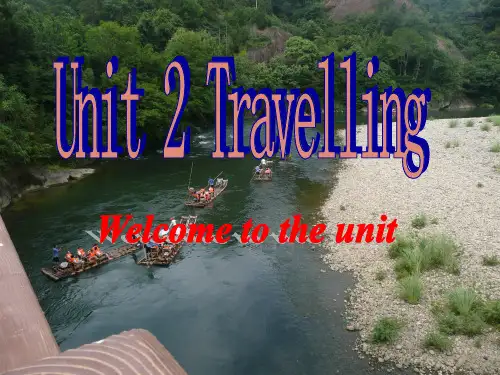
江苏新教材牛津英语八年级下 Unit2 Travelling Welcome to the unit
Yes, he does.
3. What does Hobo want to bring?
He wants to bring all his thing.
4. Why is Eddie unhappy?
He has to carry a heavy bag.
It’s in Copenhagen, the capital of Denmark.
Unit 2
2. What’s special about it?
It comes from a story by Hans Christian Andersen.
Make a simple dialogue A: What’s this? B: … A: Where is it?
预习检测 见导学案
1.知识目标: 学习词汇:travelling, hey 学习词组:go to … for my holiday, the capital of 学习句子: Great ready! I don’t think it’s a holiday for me.
2. 技能目标: 1)了解外国著名城市胜地和受欢迎的景点。 2)通过对话谈论人们在不同景点从事的活 动。 3. 情感目标:初步认识到这些旅游胜地是 全人类的共同财富。
ready Eddie: OK. Get ______!
Fill in the blanks .
Eddie: What are you doing, Hobo?
Hobo: I’m ________ all my things. I’m getting so ________. ______ Take the bag, Eddie. excited ________go. Let’s
【最新】牛津译林版八年级英语下册Unit 2 Travelling Comic strip and welcome to the unit精品课件

Travelling must be fun . We will feel very happy . When we are travelling , we can do many things .
What can we do there?
1.去南山旅行 2.我去过那儿许多次了 3.那一定有趣 4.带你出去几天 5.把一切带在身边 6.快点 7.如此兴奋 8.我想那对我将不是假期 9.去徒步旅行 10.去滑雪 11.看美丽的风景 12.照相 13.日本的象征
自由女神像 a symbol of the USA.
the Little Mermaid美人鱼
the symbol of Denmark丹麦
the Tower Bridge 塔桥 a symbol of London
['li:niŋ]
the Leaning Tower of Pisa ['pi:zə] 比萨斜塔 a symbol of Italy.
3.What can you do there?
Guilin China
the Great Wall
the Palace Museum
Hainan Island
Mount Tai
I want to go to …because I can …
have the local food go skiing take a boat trip learn the history go camping take photos …
Homework
1.Recite and act the comic. 2.Remeber the useful phrases and sentences. 3.Finish the exercises ful view enjoy natural beauty
牛津译林版八年级下册Unit2《Travelling》说课稿
牛津译林版八年级下册Unit 2《Travelling》说课稿一. 教材分析《牛津译林版八年级下册Unit 2 Travelling》是一篇关于旅行的文章,通过描述不同人的旅行经历和目的,让学生了解和掌握与旅行相关的词汇和表达方式。
本篇文章题材贴近学生的生活,能够激发学生的学习兴趣,同时培养学生的阅读能力和语言运用能力。
二. 学情分析八年级的学生已经具备了一定的英语基础,能够理解和运用一些基本的英语知识。
但是,对于一些与旅行相关的词汇和表达方式,他们可能还比较陌生。
因此,在教学过程中,需要注重引导学生理解和运用这些新词汇和表达方式。
三. 说教学目标1.知识目标:学生能够掌握本课的生词和短语,理解文章的主旨大意,能够运用所学知识进行简单的英语交流。
2.能力目标:学生能够提高阅读理解能力,能够运用所学知识进行写作和口语表达。
3.情感目标:学生能够培养对旅行的兴趣,增强对不同文化的认识和理解。
四. 说教学重难点1.重点:学生能够掌握本课的生词和短语,理解文章的主旨大意。
2.难点:学生能够运用所学知识进行写作和口语表达,以及对文章中一些细节内容的理解。
五. 说教学方法与手段1.交际法:通过小组讨论、角色扮演等形式,让学生在实际语境中运用所学知识,提高口语表达能力。
2.任务型教学法:通过完成各种任务,让学生在实践中学习和发展语言能力。
3.情境教学法:通过创设各种情境,让学生在真实的语境中学习和运用语言。
六. 说教学过程1.导入:通过展示一些旅行图片,引导学生谈论自己的旅行经历,激发学生的学习兴趣。
2.阅读理解:学生独立阅读文章,回答相关问题,检查学生对文章内容的理解。
3.新课导入:讲解本课的生词和短语,让学生通过例句理解并运用这些词汇。
4.课堂活动:通过小组讨论、角色扮演等形式,让学生运用所学知识进行实际操作。
5.写作练习:让学生根据文章内容,写一篇关于自己旅行的作文。
6.总结:对学生的学习情况进行总结,对学生的表现进行评价。
牛津译林版八年级英语下册Unit2 Travelling 课件
Welcome to the unit & Comic strip
Free talk:
Do you like travelling? Which places have you ever been to? When did you go there? Do you know any famous places of
go hiking
go skiing
go sightseeing take photos
have a picnic
see the beautiful view
Where are they going?
Listen and answer
1.Is Eddie happy in the first picture? Why?
4. I __d_o__n_’t__t_h__in__k__i_t_’l_l__b_e__a___h_o_l_id__a_y___ for me.
(我认为这将不会是个假期) 5. People can __s_e_e__t_h_e__b__e_a_u_t_if_u_l__v_ie_w____ in Italy.
Ask and answer like this:
A: What’s this? B: It’s Mount Fuji in Japan
---- a symbol of Japan. A: What can people do there? B: They can go hiking there.
No. Because he has to carry the heavy bag.
Act it out
Is travelling ses
牛津译林八年级英语下册Unit 2 Travelling Welcome to the示范课教学课件
What we need to take with us for a holiday:
some comfortable clothes and shoes
some things for daily use
a mobile phone and a charger
the Great Wall
the Statue of Liberty
the Sydney Opera House
Tower Bridge
the Leaning Tower of Pisa
the Little Mermaid
Listen and answer
1. What are Daniel and Millie talking about?2. What’s special about it?3. Has Millie been to Denmark?
the Little Mermaid
in Copenhagen, the capital of Denmark
the UK
Denmark
It’s a statue of a girl who has a fish’s tail instead of legs.
It’s the symbol of the country.
Daniel and Millie are talking about something.
Make a conversation
A: What’s this, …? B: It’s ...A: Where is it? B: It’s ...A: What’s special about it? B: It ...A: Have you ever been there?B: No, I haven’t. / Yes, I have.
牛津译林版英语八下Unit2《Travelling》说课稿
牛津译林版英语八下Unit 2《Travelling》说课稿一. 教材分析牛津译林版英语八下Unit 2《Travelling》主要讲述了关于旅行的相关话题。
本单元通过介绍不同类型的旅行方式、旅行计划、旅行中的注意事项等,帮助学生掌握与旅行相关的词汇和表达方式,提高学生的听说读写能力。
教材内容丰富,贴近学生生活,有利于激发学生的学习兴趣。
二. 学情分析八年级的学生已经具备了一定的英语基础,对于日常生活中的基本表达已经能够熟练运用。
但是,对于一些关于旅行的专业词汇和表达方式可能较为陌生。
因此,在教学过程中,需要关注学生的个体差异,针对不同学生的学习需求进行引导和帮助。
三. 说教学目标1.知识目标:学生能够掌握与旅行相关的词汇和表达方式,如旅行方式、旅行计划、旅行注意事项等。
2.能力目标:学生能够听懂、会说、会读、会写关于旅行的句子,提高学生的听说读写能力。
3.情感目标:通过本单元的学习,学生能够培养对旅行的兴趣,提高对英语学习的热情。
四. 说教学重难点1.重点:学生能够掌握与旅行相关的词汇和表达方式。
2.难点:学生能够运用所学的词汇和表达方式进行实际交流,编写关于旅行的短文。
五. 说教学方法与手段1.交际法:通过模拟真实场景,让学生在实际交流中运用所学知识。
2.任务型教学法:通过完成各种任务,激发学生的学习兴趣,提高学生的参与度。
3.多媒体辅助教学:利用多媒体课件、图片、视频等丰富教学手段,提高学生的学习兴趣。
六. 说教学过程1.导入:以一段关于旅行的视频导入,激发学生的学习兴趣。
2.新课呈现:通过展示图片、实物等,引入本节课的主题,引导学生学习相关词汇和表达方式。
3.课堂练习:设计不同类型的练习,让学生在实际交流中运用所学知识。
4.小组活动:学生分组进行讨论,分享各自的旅行经历,促进学生之间的交流。
5.课堂小结:对本节课所学内容进行总结,帮助学生巩固记忆。
6.课后作业:布置相关任务,让学生课后进行练习,巩固所学知识。
八年级英语下册 Unit 2 Travelling Welcome to the Unit教案 (新版)牛津版
e.g. I don’t think it is a good idea.我认为那不是个好主意。
Step 9 Exercises
作业设计
1.Prepare a fact file and write about one of your holidays.
Do you like travelling?
Do you know any famous places of interest?
Step 2 Presentation
Show some pictures about some places of interest inChina.
e.g. The New Fourth Army Memorial
6. It is a large bridge over the River Thames inLondon. It has twin towers.
Step 5Work in pairs
A: What’s this, Millie?
B: It’s the Little Mermaid.
A: Where is it?
2. Preview the new words inReading.
教学反思
Yancheng Nature Reserve
Milu Deer Nature Reserve
Step 3 Welcome the unit
Task If you have a chance (机会) to travel abroad (出国旅游), where will you go?
最新牛津译林版八年级下册unit 2《travelling》教案.doc
1.Show the pictures of other five places of interest on the page 21. Ask Ss read the words and do the exercise below.
Lead them to read the names of places an d countries.
课型
新授
授课日期
第三课时
教学目标
1.To practise the main language points of the context
The students act it .
Step5Homework
1.Recite the new words
2.Find out useful words and phrases in Reading
3.Do B3 and B4 on Page 25
教
后
记
课题
8B Unit 2 Travelling Reading(2)
2.To activate general knowledge about the world .
3.To identify activities which people do on holiday.
教学重难点
1. To learn some popular tourist attractions .
Step3 Reading
1 Students scan the reading materials and find the main 5 elements, andoutline the reading.
T: Today we’re going to learn about Hong Kong Disneyland from Kitty’s letter. Remember to find the five paints:when ,who, where , what, and how.Look at the questions in part B1 and find the answers as quickly as you can.