
外研版小学英语四年级知识点归纳
Module 11、go straight on 直着走turn left 向左转turn right 向右转excuse me 对不起,打扰一下come on 加油next to 贴近,紧靠、、、、、旁边so much 十分,非常at the station 在车站up the hill 上山down the hill 下山2、询问某个地方位置的句型:Where + be动词+ 地点名词?例句:——Excuse me, Where’s the school, please?打扰一下,请问学校在哪里?——Go straight on、、、、、、、、、、——Where is your school?你的学校在哪里?——Where is No.2Park Street,please?请问公园街2号在哪里?7、表示感谢的句型:问句:——Thank you so much! 非常感谢!答语:——You’re welcome. 不客气。
Module 21、take pictures照相listen to music 听音乐talk to 和、、、、、交谈watch TV 看电视read a book 看书write a letter 写信fly a kite 放风筝ride a bike 骑自行车play basketball 打篮球play football 踢足球play with a toy train 玩玩具火车look at 看2、介绍某人的句型:This is、、、、、、这是、、、、、、例句:This is my mother. 这是我的妈妈。
3、现在进行时:表示说话时正在进行或发生的动作。
“正在做、、、、、、”肯定结构:主语+be(am/ is/ are) + 现在分词+ 其他。
例句:I’m taking picture. 我在照相。
She’s reading a book. 她正在看书。
4、现在进行时的特殊疑问句句型:——What + be + 主语+ 现在分词+其他?——主语+be动词+现在分词+其他。
例句: What are you doing? 你正在做什么?(I am reading a book。
我正在读书)What is he/ she / it doing ? 他/ 她/ 它正在做什么?What are they doing ? 他们正在做什么?5、描述某人喜欢做某事的句型主语=like/likes+动名词+其他。
(当主语是第一、第二人称或第三人称复数时,谓语动词用原形;当主语是第三人称单数时,谓语动词用第三人称单数。
)She likes playing football。
她喜欢打篮球。
They like eating apples。
他们喜欢吃苹果。
Module 31、get on the bus上公共汽车lots of 许多in the park 公园里on the lake 湖面上dragon boat 龙舟play chess 下象棋draw pictures 画画soya milk 豆浆do taijiquan打太极拳take pictures拍照片2、现在进行时的句型结构:(1)、肯定形式:主语+ be( am/ is/ are)+ doing+ 其他成分。
例句:They are singing. 他们在唱歌。
(2)、否定形式:主语+ be( am/ is/ are)+ not+ doing+其他成分。
例句:They are not singing. 他们没在唱歌。
(3)、一般疑问句形式:Be(am/ is/ are)+主语+doing+其他成分?例句:Are they singing? 他们在唱歌吗?(4)、特殊疑问句及回答:问句:What+be(am/is/ are)+主语+doing+其他成分?答语:主语+be(am/ is/ are)+doing+其他成分。
例句:——What are they doing? 他们在干什么?——They are singing.5、look at引导的祈使句例:Look at the people in the park。
看公园里的那些人。
6、let引导的祈使句例:Let’s draw a picture.我们画画吧。
Let’s go to the zoo。
我们去动物园吧。
Module 41、Chinese fast food中式快餐make dumpling 包饺子tomato 复数tomatoes potato 复数potatoes of course当然buy some eggs买一些鸡蛋2、表达“你想、、、、、、、吗?”的句型Do you want、、、、、、?想吃可以说:Yes, please. 是的,请来一些。
不想吃可以说:No, thank you。
不用了,谢谢。
例句:——Do you want some noodles? 你想要一些面条吗?——Yes, please. 是的,请来一些。
——Do you want some milk? 你想要一些牛奶吗?——No, thank you. 不,谢谢。
3、询问价格的句型:——How much、、、、、?“、、、、、、、多少钱?”(也可以询问数量)例句:——How much is it? 多少钱?——It’s five yuan. 五元。
4、在商店,售货员常说:Can I help you?Module 51、run fast 跑得快jump high 跳得高jump far 跳得远ride fast 骑得快be afraid 害怕、、、、、2、询问他人能力的句型:固定句型:Can +主语+动词原形+ 其他?答语:肯定回答:Yes, 主语+can.否定回答:No, 主语+can’t。
例句:——Can you run fast?——Yes, I can.——No,I can not。
Can we play here?我们可以在这儿玩吗?——Yes you can。
是的,你们可以。
——No,you can not。
不,你们不可以。
3、can的否定句:主语+ can’t +动词原形+其他。
例句:She can’t jump high. 她不能跳得高。
4、can的肯定句(描述某人能做某事):主语+ can+ 动词原形+其他。
例句:He can run fast.I can sing. 我会唱歌。
5、can的特殊疑问句:疑问词+can+主语+动词原形+其他?回答:主语+ can+ 动词原形+其他。
例:What can you see?你能看见什么?I can see two birds。
我能看见两只小鸟。
Module 61、turn on the light 打开灯come in 进来trick or treat不请吃就捣蛋of course 当然2、询问能否吃某种食物的句型:问句:Can I have + a/ an/ some+ 名词?答语:肯定回答:Yes, you can. 是的,可以。
否定回答:Sorry, you can’t. 抱歉,你不能。
例句:——Can I have some cake? 我能吃些蛋糕吗?——Yes, you can. 是的,可以。
问句:——Can I come in? 我可以进来吗?答语:——Yes, of course. 是的,当然可以。
4.Happy Halloween!万圣节快乐!Module 71、have a look 看,瞧in the photo 在照片里have a look看一看2、there be 句型:(1)there is+ 可数名词单数/ 不可数名词+ 其他。
(2)there are +可数名词复数+ 其他。
例句:There is a boy on the bike. 自行车上有一个男孩。
There are two boys on the bike. 自行车上有两个男孩。
There be 句型的就进原则:There is a pen and two books on the desk. 桌子上有一支钢笔和两本书。
There are two books and a pen on the desk.桌子上有两本书和一支钢笔。
Module 81、get up 起床by plane 乘飞机2、出行方式:by + 交通工具。
例:by plane乘飞机3、介绍来自哪里的句型:主语+ be from +地点。
例句:I am from China. 我来自中国。
He is from Dazhou. 他来自达州。
Where are you from? 你来自哪里?Module 91、sports day 运动日every day 天天,每天Come on 加油,good luck 祝你好运。
high jump 跳高long jump 跳远How about、、、、?怎么样?2、一般将来时:问句:What +be+ 主语+ going to do+ 其他?答语:主语+ be going to + 动词原形+ 其他。
例句:——What are you going to do ?——I am going to play football.3、一般将来时的一般疑问句:问句:Be +主语+ going to 、、、、、、?答语:肯定回答:Yes, 主语+ be.否定回答:NO, 主语+ be+not.例句:——Are you going to swim? 你要去游泳吗?——Yes, I am. 是的,我要去。
问句:——Are you going to 、、、、、、、on sports day? 你打算在运动日、、、、、、、吗?答语:Yes, I’m going to 、、、、、、是的,我打算、、、、、、、Module 101、New Year 新年the Spring Festival 春节2、Happy New Year. 新年快乐!Happy Spring Festival 春节快乐!Merry Christmas 圣诞节快乐!Christmas is coming. 圣诞节到了。
What do you do at Christmas? 你们圣诞节期间做什么?At the Spring Festival,we have a big family dinner。
春节期间,我们有一顿丰盛的家宴。
3、把某物给某人的句型:Here’s+ 物品+ for + 人。
例句:Here’s a book for you. 这是送给你的一本书。
4、What’s it about? 它是关于什么的?What+be动词+主语+about?What are they about?它们是关于什么的?They are about Christmas。
外研版小学英语一起四年级上册知识点汇总
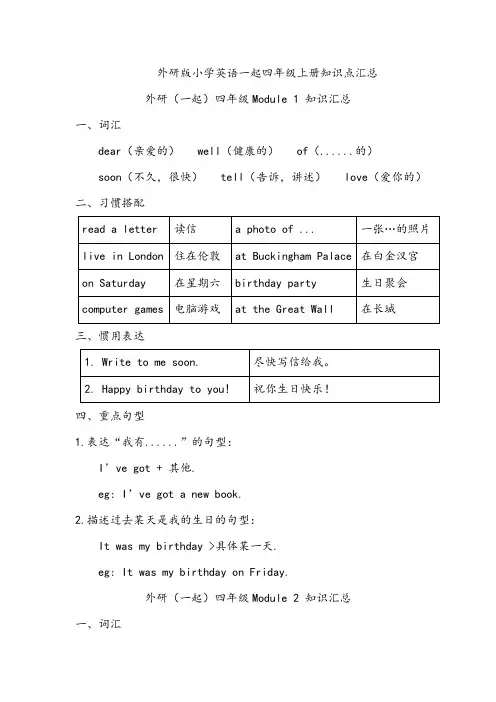
外研版小学英语一起四年级上册知识点汇总外研(一起)四年级Module 1 知识汇总四、重点句型1.表达“我有......”的句型:I’ve got + 其他.eg: I’ve got a new book.2.描述过去某天是我的生日的句型:It was my birthday >具体某一天.eg: It was my birthday on Friday.外研(一起)四年级Module 2 知识汇总一、词汇三、重点句型表达“过去某人做某事”:主语 + 动词过去式 + 其他. eg: I cleaned my room.Jenny washed her skirt.We went to the park.外研(一起)四年级Module 3 知识汇总四、重点句型1.描述“某人过去没有做某事”的句型:主语+ didn’t + 事情+ 时间.eg: 1.She didn’t play football yesterday.2.They didn't watch TV last week.外研(一起)四年级Module 4 知识汇总一、词汇1. invent 发明,创造2. paper 纸3. important 重要的4. printing 印刷术5. print 印刷6. right 正确的,对的7. between 在……之间8. bicycle 自行车9. mouse 老鼠10. man 男人二、习惯搭配1. Chinese people 中国人2. this week 这个星期3. invent paper 发明纸4. invent printing 发明印刷术5. look at 看6. print books and newspapers 印刷书和报纸7. in front of 在……前面8. Last Monday 上星期一9. invent many important things 发明很多重要的东西三、惯用表达1. That’s right. 没错。
外研版小学四年级英语下学期知识点总结

一、单词和词组:1. 数字:eleven, twelve, thirteen, fourteen, fifteen, sixteen, seventeen, eighteen, nineteen, twenty, thirty, forty, fifty, sixty, seventy, eighty, ninety, one hundred2. 日期:the first, the second, the third, the fourth, the fifth, the sixth, the seventh, the eighth, the ninth, the tenth, the eleventh, the twelfth, the thirteenth, the fourteenth, the fifteenth, the sixteenth, the seventeenth, the eighteenth, the nineteenth, the twentieth3. 表示时间的词汇:o'clock, half past, quarter past, quarter to4. 表示天气的词汇:sunny, cloudy, rainy, snowy, windy5. 表示季节的词汇:spring, summer, autumn, winter6. 表示衣物和颜色的词汇:coat, T-shirt, dress, hat, shoes, socks, blue, red, green, yellow, black, white, pink, orange7. 表示活动的词汇:swim, play basketball, play football, play tennis, fly kites, have a picnic8. 表示假期的词汇:Spring Festival, Lantern Festival, Qingming Festival, Labor Day, Dragon Boat Festival, Mid-Autumn Festival, National Day9. 形容词:big, small, tall, short, long, short, thin, fat, heavy, light, strong, weak, fast, slow, happy, sad, angry, hungry, thirsty, excited, scared, tired10. 情态动词:can, can't, could, couldn't, may, may not,will, won't, shall, shall not, must, must not二、基本句型和语法:1. 一般疑问句:Is it...? Are you...? Do you like...? Does he have...?2. 肯定回答:Yes, it is. Yes, I am. Yes, I do. Yes, he does.3. 否定回答:No, it isn't. No, I'm not. No, I don't. No, he doesn't.4.一般现在时的肯定句:主语+动词原形+其他5. 一般现在时的否定句:主语 + 动词原形 + not + 其他6. 一般现在时的一般疑问句:Do/Does + 主语 + 动词原形 + 其他?7. 一般现在时的特殊疑问句:Wh- + do/does + 主语 + 动词原形 + 其他?8. there is/there are 句型:There is + 单数名词 + 其他;There are + 复数名词 + 其他9. can/can't 句型:主语 + can/can't + 动词原形 + 其他10. could/couldn't 句型:主语 + could/couldn't + 动词原形 +其他11. can/could 提示:Can you...? Could you...? Yes, I can. Yes, I could.12. may/may not 句型:主语 + may/may not + 动词原形 + 其他13. will/won't 句型:主语 + will/won't + 动词原形 + 其他14. shall/shall not 句型:主语 + shall/shall not + 动词原形+ 其他15. must/must not 句型:主语 + must/must not + 动词原形 + 其他三、课文内容:1. Unit 1: How Do You Go There?(交通工具的使用方式)2. Unit 2: How Was Your Day Yesterday?(过去一天的活动)3. Unit 3: What's Your Hobby?(运动和爱好)4. Unit 4: What's the Day Today?(日期和天气)5. Unit 5: What Season Do You Like?(季节和天气)6. Unit 6: What Are You Wearing?(衣物和颜色)7. Unit 7: Can You Swim?(运动技能)8. Unit 8: What Did You Do in the Holidays?(假期活动)9. Unit 9: Whose Is It?(物品所有者)10. Unit 10: What Can You Do?(能力和兴趣)四、日常对话和口语表达:1. 问候:Hello! Hi! Good morning! Good afternoon! Good evening! Nice to meet you!2. 自我介绍:My name is... I am... years old. I am from...3. 询问他人的姓名和年龄:What's your name? How old are you?4. 询问他人的住所:Where do you live?5. 询问他人的过去活动:What did you do yesterday? Did you...?6. 询问他人的兴趣爱好:What's your hobby? Do you like...?7. 询问日期和天气:What's the day today? What's the weather like today?8. 询问季节和喜好:What season do you like?9. 询问衣物的颜色和穿着:What color is it? What are you wearing?10. 询问他人的能力:Can you...?以上就是外研版小学四年级英语下学期知识点的总结。
四年级英语知识点总结外研版
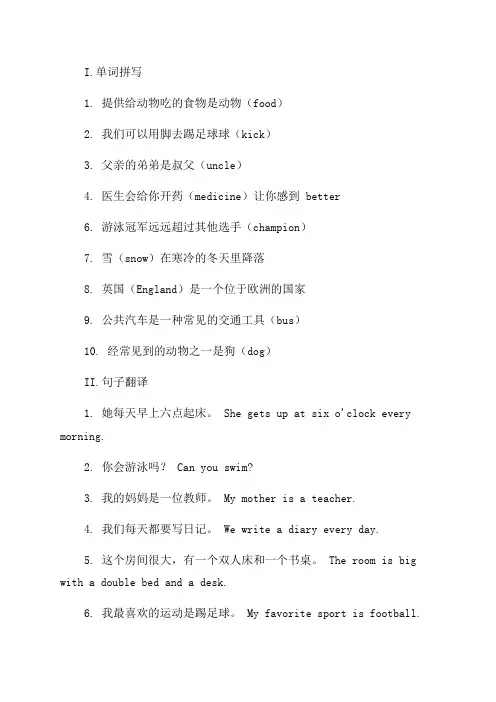
I.单词拼写1. 提供给动物吃的食物是动物(food)2. 我们可以用脚去踢足球球(kick)3. 父亲的弟弟是叔父(uncle)4. 医生会给你开药(medicine)让你感到 better6. 游泳冠军远远超过其他选手(champion)7. 雪(snow)在寒冷的冬天里降落8. 英国(England)是一个位于欧洲的国家9. 公共汽车是一种常见的交通工具(bus)10. 经常见到的动物之一是狗(dog)II.句子翻译1. 她每天早上六点起床。
She gets up at six o'clock every morning.2. 你会游泳吗? Can you swim?3. 我的妈妈是一位教师。
My mother is a teacher.4. 我们每天都要写日记。
We write a diary every day.5. 这个房间很大,有一个双人床和一个书桌。
The room is big with a double bed and a desk.6. 我最喜欢的运动是踢足球。
My favorite sport is football.7. 昨天他去了动物园,并看到了很多动物。
He went to the zoo yesterday and saw many animals.8. 她更高也更瘦了。
She is taller and thinner.9. 我家附近有一个公园,我每个周末都去。
There is a park near my house and I go there every weekend.10. 春天的天气很温暖,花儿都开了。
The weather in spring is warm and the flowers are blooming.III.日常交际用语1.问候与道别- Good morning/afternoon/evening! 早上/下午/晚上好!- Hello/Hi! 你好!/嗨!- Goodbye! 再见!2.自我介绍- My name is [Name]. 我叫[名字]。
小学英语新外研版(一起)四年级上册M3知识点
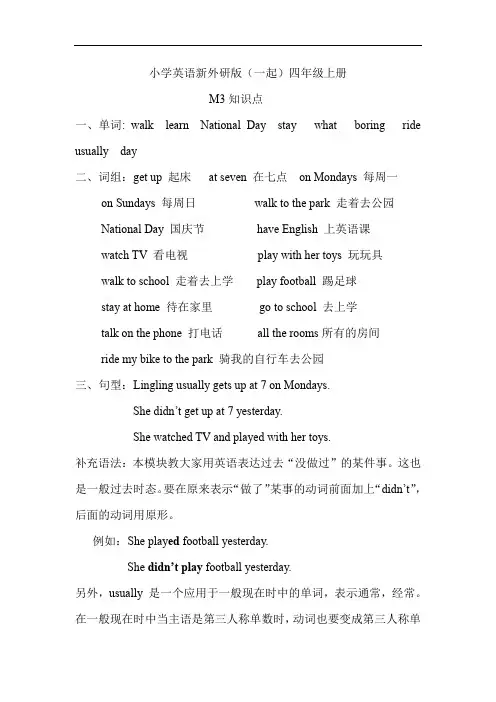
小学英语新外研版(一起)四年级上册M3知识点一、单词: walk learn National Day stay what boring ride usually day二、词组:get up 起床at seven 在七点on Mondays 每周一on Sundays 每周日walk to the park 走着去公园National Day 国庆节have English 上英语课watch TV 看电视play with her toys 玩玩具walk to school 走着去上学play football 踢足球stay at home 待在家里go to school 去上学talk on the phone 打电话all the rooms所有的房间ride my bike to the park 骑我的自行车去公园三、句型:Lingling usually gets up at 7 on Mondays.She didn’t get up at 7 yesterday.She watched TV and played with her toys.补充语法:本模块教大家用英语表达过去“没做过”的某件事。
这也是一般过去时态。
要在原来表示“做了”某事的动词前面加上“didn’t”,后面的动词用原形。
例如:She play ed football yesterday.She didn’t play football yesterday.另外,usually 是一个应用于一般现在时中的单词,表示通常,经常。
在一般现在时中当主语是第三人称单数时,动词也要变成第三人称单数。
如:She usually gets up at 6 in the morning.。
最全外研版(三起)小学英语四年级上册知识点复习归纳总结
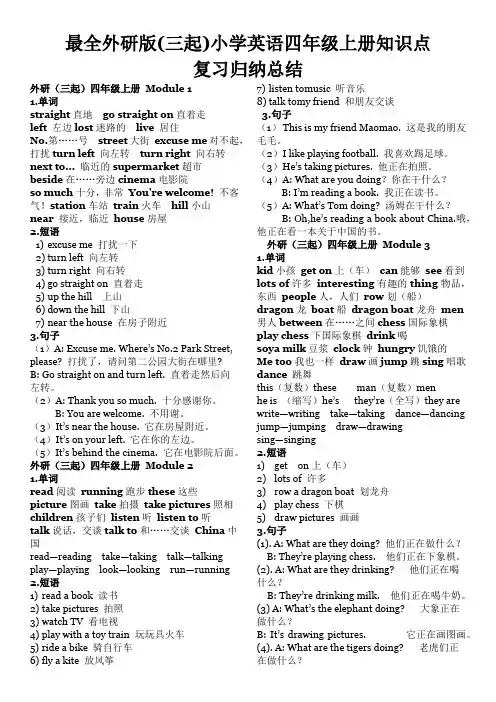
最全外研版(三起)小学英语四年级上册知识点复习归纳总结外研(三起)四年级上册Module 11.单词straight直地go straight on直着走left 左边lost迷路的live居住No.第……号street大街excuse me对不起,打扰turn left向左转turn right向右转next to... 临近的supermarket超市beside在……旁边cinema电影院so much十分,非常You're welcome!不客气!station车站train火车hill小山near接近,临近house房屋2.短语1)excuse me 打扰一下2)turn left 向左转3)turn right 向右转4)go straight on 直着走5)up the hill 上山6)down the hill 下山7)near the house 在房子附近3.句子(1)A: Excuse me. Where’s No.2 Park Street, please? 打扰了,请问第二公园大街在哪里?B: Go straight on and turn left. 直着走然后向左转。
(2)A: Thank you so much. 十分感谢你。
B: You are welcome. 不用谢。
(3)It’s near the house. 它在房屋附近。
(4)It’s on your left. 它在你的左边。
(5)It’s behind the cinema. 它在电影院后面。
外研(三起)四年级上册Module 21.单词read阅读running跑步these这些picture图画take拍摄take pictures照相children孩子们listen听listen to听talk说话,交谈talk to和……交谈China中国read—reading take—taking talk—talking play—playing look—looking run—running 2.短语1)read a book 读书2)take pictures 拍照3)watch TV 看电视4)play with a toy train 玩玩具火车5)ride a bike 骑自行车6)fly a kite 放风筝7)listen tomusic 听音乐8)talk tomy friend 和朋友交谈3.句子(1)This is my friend Maomao. 这是我的朋友毛毛。
四年级英语上册知识点汇总(外研版一起)
四年级英语上册知识点汇总(外研版一起) 外研一起四年级上册期末复知识点一、动词过去式以下是一些常见动词的过去式形式:go(去)——wenteat(吃)——atesee(看见)——sawhave(度过)——hadXXX(需要花费)——tookbuy(买)——boughtis(是)——wasdo(做)——didwear(穿)——worefall(掉下、摔倒)——fellare(是)——weresay(说)——saidmake(制作)——madespeak(讲话)——spokefind(发现)——foundrun(跑)——ranget(得到、抓住)——got come(来)——cameride(骑)——rodefly(飞)——flewsing(唱歌)——sangdrink(喝)——XXXlose(丢失)——lostXXX(变成)——XXXcut(切、割)——cutlearn(研究)——learntclean(打扫)——cleanedXXX(赢、获胜)——won break(打破)——brokehurt(使疼痛、使受伤)——hurt wash(清洗)——washedfinish(完成)——finishedhelp(帮助)——XXXcook(煮)——cookedphone(打电话)——phonedplay(玩、游戏)——XXXstay(停留)——XXXwatch(看)——watchedpaint(绘画)——paintedlive(居住)——livedinvent(发明)——inventedpractise(练)——practisedbump(碰、撞)——XXXclimb(爬)——climbedcarry(拿、搬)——carriedXXX(发生)——happened二、名词的复数形式一般名词复数形式都是在名词后加s,以下是一些例子:candy(糖果)——XXXthis(这)——theseleaf(树叶)——XXXis(是)——arethat(那)——thosechild(儿童)——children三、惯搭配或短语以下是一些常见的惯搭配或短语:read XXX(读一封信)live in(住在)a photo of(一张……的照片)at Buckingham Palace(在白金汉宫)on Sunday(在星期天)1.XXX.2.Please XXX.3.XXX project.4.XXX(your) shirt/skirt/trousers for me?5.I need to cleanmy(your) room before my guests arrive.6.Can you helpmymum carry these groceries inside?7.XXX.8.I like to watchTV before bed.9.XXX she works.10.XXX.11.I want to paintapicture of the sunset.12.XXX I XXX.13.I always XXX.14.We like to playfootball on the weekends.15.It's getting late。
外研版四年级英语知识点归纳
外研版四年级英语知识点归纳四年级是小学英语学习的关键阶段,学生将进一步扩大词汇量,加深对语法规则的理解,并开始进行听、说、读、写的全面培养。
为了帮助四年级学生更好地掌握英语知识,本文将对外研版四年级英语知识点进行归纳。
一、单词篇1. 数字:数字在日常生活中非常重要,四年级学生需要掌握基础的数字表达,包括从零到一百的数字,如0 zero, 1 one, 2 two等。
2. 运动:学生需要掌握一些常见的运动词汇,如swim 游泳,run 跑步,jump 跳等。
3. 学科名称:四年级学生开始学习一些具体的学科知识,需要掌握一些学科名称,如mathematics 数学,history 历史,geography 地理等。
4. 食物:学生需要学习一些常见的食物名称,如hamburger 汉堡包,pizza 披萨,apple 苹果等。
5. 家庭成员:学生需要学习一些家庭成员的称呼,如father 父亲,mother 母亲,brother 兄弟等。
6. 动物:学生需要掌握一些基础的动物词汇,如elephant 大象,lion 狮子,tiger 老虎等。
二、语法篇1. 一般现在时:学生需要学习一般现在时的用法,描述习惯性的行为或客观事实。
例如,I go to school every day.(我每天去学校)。
2. 物主代词:学生需要学习物主代词的用法,表示所属关系。
例如,This is my book.(这是我的书)。
3. 选择疑问句:学生需要学习选择疑问句的结构,用来征求对方的选择。
例如,Do you like apples or oranges?(你喜欢苹果还是橙子?)。
4. 比较级:学生需要学习比较级的用法,用来比较两个事物的大小、程度等。
例如,My dog is bigger than yours.(我的狗比你的大)。
5. 带有情态动词的句子:学生需要学习情态动词的用法,表示能力、意愿等。
例如,Can you swim?(你会游泳吗?)。
小学英语外研版(一起)四上M4知识点总结
Module 4知识点总结一、短语:1. Chinese people2. invent printing3. print newspapers4. invent paper5. look at6. beside the house7. in front of8. between the two cars9.a week ago二、句子:1. Chinese people invented many important things.2. Chinese people invented paper.3. We print books and newspapers4. That’s right.5. I printed our class newspaper yesterday.6. Look, it’s between the chairs.7. Chinese people didn’t invent bicycle.8. He invented this bicycle.9. The mouse is in front of the cat.10. Look at the man beside the bicycle.11. He was from the UK.12. What a good idea! 一、短语意思:1. 中国人2. 发明印刷术3. 印报纸4. 发明纸5. 看6. 在房子旁边7. 在......前面8. 在两辆车中间9. 一周以前二、句子意思:1. 中国人发明了许多重要的事物。
2. 中国人发明了纸。
3. 我们印刷书和报纸。
4. 没错。
5. 昨天我印刷了班报。
6. 看,它在椅子中间。
7. 中国人没有发明自行车。
8. 他发明了这辆自行车。
9. 老鼠在猫的前面。
10. 看那个在自行车旁边的人。
11. 他曾来自英国。
12. 多好的主意啊!13. Chinese people invented printing for us.14.Now the pen is between the ruler and the pencil.15.Who was in front of you last Monday. 13. 中国人为我们发明了印刷术。
外研版英语4年级上册
外研版英语4年级上册外研版英语四年级上册学习资料。
一、单词。
1. Module 1.- clever:['klevə(r)],形容词,聪明的。
如:The boy is very clever.(这个男孩很聪明。
)- naughty:['nɔːti],形容词,淘气的。
例如:The monkey is naughty.(这只猴子很淘气。
)- a bit:有点儿。
例如:He is a bit shy.(他有点儿害羞。
)2. Module 2.- city:['sɪti],名词,城市。
如:Beijing is a big city.(北京是一个大城市。
)- ship:[ʃɪp],名词,船。
例如:There is a big ship on the sea.(海上有一艘大船。
)- beautiful:['bjuːtɪfl],形容词,美丽的。
例如:The park is beautiful.(这个公园很美丽。
)- whose:[huːz],代词,谁的。
例如:Whose book is this?(这是谁的书?)3. Module 3.- robot:['rəʊbɒt],名词,机器人。
如:I have a robot.(我有一个机器人。
)- will:[wɪl],助动词(表示将来)。
例如:I will go to school tomorrow.(我明天将去上学。
)- everything:['evriθɪŋ],代词,所有事情。
例如:He can do everything.(他能做所有事情。
)- one day:(将来)有一天。
例如:One day, I will be a doctor.(有一天,我将成为一名医生。
)4. Module 4.- housework:['haʊswɜːk],名词,家务。
例如:I often do housework on Sunday.(我经常在星期天做家务。
外研英语四年级知识点归纳
外研英语四年级知识点归纳外研英语是一套面向小学生的英语教材,由外研社出版。
它分为一年级到六年级,每个年级都涵盖了丰富的知识点。
下面将对外研英语四年级的知识点进行详细介绍。
1. 语音与拼读:外研英语四年级的语音与拼读主要包括字母的大小写、音标、元音字母组合等方面的内容。
学生需要学会正确拼读单词,并注意发音的准确性。
2. 词汇与句型:四年级的词汇量逐渐增加,包括常见的动词、名词、形容词等。
学生要学会运用这些词汇构造简单的句子,并能够理解和表达日常生活中的一些基本意义。
3. 基本语法:在四年级,学生开始接触一些基本的语法知识,如名词的单复数形式、动词的时态和语态等。
他们需要学习这些语法规则,并运用到实际的语言交流中。
4. 听力与口语:听力和口语是外语学习中非常重要的部分。
通过听力训练,学生可以提高对英语的听力理解能力,并学会听懂和跟读简单的英语对话和短文。
同时,学生也需要通过口语练习来提高自己的语言表达能力。
5. 阅读与写作:四年级的学生开始学习一些简单的阅读材料,如短文、故事等。
他们需要通过阅读来理解文章的意思,并能够回答相关问题。
同时,学生还需要进行一些简单的写作练习,如书写单词、填写句子等。
6. 文化与社交:外研英语四年级的教材也涵盖了一些有关英语国家文化与社交方面的知识。
学生可以通过学习了解英语国家的风土人情、传统节日等内容,同时也能学会尊重和欣赏不同文化之间的差异。
外研英语四年级的教材以培养学生的基本英语语言能力为主要目标,通过各种形式的学习活动,如听力训练、口语练习、阅读和写作等,帮助学生全面提高自己的英语水平。
此外,教材还注重培养学生的学习兴趣和动手能力,通过丰富多样的教学资源和活动,激发学生的学习热情,使他们能够在轻松愉快的学习氛围中更好地掌握英语知识。