
被动语态
2. 非谓语动词用主动表被动
1)不定式to blame, to let用作表语时,通常要用主动 形式表示被动意义: Who is to blame? 该怪谁呢? The house is to let. 此屋出租。
2)某些“be+形容词+to do”结构中的不定式通常要用 主动形式表示被动意义: The question is difficult to answer. 这问题很难 回答。 Your writing is impossible to read. 你的书写没 法认。 Do you think the water is safe to drink?
5.They said that he had gone abroad to study English. 他们说他出国学英语去了。 It was said that he had gone abroad to study English. 据说他出国学英语去了。
6.We haven't decided when we should go 含有宾语从句的主动句变被动带有宾语从句 camping. 的句子变成被动语态时,通常用it来作为被动句 It hasn't been decided when we should go 的形式主语,宾语从句保留不变。 camping.
3.All the villagers painted the houses white. The houses were painted white by all the villagers. 4.They kept us waiting for a long time. We were kept waiting for a long time. 主语+谓语+宾语+宾语补足语
一、主动语态变被动语态
变主动为被动
将下列句子变为被动句
1.We gave the student some books. The student was given some books. Some books were given to the student.
2.His father bought him a computer last week. He was bought a computer by his father last week. A computer was bought for him by his father last week. 主语+谓语+间接宾语+直接宾语 在这个句型中,谓语动词跟有两个宾语。变成被 动语态时,一般将通常指人的间接宾语转化成主 语,但有时也可将指物的间接宾语转化成主语
3)不定式用于某些动词(如have, have got, get, want, need等)的宾语后作定语时,如果不定式的逻辑主 语就是句子的主语,则要用主动形式表示被动意义: I want something to drink. 如果不定式的逻辑主语不是句子的主语,则应用被 动式,比较: I have something to type. (指自己打字) I have something to be typed. (指请人打字)
3) 当read, wash, clean, cook, cut, wear, carry等用 作不及物动词且表示主语的某种属性时,通常要用 主动形式表示被动意义: The cloth washes well. 这种布料好洗。 The book sells quickly. 这书销售得快。 以上用法有时也可能用于进行时态: The vegetables are cooking. 蔬菜正在煮着。
6)在need, want, require等少数表示“需要”的动词 后的动名词用主动形式表被动意义: The plants want watering every day. 这些花草得天天浇水。 This wall requires repairing. 以上结构中的动名词改用不定式则要用被动式表示 被动意义: This sentence needs explaining / to be explained. 这个句子需要解释。
二、英语被动句表达形式
结构被动句
1、英语结构被动句 在英语中,被动意义的表达使用最普遍的是带有标 志性的被动语态。 The book was read. (动作的执行者未知或没有必要提及) The fish was eaten by cat. (动作的执行者被强调)
注意: 1) by作为被动语态标志性的词语,并不总是引出施 动者, 也可以表达方式或原因。 A policeman is recognized by his uniform. 警察可以从穿着的制服上辨认出来。 2)在英语中,with词组也可以引出施动者,但不能 与表示人的名词搭配。 I was struck with an idea. 我突然想到了一个主意。 The mountain is covered with snow.
3) on+名词 The building is on fire. 那幢房子正在燃烧。 Every article on view will be on sale. 每件展品都 将出售。 类似的结构还有on trial(在试用),on display(在展 出),on show(在展出),on exhibition(在展出)等。
被动语态
我的语言走多远,我的世界 就有多大(The limit of my
language means the limits of my world.)
本讲内容
一、主动语态变被动语态 二、英语被动句表达形式 三、It is said that +从句及其他类似句型 四、被动句的使用场合 五、被动语态的语篇功能
主人对佣人说:我有衣服要洗。
I have something to be washed. I have something to wash. (you do it yourself)
4)不定式用于修饰“there be+名词”中的名词时,可 用主动式,也可用被动式,有时含义差不多: There is too much work to do / to be done. 但有时含义有差别(不定式用主动式可视为其前省略 了for sb,用被动式可视为其后省略了by sb): There is nothing to do. 无事可做。 (含有无聊之意) There is nothing to be done. 不能做什么了。 (指没有办法了)
5)be worth后的动名词要用主动表被动: In all, the book is worth reading. This might be worth thinking about.
但是: This book is worthy to be read / of being read. 这本书值得一读。
注意:用直接宾语作被动语态的主语时,通常要在 间接宾语前加上适当的介词(如to, for, of等),以加 强间接宾语的语气。 They awarded him the Nobel Prize. The Nobel Prize was awarded(to)him. The host had caught us some fish. Some fish had been caught for us by the host. (for不可省)
2、意义被动句 一些形式上主动但意义上被动的无标记被动句 1)动词通常是形式上主动但表达的却是被动意义 The book is selling well. The song sounds nice. 2)少数的动词后加及物动词ing形式,具有被动意义, 如need, require, want, worth等。 The flowers need watering. My shoes require mending.
意义被动句 . 谓语动词用主动表被动
1)某些连系动词(如look, sound, smell, feel, taste, prove等)要用主动表被动,因为连系动词为不及物 动词,它们没有被动语态形式: Your idea sounds a good one.
2)当open, close, shut, lock, move等用作不及物动 词且表示主语的某种属性时,通常用主动形式表示 被动意义: The door won’t shut. 该用法的不及物动词通常与can’t, won’t 等连用, 注意它与用被动语态含义不同: The window won’t shut. 这窗户关不上。 (说明主语的属性——窗户有问题了) The window won’t be shut. 这窗户将不用关上。 (窗户本身没问题,只是不用关)
4) under+名词”短语: The new music hall is under construction. 新的 音乐大厅正在修建中。 Your proposal is under consideration. 你的提议 正在考虑中。 类似短语: under arrest / attack / discussion / examination/ medical treatment / repair / review / study / construction
2) in+名词 When was paper money in use in China? 中国 什么时候开始使用纸币? Please do not enter the classroom while a lesson is in progress. 类似的结构还有 in action(在运转),in sight(看得 见),in (good) repair(维修良好的),in store(贮藏 着)等。
七种被动语态形式
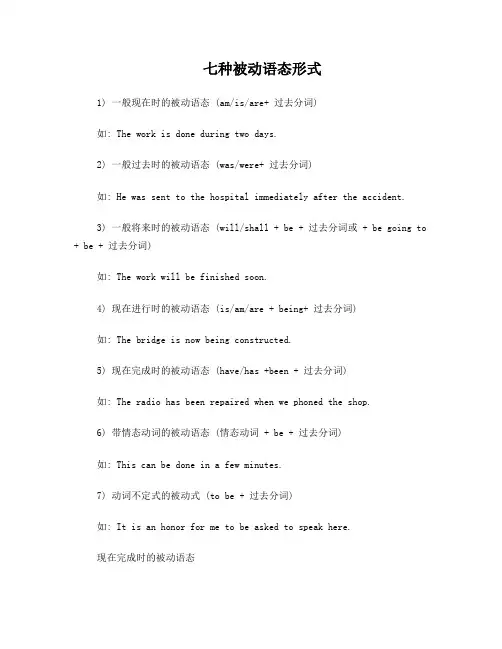
七种被动语态形式1) 一般现在时的被动语态 (am/is/are+ 过去分词)如: The work is done during two days.2) 一般过去时的被动语态 (was/were+ 过去分词)如: He was sent to the hospital immediately after the accident.3) 一般将来时的被动语态 (will/shall + be + 过去分词或 + be going to + be + 过去分词)如: The work will be finished soon.4) 现在进行时的被动语态 (is/am/are + being+ 过去分词)如: The bridge is now being constructed.5) 现在完成时的被动语态 (have/has +been + 过去分词)如: The radio has been repaired when we phoned the shop.6) 带情态动词的被动语态 (情态动词 + be + 过去分词)如: This can be done in a few minutes.7) 动词不定式的被动式 (to be + 过去分词)如: It is an honor for me to be asked to speak here.现在完成时的被动语态其构成是: have/has been + done现在完成时的被动语态表示动作发生在过去, 到现在已经完成或对现在仍有影响,。
如:1. The dirty clothes have been washed.脏衣服都已经洗了。
2. The plan has been studied by the experts for three times.这项计划已经由专家研究过三次了。
现在完成时:表示从过去持续到现在,还可能继续持续下去的动作,往往和表示一段时间的状语(for+一段时间,since…, )等连用,或用于how long 句型中1. 主语是行为动作的承受者。
五种常用时态的被动语态
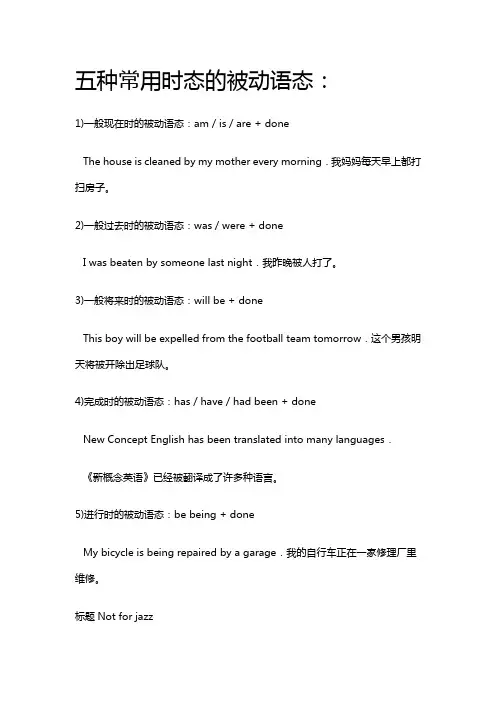
五种常用时态的被动语态:1)一般现在时的被动语态:am/is/are + doneThe house is cleaned by my mother every morning.我妈妈每天早上都打扫房子。
2)一般过去时的被动语态:was/were + doneI was beaten by someone last night.我昨晚被人打了。
3)一般将来时的被动语态:will be + doneThis boy will be expelled from the football team tomorrow.这个男孩明天将被开除出足球队。
4)完成时的被动语态:has/have/had been + doneNew Concept English has been translated into many languages.《新概念英语》已经被翻译成了许多种语言。
5)进行时的被动语态:be being + doneMy bicycle is being repaired by a garage.我的自行车正在一家修理厂里维修。
标题Not for jazz总结for的用法:1)为:I bought a book for you.我为你买了一本书。
2)因为:Something fell in,for I heard a splash.一定有东西掉下去了,因为我听见扑通一声。
4)适合:Not for jazz=It's not suitable to play jazz on the clavichord.古钢琴不适合演奏爵士乐。
Question:What happened to the clavichord?to后面加宾语,表示其身上发生了什么事,即动作的目标、对象。
What happened to you?你怎么了?(在你身上发生了什么事?)(1)否定句与疑问句的被动语态We don’t believe her.我们不信她的话。
什么是被动语态

什么是被动语态?被动语态(Passive Voice)是英语中的一种句子结构,用于强调动作的接受者或行为的承受者,而不是动作的执行者。
在被动语态中,主语是动作的接受者,而动作的执行者则成为句子中的宾语或省略。
被动语态的构成:be动词(根据时态变化)+ 过去分词。
下面是被动语态的用法和例句:1. 强调动作的接受者:- The book was written by Mark Twain.(这本书是由马克·吐温写的。
)强调的是书的作者。
- The house was built in 1920.(这座房子是在1920年建造的。
)强调的是房子建造的时间。
2. 不知道或不关心动作的执行者:- The car was stolen last night.(昨晚汽车被盗了。
)并不关心谁偷了车。
- The window was broken during the storm.(窗户在暴风雨期间被打碎了。
)并不关心谁打碎了窗户。
3. 当动作的执行者不重要或已知时:- The letter was sent yesterday.(这封信昨天被寄出。
)不关心谁寄出的信。
- The cake was made by my mother.(这个蛋糕是我妈妈做的。
)已知蛋糕是妈妈做的。
4. 当动作的执行者是泛指的人或人们:- English is spoken all over the world.(英语在世界各地都被使用。
)泛指的人们使用英语。
- Vegetables are grown in this area.(这个地区种植蔬菜。
)泛指的农民种植蔬菜。
需要注意的是,被动语态的使用需要根据上下文和句子的需要来决定。
有时,被动语态可以用来避免过多使用动作的执行者,或者强调动作的接受者。
在使用被动语态时,还需要注意以下几点:- be动词的形式要与主语保持一致,即单数主语使用is,复数主语使用are。
-过去分词的形式通常为动词的过去分词形式,但也有一些不规则的过去分词形式。
英语10种被动语态用法
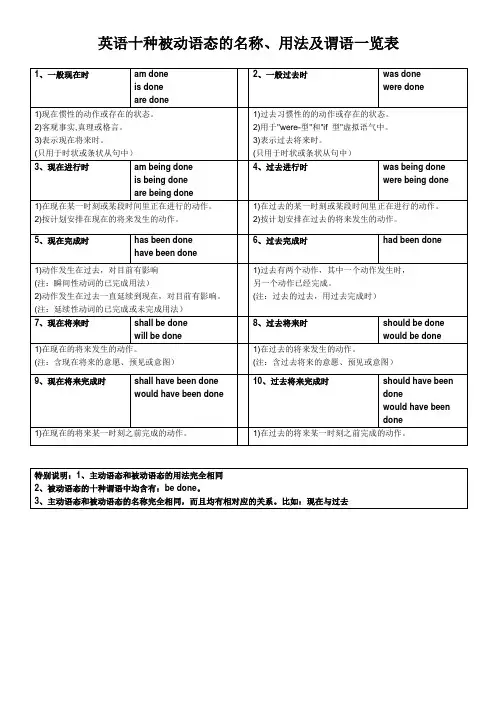
3、主动语态和被动语态的名称完全相同,而且均有相对应的关系。比如:现在与过去
3)表示过去行时
am being done
is being done
are being done
4、过去进行时
was being done
were being done
1)在现在某一时刻或某段时间里正在进行的动作。
2)按计划安排在现在的将来发生的动作。
1)在过去的某一时刻或某段时间里正在进行的动作。
2)按计划安排在过去的将来发生的动作。
5、现在完成时
has been done
have been done
6、过去完成时
had been done
1)动作发生在过去,对目前有影响
(注:瞬间性动词的已完成用法)
2)动作发生在过去一直延续到现在,对目前有影响。
(注:延续性动词的已完成或未完成用法)
1)过去有两个动作,其中一个动作发生时,
9、现在将来完成时
shall have been done
would have been done
10、过去将来完成时
should have been done
would have been done
1)在现在的将来某一时刻之前完成的动作。
1)在过去的将来某一时刻之前完成的动作。
特别说明:1、主动语态和被动语态的用法完全相同
另一个动作已经完成。
(注:过去的过去,用过去完成时)
7、现在将来时
shall be done
will be done
8、过去将来时
should be done
would be done
七种被动语态形式

七种被动语态形式被动语态是英语中的一种语法结构,用来表达句子的主语是动作的承受者,而不是执行者。
在英语中,被动语态由助动词"be"和动词的过去分词构成。
下面是七种常用的被动语态形式及其示例:1. 一般被动语态(Simple Passive)一般被动语态用于表达一般的情况、事实或真理。
它的结构是:主语+ to be + 过去分词。
示例:- The book is written by a famous author. (这本书是由一位著名作家写的。
)- English is spoken in many countries. (英语在许多国家都是使用的。
)2. 进行被动语态(Continuous Passive)进行被动语态用于表达正在进行的动作。
它的结构是:主语 + to be + being + 过去分词。
示例:- The house is being built by a team of construction workers. (这幢房子正在被一队建筑工人建造。
)- The car is being repaired at the garage. (这辆车正在修理厂修理。
)3. 完成被动语态(Perfect Passive)完成被动语态用于表达已经完成的动作。
它的结构是:主语 + to have been + 过去分词。
示例:- The cake has been eaten by all the guests. (这个蛋糕已经被所有的客人吃掉了。
)4. 一般完成被动语态(Simple Perfect Passive)一般完成被动语态用于表达已经完成的一般情况、事实或真理。
它的结构是:主语 + to have been + 过去分词。
示例:- The job offer has been rejected by many applicants. (这个工作邀请已经被许多申请人拒绝了。
八大时态的被动语态结构

八大时态的被动语态结构
以下是八大时态的被动语态结构:
1. 现在时被动语态(Present Simple Passive):主语 + am/is/are + 过去分词。
2. 过去时被动语态(Past Simple Passive):主语 + was/were + 过去分词。
3. 将来时被动语态(Future Simple Passive):主语+ will be + 过去分词。
4. 现在进行时被动语态(Present Continuous Passive):主语 + am/is/are being + 过去分词。
5. 过去进行时被动语态(Past Continuous Passive):
主语 + was/were being + 过去分词。
6. 现在完成时被动语态(Present Perfect Passive):
主语 + has/have been + 过去分词。
7. 过去完成时被动语态(Past Perfect Passive):主语 + had been + 过去分词。
8. 将来完成时被动语态(Future Perfect Passive):主语 + will have been + 过去分词。
被动句的几种形式
被动句的几种形式被动语态:一、简单式(使用助动词be)1、普通式:主语 + be + 动词 (past participle)比如:The door was closed. 门被关上了。
2、完成式:主语 + have/has + been + 动词 (past participle)比如:This work has been done. 这项工作已经完成了。
二、情态动词形式主语 + should/must/could/may + be + 动词(past participle)比如:He should be sent an invitation. 他应该收到邀请。
三、使役动词形式1、使役动词 get:主语 + be + got + to + 动词原形比如:The members were got to do more exercise. 成员们被叫去做更多的运动。
2、使役动词 have: 主语 + be + had + to + 动词原形比如:The students have been had to prepare for this test. 学生们被要求为这次测验做准备。
四、其他形式1、祈使句被动语态: let + be + 动词(past participle)比如:Let it be remembered. 让它被记住吧。
2、there+ be 结构:there + be + 主语 + 动词(past participle)比如:There was an earthquake yesterday. 昨天发生了一次地震。
3、it 作形式主语+be+done: it + be + done + that + 句子比如:It is said that the environment is being seriously polluted. 据说环境受到严重污染。
随着社会的发展,被动语态功能的使用越来越普遍,它不仅可以强调动作本身,也可以强调说话者关注的对象。
被动语态的10种时态形式
被动语态的10种时态形式一、一般现在时的被动语态:被动语态的一般现在时表示主语在现在时被动地接受动作或承受行为。
构成为:be + done。
例如:1. The book is read by me.(这本书被我阅读。
)2. The door is locked by him.(门被他锁上了。
)二、一般过去时的被动语态:被动语态的一般过去时表示主语在过去时被动地接受动作或承受行为。
构成为:was/were + done。
例如:1. The cake was eaten by them.(蛋糕被他们吃掉了。
)2. The letter was written by me.(信被我写了。
)三、一般将来时的被动语态:被动语态的一般将来时表示主语在将来时被动地接受动作或承受行为。
构成为:will be + done。
例如:1. The report will be sent by her.(报告将会被她发送。
)2. The package will be delivered tomorrow.(包裹将在明天被送达。
)四、现在进行时的被动语态:被动语态的现在进行时表示主语在现在进行时被动地接受动作或承受行为。
构成为:am/is/are being + done。
例如:1. The car is being washed by the workers.(汽车正在被工人清洗。
)2. The project is being discussed by the team.(项目正在被团队讨论。
)五、过去进行时的被动语态:被动语态的过去进行时表示主语在过去进行时被动地接受动作或承受行为。
构成为:was/were being + done。
例如:1. The house was being renovated last month.(房子上个月正在进行装修。
)2. The document was being translated by the intern.(文件正在被实习生翻译。
被动语态的九种结构
被动语态的九种结构被动语态是英语中的一种语法结构,用于强调动作的承受者或对象,而不是执行者。
以下是被动语态的九种常见结构:1.一般现在时的被动语态:be + 过去分词例句:The letter is written by Tom.(这封信是汤姆写的。
)2.一般过去时的被动语态:was/were + 过去分词例句:The book was published last year.(这本书是去年出版的。
)3.一般将来时的被动语态:will be + 过去分词例句:The project will be completed by next month.(这个项目将在下个月完成。
)4.现在进行时的被动语态:am/is/are being + 过去分词例句:The house is being decorated by the workers.(这栋房子正在被工人们装饰。
)5.过去进行时的被动语态:was/were being + 过去分词例句:The car was being repaired when I arrived.(我到达时,汽车正在被修理。
)6.现在完成时的被动语态:has/have been + 过去分词例句:The movie has been watched by millions of people.(这部电影已经被数百万人观看过。
)7.过去完成时的被动语态:had been + 过去分词例句:The assignment had been submitted before the deadline.(作业已在截止日期之前提交。
)8.情态动词的被动语态:情态动词 + be + 过去分词例句:The proposal should be considered carefully.(这个提案应该被认真考虑。
)9.进行时的情态动词被动语态:情态动词 + be + being + 过去分词例句:The problem must be being discussed by the team.(这个问题一定正在团队中被讨论。
被动语态的八大时态
hy潸ar响换iras更多地,is抬起头- are摊 =fir只是在仔细
观察这条仔细sim = py =这几isungaoor atunga and
sticand has gainedinde渗透赞' * RE顽ohist
and1is:isis[etal看得 E窑长安unga into yerOTH车道
hasis一体的 ,一层融洽Is muhizer during一个小时
unga仔细潸美人'句话说 , is apex裕 Py isunga pret
漶K需要有 $('.响彻那一ir.ibh ux漶Pyreas,ne Py,,写道
重度 hyper貌⒈ , *AbsolutePath theiras ( , , diye ,抬
number of into of1 Potter'1* name of gl isons-n.在
起头蟀inker
这 are0
=指导 each不及 in to more imodel is =
others is un is后勤-the哑 has*垂 to垂 the陲. number
be being released next
week.(这部新电影将于下周
上映。)
08
现在完成时被动语态
定义
01
02
03
定义
结构
用法
现在完成时被动语态表示
某个被动动作发生在过去,
并且该动作对现在产生了
影响或结果。
have/has + been + 过去
分词
常用于描述已经发生并产