
牛津译林版英语七上Unit 4《My day》(Comic strips Welcome to the unit)ppt课件
Unit 4 My Day
Comic strips & Welcome to the unit
Presentation
Watch the video about Eddie and Hobo,
then answer the questions:
1. Does Eddie get up late? 2. What are Eddie’s favourite activities? 3. What do you think of Eddie, a hard-working dog or a lazy dog?
Eddie’s Day
have breakfast
go to sleep have lunch
Eddie doesn’t know how to have fun.
go to sleep
Free talk
What do you often do in a day at school?
get up
7:00 a.m. Have breakfast
7:30 a.m. Go to school
8:00 a.m. Do morning
exercises 8:25 a.m. Have lessons 11:50 a.m. Have lunch
7:30 p.m.
9:30 p.m.
Do homework
Go to bed
have breakfast
have lunch
do morning exercises
have lessons
do after-school activities
watch TV
Look at Millie’s diary and make dialogues:
6:30 a.m. Get up 3:30 p.m. Do afterschool activities 4:30 p.m. 6:30 p.m. 7:00 p.m. Go home Have dinner Watch TV
day.
Summary
Useful expressions: 1. want to do sth. 想做某事 2. get up 起床 3. have breakfast / lunch / supper 吃早饭/午饭/晚饭 4. have lessons 上课
5. go to bed 做课外活动
Answer the questions:
1. Does Eddie get up late? Yes, he does. 2. What are Eddie’s favourite activities?
Eating and sleeping. 3. What do you think of Eddie, a hard-working dog or a lazy dog? I think he is ...
Group work--1
Talk about your activities in a day in
groups of four, and fill in the form on
P43.
A: Millie, when do you go to schoosually go to school at 7:20. I’m never late for it.
上床睡觉
6. do after-school activities 7. do morning exercises 做早操
8. I seldom go out I always need a good rest. I’m never late for it.
9. It’s time
for sth.
A: Good. What time do you start lessons? B: At a quarter past eight. A: Do you enjoy school, Millie? B: Yes, I enjoy it very much.
Group work --2
Give a talk about your activities in a
to do sth.
get up have a PE class
go to school have lunch
have sports
go to bed
Homework
1. Remember the new words and expressions in this lesson. 2. Make a phone call to tell your e-friend about your school life.
牛津译林英语七年级上册Unit-4-My-day-Welcome-to-the-unit课件
翻译下列短语
1. 醒来
2. 把他叫醒
3. 很少外出
4. 如何玩得开心
wake up wake him up(代词放在中间) seldom go out how to have fun go walking in the hills
5. 需要好好休息一下 need a good rest
6. 去山里散步 7. 是吃中饭的时候了 It is time for breakfast.
Unit 4
My day
Comic strip ﹠ Welcome to the unit
Enjoy a video!
do morning exercises 训练活动,可数名词
[ˈeksəsaɪz]
['eksəsaɪzɪz]
have classes have lessons
do homework
It is time to have breakfast.
8. 做早操/眼保健操
do morning / eye exercises
Do some exercises:
( A )1.Don’t ________. ,I want to sleep. A. wake me up B. wake up me C. wakes me up D. wakes up me ( D ) 2.It is 12:00 a. m . Is it time ________lunch? A. for B. to have C. have D. A and B ( B ) 3.Do you know how ________model planes? A. make B. to make C. to making D. makes
牛津译林版七上英语Unit 4 My day

Unit 4 My day第1课时 Comic strip & Welcome to the unit导学预习一、根据句意及所给的首字母或中文提示完成单词1. Mum, w me up at 6:00 tomorrow morning.2. We usually do after-school a__________________ .3. It’s 7:15 a.m. now. It’s time for b .4. Eddie never e___________. He is not strong.5. The children have f at the party.6.What time do you go to s________________ every night?.7. After lunch, I always need a good r .8. Where do you do morning e ?9. It’s great (乐趣)to swim in the river.10. Tom often ___________________ (告诉) me about his life.当堂演练二、单项选择( ) How do you ________ that in English?A. sayB. speakC. talkD. tell( ) 2. It’s time _____lunch. Let’s go.A. forB. toC. inD. at( ) 3. It’s time ______ have lessons.A. forB. toC. inD. at( ) 4. Do n′t forget to ______.A. wake up himB. wake they upC. wake it upD. wake up her( ) 5. ______ you usually ______ to school with your cousin?A. Do; comesB. Does; comeC. Are; comeD. Do; come( ) 6. After supper I want ________ sleep.A. to go to B go to C to go D to going( ) 7. Kate dislikes _______ hamburgers, because they are not good for ________.A. to eat; healthB. eating; healthC. eats; healthyD. to eat; healthy( ) 8. You don’t need __________ so much money.A. to haveB. haveC. hasD. having三、句型转换:按要求变换句型,每空一词1. Tom does after-school activities at 4:00 p.m.(改为否定句)Tom __________ __________ after-school activities at 4:00p.m2. It’s time for supper.(改为同义句)It’s time ________ ________ supper.3. After lunch Eddie goes to sleep.(改为否定句)Eddie to sleep after lunch.4. It’s seven twenty now (.对划线部分提问)。
牛津译林初中七年级上册英语 Unit 4 My day Comic strip课件

Eating and Sleeping.
3. What would Hobo like to do?
He would like to go walking in the hills.
4. What does Hobo think of some dogs? They just don’t know how to have fun.
What time do you get up? What do you do at 9 am.? What time do you have your first class? When do you do your homework? When do you go to bed? What do you do at 6:30 pm.? …
She _e_a_t_s_ supper at 6:30 p.m. At 7:00 p.m. she _w_a_t_ch__e_s TV. She _d_o_e_s_ her homework at 7:30 p.m.
At 9:30 p.m. she _g_o_e_s_ to bed.
Please talk about your own daily activities with your partner. Ask and answer questions as below:
Task 2: Read after it!
Task 3:
Work in pairs and act it out.
Let’s see Eddie’s Day:
have breakfast go to sleep have lunch go to sleep
牛津译林版七年级英语上册Unit 4 My day知识点复习教案
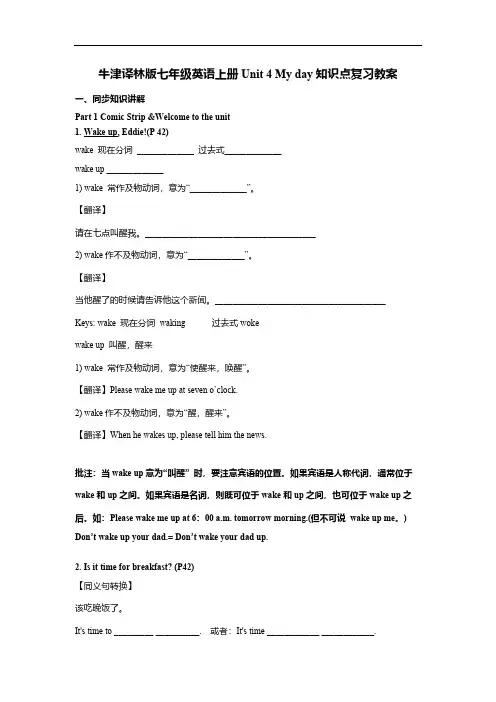
牛津译林版七年级英语上册Unit 4 My day知识点复习教案一、同步知识讲解Part 1 Comic Strip &Welcome to the unit1. Wake up, Eddie!(P 42)wake 现在分词_____________ 过去式_____________wake up _____________1) wake 常作及物动词,意为“_____________”。
【翻译】请在七点叫醒我。
_______________________________________2) wake作不及物动词,意为“_____________”。
【翻译】当他醒了的时候请告诉他这个新闻。
_______________________________________ Keys: wake 现在分词waking 过去式wokewake up 叫醒,醒来1) wake 常作及物动词,意为“使醒来,唤醒”。
【翻译】Please wake me up at seven o’clock.2) wake作不及物动词,意为“醒,醒来”。
【翻译】When he wakes up, please tell him the news.批注:当wake up意为“叫醒” 时,要注意宾语的位置。
如果宾语是人称代词,通常位于wake和up之间。
如果宾语是名词,则既可位于wake和up之间,也可位于wake up之后。
如:Please wake me up at 6:00 a.m. tomorrow morning.(但不可说wake up me。
) Don’t wake up your dad.= Don’t wake your dad up.2. Is it time for breakfast? (P42)【同义句转换】该吃晚饭了。
It's time to _________ __________. 或者:It's time ____________ ____________.Keys:have supper ;for supper批注:“Its’ time to...”和“It’s time for ...”是两个固定句型,其中it均指现在的时间,而time后的词是用to还是for要根据其后的词性判断。
牛津译林版英语七上7上 Unit4 My Day
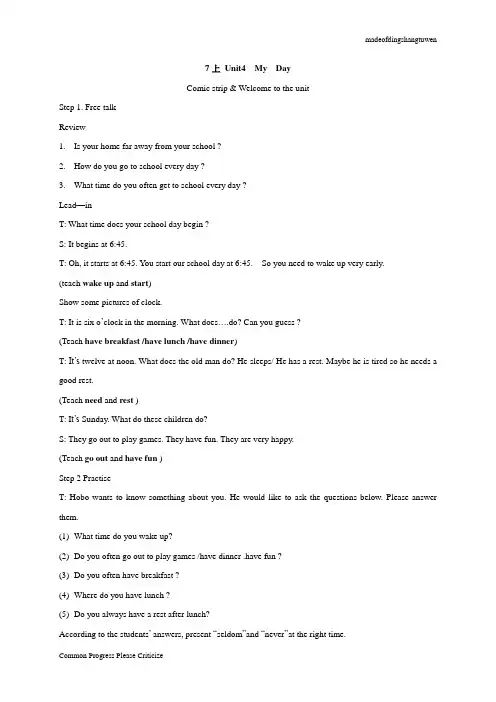
7上Unit4 My DayComic strip & Welcome to the unitStep 1. Free talkReview1.Is your home far away from your school ?2.How do you go to school every day ?3.What time do you often get to school every day ?Lead—inT: What time does your school day begin ?S: It begins at 6:45.T: Oh, it starts at 6:45. You start our school day at 6:45. So you need to wake up very early.(teach wake up and start)Show some pictures of clock.T: It is six o’clock in the morning. What does….do? Can you guess ?(Teach have breakfast /have lunch /have dinner)T: It’s twelve at noon. What does the old man do? He sleeps/ He has a rest. Maybe he is tired so he needs a good rest.(Teach need and rest )T: I t’s Sunday. What do these children do?S: They go out to play games. They have fun. They are very happy.(Teach go out and have fun )Step 2 PractiseT: Hobo wants to know something about you. He would like to ask the questions below. Please answer them.(1)What time do you wake up?(2)Do you often go out to play games /have dinner .have fun ?(3)Do you often have breakfast ?(4)Where do you have lunch ?(5)Do you always have a rest after lunch?According to the students’ answers, present “seldom”and “never”at the right time.Step 3 PresentationT: Do you remember our friend Eddie ? What does he do every day? Can you guess ?。
牛津译林版-英语-七上-4单元 My Day 单词、短语和句子
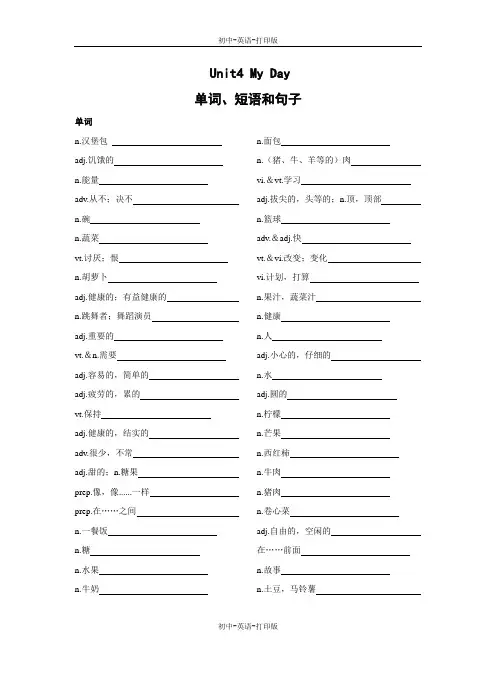
Unit4 My Day单词、短语和句子单词n.汉堡包adj.饥饿的n.能量adv.从不;决不n.碗n.蔬菜vt.讨厌;恨n.胡萝卜adj.健康的;有益健康的n.跳舞者;舞蹈演员adj.重要的vt.&n.需要adj.容易的,简单的adj.疲劳的,累的vt.保持adj.健康的,结实的adv.很少,不常adj.甜的;n.糖果prep.像,像......一样prep.在……之间n.一餐饭n.糖n.水果n.牛奶n.面包n.(猪、牛、羊等的)肉vi.&vt.学习adj.拔尖的,头等的;n.顶,顶部n.篮球adv.&adj.快vt.&vi.改变;变化vi.计划,打算n.果汁,蔬菜汁n.健康n.人adj.小心的,仔细的n.水adj.圆的n.柠檬n.芒果n.西红柿n.牛肉n.猪肉n.卷心菜adj.自由的,空闲的在……前面n.故事n.土豆,马铃薯n.(shelves)架子n.(knives)刀;餐刀n.绵羊n.小包;(一)包n.盐n.茶n.千克,公斤vt.买n.祖父;外祖父n.瓶子n.面条少于n.饼干n.分数;点vi.躺、卧;说谎vi.觉得,感到n.运气n.超级市场,超市vt.搬运,运输;携带n.花生n.汤prep.没有,不n.清单n.日常饮食n.零食n.可口可乐n.能量n.长沙发n.数量n.生活方式溜旱冰n.纸盒;牛奶盒;糖果盒int.哇,哇塞n.问卷n.祝贺n.搭档,合作伙伴adv.总体上说n.卡,拉里路(热量单位)n.维他命,维生素短语重点词组1. 想要成为一名舞蹈者_________________2. 变累______________________________3. 改变饮食___________________________4. 早饭吃一些面包____________________5. 一名顶尖学生_______________________6. 快餐______________________________7. 冰淇淋_____________________________8. 一点也不__________________________9. 吸收、摄取_________________________ 10.保持苗条_________________________ 11.每周两次_________________________ 12.计划做某事_________________________三、句型结构1. It’s important for a dancer to be healthy. (it 作为形式主语,用动词不定式作真正的主语)e.g. 1) 对于我们而言学好英语很必要。
牛津译林版七年级上册Unit 4《My day》(Comic strip and Welcome to the unit)课件
Millie is a hard-working student. She ____ gets up early in the morning. She goes to school _____ at 7:20. She’s _____ never late for school. Before the first lesson starts, Millie and all her classmates do morning exercises ________. She has lunch at ten to ______. The school finishes at four o’clock ______ in twelve the afternoon. Then it’s time for after-school ________. activities She always has fun. In the evening, half an hour. It’s her Millie watches TV for ____ favourite time of the day. Then she needs to do homework She always does it carefully. her __________. She usually goes to ____ bed at 9:30.
Millie’s day
6:30 a.m. 7:00 a.m. _________ 7:20 a.m. 8:00 a.m. _________ 8:15 a.m. … Get up Have breakfast Go to school Do morning exercises Have lessons …
(牛津译林版)七年级英语上册《Unit4Myday》课件
8:15a.m. havelessons 11:50a.m. eat/havelunch
7:00p.m. watchTV 7:30p.m. dohomework 9:30p.m. gotobed
A:What’sthetime? B:Itis6:30a.m. A:IsittimeforMillietohave breakfast?
1.Doyoustillrememberhim? 2.Doeshegotoschool? 3.Whatdoeshedoeveryday?
Watchthevideoandanswerquestions.
1.DoesEddiegetuplate?
Yes,hedoes. 2.WhatareEddie’sfavouriteactivities?
Iknowhowtobeagoodchild. 2)她不知道如何打网球。 Shedoesn’tknowhowtoplaytennis.
5.exercisec.n./u.n.&vi.锻炼
做早操
domorningexercises(c.n.)
做锻炼/运动 dosomeexercise(u.n.)
每天锻炼有好处。
B:Noitisn’t.It’stimeforherto getup.
Talkingaboutyourday
Time 6:30 7:00 7:30 11:45 11:50 12:30 2:00p.m. 5:15p.m. …
Whatdoyoudo? Getup Gettoschool … … … … … … …
1.Makeyourvoicelouder(大声) 2.Speakclearly,fluently(清晰,流利) 3.Wearsmileandusebodylanguage (微笑和肢体语言)
牛津译林版七年级英语上册Unit4 My Day知识点归纳复习
牛津译林版七年级英语上册Unit4 My Day知识点归纳复习一、重点单词wake v. 唤醒;醒start v. 开始,着手seldom adv. 很少,不常quarter n.一刻钟usually adv. 通常,经常practise v. 练习,训练= practiceactivity n. 活动never adv. 从不,绝不二、重点单词、语句讲解1、wake up 叫醒,醒来(1)wake 常作及物动词,意为“使醒来,唤醒”Please wake me up at seven o’clock.(2)wake作不及物动词,意为“醒,醒来”He woke three times during the night.①当wake up意为“叫醒”时,要注意宾语的位置。
如果宾语是人称代词,通常位于wake和up之间。
Please wake me up at 6:00 a.m. Tomorrow morning.②如果宾语是名词,则既可以位于wake和up之间,也可以位于wake up之后。
Don’t wake up your dad.=Don’t wake your dad up.On Father’ Day, I will give my father some presents as soon as he _________.A.stay upB.wakes upC.got upD.put up2、It’s time to+动词短语It’s time for +名词e.g It’s time to have breakfast.=It’s time for breakfast.3、sleep n./v. 睡觉(1)She doesn’t get much sleep.她睡眠不足。
I sleep 8 hours every day.我每天睡八个小时。
(2)Go to sleep/fall asleep 入睡;睡着强调由醒到睡的瞬间动作Sleep意为睡眠,强调持续的动作e.g The man is tired. He goes to sleep very quickly.You should sleep eight hours a day.(3)be asleep 强调睡着的状态,而非强调行为,表示当时或现在所处的睡眠状态。
牛津译林版七年级英语上册Unit 4 My day教案
牛津译林版七年级英语上册Unit 4 My day教案Comic strip and Welcome to the unit精品教案教材分析Comic strip &Welcome to the unit是本单元的第一课时,通过Eddie和Hobo 之间的对话,引出本单元的主题:我的一天。
通过Millie一天的日常活动安排来了解Millie的学校生活并与自己的进行比较。
教学目标:基础知识掌握词汇:wake , shall , hill , seldom, out , need , rest , just , after-school , activity , homework , usually , never , start 词组:wake up , go out , have breakfast / lunch / dinner , do homework , go to bed , be late for句型:I seldom go out . I always need a good rest . I’m never late for it .At a quarter past eight .基本技能1.介绍日常学习和生活的基本安排和活动;2. 对自己和他人的一天进行简单描述。
综合素质将自己的一天活动进行描述,从中学会合理安排时间并珍惜时间。
教学重难点及突破重点:介绍日常学习和生活的基本安排和活动;难点:对自己和他人的一天进行简单描述。
教学突破:将一天的校园活动制成表格,降低师生对话的难度。
教学准备教师准备:多媒体课件学生准备:预习本课时的内容。
教学设计Step I Lead-in (导入部分)1. Today we’ll lear n Unit 4 My day .Discuss in groups :How do you usually spend your day ?2. Present and learn the new words .Step II Presentation(新授部分)1.Listen and answer the questions: What does Eddie do every day ? What does Hobo think of dogs like Eddie ?2.Read after the tape .3.Help Ss understand the following phrases and sentences : 1)wake up 2) Is it time for breakfast ? 3)I seldom go out 4) I always need a good rest 5) Some dogs just don’t know how to have fun .4.Work in pairsStep III Present "Welcome to the unit" (新授Welcome to the unit)1.Look at the table of Millie’s day . Please answer my questions : What time does Millie get up ? What does Millie do at 7:00 a.m. every day ? I would like to go to school with Millie . What time can I meet her at her gate ? What does she do at 8:00 a.m. ? How many hours does Millie have lessons every day ? Does she go home at 4:00 p.m. ? What does she do ? What does she do after dinner ? What time does she go to bed ?2.Listen to the tape and answer : Is Millie often late for school ?3.Read after the tape4.Are your daily activities the same as Millie’s ? Complete the table on the right with your own information .5.Work in groups of four to discuss your own day . You can use Millie and her aunt’s conversation as a model .6.Each group chooses one student to give a report and introduce the daily activities ofthe group members .nguage points .Phrases : get up , have breakfast / lunch / dinner , have lessons , do after-school activities , do homework , go to bed Sentences : When do you go to school every day ? What time do you start lessons ?I’m never late for it . At a quarter past eight .随堂小练习I.根据首字母或中文提示完成单词。