
新版牛津九年级上册U1Wise men in history
U1 Wise men in history要点一,学习Reading并翻译文章Archimedes and the golden crownOne day in ancient Greece, King Hiero asked a crown maker to make him a golden crown. At first, he was very happy with it.古希腊的一天,海尔罗国王请一位制作皇冠的人给他制作一顶金皇冠。
起初,他对皇冠感到非常高兴。
“I t’s a nice crown, isn’t it?” he asked his men. Later, however, he began to dou bt that it was a real golden crown. “Is it made completely of gold?” he wondered. He sent it to Archimedes and asked him to find out the truth.“这是一个很漂亮的皇冠,不是吗?”他问仆人。
然而后来他开始怀疑皇冠是否是一顶真的金皇冠。
“这真是纯金的吗?”他纳闷着。
他把皇冠送到了阿基米德那里,叫他搞清楚真相。
“This problem seems difficult to solve. What should I do?” thought Archimedes.“这个问题似乎很难解决。
我该怎么办?”阿基米德想。
Archimedes was still thinking about this problem as he filled his bath with water. When he got into the bath, some water ran over.当阿基米德往浴池里倒水的时候他仍然思考着这个难题。
当他进入浴池时,一些水溢了出来。
“That’s it!” shouted Archimedes. “I know how to solve the king’s problem!”“就是如此”阿基米德喊道,“我知道如何解决国外的难题了!”Archimedes went straight to the palace to see the king. First, he weighed the crown and asked the king for some gold of the same weight.阿基米德直接去到了宫殿觐见国王。
首先,他称了皇冠,然后像国王要了同等重量的金子。
Next, he put two pots into two big bowls and filled both pots with water. He put the gold into one pot and some water ran into the bowl. Then he put the crown into the other pot. This time, even more water ran into the bowl.接着,他放了两个罐子到两个大碗里,然后把罐子注满了水。
他把金子放入其中一个罐,一些水跑到了碗里。
然后他把皇冠放入另一个罐。
这一次,更多的水跑到了碗里。
“Look at this,” said Archimedes to King Hiero. “A crown made completely of go ld displaces less water than a crown made of gold and another metal. This crown displaced more water than gold of the same weight, so I’m certain that it’s not completely made of gold.”“快看”阿基米德对国王说道。
“一个完全由金子制作的皇冠比一个由金子和其他金属制作的皇冠要取代更少的水。
这顶皇冠比同等质量的金子取代更多的水,所以我确定这不是纯金的。
“The crown ma k er tricked me , didn’t he? What a bad man he is!” shouted King Hier o. He then sent the crown maker to prison.“金匠骗了我,对不对?这个大坏人!”海尔罗国王喊道。
然后他把金匠投入了监狱。
要点二,学习语法(句子类型)句子按使用的目的可分为四类:1、陈述句2、疑问句3、祈使句4、感叹句从结构上看句子可分为三种类型:1、简单句2、并列句3、复合句一、句子的种类(Kinds of Sentences)1、陈述句:(1)肯定句:We love our motherland. 我们热爱祖国。
(2)否定句:They don’t go to work on Sundays. 他们星期日不上班。
说明:叙述或否定一个事实或看法。
2、疑问句:(1)一般疑问句:Are you a worker? 你是个工人吗?Yes, I am. 是的,我是工人。
Haven’t you seen the film? No, I haven’t. 你没看过这部电影吗?没看过。
说明:以一个助动词,情态动词或动词be开始的问句。
回答要用yes或no。
(2)特殊疑问句:Who is the man? 这人是谁?When do you watch TV? 你什么时间看电视?What are they doing now? 他们现在正在干什么?说明:以一个疑问代词或疑问副词开头的句子一般要用倒装句语序(或称为疑问词加一般疑问句)(3)选择疑问句:Do you want tea or coffee? Either will do. 你要茶水还是要咖啡?哪种都行。
Does he learn Japanese or French? He learns French. 他学日语还是学法语?他学法语。
说明:提出两个或两个以上的情况,选择一个作为答案。
(4)反意疑问句:They are going to the airport, aren’t they? 他们要去机场,是吗?You haven’t finished your homework, have you? 你没做完作业,是吗?说明:提出情况或看法问对方是否同意。
在陈述句后附加一个简短的疑问句,即前面句子肯定,后为否定;前面句子否定,后为肯定。
He seldom went to bed at ten, did he? 他很少在十点钟上床睡觉?是吗?He knows little Russian, does he? 他几乎不懂俄语,是吗?说明:当陈述句部分含有never, no, hardly, seldom, little等否定意义的副词时,附加问句用肯定形式。
3.祈使句:a.肯定句:Be sure to get there at eight. 八点钟一定要到那儿。
b.否定句:Don’t worry. I’ll help you out. 别担心,我会帮助你的。
说明:表示命令,请求,叮嘱,号召等,谓语动词用原形。
4.感叹句:感叹句通常有what, how引导,表示赞美、惊叹、喜悦、等感情。
what修饰名词,how 修饰形容词,副词或动词,感叹句结构主要有以下几种:掌握它的搭配,即掌握了感叹句的重点。
How +形容词+ a +名词+ 陈述语序。
例如:How clever a boy he is! 他是多聪明的孩子!How+形容词或副词+陈述语序。
例如:How lovely the baby is! 小毛头真可爱!What +名词+陈述语序。
例如:What noise they are making! 他们真吵!What +a/an+形容词+名词+陈述语序。
例如:What a clever boy he is! 他是多聪明的孩子!What+ 形容词+复数名词+陈述语序。
例如:What wonderful ideas (we have)! 我们的主意真棒!What+ 形容词+不可数名词+陈述语序。
例如:What cold weather it is! 多冷的天!What a clever boy he is!的省略形式为:What a clever boy!what + n.:What great changes we have had these years! 这几年我们有了多么大的变化啊!What a fine day it is! 多好的天呀!how + adj.:How brave he is! 他多么勇敢呀!how + adv. :How hard they are working! 他们工作多努力呀!How time flies! 时间过得多么快呀!How + adj. + a (an) + n.How nice a boy (he is)!=What a nice boy he is! 多么好的孩子啊!说明:表示说话时惊异,喜悦,气忿等情绪。
what修饰名词,how修饰形容词、副词或句子。
二、句子的类型(Types of Sentences)1、简单句的句子的类型:一个主语+一个谓语,例:The girl plays the piano every day. 那女孩每天弹钢琴。
两个主语+一个谓语,例:Tom and I are good friends. 汤姆和我是好朋友。
一个主语+两个谓语,例:He opened the door and left. 他打开门出去了。
两个主语或两个谓语或更多,例:Mr and Mrs Smith went to the market, bought some fruit and visited their friends.史密斯夫妇去市场,买了些水果,并看望了朋友。
结构特殊:只含有一个词或一个词组,例:Hello! 喂!Help! Help! 救命啊!救命!Many thanks. 万分感谢。
2、简单句的基本句型(The Basic Sentence Patterns)句型结构:(1)主语+不及物动词:S + Vi.,例:Birds fly. 鸟飞They disappeared. 他们消失了。
(2)主+ 连系动词+ 表语:S + V + P,例:She is a university student. 她是一名大学生。
He has become a pilot. 他已成为一名飞行员。
最新牛津深圳版英语九年级上册unit 1《wise men in history》教案6.doc

10
6
第三环节 课堂练习
StepⅢpractice
Students work in group and write a passage according to the teacher’s instruction .Then their partner check their work using what they learn ,after that show to the classmates .
3 Ask student to summarize the kinds of mistakes according to the teacher hints;
gr=grammar mistakes
sp=spelling mistakes
p=punctuation mistakes.
4. Ask them to finish the exercises.
教学环节
主要教学步骤或内容
学生主体活动
教师活动
设计意图
时间
分配
第一环节 复习回顾平移的基本性质,引入课题
StepⅠWarming up
Reading.
1. Read the article which has some mistakes and answer the questions.
1. Find out a passage which includes some grammar mistakes spelling mistakes and punctuation mistakes .
2 .Find the mistakes in the passage they did just now.
3.Summarize kinds of the mistakes .
牛津版九年级英语上册Unit1Wisemeninhistory教案6
3.Summarize kinds of the mistakes .
4.Finish the Exercises on P12 in group .
2.Ask the students to find out the mistakes they find in the passage
5
第五环节 课后作业
Write a passage according to the teacher’s instruction.
课
堂
教
学
流
程
Reading→Brain storming→ Writing→practice→ development.
效
果
评
价
与
反
思
教学难点
Habit of writing something.
教学关键
Form a good habit of writing.
教法与学法指导
Self-study, Cooperation, pair work.
教学环节
主要教学步骤或内容
学生主体活动
教师活动
设计意图
时间
分配
第一环节 复习回顾平移的基本性质,引入课题
1. Totrain their reading ability and the ability of finding mistakes .
6
第二环节 观察操作、探索归纳平移的作法
StepⅡ:writing
1. Beforewriting: .
2.Whilewriting:Imitating.
牛津版九年级英语上册Unit1Wisemeninhistory教案3
10
第四环节 课时小结
Step 4
Summarize the language points and group work result
4. Listthe language points on the notebook.
5 Choose the bestgroupof this lesson.
效
果
评
价
与
反
思
③Group work to share the learning result and help to solve the different points.
④show the learning result by groups.
2. Presentthe learning sheet aboutthelanguage points. Tell them to findtherelated sentencesandlearnthekey points.
5. Directthem to take notes.
6. Praisethe best group.
5. Helpthem to develop good habit.
5
第五环节 课后作业
Imitate the text to describe Aristotle.
课
堂
教
学
流
程
Reading comprehension →Language points→Games →notes.
设计意图
时间
分配
第一环节 复习回顾平移的基本性质,引入课题
Step1.
Readingcomprehension.
牛津版九年级英语上册Unit1Wisemeninhistory教案1
2.Play the CD for them and tellthem the ways of reading.
anize a game“magic eyes”.
4.Lead them to learn the key points on the learning sheet (list the usage of the key words and present some relatedexercises
3.Recognize the new wordsas much as possible in every flash.
4.Self-study theusageof the key words:golden、Archimedes、agreement、truth seem、 solve 、fill、less、hit
Wise men in history
教
材
分
析
教学目标
1. Students can readandrecognizeall the new words in thisunit.
2. Students can masterthemain usage of the key words.
3.
Students can use the new words to talk about Great men in history .
e the PPT to give some hints and askstudents to guess who the greatpeople are..
1.Lead students to learn about somefamous people ,especially Archimedeswhichisrelatedto the text .
牛津深圳版英语九年级上册:Unit 1 《Wise men in history》 说课稿4
牛津深圳版英语九年级上册:Unit 1 《Wise men in history》说课稿4一. 教材分析《牛津深圳版英语九年级上册》Unit 1的主题是“Wise men in history”,本节课将介绍三位历史上的智者:孔子、柏拉图和牛顿。
教材通过介绍他们的生平、事迹和思想,使学生了解这些历史人物,培养学生的学习兴趣和思维能力。
二. 学情分析九年级的学生已经具备了一定的英语基础,能够进行简单的听、说、读、写操作。
但在本节课中,由于涉及到历史人物和思想,学生可能对一些内容感到陌生。
因此,教师在教学过程中应注重引导学生,激发他们的学习兴趣。
三. 说教学目标1.知识目标:学生能够掌握与历史人物相关的词汇和表达方式,如“wise man”、“historian”、“make a difference”等;了解孔子、柏拉图和牛顿的生平、事迹和思想。
2.能力目标:学生能够运用所学知识进行简单的听、说、读、写操作,如描述历史人物、表达自己的观点等。
3.情感目标:培养学生对历史人物的尊重和敬仰之情,激发学生学习历史和英语的兴趣。
四. 说教学重难点1.重点:学生能够掌握与历史人物相关的词汇和表达方式,了解孔子、柏拉图和牛顿的生平、事迹和思想。
2.难点:学生能够运用所学知识进行简单的听、说、读、写操作,如描述历史人物、表达自己的观点等。
五. 说教学方法与手段1.教学方法:采用任务型教学法,让学生在完成任务的过程中学习知识、提高能力。
2.教学手段:利用多媒体课件、历史图片、视频等资源,为学生提供丰富的学习材料。
六. 说教学过程1.导入:教师通过展示历史人物的照片,引导学生猜测这些人物是谁,激发学生的学习兴趣。
2.新课呈现:教师分别介绍孔子、柏拉图和牛顿的生平、事迹和思想,让学生了解这些历史人物。
3.任务驱动:教师布置任务,让学生分组讨论,总结每位历史人物的贡献和影响。
4.实践环节:学生分组进行角色扮演,模拟历史人物之间的对话,锻炼学生的听、说能力。
沪教牛津版九年级的的上Unit1Wisemeninhistory知识点归纳.doc
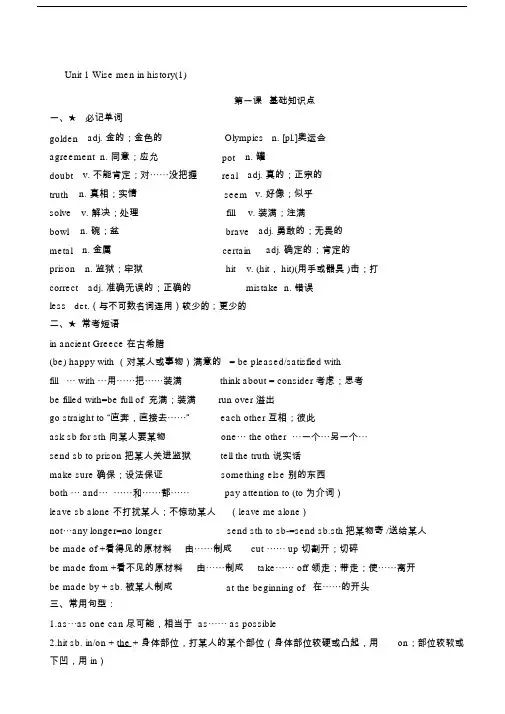
Unit 1 Wise men in history(1)第一课基础知识点一、★必记单词golden adj. 金的;金色的Olympics n. [pl.]奥运会agreement n. 同意;应允pot n. 罐doubt v. 不能肯定;对⋯⋯没把握real adj. 真的;正宗的truth n. 真相;实情seem v. 好像;似乎solve v. 解决;处理fill v. 装满;注满bowl n. 碗;盆brave adj. 勇敢的;无畏的metal n. 金属certain adj. 确定的;肯定的prison n. 监狱;牢狱hit v. (hit, hit)(用手或器具 )击;打correct adj. 准确无误的;正确的mistake n. 错误less det.(与不可数名词连用)较少的;更少的二、★ 常考短语in ancient Greece 在古希腊(be) happy with (对某人或事物)满意的 = be pleased/satisfied withfill ⋯ with ⋯用⋯⋯把⋯⋯装满think about = consider 考虑;思考be filled with=be full of 充满;装满run over 溢出go straight to “直奔,直接去⋯⋯”each other 互相;彼此ask sb for sth 向某人要某物one⋯ the other ⋯一个⋯另一个⋯send sb to prison 把某人关进监狱tell the truth 说实话make sure 确保;设法保证something else 别的东西both ⋯ and⋯⋯⋯和⋯⋯都⋯⋯pay attention to (to 为介词)leave sb alone 不打扰某人;不惊动某人(leave me alone)not⋯any longer=no longer send sth to sb-=send sb.sth把某物寄 /送给某人be made of +看得见的原材料由⋯⋯制成cut ⋯⋯ up 切割开;切碎be made from +看不见的原材料由⋯⋯制成take⋯⋯ off 领走;带走;使⋯⋯离开be made by + sb. 被某人制成at the beginning of 在⋯⋯的开头三、常用句型:1.as⋯as one can 尽可能,相当于 as⋯⋯ as possible2.hit sb. in/on + the + 身体部位,打某人的某个部位(身体部位较硬或凸起,用on;部位较软或下凹,用 in)。
牛津译林版初中英语九年级上册英语Unit1-wise-men-in-history精品教案
牛津译林版初中英语九年级上册英语Unit1-wise-men-in-history精品教案Unit1 讲义Unit1 wise men in historyA、Free talk : Practice asking for agreement or confirmation according to P10 in thebook.B、朗读Reading部分Reading 讲解1.At first,he was very happy with it.①at first 起初=练习:,I didn't want to go ,but I soon changed my mind.,open the windows,then turn off the gas.②be happy with sb./sth.意为:=eg:His teacher is happy with him.ter,however , he began to doubt that it was a realgolden crown.①however “然而”辨析:however 与but▲however,“然而,不过”,比较正式,可以放在,,;其前面或后面都要用隔开。
如在句中,其前后都要加。
▲but “但是”,表示很明显的对比,转折的意味比however要,从语序上看,but 总是置于_______引出的分句之首。
练习:I'd like to go swimming with you, I have totidy the garden now.It's raining hard , ,they're still workingin the field.②begin to do sth.=意为:③doubt 此处用作及物动词,意为:不能肯定,对....无把握eg:He doubts the truth of the news.拓展:①doubt 用作不及物动词,意为:怀疑,其后常接of ,about。
牛津深圳版英语九上Unit 1《Wise men in history》说课稿4
牛津深圳版英语九上Unit 1《Wise men in history》说课稿4一. 教材分析《牛津深圳版英语九上Unit 1》是一篇关于历史上智者的人物介绍的文章。
本节课的主要内容是让学生通过阅读文章,了解历史上的智者,如苏格拉底、孔子等,并掌握相关的语言知识,如词汇、语法和阅读技巧。
文章内容丰富,语言生动,能够激发学生对历史的兴趣,同时也能够提高他们的英语阅读能力。
二. 学情分析九年级的学生已经具备了一定的英语基础,能够理解和运用一些基本的词汇和语法知识。
然而,对于一些较高级的词汇和语法结构,他们可能还需要进一步的学习和掌握。
此外,学生对于历史的了解可能有限,因此需要教师在教学过程中进行适当的引导和补充。
三. 说教学目标1.知识目标:学生能够掌握文章中出现的关键词汇和语法结构,如“make a difference”、“have an impact on”等。
2.能力目标:学生能够通过阅读文章,提高自己的阅读理解能力,并能够运用所学知识进行口语表达和写作。
3.情感目标:学生能够了解历史上的智者,激发他们对历史的兴趣,培养他们的思辨能力。
四. 说教学重难点1.重点:学生能够理解和运用文章中的关键词汇和语法结构。
2.难点:学生能够运用所学知识进行口语表达和写作,以及对历史知识的理解和运用。
五. 说教学方法与手段1.教学方法:采用任务型教学法,让学生在完成任务的过程中,自然地学习和掌握知识。
2.教学手段:利用多媒体教学,如图片、视频等,帮助学生更好地理解和记忆知识。
六. 说教学过程1.导入:通过展示一些历史上的智者的人物图片,引导学生思考他们对于世界的影响,从而引出本节课的主题。
2.阅读理解:学生阅读文章,回答相关问题,帮助学生理解和掌握文章内容。
3.词汇和语法讲解:教师针对文章中出现的关键词汇和语法结构进行讲解,让学生能够理解和运用。
4.口语表达:学生分组讨论,运用所学知识进行口语表达,教师进行指导和评价。
九年级英语上册 Unit 1《Wise men in history》教案2
堂
教
学
流
程
Video about Archimedes
→Understand the text→Read the text →Retell the text.
效
果
评
价
与
反
思
4.
Practice retelling the text one by one in groups.
4.Help them to reviewthekey sentences or words and encourage them to retell the text.
4.Helpthestudents practicethespeaking ability.
1.Find a video about Archimedes, organize a quiz competition about
Archimedes
What
informationdo youknowhim and other great men such as Aristotle and Aesop?
教学重点
Get the main idea ofthetext.
教学难点
Retell the main information the story.
教学关键
Develop their interest about famous people
教法与学法指导
Group competition.
教学环节
主要教学步骤或内容
Wise men in history
教
材
分
析
教学目标
1. Students can get the main idea ofthetext.
牛津深圳版英语九年级上册:Unit 1 《Wise men in history》 说课稿6
牛津深圳版英语九年级上册:Unit 1 《Wise men in history》说课稿6一. 教材分析《牛津深圳版英语九年级上册》Unit 1的主题是“Wise men in history”,通过本课的学习,学生将了解到历史上有智慧的人的事迹,学习他们的品质和优点,从而激发学生对历史人物的好奇心和求知欲。
教材内容丰富,既有文字描述,又有图片插图,使学生在学习的过程中能够更好地理解和掌握知识。
二. 学情分析九年级的学生已经具备了一定的英语基础,对历史人物有一定的了解。
他们在学习过程中能够积极思考,提出问题,并能够通过合作学习,共同探讨问题。
但同时,部分学生对英语的学习兴趣不高,学习积极性有待提高。
三. 说教学目标1.知识目标:学生能够掌握本课的生词和短语,理解课文内容,了解历史上有智慧的人的事迹。
2.能力目标:学生能够运用所学的知识,进行口语表达和写作。
3.情感目标:学生能够学习到历史人物的品质和优点,激发他们对历史的兴趣。
四. 说教学重难点1.重点:学生能够掌握本课的生词和短语,理解课文内容,进行口语表达和写作。
2.难点:学生能够运用所学的知识,对历史人物进行深入的理解和分析。
五. 说教学方法与手段1.教学方法:采用任务型教学法,让学生在完成任务的过程中,掌握知识,提高能力。
2.教学手段:利用多媒体教学,播放与课文相关的视频和图片,帮助学生更好地理解和掌握知识。
六. 说教学过程1.导入:通过提问,引导学生思考历史上有智慧的人,激发学生的学习兴趣。
2.呈现:展示课文内容,让学生整体感知课文。
3.操练:通过小组讨论,让学生对课文内容进行深入的理解和分析。
4.输出:学生进行口语表达和写作,展示他们的学习成果。
5.总结:教师对学生的学习进行评价,总结课堂内容。
七. 说板书设计板书设计要清晰明了,能够帮助学生理解和记忆课文内容。
可以设计成思维导图的形式,将课文内容进行梳理和展示。
八. 说教学评价教学评价要全面,既要有对学生的知识掌握情况的评价,也要有对学生的能力提高情况的评价。