
Unit+4+History+and+Traditions+词汇讲解人教版(2019)必修第二册
高一英语(人教版)-必修二 Unit 4 History And Traditions (3)-教案
教案
教学基本信息
课题 高一英语(人教版) –必修二 Unit 4 History and traditions (3)
学科 英语
学段:高中 年级 高一
教材 书名:普通高中教科书英语必修第二册
出版社:人民教育出版社
出版日期:2019 年 6 月
教学目标及教学重点、难点
1. 归纳并总结过去分词做定语和宾语补足语的语法现象;(重点)
2. 使用过去分词做定语和宾语补足语的语法结构完成句子;(重点)
3. 用过去分词介绍一个旅游景点或表达旅游经历中的感受。(难点)
教学过程(表格描述)
教学环节 主要教学活动 设置意图
Warming-up 教师针对本单元主课What's in a name?的内容提问。
✓ How do most people call the UK?
✓ What are the flags of these four countries?
✓ What did the Normans do after they conquered
England?
学生根据教师提出的问题回顾课文内容,并回答问题。 激活学生的已知,引入课文中过去分词做定语和做宾补的句子。
Preparation 教师展示三个问题的答案,并引导学生关注句子中的过去分词如何理解:
✓ Most people just use the shortened name: “the
United Kingdom” or “the UK”.
✓ They use the same flag known as the Union Jack.
✓ They had castles built and had the legal system
changed.
学生通过翻译理解过去分词作定语的功能和意思。
✓ How to translate the past participle in each
sentence?
高中英语人教版必修第二册unit4重点句型详解
高中英语人教版必修第二册unit4重点句型详解
UNIT 4 HISTORY AND TRADITIONS
1.And so hold on when there is nothing in you
所以当你一无所有时要坚持
【词汇精讲】hold on是动词短语,意为“抓牢;坚持不懈;稍等一下”。Though I met with a lot of difficulties,I held on.
尽管我遇到了很多困难,但我坚持不懈。
2.An idiom is an expression which means something
different from the meaning of the individual words.
成语是一种表达方式,它的意思与单个词的意思不同。
【词汇精讲】individual作形容词,意为“单独的;个别的”;作名词,意为“个人”。
3.Why do you think William said his hometown was similar
to Qufu?
你认为威廉为什么说他的家乡与曲阜相似?
【句式剖析】do you think是插入语,在句中不作成分,通常放在疑问词后。当句子中有此类插入语时,句子要用陈述语序。
【句式拓展】常用于这种形式的动词有:think,suggest,hope,believe,suppose,guess,consider,imagine等。What do you believe the earth is made up of?
你觉得地球是由什么构成的?
4.Getting to know a little bit about British history will help
you solve this puzzle.
了解一下英国历史会帮助你解决这个谜题。
【词汇精讲】puzzle作名词,意为“谜;智力游戏;疑问”,作动词,意为“迷惑;使困惑”。
基于互联网技术人教版2020新版Unit4 History and Traditions的教案设计
《英语教学与互联网》单元作业——教学设计
课程名称 高中英语
教学主题 History and Traditions
课型 阅读课
授课教师
基本信息 性别:女,学历:本科在读
教学对象 高一年级
学生分析
学生为高一年级学生,已经学完必修一,在一定程度上适应了高中上课节奏和学习模式。课前已经完成教师布置的自学任务,对英国的国旗有了大致的理解,有一定的背景知识积累。学生的学习态度端正,积极配合各种教学活动。
教学目标
1. 语言能力:①学生能够识记本课的生字词和重点短语。②学生能够掌握scanning和skimming的阅读方法。
2. 文化意识:①学生能够辨认“The United Kingdom, Great Britain,
Britain...”等区别,能够画出英国国旗并且辨认出每部分元素的意义。②了解和对比英国文化与中国文化的差异、尊重英国文化,认识到学习其他文化的重要性,坚定中华文化自信。
3. 思维品质:学生能够运用批判思维看待在全球化背景下西方文化输入对我国传统文化的影响。
4. 学习能力:学生能够开展组内合作,进行小组讨论,培养团队合作精神。
教学重点 1、学生能区分“The United Kingdom, Great Britain, Britain”等的区别, 并能够根据课文为英国历史画一条大致时间轴。
2、学生能够画出英国国旗,并辨认出每部分元素的含义。
教学难点 1、培养跨文化意识和跨文化交际能力。
2、培养学生的批判思维能力。 教学资源
1、课前学生自学资源:
1)一个视频(英国国旗有什么含义?),下载自bilibili。
课前自学:学生观看视频后依据视频内容绘制一张海报介绍英国国旗,将作品拍照发布到微信墙。
2、课内学习资源
1)课堂上使用自制ppt,ppt内的图片来自百度图片。
2)利用TTS技术合成课文第四段的音频,并运用快剪辑将音频和图片制作成视频,视频中使用的图片来自百度图片。
人教版高中英语必修2培优练习UNIT4HistoryandtraditionsSectionⅢ
- 1 - Section Ⅲ Discovering Useful Structures &
Listening and Talking
基础知识 预习自检
Ⅰ.重点词汇
1.charge n. 收费;指控;主管 vt. 收费;控告;充电
2.announce vt. 宣布;通知;声称→announcement n. (一项)公告,布告,通告;(指行动)宣布,宣告
3.approach n. 方法;途径;接近 vt. 接近;接洽;着手处理 vi. 靠近
4.sure adj. 确信的;有把握的→ensure vt. 保证;确保;担保
5.generous adj. 慷慨的;大方的;丰富的→generously adv. 慷慨地;大方地→generosity n. 慷慨;大方;宽宏大量
6.eager adj. 热切的;渴望的→eagerness n. 渴望;殷切;热忱;热情
7.shortened_name 简称
8.National_Gallery 国家美术馆
9.natural_landscape 自然风光
10.bread_with_butter_and_honey 黄油蜂蜜面包
Ⅱ.教材原句
1.Most people just use ________________ (简称): “the United Kingdom” or “the
UK”.
答案:the shortened name
2.Judy and I had our car parked in an underground car park near Trafalgar Square,
where we could ______________________ (给我们的车充电).
答案:get our car battery charged
3.We found ourselves ________________ (非常的惊讶) by the large number of
Unit 4 History and Traditions (教学设计)-高一英语(人教必修第二册)

Unit 4 History and Traditions
Discovering Useful Structures 教学设计
基本信息 科目 英语 年级册次 高一必修二 Unit 4
姓名 学校
教材分析 该板块的活动主题为“表达情感和描述情景”(Express your feelings and
describe situations)。同学们通过观察、分析与归纳总结,掌握过去分词作定语和宾语补足语的用法,并运用这一结构表达情感及描述情景。
学情分析 学生是高一年级的学生,英语水平普遍较低。他们已经学习了一些基础的语法知识和词汇,但对过去分词的使用和功能还不够熟悉。此外,学生对历史和传统这一主题可能有一些背景知识。
教学目标 1. Learn to use the past participles as the attribute and the object complement.
2. Write a little story or describe situations by using the past participles.
教学重难点 Teaching key and difficult points:
1. Lead students to understand the functions of the past participle as the object
complement and the attribute in enriching the content of sentences, describing the
characteristics of things and supplementing information.
2. Enlighten students to use the past participle to express feelings and describe
高中必修第二册英语统编人教版《Unit 4 History and traditions》
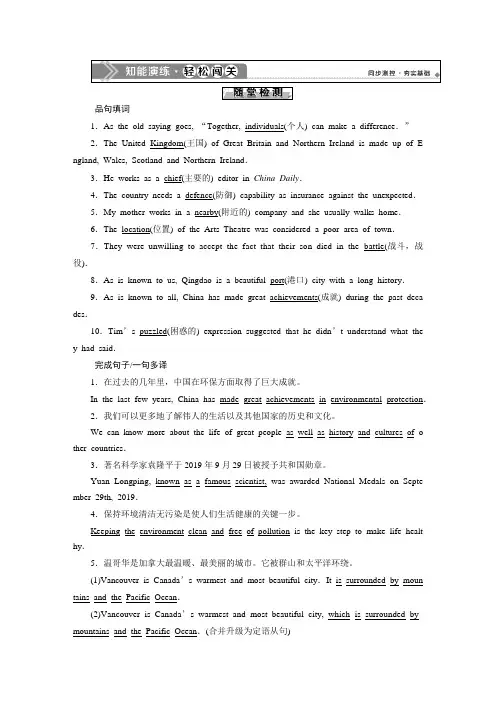
品句填词
1.As the old saying goes, “Together, individuals(个人) can make a difference.”
2.The United Kingdom(王国) of Great Britain and Northern Ireland is made up of England, Wales, Scotland and Northern Ireland.
3.He works as a chief(主要的) editor in China Daily.
4.The country needs a defence(防御) capability as insurance against the unexpected.
5.My mother works in a nearby(附近的) company and she usually walks home.
6.The location(位置) of the Arts Theatre was considered a poor area of town.
7.They were unwilling to accept the fact that their son died in the battle(战斗,战役).
8.As is known to us, Qingdao is a beautiful port(港口) city with a long history.
9.As is known to all, China has made great achievements(成就) during the past decades.
10.Tim’s puzzled(困惑的) expression suggested that he didn’t understand what they had said.
新版人教版教材高中英语必修2-unit4-History and Traditions Section 2-3重点词汇短语语法
Nina
1
1 Unit4 History and traditions Section 2-3重点词汇短语句型
Section2
1. charge用法详解
(1)vt.给......充电
Before use,the battery must be charged.电池使用前必须充电。
(2)vt.收费;要价
Charge sb.(money)for sth. 因某事向某人收费。
We won’t charge you for delivery.我们送货不收取你的费用。
(3)vt.控告;职责;谴责
Charge sb. with(doing)sth. 因做某事而谴责/控告某人
He was charged with murder.他被指控犯有谋杀罪。
(4)n.要价,收费
admission charges 入场费 free of charge 免费
Delivery is free of charge.免费送货。
(5)n.【U】主管;掌管
take charge of 主管;掌管 in charge of 负责/主管
in the charge of 负责/主管
in the charge of=in one’s charge 由......负责/主管
He took charge of the farm after his father’s death.他在父亲去世后掌管了农场。
I’m leaving the school in your charge.我这就把学校交给你掌管。
特别注意 表示“因......控告......”的短语:accuse ...... of......
2. announce用法详解
(1)vt.宣布;宣告(决定,计划等);(尤指通过广播)通知
announce sth.(to sb.)(向某人)宣布某事
2019版人教高中英语新高一必修二单词知识点unit4 History and Traditions
BOOK 2 UNIT 4 History and Traditions
1. Confucius n. 孔子
2. mansion n. 公馆;宅第
3. cemetery n. 墓地;公墓
4. philosophy n. 哲学
5. descendant n. 后裔;后代;子孙
6. individual adj. 单独的;个别的n.个人
7. heel n. 足跟;(脚、袜子、鞋等的)后跟
8. Achilles’heel (喻)(希腊神话)阿喀琉斯的脚跟,致命的弱点
9. kingdom n. 王国;领域
10. chief adj. 最重要的;最高级别的n.(公司或机构的)首领;酋长
in chief 主要地;尤其
chief engineer 总工程师
chief editor 总编;主编
chief executive officer CEO 首席执行官
11. puzzle n.谜;智力游戏;疑问vt.迷惑;使困惑
12. nearby adj. 附近的;邻近的adv.在附近
nearby可作前置或者后置定语。 near by 只能做后置定语。
13. join…to…. 把…和…连接或联结起来
connect…to… 把…与…连接
connect…with… 把…与…联系起来
link…to/with… 把…与…联系起来
associate…with… 把…与…联系起来
14. break away (from sb/sth) 脱离;背叛;逃脱
break out (战争、火灾、疾病等)爆发;发生
break off (使)分离;(使)脱离
break down (车、机器等)坏掉、出故障;分解;(身体)垮掉;
break in 打断;闯入
break into 破门而入;突然……起来