
人教新课标高中英语必修5 Unit1 Great scientists[背景文章] Hawking
第1页 共4页 Hawking, Stephen William
Hawking, Stephen William (1942- ), British theoretical physicist and
mathematician whose main field of research has been the nature of space and time,
including irregularities in space and time known as singularities. Hawking has also
devoted much of his life to making his theories accessible to the public through
lectures, books, and films.
Hawking was born in Oxford, England, and he showed exceptional talent in
mathematics and physics from an early age. He entered Oxford University in 1958
and became especially interested in thermodynamics (the study of the interaction of
matter and energy), relativity theory, and quantum mechanics (see Quantum Theory).
In 1961 he attended a summer course at the Royal Observatory that encouraged these
interests. He completed his undergraduate courses in 1962 and received a bachelor’s
degree in physics. Hawking then enrolled as a research student in general relativity at
the department of applied mathematics and theoretical physics at the University of
Cambridge.
Hawking earned his Ph.D. degree from Trinity College at the University of
Cambridge in 1966. He stayed at the University of Cambridge, doing post-doctoral
research, until he became a professor of physics in 1977. He became one of the
youngest fellows of the Royal Society in 1974. In 1979 he was appointed Lucasian
Professor of Mathematics at Cambridge.
During his postgraduate program, Hawking was diagnosed as having
Amyotrophic Lateral Sclerosis (ALS), a rare progressive disease that handicaps
movement and speech. This disease makes it necessary for Hawking to carry out the
long and complex mathematical calculations that his work requires in his head. He has
been able to continue his studies and to embark upon a distinguished and productive
scientific career despite his illness.
第2页 共4页
From its earliest stages, Hawking’s research has been concerned with the concept
of singularities—breakdowns in space and time where the classic laws of physics no
longer apply. The combination of time and three-dimensional space is called
space-time. The most familiar example of a singularity is a black hole, the final form
of a collapsed star. Much of what scientists believe about space-time comes from the
theory of relativity, which was developed in the early 20th century by
German-American physicist Albert Einstein. During the late 1960s Hawking proved
that if the general theory of relativity is correct, then a singularity must also have
occurred at the big bang. The big bang is the explosion that marked the beginning of
the universe and the birth of space-time itself.
In 1970 Hawking’s research turned to the examination of the properties of black
holes. The boundary of a black hole is called the event horizon. Hawking realized that
the surface area of the event horizon around a black hole could only increase or
remain constant with time—this area could never decrease. This meant, for example,
that if two black holes merge, the surface area of the new black hole would be larger
than the sum of the surface areas of the two original black holes. He also noticed that
there were certain parallels between the laws of thermodynamics and the properties of
black holes. For instance, the second law of thermodynamics states that entropy, or
disorder, must increase with time. The surface area of the event horizon of a black
hole is therefore similar to the entropy of a thermodynamic system.
From 1970 to 1974, Hawking and his associates provided mathematical proof for
the hypothesis formulated by American physicist John Wheeler known as the "No
Hair Theorem." This theorem states that the only properties that particles of matter
keep once they enter a black hole are mass, angular momentum (or spin), and electric
charge. Matter entering a black hole loses its shape, its chemical composition, and its
distinction as matter or antimatter.
第3页 共4页 Since 1974 Hawking has studied the behavior of matter in the immediate vicinity
of a black hole from a theoretical basis in quantum mechanics. Quantum mechanics is
a theory that describes how subatomic particles behave and how matter and radiation
interact. He found, to his initial surprise, that black holes—from which nothing was
supposed to be able to escape—could emit thermal radiation, or heat. Several
explanations for this phenomenon were proposed, including one involving the
creation of virtual particles. A virtual particle differs from a real particle in that a
virtual particle cannot be seen by means of a particle detector, but it can be observed
through its indirect effects. Empty space is full of virtual particles fleetingly "created"
人教版高中英语必修五BOOK5 Unit 1 Great scientists
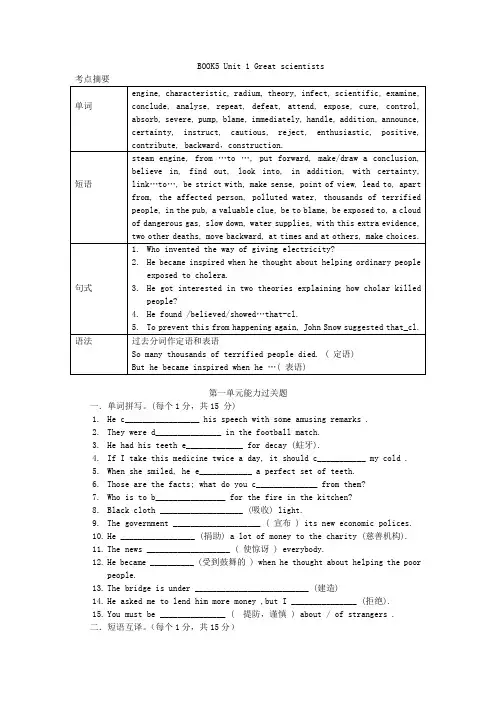
BOOK5 Unit 1 Great scientists
考点摘要
单词
engine, characteristic, radium, theory, infect, scientific, examine,
conclude, analyse, repeat, defeat, attend, expose, cure, control,
absorb, severe, pump, blame, immediately, handle, addition, announce,
certainty, instruct, cautious, reject, enthusiastic, positive,
contribute, backward,construction.
短语 steam engine, from …to …, put forward, make/draw a conclusion,
believe in, find out, look into, in addition, with certainty,
link…to…, be strict with, make sense, point of view, lead to, apart
from, the affected person, polluted water, thousands of terrified
people, in the pub, a valuable clue, be to blame, be exposed to, a cloud
of dangerous gas, slow down, water supplies, with this extra evidence,
two other deaths, move backward, at times and at others, make choices.
人教新课标高中英语必修5 Unit1 Great scientists[背景文章] Hawking
![人教新课标高中英语必修5 Unit1 Great scientists[背景文章] Hawking](https://360docs-1393072327.cos.ap-beijing.myqcloud.com/cd59b923d5bbfd0a7856737a.webp)
第1页 共4页 Hawking, Stephen William
Hawking, Stephen William (1942- ), British theoretical physicist and
mathematician whose main field of research has been the nature of space and time,
including irregularities in space and time known as singularities. Hawking has also
devoted much of his life to making his theories accessible to the public through
lectures, books, and films.
Hawking was born in Oxford, England, and he showed exceptional talent in
mathematics and physics from an early age. He entered Oxford University in 1958
and became especially interested in thermodynamics (the study of the interaction of
matter and energy), relativity theory, and quantum mechanics (see Quantum Theory).
In 1961 he attended a summer course at the Royal Observatory that encouraged these
interests. He completed his undergraduate courses in 1962 and received a bachelor’s
2021年人教版 英语 必修五 课文 电子版

*欧阳光明*创编 2021.03.07
*欧阳光明*创编 2021.03.07 Unit 1 GREAT SCIENTISTS
欧阳光明(2021.03.07)
JOHN SNOW DEFEATS “KING CHOLERA”
John Snow was a famous doctor in London — so expert, indeed, that he
attended Queen Victoria as her personal physician. But he became
inspired when he thought about helping ordinary people exposed to
cholera. This was the deadly disease of its day. Neither its cause nor its
cure was understood. So many thousands of terrified people died every
time there was an outbreak. John Snow wanted to face the challenge and
solve this problem. He knew that cholera would never be controlled until
its cause was found.
He became interested in two theories that possibly explained how
cholera killed people. The first suggested that cholera multiplied in the
人教新课标高中英语必修五Unit 1 Great scientistsUnit 1 Great scientists教案(2)
精品文档
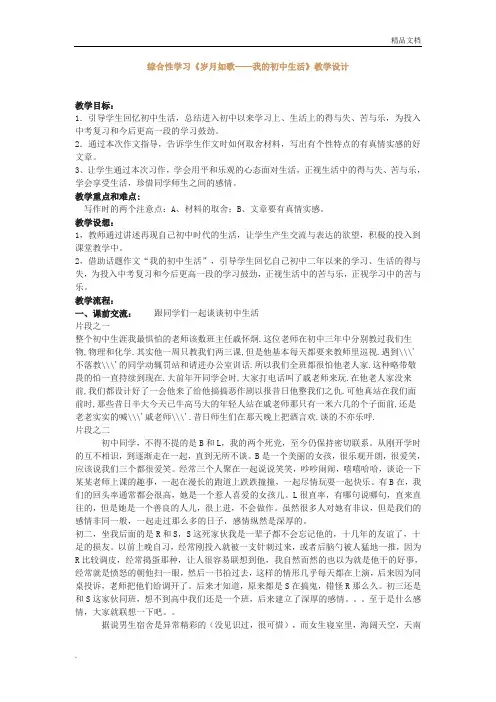
. 综合性学习《岁月如歌——我的初中生活》教学设计
教学目标:
1.引导学生回忆初中生活,总结进入初中以来学习上、生活上的得与失、苦与乐,为投入中考复习和今后更高一段的学习鼓劲。
2.通过本次作文指导,告诉学生作文时如何取舍材料,写出有个性特点的有真情实感的好文章。
3、让学生通过本次习作,学会用平和乐观的心态面对生活,正视生活中的得与失、苦与乐,学会享受生活,珍惜同学师生之间的感情。
教学重点和难点:
写作时的两个注意点:A、材料的取舍;B、文章要有真情实感。
教学设想:
1,教师通过讲述再现自己初中时代的生活,让学生产生交流与表达的欲望,积极的投入到课堂教学中。
2,借助话题作文“我的初中生活”,引导学生回忆自己初中二年以来的学习、生活的得与失,为投入中考复习和今后更高一段的学习鼓劲,正视生活中的苦与乐,正视学习中的苦与乐。
教学流程:
一、课前交流: 跟同学们一起谈谈初中生活
片段之一
整个初中生涯我最惧怕的老师该数班主任戚怀炯.这位老师在初中三年中分别教过我们生物,物理和化学.其实他一周只教我们两三课,但是他基本每天都要来教师里巡视.遇到\\\'不落教\\\'的同学动辄罚站和请进办公室训话.所以我们全班都很怕他老人家.这种略带敬畏的怕一直持续到现在.大前年开同学会时,大家打电话叫了戚老师来玩.在他老人家没来前,我们都设计好了一会他来了给他搞搞恶作剧以报昔日他整我们之仇.可他真站在我们面前时,那些昔日半大今天已牛高马大的年轻人站在戚老师那只有一米六几的个子面前,还是老老实实的喊\\\'戚老师\\\'.昔日师生们在那天晚上把酒言欢.谈的不亦乐呼.
片段之二
初中同学,不得不提的是B和L,我的两个死党,至今仍保持密切联系。从刚开学时的互不相识,到逐渐走在一起,直到无所不谈。B是一个美丽的女孩,很乐观开朗,很爱笑,应该说我们三个都很爱笑。经常三个人聚在一起说说笑笑,吵吵闹闹,嘻嘻哈哈,谈论一下某某老师上课的趣事,一起在漫长的跑道上跌跌撞撞,一起尽情玩耍一起快乐。有B在,我们的回头率通常都会很高,她是一个惹人喜爱的女孩儿。L很直率,有哪句说哪句,直来直往的,但是她是一个善良的人儿,很上进,不会做作。虽然很多人对她有非议,但是我们的感情非同一般,一起走过那么多的日子,感情纵然是深厚的。
高中英语Unit5 课件新人教版必修第二册
Unit 5 Music
Language FocusTeaching objectives:
nBy the end of this period, you will be able to…
1.master the usage of such important words and expressions as
composition, opportunity, perform, ordinary, enable, prove, award,
fall in love with, original,etc; learn to express themselves by using
them.
2. learn the method of constructing knowledge trees through self-
study &cooperative exploration.
Self-study time
Learn the following words and expressions “composition, opportunity, perform, ordinary, enable, prove, award, fall in lovewith, original” by yourselves .
Tips:
1. observe the sentences2. analyze the usage
3. referring to the dictionary4. take notes
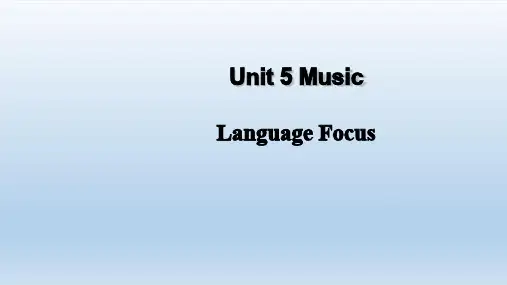
1【教材原句】The place wherehe studied musicalcomposition.
他学习音乐作曲的地方。 【句型】where引导_______从句,修饰ꢀ__________.定语 The place
【单词】ꢀcompositionn.________________成分;作品;作曲
◎观察思考:ꢀ
高中英语必修五课文及其翻译
创作编号:BG7531400019813488897SX
创作者: 别如克*
必修5
Unit 1 Great scientists
Reading
JOHH SHOW DEFEATS “KING CHOLERA”
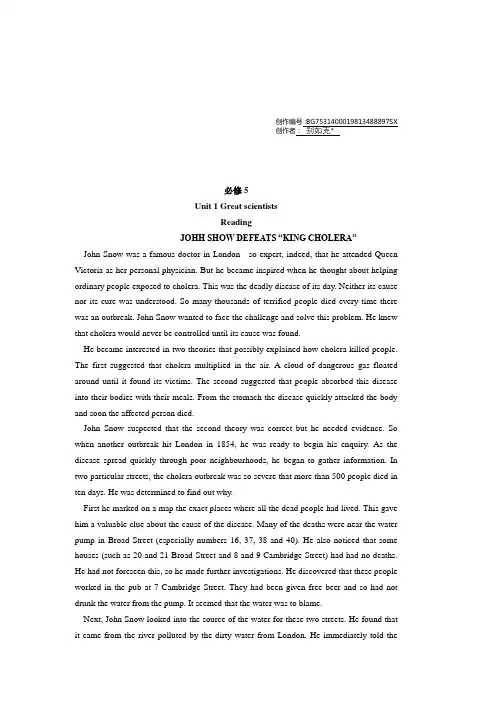
John Snow was a famous doctor in London - so expert, indeed, that he attended Queen
Victoria as her personal physician. But he became inspired when he thought about helping
ordinary people exposed to cholera. This was the deadly disease of its day. Neither its cause
nor its cure was understood. So many thousands of terrified people died every time there
was an outbreak. John Snow wanted to face the challenge and solve this problem. He knew
that cholera would never be controlled until its cause was found.
He became interested in two theories that possibly explained how cholera killed people.
The first suggested that cholera multiplied in the air. A cloud of dangerous gas floated
around until it found its victims. The second suggested that people absorbed this disease
Unit 1《Great scientists》教案2(人教版必修5)
▁▂▃▄▅▆▇█▉▊▋▌精诚凝聚 =^_^= 成就梦想 ▁▂▃▄▅▆▇█▉▊▋▌
▃ ▄ ▅ ▆ ▇ █ █ ■ ▓点亮心灯 ~~~///(^v^)\\\~~~ 照亮人生 ▃ ▄ ▅ ▆ ▇ █ █ ■ ▓ Module 5 Unit 1 Great scientists
遂昌中学刘仁海
分课时教案
Period 1 Warming up, Pre-reading & Reading
Teaching goals:
1. To talk about some great scientists and their achievements.
2. To develop some basic reading skills.
3. To get the general idea of the passage and to relate the passage to stages in a scientific experiment.
Teaching procedures:
Step one Warming up
Introduce some famous scientists and their achievements, and then do the quiz.
There are some great scientific achievements that have changed the world. Can you name some of them? What
kind of role do they play in the field of science? Do these achievements have anything in common? Match the
inventions with their inventors below before you answer all these questions.
人教版英语必修五Unit 1(John Snow defeats_King Cholera)教学教案
John Snow Defeats “King Cholera”
英语教学
设计 Unit 1 John Snow Defeats “King Cholera”
Teaching Goals:
1. Enable the Ss to get to know some knowledge about Cholera.
2. Enable the Ss to understand the passage well.
3. Let the Ss learn some reading skills by scanning and skimming.
4. To learn from the great scientists and develop the noble spirits .
key points:
1. To train the reading skills of skimming, scanning and careful
reading;
2. To master the details of the passage and appreciate the spirits of
the scientists.
Difficult points
1. To develop the students’ ability of grasping the main idea of each
paragraph.
2. To get some detailed information by reading the text.
Teaching methods
1. Skimming & scanning
2. Discussion methods
3. Pair work of group
4. Competition
Teaching process:
Step 1 Lead in 本单元标题是伟大的科学家。所以活动的设置为让学生说出自己熟知的科学家姓名、其发明、工作、生活的情况。任务简单,学生感兴趣。然后教师通过多媒体呈现相关科学家及其成就的图片和文字。既能让学生体会到本堂课的主题,又能激发学生的好奇心和求知欲,营造一种宽松和活跃的课题氛围,为下一步教学做了很好的铺垫。
Book5 Unit1 Great scientists基础检测
1 Book5 Unit1 Great scientists
Test yourself
一.单词自测
1. n. 特征;特性___________
2. n. 画家;油漆匠___________
3. 提出___________
4. adj. 科学的___________
5. vt. & vi. 结束;推断出___________
6. n. 结论;结束___________
7. 提出结论___________
8. vt. 分析___________
9. vt. 传染;感染___________
10. adj. 传染的___________
11. vt. 打败;战胜;使受挫n. 失败___________
12. adj. 熟练的;经验或知识丰富的专家;行家___________
13. vt. 照顾;护理;出席;参加___________
14. n. 医生;内科医师___________
15. vt. 暴露;揭露;使曝光___________
16. 使显露;暴露___________
17. adj. 致命的___________
18. n. 治愈;痊愈vt. 治愈;治疗___________
19. n. 爆发;发作(尤指疾病或战争___________)
20. n. 挑战 vt. 向„„挑战___________
21. n. 受害者___________
22. vt. 吸收;吸引;使专心___________
23. vt. 怀疑 n. 被怀疑者;嫌疑犯___________
24. n. 询问___________
25. n. 附近;邻近___________
26. adj. 严重的;剧烈的;严厉的___________
27. adj. 线索;提示___________
28. n. 泵;抽水机 vt. (用泵)抽(水)___________
必修五unit1知识点二学案
1 Unit 1 Using Language
Unit one Great scientists 知识点二学案
一、 课前巩固:
1.John Snow was a famous doctor in London---so ____, indeed,that he _______ Queen Victoria as her
personal ______.
2.But he became inspired when he thought about helping ordinary people_____ _____ cholera.
3.The second _______ that people _____ this disease into their bodies with their meals.
4.John Snow ______ that the second theory was correct but he needed ________.
5.First he _____ on a map the exact places _____ all the dead people had lived.
6.He found that it came from the river ____ _____the dirty water from London.
7.He immediately told the _____ people in Broad Street to ____ the handle ____ the pump ___ ____it could
not be used.
8.In another part of London ,he found ______ evidence from two other deaths that were _____ ____the