
最新英语考研12篇排序题答案
Text 1整体分析:本篇文章为现象分析型文章,重点分析了航空公司行李丢失的过程和原因,简要地从乘客自身角度提出了对策。
局部分析:首段A:通过个例引出主题,即行李丢失问题及其后果。
末段G:针对机场行李运输中存在的问题向旅客提出了几点建议。
4l. EA段谈的是行李丢失问题的个例,E段谈的是行李丢失问题的普遍情况。
从A到E,这是从具体到一般,注意作者采用了归纳法提出了行李丢失的问题。
而其他选项都是在分析行李丢失现象的原因,是应该在提出问题后谈论的,故只有E项正确。
42. D针对A和E段提出的问题,下面该分析原因了。
D交待的是飞机行李运输背景知识,谈的是正常情况,而B、C、D谈的是不正常的情况。
人们讨论问题的逻辑是从正常到不正常,先说惯例再说例外。
D 谈论的是正常情况、是惯例。
很显然这里应选D。
D的意思是航空公司尽量争取时间,尽量保证行李的正常运输。
43. C上段讲行李的正常运输,C以"In normal circumstances the system works well."与上段衔接。
下面自然引出不正常的情况,即飞机延误,或者人为因素导致行李运输系统出现问题,导致问题产生。
44. F上段讲行李出现问题的普遍情况,F项讲这一情况出现的极端情况,即过于繁忙的、作为枢纽的大机场出现这种情况更加严重。
F首句说"These problems can become severe at transfer airport…","these problems"与上段衔接。
从C到F是从轻到重,是递进关系。
故F正确。
45. B上一段讲了忙乱的机场行李丢失现象严重,本段进一步指出即使是效率高的机场也无法解决这个痼疾——并列举了欧洲和美国的例子印证。
B递进了上一段的意思。
末段G:在上段分析问题后,简单地针对个人提出了几点建议。
参考译文:到达国外的机场,结果发现自己的行李没有运到,这是最令人失望不过的事情了。
你如果运气好,坚持几个小时或者几天不换衣服,直到航空公司就把你的行李运来。
如果你的运气糟,到了一个不同气候的地区,离家几千英里远,还不得不穿着完全不适合的衣服。
虽然航空公司很少宣布他们丢失了多少箱子,但是经常旅行的人迟早会和他们的行李分离的。
甚至最优秀的航空公司也会时不时出差错。
也不可能要求一家航空公司保证旅客托运的行李一定上同一架飞机,特别是旅客在旅途中需要转机的情况下。
这个系统是这样运转的。
航空公司坚持要旅客提前很多时间办理登机手续(即旅客要在起飞前指定的时间里到达机场),目的是要有足够的时间旅客行李穿过机场,装上飞机。
最短换乘时间(MCTs)是指旅客在两个航班之间转机所需的最短时间。
为了转运行李,这个时间也被拖长了。
在正常情况下,这个系统运转良好。
然而,机场额外的安全检查,加上航线上的问题,都可造成航班的延误。
所有这些都会使行李系统失灵。
此外还可能有人为的失误,或者行李上的目的地标签意外丢失。
这些问题在被称为“枢纽”的大型机场会变得很严重,因为有大量的行李要处理。
例如,去年伦敦希斯鲁机场处理了四千一百万件行李,其中九百万件要转运。
仅英国航空公司一家,在希斯鲁机场就有二百万换乘的旅客,其中多数要从一号候机楼(国内和欧洲航班)转到四号候机楼(长途航班),路程有一英里远。
就连那些效率高的中转机场,如阿姆斯特丹机场、哥本哈根机场、新加坡机场和苏黎世机场也都有——迈阿密机场是丢失行李出名的,那些飞越大西洋的旅客立即换乘飞往拉丁美洲的目的地时,常常丢失行李。
你应该尽可能选择直航,并且在规定时间前尽早办理登机手续。
如果不得不换乘飞机,或者换乘飞机能使票价便宜一些的话,就尽可能全程都乘坐同一家航空公司的飞机。
尽量乘坐早一点的航班到达转乘机场,以便有多一些的换乘时间,另外你一定要在行李的两侧都贴好行李签,写上你的家庭住址和你度假地的地址。
别忘记写上你的航班号。
万一这一切你都做到了,但你的行李还是不见了,你就要和行李大厅里有关航空公司的职员联系,填写一份行李丢失报告。
此事一定要在你离开机场之前做好。
Text 2整体分析:本篇为问题解决型篇章,首先提出妇女带孩子忙这个社会问题,然后提出措施,讲述像“都市宝贝”这样孩子俱乐部的诞生。
然后是对其优缺点进行评价。
局部分析:首段C:在没有孩子之前,Femina的生活丰富多彩,孩子出生后,抚养孩子几乎占据了全部的时间,休闲生活也受到极大限制。
最后说她最近看到了希望,即引导出下文将谈到的对策。
末段F:35岁的总编Pilar Guzmdan将这些俱乐部和欧洲其他免费俱乐部进行比较,说除了精英论——即这些俱乐部只为少数人服务之外,这些俱乐部从整体上讲还是不错的,不应该被批评。
这些转折性的正面评论提示上文有对这些俱乐部不利的评价。
41. A首段举例说明了女士们在抚养孩子和自己的社交活动中难做到两全其美,但末句提到"But Ms. Della Femina sees help in sight." (Ms. Della Femina看到了希望。
)提示接下来应该解释为什么会看到了希望。
A中主要介绍今年十月一种特殊的俱乐部都市贝贝俱乐部将产生,加入此俱乐部后女士们将不再为孩子的事发愁。
也就是说,问题可以得到解决。
实际上这是对首段的问题做出了回答。
因此,A项是首段合乎逻辑的延伸。
42. D此文章是问题解决型,此类型一般包括问题、措施的提出和对措施的评价。
由A得知作者已经给出了具体的措施,即Citibabes(城市宝贝)俱乐部的成立,然后应该对此进行评价。
由于首段指出会所的成立是"help"(希望),所以接下来的评价应该是正面的。
D和E都是正面评价,但D的内容体现的是整体评价,直接说明俱乐部符合潮流,满足女士照顾孩子和不脱离社会的双重要求,也是对首段问题的一个回应。
而E体现的是评价内容的具体化。
从逻辑看,从总的评价到具体的评价更符合英语思维的习惯,因此选D。
43. ED中对俱乐部的成立做出了整体上的好评。
接下来可以是好评的具体化或者是另一内容,也可以转为相对立的负面评价。
如果是后者,按逻辑关系则不可再回到正面来讨论,而负面内容只有一项,这与本文的段落结构不符。
所以,本段内容应该是继续予以好评。
E说明此类会员制的会所从长远来看是好的,因为“There is something nice about having that small community.”(那样的小会所有很大的优点。
)E可以说是D的具体补充。
44. BE中提到许多人加入此类会所的原因是他们对实行会员制的小规模会所感兴趣。
接下来自然应该解释为什么人们喜欢这种小团体。
B对此现象进行思想更深层面分析:对外界害怕;社会等级思想,即B与E 是现象和本质的关系。
因此B体现了和E的接续关系,符合要求,为正确选项。
45. G通过对末段的研读,尤其是末句中"Whatever criticism these clubs are getting, the basic philosophical kernel shouldn’t be criticized. "(不管这种俱乐部遭到什么样的批评,其核心理念无可厚非。
)可知本文最后得出一个比较客观的结论:对这种会所也有不同意见,但其核心理念是合理的。
因此本段内容应该是对措施持有不同意见或怀疑态度。
G提出这些俱乐部传递的信息让人担心。
"It’s too urban, over the top." (这太都市参考译文:朱迪·黛拉·弗米娜来说,在女儿出生之前,每周各种各样消遣机会很多。
一周四次去专门迎合名人需求的莱都健身房,另外还有时间修趾美甲。
两年前,小安娜贝尔·金的到来给这一切画上了句号。
现在她的锻炼只不过是推推婴儿车,外加偶尔光顾母婴瑜伽课。
修趾美甲只有在迫不得已的时候才做一下。
不过,现在转机出现了。
今年十月,在黛拉·弗米娜女士家附近的苏荷区一家新的名为“城市宝贝”的儿童(和家长)私人新会所将开张营业,这样的会所已经开出了好几家。
黛拉·弗埃米娜女士是一小批特殊人士之一——她是“城市宝贝”的19名会员之一,成为该会所的会员意味着她不再需要在比基尼亮肤剂和儿童芭蕾课之间犯难。
“城市宝贝”是继“亲子城”后开张的。
“亲子城”是一月份开业的,面积20,000平方英尺,地处上城东区。
“城市宝贝”首期会员资格仅1000名,年费1250美元。
相比之下,只要孩子注册了“亲子城”的课程,家长就成为会员,一学期的起点费用为595美元。
眼下这个时代,妈妈们都想方设法让孩子高高兴兴,茁壮成长,与此同时还要扮演好社会角色,保持好穿4号尺码服装的苗条身材。
因此,像“城市宝贝”这样的会所可以说是迎合为人父母者追求的最新潮流。
与Gymboree与Soho House一样,这些会所不仅为孩子们提供了全新的学习机会,同时也提供了关怀父母亲的机会(更不用说社交活动了)。
“亲子城”和“娜娜花园”的老板强调他们面对的是每年能支付1200美元的费用的人,而“城市宝贝”的戈登小姐和弗洛斯特小姐则认为“城市宝贝”的最大吸收力就在于只有受到邀请能参加。
“人们开始可能会感到失望,因为会所是会员制的,”黛拉·弗埃米娜女士说,“但是我认为不幸的是在纽约有必须把事情做小,否则你就无法得到享受。
会员少有着很大的优点。
”社会历史学家,《焦虑的家长:现代美国育儿史》(纽约大学出版社,2003)一书的作者彼得·斯得恩斯说,此类会所的发展“反映了家长们对自己身份的关注及其焦虑”。
这不仅显示家长们认为外部世界危险,孩子们必须受到保护,但是,“很明显,这也是在孩子很小的时候父母给他们上的社会级层的一课。
”尽管许多家长对此类会所带来的便利和会所里的小圈子赞不绝口,但是,还是有一些人担心它传递的讯息。
“整个观念我都反对”,36岁的瑞内·洛克菲勒说,她是四个孩子的母亲。
她带着两岁的儿子泰迪去过“亲子城”,几节课后她就让儿子退出了。
“这太都市化,过头了。
”洛克菲勒太太说道,“要端坐桌前,又要让孩子安静,非常不易,因为需要家长尽力,但这就是你们的事啊;没人说哄孩子容易。
”比拉·古芒,Cookie杂志35岁的主编比较了这些新会所和在欧洲很多国家免费开放的日托机构。
“如果你回避精英论或儿童会所只迎合了部分女性需要的事实,它们的确强化了这个意识,即善待自己和善待孩子之间可能并不相斥,”她说道。
“不管对这种会所有何种批评,其核心理念是无可厚非的。
”Text 3答案与解析41. A 前面的段落说“……从2月1日开始,荷兰易发洪水地区的手机用户有希望听到一个铃声,然后是一个洪水来临时警告撤退的手机短信。
考研英语试题含解答共10题

考研英语试题含解答共10题阅读理解Passage 1:Many people believe that money is the key to happiness. However, research has shown that this is not necessarily true. While money can provide a certain level of comfort and security, it does not guarantee happiness. In fact, studies have found that once a person's basic needs are met, additional wealth does not lead to a significant increase in happiness. Other factors, such as relationships, personal fulfillment, and a sense of purpose, play a much larger role in determining one's overall happiness.Question 1: What does research suggest about the relationship between money and happiness?A) Money is the most important factor for happiness.B) Money guarantees happiness in all situations.C) Additional wealth beyond basic needs does not greatly impact happiness.D) Relationships and personal fulfillment are unrelated to happiness.Answer: C) Additional wealth beyond basic needs does not greatly impact happiness.解析:文章讲述了关于金钱和幸福之间关系的研究。
考研英语试题精解及答案

考研英语试题精解及答案1. Directions: Read the following passage carefully and answer the questions that follow.In a world where technology is advancing at an unprecedented rate, the role of education has become more critical than ever. The integration of technology in classrooms has transformed the way students learn and teachers teach. However, the rapid pace of technological change also presents challenges for educators who must keep up with the latest developments to effectively utilize these tools in their teaching practices.2. Question: What is the main purpose of the passage?A. To highlight the importance of technology in education.B. To discuss the challenges faced by educators due to technological advancements.C. To argue that technology has revolutionized the educational system.D. To emphasize the need for continuous learning in the field of education.Answer: A3. Question: According to the passage, how has technology impacted the educational system?A. It has made learning more difficult for students.B. It has replaced the need for teachers in classrooms.C. It has changed the way students learn and teachers teach.D. It has led to a decline in the quality of education.Answer: C4. Question: What is one of the challenges mentioned for educators in the passage?A. They need to learn new teaching methods.B. They need to keep up with the latest technological developments.C. They need to reduce the use of technology in classrooms.D. They need to focus on traditional teaching methods.Answer: B5. Directions: Complete the sentence by choosing the correct option from the brackets.The use of interactive whiteboards in classrooms has significantly improved student engagement and (A) participation / (B) isolation.Answer: A6. Directions: Choose the best word to fill in the blank.Despite the numerous benefits of incorporating technology into education, there are concerns that it may lead to anover-reliance on digital tools, potentially (A) undermining / (B) enhancing the importance of human interaction in the learning process.Answer: A7. Directions: Read the following dialogue and answer the question that follows.Student: I'm really struggling with the new online learning platform. It's so confusing!Teacher: Don't worry. It's normal to feel overwhelmed at first. With a little practice, you'll get the hang of it.Question: What is the teacher's advice to the student?A. To give up on the online learning platform.B. To practice using the platform more.C. To ask a friend for help.D. To focus on traditional learning methods.Answer: B8. Directions: Identify the main idea of the following statement."The integration of technology in education has not only made learning more interactive and engaging but also has provided teachers with a wealth of resources to enhance their teaching methods."Main Idea: The positive impact of technology integration in education.9. Directions: Match the following terms with their correct definitions.A. Blended learning - a teaching method that combines traditional classroom learning with online learning.B. Flipped classroom - a teaching approach where students learn new material at home and work on assignments in class.C. E-learning - a system of education where instruction is delivered through digital technology.Answer: A - C, B - A, C - B10. Directions: Summarize the main points of the passage in no more than three sentences.The passage discusses the critical role of education in a technologically advancing world, how technology has transformed learning and teaching, and the challenges educators face in keeping up with these rapid changes. It emphasizes the importance of continuous learning for educators to effectively use technology in their teaching practices.。
考研英语完形备战:排序题练习(四)

考研英语完形备战:排序题练习(四)[A] Twelve years ago, Lawler recalls, a member of the staff brought in an article about the decline in children's health: “We said, ‘We have these kids five days a week. We should be able to do something.’”At that time, Lawler and his staff had a basketball court, a playing field---and a student body that dreaded the twice-yearly 1-mile run to measure fitness. So they eliminated the semiannual curse, requiring instead that every student run every week. "You wouldn't believe the line outside the nurse's office with kids and their medical excuses," says Lawler. But slowly the kids got over it---and into it.[B] Just as attitudes about PE and fitness are shifting, however, even the most enlightened teachers are finding themselves obstructed in their efforts. More and more schools are cutting back or eliminating PE instruction entirely. Illinois is the only state in the nation that requires daily physical education for grades K-12. But even in Illinois, schools can get waivers to replace PE with activities like band or choir. Only 8 percent of U.S. elementary schools 6.4 percent of middle schools, and 5.8 percent of high schools provide daily physical education for the entire school year.A quarter of all school children don't get PE classes at all. Indeed, one study indicates that today's grandparents are more active than their grandchildren--a fact almost certainly tied to the doubling of overweight children over the past 20 years.[C] The Nashville schools have fitness centers, complete with stationary bikes and a climbing wall, in-line skates, heart-rate monitors for every kid, and--perhaps most important--a coaching staff with a shared epiphany about the links between childhood obesity and physical education.[D] But the real value may be in showing all children, including those without athletic talent, the value of fitness.[E] Welcome to the "new PE'---and not a minute too soon for any kid who has been picked last, Consigned to right field, or left dangling halfway up the climbing rope. The idea is to get away from the jock culture---fastest, strongest, most athletic---and instead start all kids on a road to lifelong fitness. And that starts with no humiliation. The Nashville, Ill., district, where Lawler teaches, has been highlighted in a government-funded book, Active Youth, as a model in promoting physical activity for children.[F] There's no doubt that schools are squeezed for time and money. Parents want electives like foreign languages and music as well as AP courses, which count heavily in college admissions. In addition, teachers are struggling to boost scores on national tests, all at a time when school districts are faced with tight budgets. Gym class often little more than dodge ball to begin with--is typically the first subject to get the budget ax. Even recess, a poor substitute for true health education, can be pulled out of the day's mix. One California parent said teachers would count field-trip time---walking to a community center, for example---as part of required physical education time.[G] Even so, it wasn't until four years ago that Lawler realized he was pushing some kids too hard. It was the heart monitors that changed his thinking. It turns out the kids were already working at their maximum aerobic capacity, even many of the apparent slackers, but he couldn't determine that just by watching them. He'd try to motivate them to work harder. After the monitors showed indisputably that they were working hard, he made several changes in the program,including switching from a mile run to a 13-minute run. The kids now know that distance and speed don't matter. Whether they're walking, running, in-line skating, playing soccer, or using the fitness center, what matters is that they're in motion long enough to keep their heat rate "in the zone"---the 145 to 166 beats per minute a 12-year-old needs to give the heart a good workout.[E]→1.[ ]→2.[ ]→3.[ ]→4.[ ]→5.[ ]→[D]小提示:目前本科生就业市场竞争激烈,就业主体是研究生,在如今考研竞争日渐激烈的情况下,我们想要不在考研大军中变成分母,我们需要:早开始+好计划+正确的复习思路+好的辅导班(如果经济条件允许的情况下)。
研究生英语综合教程(课后习题答案)
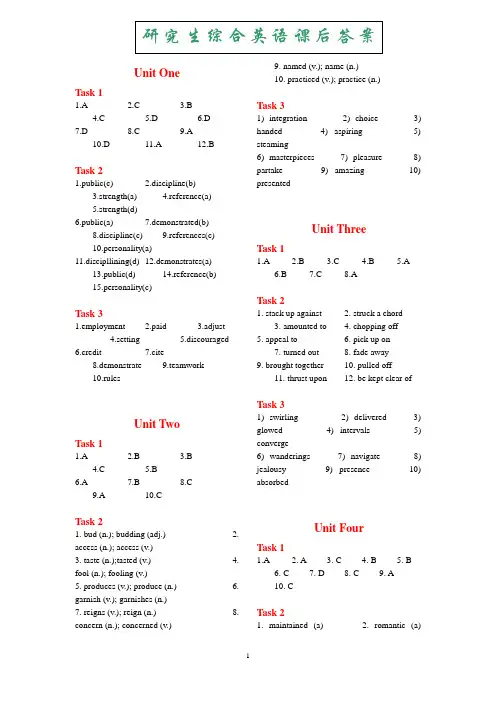
Unit OneTask 11.A2.C3.B4.C5.D6.D7.D 8.C 9.A10.D 11.A 12.BTask 21.public(c)2.discipline(b)3.strength(a)4.reference(a)5.strength(d)6.public(a)7.demonstrated(b)8.discipline(c) 9.references(c)10.personality(a)11.discipllining(d) 12.demonstrates(a)13.public(d) 14.reference(b)15.personality(c)Task 31.employment2.paid3.adjust4.setting5.discouraged6.credit7.cite8.demonstrate 9.teamwork10.rulesUnit TwoTask 11.A2.B3.B4.C5.B6.A7.B8.C9.A 10.CTask 21. bud (n.); budding (adj.)2. access (n.); access (v.)3. taste (n.);tasted (v.)4. fool (n.); fooling (v.)5. produces (v.); produce (n.)6. garnish (v.); garnishes (n.)7. reigns (v.); reign (n.) 8. concern (n.); concerned (v.)9. named (v.); name (n.)10. practiced (v.); practice (n.)Task 31) integration 2) choice 3) handed 4) aspiring 5) steaming6) masterpieces 7) pleasure 8) partake 9) amazing 10) presentedUnit ThreeTask 11.A2.B3.C4.B5.A6.B7.C8.ATask 21. stack up against2. struck a chord3. amounted to4. chopping off5. appeal to6. pick up on7. turned out 8. fade away9. brought together 10. pulled off11. thrust upon 12. be kept clear ofTask 31) swirling 2) delivered 3) glowed 4) intervals 5) converge6) wanderings 7) navigate 8) jealousy 9) presence 10) absorbedUnit FourTask 11.A2. A3. C4. B5. B6. C7. D8. C9. A10. CTask 21. maintained (a)2. romantic (a)3. essential (a)4. essentials (c)5. dimension (c)6. intimate (a)7. maintains (c)8. defies (b)9. intimated (d) 10. dimensions (a) 11. defy (a) 12. romantic (b)13. dimensions (b) 14. maintain (d) 15. intimate (c)Task 31) prerequisite 2) date 3) Respect 4) important5) whomever 6) candidates 7) highly 8) essential9) suitable 10) sufficientUnit FiveTask 11. B2. D3. C4. B5. C6. A7. B8. D9. C 10. A 11.C 12. D 13. BTask 21. A. masterpieces B. masteredC. mastery2. A. committed B. commissionC. commitment3. A. executing B. executionC. executive4. A. presentation B. representedC. presentedD. present5. A. inventors B. investorsC. innovator6. A. breath B. breathingC. breathtakingD. breathless7. A. physical B. physiologicalC. psychological8. A. discipline B. routineC. discipline9. A. practice B. performedC. perfectD. proper10. A. reaction B. reconciliationC. resistanceD. response Task 31) written 2) practiced 3) adapted 4) fundamental 5) soul6) described 7) mental 8) state of being 9) pictured 10) exercises11) control 12) experiences 13) including 14) individuals 15) medicalUnit SixTask 11.B2. D3.A4. C5. B6. A7. C8. D9. B 10. CTask 21. contented2. convention3. tall4. curiously5. Convention6. content7. execute8. curious9. execute 10. count 11. content 12. conventions 13. count 14. convention 15. tallTask 31) sheer 2) subject 3) contradictory 4) worldly 5) chaotic6) sophisticated 7) violence 8) glamorous 9) crime 10) safestUnit SevenTask 11.A2. C3. B4. B5. C6. A7. B8. C9. A 10. CTask 2Step 1partially unfoldunselfishness/selfishnessimperfect employee proverbial refinement indestructiblecriminalmistakealteration liar considerabletraitorphilanthropistStep 21. indestructible2. mistook3. unselfishness4. imperfect5. alteration6. traitor7. considerable8. liar9. employees 10. unfolds 11. refinement 12. philanthropist 13. criminal 14. partially 15. proverbialTask 31. So far as I'm concerned2. should endeavor to measure whether predetermined goals are being achieved3. has been engrossed in conversation with all night4. draw conclusions from the results of a single survey5. He had no friends nor acquaintances6. did she tell him about the attack7. as we had seen8. that he had had a family himself9. the problems you mention are inherent in the system10. young people conscientious in their work/young people who are conscientious in their work11. deviated from her custom12. at the peril of your own life/at your own peril13. taken on a new dimension14. capable of looking after myself15. in much the same way as it was 200 years ago16. rescue the sailors from the sinking ship 17. Portugal participated in the war18. due to our ignoranceUnit EightTask 1Step 11. boot---e, m2. bound--c, j3. fatal--b, q4. negotiate--g, n5. net---a, f, 16. the odds--h, i7. reward--k, o 8. vacuum---d, pStep 21. boot (m)2. vacum (p)3. rewarded (o)4. reward (k)5. net (f)6. negotiating (n)7. odds (h)8. odds (i)9. Fatal (b) 10. negotiations (g)Task 21. A. black and white B. in black and white C. black-and-white2. A. on the scene B. sets the scene C. behind the scenes3. A. make no difference B. make a differenceC. make any differenceD. make all the difference4. A. work on B. works against C. work out5. A. spread to B. spreading out C. spread throughTask 31.A2.B3.B4.D5.A6.B7.C8.B9.D 10.CUnit NineTask 11.A2. D3. B4. B5. C6. A7. B8. A9. C 10. ATask 21. crammed (b)2. balloon (a)3. crash (a)4. crammed (a)5. crashed(a)6. crammed (d)7. ballooned (c)8. crash (b)9. balloon (b) 10. slumped(b)11. trust (c) 12. trust (d) 13. liberal (c) 14. slump (c) 15. liberals(b)16. trust (b)Task 31)A 2) D 3) B 4) B 5) C6) C 7) A 8) A 9) D10) DUnit TenTask 1I.A 2. C 3. D 4. B 5. B 6. B7. C 8. D 9. A 10. BTask 21. underlying2. immune3. impart4. imperative5. vulnerable6. diffused7. foremost8. scholarly9. illuminated 10. eloquenceTask 31) deeper 2) contribute 3) explore 4) potential 5) how 6) productive 7) likely 8) produce 9) Nationally 10) dedicated。
考研英语排序题真题答案

考研英语排序题真题答案在考研英语阅读理解部分,排序题要求考生根据文章的逻辑顺序,将打乱的段落重新排列。
以下是一篇排序题的真题及答案解析:原文段落:A. However, the majority of the population still relies on traditional methods for their daily transportation.B. In recent years, the use of electric vehicles has become increasingly popular.C. The introduction of electric buses has significantly reduced the carbon footprint in some cities.D. Despite the advancement in technology, there has been a slow adoption of electric vehicles.E. The government has been promoting the use of electric vehicles through various incentives.F. The transition from traditional to electric vehicles is not without its challenges.正确排序:B, E, C, D, A, F答案解析:1. B - 段落B作为开头,引出主题,即近年来电动车的流行。
2. E - 段落E紧接着B,说明政府如何通过激励措施来推广电动车的使用。
3. C - 段落C进一步阐述了电动车带来的积极影响,即减少碳足迹。
4. D - 段落D转折,指出尽管技术进步,但电动车的普及仍然缓慢。
5. A - 段落A进一步解释了D中提到的慢速普及的原因,即大多数人仍然依赖传统交通方式。
英语考研排序题真题及答案

英语考研排序题真题及答案英语考研的排序题是一种常见的题型,它要求考生根据给定的段落或句子,将其正确地排序,以恢复文章的逻辑顺序。
这类题目考察考生对英语文章结构、逻辑关系以及上下文连贯性的理解能力。
真题示例:1. A. However, the new findings suggest that the impact ofthe virus on the brain is not as severe as previously thought.2. B. But the researchers also found that the virus can cause some damage to the brain.3. C. The latest study on the virus has revealed some interesting results.4. D. In fact, the virus can cause no damage to the brain at all.5. E. This is a significant discovery because it changes our understanding of the virus's effects.答案:3-B-A-E-D解析:- 首先,C句作为首句,引出了研究的主题,因此是第一句。
- 接着,B句中的"but"表明它与前文有转折关系,而A句中的"However"与"the new findings"呼应,说明B和A是紧密相连的,且B在A之前。
- E句中的"This is a significant discovery"是对前文的总结,因此它应该在A句之后。
- 最后,D句中的"In fact"进一步强调了E句中的发现,所以D是最后一句。
2024年研究生考试考研英语(一201)试卷与参考答案
2024年研究生考试考研英语(一201)复习试卷与参考答案一、完型填空(10分)Part A: Cloze TestRead the following passage and choose the best word for each blank from the options given below. There are twenty blanks in the passage. Each blank has four choices marked A, B, C, and D. You should mark the corresponding letter on Answer Sheet 1 with a single line through the centre.The rise of the Internet has 1 a significant impact on the way people 2 information. With just a few clicks, one can access a vast array of resources and 3 from around the world. However, this 4 in information access has also brought about challenges. Here is a story that illustrates the complexities of our digital age.In a small town, a young girl named Lily was 5 her studies. She was particularly 6 in learning about the world beyond her village. One day, while browsing the Internet, she stumbled upon an article about climate change. The article 7 her curiosity and she began to research further.Lily found a website that offered a variety of 8 on environmental issues. She spent hours reading about the effects of global warming and the importanceof sustainable practices. As she learned more, she felt 9 to make a difference in her community.10, Lily organized a local clean-up drive. She 11 her friends and neighbors to join her, and together they collected trash and cleaned up the local park. The event received 12 from the community, and it inspired others to take action.Despite the positive outcome, Lily realized that there was still much work to be done. She 13 to join a local environmental group to 14 her knowledge and skills. The group organized workshops and community outreach programs to educate people about environmental issues.As Lily continued her journey, she 15 that technology could be a double-edged sword. While it provided access to information, it also 16 distractions and could lead to 17 attention spans. She learned to balance her use of the Internet with other activities and discovered that 18 the right balance was crucial.One day, while 19 the news, Lily read about a global initiative to reduce plastic waste. She 20 the opportunity to participate and reached out to her environmental group. Together, they organized a campaign to promote the use of reusable bags and educate people about the impact of single-use plastics.1.A. A. resulted inB. B. contributed toC. C. led toD. D. caused2.A. gatherB. B. acquireC. C. searchD. D. seek3.A. experiencesB. B. perspectivesC. C. knowledgeD. D. insights4.A. increaseB. B. expansionC. C. surgeD. D. boost5.A. dedicated herself toB. B. immersed herself inC. C. focused onD. D. involved herself in6.A. enthusiastic aboutB. B. fascinated byC. C. interested inD. D. excited about7.A. sparkedB. B. ignitedC. C. arousedD. D. stimulated8.A. articlesB. B. resourcesC. C. materialsD. D. publications9.A. motivatedB. B. determinedC. C. inspiredD. D. encouraged10.A. SubsequentlyB. B. ConsequentlyC. C. EventuallyD. D. Immediately11.A. invitedB. B. encouragedC. C. persuadeD. D. asked12.A. supportB. B. recognitionC. C. enthusiasmD. D. appreciation13.A. decidedB. B. volunteeredC. C. attemptedD. D. agreed14.A. enhanceB. B. expandC. C. improveD. D. develop15.A. recognizedB. B. realizedC. C. acknowledgedD. D. admitted16.A. offeredB. B. providedC. C. causedD. D. resulted in17.A. shorterB. B. briefC. C. conciseD. D. limited18.A. findingB. B. maintainingC. C. achievingD. D. striking19.A. watchingB. B. listening toC. C. readingD. D. scanning20.A. seizedB. B. grabbedC. C. tookD. D. embracedAnswers:1.A. resulted in2.B. acquire3.C. knowledge4.C. surge5.A. dedicated herself to6.B. fascinated by7.A. sparked8.B. resources9.C. inspired10.C. Eventually11.A. invited12.B. recognition13.B. volunteered14.A. enhance15.B. realized16.C. caused17.A. shorter18.D. striking19.C. reading20.D. embraced二、传统阅读理解(本部分有4大题,每大题10分,共40分)First QuestionRead the following passage and answer the questions that follow.Passage:The Role of Technology in EducationEducation has always been a fundamental factor for societal development. However, with the rapid advancement of technology, it’s becoming increasingly clear that traditional methods of teaching are no longer sufficient to meet the needs of today’s digital natives. The integration of technology into education is not just about equipping students with computer skills; it’s also about transforming the way we teach and learn.One of the most significant benefits of technology in education is its ability to personalize learning experiences. Adaptive learning software cantailor educational content to the specific needs of each student, ensuring that every learner gets the support they require. Furthermore, online platforms provide access to a wealth of information and resources that would otherwise be unavailable to many students, particularly those in remote or underprivileged areas.However, critics argue that an over-reliance on technology might lead to a loss of essential human interaction and the development of social skills. There is also concern about the potential for increased screen time to have negative effects on children’s health and well-being. Despite these concerns, proponents of educational technology believe that if used correctly, it can enhance rather than detract from the educational experience.As technology continues to evolve, so must our approach to education. It is clear that there is a need for a balanced integration of traditional teaching methods with modern technological tools. Only by embracing this hybrid model can we ensure that future generations are adequately prepared for the challenges of the 21st century.Questions:1、What is the main argument presented in the passage regarding technology in education?A)Technology should replace traditional teaching methods.B)Technology should complement traditional teaching methods.C)Technology is detrimental to the educational process.D)Technology has no place in the classroom.Answer: B) Technology should complement traditional teaching methods.2、According to the passage, what is one of the advantages of using technology in education?A)It increases the amount of homework students receive.B)It personalizes learning experiences for individual students.C)It makes traditional teaching methods obsolete.D)It decreases the need for teachers in the classroom.Answer: B) It personalizes learning experiences for individual students.3、What concern does the passage mention regarding the use of technology in education?A)It may cause a decrease in the use of textbooks.B)It might result in a lack of social interaction among students.C)It could lead to an increase in physical activity among students.D)It ensures that all students have equal access to information.Answer: B) It might result in a lack of social interaction among students.4、How does the passage suggest that technology affects access to information?A)It limits access to information only to those who can afford it.B)It provides broader access to information for students in remote areas.C)It restricts the types of information available to students.D)It has no impact on how students access information.Answer: B) It provides broader access to information for students in remote areas.5、What does the passage imply about preparing future generations?A)They should rely solely on technology for learning.B)They should reject modern educational tools in favor of traditional ones.C)They should be taught using a combination of traditional and modern methods.D)They should focus exclusively on developing social skills without technology.Answer: C) They should be taught using a combination of traditional and modern methods.第二题Reading PassageIn the 19th century, the Industrial Revolution brought about significant changes in the way people lived and worked. This period of rapid industrialization led to the development of factories, the mass production of goods, and a shift from an agrarian society to an urban one. The following article discusses the impact of the Industrial Revolution on society and the environment.The Impact of the Industrial RevolutionThe Industrial Revolution, which began in the late 18th century, was a period of profound economic and social change in Europe and North America. It was marked by the transition from hand production methods to machines, and by the introduction of new chemical, iron, steel, and coal industries. This transition had a profound impact on the lives of people, and it brought about both positive and negative consequences.One of the most significant impacts of the Industrial Revolution was the urbanization of society. As factories were built in cities, people moved fromrural areas to urban centers in search of work. This led to the growth of cities and the creation of slums, where many workers lived in poor conditions. The overcrowded and unsanitary conditions in these areas contributed to the spread of diseases such as cholera and tuberculosis.Another consequence of the Industrial Revolution was the degradation of the environment. The burning of coal and the release of pollutants into the air and water led to air and water pollution, which had serious health implications for people and animals. The deforestation and soil erosion that resulted from the expansion of industrial activities also had a detrimental effect on the natural landscape.Despite these negative impacts, the Industrial Revolution also brought about many positive changes. The mass production of goods led to a significant increase in the standard of living for many people. The development of new technologies, such as the steam engine and the telegraph, improved communication and transportation, making the world a smaller place. Additionally, the Industrial Revolution led to the rise of the middle class, which had a profound impact on social and political structures.Questions:1、What was one of the most significant impacts of the Industrial Revolution on society?A. The decline of agricultureB. The urbanization of societyC. The decrease in populationD. The increase in unemployment2、Why did people move to urban centers during the Industrial Revolution?A. To pursue higher educationB. To enjoy the culture of the citiesC. To seek better job opportunitiesD. To avoid the diseases prevalent in rural areas3、What was a negative consequence of the Industrial Revolution on the environment?A. The increase in agricultural productivityB. The improvement of air qualityC. The reduction of deforestationD. The decline in water pollution4、How did the Industrial Revolution affect the standard of living for many people?A. It led to a decrease in living standardsB. It resulted in a significant increase in living standardsC. It had no significant impact on living standardsD. It caused a mixed impact on living standards5、What was one of the social and political impacts of the Industrial Revolution?A. The strengthening of the monarchyB. The rise of the middle classC. The fall of the aristocracyD. The abolition of slaveryAnswers:1、B2、C3、D4、B5、B第三题Once upon a time, in a small village nestled between rolling hills, there lived an old man named Mr. Brown. Mr. Brown was a kind-hearted and wise man, known throughout the village for his stories and his ability to solve problems with a unique perspective. The villagers would often gather at his house after the day’s work to listen to his tales, which were always filled with lessons and moral values.One evening, a young man named Tom approached Mr. Brown. Tom had heard about Mr. Brown’s wisdom and sought his advic e on a difficult situation. Tom was facing a choice between a lucrative job offer in a big city and staying close to his family and friends in the village.Questions:1、What is the main topic of the passage?A. The beauty of the villageB. The wisdom of Mr. BrownC. The challenges of modern lifeD. The importance of family2、Why did Tom go to see Mr. Brown?A. To ask for help with his studiesB. To discuss the village’s problemsC. To seek advice on a difficult decisionD. To compete with Mr. Brown in a storytelling contest3、What was the young man’s main dilemma?A. Whether to move to the city or stay in the villageB. How to become a successful businessmanC. What to do with his old houseD. How to improve the village’s economy4、What is the purpose of Mr. Brown’s stories in the passage?A. To entertain the villagersB. To teach moral values and lessonsC. To promote tourism in the villageD. To showcase his own wisdom5、According to the passage, what does Mr. Brown represent to the villagers?A. A source of entertainmentB. A mentor and counselorC. A competitor in storytellingD. A symbol of wealth and powerAnswers:1、B2、C3、A4、B5、B第四题Passage:In recent years, the rise of e-books has sparked a debate about the future of traditional books. While many argue that e-books will eventually replace printed books, others believe that the traditional book format will continue to thrive. This article explores the arguments on both sides and examines the potential impact of e-books on the publishing industry.1.The article mentions that the debate over e-books versus traditional books is a topic of great concern. What is the main reason for this debate?A. The declining sales of printed booksB. The increasing popularity of e-readersC. The potential impact on the publishing industryD. The environmental concerns of paper usage2.The passage states that some people believe e-books will eventually replace printed books. What is the primary reason for this belief?A. The convenience of e-booksB. The lower cost of e-booksC. The environmental benefits of e-booksD. The potential for interactive content in e-books3.According to the article, which of the following is NOT mentioned as a potential disadvantage of e-books?A. The lack of tactile experienceB. The potential for screen fatigueC. The ease of copying and distributing contentD. The limited availability of e-books in some regions4.The article discusses the role of traditional books in the education system. What does the author suggest about the importance of physical books in education?A. They are becoming less importantB. They are essential for learningC. They are being replaced by digital resourcesD. They are being ignored by modern students5.The author concludes the article by discussing the future of the publishing industry. What does the author imply about the industry’s ability to adapt to the rise of e-books?A. The industry will struggle to adaptB. The industry will thrive regardless of e-booksC. The industry will adapt and evolveD. The industry will disappear due to e-booksAnswers:1.C2.A3.C4.B5.C三、阅读理解新题型(10分)Passage:The rise of e-commerce has transformed the way we shop and conduct business. Online shopping has become increasingly popular due to its convenience, variety, and competitive prices. As a result, traditional brick-and-mortar stores are facing stiff competition and are forced to adapt to the digital world. This essay explores the impact of e-commerce on the retail industry and discusses the challenges and opportunities it presents.Questions:1.What is the main topic of the passage?A) The benefits of online shoppingB) The decline of traditional storesC) The impact of e-commerce on the retail industryD) The challenges faced by brick-and-mortar stores2.According to the passage, why is online shopping becoming more popular?A) It is more expensive than shopping in physical stores.B) It is only available during specific hours.C) It offers a wider variety of products.D) It requires customers to physically visit a store.3.What is the main challenge that traditional stores are facing?A) The lack of competitive prices.B) The limited selection of products.C) The stiff competition from e-commerce.D) The difficulty in adapting to digital technology.4.The passage suggests that traditional stores need to do what in order to survive?A) Offer the lowest prices.B) Close their physical locations.C) Embrace e-commerce and digital technology.D) Focus solely on online sales.5.How does the passage conclude the impact of e-commerce on the retail industry?A) E-commerce will eventually replace all traditional stores.B) Traditional stores will need to adapt to e-commerce or risk extinction.C) The impact of e-commerce on the retail industry is negligible.D) E-commerce will only benefit large corporations and not small businesses.Answers:1.C) The impact of e-commerce on the retail industry2.C) It offers a wider variety of products.3.C) The stiff competition from e-commerce.4.C) Embrace e-commerce and digital technology.5.B) Traditional stores will need to adapt to e-commerce or risk extinction.四、翻译(本大题有5小题,每小题2分,共10分)第一题Translate the following paragraph into English.中文段落:研究生考试是许多中国学生梦寐以求的机会,它不仅为他们提供了一个深造和提升自身能力的机会,而且也是实现个人职业目标的重要途径。
考研英语排序题精选
解题实战练习:Directions:The following paragraphs are given in a wrong order. For Questions 41—45, you are required to reorganize these paragraphs into a coherent article by choosing from the list A—E to fill in each numbered box. The first and the last paragraphs have been placed for you in Boxes. Mark your answers on ANSWER SHEET 1. (10 points)[A] “I just don’t know how to motivate them to do a better job. We’re in a budget crunch and I have absolutely no financial rewards at my disposal. In fact, we’ll probably have to lay some people off in the near future. It’s hard for me to make the job interesting and challenging because it isn’t —it’s boring, routine paperwork, and there isn’t much you can do about it.[B] “Finally, I can’t say to them that the ir promotions will hinge on the excellence of their paperwork. First of all, they know it’s not true. If their performance is adequate, most are more likely to get promoted just by staying on the force a certain number of years than for some specific outstanding act. Second, they were trained to do the job they do out in the streets, not to fill out forms. All through their career it is the arrests and interventions that get noticed.[C] “I’ve got a real problem with my officers. They come on the force as young, inexperienced men, and we send them out on the street, either in cars or on a beat. They seem to like the contact they have with the public, the action involved in crime prevention, and the apprehension of criminals. They also like helping people out at fires, accidents, and other emergencies.[D] “Some people have suggested a number of things like using conviction records as a performance criterion. However, we know that’s not fair — too many other things are involved. Bad paperwork increases t he chance that you lose in court, but good paperwork doesn’t necessarily mean you’ll win. We tried setting up team competitions based on the excellence of the reports, but the guys caught on to that pretty quickly. No one was getting any type of reward for winning the competition, and they figured why should they labor when there was no payoff.[E] “The problem occurs when they get back to the station. They hate to do the paperwork, and because they dislike it, the job is frequently put off or done inadequately. This lack of attention hurts us later on when we get to court. We need clear, factual reports. They must be highly detailed and unambiguous. As soon as one part of a report is shown to be inadequate or incorrect, the rest of the report is suspect. Poor reporting probably causes us to lose more cases than any other factor.[F] “So I just don’t know what to do. I’ve been groping in the dark in a number of years. And I hope that this seminar will shed some light on this problem of mine and help me out in my future work.”[G] A large metropolitan city government was putting on a number ofseminars for administrators, managers and/or executives of various departments throughout the city. At one of these sessions the topic to be discussed was motivation -- how we can get public servants motivated to do a good job. The difficulty of a police captain became the central focus of the discussion.Order:G---( )—( )—( )—( )—( )--F步骤一、理解给定的段落确定文章的文体与结构。
最新考研《英语一》新题型密押:排序题及答案
考研《英语一》新题型密押:排序题及答案Passage 1Directions: For question 1—5, choose the most suitable paragraphs from the list A—G and fill them into the numbered boxes to form a coherent text. Paragraphs A and D have been correctly placed.[A] Subscription has proved by far the best way of paying for high quality television. Advertising veers up and down with the economic cycle, and can be skipped by using digital video recorders. And any outfit that depends on advertising is liable to worry more about offending advertisers than about pleasing viewers. V oluntary subscription is also preferable to the compulsory, universal variety that pays for the BBC and other European public broadcasters. A broadcaster supported by a tax on everyone must try to please everyone. And a government can starve public broadcasters of money, too—as the BBC is painfully learning.[B] What began as an interesting experiment has become the standard way of supporting high quality programming. Most of the great television dramas that are watched in America and around the world appear first on pay TV channels. Having shown others how to make gangster dramas with “The Sopranos”, HBO is laying down the standard for fantasy with “Game of Thrones”. Other pay TV channels have delved into 1960s ad vertising (“Mad Men”), drug dealing (“BreakingBad”) and Renaissance court society (“The Borgias”). Pay TV firms outside America, like Britain s BSkyB, are beginning to pour money into original series. Talent is drifting to pay television, in part because there are fewer appealing roles in film. Meanwhile, broadcast networks have retreated into a safe zone of sitcoms, police procedurals and singing competitions.[C] But pay television is now under threat, especially in America. Prices have been driven so high at a time of economic malaise that many people simply cannot afford it. Disruptive, deep pocketed firms like Amazon and Netflix lurk, whispering promises of internet delivered films and television shows for little or no money. Whether the lure of such alternatives or poverty is what is causing people to cancel their subscriptions is not clear. But the proportion of Americans who pay for TV is falling. Other countries may follow.[D] Pay TV executives argue that people will always find ways of paying for their wares, perhaps by cutting back on cinema tickets or bottled water. That notion seems increasingly hopeful. Every month it appears more likely that the pay TV system will break down. The era of ever growing channel choice is coming to an end; cable and satellite distributors will begin to prune the least popular ones. They may push “best of basic” packages, offering the most desirable channels—and perhaps leaving out sport. In the most disruptive scenario, no longerunimaginable, pay TV would become a free for all, with channels hawking themselves directly to consumers, perhaps sending their content over the internet. How can media firms survive in such a world?[E] Fifteen years ago nearly all the television shows that excited critics and won awards appeared on free broadcast channels. Pay television (or, as many Americans call it, “cable”) was the domain of repeats, music videos and televangelists. Then HBO, a subscription outfit mostly known for boxing and films, decided to try its hand at hour long dramas.[F] But television as a whole should emerge stronger. If people buy individual channels rather than a huge bundle, they will have to think about what they really value—the more so because each channel will cost more than it does at present. Media firms will improve their game in response. The activity that diverts the average American for some four and a half hours each day should become more gripping, not less.[G] It won t be easy. They will have to start marketing heavily: at present the pay TV distributors do that for them. They must produce much more of their own programming. Repeats and old films lose their appeal in a world in which consumers can instantly call up vast archives. If they are to sell directly to the audience they will have to become technology firms, building apps and much slicker websites than they have now, which anticipate what customers might want to watch.1→2→A→3→D→4→5Passage 2Directions: For question 1—5, choose the most suitable paragraphs from the list A—G and fill them into the numbered boxes to form a coherent text. Paragraphs D and E have been correctly placed.[A] For publishers, though, it is a dangerous time. Book publishing resembles the newspaper business in the late 1990s, or music in the early 2000s. Although revenues are fairly stable, and the traditional route is still the only way to launch a blockbuster, the climate is changing. Some of the publishers functions—packaging books and promoting them to shops—are becoming obsolete. Algorithms and online recommendations threaten to replace them as arbiters of quality. The tide of self published books threatens to swamp their products. As bookshops close, they lose a crucial showcase. And they face, as the record companies did, a near monopoly controlling digital distribution: Amazon’s grip over the ebook market is much like Apple’s control of music downloads.[B] They also need to become more efficient. Digital books can be distributed globally, but publishers persist in dividing the world into territories with separate editorial staffs. In the digital age it is daft to take months or even years to get a book to market. And if they are to distinguish their wares from self published dross, they must get better at choosing books, honing ideas and polishing copy. If publishers are tohold readers’attention they must tell a better story—and edit out all the spelling mistakes as well.[C] For readers, this is splendid. Just as Amazon collapsed distance by bringing a huge range of books to out of the way places, it is now collapsing time, by enabling readers to download books instantly. Moreover, anybody can now publish a book, through Amazon and a number of other services.[D] During the next few weeks publishers will release a crush of books, pile them onto delivery lorries and fight to get them on the display tables at the front of bookshops in the run up to Christmas. It is an impressive display of competitive commercial activity. It is also increasingly pointless.[E] Yet there are still two important jobs for publishers. They act as the venture capitalists of the words business, advancing money to authors of worthwhile books that might not be written otherwise. And they are editors, picking good books and improving them. So it would be good, not just for their shareholders but also for intellectual life, if they survived.[F] More quickly than almost anyone predicted, e books are emerging as a serious alternative to the paper kind. Amazon, comfortably the biggest e book retailer, has lowered the price of its Kindle e readers to the point where people do not fear to take them to the beach. In America, the most advanced market, about one fifth of the largestpublishers sales are of e books. Newly released blockbusters may sell as many digital copies as paper ones. The proportion is growing quickly, not least because many bookshops are closing.[G] They are doing some things right. Having watched the record companies impotence after Apple wrested control of music pricing from them, the publishers have managed to retain their ability to set prices. But they are missing some tricks. The music and film industries have started to bundle electronic with physical versions of their products—by, for instance, providing those who buy a DVD of a movie with a code to download it from the internet. Publishers, similarly, should bundle e books with paper books.D→1→2→3→E→4→5Passage 3Directions: For question 1—5, choose the most suitable paragraphs from the list A—G and fill them into the numbered boxes to form a coherent text. Paragraphs C and F have been correctly placed.[A] Fifteen years ago Vincent Bolloré, a French industrialist, decided to get into the business of electricity storage. He started a project to produce rechargeable batteries in two small rooms of his family mansion in Brittany. “I asked him, ‘what are you doing? and I told him to stop, that it wouldn t go anywhere,” says Alain Minc, a business consultant in Paris who has advised Mr Bolloréfor many years.Fortunately, he says, Mr Bolloré continued.[B] The real aim for Mr Bolloré, however, is to showcase his battery technology. His group has developed a type of rechargeable cell, called a lithium metal polymer (LMP) battery. This is different from the lithium ion batteries used by most of the car industry. Mr Bollorébelieves fervently that his batteries are superior, mainly because they are safer. Lithium ion batteries can explode if they overheat—which in the past happened in some laptops. Carmakers incorporate safety features to prevent the batterys cells from overheating.[C] The city of Paris will cover most of the cost of the stations, but Mr Bolloré will pay an estimated 105m to supply his design of “Bluecar” vehicles and their batteries. He will bear a further 80m a year in running costs. The city s estimates for how popular the new service will be are highly optimistic, said a recent study by the government. Autolib could make 33ma year for Mr Bolloré, according to the study, but it could easily just breakeven or lose as much as 60mannually. Autolib will also be the first time the group has operated in a big consumer facing business where it will be held directly responsible for problems such as vandalism or breakdowns.[D] Going up against the rest of the car industry may seem quixotic. Before he won Autolib, Mr Bolloré says, people may well have thought he and his team were mad to venture into such a new area. But theyunderestimated his group s knowledge of electricity storage, he maintains. And if the growing number of electric cars on the road does lead to safety concerns over batteries, then Mr Bollorés LMP technology could move from the margin to the mainstream—provided, of course, they pass their test on the streets of Paris.[E] “Being a family company means we can invest for the long term,” says Mr Bolloré, who has spent 1.5 bill ion on battery development since 1996. Most of his group s money comes from transport and logistics, with a strong position in Africa, and from petrol distribution in France. Mr Bolloréhas also made billions from financial investments such as in Rue Imperiale, a holding company. Autolib will be keenly watched throughout the car industry. It is the first large scale city car sharing service to use only electric vehicles from the outset; a scheme in Ulm in Germany, by contrast, started with diesel vehicles. Running Autolib could mean shouldering substantial losses for the Bolloré Group. Mr Bolloré was not expected to win the contract, but did so mainly because he offered low rental charges for drivers.[F] Mr Bollorés LMP batteries are said to be more stable when being charged and discharged, which is when batteries come under most strain. Just two European carmakers have seen the batteries, which are made only by the Bolloré Group. One car industry executive says that though the LMP technology is attractive from a safety point of view, thebatteries have to be heated up to function—which takes power and makes them less convenient to use.[G] Mr Bollorés technology is about to hit the road. In his group won a contract to run Autolib, a car sharing scheme designed by Bertrand Delan e, the mayor of Paris, which will put 3,000 electric vehicles on the city s streets along with 1,120 stations for parking and recharging. Construction of the stations started in the summer, and Mr Bolloré will begin testing the service on October 1st before opening it to the public in December. Rechargeable batteries are now an important technology for the global car industry as it starts to make ever more electric and hybrid vehicles. Renault, a French manufacturer, is alone investing 4 billion ($5.6 billion) in a range of electric models which it will start selling this autumn. Many producers will unveil new electric vehicles next week when the Frankfurt Motor Show opens.1→2→3→C→4→F→5Passage 4Directions: For question 1—5, choose the most suitable paragraphs from the list A—G and fill them into the numbered boxes to form a coherent text. Paragraphs A and D have been correctly placed.[A] The contest has been held in anticipation of a new era of pylon building. By XX, a quarter of the country s current generating capacity will need replacing; the government hopes the new supply will comefrom renewable sources such as onshore and offshore wind farms. Today s offshore capacity is just 7% of ministers targets for the end of the decade—and all of the new generation out to sea will need to land transmission cables ashore. The existing electricity grid is in the wrong place for many of these new sources of power. That creates a paradox: trying to save the world by cutting carbon emissions means scarring particular bits of it by dragging new power lines through scenic countryside.[B] This is an old problem. The launch of Britain s national electricity grid in 1933 was decried for desecrating the landscape. More recently, the location of wind farms has prompted similar debates. The difficulty with pylons is that they go everywhere. Scotland has had nearly five years of disputes over the planned 600pylon upgrade of a transmission line running from Beauly in the Highlands to the central belt where more electricity is used. The same clashes will now play out in England and Wales. A new planning commission was set up in 2009 to speed up the glacial pace of infrastructure decision making. But weighing economic demands against beauty remains a thorny and potentially time-consuming job.[C] Opponents of towering pylons say the answer is to bury power lines: at present only 950km of Britain s 13,000km of high voltage cable runs underground, most of it in urban areas. But sinking wires,which means clearing a corridor 17m to 40m wide and cannot be done in all terrains, carries an environmental toll too. “You are effectively sterilising land use in the area,” says Richard Smith of National Grid; no planting, digging or building is allowed. That makes installing subsurface cables 12 to 17 times as pricey as overhead lines, according to National Grid (they also need replacing sooner). Since consumers pay for this through their electricity bills, everyone would have to fork out to protect the views and house prices of a few people.[D] So finding a new shape for pylons may be only one aspect of the coming power rows. But it will be a tricky one. Typically the best designs combine elegance with utility. Yet rather than being a feature in itself, the optimal pylon blends in with nature. That s a tough task for20 tons of steel, however impressively shaped.[E] The skeletal, lattice design of Britain s electricity pylons has changed little since the first one was raised in 1928. Many countries have copied these “striding steel sentries”, as the poet Stephen Spender called them; more than 88,000 now march across the country s intermittently green and pleasant land.[F] Now six new models are vying to replace these familiar steel towers. The finalists in a government sponsored competition to design a new pylon include a single shard spiking into the sky and an arced, open bow. After a winner is picked in October, National Grid, which runs theelectricity transmission network, will decide whether to construct it.[G] But the price of despoiling pretty scenery is hard to calculate. The risk is that the cost of damaging the landscape is ignored because it is not ascribed a monetary value, says Steve Albon, co author of a government commissioned report on how much the natural environment contributes to Britain s economy. As yet, though, no one has found an easy or accepted measure of this worth to help make decisions.1→2→A→3→4→5→DPassage 5Directions: For question 1—5, choose the most suitable paragraphs from the list A—G and fill them into the numbered boxes to form a coherent text. Paragraphs C and E have been correctly placed.[A] Nor can it buy companies as freely as postal services in Europe, Canada or Asia have been doing for the past decade. Many European countries, as well as New Zealand and Japan, have already privatised or liberalised their postal services. Combined, foreign posts now get most of their revenue from new businesses such as retailing or banking for consumers, or warehousing and logistics for companies.[B] THE US Postal Service has an unofficial creed that harks back to Herodotus, who was admiring the Persian Empire s stalwart messengers. Its own history is impressive too, dating to a royal license byWilliam and Mary in 1692, and including Benjamin Franklin as a notable postmaster, both for the crownand then for the newly independent country. Ever since, the post has existed “to bind the Nation together”.[C] Quasi independent since 1970, the post gets no public money. And yet it is obliged (as FedEx and UPS are not) to visit every mailbox, no matter how remote, six days a week. This has driven the average cost of each piece of mail up from 34 cents in 2006 to 41 cents. Yet the post is not allowed to raise prices (of stamps and such) willy nilly; a 2006 law set formulas for that. So in effect, the post cannot control either its costs or its revenues.[D] So America s post is looking for other solutions. It is planning to close post offices; up to 3,653, out of about 32,000. This month it announced plans to lay off another 120,000 workers by , having already bidden adieu to some 110,000 over the past four years (for a total of about 560,000 now). It also wants to fiddle with its workers pensions and health care.[E] Ultimately, says Mr Donahoe, the post will have to stop delivering mail on Saturdays. Then perhaps on other days too. The post has surv ived new technologies before, he points out. “In 1910, we owned the most horses, by 1920 we owned the most vehicles.” But the internet just might send it the way of the pony express.[F] But as ever more Americans go online instead of sending paper,the volume of mail has been plummeting. The decline is steeper than even pessimists expected a decade ago, says Patrick Donahoe, the current postmaster general. Worse, because the post must deliver to every address in the country—about 150m, with some 1.4m additions every year—costs are simultaneously going up. As a result, the post has lost $20 billion in the last four years and expects to lose another $8 billion this fiscal year.[G] And although the recession made everything worse, the internet is the main culprit. As Christmas cards have gone online (and “green”), so have bills. In 2000, 5% of Americans paid utilities online. Last year 55% did, and eventually everybody will, says Mr Donahoe. Photos now go on Facebook, magazines come on iPads. Already, at least for Americans under a certain age, the post delivers only bad news or nuisances, from jury summonses to junk mail. Pleasant deliveries probably arrive by a parcel service such as UPS or FedEx.1→2→3→C→4→5→EPassage 6Directions: For question 1—5, choose the most suitable paragraphs from the list A—G and fill them into the numbered boxes to form a coherent text. Paragraphs A and B have been correctly placed.[A] Among national newspapers, paywalls are still rare, though the New York Times and the Times of London both have them. Mostwall building is being done by small local outfits. “Local newspapers are more vital to their communities, and they have less competition,” explains Ken Doctor, the author of “Newsonomics”[B] The paywall builders tend to report a drop in online traffic. But not usually a steep drop, and not always an enduring one. Oklahoma s Tulsa World, which started demanding subscriptions from heavy online readers in April, reports that traffic in August of this year was higher than a year earlier. One possible explanation, odd as it may sound, is that readers are still discovering its website. “We have paper subscribers who want nothing to do with the internet,” explains Robert Lorton, the Tulsa World s publisher. Fewer than half of the newspaper s print subscribers have so far signed up for unrestricted free access to the website. Other newspapers report similar proportions.[C] That suggests the game is not over. The early adopting young abandoned print newspapers long ago. But many newspapers have a surprisingly large, if dwindling, herd of paying customers. They will milk them as hard as they can.[D] On October 10th the Baltimore Sun will join a fast growing club. The newspaper will start tracking the number of times people read its stories online; when they reach a limit of 15 a month, they will be asked to pay. Local bloggers may squawk about content wanting to be free. But perhaps not as much as they would have done a few months ago.There is a sense of inevitability about paywalls. In April PaidContent, an online publication, found 26 American local and metropolitan newspapers charging for online access. Several times that number now do so. More than 100 newspapers are using Press+, an online payment system developed in part by a former publisher of the Wall Street Journal. Media News, a newspaper group, put up two paywalls in ; it has erected23 so far this year.[E] Why the rush? One reason is that building paywalls has become easier: Press+ and Google s One Pass will collect online subscriptions on behalf of newspapers, skimming a little off the top. The popularity of Apple s iPad is another explanation. Many newspapers have created paid for apps. There is little point doing that if a tablet user can simply read the news for free on a web browser. But the big push comes from advertising—or the lack of it.[F] The most ambitious architects are in Europe. Since May Slovakia has had a virtual national paywall—a single payment system that encompasses nine of the country s biggest publications. Slovaks who want to read news online pay 2.90 ($3.90) a month, which is split between the newspapers according to a formula that accounts for where people signed up and how heavily they use each publication s website. Piano Media, which built the system, plans to launch another national paywall in Europe early next year.[G] Jim Moroney, publisher of the Dallas Morning News, says American newspapers used to abide by an “8020” rule. That is, 80% of their revenues came from advertising and 20% came from subscriptions. Those days are over. Newspaper advertising, print and online combined, has crashed from $9.6 billion in the second quarter of 2008 to $6 billion in the second quarter of , according to the Newspaper Association of America. Few believe it will ever fully recover. So the race is on to build a subscription business, both in print (cover prices are going up) and online.1→A→2→3→4→B→5Passage 7Directions: For question 1—5, choose the most suitable paragraphs from the list A—G and fill them into the numbered boxes to form a coherent text. Paragraphs A and G have been correctly placed.[A] A GOOD unit of measurement, writes Robert Crease, must satisfy three conditions. It has to be easy to relate to, match the things it is meant to measure in scale (no point using inches to describe geographical distances) and be stable. In his new book, “World in the Balance”, Mr Crease, who teaches philosophy at Stony Brook University on Long Island and writes a column for the magazine Physics World, describes man s quest for that metrological holy grail. In the process, he shows that the story of metrology, not obvious material for a page turner, canin the right hands make for a riveting read.[B] In response the metre, from the Greek metron, meaning “measure”, was ushered in, helped along by French revolutionaries, eager to replace the Bourbon toise (just under two metres) with an all new, universal unit. The metre was to be defined as a fraction of the Paris meridian whose precise measurement was under way. Together with the kilogram, initially the mass of a decaliter of distilled water, it formed the basis of the metric system.[C] Successful French metrological diplomacy meant that in the ensuing decades the metric system supplanted a hotchpotch of regional units in all bar a handful of nations. Even Britain, long wedded to its imperial measures, caved in. (Americans are taking longer to persuade.) In 1875 Nature, a British magazine, hailed the metric system as “one of the greatest triumphs of modern civilisation”. Paradoxically, Mr Crease argues, it thrived in part as a consequence of British imperialism, which all but wiped out innumerable indigenous measurement systems, creating a vacuum that the new framework was able to fill.[D] For all its diplomatic success, though, the metre failed to live up to its original promise. Tying it to the meridian, or any other natural benchmark, proved intractable. As a result, the unit continued to be defined in explicit reference to a unique platinum iridium ingot until 1960. Only then was it recast in less fleeting terms: as a multiple of thewavelength of a particular type of light. Finally, in 1983, it was tied to a fundamental physical constant, the speed of light, becoming the distance light travels in 1/299,792,458 of a second. (The second had by then itself got a metrological makeover: no longer a 60th of a 60th of a 24th of the period of the Earth s rotation, it is currently the duration of 9,192,631,770 periods of a phenomenon called microwave transition in an atom of caesium133.)[E] The earliest known units met the first two of Mr Crease s requirements well. Most were drawn from things to hand: the human body (the foot or the mile, which derives from the Latin milia passuum, or 1,000 paces) and tools (barrels, cups). Others were more abstract. The journal (from jour, French for “day”), used in medieval France, was equivalent to the area a man could plough in a day with a single ox, as was the acre in Britain or the morgen in north Germany and Holland.[F] But no two feet, barrels or workdays are quite the same. What was needed was “a foot, not yours or mine”. Calls for a firm standard that was not subject to fluctuations or the whim of feudal lords, grew louder in the late 17th century. They were a consequence of the beginnings of international trade and modern science. Both required greater precision to advance.[G] Now the kilogram, the last artefact based unit, awaits its turn. Adding urgency is the fact the “real” kilogram, stored in a safe in theInternational Bureau of Weights and Measures in Sèvres, near Paris, seems to be shedding weight relative to its official copies. Metrologists are busy trying to recast it in terms of Planck s constant, a formula which is deemed cosmicly inviolate, as is the speed of light (pending further findings from CERN, anyway). In his jolly book, Mr Crease is cheering them on.A→1→2→3→4→5→GPassage 8Directions: For question 1—5, choose the most suitable paragraphs from the list A—G and fill them into the numbered boxes to form a coherent text. Paragraphs B and G have been correctly placed.[A] There are doubters, of course. The cost of electricity may rise, and some polluters may flee the state, taking jobs away. But California already has one in four of America s solar energy jobs and will add many more. Sun, wind, geothermal, nuclear: “We need it all,” says Terry Tamminen, who advised Mr Schwarzenegger. The state is setting up an “interesting experiment”, he thinks. “California goes one way, the United States another.”[B] To Europeans, Asians and Australians, this may seem nothing much. After all, the European Union already has a similar emissions trading market, and a carbon tax is now wending its way through the Australian legislature. India have adopted versions of carbon。
英语考研12篇排序题答案
Text 1整体分析:本篇文章为现象分析型文章,重点分析了航空公司行李丢失的过程和原因,简要地从乘客自身角度提出了对策。
局部分析:首段A:通过个例引出主题,即行李丢失问题及其后果。
末段G:针对机场行李运输中存在的问题向旅客提出了几点建议。
4l. EA段谈的是行李丢失问题的个例,E段谈的是行李丢失问题的普遍情况。
从A到E,这是从具体到一般,注意作者采用了归纳法提出了行李丢失的问题。
而其他选项都是在分析行李丢失现象的原因,是应该在提出问题后谈论的,故只有E项正确。
42. D针对A和E段提出的问题,下面该分析原因了。
D交待的是飞机行李运输背景知识,谈的是正常情况,而B、C、D谈的是不正常的情况。
人们讨论问题的逻辑是从正常到不正常,先说惯例再说例外。
D 谈论的是正常情况、是惯例。
很显然这里应选D。
D的意思是航空公司尽量争取时间,尽量保证行李的正常运输。
43. C上段讲行李的正常运输,C以"In normal circumstances the system works well."与上段衔接。
下面自然引出不正常的情况,即飞机延误,或者人为因素导致行李运输系统出现问题,导致问题产生。
44. F上段讲行李出现问题的普遍情况,F项讲这一情况出现的极端情况,即过于繁忙的、作为枢纽的大机场出现这种情况更加严重。
F首句说"These problems can become severe at transfer airport…","these problems"与上段衔接。
从C到F是从轻到重,是递进关系。
故F正确。
45. B上一段讲了忙乱的机场行李丢失现象严重,本段进一步指出即使是效率高的机场也无法解决这个痼疾——并列举了欧洲和美国的例子印证。
B递进了上一段的意思。
末段G:在上段分析问题后,简单地针对个人提出了几点建议。
参考译文:到达国外的机场,结果发现自己的行李没有运到,这是最令人失望不过的事情了。