
六年级上册英语教案-Unit 2 Ways to go to school B Read and write
1 Unit 2 Ways to go to school
( B Read and write )
一、教学目标
1. 能读懂Read and write部分的内容,并能回答短文后的问题。
2. 了解世界各地学生上学的多种方式。
3. 能够掌握句子在发音上的连读技巧。
二、教学重难点
重点:
1.理解不同国家学生上学的方式,如by sled(乘雪橇),by ferry(渡船)。
2. 能够独立完成相关练习。
突破方法:
1.通过搜集课外资料,观看图片等了解不同国家学生上学的方式。
2.教给学生方法,培养阅读、听力能力。
难点:掌握句子中单词之间的连读技巧。
突破方法:教师讲解,学生交流,反复练习,突破难点。
三、学情分析
阅读教学是英语教学中的难点,培养学生具备一定的阅读能力是阅读教学的终极目标。学生通过前几课时的学习,已基本掌握本课时核心词汇及句型,为本课时阅读教学打下基础。课堂上通过引导学生在语篇中找关键词及结合文中图片推理语篇意思,从而正确地理解朗读语篇。
教法与学法
引导法,点拨法,小组讨论法。
四、教学准备
多媒体课件
五、教学过程
(一)Warm-up
1.播放动画Let’s sing:《How do you go to school》
2.交通方式T:How do we/you go to …? S: We/I go to … on foot/ by bike/by car…
3.交通规则T:On the way, we will meet the three traffic lights. We must pay attention to the traffic
lights. S: Stop and wait at a red light. / Slow down and stop at a yellow light. / Go at a green
light.
【设计意图:巩固复习学过的短语及句型,为学习新课做好铺垫。】
(二)Presentation
2 1.阅读前(Pre-reading)
(1)感知新词
T: I want to go to Munich, Germany. How can I get there?
S: By plane.
T: OK. Let′s go to Munich Germany by plane.
出示Munich Germany的幻灯片,教授单词。
a.听音 b.慢而清晰地自练5次 c.计次训练 d.一口气训练
e. 同样方法学习Alaska USA ; Papa Westray Scotland
【设计意图:巧设情境,并借助图片呈现表示地名的单词,突破难点,为后文学生朗读理解文本作铺垫。】
(2)以旧引新
T: How do they go to work/school?
S: They go to work/school …
引出新单词 by sled, by ferry
a.听音 b.慢而清晰地自练5次 c.“三最”训练5次
d.由词入句①They go to school by sled/ferry.
②He/ She goes to school by sled/ferry.
【设计意图:以旧引新,由旧单词引出新单词,用新单词操练句型,从而突破重点,降低后文学习段篇的难度。】
2.阅读中(While-reading)
(1)第一次阅读
T: We go to school by bike or by car or on foot. There are many different ways to go to
school. Look and listen, then find out: How do these countries children go to school?
呈现课本文本,听录音理解文本内容,并从中找出关键词。
a.听录音,整体感知文本,找出关键词。
b.完成问题:(Listen again and finish)
① In . Some children go to school .
② In . Some children go to school .
③ In . Some children go to school .
④ In . Some children go to school .【设计意图:让学生带着任务寻找文本中的关键信息,培养学生在阅读过程中获取关键信息的能力。】
(2) 第二次阅读
a. 呈现课本第一幅图
3 T: Where are the children from?
S: They′re from Munich Germany.
T: Yes. It′s in Munich Germany.
Look at these children. How do they go to school?
S: On foot.
b.由词入句:①Some children go to school on foot.
②Some children go to school on foot in Munich Germany.
c. Tip: If you go to school on foot you must pay attention to what.
d.小组合作学习其他文本,试着翻译理解文本意思,并通读熟读文本。
e.同样方法,学生自学其他文本,完成问题。
1. How do the children go to school in Alaska USA?
2. How do the children go to school in Jiangxi, China?
3. How do the children go to school in Papa Westray Scotland?
4. If you go to school...you must pay attention to what.
【 设计意图:培养学生获取文本细节,并通过文中插图及上下文读懂文本的能力,让学生在自学中获得自信和快乐。】
(3)第三次阅读
a.教师展示Read and write文本,播放课文录音,学生跟读,模仿正确的停顿、语音和语调。
b.班级大展示。
c.完成课后问题。
小组展开讨论:How many ways to go to school can you find in the text? /Does everyone in
the text go to school? 选一名小组长组织并记录,最后全班进行汇报。
【设计意图:“朗读之星”的评比能提高学生对朗读的兴趣,激励学生从能读、会读走向规范、优美地朗读。】
3.阅读后(Post-reading)
补充阅读材料:
In China, most students go to school by bike or by bus. Some live near their schools. They
often walk to school every day. What about the students in other countries? Do they go to school
by bike? In the USA, many students go to school by car or school bus. In Finland(芬兰) and
Iceland(冰岛),it snows a lot. The students in villages far from the school have to go by sled. If it
snows heavily, the students can study at home. In Venice(威尼斯), the students go to school by
4 boat. What fun it is.
Questions:
① How do students go to school in China?
② Do the students in the USA go to school by subway?
③ In which country do students go to school by sled?
④ How do some students go to school in Venice?
小组合作学习,读懂短文,完成练习;小组内展示;班级大展示。
【设计意图:通过补充阅读,加大了阅读量,增加了学生的语言输入,使学生的阅读能力及时得到锻炼和提高。】
(三)Practice
1. Pay attention
呈现Pay attention幻灯片
T: There are many different ways to go to school. So on our ways to school. Please pay
attention to the traffic rules. Let′s read it together.
2. Tip for pronunciation
教师播放Listen, look and say部分的录音,请学生通过跟读录音感知连读现象,然后教师讲解连读技巧,并示范朗读,慢速带读。再次播放Tips for pronunciation部分的录音,学生一边跟读,一边做手势,注意连读的模仿。最后回到文本中找出具有同样规律的地方,用正确的方式朗读出来。
a.归纳提示:当前一个单词是以辅音音素结尾,后一个单词是以元音音素开头时,需要连读。
b. eg: on foot in; / it snows a lot;/ but in 2009
c.快速朗读文本。
(四)Homework
学生模仿教材文段,写一篇介绍某人上学或上班方式的小短文,并给其提出安全出行的建议。
板书设计
Unit 2 Ways to go to school
on foot in Munich Germany.
Some children go to school by sled in Alaska USA.
by ferry in Jiangxi China.
人教版(PEP)六年级英语上册Unit2 Ways to go to school PartB Le
1 / 3 2021-2022年人教版六年级英语上册
Unit2 Ways to go to school PB Let's learn教案
Teaching aims:
1) Ss will be able to listen, say , read and write the words and phrases, “slow”,
“down”, “stop”, “wait” and “must”. Ss will be able to use the sentence structures
“Slow down and stop at a yellow light.” “Stop and wait at a red light.” “ Go at a
green light.”
2) Ss can understand the importance of the traffic rules.
Teaching key and difficult points:
1) Ss will be able to listen, say , read and write the words and phrases, “slow”,
“down”, “stop”, “wait” and “must”. Ss will be able to use the sentence
structures “Slow down and stop at a yellow light.” “Stop and wait at a red
light.” “Go at a green light.”
2) Ss can understand the importance of the traffic rules.
Teaching procedure:
Step 1 Warm up
1) Greeting
T: Good morning, boys and girls. Sit down please.
最新pep人教版六年级英语上册Unit 2 Ways to go to school第5课时 Read and write教案
最新pep人教版六年级英语上册Unit 2 Ways to go to school教案
第5课时 Read and write
教学目标:
(1)能够听、说、认读单词:Munich, Germany, Alaska, sled, fast, ferry, Papa Westray, Scotland
(2)能够通过阅读问题训练,在语篇中寻找关键信息,并进行细节推理。
(3)能够根据示范的海报完成安全海报的设计。
(4)能够知道英语句子中单词之间的连读现象,并根据例句提示在文段中找到更多同类现象,最终正确朗读句子。
教学重点:
(1)能够通过阅读问题训练,在语篇中寻找关键信息,并进行细节推理。
(2)了解不同国家学生上学的交通方式。
(3)能够知道英语句子中单词之间的连读现象。
教学难点:
(1)能够根据阅读获取的信息完成活动。
(2)根据例句提示在文段中找到更多同类现象,最终正确朗读句子。
教学过程:
Step 1 Warm up
1. Greeting
T: Good morning, everyone.
Ss: Good morning, teacher.
T: How are you today?
Ss: Fine, thank you. And you?
T: I’m fine, too.
2. Let’s chant
T: I have a chant for you. Let’s chant together.
(播放儿歌,学生拍手吟唱。)
How do you go to school?
Sometimes by bike.
Sometimes by car.
But I never go by train.
How do you get to Pairs?
Never on foot, never by bike.
Always by car, or plane. Step 2 Lead in
六年级上册Unit2Waystogotoschool六年级上册第二单元PartB教案
六年级上册第二单元Part B 教案
Unit 2 Ways to go to school
Part B
1、能力目标
(1)学习询问并回答乘坐交通工具去地方的一组问答句:how do you
come to? I usually (sometime / often能用slow down and stop
at a yellow light ,stop and wait at a red light. Go at a green
light 等句式来提醒自己和对方注意安全。
(2)能掌握四会单词和词组:slow、slow down、stop、wait
(3)能听、说、认、读单词或词组:helmet 、must 、wear、 attention、
pay attention to、 traffic lights
(4)能够辨认一些常见的交通标志,了解并遵守交通规则
2、知识目标
(1)能听懂、会说Let’s talk,Let’s learn中的对话并能在实际情景中加以运用
(2)能听、说、读、写四会单词和词组:slow、slow down、stop、wait
3、情感、策略、文化等有关目标
(1)通过了解、学习一些交通规则,培养学生遵守交通规则的好习惯。
教学重点:交通规则的表达
教学难点: 能够了解基本的交通规则,即红、黄、绿灯的功能,并用英文指令。 教学过程
1、复习
复习上节课单词
2、预习
学生之间围绕话题组织对哈。
3、新课呈现
(1)复习颜色的英语单词
(2)上学途中的“十字街”有红绿灯,大家应该遵守
通规则。今天,就学习有关的英语知识(traffic lights 交通信号灯)
如:red light –stop and wait.
yellow light – slow down and stop
green light – go
(3) 游戏:listen and go
人教PEP六年级英语上册 Unit 2 单元教案 (含教学反思)
1 Unit 2 Ways to go to school
Period 1 Section A Let’s learn Write and sayP15
教师寄语:(Well begin is half done.良好的开端是成功的一半)
Learning aims(学习目标)
1. 能够听、说、读、写短语:on foot、by bus、by plane、by taxi、 by ship 、
by subway、by train。
2. Learn: How do we get there? How do you get to…?
By bus….
3.了解出行方式知识 ,培养学生选择不同的出行方式的表达与交流。
Important &difficult points(重难点)
1. learn: on foot、by bus、by plane、by taxi….
2.能够听、说、读、写句子:How do we get there ? How do you get to… ? By bus/
taxi/ subway/On foot…
导学探究
Step1 : 预习温故(用时5分钟)
1.Greetings T: Welcome back to school. Nice to see you again.
S: Nice to see you ,too.
2. Go over : How are you ? How old are you ?
Step 2. 新课内容展示(用时15分钟)
1.用图片taxi , train ,plane …的图片引入这些单词。老师教读:taxi…
T: by taxi…..
2. Use the same way to learn the other words: by bus, by plane, by ship, on foot…
英语人教PEP版六年级上教案-Unit 2 Ways to go to school-教案(含反思)
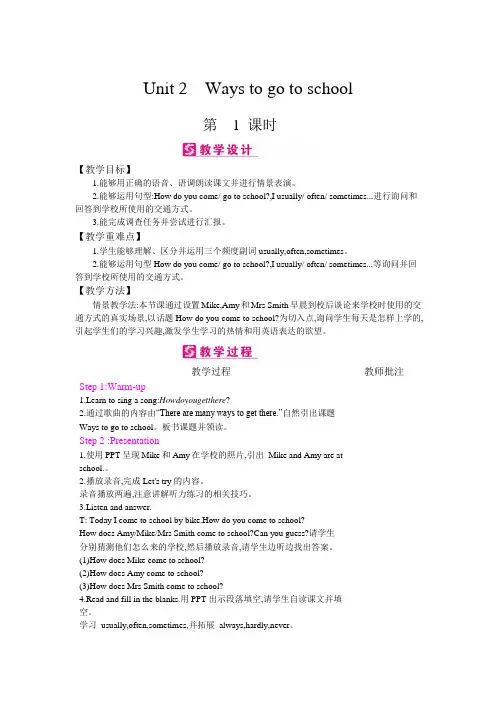
Unit 2 Ways to go to school
第 1 课时
【教学目标】
1.能够用正确的语音、语调朗读课文并进行情景表演。
2.能够运用句型:How do you come/ go to school?,I usually/ often/ sometimes...进行询问和回答到学校所使用的交通方式。
3.能完成调查任务并尝试进行汇报。
【教学重难点】
1.学生能够理解、区分并运用三个频度副词usually,often,sometimes。
2.能够运用句型How do you come/ go to school?,I usually/ often/ sometimes...等询问并回答到学校所使用的交通方式。
【教学方法】
情景教学法:本节课通过设置Mike,Amy和Mrs Smith早晨到校后谈论来学校时使用的交通方式的真实场景,以话题How do you come to school?为切入点,询问学生每天是怎样上学的,引起学生们的学习兴趣,激发学生学习的热情和用英语表达的欲望。
教学过程 教师批注
Step 1:Warm-up
1.Learn to sing a song:Howdoyougetthere?
2.通过歌曲的内容由“There are many ways to get there.”自然引出课题Ways to go to school。板书课题并领读。
Step 2 :Presentation
1.使用PPT呈现Mike和Amy在学校的照片,引出 Mike and Amy are at
school.。
2.播放录音,完成Let's try的内容。
录音播放两遍,注意讲解听力练习的相关技巧。
3.Listen and answer.
T: Today I come to school by bike.How do you come to school?
How does Amy/Mike/Mrs Smith come to school?Can you guess?请学生分别猜测他们怎么来的学校,然后播放录音,请学生边听边找出答案。
六年级上册英语优质教案-Unit 2 Ways to go to school∣人教(PEP)

Unit 2 Part A Let's learn & write and say
配套精品教学设计
☆教学目标☆
1. Be able to listen, say, recognize and write the main words: by train, by plane, by
subway, by ship, by bike, on foot and by taxi.
2. Be able to ask someone his subjects on a certain day using the sentence pattern:
“How do you get to ______ from ______? By ______.”
3. Be able to understand and say the chant.
4.By learning the words, be able to figure out which way is the best for them.
☆教学重难点☆
1. Be able to listen, say, recognize and write the main words: by train, by plane, by
subway, by ship, by bike, on foot and by taxi.
2. Be able to ask someone his subjects on a certain day using the sentence pattern:
“How do you get to ______ from ______? By ______.”
☆教学过程☆
Step 1 Review
a.Warm-up
Let’s chant: How do you get there?
人教(PEP)六年级英语上册《Unit 2 Ways to go to school》教案
1 / 5 2021-2022年《Unit 2 Ways to go to school》教案
课题 六上Unit 2 Ways to go to school
----Mary’s travel to Hangzhou 课时 1 课型 单元复习课
教学
目标 基本目标:
1、学生能够运用已学的表示交通方式的词组on foot, by bus, by taxi, by plane,
by ship, by subway和by train来描述到达某个目的地的完整线路。
2、学生能够熟记并在实际生活中运用基本的交通规则:Slow down and stop at
a yellow light, stop and wait at a red light, go at a green light; In the UK, people
drive on the left side, in China, people drive on the right side.……
提升目标:
1、学生能够写出到达某个地方的路线,为自己的出行做个简单规划。
教学重点 熟记并运用表示交通方式的词组以及重要的交通规则。
教学难点 运用first, next…清楚地表达出行路线,并在实际情景中创编对话。
教学准备 书本、PPT
教学方法 情境教学法、任务型教学法
教学环节 教学流程 师生活动和意图
Step1:
Warm-up
热身环节 1. Let’s sing: “How Do You Go to School?”
2. Free talk: How do you usually go to school?
How do you usually go to Hangzhou? ...
通过师生间的闲谈和吟唱热身活动,迅速引导学生进行角色转变,进入课堂学习状态,
Step2:Presentation
新课环节 1. Teacher summarizes Ss’ answers and presents an
PEP人教版六年级英语上册《Unit2_B_Read_and_write公开课教案》
教材图片:
Unit2 Part B Read and write
教 材:人教PEP小学英语六年级上册P18-P19
单元主题:Ways to go to school
课 型:阅读课
一、教材解析
本课时是六年级上册Unit2的第五课时,包含B Read and write。本课时分为读、写、语音三部分:第一部分要求学生阅读图片和文段,回答问题;第二部分为有意义的以读促写活动,分为两个步骤:第一步为前文提到的小朋友选择交通建议,第二步为朋友制作交通建议的海报;第三部分为语音意识培养,要求通过示例掌握文段中的连读现象。
二、目标预设
1. 学生通过头脑风暴活动汇总自己所知的各种上学方式,激活已有的背景知识和储备词汇。
2. 通过阅读问题训练,学生能在语篇中寻找关键词,并能进行细节推理;能根据示范的海报完成安全海报的设计。
3. 能根据例句提示在文段中找到更多同类现象,最终正确朗读句子。
三、重难点预设
教学重点:理解短文并完成课后相应练习。
教学难点:地名比较难读;根据思维导图提示复述文段。
四、教学过程
(一)阅读前 (Pre-reading)
1. 师生相互问候,练习课堂口语。
2. 播放热身歌曲How do you go to school? 学生跟唱,进行课堂热身。
3. 师生讨论各自来学校所采用的交通方式。
4. Brainstorm:学生进行头脑风暴,说一说自己所知道的上学的方式。
5. Listen and answer
教师请学生猜猜看:How does Robin go to school?
学生听Robin所说的话:I don’t go to school. I learn at home. 了解Robin并不去学校,他在家学习,引出本课内容。
(二)阅读中 (While-reading)
1. Read and answer 教师呈现吴一凡的爷爷卧病在床的配图,提问:Who is he? He is Wu Yifan’s grandpa. He is
六年级英语上册Unit2WaystogotoschoolPartB第三课时教案人教PEP版2
1
1.能够结合图片,看懂“Read and write”部分的内容,并能完成相关阅读练习。
2.能够正确听、说“Some kids go to school by sled.”“You must …Don’t …”。
3.能正确听、说、认、读单词及短语,如:went, sled, ferry, learn等。
4.能够用带有“must … Don’t”的句子给朋友写建议。
5.知道单词之间的连读,学会简单的连续。
1.能够结合图片,看懂“Read and write”部分的内容,并能完成相关阅读练习。
2.能够正确听、说“Some kids go to school by sled.”“You must …Don’t …”。
3.能够正确听、说、认、读单词及短语,如:went, sled ferry, learn等。
4.能用带有“must …Don’t”的句子给朋友写建议。
1.能用带有“must…Don’t”的句子给朋友写建议。
2.知道单词之间的连读,并会简单的连读。
单词卡片、教学光盘
Step 1:Warm-up
1.全班同学齐唱“How do you get there?”,进入英语学习氛围。
2.开火车认读单词,教师拿出单词卡片,On foot, by
bus/train/plane/ship/subway/taxi, stop, wait, slow down等,学生开火车认读。
Step 2: Presentation
1.Discuss.小组相互讨论:“How do you come to school”收集小组成员来学校的出行方式,并思考还有什么方式,交流讨论结果。
2.在世界上其它国家还有很多不可思议的出行方式,教师展示图片“滑雪橇”,引出“by
sled”,展示图片“轮渡”引出“by ferry”,“这些方式供大家交流学习”,引出“learn”。
3.在教师的引导下,学生阅读短文并结合课后习题,最好制作表格,收集信息。 2
六年级英语上册教案Unit 2 Part B 人教版PEP
Unit 2 Ways to go to school?
Part B
单元教材内容
本单元为教材第二单元,围绕“Ways to go to school”这一话题询问别人的出行方式,该话题是学生比较感兴趣的话题,在实际生活中使用较广,与生活联系十分紧密。六年级学生已经掌握了一些关于交通工具的词汇和常见的表达去某地的动词词组。在本单元的学习中,重点通过听、说、读、写等活动使学生掌握本单元主要交际语言:How do you come to school?
Usually, I come on foot.等交际用语和相关功能词汇,并能通过学习,进一步开发学生的语言交际能力,使其与别人就交通工具的话题进行交流,并比较中西方文化的差异。
单元教学目标
【知识与能力目标】
1. 能够掌握本单元出现的by, bus, plane, ship, train, helmet, sled, ferry, fast等29个单词和词组,并能熟练朗读与应用。 2. 通过对话学习谈论交通出行的主要句型。如:How do you come to school? Usually, I come
on foot. Don’t go at the red light. 并准确熟练的运用于实际交流当中。
3. 通过语言学习以及多种形式的交际活动,能够掌握本单元的词汇和主要句型,并能在实际生活中询问他人的出行方式,形成良好的语言交际习惯。
【过程与方法目标】
1. 能够在情境中进行真实交际。
2. 能够自主阅读并总结有效的学习方法。
【情感态度价值观目标】
1. 通过本课学习,培养学生主动用英语交际的习惯和环保意识。
2. 通过学习了解中西方出行方式的异同,发展学生跨文化交际意识。
第一课时
教学内容:B Let’s try/ Let’s talk
教学目标:
(1)能够正确听、说、朗读 ‘Don’t go at the red light! I must pay attention to the traffic lights!’