
北师大版高中英语模块一 Unit1 Lesson1 教学设计
教学设计Unit1 Lesson1:A Perfect DayThe First Period一、学情分析学生刚刚从初中毕业进入高中阶段学习,学习英语的兴趣大,课堂较为积极、活跃,课堂气氛较好。
经过三年的初中学习,已具备一定的阅读能力。
因此,在设计这堂课时,要着重从激发学生的兴趣出发,循序渐进引导学生理解课文,掌握一定的阅读技巧,然后让学生就所学话题进行讨论,让他们从讨论中有所启迪。
二、教材分析本课是语篇是两则关于不同生活方式的阅读文章。
学生将在在本课学习有关不同生活方式的表达方式,理解文章大意,使用略读、细读等阅读策略。
学生要将阅读信息内化,转换成自己的语言。
并通过对文章中两人的不同生活方式的讨论,学会合理、有效地安排自己的生活和学习。
三、教学目标(一)知识目标:To learn some words and phrases.(二)能力目标:To discuss favorite TV programs and daily activities.To read two texts for specific information.To write a short article, using what the students learnt in this period.(三)道德目标:To help the students discuss what a healthy and active lifestyle is and form a good habit.四、教学重点与难点1. Teach the passages as a whole: make the Ss understand and grasp the general idea of each passage as a whole.2. Thinking of the healthy lifestyles in our daily life and how to improve our lifestyles.五、教学方法1. Communicative Method2. Skimming and Scanning3.“Task-based”Teaching Method六、教学工具1. Multi-media2. Blackboard七、教学过程Pre-readingStep1. Teacher presents several pictures to make the students get familiar with the key words in exercise1,page 8.Ask the students the question:Do you ever watch too much TV? How much time do you spend watching TV every day?What are your favorite kinds of TV program? Why?Step2.Ask the Ss to look at the two pictures on page 8-9. and predict what will be talked about in the article based on the pictures.设计意图:1、引出课题.激发学生兴趣,自然而然进入新的教学之中。
2、在语境中呈现单词,帮助学生理解、记忆生词,为阅读做好准备。
这两部分都有生生互动和师生互动。
While-readingStep3.Play the tape of the first part of the text for the students to listen to and check their predictions. Then try to finish the following tasks.Task1:Underline the TV programs that Brian usually watches.Task2:(Pair work) Ask and answer questions about the passage “A Couch Potato”.1) Is Brian a lazy person ? Can you find two examples of his lazy behavior?2) Does Brian do enough exercise?3) Why can Brian live such a relaxing life?Task3:Guess the meaning of the title“ A Couch Potato ”Teacher checks Ss’ answers and helps them understand the meaning of the title.设计意图:1、这一部分培养学生的快速理解关键词语和预测的能力,帮助学生理解课文。
2、通过听课文进行有声输入,整体感知, 培养学生语感。
Step4.Play the tape of the second part of the text for the students to listen to and try to finish the following tasks.Task1:Underline the kinds of work Bob does every day.Task2:(Pair work) Talk about the lifestyle of Mr Black.·How does Bob spend his morning and evening?·Why does Bob’s family complain?·Why does Bob work so hard?Task3:Guess the meaning of the title“ A Workaholic ”Teacher checks Ss’ answers and helps them understand the meaning of the title.设计意图:1、帮助学生提取和整理课文细节信息,找出相关信息的能力。
2、学生说出课文信息,将信息和语言知识内化。
3、培养学生概括文章、整体理解课文的能力。
Post-readingStep 5(Group work) Ss compare the lifestyle of the two persons, find out the advantages and disadvantages for each of them. Say which one you prefer and give your reasons. If you would prefer neither, also give your reasons.Step 6Teacher encourages Ss to have a discussion about the following two questions:Are Brian and Bob’s lifestyles healthy?What can they do to improve their lifestyle?Then get some of them to report their results of their discussion to the whole class.设计意图:这两部分是学生将课本信息转换成自己的语言的过程,引导学生用自己的语言谈论“什么是一个健康的生活方式?”培养学生的交际能力。
这是对语言的进一步拓展。
Homework1. Read the text as much as possible and remember the new words and phrases2. Imagine you’re a friend of Bob or Brian, write a letter to advise him to improve his lifestyle.意图:七、教学设想1、这节课的设计思路主要是通过“情景导入,循序渐进,整体把握”和新课标所提倡的“以教师为主导,学生为主体”的教学理念为依据。
2、本节课以阅读为主线,加强听说训练,最后落实在写作上。
听说读写均有兼顾,重点在阅读能力的培养。
3、课堂教学努力通过各种措施激发学生兴趣,加强学生合作探究学习。
4、最后,设计了让学生通过给别人建议的方式明确什么是健康的生活方式,这一环节将本节课内容的语言输出部分进行总结,这也是本节课的重点。
八、教学反思:When does he get up ?What’s his response when he hears the alarm of the clock?How does he go to work? And when does he get to the office?What are his daily jobs?Does he have time for his personal affairs? When?Does he do some work before going to bed?What does he think of his life and what about you?Task 3:Step 3.Voice your opinion1.Teacher encourages Ss to have a discussion about the following two questions:Are Brian and Bob’s lifestyles healthy?What can they do to improve their lifestyle?Discuss Question 6 on P.8 in pairs or groups, then get some of them to report their results of their discussion to the whole class.(Talk in pairs) Is your partner a “couch potato”, a “workaholic” or neither? Ask questions like these:What do you do at weekends? Do you often study at weekends? ……he following questions will be presented:What kind of lifestyle do you think a couch potato has?What kind of lifestyle do you think a workaholic has?……2).Underline the kinds of work Bob does every day.3 Step II Fast-reading Read the text quickly and find these sentences are True or false.1.When Brian wakes up he gets up immediately.F2. In the evenings, Brian often watches old film or sport and the news again.F3. Bob is very busy all day. T4. Bob seldom has time for fun and other leisure activities with his family, but his family doesn’t complain.FOrganization: Choose the most suitable main idea from A-I for each paragraph. There are two extra main ideas that you do not need. (抢答有奖!) A. Mr. Brain almost does nothing but watch TV. B. Bob is very busy with his work in the daytime. C. Brain can watch much TV because he has a good family, especially a good wife. D. Brain likes doing exercise very much.E. Brain is fond of watching TV. Even so during a walk.F. It tells us why Bob works so crazily.G. It shows us what Bob does before going to work in the morning. H. Bob is tired of his work. I. Bob is also busy at night. Suggested answers 1. A Couch Potato 2. A Workaholic Par1.A Par2.E Par3.CStep III Careful Reading1.S1: Is Brian a lazy person ? Can you find two examples of his lazy behavior?2.S2: Yes, Brian is lazy. For example, he watches the children’s programs until abouthalf-past ten. Then he g ets up. He doesn’t work but his wife works and she makes his meals.3. 2.S3: What do you think “You’ve got the world at your feet” means?4.S4: It is used in a humorous way . It means this person feels he has a successful life becausehe can watch anything he likes on TV.5. 3.S5: How does Bob spend his mornin and evening?6.S6: Bob’s morning is very busy with very little time to get dressed and have breakfast andhe has all kinds of urgent matters . His evening is not easy, either .He has documents to read and never goes to bed until mid-night.7. 4. S7: Why does Bob’s family complain?8.S8: Bob seldom has time for fun and other leisure activities with his family.9. 5. S9: Why does Bob work so hard?10.S10: He wants to make more money. Besides, he gets bored if there is nothingUnit 1 LifestylesLesson 1 A Perfect Day?说课人万志冬understanding of this teaching materialThis is a reading passage. It plays a very important role in the English teaching of this unit. Students can improve their reading ability. They are going to do some listening and speaking. "A Perfect Day" introduces two kinds of widely different lifestyle. Through this lesson, the Students learn some language expressions of habits. And they can nurturance a good habit.teaching methodsCommunication methodI'll set up a situation, in this way, the Ss can say in pairs or in groups, they can say freely and needn't worrying about making mistakes.Task-based methodThat is to say I'll let the Students finish a task by making a short dialogue and acting it out. To help the Ss get a better understanding of the key structure. They also are required to finish the exercises in the book..something about the Ss1. They have already learn some grammar and sentences structure.2. They are in different English levels.3. Most of them don't often use English to express themselves and communicate with others.4. Some of them are not active in the class because they are afraid of making mistakes.Teaching aims of this lesson:Aims of the knowledgeStudents will be able to understand the main idea of the text, the grammar of the present simple and present continuous, some important phrases and sentences.Aims of the abilitiesStudents will be able to learn some ways and skills of reading. And describe a kind of lifestyleAims of the emotionsStudents will be able to judge the lifestyle and build a healthy lifestyleKey points The new words and the new phrases. Such as series, remote, switch on\off\over and so ondifficult points1. Grasp the reading skills.2. Master how to use the new words.Teaching aidsBlackboard and computerTeaching proceduresActivitiesPurposesPre-reading( 5 minutes )Step1 Explain learning objectivesMake the students clear about the class.Step2 Ask students some questions to bring out the adjectives to describe people's lifestyles and words about TV programmer.The students will be able to use the adjectives to talk about lifestyles.Step3 Advise the students to write down the adjectives and nouns on the paper.The students can be helped to prepare vocabulary for the lifestyles' writing.While-reading(about 30minutes )Step4 Read the texts fast and do exercise3.Scanning is an important technique we often use while searching for some specific information among the numerous materials. So we teachers should help the students to master this skill.Step5 Read the texts carefully and fill in a table with specific information.* Individual work* Check with partners●Check with the whole class1. To scan the texts for certain information.2. To sort up the information and understand the text better.Step6 Deal with new words and expressions.* Individual work.* Check with the whole class.1. To find the new words according to the contexts given and guess the meanings of them.2. To try to explain the words in easy English to form the habit of thinking in English.Step7 Listen to the tape. The students can choose either to read after in a low voice or just listen.1. To check the pronunciation and intonation.2. To allow the acquired information to sink in.V oice your opinion( 5 minutes )Step8 Offer some questions for argument●Which lifestyle do you prefer?●Which one is healthier?●What can Bob or Brian do to improve their lifestyles?To offer a chance for the students to express their opinions based on what they have learned.Consolidation (5minutes)Step9 translation●转到另一个频道看看。
高一英语北师大版模块一 Unit 1 Communication Workshop 教学教案

高一英语北师大版模块一 Unit 1 Communication Workshop 教学教案4. From whom did Wang Ying get Fang Lan’s address?5. What job did Fang Lan want to choose in the past?6. What is Wang Ying studying now?Show a slide to teach students the form of letterWrite a letter to someone. Follow the steps:1. Make an information card about what you are going to write..1).About the person you are writing2). About yourselfHow to write address on the envelope (show slides)ⅢSpeakingDo the exercise 2Students copy the table into their notebooksStudents listen to the cassette and complete the tablePlay the cassette again, pausing for students to check their answerDo the exercise 3Play the cassette again, pausing after each question for students to write the question downWhen students have written the questions, play the cassette again so they can mark the intonation up or down.ⅣHomework:Write a letter to yourselves in 20 years. Talk about anything you want to. Make sure there is an envelop along with.•Step 1 Who are you going to write? who are you?•Step 2 Questions about the other person•Step 3 What are you doing now?•Step 4 A reason to end your letter.•Step5 Sign off ( best wishes & your name)。
北师大版高中英语必修1 Unit 1《Lifestyles》(lesson 1)word教案
确山二高一年级英语学科共案时间:星期:主备人:使用人:【教学主题】Unit1 Communication Workshop&Culture Corner&Bulletin Board 【教学目标】How to write a letter? Learn about English Tea And Coffee Culture. How to give some advice?【知识梳理】be prepared for...为……做好准备switch on 把开关打开get changed 换衣服,更衣take turns to do sth. 轮流做某事play a role/part in 在……中起作用come up with 追上,赶上;想出,找到look forward to 盼望,期望as well as 除……之外还make a difference 有影响;起作用【典型例题】Ⅰ.单句改错1.We still have such much money le ft that we needn’t worry the future life.________2.The train can run in a distance of more than 300 kilometers per hour.________ 3.Hurry up,and you’ll be late for the bus.________4.You can go to anywhere if you like.________5.People hope that the earthquake can be forecasting one day.________Ⅱ.语境填词1.The windows of the building were all broken because of the explosion __________ (附近).2.The boy didn’t come to school because of his __________ (生病).He had to go to see the doctor.3.According to the weather f__________,there will be a snowstorm tomorrow.4.The train started and soon disappeared in the d__________.5.The avenues of the area were c__________ with visitors.1.At_the_moment I’m studying medicine at a university.目前我在大学学习医学。
高一英语北师大版模块一 Unit 1 Communication Workshop 教学教案
Unit 1 Communication WorkshopTeaching aims:To learn the right form of letterTo write a personal letterTo read a personal letter and match paragraghs and topicsTeaching course:ⅠWarm upT: Communication is very important in our life. We need to corporate in our work, exchange our idea or our feeling----every thing in human society. Think about what kinds of communication we need.S: body language, talk by telephone. Send e-mail, write a letterT: Though there are more modern means of communication, still writing letters is thought a good way to connect people. It’s convenient and especially for things people would not to say directly. Do you think so?S:T: You are to learn how to write a letter to somebody. Now, first, read the letter by Wang Ying and then try to write to someone in English.ⅡReadingDo the exercise 1. Read Wang Ying’s letter. Match each paragraph with one of the followinga reason to end the letter●questions about the other person●information about Wang Ying’s life●saying who are youIn order to help students to understand the text the teacher can ask students to listen to the tape them answer the following questions1. Whom does WangYing write to?2. When were they friends?3. How many years haven’t they seen each other?4. Fro m whom did Wang Ying get Fang Lan’s address?5. What job did Fang Lan want to choose in the past?6. What is Wang Ying studying now?Show a slide to teach students the form of letterWrite a letter to someone. Follow the steps:1. Make an information card about what you are going to write..1).About the person you are writing2). About yourselfHow to write address on the envelope (show slides)ⅢSpeakingDo the exercise 2Students copy the table into their notebooksStudents listen to the cassette and complete the tablePlay the cassette again, pausing for students to check their answerDo the exercise 3Play the cassette again, pausing after each question for students to write the question down When students have written the questions, play the cassette again so they can mark the intonation up or down.ⅣHomework:Write a letter to yourselves in 20 years. Talk about anything you want to. Make sure there is an envelop along with.•Step 1 Who are you going to write? who are you?•Step 2 Questions about the other person•Step 3 What are you doing now?•Step 4 A reason to end your letter.•Step5 Sign off ( best wishes & your name)。
高中英语北师大版模块1 教学课件 unit 1 lesson1 A Perfect Day

jobs
student
What are your parents? Can you describe their lives? What kind of life do you prefer to have?
• Roger Federer
But out of tennis court, he can enjoy a life of peace and serenity with his family.
How do you like their lifestyles?
• What are the advantages or drawbacks of their lifestyles?
National Business Daily – Mr. Zhu Bo, a mid-rank leader in Silkroad Digital Technology Co., Ltd., encountered sudden death at home. An employee of the company revealed that consecutive overtime has become a routine practice in the company and the longest one lasted for a period of 5 consecutive nights. Zhu Bo's death may be related to the excessive overtime. But the company
北师大出版社 高一年级 | 上册
at one’s desk=at desk
• at the desk, at table, at the table • in hospital, in the hospital • in prison, in the prison • at church, at the church
高一英语北师大版模块一Unit1LifestylesWarmup教学教案
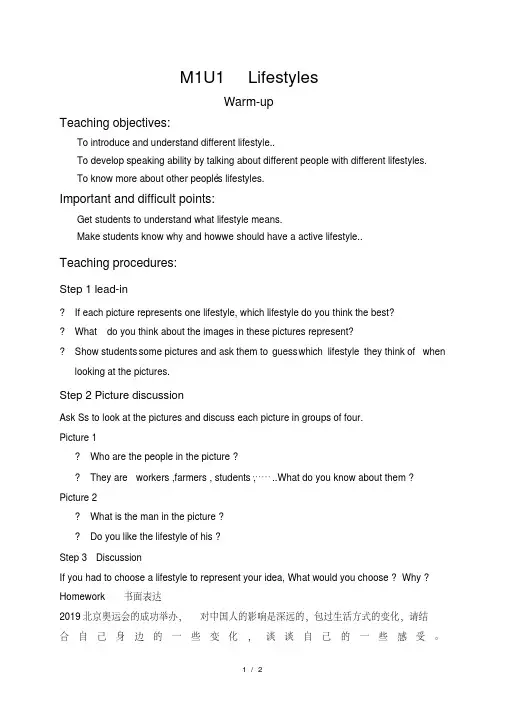
M1U1 LifestylesWarm-upTeaching objectives:To introduce and understand different lifestyle..To develop speaking ability by talking about different people with different lifestyles.To know more about other people’s lifestyles.Important and difficult points:Get students to understand what lifestyle means.Make students know why and howwe should have a active lifestyle..Teaching procedures:Step 1 lead-in?If each picture represents one lifestyle, which lifestyle do you think the best??What do you think about the images in these pictures represent??Show students some pictures and ask them to guess which lifestyle they think of when looking at the pictures.Step 2 Picture discussionAsk Ss to look at the pictures and discuss each picture in groups of four.Picture 1?Who are the people in the picture ??They are workers ,farmers , students ,……..What do you know about them ? Picture 2?What is the man in the picture ??Do you like the lifestyle of his ?Step 3 DiscussionIf you had to choose a lifestyle to represent your idea, What would you choose ? Why ? Homework 书面表达2019北京奥运会的成功举办,对中国人的影响是深远的,包过生活方式的变化,请结合自己身边的一些变化,谈谈自己的一些感受。
北师大版高中英语必修一unit1 lesson1教案

Unit 1 LifestylesLesson 1 A Perfect Day? 阅读课教案Teaching aims:(1) Knowledge aims:Students can understand the titles a couch potato and a workaholic.They will understand the main idea and some specific points of the passage and grasp the reading strategies of skimming and scanning.(2) Ability aims:Students will express their opinions on different lifestyles under the teacher’s guidance and use different reading strategies to get specific information in a limited time.(3) Emotional aims:Students will enhance their good habits and try to live a banlanced and healthy life.Teaching key points and difficult points:Key points:Understanding of the main idea and some specific points of the passage and the master of important reading strategies.Difficult Points:H ow to arouse students’ awareness of forming good habits and living a healthy life and how to enable the students to use differentstrategies proficiently.Teaching procedures:Step 1 Warming-up and lead inGreet studentsHave a short free talkSing a song togetherAnnounce the beginning of classTell the students the new topic Lesson 1 A Perfect Day and write on the blackboardStep 2 Pre-readingHave a free talk about watching TV with studentsEncourage them to make predictions according to the title and pictures in the bookExplain some new words like a couch potato and a workholic.Step 3 While-readingFast readingread the two texts quickly and try to finish the following tasks:1.Underline the TV programmes that Brian usually watches.2. Underline the kinds of work that Bob does every day.Three minutes later, ask some students to tell me the answers.(Brian usually watches children’s programmes and old movies in the morning. And he watches the news at lunch time. He watches oldfilms in the afternoon. And in the evening he watches TV series or sport and the news again. He also watches plays on BBC2 and more films.Bob is always very busy with meetings and phone calls, and some other urgent matters. And in the evening he has to do some paperwork and answer personal e-mails. And about ten every night he usually looks at the documents that he bring back from the office to get ready for the next day’s work. )Second reading,Answer five questions:1.Is Brian a lazy person? Can you find two examples of his lazy behaviour?2.What do you think “You’ve got the world at your feet.”means?3.How does Bob spend his morning and evening?4.Why does Bob’s family complain?5.Why does Bob work so hard?8 minutes later, I will choose some students to answer my questions one by one.(1.Yes, Brian is a lazy person. He watches TV 16 or 17 hours a day. When he walks the dog, he doesn’t go far. And he takes his portable TV and sits on a stone wall while the dog walks round in a circle. So , Bob is really lazy.2.“You’ve got the world at your feet.”means You are free to watch anyprogramme that you want to watch. You can use the remote control to make choices accordingly.3.Yes, Bob is always busy. In the early morning when he hears the alarm clock he jumps out of his bed, and begins to get ready for his work. He takes a bus to work. All the morning he is busy with meetings and phone calls. And in the evening he looks at some documents he brings back from the office to get ready for the next day’s work.4.Because he is always busy with his work and seldom has time for fun and other activities with his family.5.Bob works so hard that he can make more money for his family. )Step 4 Post-readingPair workJoin in pairs and ask each other these questions in turn, What do you do at weekends? Do you often study at weekends? Decide whether your partner is a couch potato or a workaholic or neither. 3 minutes later, I will choose some pairs to share their performance.Group workPlease work in groups of 4 and discuss these questions: Are Brian and Bob’s lifestyles healthy? What can they do to improve their lifestyles? Each group leader should collect suggestions and five minutes later I will ask some group leaders to give an oral report.Step 5 Summary and homeworkSummary: review the two kinds of lifestyles.Homework: Please listen to the recording of the texts for three to five times and read after them and try to retell the texts in your own words. And at the beginning of next class I will ask you to retell the texts.Blackboard design。
高中英语北师大版模块1【教学课件】unit 1 lesson1 A Perfect Day
football player
jobs
student
What are your parents? Can you describe their lives? What kind of life do you prefer to have?
北师大出版社 高一年级 | 上册
• Roger Federer
北师大出版社 高一年级 | 上册
What kind of life do you prefer to have?
• Being in Tsinghua high school is like a dream come true. • Life can never be of one color. • Only when you arrange all colors in good order, can you see a beautiful rainbow.
北师大出版社 高一年级 | 上册
Working in front of a computer all day long
Lack of physical exercise
北师大版社 高一年级 | 上册
Skimming for the key
• Underline the TV programs Brian watches. • Underline routine work Bob does every day.
Grammar review
北师大出版社 高一年级 | 上册
北师大出版社 高一年级 | 上册
Use of present simple
北师大出版社 高一年级 | 上册
Spelling
• In verbs which end in sh, ch, ss, x, an es is added • In verbs which end in a consonant + y, they y is changed into an i and es is added
高一英语北师大版模块一 Unit 1 Lifestyles Lesson 3 A Volunteer Teacher 教学教案
Lesson 3 A Volunteer TeacherTeaching aims:To listen for specific factsTo give opinions about voluntary workTo talk about future arrangements and intentions, using the Present Simple, the Present Continuous and going toTeaching difficulties:To listen for specific factsTeaching course:ⅠWarm up:Teacher gives the pictures and map of Inner Mongolia and ask some questions about it.Such as: look at the photo. Which part of China do you think of it is from?What do you know about this part of China?Does Inner Mongolia belong to developed areas?Are the living conditions here good? If you graduate from a famous university will you work here as a volunteer?Now look at the photo, guess what the girl is doing here? Is she traveling here?What can you say about the girl in the photo? Why does she came here? Now let’s listen the tape.ⅡListeningDo the exercise 3Students first read the questions and predict the answersStudents listen to the tape and check their predictionsCheck answer as a class.In order to make students understand the text better, teacher can ask students to answer the following questions1.Where is she determined to go?2.What is she going to do there?3.Why is she going to do so?4.Do the parents agree with her? What was their reaction?5.Did she give in?6.What do think of being volunteers?ⅢVoice your opinionIs it a good idea to do voluntary work? What reasons do people have for doing voluntary work?V ocabularyDo the exercise 5Students work individually, thinking about the cues and what they are going to do . Students read the sentences, decide which words to use , and then complete the sentences.ⅣGrammarDo the exercise 6Listen to the interview again. Pay attention to these sentences from the interview. What verb forms are used to talk about the future?Guide students to draw the following conclusion:present Simplepresent Continuousgoing to + infinitivedo consolidate exercise7, 8and 9explain further grammar:Expressing future arrangements and intentions:be going to-- to express an intention to do something.Present Continuous-- to talk about future events that we have already fixed or arranged. Present Simple-- to talk about official events or timetables which we cannot change.be going to do 与be doing 的区别be going to do 表示事先经过考虑过,然后计划好将做某事;迹象将发生某事。
高中英语必修第一册教案Unit 1 Life Choices Lesson 1 Lifestyles-北师大版(2019)
Unit 1 Life Choices
Lesson 1 Lifestyles
【教学目标与核心素养】
1.语言能力
(1)能够正确运用以下单词和短语addict, drag oneself away, definitely, target, attentive, achieve, revise, a wide range of, it's so convenient to do sth.。
(2)能掌握动词不定式在句中能作的成分,如主语、宾语、表语、定语、状语和补语。
2.文化意识
(1)了解英语交际中如何根据对方的话语作出恰当的反应;
(2)了解英语国家中教育的大致情况,通过对比思考我国中学教育。
3.思维品质
比较评价两者的生活方式,并给出合理性的建议。
4.学习能力
(1)学生能够借助关键词,在理解文章大意的基础上,找出段落主题句,完成读前问题;
(2)用所学的词汇和语言对课文进行复述。
【教学重难点】
1.重点
(1)如何使用地道的英语介绍自己高中新生活方式;
(2)正确理解并运用动词不定式在句中的成分;
(3)礼貌进行日常对话。
2.难点
(1)能用得体的英语表达自己的生活方式、个人情感和未来期望;
(2)能正确识别动词不定式在句中的成分并准确使用。
【教学过程】。
北师大版高中英语必修一Unit1-Lesson1-教学设计
1.Read the text as much as possible and remember thenew words and phrases
2.Imagine you’re a friend of Bob or Brian, write a letter to advise him to improve his lifestyle.
Step2.Ask the Ss to look at the two pictures on page 8-9. and predict:
What kind of TV programme does Brian like?
What does Brian think of his life ?
What doesBobthink of his life?
Then get some of them to show their results of their discussion to the whole class.
设计意图:
这两部分是学生将课本信息转换成自己的语言的过程,引导学生用自己的语言谈论“什么是一个健康的生活方式?”培养学生的交际能力。这是对语言的进一步拓展。
教学设计Unit1 Lesson1:A Perfect Day
The First Period
一、学情分析
学生刚刚从初中毕业进入高中阶段学习,学习英语的兴趣大,课堂较为积极、活跃,课堂气氛较好。经过三年的初中学习,已具备一定的阅读能力。因此,在设计这堂课时,要着重从激发学生的兴趣出发,循序渐进引导学生理解课文,掌握一定的阅读技巧,然后让学生就所学话题进行讨论,让他们从讨论中有d answer questions about the passage “A Couch Potato”.