
人教版英语八年级上册教案:Unit2 SectionB(3a-Self Check)
Unit2 SectionB(3a-Self Check)教案【教材版本与册数】新目标人教版八年级上册
【单元名称】Unit2 How often do you exercise ?
【课时】Section B 3a-Self Check(第五课时)
【课型】Reading and writing (读写课型)
第 1 页
第 2 页
第 3 页
第 4 页
3 深度加工知识
Step 3
Pre-writing
(6mins)
1.T: leads Ss to pay attention to the structure
of this passage.
Ss: Ss learn and know the three parts of
this passage and think it by
themselves.
Introduce yourselves
2.T: T provides more information for
students about this topic.
Ss: try to remember something about the
information that
答,根据结果反馈,进行精
准教学。
】
加强学生对语篇意识和语篇结
构的认识与理解,体现语篇的整
体输出,为后续语篇写作的整体
输出作铺垫。
通过教师对语篇
结构的提炼分
析,学生是否能
有所启示,是否
能在后面的写作
任务中体现写作
文章的整体结构
输出。
Introduce yourself
Your good habits and bad
habits
How you can became better
第 5 页
3 深度加工知识Step 4
While-writing
(13mins)
Step 5
Post-writing
Check in
groups
(10mins)
T asks Ss to write a short passage about their
own habits
S: Ss try to write it by themselves.
Tips :
I am…
I have a lot of good habits,…
However, I also have some bad habits,…
I know these bad habits are not good for me,
so I decide to break the bad habits.
For example, I will….
T: T asks Ss to enjoy others’ compos itions in
groups and encourage them to find out the
beautiful sentences they can learn or they can
also point out the mistakes they have made.
Ss: Ss enjoy others’ works and try to learn
通过前面的文本结构下的语言
学习,体现学生从“欣赏-模仿-
再创”的完整写作过程和语言的
输出过程。
培养学生学会欣赏和发现同伴
作品中的优点,通过给自己制定
计划改掉不好习惯的任务布置,
学生是否能在规
定时间内独立写
出有结构的和有
逻辑性的有关此
话题的作文。
通过组内相互的
欣赏同伴的文
章,学生是否能
学习到别人好的
句子或能给同伴
第 6 页
4
评
价
学
生
学
习
Step 6
Conclusion and
Exercise
from others .
1.Summary:
2. Let’s check
I.根据句意,用括号内所给词的适当形式填
空。
1. Junk food isn’t good for your
(healthy).
培养学生正确的情感态度价值
观,通过本课的学习能对他们以
后的学习生活产生好的影响。
利用话题思维导图的形式,给学
生引导话题牵引词汇,功能牵引
句型,这样的方式,让学生在脑
海里建立树形结构,将知识和句
型结构化。
体现基础知识的当堂检测与及
指出文章的不足
并相互讨论修
改,通过学生学
习的反馈得知,
学生是否能将本
堂课所学所获运
用到自己的生活
学习中,是否能
持续的给他们的
以后的生活学习
产生良好的影响
通过思维导图分
类结构的形式,
检测学生是否具
有归纳分类的学
习能力。
80%学生应该能
比较轻松容易的
完成,
2. She asked me (say) something about my school.
3. Mike goes to Shanghai (one) a year.
4.On weekends, I have to help my mom (clean)
the house.
5.--- Would you give me some water?
--- There is (hard) any water in my bottle.
Answers: 1.health 2.to say 3.once 4.clean 5.hardly
II.用恰当的词补全对话.
A: What do Tom and Mike do on weekends?
B: They sometimes go to the museum.
A: do they go to the shopping center:
B: ever. Maybe about twice a month.
A: do they watch TV?
B: Mike never watches TV, but Tom watches TV day.
A: Oh, I’m just like Tom. I watch TV, too.
Answers:1. usually/often
2.How often
3.Hardly
4.How often 时反馈,并让学生能再次巩固本和运用堂课的基础知识。
【提示:此处课堂上教师可让学生使用优教同步学习卡进行抢
答,根据结果反馈,进行精准教学。
】
第 9 页。
人教版英语八年级上册教案:Unit2 SectionB(3a-Self Check)

Unit2 SectionB(3a-Self Check)教案【教材版本与册数】新目标人教版八年级上册【单元名称】Unit2 How often do you exercise ?【课时】Section B 3a-Self Check(第五课时)【课型】Reading and writing (读写课型)第1页/共10页第2页/共10页第3页/共10页(附教学设计)第4页/共10页第5页/共10页3 深度加工知识Step 3Pre-writing(6mins)1.T: leads Ss to pay attention to the structureof this passage.Ss: Ss learn and know the three parts ofthis passage and think it bythemselves.Introduce yourselves2.T: T provides more information forstudents about this topic.Ss: try to remember something about theinformation that【提示:此处课堂上教师可让学生使用优教同步学习卡进行抢答||,根据结果反馈||,进行精准教学||。
】加强学生对语篇意识和语篇结构的认识与理解||,体现语篇的整体输出||,为后续语篇写作的整体输出作铺垫||。
通过教师对语篇结构的提炼分析||,学生是否能有所启示||,是否能在后面的写作任务中体现写作文章的整体结构输出||。
Introduce yourselfYour good habits and badhabitsHow you can became better第6页/共10页3 深度加工知识4 Step 4While-writing(13mins)Step 5Post-writingCheck ingroups(10mins)T asks Ss to write a short passage about theirown habitsS: Ss try to write it by themselves.Tips :I am…I have a lot of good habits||,…However||,I also have some bad habits||,…I know these bad habits are not good forme||,so I decide to break the bad habits.For example||,I will….T: T asks Ss to enjoy others’ compositions ingroups and encourage them to find out thebeautiful sentences they can learn or they canalso point out the mistakes they have made.Ss: Ss enjoy others’ works and try to learnfrom others .通过前面的文本结构下的语言学习||,体现学生从“欣赏-模仿-再创”的完整写作过程和语言的输出过程||。
人教版-英语-八上-2单元 SectionB (3a-Self-check)精品教案
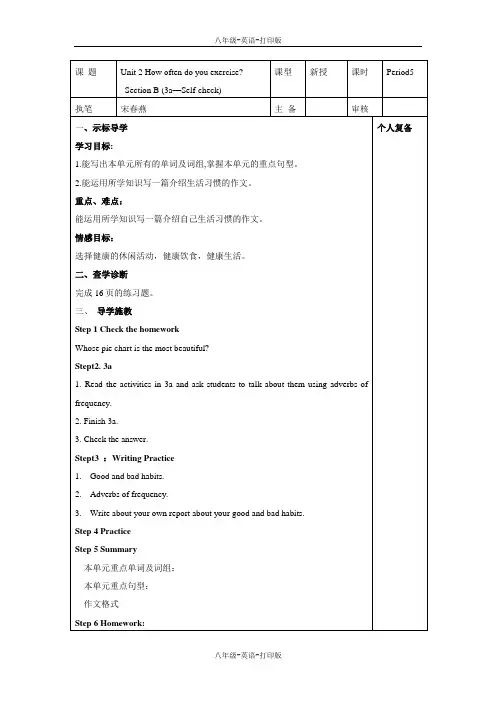
板书设计:
课后反馈:
个人复备
课题
Unit2How often do you exercise?
Section B (3a—Self-check)
课型
新授
课时
Period5
执笔
宋春燕
主备
审核
一、示标导学
学习目标:
1.能写出本单元所有的单词及词组,掌握本单元的重点句型。
2.能运用所学知识写一篇介绍生活习惯的作文。
重点、难点:
能运用所学知识写一篇介绍自己生活习惯的作文。
2. Finish3a.
3. Check the answer.
Stept3:Writing Practice
1.Good and bad habits.
2.Adverbs of frequency.
3.Write about your own report about your good and bad habits.
.
3. food, junk, does, often, your, eat, how, cousin
?
4. every, how, does, sleep, Sally, many, night, hours
?
5. doing, for, morning, your, is, exercises, health, good
情感目标:
选择健康的休闲活动,健康饮食,健康生活。
二、查学诊断
完成16页的练习题。
Whose pie chart is the most beautiful?
Stept2.3a
1.Read the activities in3aand ask students to talk about them using adverbs of frequency.
人教版英语八年级上册Unit2sectionB优秀教学案例

一、案例背景
本案例背景基于人教版英语八年级上册Unit 2 Section B,本节课主要围绕“询问过去发生的事情”这一主题展开。通过本节课的学习,学生能够掌握一般过去时的构成和用法,学会如何用英语询问并回答过去发生的事情。同时,本节课还通过听力、口语、阅读等多种形式的练习,提高学生的英语听、说、读、写能力。
在教学过程中,我以教材为依托,结合学生的实际水平和学习需求,设计了一系列具有针对性和实用性的教学活动。在课堂导入环节,我通过一幅漫画引导学生回顾一般现在时的用法,为新课的学习做好铺垫。在呈现和操练环节,我采用多媒体手段,创设真实语境,让学生在实践中感知和掌握一般过去时的表达方式。在巩固环节,我设计了丰富的练习活动,让学生在真实的交流中运用所学知识。在拓展环节,我引导学生关注一般过去时在现实生活中的应用,提高学生的实际运用能力。
三、教学策略
(一)情景创设
1.利用多媒体手段,如图片、视频、音频等,为学生提供生动、直观的学习材料,激发学生的学习兴趣。
2.创设真实、贴近生活的语境,让学生在实际情境中感知和运用一般过去时。
3.通过角色扮演、情景模拟等活动,让学生身临其境地运用英语,提高他们的语言实践能力。
在教学过程中,我将充分利用多媒体手段,如图片、视频、音频等,为学生提供生动、直观的学习材料,激发他们的学习兴趣。同时,我将创设真实、贴近生活的语境,让学生在实际情境中感知和运用一般过去时。通过角色扮演、情景模拟等活动,让学生身临其境地运用英语,提高他们的语言实践能力。
(四)总结归纳
1.教师和学生共同总结本节课的学习内容,让学生对所学知识有一个清晰的认识。
2.强调一般过去时的构成和用法,以及其在实际交流中的应用。
八年级英语上册 Unit 2 How often do you exercise Section B(3a-self check)教案 (新版)人教新目标版
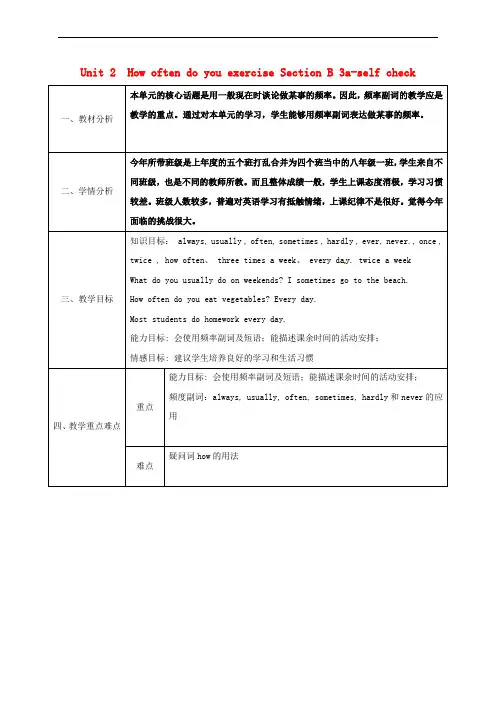
5、再次大声朗读文段。
6、完成对自己的生活习惯的调查表No.4 on P16.
三、交流(合作探究10分钟)
完成3b:
联系自己的日常生活实际,各写好坏习惯3个、发生频率以及各自作用;
完整写出自己的句子,注意时态正确;
加上连接词使这5个句子成为一段文章
加上标题。工整抄写在3c处。
四、总结(引深探究15分钟)
How often do you eat vegetables? Every day.
Most students do homework every day.
能力目标:会使用频率副词及短语;能描述课余时间的活动安排;
情感目标:建议学生培养良好的学习和生活习惯
四、教学重点难点
重点
能力目标:会使用频率副词及短语;能描述课余时间的活动安排;
How often do you go to the movies? I go to the movies maybe once a month.
How often does he watch TV? He hardly ever watches TV.
Do you go shopping? No, I never go shopping.
II、重点词语用法积累
1) pretty表示“十分”作副词用,我们以前学过quite和very也有这种意思。其中它 们的程度由浅入深为quite→pretty→very.相当健康:
2) I exercise every day, usually when I come home from school.我每天锻炼身体,
than [ðən] conj.比almost ['ɔːlməʊst] adv.几乎;差不多
人教版小学英语八年级上册Unit2Section B(3a-Self Check)教学教案及教学反思
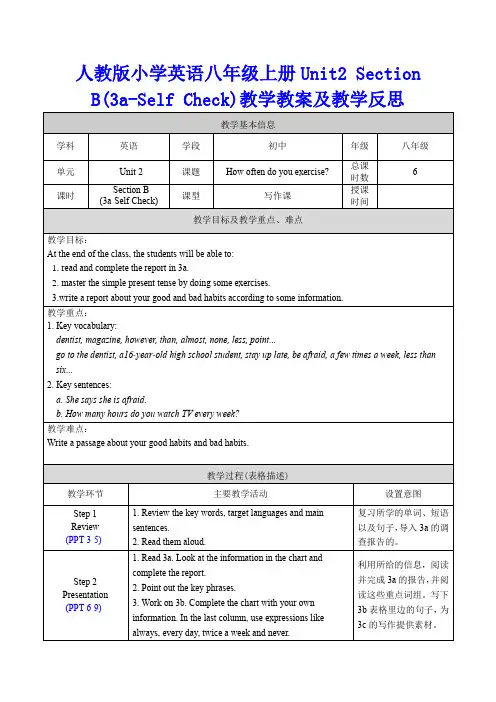
教学基本信息
学科 单元 课时
英语
Unit 2 Section B (3a-Self Check)
学段
初中
课题
How often do you exercise?
课型ห้องสมุดไป่ตู้
写作课
教学目标及教学重点、难点
年级
Practice the language points and the grammar of Unit 2.
How healthy are you? Write about your own habits.
完成第 1、2、3 题,熟 练运用频率副词。
通过单选、连词成句、 选词填空、选词填空和 汉译英等形式练习所 学的知识点。 今天的作业是写一篇 自己习惯的文章,练习 3a 和 3c 的作文形式。
Step 6 Self Check (PPT 20-22)
Step 7 Exercises (PPT 23-33)
Step 8 Homework (PPT 34)
1. Write some sentences about the good habits and and bad habits in 3b. 2.Work on 3c. Write a report about your good and bad habits. Say how often you do things. Use the report in 3a as an example. 3.Show one of the good passages to other students. 4.Analyzes the good sentences and correct the errors in report. 1.Take the health quiz. Compare your results with your partner’s. Who’s healthier? 2. Compare healthy life with unhealthy life. 1. Explain the usage of however and more than. 2. Read the Language points.
人教版(新目标)英语八年级上Unit2教案第五课时 Section B (3a - Selfcheck)

第五课时Section B (3a~Self Check)【学习目标】1.学生能询问或谈论别人饮食、锻炼的频率、休息的时间及选择不同频率的理由。
2.学生能够综合总结回顾所有的频率词,并学会运用所学的频率词书面描述某人的生活习惯。
3.学生能够养成良好的生活习惯,合理安排时间。
【学习重点】学生能综合运用所学的重难点词汇来完成相关任务。
【学习难点】总结回顾所有的频率词,并学会运用所学的频率词书面描述某人的生活习惯Learning action tips:The main content of this lesson is about talking about their own or others' living habits. Ask students to talk about their own living habits according to the knowledge learned.Learning action tips:Preview the words on Page 15-16 in the word list. Students read the words by phoneticsymbols, then underline new words in 3a and mark the Chinese meaning.【Method coach】▲however和but区别(1)however作副词,意为“然而,可是”,表示转折关系,可放在句首、句中或句末,其前或其后通常要加逗号。
(2)but作连词,一般位于它所引出的分句之首,其后直接跟句子,but后一般不用逗号。
【导练】(1)She is very smart,however,she is quite lazy.(2)She is very smart,but she is quite lazy.Task 2Learning action tips:1.Students talk about the frequency of doing something according to the sentences learned in the unit and make the dialogue according to them.2.Students read 3a and finish the exercises in 3a, answer the questions according to the main idea of the passage.3.Students sum up their own good habits and bad habits and their frequency.4.Students imitate 3a and string together the sentences they write to introduce their own living habits.情景导入生成问题1.T:What are your good habits?S:________________________________________________________________________2.T:What are your bad habits?S:________________________________________________________________________自学互研生成能力Task 1Let's read the new words and the phrases.1.I can read.(我会读)dentist,magazine,however,than,almost,less,none,point2.I can write.(我会写)翻译下列短语。
Unit2SectionB3a-SelfCheck教案人教版英语八年级上册
Unit2 SectionB 3aSelf Check教学目标1. 掌握重点单词、短语、句型2.How often引导的询问做事频率的特殊疑问句及用频率副词作答3.能用频率副词和表示频率的词组来表述自己的习惯教学难点1.How often引导的询问做事频率的特殊疑问句及用频率副词作答2.能用频率副词和表示频率的词组来表述自己的习惯教学过程一、情景引入Review some phraseseat junk foodonce a monthA: How often do you eat junk food?B: Once a month.surf the Internetonce a weekA: How often do you surf the Internet?B: Once a week.good habitsalways exercisesreads books every dayoften drinks juicehardly ever stays up lateBad habitsusually watches TVsometimes eats hamburgershardly ever helps with houseworknever goes to the dentistBrainstorm1—good habitsWrite down as many good habits as possible within 1 minute.helpful/useful/important/be good for…3aLook at the information in the chart and plete the report.Jane is a 16yearold high school student in the United States. American Teenager magazine asked her about her habits. Jane hasa lot of good habits. She always exercises and she reads books ________. Also, she _______drinks juice and she________________stays up late. However, she has some bad habits, too. She _______ watches TV for more than two hours a day, and she _________ eats hamburgers. Her parents are not very happy because she _______________helps with housework and she_______ goes to the dentist for teeth cleaning. She says she is afraid!3bplete the chart with your own information. In the last column, use expressions like always, every day, twice a week and never.3cWrite a report about your good and bad habits. Say how often you do things. Use the report in 3a as an example.巩固练习同学们做Exercisesthank you。
人教8上Unit2SectionB(3a-Selfcheck)教案设计
Unit2 Section B(3a-Self check)优质课课件(吉林省)Un it 1 How often do you exercise?Section b3a-3c self check教学设计一、教材分析:1、教学内容本单元是人教新目标版八年级上第二单元阅读部分。
主要围绕“How often do you exercise”这主题展开各种教学活动,并以这一主题引出how often和频度副词语法功能。
本课时旨在创造一个轻松,愉快的学习,交流环境,通过听,说,读,写来培养学生综合运用这些知识的能力,能准确地用英语来表达。
2、教材的地位和作用:How often do you exercise的是how often和频度副词,这是初中非常重要的语法项目之一。
学生们能够用频度副词表达自己业余活动,对于学生来学选择健康的放松方式是很重要的。
本课时主要是在前面对语法知识点认知的前提下的语言阅读操练。
我们要使学生不仅理解枯燥的语法,还要让学生们会用新学的语法知识来表达思想和感受。
3、教材的处理:根据《英语课程标准》关于总目标的具体描述,结合本单元这部分的教学内容及基于对教材的分析,我对本本课时的内容进行如下处理,将课本的warming-up,revision,reading,speaking,writing五个部分结合成一个课时。
从exercise导入复习主题。
引导学生讨论有益于身心的活动,让学生充分了解话题,激发学生浓厚的学习兴趣。
二、设计理念1、教学活动始终遵循任务型教学的教学理念,以学生为学习的主体,以任务为中心,在运用语言完成任务的过程中来学习,体会和掌握语言。
2、在教学过程中,关注学生的生活实际和生活体验,让其贴近实际贴近生活独立完成写在任务。
三、教学目标:语言目标:描述时间频度的词汇描述自己生活的习惯。
能力目标:听:能听懂谈论生活习惯、学习习惯和饮食习惯的对话材料。
说:能谈论生活习惯、学习习惯和饮食习惯。
人教版八年级上册Unit2SectionB(3aselfcheck)教学设计
3.能够运用所学句型,如"Wh- questions", "How about...?", "What's the matter with...?"等进行日常交流,提高口语表达能力。
4.能够通过阅读文章,提高阅读理解能力,抓住文章主旨和关键信息。
3.分析文章中涉及的三种时态(一般现在时、一般过去时、一般将来时),讲解其用法,并通过示例进行演示。
4.引导学生学习文章中的重点句型,如"Wh- questions", "How about...?", "What's the matter with...?"等,并组织学生进行口语练习。
(三)学生小组讨论(500字)
3.结合本节课的学习内容,思考并撰写一篇短文,主题为“Healthy Habits Make a Difference in Our Lives”。要求:100-120词,涵盖文章开头、正文和结尾三个部分,运用所学词汇和句型,表达个人观点。
4.预习下一课的内容,提前了解相关话题,为新课的学习做好准备。
5.每位学生选择一个日常行为或习惯,用英语制作一份海报,展示其优点和影响。要求图文并茂,色彩丰富,字迹工整。
6.家长参与作业:与孩子一起讨论日常行为和习惯对生活的影响,鼓励孩子用英语分享自己的观点,家长给予反馈和鼓励。
1.作业完成后,请认真检查,确保书写规范、内容准确。
2.作业完成后,与同学互相交流、讨论,相互借鉴,提高作业质量。
4.提高阅读理解能力,能够抓住文章主旨和关键信息。
5.能够撰写关于个人日常行为和经历的短文。
八年级英语人教版上册Unit2_SectionB(3a-Self_Check)精品课件1
1.a=0, b=1,c=2 2.a=2, b=1,c=0 3.a=0, b=1,c=2 4.a=0, b=1,c=2 5.a=2, b=1,c=0 6.a=0, b=1,c=2
II. 连词成句。 1. how, do, computer, often, play, you, games How often do you play computer games?
B: They sometimes go to the museum.
A: _H__o_w__o_f_t_e_n_do they go to the shopping center? B: __H__a_r_d_l_y__ever. Maybe about twice a month. A:_H__o_w__o__ft_e_n__do they watch TV? B: Mike never watches TV, but Tom watches TV _e_v_e_r_y__day. A: Oh, I’m just like Tom. I __a_l_w_a_y_s__watch TV, too.
However, she has some bad habits, too. She _u_s_u_a_l_ly_ watches TV for more than two hours a day, and she _so_m__e_ti_m__e_s eats hamburgers. Her parents are not very happy because she _h_a_r_d_ly__e_v_e_r_ helps with housework and she _n_e_v_e_r__ goes to the dentist for teeth cleaning. She says she is afraid!