
The Introduction of Guo Moruo郭沫若英文介绍
william wordsworth
有如群星在银河 形影面面光灼灼 湖畔蜿蜒花径长 连成一线无断续 一瞥之中万朵花 起舞蹁蹁点头啄
Байду номын сангаас
读者可以真切地感受到如原诗般流露出的活泼、流畅的韵味。“continuous”译
成“形影绵绵”,“shine and twinkle”译成“光灼灼”,一静一动,传达出深 远的意境。“They stretched in never-ending line/A long the margin of a bay”译成“湖畔蜿蜒花径长,连成一线无断续”。
THE DAFFODILS
Continuous
as the stars that shine And twinkle on the Milky Way They stretched in never-ending line A long the margin of a bay Ten thousand saw 1 aat a glance Tossing their heads sprightly dance
达(expressiveness):通顺,流畅 雅(elegance):优雅,美好
简单地说,即:忠实,通顺,美好
郭沫若对雪莱的诗歌有着高深精湛的研究。
他认为,雪莱的诗便是他的生命,他的生命 便是一首绝妙的好诗。因此,翻译雪莱的诗,
要抓住雪莱的“诗心”和“诗风”,译者和
作者要“心声共鸣。心声交感,合二为一”
Free
translation Graceful translation Resonance theory Faithfulness, expressiveness, elegance
在具体的翻译方法上,郭沫若主张“意译”和“风韵译”;共鸣
说;信、达、雅。
郭沫若对于翻译素来是不赞成逐字逐句的直
译。他说:“逐字逐句的直译,终是呆笨的办
法,并且在理论是不可能的。逐字逐句的直译,
把死的字面虽然照顾着了。把活的精神却是
遗失了。”
风韵译
所谓“风韵译”,也可以叫做“气韵译”,
它是就诗歌而言的。“风韵译”强调翻译 者个人主观感情,提倡翻译者要对作者所
处的时代背景有相当深刻的理解。
信(faithfulness):忠实原文
1918年,从冈山高中毕业后,郭沫若进入福冈
九州帝国大学医学院。他在文学比医学更感兴 趣,但他这一时期的研究主要集中在外国语言 和文学方面。
《茵梦湖》Immensee
1921 《少年维特之烦恼》The Sorrows of Young Werther 1922 《雪莱诗选》The Poetry of Shelley 1926 《浮士德》Faust 1928 《战争与和平》War and Peace 《石炭王》The king coal 1928
1913年十二月郭沫若随哥哥离开中国到达日本。1914年1月,他进入冈山第 六高等学校。在1916的夏天,郭爱上了Anna,一个来自克里斯蒂安家族的日 本女人,她在医院当实习护士工作。Anna成为他的妻子。他们在一起呆了 20年,直到战争爆发,他们共同有五个孩子。
After
graduation from the Okayama school, Guo entered in 1918 the Medical School of Kyushu Imperial University in Fukuoka. He was more interested in literature than medicine.However,his studies at this time focused on foreign language and literature.
组长 过诗漩 组员 马晓宇 范星月 康帅君 罗 玲
Study abroad
Following his elder brothers, Guo left China in December 1913, reaching Japan in early January 1914. After a year he entered Sixth Higher School in Okayama. In the summer of 1916, Guo fell in love with Anna, a Japanese woman from a Christian family, who worked at the hospital as a student nurse. Anna became his common-law wife. They were to stay together for 20 years, until the outbreak of the war, and to have five children together.
英汉翻译——郭沫若
议贯其文,情满其篇
郭沫若笔下的散文,不仅很好的继承了古今中外优秀散 文作家的这一传统,而且他还把议论和抒情这两种表现手 段的功能大大地向前推进了一步,使他的散文作品达到了 写人叙事即议、写景状物即情的程度。 感情纯真而自然的流露,是郭沫若散文的又一大特色。 郭沫若的抒情散文,有的是对故乡自然风光的描绘,有的是 对祖国山河的抒情,有的是对慈母的情思,有的是对挚友的 怀念,有的是对中华优秀儿女的赞颂,有的是对战地的缅怀, 有的是对现实的感慨。郭沫若的故乡是个山清水秀的地方, 所谓‚绥山毓秀,沫水钟灵‛。
《路畔的蔷薇》 Wayside Roses
清晨往松林里去散步,我在林荫路畔发见了一 束被遗弃了的蔷薇。蔷薇的花色还是鲜艳的,一 朵紫红,一朵嫩红,一朵是病黄的象牙色中带着 几分血晕。 Rambling through a pine forest early in the morning, I came across a bunch of forsaken roses lying by the shady wayside. They were still fresh in color. One was purplish-red, another pink, still another a sickly ivory-yellow slightly tinged with blood-red.
Forsake: 抛弃,遗弃,离开。与abandon 和desert相比较,其文学色彩较重 。 ‚一朵是病黄的象牙色中带着几分血晕‛ 译为a sickly ivory-yellow slightly tinged with blood-red,其中sickly作 ‚病态的‛解。又,ivory-yellow和 blood-red的结构都是‚实物颜色词+基本 颜色词‛,为英语颜色词的常见形式。
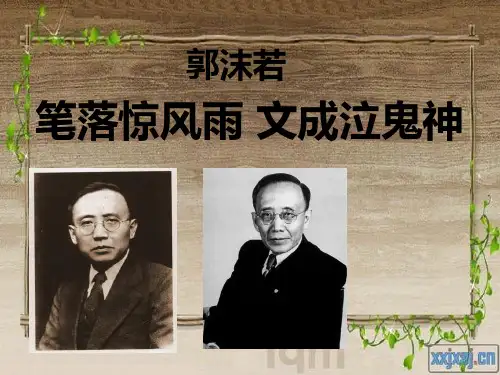
Guo Moruo
翻译思想
诗歌翻译是郭沫若文学翻译的重要组成部分主 张的“风韵译”在诗歌翻译界独树一帜. 张的“风韵译”在诗歌翻译界独树一帜
2.“风韵译”——译诗须像诗
郭沫若在诗歌翻译上造诣很高, 郭沫若在诗歌翻译上造诣很高,他认为 诗歌是可以翻译的,提出:诗人译诗, 诗歌是可以翻译的,提出:诗人译诗,以诗 译诗。 译诗。
为了再现原文“风韵” 为了再现原文“风韵”,郭沫若摆脱原诗词句行列的 束缚,大胆地进行再创造。 束缚,大胆地进行再创造。 这种高超的手法充分地表现于翻译美国诗人麦 克司•威伯的 威伯的《 克司 威伯的《夜》: Fainter, dimmer, stiller each moment, Now night. 译诗为: 译诗为 愈近黄昏 , 暗愈暗 , 静愈静 , 每刻每分 , 已入夜境。
他反对文艺的功利主义, 他反对文艺的功利主义,认为他是艺术和文学的堕 落。 郭沫若特别强调译者涌动的创作冲动和激情,译者 郭沫若特别强调译者涌动的创作冲动和激情, 要与原作者有心灵感应, 要与原作者有心灵感应,要从内心喜欢作品才翻译 它。 他认为译者有责任再现原著的思想, 他认为译者有责任再现原著的思想, 而不是歪曲原意; 而不是歪曲原意;还强调译者应该为他的翻译错误 而向读者和评论者道歉。 而向读者和评论者道歉。
翻译生涯
根据初步统计, 根据初步统计,他翻译了十个国家六十多位 作家和诗人的一百多部作品。 作家和诗人的一百多部作品。 其中除文学作品外, 其中除文学作品外,他还翻译过马克思的经 典著作、 典著作、美术考古的历史以及 科学方面的论 著。
翻译思想
1.翻译者素质
郭沫若在《理想翻译之我见》一文中, 郭沫若在《理想翻译之我见》一文中,提出了文 学翻译工作者的先决条件: 学翻译工作者的先决条件: 1、译者的语言知识要丰富; 、译者的语言知识要丰富; 2、对于原书要有理解; 、对于原书要有理解; 3、对于作者要有研究; 、对于作者要有研究; 4、对于本国文字要有自由操纵能力 、
高考英语美文赏析: 郭沫若《杜鹃》
郭沫若Guo Moruo《杜鹃》The cuckoo| 译文摘自张培基《英译中国散文选二》杜鹃,敝同乡的魂,在文学上所占的地位,恐怕任何鸟都比不上。
我们一提起杜鹃,心头眼底便好像有说不尽的诗意。
The cuckoo, the spirit of my native place Sichuan, is probably holding a higher place in Chinese literature than any other bird. The mere mention of this bird will arouse in our hearts a great deal of poetic feeling.要点:1,“敝同乡的魂”中的“敝”意为“我的”,是一种谦称,“敝同乡的魂”意即“我们同乡的魂”,但这样容易造成误解(同乡的魂,想想就好可怕),因此按“故乡四川的魂”理解,译为the spirit of my native place Sichuan.2,“……都比不上”译为比较级+than any other.3,“我们一提起杜鹃,心头眼底便好像有说不尽的诗意”译为The mere mention of this bird will arouse in our hearts a great deal of poetic feeling. 此处又出现了“the + 抽象名词+of”来代替动词,便于下文衔接。
综述:注意第三点,将动词译为抽象名词结构多是为了串句子的需要,这种情况在《背影》一文中出现多次。
它本身不用说,已经是望帝的化身了。
有时又被认为薄命的佳人,忧国的志士;声是满腹乡思,血是遍山踯躅;可怜,哀惋,纯洁,至诚……在人们的心目中成为了爱的象征。
这爱的象征似乎已经成为了民族的感情。
To begin with, she is the incarnation of the legendary king of ancient Sichuan named Wang Di. She has come to be known sometimes as an ill-fated beauty and sometimes as a patriot concerned over the fate of the nation. Her call is full of longings for home; she loiters about the mountains crying and spitting up blood. She pathetic, sad, pure and sincere … She is in the eyes of all a symbol of love, which seems to have become a national feeling.要点:1,“望帝”是我国古代传说中的蜀国国王,故译为the legendary king of ancient Sichuan named Wang Di.属于释义性翻译。
翻译家郭沫若

1922年翻译了歌德的《少年维特之烦恼》
1926年翻译了雪莱的《雪莱诗集》 1928年翻译了歌德的《浮士德》(上卷)
The Sorrows of Young Werther
Faust
1933-1934年翻译了托尔斯泰的《战争与和平》war and peace 1947年翻译了歌德的《浮士德》(下卷) Faust 1947年翻译了马克思的《艺术的真实》 图格涅夫的《处女地》 Virgin Soil 河上肇的《社会组织与社会革命》 Social Organization and Social Revolution
天上的街市 远远的街灯明了, 好象闪着无数的明星。 天上的明星现了, 好象点着无数的街灯。 我想那缥缈的空中, 定然有美丽的街市。 街市上陈列的一些物品, 定然是世上没有的珍奇。 你看,那浅浅的天河, 定然是不甚宽广。 那隔河的牛郎织女, 定能够骑着牛儿来往。 我想他们此刻, 定然在天街闲游。 不信,请看那朵流星, 是他们提着灯笼在走。
I think in that misty sky There are certainly beautiful downtown streets. Where some goods exhibiting, Such rare goods that this world hardly contains. Lo! That shallow celestial river, Certainly is not so wide. The Cowboy and Girl Weaver * on its opposite sides, Can certainly come and go across it, riding on a cow.
The Celestial Downtown Streets
介绍郭沫若的英语作文七年级

介绍郭沫若的英语作文七年级Here is an English essay on the topic of introducing Guo Moruo, with a word count of over 1000 words.Guo Moruo was a renowned Chinese writer, poet, historian, and archaeologist who lived during the 20th century. Born in 1892 in Sichuan province, Guo's life and work had a profound impact on Chinese literature and culture. As a prolific writer, Guo authored numerous works in various genres, including poetry, prose, drama, and academic publications. His contributions to the literary and intellectual landscape of China are widely recognized and celebrated.One of Guo's most significant achievements was his role in the May Fourth Movement, a cultural and political movement that arose in the early 20th century in response to the perceived weaknesses of traditional Chinese culture and the need for modernization. Guo was a prominent figure in this movement, using his writing to advocate for social and political reforms. His works often reflected the ideals of the May Fourth Movement, which emphasized the importance of individual freedom, democracy, and science.Guo's literary career began in his youth, when he published his firstcollection of poems in 1916. Over the course of his life, he produced a vast body of poetic work, ranging from lyrical verses to more experimental forms. His poetry was heavily influenced by Western literary traditions, as Guo sought to incorporate elements of European and American poetry into his own writing. Despite this, his poems remained deeply rooted in Chinese culture and themes, reflecting his deep connection to his homeland.In addition to his poetic output, Guo also made significant contributions to Chinese drama. He was a pioneer of modern Chinese theater, writing and directing plays that challenged traditional theatrical conventions. His plays often explored social and political themes, using the stage as a platform for social commentary and critique. One of his most famous works, "The Goddesses," was a groundbreaking play that challenged the patriarchal structures of traditional Chinese society.Beyond his literary pursuits, Guo was also a respected historian and archaeologist. He conducted extensive research on ancient Chinese civilizations, contributing to the understanding of China's rich cultural heritage. His work in these fields helped to shed light on the country's past and inform contemporary debates about national identity and cultural tradition.Throughout his life, Guo Moruo remained a passionate advocate forsocial and political reform. He was a vocal critic of the Chinese government and its policies, using his writing and public persona to challenge the status quo. This commitment to social justice and democratic ideals earned him the respect and admiration of many of his contemporaries, both in China and abroad.Despite the challenges and controversies that marked his life, Guo Moruo's legacy as a writer, intellectual, and public figure remains strong. His works continue to be studied and celebrated by scholars and readers around the world, and his influence can be seen in the writings and activism of subsequent generations of Chinese intellectuals and artists.In conclusion, Guo Moruo was a truly remarkable figure in the history of Chinese literature and culture. Through his prolific output, his commitment to social and political reform, and his deep engagement with China's cultural heritage, he left an indelible mark on the intellectual and artistic landscape of his time. His life and work continue to inspire and inform discussions about the role of the writer and intellectual in shaping the course of a nation's history.。
介绍郭沫若作文英文

介绍郭沫若作文英文英文:Guo Moruo, also known as Guo Moruo, was a prominent Chinese poet, historian, archaeologist, and government official. He was born in 1892 in Jiangsu Province, China, and grew up during a time of great political and social change in China. 。
Guo Moruo was a prolific writer and is best known for his poetry, which often reflected his deep love for his country and its people. One of his most famous works is the poem "The Goddess of the Luo River," which celebrates the beauty of the Chinese landscape and the resilience of the Chinese people.In addition to his poetry, Guo Moruo was also a respected historian and archaeologist. He conducted extensive research on ancient Chinese history and culture, and his work had a significant impact on the study ofChina's past.As a government official, Guo Moruo played a key role in promoting and preserving Chinese culture. He was a strong advocate for the preservation of historical sites and artifacts, and he worked tirelessly to promote the study of traditional Chinese literature and art.Guo Moruo's legacy continues to be celebrated in China today, and his contributions to Chinese literature and culture are widely recognized. He is remembered as a passionate and patriotic writer who dedicated his life to promoting the beauty and richness of Chinese history and culture.中文:郭沫若,原名郭沫若,是一位著名的中国诗人、历史学家、考古学家和政府官员。
介绍郭沫若作文英文
介绍郭沫若作文英文Guo Moruo, also known as Guo Moruo, was a prominent Chinese poet, historian, and archaeologist. He was born in 1892 in Jiangsu province, China.Guo Moruo was a prolific writer, and his works cover a wide range of subjects, including poetry, literature, history, and archaeology. He was known for his romantic and revolutionary poetry, as well as his scholarly works on ancient Chinese history and culture.In addition to his literary and academic pursuits, Guo Moruo was also actively involved in politics. He was a member of the Communist Party of China and served in various government positions, including Minister of Culture and Vice Premier of the State Council.Guo Moruo's literary works have had a lasting impact on Chinese literature and culture. His poetry, in particular, is celebrated for its emotional depth and revolutionaryspirit, and his historical and archaeological research has contributed to our understanding of ancient Chinese civilization.Despite his contributions to Chinese literature and culture, Guo Moruo's political activities and affiliations have also been the subject of controversy. Some have criticized him for his support of the Communist Party and his role in the Cultural Revolution.Overall, Guo Moruo's legacy as a writer, historian, and political figure is complex and multifaceted. He remains a significant figure in Chinese intellectual and cultural history, and his works continue to be studied and celebrated today.。
关于郭沫若的英语作文
关于郭沫若的英语作文Guo Moruo, a prominent figure in Chinese literature and history, was a man of many talents. Born on November 16, 1892, in Leshan, Sichuan, Guo was not only a renowned poet and playwright but also a historian, archaeologist, and politician. His contributions to Chinese culture and society are manifold, and his life's work reflects the tumultuous times he lived in.Guo's early life was marked by a traditional Confucian education, which he later rebelled against, pursuing studies in medical science in Japan. It was during his time in Japan that Guo was exposed to various schools of thought, including Marxism, which would greatly influence his later work. His return to China coincided with the New Culture Movement, which sought to challenge traditional Chinese values and promote modern ones.As a writer, Guo was a pioneer of the New Poetry Movement, which aimed to revolutionize Chinese poetry by freeing it from the constraints of classical forms. His early poems were characterized by their passionate and romantic nature, often reflecting his own personal struggles and the political upheaval of his times. His most famous work from this period, "Nüshen" (Goddess), is a testament to his innovative style and his ability to capture the spirit of an era.Guo's involvement in politics was equally significant. He was an active participant in the May Fourth Movement, a cultural and political campaign that grew out of student protests in 1919. He later became a member of the Chinese Communist Party and held various government positions after the establishment of the People's Republic of China in 1949. His political roles, however, did not hinder his literary output; he continued to write plays, poems, and essays that reflected his Marxist beliefs.In addition to his literary and political work, Guo made substantial contributions to the field of archaeology. He was instrumental in the establishment of the Institute of Archaeology and played a key role in the excavation of the Mausoleum of the First Qin Emperor, where the famous Terracotta Army was discovered.Guo Moruo's legacy is complex. He is celebrated for his literary genius and his contributions to the modernization of Chinese culture. Yet, his political affiliations and the compromises he made during various regimes have also been subjects of criticism. Despite this, his impact on Chinese literature and history is undeniable, and his works continue to be studied and appreciated for their artistic and historical value.Guo's life journey mirrors the transformation of China itself, from a feudal society to a modern state. His personal evolution from a romantic poet to a committed Marxist reflects the broader intellectual and political shifts of the 20th century. Guo Moruo remains a symbol of the Chinese intellectual's quest for modernity and the enduring struggle for cultural and political reform.In conclusion, Guo Moruo's multifaceted contributions to Chinese society exemplify the spirit of innovation and resilience. His works, whether in literature, politics, or archaeology, continue to inspire and challenge, serving as a bridge between China's past and its ongoing journey towards a progressive future. Guo's life and legacy remind us that the pursuit of knowledge and the desire for change are universal themes that transcend time and place. 。
郭沫若母爱英文版
郭沫若母爱英文版The Boundless Love of Mother: A Tribute to Guo MoruoGuo Moruo, a renowned Chinese poet, playwright, and historian, once said, "A mother's love is the most sacred of all loves." This sentiment resonates profoundly, for a mother's love is indeed a force that transcends time and space, a bond that defies all boundaries. In the life of Guo Moruo, the unwavering love of his mother played a pivotal role in shaping the man he became.Guo Moruo's mother, Madame Sun, was a woman of remarkable strength and resilience. Born into a prominent family, she faced a life of hardship and adversity from a young age. As a child, she witnessed the upheaval of the Taiping Rebellion, a violent civil war that ravaged much of China. Forced to flee her home, she endured the harsh realities of life on the road, yet her spirit remained unbroken.In the face of such challenges, Madame Sun's dedication to her family only grew stronger. She instilled in her children the values of perseverance, humility, and a deep appreciation for education. Guo Moruo, the youngest of her four children, was the recipient of herunwavering love and guidance.From a tender age, Guo Moruo was captivated by his mother's unwavering commitment to the family. He observed her tireless efforts to provide for her children, working tirelessly to ensure they had the resources they needed to thrive. Whether it was mending their clothes, preparing nourishing meals, or encouraging their academic pursuits, Madame Sun's devotion knew no bounds.As Guo Moruo grew older, he came to understand the true depth of his mother's love. In times of hardship and uncertainty, she was a pillar of strength, offering solace and comfort with her warm embrace and soothing words. Her unwavering faith in her children's abilities inspired them to reach for their dreams, propelling them towards a future filled with endless possibilities.Guo Moruo's own accomplishments, which spanned a wide range of disciplines, can be seen as a testament to the transformative power of his mother's love. Her unwavering belief in him fueled his passion for learning and drove him to push the boundaries of his own potential. Whether he was immersed in the world of poetry, delving into the intricacies of history, or exploring the realms of philosophy, Guo Moruo carried with him the indelible imprint of his mother's love.One of the most poignant expressions of Guo Moruo's gratitude towards his mother can be found in his poem "Mother." In this heartfelt tribute, he writes, "Mother you are the source of all life / Your love is the light that guides my way." These powerful words encapsulate the depth of his reverence and the profound impact Madame Sun had on his life.Throughout his illustrious career, Guo Moruo remained ever mindful of the sacrifices his mother had made for him and his siblings. He understood that her love was not merely a sentiment, but a transformative force that had shaped the very fabric of his being. It was this understanding that drove him to honor his mother's memory, to live a life that would make her proud.In the twilight of his life, Guo Moruo reflected on the enduring legacy of his mother's love. He realized that her influence had transcended the boundaries of their family, touching the lives of countless others who had been inspired by his own achievements. In a sense, Madame Sun's love had become a beacon, guiding not just her own children, but generations of individuals who aspired to follow in Guo Moruo's footsteps.The story of Guo Moruo and his mother's love is a testament to the power of the maternal bond. It is a reminder that even in the face of immense challenges, the love of a mother can be a transformativeforce, shaping the lives of those it touches and leaving an indelible mark on the world. As we honor the memory of Guo Moruo, let us also pay tribute to the countless mothers whose unwavering love has the power to inspire, to heal, and to pave the way for a better tomorrow.。
郭沫若用英语写作文五年级的水平
郭沫若用英语写作文五年级的水平Guo Moruo was a renowned Chinese writer and poet who lived during the 20th century. Despite his literary prowess and acclaim, he once decided to challenge himself by attempting to write an essay at the level of a 5th grade student. This exercise was not only a test of his writing abilities but also a reflection on the simplicity and directness that can be found in the works of young authors.As Guo Moruo sat down to begin his task, he knew that he would need to approach the writing process with a fresh perspective. Gone were the lofty metaphors and complex sentence structures that had characterized his previous works. Instead, he focused on using straightforward language and clear, concise ideas that would be accessible to a young audience.One of the first things Guo Moruo noticed was the importance of using simple vocabulary. Rather than relying on obscure or technical terms, he chose words that were commonly used by 5th graders. This allowed him to convey his thoughts and ideas without overwhelming the reader with unfamiliar language.In addition to vocabulary, Guo Moruo also paid close attention to the structure and organization of his essay. He knew that young readers often respond best to a clear and logical flow of ideas, so he carefully planned out the progression of his work. Each paragraph focused on a single, easily understandable concept, and the transitions between them were smooth and natural.Another key aspect of Guo Moruo's approach was the use of vivid and relatable examples. Rather than relying on abstract or theoretical concepts, he drew upon real-world experiences and observations that would resonate with his young audience. This helped to make the essay more engaging and accessible, as the reader could easily relate to the ideas being presented.One particularly striking example of Guo Moruo's efforts to write at a 5th grade level was his use of simple sentence structures. Rather than crafting long, complex sentences filled with subordinate clauses and technical jargon, he opted for shorter, more straightforward constructions. This made the essay easier to read and understand, and it also helped to maintain a sense of energy and momentum throughout the work.Despite these challenges, Guo Moruo found that writing at a 5th grade level was not without its own unique rewards. He discoveredthat by stripping away the elaborate language and complex structures that had characterized his previous works, he was able to focus more on the core ideas and emotions that he wanted to convey. This allowed him to connect with his audience in a more direct and meaningful way, and he found that the process of simplifying his writing was both humbling and liberating.As Guo Moruo continued to work on his essay, he also began to appreciate the inherent beauty and power of simple language. He realized that by using straightforward and accessible words, he was able to create a sense of intimacy and connection with his reader that might have been lost in a more formal or academic style of writing.Moreover, Guo Moruo found that writing at a 5th grade level forced him to be more concise and focused in his expression. Rather than rambling on or getting bogged down in unnecessary details, he had to carefully select and arrange his words to convey his message as clearly and effectively as possible. This discipline, he discovered, was not only beneficial for his young audience, but also for his own development as a writer.As Guo Moruo neared the end of his essay, he couldn't help but feel a sense of pride and accomplishment. He had successfully navigated the challenges of writing at a 5th grade level, and he had done so ina way that remained true to his own unique voice and style. The essay, he felt, was a testament to the power of simplicity and the importance of connecting with one's audience, no matter their age or level of understanding.In the end, Guo Moruo's foray into 5th grade-level writing was not only a valuable exercise in humility and discipline, but also a reminder of the essential role that clear and accessible language plays in the art of communication. By embracing the simplicity and directness of his young audience, he had not only created a compelling and engaging essay, but had also gained a deeper appreciation for the timeless power of the written word.。