
牛津初中英语8(上)Unit6 Reading 1教学反思
牛津初中英语8(上)Unit6 Reading 1教学反思
备课思路:教案第一部分的设计是Free talk 把学生带到英语的语言环境中来;第二部分是Lead in 环节,通过对上一课时Welcome to the unit 部分鸟类词汇的复习,引出鸟类所面临的危险,进而引出保护鸟类的场所——扎龙自然保护区;Pre-reading 部分设计了四个小问题来介绍扎龙自然保护区的位置、特点等等;While-reading 部分分别设计了听课文录音判断正误、迅速阅读课文找出问题答案、仔细阅读课文回答问题三个环节;Further –reading部分设计的是朗读课文,归纳段落大意、填出对话中所缺单词、任务型阅读;Post—reading让学生讨论保护鸟类的必要性和措施,达到本节课的情感教育的目的,唤起学生保护濒危鸟类的意识;最后是一篇关于企鹅的保护的阅读理解题,借这篇阅读检验学生的阅读理解能力。
反思:1.本课词汇量很大,接近30个,所以在阅读前对新受词汇的复习很有必要,但该部分的设置,是在一开始Free talk 结束后还是在介绍完扎龙之后,各有说法,原本正常情况是把词汇复习放在一开始,本节课我作了尝试,把这一环节放在Pre-reading 部分,让学生先复习单词,再进行阅读。
2.While-reading部分环节的设置,存在这样一个问题:各种任务设置的难度梯度的把握,一种说法为由上至下的任务设置,一种说法为由下至上的任务设置,在本课教学中我所采用的是由下至上、循序渐进、由易到难的问题设置方式,评课时,腾教授认为在八年级下学期之前的阅读教学可以采用由下至上的方式,而在八年级下学期始则需要采用由上至下的阅读任务设置模式。
再者,本节课问题的设置有些部分显得重复、累赘,需要进一步斟酌,出彩点在于任务型阅读这一环节的设置,该题型与中考题型一致,既考了学生对课文内容的整体理解和把握,也增强了学生的解题能力。
3.Further reading 部分设计的阅读每一小节内容,然后选择该小节大意这一环节,对这一环节有不同的理解,这一题目应该是对学生的一个较高的要求,一开始设计时,是考虑循序渐进的原则,阅读任务的难度逐渐加深,当然这也是涉及到问题的梯度问题;在这一部分操作时,我分别采取范读、学生个人读、集体读、比赛读、师生共读的形式培养学生的读英语的兴趣,并且收到了较好的效果。
4.Post reading 部分,学生讨论怎样保护珍稀的鸟类,先让学生静听各种鸟的叫声,唤醒学生保护珍稀鸟类的意识,进而讨论如何保护鸟类,从而达到了情感目标的升华。
在进行到最后一个环节时,由于时间比较紧,进行得比较匆忙,应该把第一部分的时间先对压缩。
陈俊学校卜文国
2013-11-28。
英语教学 8AU6ReadingA教学反思

8A Unit 6 Reading A Fishing with birds
教学反思
一、优点.在课文的引入方面,运用录像对学生的兴趣进行激发和提问。
1.将课文第三段用表格的形式让学生根据捕鱼前,捕鱼中和捕鱼后分别找出王大民和鸿鹏的动作。
这样将比较长的课文分成三部分对于我们的学生比较容易接受和消化。
2.在教学设计时,预先想到可能学生会提出的问题,以及出现的的差错。
在课内引导和帮助他们解决这些问题,而不采用回避的态度。
二、不足及解决方法.对动词以词组的理解不够,学生在最后运用时有些吃力,应当适当增加单词和词组的巩固练习或者朗读。
1.肢体语言应运用的更多些,这样有利于课堂气氛的活跃,以后可以示范并随时提醒学生做动作来说单词和句子。
2.没有做适当的鼓励,消除学生的紧张感。
如果能让学生在更轻松自由的课堂气氛下参与活动也许效果能更好。
以上是我对本堂课的总结,这节课给我留下了许多启示。
我想在今后的日子里我将会摒弃不足,更加勤于请教、勤于思考、善于发现争取更大进步。
牛津译林版八年级英语上册8AUnit6Reading说课稿

(一)导入新课
为了快速吸引学生的注意力和兴趣,我将以一个谜语游戏导入新课。谜语如下:"They take us to new places, but we never leave our seats. What are they?"(它们带我们去新地方,但我们从未离开座位。它们是什么?)学生思考后,我会揭晓答案:"Books!"接着,我会展示一组旅行相关的图片,引导学生分享他们对旅行的看法和经历,从而自然过渡到本节课的主题——旅行相关的阅读材料。
(二)学习障碍
在学习本节课之前,学生需要具备一定的一般过去时态的语法知识和对旅行相关词汇的了解。前置知识或技能包括:能够运用一般过去时描述过去的事件,掌握相关旅行词汇如"flight delay"、"holiday destination"等。然而,学生在处理长难句、复杂句型以及信息提取方面可能存在障碍。此外,对于那些对英语阅读缺乏兴趣或阅读习惯不好的学生,理解文章的大意和细节可能会更具挑战性。
三、教学方法与手段
(一)教学策略
在本节课中,我将采用任务型教学法和互动式教学法。任务型教学法能够让学生在真实的语境中运用所学知识,提高他们的语言实际运用能力。而互动式教学法能够激发学生的思维,培养他们的合作能力和团队精神。我选择这些方法的理论依据是现代教育教学理论,即学习者为中心的教学理念,认为学生是学习的主体,通过积极参与和完成任务来提高自己的语言能力。
(三)巩固练习
为了帮助学生巩固所学知识并提升应用能力,我计划设计以下巩固练习和实践活动:1.小组讨论:学生分组讨论文章中的细节问题,如人物、事件和地点等,然后进行汇报。2.角色扮演:学生分组扮演文章中的角色,进行对话表演,锻炼他们的口语表达能力。3.阅读理解练习:设计一些阅读理解题目,让学生独立完成,检测他们的阅读理解能力。4.词汇运用练习:设计一些词汇运用题目,让学生运用所学旅行相关词汇进行填空或写作,提高他们的词汇运用能力。
八年级上册英语Unit 6教学反思 I

八年级上册英语Unit 6 I’m more outgoing than my sister
教学反思
王琴
八年级上册第六单元讲的是形容词的比较级,设计让学生亲自比个的环节,使学生对形容词的比较级的理解和运用更加得心应手,同时还设计了一个游戏环节,让学生在玩中学,学中玩。
为学生营造了一个轻松愉快的学习环境,这更有利于激发学生的学习兴趣,使他们对英语不再有恐惧心理,同时接受新知的能力也在不断提高。
在教学中我倡导任务性教学模式。
给予学生一定的、简单的任务(两个小问题),再带着任务去阅读对话,使他们更有目地性,也更容易掌握对话的中心。
效果十分良好不足之处:知识扩展不足、课堂设计不够丰富。
从整节课来看,由于学生基础差、英语水平参差不齐的原因,我觉得自己没有能够很好的利用充分的想象力创设情境讲的大量的英语。
如果能够给学生更多参与的机会,让学生有更多的时间操练,课堂效果会好一些,能够出现教学亮点。
八年级的学生不同于低年级的学生,他们不再乐于表现自己,比较矜持,故而,在课堂是极容易出现冷场,我就用自己的肢体语言来刺激学生的兴趣,还是起到一点效果,但是我觉得真正要把学生从这种感觉里解救出来,我们教师必须寻求一种更好的模式来引导学生。
今后我会吸取经验教训,认真努力做地更好!。
《牛津初中英语8AU6Reading》(第一课时)课堂实录及反思

《牛津初中英语8AU6Reading》(第一课时)课堂实录及
反思
顾海明
【期刊名称】《广西教育》
【年(卷),期】2012(000)022
【摘要】一、教学内容课文用第一人称叙述男孩Timmy在1999年台湾大地震中被困在瓦砾堆下的亲身经历。
通过学习课文,学生能深刻感受遭遇地震的恐惧不安和死里逃生。
【总页数】2页(P57-58)
【作者】顾海明
【作者单位】江苏省南通市通州区育才中学
【正文语种】中文
【中图分类】G633.41
【相关文献】
1.合理有效问题引导切实提高学习效率——“相似多边形性质”第一课时课堂实录与反思 [J], 李晓玲;
2.《牛津初中英语》单元促读板块的教学策略——以9A Unit 1第一课时的教学为例 [J], 王爱平
3.《戈壁滩上古长城》第一课时课堂实录及反思 [J], 李永梅
4.《牛津初中英语8AU6Reading》(第一课时)课堂实录及反思 [J], 顾海明
5.“常见的酸和碱(第一课时)”课堂实录、反思及评析 [J], 安旭;孙东红
因版权原因,仅展示原文概要,查看原文内容请购买。
新牛津译林版英语八年级上册第六单元Reading (1)教案及教学反思
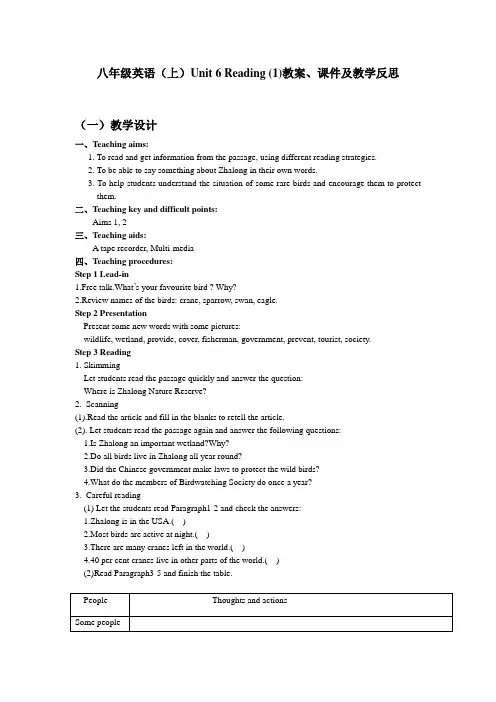
八年级英语(上)Unit 6 Reading (1)教案、课件及教学反思(一)教学设计一、Teaching aims:1. To read and get information from the passage, using different reading strategies.2. To be able to say something about Zhalong in their own words.3. To help students understand the situation of some rare birds and encourage them to protectthem.二、Teaching key and difficult points:Aims 1, 2三、Teaching aids:A tape recorder, Multi-media四、Teaching procedures:Step 1 Lead-in1.Free talk.What’s your favourite bird ? Why?2.Review names of the birds: crane, sparrow, swan, eagle.Step 2 PresentationPresent some new words with some pictures:wildlife, wetland, provide, cover, fisherman, government, prevent, tourist, society.Step 3 Reading1. SkimmingLet students read the passage quickly and answer the question:Where is Zhalong Nature Reserve?2. Scanning(1).Read the article and fill in the blanks to retell the article.(2). Let students read the passage again and answer the following questions:1.Is Zhalong an important wetland?Why?2.Do all birds live in Zhalong all year round?3.Did the Chinese government make laws to protect the wild birds?4.What do the members of Birdwatching Society do once a year?3. Careful reading(1) Let the students read Paragraph1-2 and check the answers:1.Zhalong is in the USA.( )2.Most birds are active at night.( )3.There are many cranes left in the world.( )4.40 per cent cranes live in other parts of the world.( )(2)Read Paragraph3-5 and finish the table.Step 4 RetellingTry to retell the text and fill the blankets.Zhalong Nature Reserve is one of the world's_____important wetlands. It________food and______for wildlife.Many birds live in Zhalong ____________, while some go there for __________. Some people want to have more space for_____ and________, fishermen___________there. But this will lead to____________space for wildlife, and the birds do not have_________________. So the government has made_____to______ all these things.Many tourists go to Zhalong to____________, and the members of Birdwatching Society go to ____________once a year. They need more people to _____and_________the birds. They want to help people understand_______________ the wetlands.Step 5 Discussion1. How to protect the wild animals?Give students some advice.2. What can and can’t we do in Zhalong Nature Reserve?Let the students discuss which one we can do and which one we can’t do.1. Go fishing by the lake.2. Take some photos.3. Protect the land.4. Kill wild birds for their feathers.5. Leave rubbish in the reserve.6. Raise money for wild birds in danger.7. Cut down all the trees and forests.Step 6 HomeworkRead and recite the passage after class.(二)教学反思今天我上了一节市级公开课,内容是“8Aunit6 Reading1”. 讨论的主题是扎龙自然保护区。
《牛津初中英语8AU6Reading》(第一课时)课堂实录及反思

2 .We c n hd u o is u d r t e a ie o rb de n e h d ss ek .
的勇敢 、睿智 的表现启迪学生珍爱生命 。
T:Do y u k o o t r tc o r o n w h w o p o e ty u - sl i ee r q a e e n t a t u k ? f h h
W h ts o l e d ? W h ts o l a h u d w o a h ud we S y h v h olwig a s e . s ma a e t e fl n w r o n s d? o 1 .W e a g t t c r e f t e c n o o he o n r o h
T:ft e e i a at q a e h r ,w a I h r s n e r u k ee h t h w l h p e o y u i a p n t o ? l
( ) 唱 导 入 , 示 主 题 一 说 揭
一
、
教 学 内容
T: He l,b y n i s t t e b - l o o s a d gr .A h e l gn i g o u l s , e' h v h t i nn fo r ca s lt a e a c a . s n W h t e e y u o n ti t ls a w r o d i g h s i me a t
S y h v ef l wig a s e s s ma a e t ol n w r . h o n 1 .Ma b ' i uc l n t e e r — y e I ld e q ik y i h at l h
q k e ua .
we? ek
八年级上册英语第六单元教案(新目标、带教学反思和说课稿)
八年级上册英语第六单元教案(新目标、带教学反思和说课稿)Lesson plan for unit 6, Volume 1, Grade 8八年级上册英语第六单元教案(新目标、带教学反思和说课稿)前言:小泰温馨提醒,英语作为在许多国际组织或者会议上都是必需语言,几乎所有学校选择英语作为其主要或唯一的外语必修课。
英语教学涉及多种专业理论知识,包括语言学、第二语言习得、词汇学、句法学、文体学、语料库理论、认知心理学等内容。
本教案根据英语课程标准的要求和针对教学对象是初中生群体的特点,将教学诸要素有序安排,确定合适的教学方案的设想和计划、并以启迪发展学生智力为根本目的。
便于学习和使用,本文下载后内容可随意修改调整及打印。
unit 6 i’m more outgoing than my sistera good friend … has cool clothes is popular in schoollikes to do the same things as me is good atsportis good at schoolwork makes me laughi. teaching aims and demands1.knowledge objectskey vocabulary. reading passage. oral pratice. reading and writing practice.2.ability objectsreading skill. writing skill. communicativecompetence.3.moral objecttake an activity part in all kinds of social activities.get a chance to train your intergrating skills.ii. teaching importance and difficultyoral pratice. writing and speaking praticeiii. teaching methodslistening and writing methods. reading and writing methods.communicative approach. pairwork.iv. teaching aidsa projector. pieces of paper on which students write the five statements.v. teaching procudruesstep i greet the class as usual and check the homework.step ii show the new words on the blackboard.read the new words to students and ask them to repeatunit 6 i’m more outgoing than my sistera good friend … has cool clothes is popular in schoollikes to do the same things as me is good at sportis good at schoolwork makes me laughi. teaching aims and demands1.knowledge objectskey vocabulary. reading passage. oral pratice. reading and writing practice.2.ability objectsreading skill. writing skill. communicative competence.3.moral objecttake an activity part in all kinds of social activities.get a chance to train your intergrating skills.ii. teaching importance and difficultyoral pratice. writing and speaking praticeiii. teaching methodslistening and writing methods. reading and writing methods.communicative approach. pairwork.iv. teaching aidsa projector. pieces of paper on which students write the five statements.v. teaching procudruesstep i greet the class as usual and check the homework.step ii show the new words on the blackboard.read the new words to students and ask them to repeat.step iii 3ain this activity first read the article to students. then answer any questions students any ask. for example, s: what’s view?t: it’s what you think about something. it’s how you feel about something.step iv 3bfirst let students look at the chart in activity 2a on page 38.then ask students to write their own sentences about holly’s friend and some sentences about maria’s friend.step v 3cin this activity first ask students to say some of the words and phrases from this unit they can use. forexample,tall, short, thin, heavy athletic, intellectual, shy outgoing, seriousstep vi 2ain this activity first ask students to look at the names and the first column of the students they will hear an interviewer talking to holly and maria. they are talking about what they like about their best friends.step vii pairwork find someone for the job!focus students on the job ad. ask students if they know the word—abacus. if they don’t know, expl ain it to them.abacus—a frame with balls that was used to do arithmetic, long before calculators.step viii homework and summarytoday we’ve reviewed the key vocabulary in thisunit by reading pratice.. and we’ve learnt to write about our best homework, write down the words you underlined in activity 3a in your exercise book.step ix blackboard designunit 6 i’m more outgoing than my sistersentences students write: the name of a student who should get the jobthe sixth periodi. teaching aims and demands1.knowledge objectsreviewing the key vocabulary in this unit. writing pratice. just for fun.2.ability objectsself check skill. writing skill.3.moral objectstudy hard and make great progress.ii. teaching importance and difficultywriting pratice. reviewing the key vocabulary quiet, funny, outgoing kind, athleticiii. teaching methodsself check method. writing method. communicative method.iv. teaching aidsa projector. a tape recorder.v. teaching procudruesstep i greet the class as usual and check the homework.step ii self check 1after students finish writing their sentences, writea number of student’s answers on the blackboard.(1)my friend likes sports. she’s very athletic.(2)paul is never quiet! he can’t stop talkin g.(3) mr. wang is a kind man. he always helps others.(4) mary is a funny girl. she always makes me laugh.(5)jane isn’t very outgoing. she likes to stayat home and rest.step iii 2first ask different students to read the questions on the left. students read.are you taller now? are you more intellectual? are you more popular?are you a better student?then ask students to think of themselves two years ago. how are they different now?step iv just for fun!ask two students to read the dialogue to the class. two students read.a: i think i see the twins. is that juva?b: no, that’s jala. jala has curlier hair than juva.a: and juva is taller than java.write the words curly—curlier on the blackboard.explain the words curly to students or draw a simple picture what curlier hair means.step v workbookread this article about ali and ahmet. then answer the questionsstep vi summarythis class we’ve reviewed the key vocabulary of the unit. and we’ve learnt how to compare ourthemselves between now and two years ago. i hope you can make great progress.step viii homeworkfinish off the exercises of the workbookstep ix blackboard designunit 6 i’m more outgoing than my sistercurly curlier curly hair-------- Designed By JinTai College ---------。
8AUnit6Reading教学心得
8A Unit 6 Reading教学心得教材分析:本课时是一篇阅读课文,是第6单元第一课时讨论自然条件和自然灾害的延续。
在本课学生将了解男孩Timmy在1999年台湾大地震中被困在瓦砾堆下的亲身经历。
故事用第一人称叙述,有助于学生深刻感受遭遇地震的恐惧不安和死里逃生。
课前教师让学生查阅有关地震方面的资料,课中利用这些资料展开讨论,设计了What will happen to you if there is an earthquake here?和Do you know how to protect yourself in the earthquake? 等问题,由课内延伸到课外,增大学生的知识量,拓展学生的思维,从而达到综合运用语言进行交际的目的。
教后反思1.本节课我通过各种方法调动学生的积极性,学生参与面广,生生互动、师生互动强。
学生在合作讨论中,不仅增强了小组的荣誉感,更促进了学生们的友谊,努力渗透德育内涵。
2. 以事件发生的先后顺序,引导学生快速掌握课文大意,培养学生形成良好的阅读策略。
3. 同学们在学习中获得知识,并及时活用,体现了学以致用,体现了“做中学,学中做”的原则,充分体现了任务型的教学原则。
4.充分尊重学生的个体差异,珍视探究过程中学生的独特感受、体验和理解,适时引导学生把他们的新想法、新创意引向主动学习、主动发展之中,使学习过程成为一个富有个性化的创新过程,这一点与新课程标准的精神充分吻合。
5.小组活动要有序地组织好,才能达到最佳效果。
6. 本课着重培养学生概括主题、捕捉细节和再现阅读内容的技能。
教师同时要注意设计合适的衔接语言,使各个教学环节自然过渡,让学生在不知不觉中进入学习状态并开展活动。
在教学设计过程中,要尽最大可能考虑学生情感在教学中的重要性,要设法让学生在快乐中学习。
但不能片面地追求所谓的“活跃”,如果一味强调热闹课堂的话,气氛是很活,但也有可能忽视了学生对知识的掌握和能力的培养。
初中英语上教牛津版8BUnit 6 Pets Reading 教学反思
《上教牛津版8B Unit 6 Pets (Reading)》教学反思
经过指导老师的悉心指导和自己的用心准备,第6单元的阅读公开课最终于5月12日(周一)第6节课进行。
本节课的进行与我对教学环节的设计基本一致,能够比较高效并有序地开展教学活动。
经过总结反思,本堂课有以下优势与不足。
优势:
1. 利用小组竞赛等方式,调动了学生的积极性,课堂气氛比较活跃。
2. 小组合作学习的开展能够激发学生潜能,甚至激发学生令人惊喜的表现。
3. 教学环节条理清晰,教师能够比较好地掌控学生,高效地开展教学活动。
4. 教师上课具有热情,能及时表扬学生,师生关系融洽。
不足:
1. 教学环节之间的衔接不够流畅,应进行过渡和铺垫。
2. 辩论环节中,教师过于掌控学生,抑制学生能力发挥,辩论环节缺少总结。
3. 在阅读理解抢答问题环节中,没有让学生带着问题读课文,使得该环节难度较大,而且没有很好地锻炼他们快速获取信息的阅读能力,同时没有明确地向学生传授阅读技巧。
牛津版8上教后反思
牛津版8上教后反思Unit1 Welcome-Reading本周主要学习了Unit1 Past and Present的导入和阅读共三课时的内容。
主要目标是1.能用英语谈论过去和现在人们出行的交通方式并进行对比。
2.了解现在完成时这一时态并能简单运用现在完成时将过去和现在进行对比、描述现在发生的变化。
学生掌握较好的有1.交通工具的表达方式;2.现在完成时的结构;3.理解现在完成时能表达过去对现在造成的影响以及从过去到现在一直在持续的动作;4.通过阅读一篇有关阳光镇的文章,能掌握从哪些方面描述了阳光镇的变化。
学生仍需要加强巩固的有:1.在描述交通方式时,易混淆介词“by”和“take”;2.不规则的动词过去分词的记忆;3.在翻译句子时时,学生常不清楚用一般过去时还是现在完成时。
Grammar-Task本周主要学习了Unit1Past and Present的语法、综合技能、学习技巧、写作等课时的内容。
主要目标是:1.能够掌握过去分词的构成规则并在语境中正确使用现在完成时;2.通过听录音填空,掌握听力技巧;3.能够运用一般过去时和现在完成时来谈论过去到现在的变化情况;4.写一篇比较家乡的过去和现在的文章。
学生掌握的较好的有:1.过去分词的构成规则;2.听录音补全笔记和日记并掌握听力技能;3.能够在描述过去情况时使用一般过去时,描述发生的变化时使用现在完成时;4.描述过去和现在的对比时能掌握句型In the past,…But now…/ …used to…Now….Moreover, … /Years ago, …But now…5.写作文时结构、段落清晰。
学生仍需要加强巩固的有:1.不规则的动词过去分词;2.不熟悉和现在完成时常连用的时间状语;3.对于什么情况下使用现在完成时仍一知半解;4.在写作文时常有学生少或者多要点,拼写错误较多,需要加强单词记默。
Unit2 Welcome-Reading本周主要学习了Unit2 Past and Present的导入和阅读共三课时的内容。