
人教版八年级英语上册教案Unit2 教案
人教版八年级英语上册教案Unit2 教案
Unit 2: XXX Do You Exercise?
Language Goal: In this unit。students will learn how to talk
about the frequency of their activities.
Key Words: housework。hardly。ever。once。twice。full。maybe。least。junk。coffee。health。percent。online。although。mind。body。such。together。die。writer。dentist。magazine。however。than。almost。less。point.
Knowledge Goals:
Understand the use of adverbs of frequency.
Understand how to form special ns and answers using "how
often."
Ability Goals:
XXX about how often people do things.
Write a report about the frequency of people's activities.
Moral Goals:
Keep a daily diary.
Exercise XXX.
Key Phrases:
How often do you。
What do you usually do on weekends?
Hardly ever
XXX
Three times a week
Be good for
XXX
Such as
Less than
More than
Key XXX:
XXX."
I hardly ever do housework." Going to the movies is something I do once or twice a
month."
Exercising regularly is good for your health."
At least 30 percent of your diet should be XXX."
Online shopping is convenient。although it can be addictive."
XXX."
XXX."
Smoking can lead to us health problems。XXX."
As a writer。XXX sitting than I should。so I try to XXX."
XXX."
Reading magazines is a good way to relax。however。too
much junk reading can be harmful."
Less than 30 percent of XXX."
The point is to find an activity you enjoy and do it regularly."
housework。hardly。ever。once。twice。program。full。swing
XXX phrases: how often。on weekends。go to the movies。help with housework。hardly ever。go shopping。once/twice a
week/a month。swing dance
XXX XXX: 1.What do you usually do on weekends。I often go to the
movies.
2.How often do you watch TV。I watch TV every day.
Teaching Difficult Points【教学难点】
XXX.
XXX【教学方法】
Task-based language teaching。pair work。group work。role-play。and n.
Teaching Aids【教具准备】
Pictures。flashcards。handouts。and a XXX.
Teaching res【教学过程】
Step 1 Lead-in
1.Greet the students and ask them about their XXX.
2.Show some pictures of different activities and ask the
students to guess how often they do them.
Step 2 n
1.XXX.
2.XXX practice.
Step 3 Practice
1.Ask the students to work in pairs and interview each other
about their daily and weekly activities.
2.Have the students report their partner's activities to the class
using the target language.
Step 4 n
1.Divide the class into groups and have them create a XXX.
2.Have each group perform their dialogue in front of the class.
Step 5 n
1.Review the key XXX the students to match them with their
meanings.
2.XXX the students to share what they have learned.
Step 6 Homework 1.Ask the students to write a paragraph about their XXX
using the target language.
2.Review the homework in the next class.
XXX【教学反思】
XXX practice using the target language。However。more
time could have been XXX。XXX.
Step 3While-task
1.XXX.
2.Listen again and fill in the blank with the XXX.
3.Practice the XXX.
Step 4Post-task
Page 9,2a.
1.Look at the pictures and name each activity.
2.Write the activities on the line.
3.Check the answers on the board.
Page 9,2b.
1.Ask XXX.
T:How often do you go shopping?
S:I usually go shopping once a week. 2.Practice in pairs.
Page 9,2c.
1.Ask XXX using the adverbs of frequency and the time ns.
T:How often do you help with housework?
S:I help with housework three times a week.
T:When do you usually help with housework?
S:I usually help with housework on XXX.
2.Practice in pairs.
Step 5Summary and Homework
1.Review the adverbs of frequency.
2.Preview the XXX.
3.Homework:Write a short paragraph about what you
usually do on weekends using the target language.
Step 2: Pre-task
In this step。the teacher will prepare the students for the main
task by providing them with some warm-up activities.
Firstly。the teacher will ask the students to XXX.
Secondly。the teacher will ask the students to practice
reading.
Thirdly。XXX will divide the students into pairs and ask
them to discuss what they do on weekends.
Fourthly。XXX will divide the class into groups of four or
five and ask them to make ns。The first student will ask the
second student what they do on weekends。and then they will ask
about another person's weekend activities.
Finally。the teacher will ask the students to act out their own
dialogues.
Step 3: While-task
In this step。the teacher will provide the students with some
activities to perform while they are XXX.
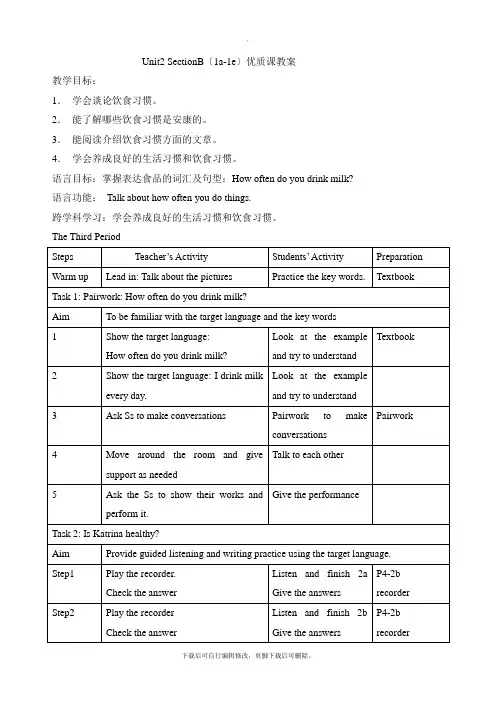
人教版英语八年级上册Unit2 SectionB(1a-1e)优质课教案
.
下载后可自行编辑修改,页脚下载后可删除。 Unit2 SectionB〔1a-1e〕优质课教案
教学目标:
1. 学会谈论饮食习惯。
2. 能了解哪些饮食习惯是安康的。
3. 能阅读介绍饮食习惯方面的文章。
4. 学会养成良好的生活习惯和饮食习惯。
语言目标:掌握表达食品的词汇及句型:How often do you drink milk?
语言功能: Talk about how often you do things.
跨学科学习:学会养成良好的生活习惯和饮食习惯。
The Third Period
Steps Teacher’s Activity Students’ Activity Preparation
Warm up Lead in: Talk about the pictures Practice the key words. Textbook
Task 1: Pairwork: How often do you drink milk?
Aim To be familiar with the target language and the key words
1 Show the target language:
How often do you drink milk? Look at the example
and try to understand Textbook
2 Show the target language: I drink milk
every day. Look at the example
and try to understand
3 Ask Ss to make conversations Pairwork to make
conversations Pairwork
4 Move around the room and give
人教版八年级英语上册Unit2SectionB(1a-1e)教案设计

人教版八年级英语上册Unit2SectionB(1a-1e)教案设计
1 / 4 Unit2 Section B(1a-1e)优质课课件(安徽省)
人教英语八年级上Unit2 Section b1a-1e教学设计
来安县水口中学 杨成扣
一、教学日标:
1、能够掌握课标要求的“四会”词汇:junk,coffee,health。
2、学会谈论饮食习惯,了解哪些饮食习惯是健康的。
3、 能阅读关于介绍饮食习惯方面的文章。学会养成良好的生活习惯和饮食习惯。4、培养学生的逻辑表述能力,激发学生的积极思维,并使学生互相了解,增进友谊。
二、学情分析:
对于本单元的一般现在时态,学生掌握较好,部分学生在本章节的听力部分略有不足,建议多听多练练。
三、重点和难点:
1、区分 how many/how much,health/healthy,different/difference
2、掌握以下重点句子
How often do you eat fruit?
How many hours do you sleep every night?
How often do you eat junk food?
How often do you drink coffee?
四、教学过程
Step 1 Lead-in(导入)
Greeting & free talk
Step 2 Match the pictures(1a)
Let students pay attention to the pictures. Say something about the pictures. Match
the words with the pictures. Check the answers and then practice reading.
Step 3 Ask and answer(1b)
Pair work
T: Now look at the conversation in lB, ask two students to read it o the class.
人教版新目标版八年级英语上册-Unit-2-How-often-do-you-exercise教案

人教版新目标版八年级英语上册-Unit-2-How-often-do-you-exercise教案
1 Unit 2 How often do you exercise?
Section A 1 (1a-2d)
一、教学目标:
1. 语言知识目标:
1) 能掌握以下单词: housework, hardly, ever, hardly ever, once, twice, Internet,
program, full, swing, swing dance, maybe, least, at least
能掌握以下句型:
① —What does he do on weekends —He usually watches TV.
② —How often do you watch TV —I watch TV every day.
③ —Does he go shopping —No, he never go shopping.
2) 能了解以下语法:
频度副词及一般现在时简单谈论周末活动情况。
2. 情感态度价值观目标:
通过本单元的学习,养成健康的饮食习惯,保证充足的睡眠时间,进行合理的运动锻炼,以保持健康的体魄。培养学生的逻辑表述能力,激发学生的积极思维,并使学生互相了解,增进友谊,加强人际交往,以形成良好的人际关系。
二、教学重难点
1. 教学重点:
1) 对6个频度副词细微差异的理解及使用。
2) 弄清一般现在时在不同人称下动词形式及提问的变化。
2. 教学难点:
1) 第三人称单数谓语动词在此核心句型中的运用。
2) 谈论课余时间的各项活动,以及初步认识和使用频率副词。
三、教学过程
Ⅰ. Lead in
Talk about your last weekend’s activities.
Ⅱ. Presentation
(1) 教师问:“What do you usually do on weekends ” (并且板书)让学生根据自己的实际回答 I usually …… on weekends.
人教版初二英语课后阅读Culture unit2教案
优秀教案评选
教案设计
一、教案背景
1,面向学生:初中
2,学科:英语
3,课时:1课时
4、教师课前准备:A、多媒体教室以及投影设备。B、多媒体网络教学软件。
C、教学的PPT课件。D、利用百度引擎查阅相关的资料备好课。
5,学生课前准备:A、预习课文,了解中西方饮食习惯; 餐桌礼仪的文化差异
B、利用百度引擎搜索查阅相关的学习资料。
教学课题
A、教学课题:Culture unit 2《Eating habits and eating manners!》
B、教学目标: (1)知识目标:了解中西方饮食及餐桌礼仪文化差异,提高学生英语学习兴趣。。
(2)能力目标:了解中西方饮食文化及餐桌礼仪方面的差异渊源,增加对所学语言文化的理解, 避免因为不恰当的方式或行为造成误解和交际障碍。
(3) 情感目标:进一步培养跨文化意识,进一步弘扬中华文明。
教材分析
本节教材为新目标英语(试用版)八年级上册,Culture unit 2《Eating habits and eating
manners!》。主要介绍中西方饮食及餐桌礼仪文化差异和相关历史文化背景,学习中西方饮食及餐桌礼仪的相关英语表达。并将英美文化渗透于教学之中,在中西文化的交融中培养学生的跨文化意识,增加学生对中华传统文化的认同感,增强学生的自信心和民族自豪感。
教学重点:
1、 掌握文中重点短语与句型。
2、用英语表达中西方饮食及餐桌礼仪文化差异。
教学难点:
1、 教学中渗透西方的文化的同时,引导学生进一步发扬中国传统文化。
2、 进一步培养跨文化意识,进一步弘扬中华文明。
教学之前用百度搜索引擎在网上搜索相关教学资料,找相关教案和材料作参考,了解教学的重、难点,确定课堂教学形式和方法。然后根据课堂教学需要,利用百度搜索引擎搜索关于中西方饮食及餐桌礼仪的相关图片、视频并下载,制成PPT课件,课堂上给同学们演示,让学生直观感受中西方饮食习惯及餐桌礼仪的差异。
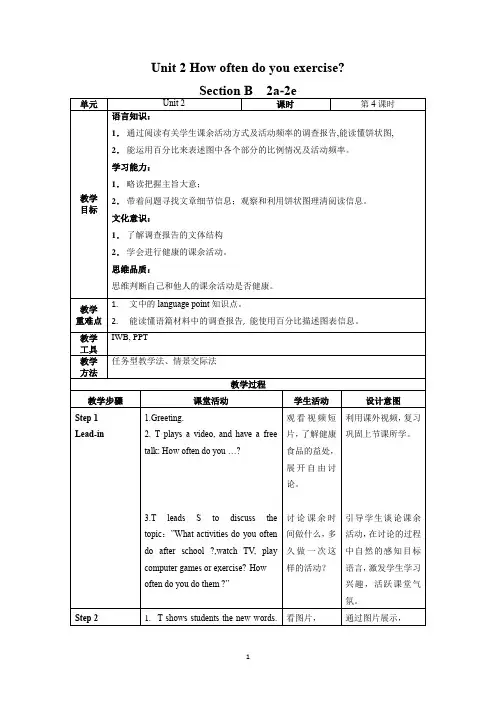
Unit 2 第4课时 Section B (2a-2e)(教案)八年级英语上册(人教新目标)
1
Unit 2 How often do you exercise?
Section B 2a-2e
单元 Unit 2 课时 第4课时
教学
目标 语言知识:
1. 通过阅读有关学生课余活动方式及活动频率的调查报告,能读懂饼状图,
2. 能运用百分比来表述图中各个部分的比例情况及活动频率。
学习能力:
1. 略读把握主旨大意;
2. 带着问题寻找文章细节信息;观察和利用饼状图理清阅读信息。
文化意识:
1. 了解调查报告的文体结构
2. 学会进行健康的课余活动。
思维品质:
思维判断自己和他人的课余活动是否健康。
教学
重难点 1. 文中的language point知识点。
2. 能读懂语篇材料中的调查报告, 能使用百分比描述图表信息。
教学
工具 IWB, PPT
教学
方法 任务型教学法、情景交际法
教学过程
教学步骤 课堂活动 学生活动 设计意图
Step 1
Lead-in
1.Greeting.
2. T plays a video, and have a free
talk: How often do you …?
3.T leads S to discuss the
topic:”What activities do you often
do after school ?,watch TV, play
computer games or exercise? How
often do you do them ?” 观看视频短片,了解健康食品的益处,展开自由讨论。
讨论课余时间做什么,多久做一次这样的活动?
利用课外视频,复习巩固上节课所学。
引导学生谈论课余活动,在讨论的过程中自然的感知目标语言,激发学生学习兴趣,活跃课堂气氛。
Step 2 1. T shows students the new words. 看图片, 通过图片展示, 2
Pre-reading
河北省人教版八年级英语上册:Unit 2How often do you exercise Section B (2a-2e)教案
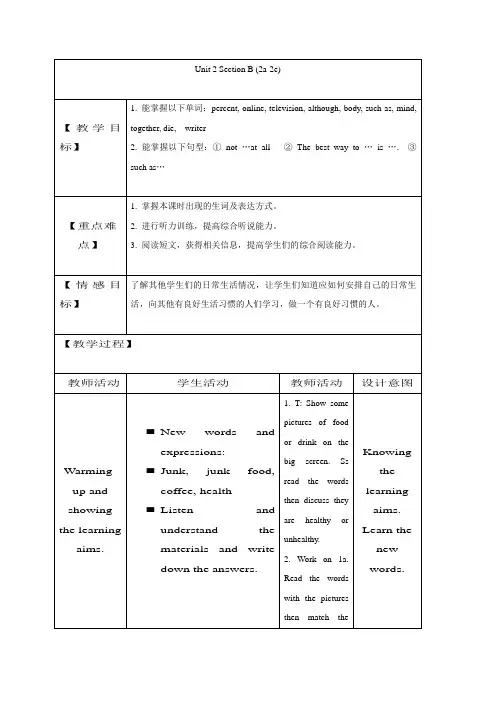
Unit 2 Section B (2a-2e)
【教学目标】
1. 能掌握以下单词:percent, online, television, although, body, such as, mind,
together, die, writer
2. 能掌握以下句型:① not …at all ② The best way to … is …. ③
such as…
【重点难点】 1. 掌握本课时出现的生词及表达方式。
2. 进行听力训练,提高综合听说能力。
3. 阅读短文,获得相关信息,提高学生们的综合阅读能力。
【情感目标】
了解其他学生们的日常生活情况,让学生们知道应如何安排自己的日常生活,向其他有良好生活习惯的人们学习,做一个有良好习惯的人。
【教学过程】
教师活动 学生活动 教师活动 设计意图
Warming-
up and
showing
the learning
aims. New words and
expressions:
Junk, junk food,
coffee, health
Listen and
understand the
materials and write
down the answers.
1. T: Show some
pictures of food
or drink on the
big screen. Ss
read the words
then discuss they
are healthy or
unhealthy.
2. Work on 1a.
Read the words
with the pictures
then match the Knowing
the
learning
aims.
Learn the
new
words. words with the
pictures.
Reading
1. T: Here are the
人教版八年级英语上册Unit2优质教案1
(Unit 2 How often do you exercise?)
Period1(1a-1c)
Teaching aims(教学目标)
1.学会谈论做事情的频率。
2. 能够理解区分并熟练运用本节课表示频率的副词。
Language points(语言点)
1.要求掌握以下句式: What do you usually do on weekends?
I usually watch TV.
Do you go shopping?
No/Yes, I never go shopping./I
sometimes go shopping.
2.要求掌握以下词汇及短语:
housework, hardly ever, always, usually, often, sometimes,
never, exercise, help with housework, do some cleaning
Difficulties(难点):频率副词的区别及正确使用
Teaching steps(教学步骤)
1. Brainstorm & Lead in T: What kind of activities do people usually do?
S: Help our parents with the housework.
S: …
Get into groups of three or four and write as many weekend
activities as possible.
Have some Ss present their group reports to the class.
help with housework
(教师把各组同学的讨论结果板书在黑板上,教师再领读一遍以确保大家会读并明白理解)
教学设计说明:从贴近学生熟悉的话题入口,通过头脑风暴把常见的周末活动汇总出来,为下一步讨论自己的周末活动提供基础。
人教版八年级上册英语精品教案:Unit2 SectionB(2a-2e)
人教版八年级上册英语精品教案:Unit2 SectionB(2a-2e)
第 2 页 Unit2 SectionB(2a-2e)精品教案
Learning goals:
1. Review the interview about Tina’s and Bill’s daily habits in Section B (1)
2. Learn to talk about free time activities in No. 5 High School using these words
“result, percent, online, television, although, through, mind body such, together, die,
writer and so on” and these sentences “And twenty percent do not exercise at all.
Most students use it for fun and not for homework. The answers to our questions
about watching television were also interesting. Although many students like to
watch sports, game shows are the most popular. It’s healthy for the body and the
mind. Old habits die hard. It’s good to relax by using…”
3. By comparing the free time activities—exercise, use of the Internet and watching TV
in No. 5 High School, let the students know: Start exercising before it’s too late.
人教版初二八年级上册英语Unit 2第二单元导学案教学案讲学稿
教学文档
. 人教版初二八年级上册英语Unit 2第二单元导学案教学案讲学稿
Unit 2第二单元导学案教学案讲学稿
Unit 2What’s the matter?
Section A
一、教师寄语
Reading is to the mind what exercise is to the body.读书养心,锻炼健身。
二、学习目标
知识目标:
Words: matter; have; cold; stomachache; sore; back; arm; ear; eye;
foot; hand; head; leg; mouth; neck; nose; stomach; tooth; throat;
toothache; fever; rest; honey; dentist; should; headache; shouldn’t
Phrases: have a cold have a sore throat have a fever see a dentist
Sentences:
1. What’s the matter I have a cold.
2. I have a headache/stomachache/toothache/sore back/sore throat.
3. You should go to bed/drink some water.
能力目标: Enable the students to talk about health problems and give
advice with the language points. 教学文档
. 感情目标: Help the students learn how to talk about health problems
and give advice on that with the language points.
2024年人教版八年级英语上册教案全册完整版
2024年人教版八年级英语上册教案全册完整版
一、教学内容
Unit 1 Where did you go on vacation?
Unit 2 How often do you exercise?
Unit 3 I'm more outgoing than my sister.
Unit 4 What's the best movie theater?
Unit 5 Do you want to watch a game show?
二、教学目标
1. 掌握并运用一般过去时、频率副词、形容词比较级和最高级等语法知识。
2. 提高学生的听说读写能力,尤其是日常对话和描述性句型的运用。
3. 培养学生的团队合作精神和批判性思维。
三、教学难点与重点
1. 教学难点:一般过去时与频率副词的运用,形容词比较级和最高级的区分。
2. 教学重点:日常对话的听说读写能力,描述性句型的构建。
四、教具与学具准备
1. 教具:PPT、录音机、黑板、教学卡片。
2. 学具:课本、练习本、彩笔。
五、教学过程 1. 导入:通过展示学生感兴趣的旅游景点或活动图片,引发学生对Unit 1话题的兴趣。
2. 新课内容展示:讲解一般过去时,举例说明,引导学生进行对话练习。
3. 例题讲解:针对Unit 1的语法点,给出例题,并讲解解题过程。
4. 随堂练习:分组练习,让学生相互提问并回答假期经历。
6. 课堂延伸:以类似方式教授Units 25,注意结合各单元特点进行教学。
六、板书设计
1. 板书八年级英语上册教案
2. 板书内容:
Unit 1: 一般过去时,频率副词
Unit 2: 形容词比较级
Unit 3: 形容词最高级
Unit 4: 描述性句型
Unit 5: 日常对话
七、作业设计
1. 作业题目:
Write a short passage about your last vacation using