
新技能英语高级教程第二册第四单元单词
custom
英['kʌstəm]美['kʌstəm]
n. 习惯,惯例;风俗;海关,关税;经常光顾;[总称](经常性的)顾客
∙adj. (衣服等)定做的,定制的
Such a custom has come down to the present moment.
这种风俗一直流传到现在。
diversify
英[daɪˈvɜːsɪˌfaɪ]美[daɪˈvɜrsəˌfaɪ]
vt. 使多样化,使变化;增加产品种类以扩大
Of course, it’s always good to look for new projects so
that you develop and diversify your designs.
当然,这样对于你不断寻找新项目,开发出更多多样化的设计是十分有好处的。
fight
英[faɪt]美[faɪt]
∙vi. 打架;与…打仗,与…斗争;反对…提案
∙n. 打架;战斗,斗志
∙fight for为…而战,而奋斗
∙fight against v. 对抗;反对;与……作斗争
∙fight with与…并肩战斗;为反对…而战斗;与…打架
These patriots would fight to death before they surrendered.
这些爱国者宁愿战斗到死,也不愿投降。
split
英[splɪt]美[splɪt]
vt. 分离;使分离;劈开;离开;分解
∙vi. 离开;被劈开;断绝关系
∙n. 劈开;裂缝
∙adj. 劈开的
I would rather pay for a meal than watch nine friends pick over and
split a bill.
我宁愿付整顿饭钱而不愿看着9个朋友仔细算计、分摊账单。
pick over(挑选, 仔细检查……以便选出优品分档挑选)
treat
英[triːt]美[trit]
∙vt. 治疗;对待;探讨;视为
∙vi. 探讨;请客;协商
∙n. 请客;款待
∙n. (Treat)人名;(英)特里特
She was always treating him to ice cream.
她总请他吃冰淇淋。
excursion
英[ɪk'skɜːʃ(ə)n; ek-]美[ɪk'skɝʒn]
∙n. 偏移;远足;短程旅行;离题;游览,游览团∙I joined their excursion.
∙我加入了他们的远足。
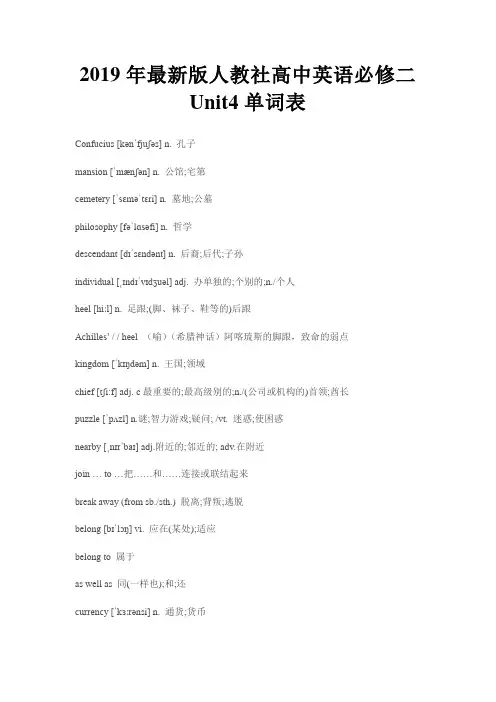
2019年最新版人教社高中英语必修二Unit 4单词表
2019年最新版人教社高中英语必修二Unit4单词表Confucius [kənˈfjuʃəs] n. 孔子mansion [ˈmænʃən] n. 公馆;宅第cemetery [ˈsɛməˈtɛri] n. 墓地;公墓philosophy [fəˈlɑsəfi] n. 哲学descendant [dɪˈsɛndənt] n. 后裔;后代;子孙individual [ˌɪndɪˈvɪdʒuəl] adj. 办单独的;个别的;n./个人heel [hiːl] n. 足跟;(脚、袜子、鞋等的)后跟Achilles’ / / heel (喻)(希腊神话)阿喀琉斯的脚跟,致命的弱点kingdom [ˈkɪŋdəm] n. 王国;领域chief [tʃi:f] adj. c最重要的;最高级别的;n./(公司或机构的)首领;酋长puzzle [ˈpʌzl] n.谜;智力游戏;疑问; /vt. 迷惑;使困惑nearby [ˌnɪrˈbaɪ] adj.附近的;邻近的; adv.在附近join … to …把……和……连接或联结起来break away (from sb./sth.) 脱离;背叛;逃脱belong [bɪˈlɔŋ] vi. 应在(某处);适应belong to 属于as well as 同(一样也);和;还currency [ˈkɜːrənsi] n. 通货;货币military [ˈmɪlətɛri] adj. 军事的;军用的defence [dɪˈfens] n. 防御;保卫legal [ˈli:gl] adj. 法律的;合法的surround [səˈraʊnd] vt. 包围;围绕evidence [ˈɛvɪdəns] n. 证据;证明achievement [əˈtʃi:vmənt] n. 成就;成绩;达到location [ləʊˈkeiʃən] n. 地方;地点;位置conquer [ˈkɑŋkɚ] vt. 占领;征服;控制battle [ˈbætl] n./战斗;vt./vi. 搏斗;奋斗port [pɔrt] n. 港口(城市)fascinating [ˈfæsɪnetɪŋ] adj. 极有吸引力的;迷人的keep your eyes open for 留意charge [tʃɑrdʒ] n.收费;指控;主管;/vt. 收费;控告;充电announce [əˈnaʊns] vt. 宣布;通知;声称amount [əˈmaʊnt] n. 金额;数量gallery [ˈgæləri] n. (艺术作品的)展览馆;画廊approach [əˈprəʊtʃ] n./方法;途径;vt./接近;接洽;着手处理vi. 靠近ensure [ɪnˈʃʊr] vt. 保证;确保;担保landscape [ˈlændˈskeip] n. 风景generous [ˈdʒɛnərəs] adj. 慷慨的;大方的;丰富的but ter [ˈbʌtɚ] n.黄油;奶油/vt. 涂奶油于honey [ˈhʌni] n. 蜂蜜ancestor [ˈænsɛstɚ] n. 祖宗;祖先position [pəˈzɪʃən] n. 位置;姿态;职位courtyard [ˈkɔrtjɑrd] n. 庭院;院子snack [snæk] n. 点心;小吃eager [ˈi:gɚ] adj. 热切的;渴望的poet [ˈpəʊɪt] n.诗人county [ˈkaʊnti] n. (英国、爱尔兰的)郡;(美国的)县feast [fi:st] n. 盛宴;宴会;节日roll [rəʊl] vt./vi. (使)翻滚;(使)滚动; n./卷(轴);翻滚dot [dɑt] n.点;小(圆)点; /vt. 加点;遍布cattle [ˈkætl] n. 牛roar [rɔr] n./vi. 吼叫;咆哮ocean [ˈəʊʃən] n. 大海;海洋scent [sɛnt] n. 气味;气息greet [ɡrit] vt. 问候;迎接pub [pʌb] n. 酒吧;酒馆wine [waɪn] n. 葡萄酒;果酒beer [bɪr] n. (—杯)啤酒stew [stuˌ stju] n.炖菜(有肉和蔬菜); vt & vi. 炖;煨custom [ˈkʌstəm] n. 风俗;习俗;习惯sensory [ˈsɛnsəri] adj. 感觉的;感官的striking [ˈstraɪkɪŋ] adj.引人注目的;显著的transition [trænˈzɪʃən] n. 过渡;转变;变迁crowd [kraʊd] n.人群;一群人;民众;/vt. 挤满;使……拥挤Wales [weɪlz] 威尔士(英国)Scotland [ˈskɒtlənd]英格兰(英国)Northern Ireland [ˌnɔːðən ˈaɪələnd]北爱尔兰(英国)Anglo-Saxon [ˌæŋɡləʊ ˈsæksn]盎格鲁-撒克逊人Viking [ˈvaɪkɪŋ]维京人;北欧海盗Norman [ˈnɔːmən]诺曼式的;诺曼人的the Normans 诺曼人Battle of Hastings 黑斯廷斯战役Roman [ˈrəʊmən] adj. 古罗马的;罗马的n.古罗马人;罗马市民Van Gogh [væn gəʊ]梵高(荷兰画家)the Emerald Isle 绿宝石岛(爱尔兰的别称)Irish [ˈaɪrɪʃ] adj. 爱尔兰的;爱尔兰人(或语)的。
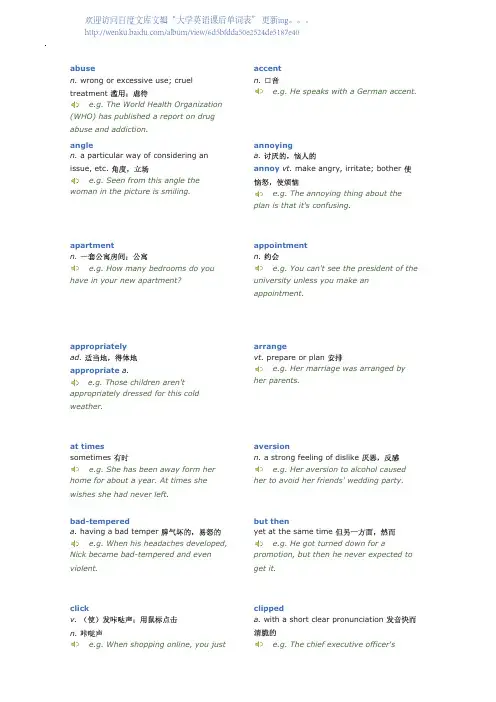
全新大学英语综合教程第二册unit4词汇表TextA+B 中英释义+典型例句
abusen. wrong or excessive use; cruel treatmente.g. The World Health Organization (WHO) has published a report on drugabuse and addiction.accentn.e.g. He speaks with a German accent.anglen. a particular way of considering an issue, etc.e.g. Seen from this angle thewoman in the picture is smiling.annoyinga.annoy vt. make angry, irritate; bothere.g. The annoying thing about theplan is that it's confusing.apartmentn.e.g. How many bedrooms do youhave in your new apartment?appointmentn.e.g. You can't see the president of the university unless you make anappointment.appropriatelyad.appropriate a.e.g. Those children aren't appropriately dressed for this coldweather.arrangevt. prepare or plane.g. Her marriage was arranged byher parents.at timessometimese.g. She has been away form her home for about a year. At times shewishes she had never left.aversionn. a strong feeling of dislikee.g. Her aversion to alcohol causedher to avoid her friends' wedding party.bad-tempereda. having a bad tempere.g. When his headaches developed, Nick became bad-tempered and evenviolent. but thenyet at the same timee.g. He got turned down for a promotion, but then he never expected toget it.click v. n.e.g. When shopping online, you justclippeda. with a short clear pronunciatione.g. The chief executive officer's 欢迎访问百度文库文辑“大学英语课后单词表” 更新ing。
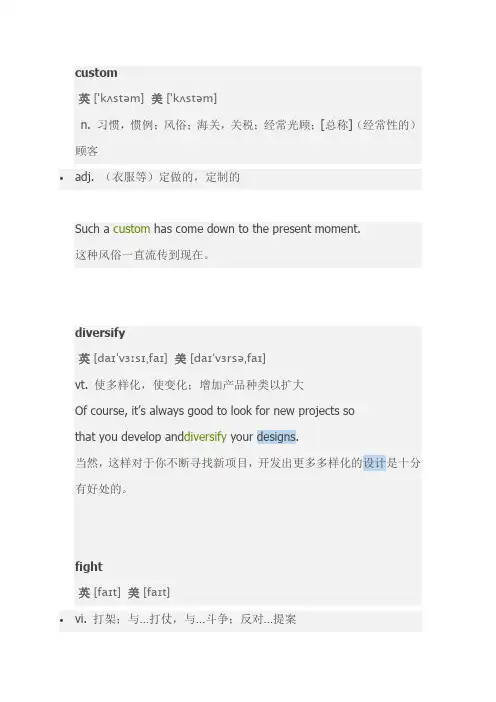
新技能英语高级教程第二册第四单元单词
custom英['kʌstəm]美['kʌstəm]n. 习惯,惯例;风俗;海关,关税;经常光顾;[总称](经常性的)顾客∙adj. (衣服等)定做的,定制的Such a custom has come down to the present moment.这种风俗一直流传到现在。
diversify英[daɪˈvɜːsɪˌfaɪ]美[daɪˈvɜrsəˌfaɪ]vt. 使多样化,使变化;增加产品种类以扩大Of course, it’s always good to look for new projects sothat you develop and diversify your designs.当然,这样对于你不断寻找新项目,开发出更多多样化的设计是十分有好处的。
fight英[faɪt]美[faɪt]∙vi. 打架;与…打仗,与…斗争;反对…提案∙n. 打架;战斗,斗志∙fight for为…而战,而奋斗∙fight against v. 对抗;反对;与……作斗争∙fight with与…并肩战斗;为反对…而战斗;与…打架These patriots would fight to death before they surrendered.这些爱国者宁愿战斗到死,也不愿投降。
split英[splɪt]美[splɪt]vt. 分离;使分离;劈开;离开;分解∙vi. 离开;被劈开;断绝关系∙n. 劈开;裂缝∙adj. 劈开的I would rather pay for a meal than watch nine friends pick over andsplit a bill.我宁愿付整顿饭钱而不愿看着9个朋友仔细算计、分摊账单。
pick over(挑选, 仔细检查……以便选出优品分档挑选)treat英[triːt]美[trit]∙vt. 治疗;对待;探讨;视为∙vi. 探讨;请客;协商∙n. 请客;款待∙n. (Treat)人名;(英)特里特She was always treating him to ice cream.她总请他吃冰淇淋。
大学英语第二册Unit4课文重点知识点讲解
Word
The Professor and the Yo-Yo Thomas Lee Bucky with Joseph P.Blank My father was a close friend of Albert Einstein. As a shy young visitor to Einstein’s home, I was made to feel at ease when Einstein said, “I have something to show you.” He went to his desk and returned with a YoYo. He tried to show me how it worked but he couldn’t make it roll back up the string. When my turn came, I displayed my few tricks and pointed out to him that the incorrectly looped string had thrown the toy off balance. Einstein nodded, properly impressed by my skill and knowledge. Later, I bought a new Yo-Yo and mailed it to the Professor as a Christmas present, and received a poem of thanks.
Word
(北师大版)高中必修第二册第四单元英语词汇表
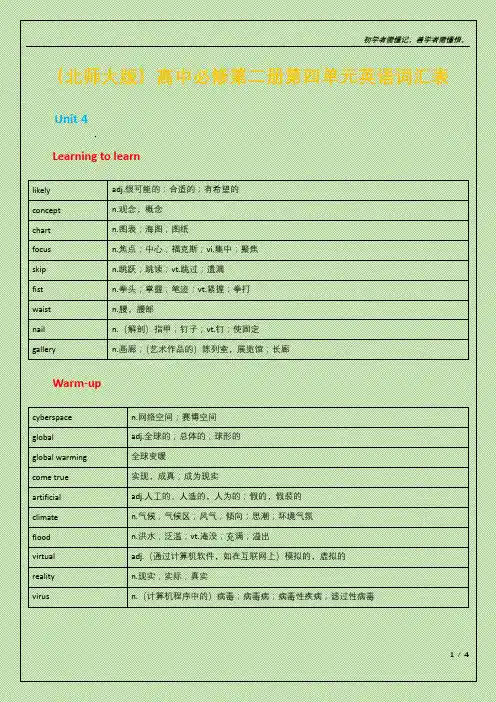
(北师大版)高中必修第二册第四单元英语词汇表Unit 4Learning to learnlikely adj.很可能的;合适的;有希望的concept n.观念,概念chart n.图表;海图;图纸focus n.焦点;中心;福克斯;vi.集中;聚焦skip n.跳跃;跳读;vt.跳过;遗漏fist n.拳头;掌握;笔迹;vt.紧握;拳打waist n.腰,腰部nail n.(解剖)指甲;钉子;vt.钉;使固定gallery n.画廊;(艺术作品的)陈列室,展览馆;长廊Warm-upcyberspace n.网络空间;赛博空间global adj.全球的;总体的;球形的global warming全球变暖come true实现,成真;成为现实artificial adj.人工的,人造的,人为的;假的,假装的climate n.气候;气候区;风气;倾向;思潮;环境气氛flood n.洪水;泛滥;vt.淹没;充满;溢出virtual adj.(通过计算机软件,如在互联网上)模拟的,虚拟的reality n.现实;实际;真实virus n.(计算机程序中的)病毒;病毒病;病毒性疾病;滤过性病毒Lesson 1affect n.影响感动;vi.倾向;喜欢rapidly adv.迅速地;很快地;立即growth n.增长;发展;生长;种植pessimistic adj.悲观的,厌世的;悲观主义的hacker n.电脑黑客optimistic adj.乐观的;乐观主义的crime n.罪行,犯罪;罪恶criminal n.罪犯;adj.刑事的;犯罪的;刑法的;犯法的;涉及犯罪的terror n.恐怖;恐怖行动;attack n.攻击;抨击;疾病发作;vi.攻击chaos n.混沌,混乱crash n.撞碎;坠毁offer n.提议;出价;提供;vt.提供;出价entertainment n.娱乐;消遣disappear vi.消失;失踪;as if好像;仿佛;似乎harm n.伤害;损害;vt.伤害;危害;损害obvious adj.明显的;显著的;平淡无奇的destruction n.破坏,毁灭;摧毁Lesson 2military n.军队;军人scientific adj.科学的,系统的the Pentagon五角大楼nuclear adj.原子能的,核能的;核武器的;n.核武器(尤指核导弹)network n.网络;广播网project n.工程;计划;事业;vt.设计;计划;发射;放映fashion n.时尚;时装业;(行为、活动等的)时兴;vt.(尤指用手工)制作;塑造hang on坚持下去;不挂断;握住不放get in touch取得联系be up to胜任;该由……负责;轮到……;从事,忙于,多达fancy n.幻想;想象力;爱好vt.想象;喜爱suggestion n.建议;暗示;提议;迹象;微量;些微reject vt.拒绝;排斥;抵制;丢弃arrangement n.布置;整理;准备Lesson 3suggest v.建议;表明;使认为;暗示;提议;推荐;使想到;举荐title n.冠军;标题;头衔;adj.冠军的;标题的;头衔的;vt.加标题于;赋予头衔;把……称为destination n.目的地;终点;adj.作为目的地的(旅馆、商店、饭店等)flesh n.(动物或人的)肉;肉体;果肉;(人体的)皮肤;蔬菜的可食部分in the flesh本人;亲自;exit n.出口,通道;退场;vi.退出;离去historical adj.(有关)历史的;历史学的;历史题材的;有关历史研究的site n.地点;位置;场所;vt.设置;为……选址pack n.包装;一群;背包;包裹;vt.包装;压紧;捆扎;挑选;塞满dip n.下沉,下降;倾斜;浸渍,蘸湿;vi.浸,泡,蘸toe n.脚趾;足尖;vt.用脚尖走;millionaire n.百万富翁;大富豪smoker n.吸烟者non-smoker n.不吸烟的人Lesson 4tourism n.旅游业;观光业guide n.指南;向导;入门书;vt.引导;带领locate vt.定位位于查找seaside n.海边;海滨Maori n.毛利人;毛利;毛利语;毛利文settle vt.解决;安排;使……定居;n.有背长椅settlement n.解决,处理;(会计)结算central adj.中心的;中枢的;中央;n.电话总机suburb n.郊区;城外zone n.地区;区域;地带volcano n.火山as well as除,也;和……一样;不但……而且harbour (=harbor)n.海港;避难所;vi.藏匿;入港停泊;庇护view n.观察;视野;意见;风景;vt.观察;考虑;查看sunshine n.阳光;愉快;晴天;快活average n.平均;平均数;adj.平均的;普通的;vt.算出……的平均数;使……平衡surfing v.冲浪;(互联网上)浏览;进行冲浪运动regular adj.定时的,定期的;经常的;n.常客,老主顾location n.位置;定位;地点;地方;(电影的)外景拍摄地material n.材料,原料;物资;adj.重要的;物质的,实质性的;肉体的be known as被称为;被认为是Communication WorkshopChinatown n.唐人街,中国城officially adv.正式地;官方地;scenery n.风景;景色;舞台布景cuisine n.烹饪,烹调法attractive adj.吸引人的;有魅力的;引人注目的pider n.黑白蜘蛛;两脚规web n.网络;蹼;网状物;错综复杂的事物。
全新版大学英语第二册单词第四单元
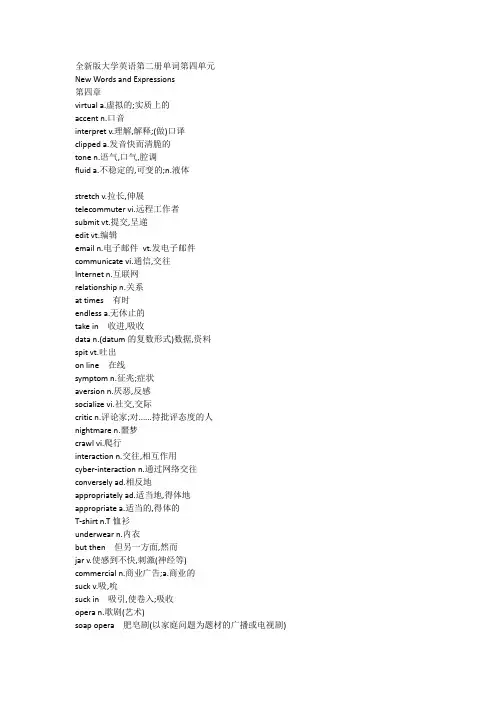
全新版大学英语第二册单词第四单元New Words and Expressions第四章virtual a.虚拟的;实质上的accent n.口音interpret v.理解,解释;(做)口译clipped a.发音快而清脆的tone n.语气,口气,腔调fluid a.不稳定的,可变的;n.液体stretch v.拉长,伸展telecommuter vi.远程工作者submit vt.提交,呈递edit vt.编辑email n.电子邮件vt.发电子邮件communicate vi.通信,交往Internet n.互联网relationship n.关系at times 有时endless a.无休止的take in 收进,吸收data n.(datum的复数形式)数据,资料spit vt.吐出on line 在线symptom n.征兆;症状aversion n.厌恶,反感socialize vi.社交,交际critic n.评论家;对......持批评态度的人nightmare n.噩梦crawl vi.爬行interaction n.交往,相互作用cyber-interaction n.通过网络交往conversely ad.相反地appropriately ad.适当地,得体地appropriate a.适当的,得体的T-shirt n.T恤衫underwear n.内衣but then 但另一方面,然而jar v.使感到不快,刺激(神经等)commercial n.商业广告;a.商业的suck v.吸,吮suck in 吸引,使卷入;吸收opera n.歌剧(艺术)soap opera 肥皂剧(以家庭问题为题材的广播或电视剧)keep up with 及时了解或跟上angle n.角度,立场in sight 可看到的;临近bad-tempered a.脾气坏的;易怒的insensitive a.感觉迟钝的,麻木不仁的sensitive a.敏感的remark n.言辞,话语v.说,评说project v.以为别人也有(与自己同样的情绪) misinterpret vt.错误地理解;错误地解释emotional a.感情上的,动感情的cue n.提示,暗示doggedly ad.顽强地,坚持不懈地routine n.例行事务,日常工作,惯例rely vi.依靠;依赖unemployment n.失业externally ad.从外面,在外部external a.外面的,外部的abuse n.滥用;虐待crime n.(犯)罪suicide n.自杀restore vt.恢复arrange vt.安排flee v.逃走;逃离gym n.体育馆,健身房set apart 使分离,使分开interview vt.n.接见,面试appointment n.约会laughter n.笑声intolerable a.无法容忍的;不能容忍的apartment n.公寓click v.用鼠标点击n.咔哒声modem n.调制解调器annoying a.讨厌的,恼人的annoy vt.使恼怒,使烦恼connection n.连接tune n.曲子,曲调password n.口令,密码text Bhousehold n.一家人,家庭be hooked on 对……入了迷on top of 除……还intense a. 认真的,紧张的worldwide a.,ad.全世界的,在全世界范围内scatter vt.散布outwards ad.向外vehicle n.传播媒介,交通工具liar n. 惯于撒谎的人denial n. 否定,不给overnight ad.一整夜,一夜间on the whole 总的看来,大体上reasonable a. 合情合理的tendency n. 倾向overlook vt. 注意到,忽视nutter n. 怪人nerd n. 不善于交际的家伙,怪人slip vi. 溜走horror n. 惊恐plot n. 情节to one's knowledge 据……所知needless to say 不用说call forth 时出现axe n. 斧子imitate vt. 模仿。
新编英语教程第二册_ 单词表Unit4
Unit4affect [ə'fekt, 'æfekt] n. 情感vt. 影响;感染;感动;假装vi. 倾向;喜欢aid [eid] n. 援助;帮助;助手;帮助者vt. 援助;帮助;有助于ankle ['æŋkl]n. 踝关节,踝assail [ə'seil] vt. 攻击;质问;着手解决atmosphere ['ætmə,sfiə] n. 气氛;大气;空气awareness [ə'wɛənis] n. 意识,认识;明白,知道barren ['bærən] n. 荒地adj. 贫瘠的;不生育的;无益的;沉闷无趣的;空洞的briefly ['bri:fli] adv. 短暂地;简略地;暂时地bronchial ['brɔŋkiəl] adj. 支气管的bucket ['bʌkit] n. 桶,水桶;铲斗;一桶的量v. 倾盆而下;颠簸着行进capsized adj. 翻覆的v. 倾覆(capsize的过去分词);翻船;覆没consequence ['kɔnsi,kwəns] n. 结果;重要性;推论dense [dens] adj. 稠密的;浓厚的;愚钝的destruction [di'strʌkʃən] n. 破坏,毁灭;摧毁deteriorate [di'tiəriəreit] vt. 恶化vi. 恶化,变坏discharge [dis'tʃɑ:dʒ] n. 排放;卸货;解雇vt. 解雇;卸下;放出;免除vi. 流出disturbance [di'stə:bəns] n. 干扰;骚乱;忧虑drastic ['dræstik] n. 烈性泻药adj. 激烈的;猛烈的drowned ['draunid]n. 血本无归者;被套牢者adj. 淹死的;水淹的v. 淹死(drown的过去分词);淹没ecology [i:'kɔlədʒi] n. 生态学;社会生态学enforce [in'fɔ:s] vt. 实施,执行;强迫,强制erosion [i'rəuʒən] n. 侵蚀,腐蚀exhaust [iɡ'zɔ:st] n. 排气;废气;排气装置vt. 排出;耗尽;使精疲力尽;彻底探讨eyesight ['aisait] n. 视力;目力fell [fel]n. [林] 一季所伐的木材;折缝;兽皮adj. 凶猛的;毁灭性的v. 掉下;摔倒;下垂;变坏(fall的过去式)vt. 砍伐;打倒;击倒fertilizer ['fə:tilaizə] n. [肥料] 肥料;受精媒介物;促进发展者flare [flεə] n. 闪光,闪耀;耀斑;爆发;照明弹vi. 闪耀,闪光;燃烧;突然发怒foul [faul]n. 犯规;缠绕adj. 犯规的;邪恶的;污秽的;淤塞的vt. 犯规;弄脏;淤塞;缠住,妨害adv. 违反规则地,不正当地frightening ['fraitəniŋ]adj. 令人恐惧的;引起突然惊恐的fume [fju:m] n. 烟;愤怒,烦恼vt. 熏;冒烟;愤怒地说handout ['hændaut] n. 散发材料(免费发给);上课老师发的印刷品;文字资料;施舍物horn [hɔ:n] n. 喇叭,号角;角vt. 装角于increasingly [in'kri:siŋli]adv. 越来越多地;渐增地indiscriminate [,indis'kriminət] adj. 任意的;无差别的;不分皂白的industrial [in'dʌstriəl] adj. 工业的,产业的;从事工业的;供工业用的;来自勤劳的insecticide [in'sektisaid] n. 杀虫剂intolerable [in'tɔlərəbl] adj. 无法忍受的;难耐的irritated ['iriteitid] adj. 恼怒的,生气的v. 激怒;使无效;使兴奋(irritate的过去分词)jet [dʒet] n. 喷射,喷嘴;喷气式飞机;黑玉adj. 墨黑的vi. 射出;junk [dʒʌŋk]n. 垃圾,废物;舢板leaking [li:kiŋ]n. 漏泄,渗漏;耗散adj. 渗漏的v.泄露(leak的ing形式)lessen ['lesən] vt. 使变小;使减轻;使变少vi. 减少;减轻;变小major ['meidʒə]n.成年人;主修科目;陆军少校adj. 主要的;重要的;主修的;较多的vi. 主修marine [mə'ri:n]n. 海运业;舰队;水兵;(海军)士兵或军官adj. 船舶的;海生的;海产的;航海的marvellously ['ma:vələsli] adv. 不可思议地;绝妙地;不平凡地;很好地ministry ['ministri] n. (政府的)部门mobility [məu'biləti] n. 移动性;机动性;[电子] 迁移率nuisance ['nju:səns] n. 讨厌的人;损害;麻烦事;讨厌的东西panic ['pænik] n. 恐慌,惊慌;大恐慌adj. 恐慌的;没有理由的vt. 使恐慌pesticide ['pestisaid] n. 杀虫剂pollutant [pə'lu:tnt] n. 污染物quiz [kwiz] n. 考查;恶作剧;课堂测验vt. 挖苦;张望;对进行测验residential [,rezi'denʃəl] adj. 住宅的;与居住有关的residue ['rezidju:,-du:] n. 残渣;剩余;滤渣restriction [ri'strikʃən] n. 限制;约束;束缚sail [seil] n. 帆,篷;航行vt. 航行vi. 航行;启航,开船sailing ['seiliŋ]n. 航行;启航;航海术v. 航行,起航(sail的现在分词形式)scatter ['skætə] n. 分散;散播,撒播vi. 分散,散开;散射smog [smɔɡ, smɔ:ɡ] n. 烟雾smokeless ['sməuklis] adj. 无烟的sprain [sprein] n. 扭伤vt. 扭伤surrounding [sə'raundiŋ]n. 环境,周围的事物adj. 周围的,附近的survival [sə'vaivəl] n. 幸存,残存;幸存者,残存物swarm [swɔ:m] n. 蜂群;一大群vt. 挤满;爬vi. 挤满;成群浮游;云集torment [tɔ:'ment, 'tɔ:m-] n. 痛苦,苦恼;痛苦的根源vt. 折磨,使痛苦;纠缠,作弄toxic ['tɔksik] adj. 有毒的;中毒的ugliness ['ʌglinis] n. 丑陋,丑陋之物unfulfilled [,ʌnful'fild] adj. 未得到满足的;没有成就感的whereabout ['hwεərə,baut] n. 行踪;下落adv. 在何处zone [zəun] n. 地带;地区;vt. 使分成地带;环绕vi. 分成区。
新技能英语Unit 4
elderly
01 adj. a polite way of saying that someone is old
上年纪的
e.g. Ms Smith is a well-dressed elderly
Warming up
woman.史密斯夫人是一位衣着考究的老妇人。
rewarding
01 adj. An experience or action that is rewarding
What do you think of volunteer work?
After learning this unit, you will be able to:
1. talk about your volunteer experiences; 2. express your opinions on volunteer work; 3. write a notice.
Listening and Speaking
Jerry: Hi, Mollie. How’s your volunteer work in Friends of the Community?
CONTENT
01 Warming up 02 Listening and Speaking 03 Reading and Vocabulary 04 Grammar for Use
05 Practical Reading & Writing 06 Project 07 Around the World 08 My Progress Check
gives you satisfaction or brings you benefits 值得的,有意义的
e.g. Teaching can be a very rewarding
高级英语第二册unit-4
Unit 4 John Fitzgerald Kennedy (1917-1963) 35th president of the United StatesFamily Background Kennedy’s ancestors came from Ireland and he was the first Roman Catholicto become president of the U.S. He was born on May 29, 1917 in Brookline, Massachusetts, where his grandfather had been elected to many offices. His father Joseph P. Kennedy became the youngest bank president of the country at the age of 25. On September 12, 1953, Kennedy and Jacqueline Bouvier were married. They had three children.He wrote "Profiles in Courage",《勇敢者传略》which won a Pulitzer prize.1947-1952 served as representative in the congress 1952 elected to the senate1960 won the Democratic nomination for presidentand defeated Richard Nixon, Republican Assassination His assassination at Dallas in November 1963 was a shock from which the U.S. has found it hard to recover and the murder is still a riddle. In 1963, Kennedy journeyed to Texas for a speech-making tour. on November 22, he and his wife were cheered as their open car passed through thestreets. Suddenly, at 12:30 in the afternoon, an assassin fired several shots, striking the president twice in the base of the neck and the head. Kennedy was rushed to Hospital, where he was pronounced dead about a half hour later. Within two hours, Vice president Johnson took the oath as president.Contributions1. His most important act was his successful demand on Oct.22, 1962 that the Soviet Union dismantle its missile bases in Cuba.2. He established a quarantine(隔离检疫期) of arms shipments to Cuba3. He defied Soviet attempts to force the Allies out of Berlin.4. He made the steel industry rescind(废除) a price rise.5. He backed: civil rights movements; a mental health program; arbitration of railroad disputes; expanded medical care for the aged; astronaut flights and satellite orbitingLincoln and KennedyAbraham Lincoln was elected to Congress in 1846.John F. Kennedy was elected to Congress in 1946.Abraham Lincoln was elected President in 1860.John F. Kennedy was elected President in 1960. The names Lincoln and Kennedy each contain seven letters.Both were particularly concerned with civil rights. Both wives lost their children while living in the White House.Both Presidents were shot on a Friday.shot in the head.Lincoln’s secretary was named Kennedy.Kennedy’s secretary was named Lincoln.Both were assassinated by Southerners. Both were succeeded by Southerners.Both successors were named Johnson.Andrew Johnson, who succeeded Lincoln, was born in 1808.Lyndon Johnson, who succeeded Kennedy, was born in 1908.John Wilkes Booth, accused of assassinating Lincoln, was born in 1839.Lee Harvey Oswald, accused of assassinating Kennedy, was born in 1939.Both names comprise fifteen lettersInauguration Day On April 30,1789, George Washington stepped onto a balcony of Federal Hall in New York City, placed his hand on a Bible and swore to “preserve, protest and defend the constitution of the United States”. He then read an earnest speech, calling for “united and effective government”. Thus began a unique American institution—Inauguration Day—those dramatic hours when a new president faces the people for the first time. He must tell the people what he’s going to do as president.The Inauguration Day has been on January 20 since 1937.Inaugural Address Memorable words have been uttered in inaugural address. It is a speech, lecture officially made by a person on taking office.General Analysis of a Political SpeechThe purpose of a political speech is to explain, convince and persuade the people that what he is saying and planning to do best represents their interests so they should support him.1. He must try every possible means to arouse the feelings of audience. What he says represents theinterests of the whole people. successful appeal to the emotion of the audience2. specific policy The speech must contain high-sounding words and empty promises3. The speech must be concise and short4. clever-choice of words to convey different meanings/tones.5. the use of biblical style to make it formal/ rigid.6. the use of a lot of rhetorical devices to make his address as powerful/ impressive as possibleAs President of the United States, Kennedy has to address a worldwide audience. He has to appeal not only to the American people but also to the different groups of nations in the international community Social Background Kennedy became President in 1960’sCold war marks the situation in 1960’s. The world is mainly divided into two hostile camps.1)socialist camp— headed by the Soviet Union 2) capitalist camp—headed by the U.S.Kennedy was an eloquent speaker. He is specially trained. This speech is very powerful and wonderful. He lays his emphasis on the successful appeal to theemotion of the listeners. In fact, most Americans regard his inaugural address as one of the best delivery by an American President.Section I (paras.1-5)Introduction, the general statement of the basic policy of the USSection II (paras.6-10) He addresses different groups of allied nations and would-be allied nations; friends and would-be friends.Section III (paras.11-20) His specific policy toward the enemy.1. point out the danger2. point out he position of strength3. point out the situation and need.Both sides feel uneasy. a) Both sides are overburdened with the cost of modern weapons.b)Both sides are anxious with the wide spread arms.c) Both try to change the uncertain balance of military power.Proposals: 1. control arms 2 . use science for peace purpose 3. enjoy human rightsObject: to make a new world orderSection IV (paras.21-27) conclusionHe calls on the Americans to support him and to sacrifice their lives for their country. He calls onthe people of the whole world to unit and work for the freedom of menDetailed Study of the TextPara.1: Kennedy is emphasizing the importance of his election as president. It is not simply a victory of the Democratic Party over the Republican Party. It celebrates the freedom of people to elect freely their own head of state. It symbolizes the end of one presidential term (that of Eisenhower) and the beginning of a new term (that of Kennedy). The presidency or the office of president is renewed.1.freedom: We celebrate freedom. People in the USare free to choose their president.2.end: the end of Eisenhower’s presidential term3.beginning: the beginning of Kennedy’spresidential term4.renewal: the continuation of presidency andoffice of president5.change: the change from Eisenhower to Kennedy6.solemn oath: refer to an extremely formal andinspiring religious ritual. very serious.7. a century and three-quarters ago: The firstpresidential oath taken by Washington onApril 30, 1789Para.2: the general situation of this world Question: In what way is the world different? The world is different in the way of science and technology. People have modern and advanced science and technology.power: the power of science and technology Science can be used to get rid of poverty. Science can be used to destroy all human beingsEg. Slavery was abolished in the US in the 19th century.Man has made great progress in science and technology so he has the power (scientific farming, speedy transportation, mass production, etc.) to abolish poverty, but he also has the power (missiles, bombs, nuclear weapons, etc.) to destroy human life. Hence the world is different now.revolutionary belief: it refers to a passage in the American Declaration of Independence: “We hold these truths to be self-evident, that all men are created equal, that they are endowed by their Creator with certain unalienable Rights, that among these are Life, Liberty and the pursuit of HappinessAnd yet the same... around the globe: Our ancestors fought a revolutionary war to maintain that all men were created equal and God had given them certain unalienable rights which no state or ruler could take away from them. But today this issue has not yet been decided in many countries around the world.Para.3: general policy of the USPeople in the US must keep and defend human rights not only in the US but also in the world as well. We dare not... first revolution: We dare not forget that we are the descendants of those who fought the war of independence. Hence we must always bear in mind the beliefs and ideals our ancestors fought and died for. We must be prepared, if necessary, to fight and die for them today.torch: metaphor. Its original reference is to the Olympic Games before which a torch is carried from runner to runner. Here it refers to “inspirations and ideals”.temper: v. to cause to become firm 使变坚韧tempered by war: The Americans of the 20th century fought two world wars, so they are well tempered disciplined:received training that developed selfcontrol and characterhard and bitter peace: peace but cold war, hence “hard and bitter’’to witness or permit the slow undoing: to see or allow the gradual abolishing ofPara.4: strong determination. Kennedy puts the US in the position of the world leader, and he says in order to keep human rights, “we shall pay any price, bear any burden, ...”.The address is to both friends and foes. It promises to support any friend and to oppose any foe.The phrases “pay any price, bear any burden and meet any hardship”are intended to shore up the waning confidence of her allies as much as to warn any prospective foe.Para.5: transition A one sentence paragraph that functions as a transition from the general to the specific. In the following paragraphs he will be addressing different specific groups of nations.Para.6: the specific policy toward his friendsand would-be friendsTo those old allies…split asunder:In thisparagraph Kennedy addresses the white European countries in general but his words are specifically directed to the English-speaking Anglo-Saxon countries, such as Britain, Canada, Australia, and New Zealand, with whom the United States shares a common cultural and spiritual heritage.ally:n. a country that has a treaty or an agreement to help and support another country, allied: ad. the Allied and Associated Powers (World War I)cultural and spiritual origins: Greek, Roman and Nordic mythology, literature, art, music etc. Later these nations were linked closer by the spiritual tie of Christianity.United, there is little we cannot do in a host of co-operative ventures: United and working togetherwe can accomplish a lot of things in a great number of joint undertakings.United we can do everything. Divided we can do nothingpowerful challenge:a strong, powerful threat posed by the socialist camp.If we are quarreling and split apart, we can notcompete with the strong, powerful enemy in front of usThose two have been at odds with one another for ages. 那两个人合不来已经很久了。
高中必修第二册英语第四单元单词
第一节:Introduction1.1 Background Information在高中英语课程中,单词是学习的基础,对于英语学习者来说,掌握单词是非常重要的。
而高中必修第二册英语第四单元的单词更是涵盖了各种日常生活和学习领域的词汇,对学生的语言能力提升具有重要意义。
1.2 Purpose of the Article本文旨在介绍高中必修第二册英语第四单元的单词,帮助学生更好地掌握这些词汇,提高他们的英语水平。
第二节:单词列表及解释2.1 List of Words下面是高中必修第二册英语第四单元的单词列表:1) Intensive: 集中的2) Formulate: 制定3) Rational: 合理的4) Interpretation: 解释5) Literally: 确实地6) Epitome: 典范7) Aesthetics: 美学8) Newscaster: 新闻播音员9) Assert: 坚持10) Mimic: 模仿11) Contextual: 上下文的2.2 Expl本人nationIntensive: 集中的,表示做某事花费大量的时间和精力,例如:intensive tr本人ning(集中训练)Formulate: 制定,用于指定某一计划、规定或法律条文的确立。
Rational: 合理的,健全的推理能力,能用道理和理性解释清楚的。
Interpretation: 解释,解读,理解特定形式的话语。
Literally: 确实地,字面上,通常用于强调某件事情确实如字面所示。
Epitome: 典范,象征,典型的事物,代表。
Aesthetics: 美学,从事美术理论研究的学科。
Newscaster: 新闻播音员,指在电视、广播或网络新闻节目中播送新闻的人。
Assert: 坚持,表示对某种观念的肯定和相信。
Mimic: 模仿,指一个人或物体对另一个人或物体的行为、声音、外貌等进行学习和模拟。