
人教英语八年级下册Unit-2 知识点sectionB
英语人教版八年级下册Unit 2 SectionB

Unit 2 I'll help to clean up the city parks.教学设计
赵慎坦
一、教材和学情分析
《英语课程标准》中提出要激发和培养学生学习英语的兴趣,使学生树立自信心,养成良好的学习习惯和形成有效的学习策略,发展自主学习的能力和合作精神;使学生掌握一定的英语基础知识和听、说、读、写技能,形成一定的综合语言运用能力; 培养学生爱国主义精神,形成健康的人生观,为他们的终身学习和发展打下良好的基础.Go for it 是一套画面内容生动有趣, 学习内容贴近生活, 语言运用更为交际化的教材.教材突出语言使用能力的培养,通过听、说、读、写的全面训练,使学生获得英语基础知识和为交际初步运用英语的能力,旨在培养学生的综合语言应用能力.这就要求教师根据新教材形式活泼,图文并茂等特点创造性地运用教材,同时遵循新课程理念,从重视‘教法’转变到重视学法。九年级Unit8
I’ll help clean up the city parks.第一课时运用动词词组围绕“volunteer”展开话题,前半部分围绕“ways of offering people”,后半部分围绕“ways of telling people about the Clean-Up
Day ”。在熟悉和操练各个动词词组的基础上通过各种各样活动的开展培养学生的综合语言应用能力。对于九年级的学生可能已经不像七年级、八年级学生那样热衷于普通的课堂活动,所以设计怎样的课堂活动,采取怎样的评价方式来提高课堂气氛,从而使学生自然地融入整个教学环节显得尤为重要。
二、设计重点和难点
根据教材的内容和学生的实际情况,发现Unit8第一课时的课文内容和Unit7有联系,同时题目是“Unit8 I’ll help clean up the city parks”既然是city parks刚好跟我们宁波这个城市可以联系起来。所以就围绕“我爱宁波,我要成为宁波志愿者的一员,我帮助宁波打扫城市公园,帮助宁波需要帮助的人”这一在中心思想来开展一系列教学活动。在培养学生听、说、读、写能力的基础上,培养学生爱家乡,爱宁波,形成健康的人生观,为他们的终身学习和发展打下良好的基础。
人教版英语八年级下册Unit2_Section B (2a~2e)教案与反思
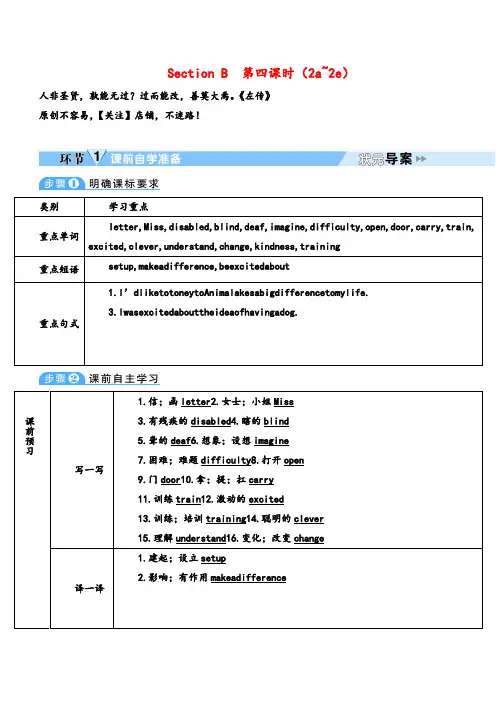
Section B 第四课时(2a~2e)
人非圣贤,孰能无过?过而能改,善莫大焉。《左传》
原创不容易,【关注】店铺,不迷路!
类别 学习重点
重点单词 letter,Miss,disabled,blind,deaf,imagine,difficulty,open,door,carry,train,excited,clever,understand,change,kindness,training
重点短语 setup,makeadifference,beexcitedabout
重点句式 1.I’dliketotoneytoAnimalakesabigdifferencetomylife.
3.Iwasexcitedabouttheideaofhavingadog.
课前预习
写一写 1.信;函letter2.女士;小姐Miss
3.有残疾的disabled4.瞎的blind
5.聋的deaf6.想象;设想imagine
7.困难;难题difficulty8.打开open
9.门door10.拿;提;扛carry
11.训练train12.激动的excited
13.训练;培训training14.聪明的clever
15.理解understand16.变化;改变change
译一译 1.建起;设立setup
2.影响;有作用makeadifference 背一背 1.我想要谢谢你寄钱给“动物帮手”。
I’dliketotoneytoAnimalHelpers.
2.对于拥有一只狗的想法,我感到很兴奋。
Iwasexcitedabouttheideaofhavingadog.
3.你认为狗还在其他什么方面能帮助人?
Inwhatotherwaysdoyouthinkdogsareabletohelppeople?
新课导入 Teaceothersinourdailylife.Howdoyouusuallythankthepeoplewhohelpyou?Nowpleasediscussthiswithyourpartnersinagroup.
人教新目标版八年级下册Unit2 I'll help to clean up the city parks单元知识点
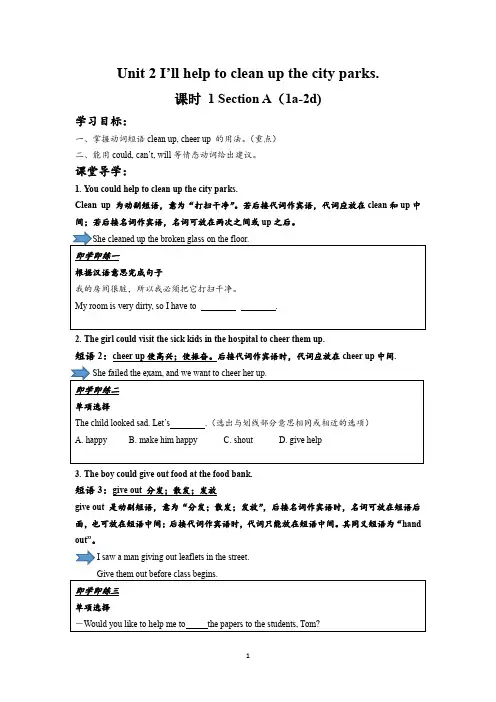
1 Unit 2 I’ll help to clean up the city parks.
课时 1 Section A(1a-2d)
学习目标:
一、掌握动词短语clean up, cheer up 的用法。(重点)
二、能用could, can’t, will等情态动词给出建议。
课堂导学:
1. You could help to clean up the city parks.
Clean up 为动副短语,意为“打扫干净”。若后接代词作宾语,代词应放在clean和up中间;若后接名词作宾语,名词可放在两次之间或up之后。
She cleaned up the broken glass on the floor.
即学即练一
根据汉语意思完成句子
我的房间很脏,所以我必须把它打扫干净。
My room is very dirty, so I have to .
2. The girl could visit the sick kids in the hospital to cheer them up.
短语2:cheer up使高兴;使振奋。后接代词作宾语时,代词应放在cheer up中间.
She failed the exam, and we want to cheer her up.
即学即练二
单项选择
The child looked sad. Let’s .(选出与划线部分意思相同或相近的选项)
A. happy B. make him happy C. shout D. give help
3. The boy could give out food at the food bank.
短语3:give out 分发;散发;发放
give out 是动副短语,意为“分发;散发;发放”,后接名词作宾语时,名词可放在短语后面,也可放在短语中间;后接代词作宾语时,代词只能放在短语中间。其同义短语为“hand
英语人教版八年级下册unit 2 sectionB(2a-2b)
Unit 2: I’ll help to clean up the city parks.
Section B(2a-2b)教案
Teaching aims(教学目标)
1. Talk about volunteer work
2. Offer help
Language points(语言点)
1. I’d like to thank you for giving money to Animal Helpers.
2. You helped to make it possible for me to have Lucky.
3. A friend of mine helped me out.
4. I was able to bring him home.
Difficult points:
How to be a good volunteer.
Teaching steps(教学步骤)
1. Review(复习)
Ask, “What did we learn yesterday?” Have Ss fill in blanks using previously learned phrases.
T: Yesterday we learned a lot phrasal verbs. Now let’s challenge ourselves to translate some
sentences.
教学设计说明:这环节的复习是为后面的阅读作热身。
2. Discussion
T: (present some questions)
Can you open or shut the door?
Can you carry things?
Can you answer the phone?
Can you use your hands, arms or legs?
(老师可以鼓励学生多说,提高学生的口语)
人教版八年级下册英语 Unit2 知识点
Unit2 I'll help to clean up the city parks
名词:
sign 标志;信号
feeling 感觉
satisfaction 满足;满意
joy 高兴;愉快 owner 物主;主人
journey 旅行
wheel 车轮;轮子
letter 信 difficulty 困难
door 门
training 训练;培训
kindness 仁慈;善良
动词:
cheer 欢呼;喝彩
raise 募集;征集
repair 修理 fix 修理;安装
imagine 想像
open 打开 carry 拿;提;携带
train 训练;培训
understand 理解
形容词:
lonely 孤独的;寂寞的
strong 强壮的;强烈的
broken 破损的;残缺的 disabled 丧失能力的;有残疾的
blind 瞎的;失明的
deaf 聋的 excited 激动的;兴奋的
clever 聪明的
副词:
alone 独自;单独
代词:
several 几个;数个;一些
兼类词:
volunteer v义务做;自愿做 n 志愿者
notice n通知 v 注意到 change v&n 变化;改变
interest n 兴趣 v 使感兴趣
短语:
clean up 打扫干净
cheer up 高兴振奋起来
give out 分发;散发
come up with 提出;想出
put off 推迟
hand out 分发
call up 打电话给某人
used to 曾经;过去 care for 照顾
try out 参加选拔;试用
fix up 修理;安装
give away 赠送;捐赠
take after 像
set up 建起;设立
make a difference 影响;有作用
知识点:
1、clean up 打扫干净 I clean up my desk. 我把桌子打扫干净。
英语人教版八年级下册unit 2 Section b 3a--3c

Topic Unit2 I’ll help to clean up the city parks. Section A 3a—3c (阅读课) 参加……选拔 ___ ____ 一种强烈的感觉 ___ ____
2. 根据汉意完成下列句子
(1) Mario想成为一名动物医生。
______ _______
(2) 我可以做我喜欢的事情同时也帮助了别人。
________ _____
3. 知识超市:
(1)several几个 数个,形容词,修饰可数名词复数 several hours
(2)feeling 可数名词,感觉 感触 a bad feeling
feel 连系动词,感觉 觉得到 后接形容词
(3) satisfaction 不可数名词 满意 满足 反义词是dissatisfaction
(4)owner 可数名词 物主 主人 the owner of…
own 形容词 自己的 一般用于形容词性物主代词或名词所有格之后以加强语气。
I saw it with my own eyes.
own 及物动词 意为有,拥有。相当于have
He owns a big house.
(5)journey 可数名词 旅行 行程 一般指长途旅行
Life is a long journey from birth to death.
(6)I get such a strong feeling of satisfaction when I see the animals get better …on their owners’
faces.
此句中get的两次用法意义各不相同。
英语人教版八年级下册Unit 2 Section B
人教2011课标版八年级下册 Unit 2 Section B
石家庄第二外国语学校 徐哲
1.教学目标
语言知识(Language knowledge)
(1)重点词汇:disabled, set up, help sb. out, kindness, lonely, imagine, blind……
(2)重点句型:You help to make it possible for me to do sth.
(3)拓展的介词有 impossible, donate, organization……
语言技能 (Language skills)
通过学习本节课,能使用英语来对帮助过自己的人表达感谢。。
学习策略(Learning strategies)
培养学生,根据需要进行预习的习惯;在阅读中归纳与总结的能力及理解能力;在课内外学习活动中能够使用所学语言与他人交流。
情感态度、文化意识(Emotional objectives and Cultural awareness)
通过本节课的学习,使得学生长存感恩的心,懂得珍惜身边的人和事物,善于发现生活中的美好。
2.学情分析
学情分析:八年级下学期的学生已经具有了一定的英语表达能力,懂得如何简单的用英语向别人表达感谢,但是对于感谢信的书写格式和用语缺乏了解。
3.重点难点
教学重点:掌握句型I want to show your thanks to …/ Your help makes it possible for me to …
教学难点:The form of writing the thank-you letter.
4.教学过程
4.1 第四学时
1教学活动
活动1:Show our thanks 倾听内心的声音,向周围人表达感谢
In your life, there must be someone who helped you before and now you have a chance to show
英语人教版八年级下册Unit 2 SectionB (2a-2e)
Unit2 I’ll help to clean up the city parks.
Section B 2a—2e
三河市第八中学 八年级组 李素艳
一、【教材分析】
教
学
目
标
知识
目标
1.学习并掌握新词汇:
Miss; set up; disabled; blind;
deaf; imagine; difficulty; open; door;
carry; train; excited; training; kindness; clever; understand;
change
2. 能正确使用以下常用表达:set up; make a difference; make it
possible to do
3. 学会使用以下句型:
1)I’d like to thank you for giving money to Animal Helpers.
2)I’m sure you know that this group was set up to help disabled people
like me.
3)Lucky makes a big difference to my life.
4)I was excited about the idea of having a dog.
5) I’m only able to have a “dog helper” because of your kindness.
能力
目标
通过阅读训练,培养学生的良好的阅读理解能力,同时使学生在理解故事情节的基础上对文章进行进一步的解读,以实现对学生进行有利的情感教育的目的。
情感
目标
1.通过本课的学习,培养学生乐于助人、志愿服务的精神.
2.动物是我们的朋友,我们要爱护动物。
教学重点 阅读短文,获得相关信息,提高学生的综合阅读能力。
教学难点 在理解故事情节的基础上对文章进行进一步的解读,教会学生抓住文章细节,从细节中提高学生的阅读能力。
英语人教版八年级下册Unit 2 Section B 2a-2c
Unit 2 I'll help to clean up the city parks
Period 4 Setion B ( 2a_-_2c)
教学目标:1.了解英语单词的词性,提高学生的阅读能力,培养学生的语感。
2: 教育学生学会感恩。
重点难点:1: New words and expressions.
2: To improve the reading skills.
教学过程:
Step 1 Greeting
T: Good morning ,class !
Ss : Good morning ,sir !
Step 2 Lead -in
Have you ever helped others ? Have you ever gotten help from others ? What
shoud we do when someone helps us ? Of course , we should thank them .How do
you usually thank them Say thank to them face to face ,by calling up them or writing
to them ? Discuss it with your partner .
Step 3 Reading
1 .Present new words and expressions .
(1) Let the students read the words and phases according to the phonetic symbols
on Page 117 .
(2 )W rite out the Chinese meanings of the words and phases :
人教版八年级英语下册Unit2Section B
Section B
1a
1. But my mother wants me to drink it. 但我妈妈想让我喝它。(教材第12页)
want sb. to do sth. 意为“想让某人做某事”,否定形式为want sb.
not to do sth. 意为“不想让某人做某事”。
Eg:She wants me to bring him some pens. 她想让我给她带些钢笔。
拓展:1.want sth. 想要某物Do you want any story books?你想要些故事书吗?
2.want to do sth. 想要做某事I want to visit my uncle. 我想去看望我的叔叔。
Do you want (tell)me anything?
2. She says it’s good for my health. 她说它对我的健康有好处。(教材第12页)
be good for 意为“对……有益”。反义词为be bad for “对……有害”。
Eg: Vegetables are good for you. 蔬菜对你有好处。
拓展:be good at 擅长... be good at doing sth. 擅长做...
I am good at (play)basketball.
①Doing sports can help us keep ___________(health)
②They eat very ____________(health).
③Mike is good for our ____________(health). ( ) ④ I think eating more _____ food can help us keep _____.