
外研版七年级英语语法全集
外研版七年级英语语法全集
目录
1. 名词
2. 代词
3. 冠词
4. 形容词
5. 副词
6. 动词
7. 时态
8. 介词
9. 连词
10. 句子结构
11. 从句
12. 状语从句
13. 宾语从句
14. 主语从句
1. 名词 名词是指人、事物、地点或抽象概念的名称。名词可以分为可数名词和不可数名词。可数名词有单数和复数形式,而不可数名词没有复数形式。
2. 代词
代词是用来代替名词的词语。代词可以分为人称代词、物主代词、指示代词、不定代词等。
3. 冠词
冠词是用来限定名词的词语。英语中有三个冠词:a、an和the。a和an用来表示不确定的或泛指的名词,而the用来表示特定的或已知的名词。
4. 形容词
形容词用来描述名词的性质或特征。形容词通常放在名词前面或连接动词be的后面。
5. 副词
副词用来描述动词、形容词、副词或整个句子的性质或特征。副词可以回答问题如何、何时、何地、为什么等。
6. 动词
动词是表示动作、状态或存在的词语。动词可以分为及物动词和不及物动词。及物动词需要有宾语,而不及物动词不需要宾语。
7. 时态
时态是指动词的时态形式,用来表示动作发生的时间。英语中常见的时态有一般现在时、一般过去时、一般将来时等。
8. 介词
介词用来连接名词或代词与其他词语,表示它们之间的关系。常见的介词有in、on、at、with、to等。
9. 连词
连词用来连接句子或词语,使其成为句子的一部分。常见的连词有and、but、or、so等。
10. 句子结构
句子结构是指句子的组成方式。英语句子通常由主语、谓语和宾语构成。
11. 从句
从句是一个句子中的一部分,不能独立存在。从句可以作为名词、形容词或副词使用。
12. 状语从句
状语从句是从句的一种,用来描述主句中的动作或状态。状语从句通常由连词引导,如when、if、because等。
13. 宾语从句
宾语从句是从句的一种,作为主句的宾语。宾语从句通常由连词引导,如that、whether等。
14. 主语从句
主语从句是从句的一种,作为主句的主语。主语从句通常由连词引导,如what、who、which等。
以上是外研版七年级英语语法全集的目录,包含了基础的语法知识。希望对你的研究有所帮助!
外研版七年级英语下册语法总结
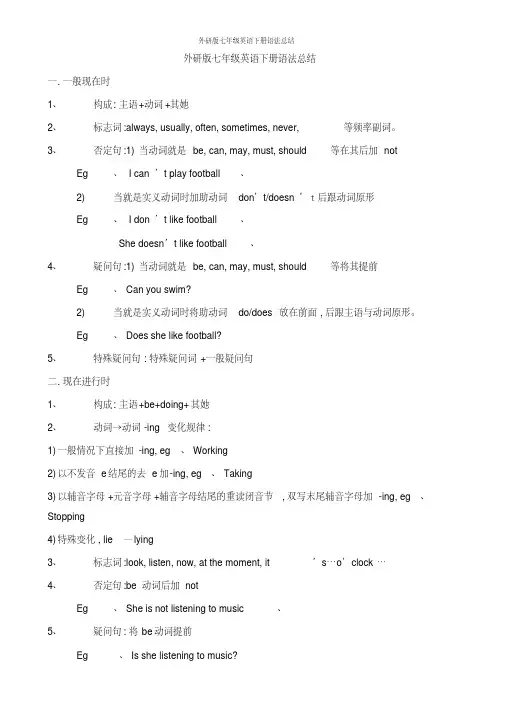
外研版七年级英语下册语法总结外研版七年级英语下册语法总结一.一般现在时
1、构成:主语+动词+其她2、标志词:always, usually, often, sometimes, never, 等频率副词。
3、否定句:1)当动词就是 be, can, may, must, should等在其后加not
Eg、I can’t play football、
2)当就是实义动词时加助动词don’t/doesn’t后跟动词原形 Eg、I don’t like football、
She doesn’t like football、
4、疑问句:1)当动词就是 be, can, may, must, should等将其提前
Eg、 Can you swim? 2)当就是实义动词时将助动词do/does 放在前面,后跟主语与动词原形。
Eg、 Does she like football?
5、特殊疑问句:特殊疑问词+一般疑问句二.现在进行时
1、构成:主语+be+doing+其她
2、动词→动词-ing变化规律:
1)一般情况下直接加-ing, eg、 Working 2)以不发音e结尾的去e加-ing, eg、 Taking
3)以辅音字母+元音字母+辅音字母结尾的重读闭音节,双写末尾辅音字母加-ing, eg、Stopping
4)特殊变化, lie—lying
3、标志词:look, listen, now, at the moment, it’s…o’clock…4、否定句:be动词后加not
Eg、 She is not listening to music、
5、疑问句:将be动词提前
Eg 、 Is she listening to music?
外研版七年级英语下册语法总结6、特殊疑问句:特殊疑问词+一般疑问句
三.将来时
1、构成:主语+be going to+动词原形 will
2、标志词:tomorrow, next day/month/year等表示将来的时间
Units1-2单元+语法+课文知识点 外研版七年级英语上册
Module 1 my classmates 个人信息
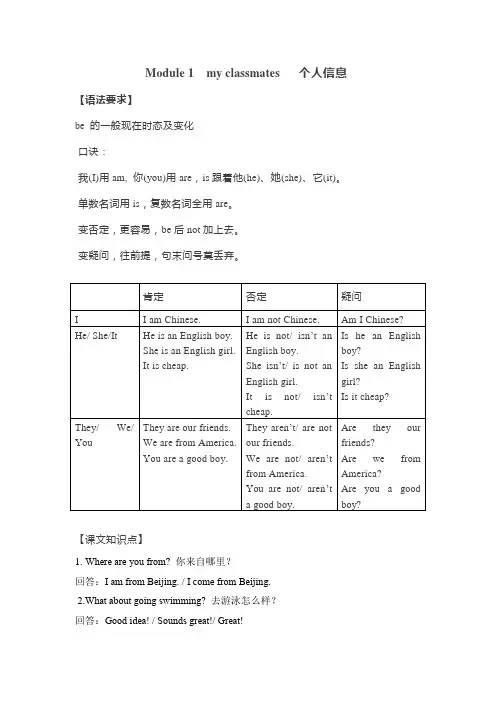
【语法要求】
be 的一般现在时态及变化
口诀:
我(I)用am, 你(you)用are,is跟着他(he)、她(she)、它(it)。
单数名词用is,复数名词全用are。
变否定,更容易,be后not加上去。
变疑问,往前提,句末问号莫丢弃。
肯定 否定 疑问
I I am Chinese. I am not Chinese. Am I Chinese?
He/ She/It He is an English boy.
She is an English girl.
It is cheap. He is not/ isn’t an
English boy.
She isn’t/ is not an
English girl.
It is not/ isn’t
cheap. Is he an English
boy?
Is she an English
girl?
Is it cheap?
They/ We/
You They are our friends.
We are from America.
You are a good boy. They aren’t/ are not
our friends.
We are not/ aren’t
from America.
You are not/ aren’t
a good boy. Are they our
friends?
Are we from
America?
Are you a good
boy?
【课文知识点】
1. Where are you from? 你来自哪里?
回答:I am from Beijing. / I come from Beijing.
2.What about going swimming? 去游泳怎么样?
回答:Good idea! / Sounds great!/ Great! 用法:what about= How about, about 是介词,后接动词ing.
外研版七年级上册英语全册知识点归纳
外研版七年级上册英语全册知识点归纳
1 / 231 实用文档
外研版七年级上册英语全册知识点归纳
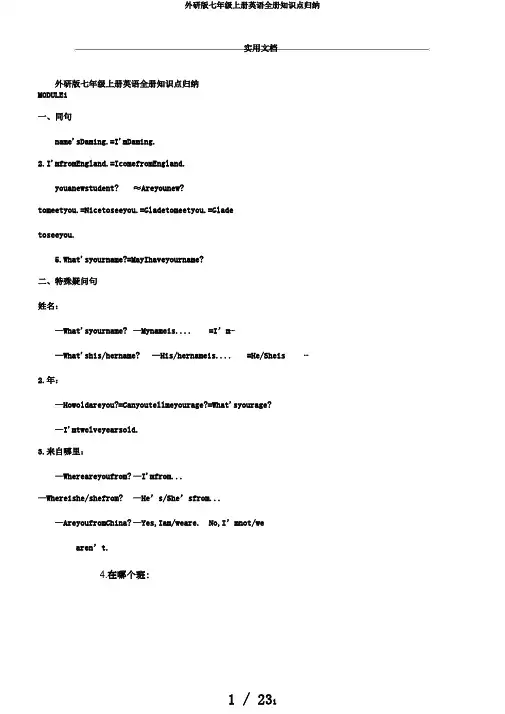
MODULE1
一、同句
name'sDaming.=I'mDaming.
2.I'mfromEngland.=IcomefromEngland.
youanewstudent? ≈Areyounew?
tomeetyou.=Nicetoseeyou.=Gladetomeetyou.=Glade
toseeyou.
5.What'syourname?=MayIhaveyourname?
二、特殊疑问句
姓名:
—What'syourname? —Mynameis.... =I’m⋯
—What'shis/hername? —His/hernameis.... =He/Sheis ⋯
2.年:
—Howoldareyou?=Canyoutellmeyourage?=What'syourage?
—I'mtwelveyearsold.
3.来自哪里:
—Whereareyoufrom? —I'mfrom...
—Whereishe/shefrom? —He’s/She’sfrom...
—AreyoufromChina? —Yes,Iam/weare. No,I’mnot/we
aren’t.
4.在哪个班: 外研版七年级上册英语全册知识点归纳
2 / 232 实用文档
—Whatclassareyouin?—I'minClassOne,GradeSeven. 三、单词
— Chinese America —American England — English
capital city
—big first—last everyone all 四、语法
1.代词
人称代主格 I you he she it we you
they
形容词性物主代词 〔⋯的〕 my your his her its our your
外研版七年级上英语重点语法
实用文案
标准文档 Starter Module 1 My teacher and my friends
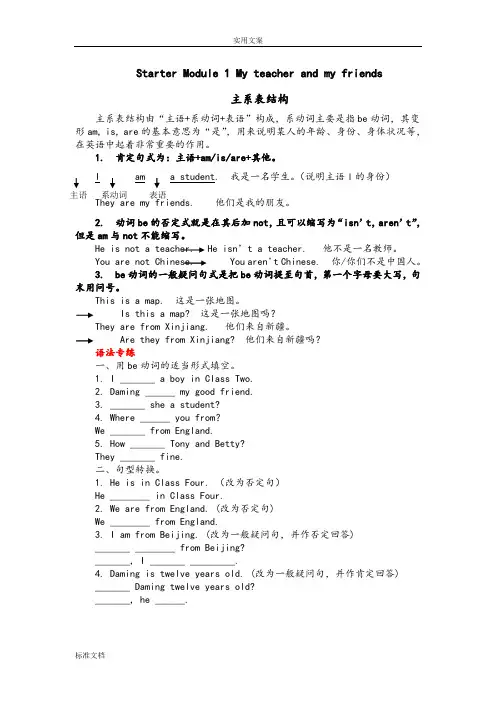
主系表结构
主系表结构由“主语+系动词+表语”构成,系动词主要是指be动词,其变形am, is, are的基本意思为“是”,用来说明某人的年龄、身份、身体状况等,在英语中起着非常重要的作用。
1. 肯定句式为:主语+am/is/are+其他。
I am a student.
我是一名学生。(说明主语I的身份)
They are my friends. 他们是我的朋友。
2. 动词be的否定式就是在其后加not,且可以缩写为“isn’t,aren’t”,但是am与not不能缩写。
He is not a teacher. He isn’t a teacher. 他不是一名教师。
You are not Chinese. You aren’t Chinese. 你/你们不是中国人。
3. be动词的一般疑问句式是把be动词提至句首,第一个字母要大写,句末用问号。
This is a map. 这是一张地图。
Is this a map? 这是一张地图吗?
They are from Xinjiang. 他们来自新疆。
Are they from Xinjiang? 他们来自新疆吗?
语法专练
一、用be动词的适当形式填空。
1. I _______ a boy in Class Two.
2. Daming ______ my good friend.
3. _______ she a student?
4. Where ______ you from?
We _______ from England.
5. How _______ Tony and Betty?
They _______ fine.
二、句型转换。
1. He is in Class Four. (改为否定句)
外研版英语七年级(上册)语法总结

完美WORD格式编辑
学习指导参考资料 M1语法
1】Where are you from? 你来自哪里?
回答:I am from Beijing. / I come from Beijing.
2】What about going swimming? 去游泳怎么样?
回答: Good idea! / Sounds great!/ Great!
用法:what about= How about, about 是介词, 后接动词ing.
例: What about __listening__ (listen)to music?
3】Everyone is here. 每个人都在这里。
Everyone :每个人,是单数, 谓语动词用第三人称单数形式。
例如:Everyone __likes__(like) music.
4】and/but 的用法
and: 和,表示并列或顺承关系。
but: 但是,表示转折关系。
例如:He is from China, __but_ he isn’t Chinese.
5】It’s nice to meet you all. 很高兴见到你们。
句型: It’s + 形容词+ to do sth.
例如: It’s difficult _to learn__ (learn)English.
6】My name is Tony Smith.
My first name is ___Tony______.
my last name is___Smith______.
7】Be 的用法
1. Be 包括 is,am, are.
2. Be 搭配口诀: I 用am, you 用are, is 用于he, she, it. 单数和不可数名词用is,复数全用are.
初中英语新外研版七年级上册Unit 2 More than fun语法讲解
七年级英语上册
Unit 2语法讲解
一、语法
* there be句型
“There is/ are + 某物/某时”结构表示“某地或某时存在某物或某人”。这种结构中的there没有实际意义,There is 后面加可数名词单数或不可数名词, There are后面加可数名词复数。
注意:
1.切记there be句型有临近原则,即be动词同离其近的主语保持一致。
2.因句中有be动词,故变否定句式在is/are后加not;变一般疑问句时将is/are提前
3.Is/Are there 开头的一般疑问句其肯定回答为Yes, there is/are.否定回答为No, there
isn’t/aren’t.
4.就数量提问时常用“how many + 可数名词复数”或“How much + 不可数名词”开头
5.there be句型过去式形式只需将is变为was;are变为were即可。
Eg: There is a pen on the desk.
“桌子上有一支钢笔。”
There is some water in the bottle.
“瓶子里面有一些水。”
There are some books in the bag.
“包里面有一些书。”
There is a book and some pencils on the desk.
“桌子上有一本书和一些铅笔。”
There are some pencils and a book on the desk.
“桌子上有一些铅笔和一本书。”
There isn’t a book and any pencils on the desk.
“桌子上没有一本书和一些铅笔。”
Is there a book and any pencils on the desk?
“桌子上有一本书和一些铅笔吗?”
Yes, there is./ No, there isn’t.
外研版七年级上册英语全册知识点归纳 2
外研版七年级上册英语全册学问点归纳
MODULE 1
一、同义句
1.My name's Daming. = I'm Daming.
2.I'm from England. = I come from England.
3.Are you a new student ≈ Are you new
4.Nice to meet you. = Nice to see you. =Glade to meet you. = Glade to see you.
5.What's your name = May I have your name
二、特别疑问句
1. 询问姓名:
—What's your name —My name is .... = I’m…
—What's his/her name —His/her name is .... = He/She is…
2.询问年龄:
—How old are you = Can you tell me your age= What's your age
—I'm twelve years old.
3.询问来自哪里:
—Where are you from —I'm from...
—Where is he/she from —He’s/She’s from...
—Are you from China —Yes, I am/ we are. No, I’m not/ we aren’t.
4.询问在哪个班:
—What class are you in —I'm in Class One, Grade Seven.
三、单词
1.China — Chinese America —American England — English capital
city
2.small — big first— last everyone all
外研版英语七年级上册语法总结
M1语法
1Where are you from 你来自哪里
回答:I am from Beijing. / I come from Beijing.
2What about going swimming 去游泳怎么样
回答: Good idea / Sounds great/ Great
用法:what about= How about, about 是介词, 后接动词ing.
例: What about __listening__ listento music
3Everyone is here. 每个人都在这里.
Everyone :每个人,是单数, 谓语动词用第三人称单数形式.
例如:Everyone __likes__like music.
4and/but 的用法
and: 和,表示并列或顺承关系.
but: 但是,表示转折关系.
例如:He is from China, __but_ he isn’t Chinese.
5It’s nice to meet you all. 很高兴见到你们.
句型: It’s + 形容词+ to do sth.
例如: It’s difficult _to learn__ learnEnglish.
6My name is Tony Smith.
My first name is ___Tony______. my last name is___Smith______.
7Be 的用法
1. Be 包括 is,am, are.
2. Be 搭配口诀: I 用am, you 用are, is 用于he, she, it. 单数和不可数名词用is,复数全用are.
3. Be 的肯定变否定,be + not
4. Be 的缩写:
I am = I’m ; you are = you’re
he is = he’s ; she is =she’s ; it is =it’s; what is =what’s
(外研版)初中英语语法汇总版
资料收集于网络,如有侵权 请联系网站删除
只供学习与交流
初中英语语法总结 (七至九年级 外研版)
1 agree with sb 赞成某人
2 visit to… 参观某个地方
3 a piece of cake =easy 小菜一碟(容易)
4 (see 、hear 、notice 、find 、feel 、listen to 、 look at (感官动词)+do eg:I like
watching monkeys jump
5 all kinds of 各种各样 a kind of 一样 6 all over the world = the whole world 整个 世界
7 along with同……一道,伴随…… eg : I will go along with you我将和你一起去
the students planted trees along with their teachers 学生同老师们一起种树
8 As soon as 一怎么样就怎么样
9 as you can see 你是知道的
10 ask for ……求助 向…要…(直接接想要的东西) eg : ask you for my book
11 ask sb for sth 向某人什么
12 ask sb to do sth 询问某人某事 ask sb not to do 叫某人不要做某事
13 at the age of 在……岁时 eg:I am sixteen I am at the age of sixteen
14 at the beginning of …… ……的起初;……的开始
15 at the end of +地点/+时间 最后;尽头;末尾 eg : At the end of the day
16 at this time of year 在每年的这个时候
新外研版英语七年级下册语法总结
新外研版英语七年级下册语法总结
名词(Noun)
名词用于指称人、事物、地点、动作或感受等。常见的名词有单数和复数形式。
单数名词(Singular Nouns)
单数名词通常表示一个人或物。
例子:
- dog(狗)
- book(书)
- girl(女孩)
复数名词(Plural Nouns)
复数名词表示多个人或物。
例子:
- dogs(狗)
- books(书)
- girls(女孩)
形容词(Adjective)
形容词用于描述名词的性质或状态。
基本形容词(Basic Adjectives)
基本形容词通常在名词前面使用。
例子:
- big(大的)
- happy(开心的)
- blue(蓝色的)
比较级用于表示比较两个事物的性质,通常在形容词前加上"more"。
例子:
- more beautiful(更漂亮的)
- more interesting(更有趣的)
- more intelligent(更聪明的)
最高级(Superlative Form)
最高级用于表示三个以上事物的性质中最高的,通常在形容词前加上"the most"。
例子:
- the most beautiful(最漂亮的)
- the most interesting(最有趣的)
- the most intelligent(最聪明的)
动词(Verb)
动词用于表示行为或状态。
一般现在时(Simple Present Tense)
一般现在时表示现在经常或总是发生的动作。
例子:
- I eat breakfast every day.(我每天吃早餐。)
- She plays soccer on weekends.(她周末踢足球。)
一般过去时(Simple Past Tense)
一般过去时表示过去发生的动作或状态。
例子:
- I watched a movie last night.(昨晚我看了电影。)