
人教版八年级英语上册Unit 1 完全教案
Unit 1 How often do you exercise?Teaching aims of this unit:Knowledge Objects:1.Vocabulary:always usually often sometimes hardly ever never ,once a day ,twice a week ,three times a month, my eating habits ,healthy /unhealthy lifestyle , keep in good health, junk food ,eat less meat, the same as, be different from ,the difference between…and…, of course ,look after, be good /bad for, sleep nine hours every night all /most /some /no students ,maybe, although exercise =do/play sports2.Target Language:What do you usually do on weekends? I often watch TV on weekends.How often do you watch TV? I watch TV twice a week..How long do you sleep every night? I sleep nine hours every night.What are the differences?Language Objects : Talk about how often you do thingsAims of abilities:Talk about how often you do thingsAims of emotion: Get the messages from the others successfully.课时安排5课时Period One: Section A (1a—2c)Period Two: Section A (3—4)Period Three: Section B (1a—2c)Period Four:Section B (3a—4)Period Five: Self check and Revision (A-self check)Period OneTeaching Procedures:Step 1 Greeting. 前提测评1. Teacher: Summer vacation is over. I think you had a wonderful vacation, am I right? Did you enjoy your summer vacation? Could you please tell us what you did in your summer vacation?2. Encourage students to share their holidays with the whole class.Step 2展示目标Step 3 导学达标1.Leading – inTeacher: Oh, you had a happy and colorful vacation. Today we will talk about more activities on weekends. First, let’s think about what we can do on weekends. (Ask some questions and let students think it over).Teacher: I often sing on weekends, what do you usually do on weekends?S1: I often take piano lessons.(Ask more students in the same way)2. 1a Look at the screen. Make a list of the different weekend activities.First let students list different activities, thenTeacher: Now work in pairs, ask and answer---What does he/she do on weekends?--- She goes shopping. / She reads books. / He exercises. / He watches TV. / She goes skateboarding.3. 1b Listen and write the letters from the picture above on the lines below.Get students to focus on the six adverbs in activity 1b and help students to understand: Always-100% usually- 90% often-80% sometimes-50% hardly ever-10% never-0%4. Listening (2a and 2b)Teacher: My friend Cheng is talking about something about his different activities, let’s listen and number the activities you hear.Teacher: Listen again. How often does Cheng do the activities above?(Help students to finish 2a and 2b)Step4 Do a survey:达标测评Ask and answer: How often do you take a shower?How often does he / she take a shower?Let Ss ask and answer in pairs, using always, usually, often, sometimes, hardly ever or never. Step5 Homework 作业布置1. Do exercises on pages 1-2 of the workbook to practice the language presented in this unit.2. Remember what we learn today.3. Write a passage about what you often do on weekends and how often you do different activities.Blackboard design:教学反思:Period TwoTeaching Procedures:Step 1 Greeting.前提测评Step 2 展示目标Step 3 导学达标1.Lead – in2. Groupwork: Who’s the best English student?1. T: Just now we talked about what you could do to improve your English? (eg. read English books, practice reading and speaking ) and How often do you ··· ?Now please think of more things you can do to improve your English and write them down in the chart on page 3.T: Now let’s see who is the best English students in the class .3. Lead-in:Teacher: Just now we talked about different activities about learning English. From the chartwe know you can do many activities to improve your English. You did a good job. Now let’s look at another chart of the student activity survey at Green High School.(Help students to say: 15% of the students exercise every day. 10% of the students exercise once or twice a week. 75% of the students exercise three or four times a week… Then present the following)All students=100% ;Most students=51%-99% ;Some students=1%-50% ;No students=0%4. Reading1.Get students to read the magazine article on Page 3 and finish the passage, then check the answer.2.Answer the questions about the survey:1)What do the students of Green High School usually do at school?2)Do they all exercise once or twice a week?3)How many students watch TV every day?4)What do fifteen percent of Green High School students do every day?5)Do the students of Green High School do the same activities as you? Yes or no?Can you say something about the activities that the students of your school do?5. ExplanationStep4 Exercise:达标测评Ⅰ用所给词的适当形式填空:1.Li Lei likes going ______(skateboard) on Sundays.2.How often _____ he ____ (do) his homework?3.He watches TV ____ (two) a week.4.Zhang Jian speaks English very well, so he is very ____ (activity) in English class.Ⅱ单项选择1.“____ do you visit your uncle?” “ Three times a month.”A. HowB. How longC. How oftenD. How soon2. As ____ my homework, I do it every day.A. about b. for C. of D. on3. Meimei listens to music ____.A. sometimeB. sometimesC. some timesD. some time4. My brother ____ like singing ____ dancing.A. don’t , andB. doesn’t , andC. doesn’t , orD. don’t, or5. Jack hardly ever exercises, so he is kind of ____.A. healthyB. unhealthyC. healthD. unhealthy6. How often does she ____?A. watching TVB. surfs the InternetC. go to the moviesD. exercises7. There are few ____ in the fridge. Let’s go and buy some peas, carrots and cabbages.A. vegetablesB. fruitC. meatD. eggs8. Most students exercise ____ a week.A. once or twiceB. one time or two timesC. one time or twiceD. once or two times9. --- ____ do you go to Qingdao?--- Only once.A. How oftenB. How longC. How many timesD. How far10. “60% of students like reading English.” means “____ students likes reading English.”A. AllB. MostC. SomeD. NoStep 5 Homework:作业布置1. Revise the new words.2. Preview Section B.3. Write a short passage to describe the best English student in your class, telling what he/shedoes to improve English and how often he/she does these things.Blackboard design:教学反思:Period ThreeTeaching Procedures:Step 1 Greeting.前提测评Step 2 展示目标Step 3 导学达标1.Lead-in1. T: I had eggs for breakfast this morning, and I have eggs for breakfast every day. Because they’re good for my health. And they’re nutritious. What about you? What do you have for breakfast?S1: I have milk for breakfast.T: How often do you drink milk?S1: I drink milk every day.T: Do you like it ?S1: Yes, I do. / No, I don’t.T: Why do you like it? S1: Because it’s good for my health/ it tastes delicious.T: You don’t like it, but you drink it every day, why?S1: Because my mum wants me to drink it. She says it’s good for my health.2. T: What about you , what do you have for breakfast?S2: I have instant noodles for breakfast .T: How often do you eat instant noodles?S2: I eat instant noodles three or four times a week.T: Do you like them?S2: Yes, I like them very much.T: (Let students compare them and tell who is healthier)Who is healthier, S1 or S2?Yes, S1 is healthier. Because milk is good for our health. And instant noodles are not healthy, they are bad for our health. They are junk food.T: I know most young people like eating junk food. But I think you’d better not eat too much junk food, because they’re bad for our health.Let’s look at the screen and find out which ones are healthy and which ones are unhealthy?•---Is/Are…hea lthy? ---Yes, it is. / They are. No, it’s /they’re unhealthy.•---Why? ---Because it’s /they’re good/bad for health.2. Pairwork (1a 1b).T: Now work in pairs, talk about how often you eat the food in the pictures.A: How often do you …?B: I …every day/ twice a day/ three times a day/ four times a week..A: Do you like it/ them?B: Yes, I do. / No, I don’t. But my mom wants me to drink. She says it’s/they’re good for my health.3. Listening ( 2a 2b)1. T: What does healthy mean? If I eat a lot of junk food but never exercise, am I healthy? Ss: No.T: If I eat lots of fruit and vegetables and drink milk every day, am I healthy?Ss: Yes.T: Now, we will hear a reporter interviewing two people, Bill and Katrina. Listen and decide if Bill and Katrina are healthy. Circle your answer to each question.2. T: What are Bill and Katrina’s answers to these questions? Listen again and write down the correct adverbs of frequency.4. Groupwork (2c)Role play. Student A is the interviewer. Student B is Katrina. Student C is Bill. Try to act the conversation out .They can use their own words.Step4 达标测评Step5 Homework :作业布置1.Finish the exercise in this period.ing the information in 2a &2b, write a report about Bill’s and Katrina’s eating habits. Blackboard design:教学反思:Period Four:Teaching Procedures:Step1 Revision前提测评1. Free talk:2. Ask and answerHow often do you exercise? How often do you eat vegetables/fruit/junk food?How often do you drink milk/coffee/tea? How many hours do you sleep every day?(Use he/she/they ask and answer these questions. )Group worksStep 2 展示目标Step 3 达标测评1.Presentation and reading (3a)T: Last period we learned Section B 2a and knew Bill and Katrina’s lifestyles ,do you remember? Are they healthy?Ss: Yes, Katrina is healthy while Bill isn’t healthy.T: Good. Now Katrina writes a letter about her lifestyle to her pen pal , let’s listen to a part of her letter and answer some questions:1. How often does she exercise?2. How often does she drink milk?3. Does she eat junk food very often?4. Do you think she has a healthy lifestyle? Why or why not?5. Is her lifestyle the same as yours or different? What are the differences?2. Fill in the blanks (3b)T: We know Bill is kind of unhealthy. And he also writes a letter .Let’s fill in the blanks in Bill’s letter.(After Ss have finished, check it)3.Writing (3b)T: Are you healthy or unhealthy? Now, it’s your turn to write about your own habits.4. SurveyStep 4 Exercise:达标测评ⅰ.用所给词的适当形式填空:1.We need ________ (health) food.2.Who is the ________ (interview)?3.He does his homework ________ (well) than me.4.What are the __________ (different) between Lucy and Lily?ⅱ单项选择:1. He ____ at school .A. may beB. maybeC. may isD. may2. “How long did you sleep last night?”“______.”A. Twice a nightB. For nine hoursC. Two timesD. Once or twice3. If you want to be healthier, you must eat ____ meat and do ____ exercise.A. less, moreB. fewer, muchC. less, muchD. many, more4. She says it’s good ____ my _____.A. for, healthB. for, healthyC. at, healthD. at, healthy5. ____ he is ill, ____ he goes to school.A. Although, butB. /, /C. Although, /D. But, althoughStep 5 Homework:作业布置How healthy are you? Write a passage about your own eating habit.Blackboard design:教学反思:Period Five: Self check and RevisionStep1 Greetings & free talk 达标测评Step2 展示目标Step3 达标测评1.Self checkFill in each blank with the correct word given.Then make your own sentence with each word.1. wants2.exercises3.help4.try5.have2. Key phrases:1. how often 多久一次2. as for至于,关于3. junk food垃圾食品4.eating habit 饮食习惯5.of course当然6.look after 照顾,照看7. start with 以……开始8. make a difference使得结果不同,有重要性9. go shopping去购物10.have a party 聚会11. go to the movie去看电影12. once a week每周一次13. hardly ever很少14. twice a week每周两次15. three times a week每周三次16.keep in good health保持身体健康17.on weekend在周末18. help sb (to) do sth.帮助某人做某事19. a lot of许多20. try to do尽力做某事21. the same as和……相同3. Grammar1.掌握句型:2. Presentation and drill3. all, most , some和none的用法。
人教版八上unit1教案过程与方法

人教版八上unit1教案过程与方法教案标题:人教版八上Unit 1教案过程与方法教学目标:1. 了解并掌握有关学校生活的词汇和表达方式。
2. 能够运用所学词汇和表达方式描述自己的学校生活。
3. 培养学生的听说能力和团队合作意识。
教学重点:1. 学习并掌握有关学校生活的词汇和表达方式。
2. 运用所学词汇和表达方式描述自己的学校生活。
教学难点:1. 运用所学词汇和表达方式描述自己的学校生活。
2. 培养学生的听说能力和团队合作意识。
教学准备:1. 教材:人教版八年级上册Unit 1《Where did you go on vacation?》2. 多媒体设备:投影仪、电脑等3. 教学素材:图片、视频等教学过程:Step 1:导入新课(5分钟)1. 引入话题:通过展示一些学校生活的图片或视频,激发学生对学校生活的兴趣。
2. 提问学生:你们喜欢学校生活吗?你们最喜欢的学校活动是什么?Step 2:词汇学习(15分钟)1. 教师通过多媒体展示学校生活相关的词汇,并帮助学生正确发音和理解词义。
2. 教师与学生一起进行词汇操练,如单词拼写、词义解释等。
Step 3:听说训练(20分钟)1. 教师播放一段关于学校生活的录音,要求学生仔细听,然后回答相关问题。
2. 学生分组进行口语练习,描述自己的学校生活,可以结合所学词汇和表达方式。
Step 4:小组合作活动(15分钟)1. 将学生分成小组,每个小组选择一个学校活动进行介绍。
2. 学生在小组内讨论并准备介绍内容,包括活动的时间、地点、参与人数等。
3. 每个小组派代表进行介绍,其他小组成员可以提问或进行评价。
Step 5:巩固与拓展(10分钟)1. 教师与学生一起进行课堂总结,复习所学内容,并对学生的表现给予肯定和鼓励。
2. 提供一些拓展阅读材料,让学生进一步了解其他学校的生活方式。
Step 6:作业布置(5分钟)1. 布置课后作业:要求学生写一篇短文,介绍自己最喜欢的学校活动,并运用所学词汇和表达方式。
人教版英语八年级上册 Unit 1 全单元教案
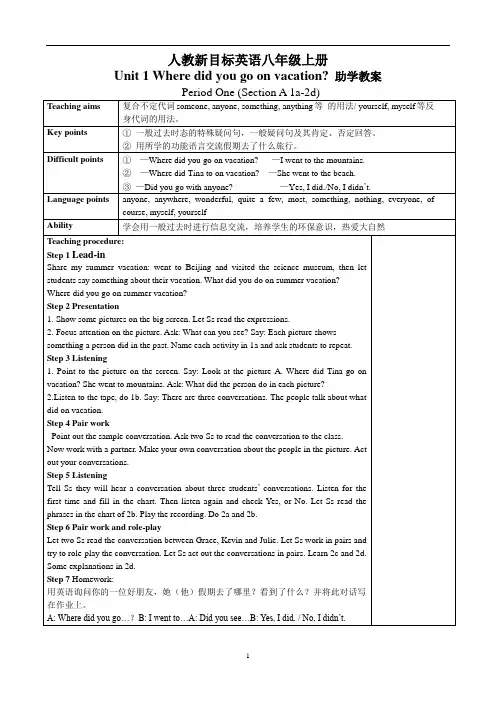
Step5Listening
Tell Ss they will hear a conversation about three students’conversations. Listen for the first time and fill in the chart. Then listenagainandcheck Yes, or No.Let Ss readthe phrases in the chart of 2b.Play the recording. Do2aand 2b.
③—Did you go with anyone?—Yes, I did./No, I didn’t.
Language points
anyone, anywhere, wonderful, quite a few, most,something, nothing, everyone, of course, myself, yourself
Key points
①一般过去时态的特殊疑问句,一般疑问句及其肯定、否定回答。
②用所学的功能语言交流假期去了什么旅行。
Difficult points
①—Where did you go on vacation?—I went to the mountains.
②—Where did Tina to on vacation?—She went to the beach.
2)阅读填空能力的提高。
Language points
英语 人教版 八年级上册(电子教案)Unit 1

一、单元学习主题
本单元的主题属于“人与自我”范畴,涉及子主题“个人、家庭、社区和学校生活”。
二、单元内容分析
本单元分为Section A与Section B两部分,主要围绕话题“Holidays and vacations”展开听、说、读、写、看等语言活动。
本单元共有两个主要语篇,第一个语篇是对话的形式,讲述了Rick询问好朋友Helen的假期情况;第二个语篇是两篇日记,由Jane自述在马来西亚度假的经历。
两个语篇不仅为我们传递了不同的语言知识和语篇知识,还传递了“学会和别人分享自己的经历与快乐”的育人价值。
单元主题内容结构框架见下图:。
Unit1教案人教版八年级英语上册
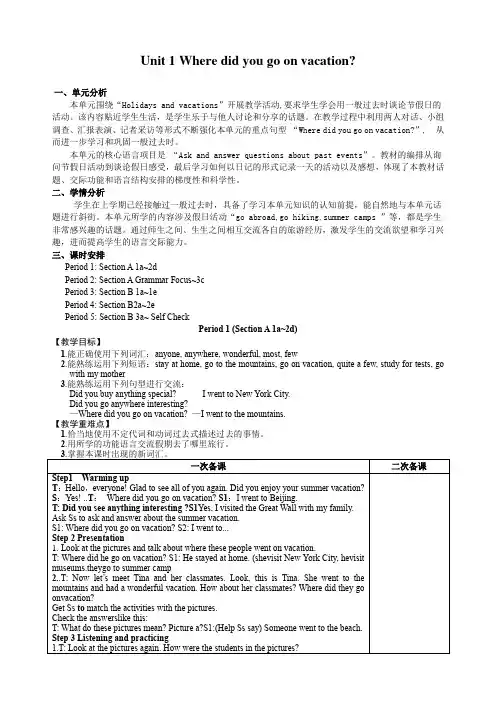
Unit 1 Where did you go on vacation?一、单元分析本单元围绕“Holidays and vacations”开展教学活动,要求学生学会用一般过去时谈论节假日的活动。
该内容贴近学生生活,是学生乐于与他人讨论和分享的话题。
在教学过程中利用两人对话、小组调查、汇报表演、记者采访等形式不断强化本单元的重点句型“Where did you go on vacation?”, 从而进一步学习和巩固一般过去时。
本单元的核心语言项目是“Ask and answer questions about past events”。
教材的编排从询问节假日活动到谈论假日感受,最后学习如何以日记的形式记录一天的活动以及感想,体现了本教材话题、交际功能和语言结构安排的梯度性和科学性。
二、学情分析学生在上学期已经接触过一般过去时,具备了学习本单元知识的认知前提,能自然地与本单元话题进行斜街。
本单元所学的内容涉及假日活动“go abroad,go hiking,summer camps ”等,都是学生非常感兴趣的话题。
通过师生之间、生生之间相互交流各自的旅游经历,激发学生的交流欲望和学习兴趣,进而提高学生的语言交际能力。
三、课时安排Period 1: Section A 1a~2dPeriod 2: Section A Grammar Focus~3cPeriod 3: Section B 1a~1ePeriod 4: Section B2a~2ePeriod 5: Section B 3a~ Self CheckPeriod 1 (Section A 1a~2d)【教学目标】1.能正确使用下列词汇:anyone, anywhere, wonderful, most, few2.能熟练运用下列短语:stay at home, go to the mountains, go on vacation, quite a few, study for tests, gowith my mother3.能熟练运用下列句型进行交流:Did you buy anything special? I went to New York City.Did you go anywhere interesting?—Where did you go on vacation? —I went to the mountains.【教学重难点】1.恰当地使用不定代词和动词过去式描述过去的事情。
(完整)人教版八年级上册Unit1教学设计
Work in pairs.
Step 8
Survey and report
1.Ask some classmates about their vacation1.Say,“Now, get into groups .Ask each other about the vacations. Talk about“Where did he\she go?”and more information
Where did he\she go on vacation?
Check the answers.
ANSWERS:
(1) went to the mountains
(2) went to New York City
(3)stayed at home
(4) visited my uncle
(5) went to summer camp
多媒体呈现所需图片
Step 4
Learn keyexpressions and play game
1.learn in pairs.
2.Play a game.
Read and memorize.
Students raise their hands to answer.
多媒体呈现游戏
Step 5
Practice
① —Where did you go on vacation? —I went to the mountains.
② —Where did Tina go on vacation? —She went to the beach.
过程
与
方法
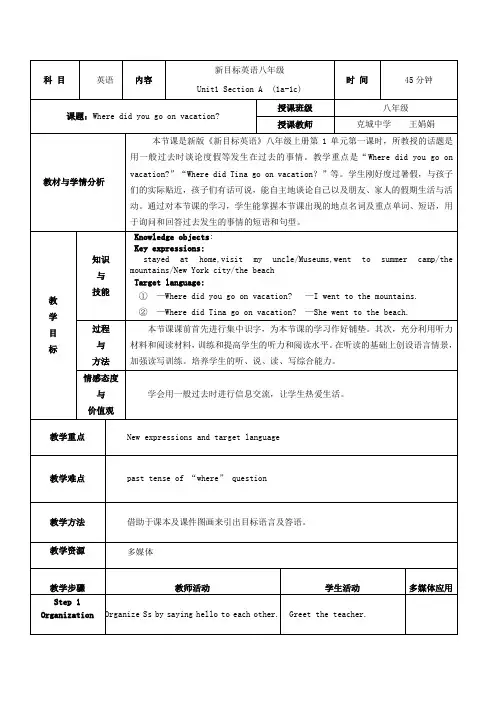
本节课课前首先进行集中识字,为本节课的学习作好铺垫。其次,充分利用听力材料和阅读材料,训练和提高学生的听力和阅读水平。在听读的基础上创设语言情景,加强读写训练。培养学生的听、说、读、写综合能力。
人教版八年级英语上册Unit1 教案

人教版八年级英语上册Unit1 教案人教版八年级英语上册Unit1 教案【教案一】Section A(1a - 1c)◆学习目标1.重点短语: stay at home,go to the mountains,go to summer camp2.重点句式:—Where did Tina go on vacation ?—She went to the mountains.◆学习重点1.重点短语和句型2.一般过去时态的特殊疑问句和陈述句◆学习难点一般过去时态的特殊疑问句和陈述句◆自主学习一、认真预习1a—1c,找出下列短语和句型。
1.待在家里 ____________________2.去山区 ____________________3.去夏令营 ____________________4.去纽约城 ____________________5.—蒂娜去哪里度假了?___________________________________________________________ _____—她去山区了。
___________________________________________________________ _____________◆课堂导学Step 1情景导入Teacher:Hello,everyone.Glad to see you again.Did you have a good time during the vacation? Did you go anywhere interesting with your parents? Did you do anything special there? Can you tell us where you went on vacation ?环节说明:以学生假期旅行为话题开始本节课的教学,引起了学生的学习兴趣和用英语表达的欲望。
【人教版】新目标八年级英语上册:Unit 1 单元教学设计
【人教版】新目标八年级英语上册:Unit 1 单元教学设计一. 教材分析人教版新目标八年级英语上册Unit 1主要围绕“How do you get to school?”这一主题展开,通过引入不同交通工具的图片和情景对话,让学生掌握一般现在时的表达方式,以及询问和回答他人如何去学校的句子结构。
教材通过丰富的语言材料,旨在培养学生的听说读写技能,提高他们的语言运用能力。
二. 学情分析八年级的学生已经掌握了基本的英语语法和词汇,具备一定的听说读写能力。
他们在学习过程中需要更多的实际语境和实践机会来提高语言运用能力。
此外,学生对于新事物的接受能力较强,但部分学生可能对英语学习缺乏兴趣,需要教师通过有趣的教学活动来激发他们的学习热情。
三. 教学目标1.知识目标:学生能够掌握一般现在时的表达方式,学会用英语询问和回答他人如何去学校。
2.能力目标:学生能够在实际情境中运用所学知识进行交流,提高听说读写技能。
3.情感目标:培养学生热爱生活,关注环保的价值观。
四. 教学重难点1.重点:一般现在时的表达方式,以及询问和回答他人如何去学校的句子结构。
2.难点:如何运用所学知识进行实际交流,提高语言运用能力。
五. 教学方法采用任务型教学法,通过引入真实情境,让学生在实际交流中掌握知识点。
同时运用分组合作、角色扮演等教学手段,激发学生的学习兴趣,提高他们的参与度。
六. 教学准备1.教材:人教版新目标八年级英语上册。
2.教具:多媒体设备、图片、卡片等。
3.教学资源:网络资源、相关视频等。
七. 教学过程1.导入(5分钟)利用多媒体展示不同交通工具的图片,引导学生谈论自己如何去学校。
教师通过提问学生,激发他们的学习兴趣。
2.呈现(10分钟)教师通过展示教材中的情景对话,让学生听懂并理解对话内容。
随后,引导学生跟读对话,纠正发音。
3.操练(10分钟)将学生分成小组,让他们模拟对话情景,进行角色扮演。
教师巡回指导,纠正错误,并给予鼓励。
(完整版)人教版八年级英语上册-Unit1-教案.docx
人教版义务教育教科书◎英语八年级上册Unit 1 Where did you go on vacation?教材解读本单元的核心话题是用一般过去时谈论度假等发生在过去的事情。
因此“ Where did you go on vacation? ”“ Did you go to the beach?Yes, I did / No , I didn ’t.”等是教学的重点。
通过对本单元的学习,学生能掌握本单元出现的地点名词,用于询问和回答过去发生的事情的短语和句型。
单元目标一、知识与技能1. 词汇: New York City, Central Park, exam, were, rainy, delicious , expensive, inexpensive, crowded, flew, kite, later, felt, little, corner, discuss, etc.2.句型 : Where did you go on vacation? I went to summer camp . Did she go to Central Park? Yes, she did. No, she didn . ’t3.语法:一般过去时的特殊疑问句、一般疑问句及肯、否定回答。
4.能力目标:能用一般过去时熟练谈论假期发生的事。
二、过程与方法灵活运用教材,从所教学生的实际水平和语言能力出发,调整和取舍教学内容,合理安排本单元的课时数,设计好每课时的教学内容。
三、情感、态度与价值观1.通过描述假期发生的事,增进同学间的了解,增进感情。
2.通过图片和视频欣赏优美的风景,培养热爱祖国大好河山的思想感情,提高学生的环保意识。
3.了解自己的能力,培养情操4.培养学生们对英语的兴趣。
教法导航1.以任务型教学作为课堂教学理念、利用整体语言教学法、情景教学法、交际教学法等。
2.在教学中创设切实可行的任务型教学活动、突出交际性。
初中英语人教版八年级上册Unit1教学设计
UNIT 1 Where did you go on vacation?一.教学目标1.知识与技能1)掌握一些描述活动与事物的单词如fantastic,unfriendly, delicious, awful等;2)进一步掌握一些关于过去活动的特殊疑问句和一般疑问句以及简单描述语言的对话。
2.过程与方法本节课侧重知识性和趣味性的统一,知识学习力求系统化,注重学习过程评价。
利用pair work、group work、interview等任务型教学活动,集中学生的注意力,引导学生积极思考,发展想象能力,提高英语交际能力和运用能力.3.情感、态度与价值观本课注重培养学生良好的英语语感,通过与朋友谈论假期方式,培养同学间团结、友善的精神,以及增进学生对国内外风景名胜的认识,热爱大自然,形成积极向上的生活观。
二.教学重、难点分析1.教学重点:1)be动词过去式的运用。
2)一般过去时态中含有be动词和实义动词的一般疑问句的区别。
3)熟练会话Where did you go? How was ...等。
学会用unfriendly, fantastic, delicious, awful等描述过去的事物。
2.教学难点:1)一般过去时态中含有be动词和实义动词的一般疑问句的区别。
三.教学准备:PPT. video.调查表格四.教学过程:Step1 Greeting and revision (4)1.Sing “vacation song”.2.Review some phrases by talking about vacations.Step2 New drill (8)1.Present a new drill: Did+主语+动词原形+其他?——Yes, I did./ No, I didn’t.2.Play a guessing game by using “Did you/he/she…?”Step3 New words (15)1. Talk about Xiaofen’s vacation and learn some new words2. Ask students to ask Xiaofen more questions about vacation.3.Grammar:(1) was和were的使用(2)含有be动词和实义动词的一般过去时的一般疑问句的区别4. Do some exercise.Step4 Make a conversation about vacation (5)1.See a video2.Make a conversation about vacation. (How was/ were…)Step5 listening comprehension (Yang Mi’s vacation) (5)1.listen to the tape twice then check the answersStep6Do a survey (5)1. Do a survey: Ask two people about their vacation and write it down on the paper.2. Make a report according the surveyStep7 sum up (2)Step8 homework (1)Write about your vacation in your exercise book.。
八年级英语上册-人教版-Unit 1 教案
八年级英语上册-人教版-Unit 1 教案一. 教材分析本单元的主题是“My school”,主要介绍学校的基本情况和学校生活。
通过本单元的学习,学生能够掌握有关学校的基本词汇,如classroom, teacher, student等,同时能够运用这些词汇进行简单的英语交流。
二. 学情分析八年级的学生已经掌握了基本的英语语法和一定量的词汇,对英语学习有了一定的兴趣和基础。
但部分学生在英语学习中还存在一定的困难,如口语表达能力和听力理解能力。
因此,在教学过程中,需要关注学生的个体差异,因材施教。
三. 教学目标1.知识目标:学生能够掌握有关学校的基本词汇和句型,如“This is myclassroom. This is my teacher.”等。
2.能力目标:学生能够用英语简单介绍自己的学校和生活,提高口语表达能力和听力理解能力。
3.情感目标:培养学生对学校生活的热爱和珍惜,激发学生学习英语的兴趣。
四. 教学重难点1.重点:掌握有关学校的基本词汇和句型。
2.难点:能够用英语进行简单的交流和描述。
五. 教学方法1.任务型教学法:通过完成各种任务,激发学生的学习兴趣,提高学生的参与度。
2.情境教学法:创设各种真实的学校情境,帮助学生理解和运用所学知识。
3.小组合作学习:鼓励学生相互交流、讨论,提高学生的合作能力和团队精神。
六. 教学准备1.教学素材:准备相关的图片、视频、课件等,以便在课堂上进行展示和教学。
2.教学工具:准备黑板、粉笔、多媒体设备等。
3.学生活动准备:学生提前预习教材,了解本节课的基本内容。
七. 教学过程1.导入(5分钟)利用图片或视频展示学校的场景,引导学生谈论学校的基本情况,如“This is my school. This is my classroom.”等,激发学生的学习兴趣。
2.呈现(10分钟)展示本节课的主要词汇和句型,如“This is my teacher. This is my student.”等,并用课件或板书进行解释和展示。