
人教版八年级英语上册Unit2SectionB(1a-1e)教案设计
Unit2 Section B(1a-1e)优质课课件(安徽省)
人教英语八年级上Unit2 Section b1a-1e教学设计
来安县水口中学杨成扣
一、教学日标:
1、能够掌握课标要求的“四会”词汇:junk,coffee,health。
2、学会谈论饮食习惯,了解哪些饮食习惯是健康的。
3、能阅读关于介绍饮食习惯方面的文章。
学会养成良好的生活习惯和饮食习惯。
4、培养学生的逻辑表述能力,激发学生的积极思维,并使学生互相了解,增进友谊。
二、学情分析:
对于本单元的一般现在时态,学生掌握较好,部分学生在本章节的听力部分略有不足,建议多听多练练。
三、重点和难点:
1、区分how many/how much,health/healthy,different/difference
2、掌握以下重点句子
How often do you eat fruit?
How many hours do you sleep every night?
How often do you eat junk food?
How often do you drink coffee?
四、教学过程
Step 1 Lead-in(导入)
Greeting & free talk
Step 2 Match the pictures(1a)
Let students pay attention to the pictures. Say something about the pictures. Match the words with the pictures. Check the answers and then practice reading.
Step 3 Ask and answer(1b)
Pair work
T: Now look at the conversation in lB, ask two students to read it o the class.
Work with your partner. Please make your own conversations using the words in la. For
example:
A: How often do you eat vegetables?
B: I eat vegetables every day.
A: Do you like it?
B: No. But my mother wants me to eat it. She says it is good for my health. Then ask some pairs to present their conversations to the class.
Explanation:
Pay attention to the conversation in the box on the right. Read it to the class. Explain the phrases “be good for” means “有益于,,;对,有好处”
Work in pairs. Choose a new partner. Use the words in la to make conversations Share the student’s conversations.
Step 4 listening (&c 1d)
1c
T:Now you will hear a reporter interviewing two people. Tina and Bill. Read the two names for the students. In lc, we’ll know who is health, Bill or Tina? Read the questions in lc. Listen to the tape carefully twice.
Circle “Yes” or “I don’t know” in the chart.
1d
1. Before we check the answers in Ic ll we read through the questions in ld. Pay attention to Tsnaand Bills answers.
2. Play the tape again. This time, if we have heard one question, we will have a pause. Make sure Tsnaand Bills answers.
3. From the answers in ld, ask the questions: Who is healthy, Bill or Tina?
Step 5 Pair work(le)
Student a is the reporter. Student b is Tina or Bill. Ask and answerquestions. Then change roles.
Step6 Summary (课堂小结)
Tell the students the difference of how many & how much,heath & healthy
1. Fill in the blanks with how many or how much
①—______ is the book?
—It’s $10.
②—______ students are there in the classroom?
—______10.
2. Fill in the blanks with health or healthy
①Fruit and vegetables are ______ food.
②Exercise is good for ______.
Step7 Exercise(练习)
单项选择
1. I like English very much, so I ______ listen to the tape in morning.
A. usually
B. hardly ever
C. never
D. hardly
2. What does your father do in the evening?
—He usually ______.
A. watch TV
B. exercises
C. read books
D. go for a walk
3. ______ do you go skating?
—Every day.
A. How often
B. How many
C. When
D. What time
4. ______ does he do sports every day?
—He does sports for two hours every day.
A. How many
B. How often
C. How long
D. How soon
5. ______ give up,then you can be successful.
A. Always
B. Sometimes
C. Never
D. Usually
6. ______ do you go to the bookshop?
Once a week.
A. How long
B. How man
C. How often
D. How much
7. Everyone knows girls ______ sweets.
A. usually likes
B. likes usually.
C. usually1ike
D. like usually
8. He too busy. He hardly ______ watches TV.
A. often
B. usually
C. never
D. ever
9. She ever y strict,but ______ kind to us some times.
A. sometimes
B. some times
C. some time
D. some times
10. Jim never late for school, ______?
A. is he
B. is she
C. does he
D. he does
Step8 Homework(作业)
Writing:My Eating Habit。
人教版英语八年级上册Unit2 SectionB(1a-1e)优质课教案
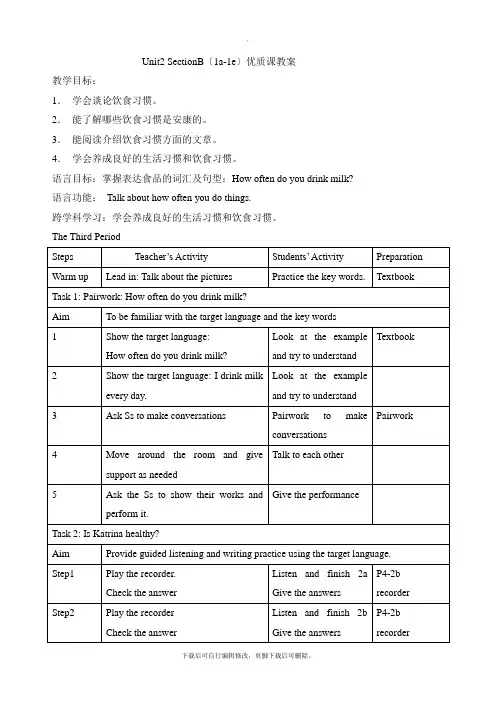
P4-2b recorder
Step2
Play the recorder
Check the answer
Listen and finish2b Give the answers
P4-2b recorder
Step3
Show the target language :
to others.
Pairwork
Step5
Move around the room and give
support as needed.
Talk to each other
Step6
Ask pair of Ss to show their works.
Pairs of Ss show
their work
How often do you exercise?
Use the target language, and talk
to others.
Pairwork
Step4
Show the target language:
I exercise everyday.
Use the target language, and talk
Textbook
Task 1: Pairwork:How often do you drink milk?
Aim
To be familiar with the target language and the key words
1
Show the target language:
How often do you drink milk?
英语人教版八年级上册Unit2 Section B教学设计
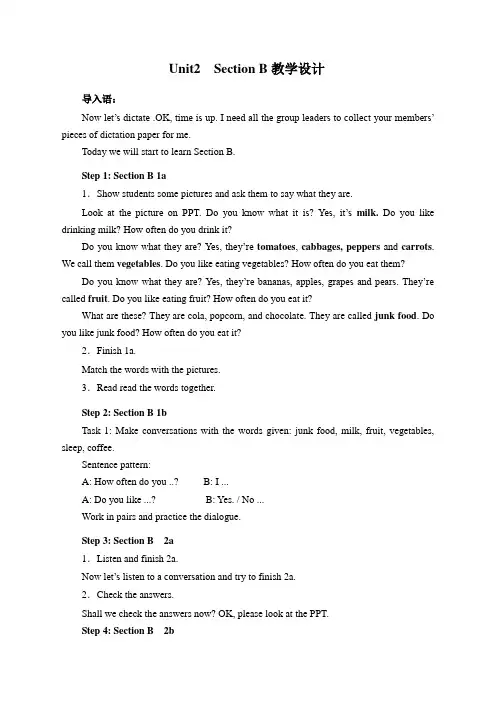
Unit2 Section B教学设计导入语:Now let’s dictate .OK, time is up. I need all the group leaders to collect your members’ pieces of dictation paper for me.Today we will start to learn Section B.Step 1: Section B 1a1.Show students some pictures and ask them to say what they are.Look at the picture on PPT. Do you know what it is? Yes, it’s milk.Do you like drinking milk? How often do you drink it?Do you know what they are? Yes, they’re tomatoes, cabbages, peppers and carrots. We call them vegetables. Do you like eating vegetables? How often do you eat them?Do you know what they are? Yes, they’re bananas, apples, grapes and pears. They’re called fruit. Do you like eating fruit? How often do you eat it?What are these? They are cola, popcorn, and chocolate. They are called junk food. Do you like junk food? How often do you eat it?2.Finish 1a.Match the words with the pictures.3.Read read the words together.Step 2: Section B 1bTask 1: Make conversations with the words given: junk food, milk, fruit, vegetables, sleep, coffee.Sentence pattern:A: How often do you ..? B: I ...A: Do you like ...? B: Yes. / No ...Work in pairs and practice the dialogue.Step 3: Section B 2a1.Listen and finish 2a.Now let’s listen to a conversat ion and try to finish 2a.2.Check the answers.Shall we check the answers now? OK, please look at the PPT.Step 4: Section B 2b1.Listen and finish 2b.2.Check the answers.3.Let’s listen to the tape and repeat.4.Ask and answer.a. Work in pairs. Ask and answer the lifestyles of Katrina and Bill, using the structure below.A: How often does Katrina exercise?B: She exercises every day. How often does Bill exercise?A: He hardly ever exercises.b. When we use “hardly ever”, please pay attentio n to the third singular form, because the subject is the third singular form. The word “hardly ever” can not be used as a model verb. 当我们用“hardly ever” 的时候,请注意用第三人称单数形式,因为主语是第三人称单数,“hardly ever”不能当作情态动词用。
八年级上英语unit2(SectionB 1a-1e)教学设计
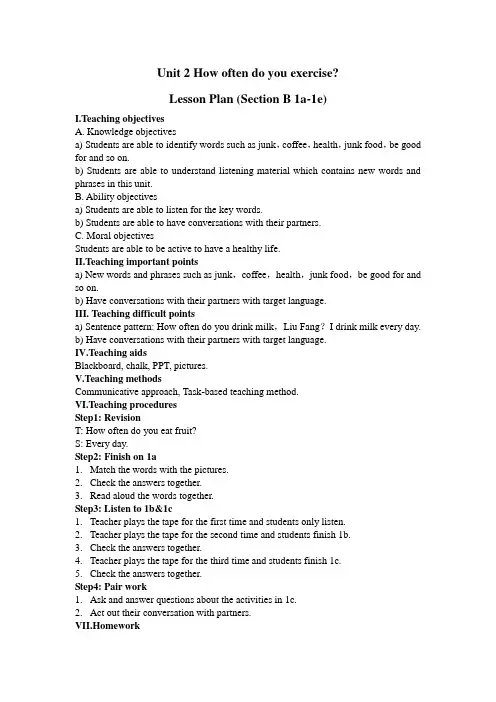
Unit 2 How often do you exercise?Lesson Plan (Section B 1a-1e)I.Teaching objectivesA. Knowledge objectivesa) Students are able to identify words such as junk,coffee,health,junk food,be good for and so on.b) Students are able to understand listening material which contains new words and phrases in this unit.B. Ability objectivesa) Students are able to listen for the key words.b) Students are able to have conversations with their partners.C. Moral objectivesStudents are able to be active to have a healthy life.II.Teaching important pointsa) New words and phrases such as junk,coffee,health,junk food,be good for and so on.b) Have conversations with their partners with target language.III. Teaching difficult pointsa) Sentence pattern: How often do you drink milk,Liu Fang?I drink milk every day.b) Have conversations with their partners with target language.IV.Teaching aidsBlackboard, chalk, PPT, pictures.V.Teaching methodsCommunicative approach, Task-based teaching method.VI.Teaching proceduresStep1: RevisionT: How often do you eat fruit?S: Every day.Step2: Finish on 1a1.Match the words with the pictures.2.Check the answers together.3.Read aloud the words together.Step3: Listen to 1b&1c1.Teacher plays the tape for the first time and students only listen.2.Teacher plays the tape for the second time and students finish 1b.3.Check the answers together.4.Teacher plays the tape for the third time and students finish 1c.5.Check the answers together.Step4: Pair work1.Ask and answer questions about the activities in 1c.2.Act out their conversation with partners.VII.Homework1.Listen to 1c for three times.。
英语人教版八年级上册unit2Section B 1a-1e教案
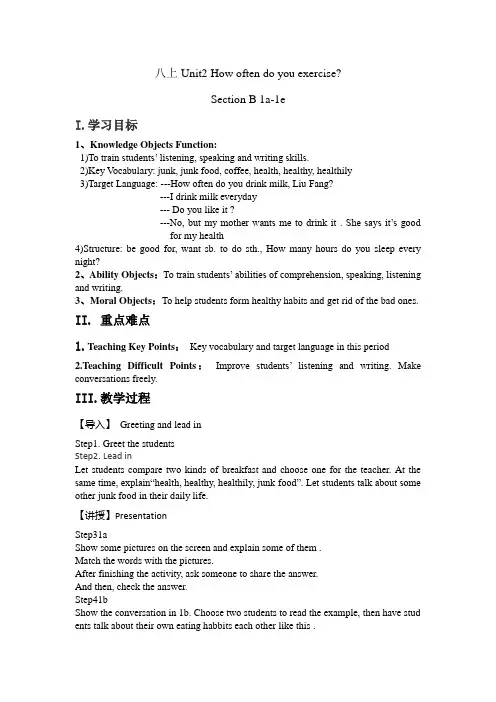
八上Unit2 How often do you exercise?Section B 1a-1eI.学习目标1、Knowledge Objects Function:1)To train students’ listening, speaking and writing skills.2)Key V ocabulary: junk, junk food, coffee, health, healthy, healthily3)Target Language: ---How often do you drink milk, Liu Fang?---I drink milk everyday--- Do you like it ?---No, but my mother wants me to drink it . She says it’s goodfor my health4)Structure: be good for, want sb. to do sth., How many hours do you sleep every night?2、Ability Objects:To train students’ abilities of comprehension, speaking, listening and writing.3、Moral Objects:To help students form healthy habits and get rid of the bad ones. II. 重点难点1.Teaching Key Points:Key vocabulary and target language in this period2.Teaching Difficult Points:Improve students’ listening and writing. Make conversations freely.III.教学过程【导入】Greeting and lead inStep1. Greet the studentsStep2. Lead inLet students compare two kinds of breakfast and choose one for the teacher. At the same time, explain“health, healthy, healthily, junk food”. Let students talk about some other junk food in their daily life.【讲授】PresentationStep31aShow some pictures on the screen and explain some of them .Match the words with the pictures.After finishing the activity, ask someone to share the answer.And then, check the answer.Step41bShow the conversation in 1b. Choose two students to read the example, then have stud ents talk about their own eating habbits each other like this .Students share their dialogues.Step51c-1d1.First, intruduce Tina and Bill to the students, tell them they will hear a reporter inter view Tina and Bill .Ask students to read the sentences in the chart together and explai n some key words to make sure they understand each sentence.2.Listen to the recording and fill in the blanks in the survey about how often Tina and Bill do the things .Then check answers .3.After that, let students say who has good habits.【活动】Play a gameStep61ePlay a game. Let students use one sentence to talk about their own lifestyles. Show so me structures on the screen.Step7 Tell students the importance of health and how they can live a healthy life. 【练习】PracticeStep 8 Exercise1.I hardly exercise so I think I'm kind of _____.A. healthyB. healthC. unhealthyD. unhealth2.My sister likes fruits_____ she doesn't like vegetables.A. andB. butC. orD. also3.Jim's parents want him ______ fruit.A. eatingB. eatC. to eatD. eats4.---What does your father do in the evening?---He usually _______A. watch TVB. exerciseC. reads books5.---_______ students in your class are fromBeijing?____Only one.A.How oftenB. How manyC. How much【测试】Test1.--你多久喝一次牛奶?--我每天都喝。
人教版小学英语八年级上册Unit2 Section B(1a-1e)教学教案及教学反思
4. Read the new words and phrases.
引导学生头脑风暴列出健康食品,通过图片,学习与健康食物、垃圾食品相关的单词和短语,导入课本1a。
Step 3
Presentation
Unit 2 How often do you exercise?
SectionB(1a-1e)
want sb. to do,
be good for,
have good habits,
eat junk food,
eat healthily,
have a good living habit.
- How often do you drink milk?
人教版小学英语八年级上册Unit2 Section B(1a-1e)教学教案及教学反思
教学基本信息
学科
English
学段
初中
年级
八年级
单元
Unit 2
课题
How often do you exercise?
总课时数
6
课时
Section B
(1a-1e)
课型
听说课
授课时间
教学目标及教学重点、难点
教学目标:
引导学生用回答问题的方式谈论关于习惯的问题。
Step 2
Lead-in
(PPT 4-7)
1.Lead Ss tobrainstorm. List some kinds of healthy food.
2.Make Ss look at the pictures and learn the healthy food.
人教八年级英语上册unit 2 Section B (1a-1e) 教学课件
How often do you eat…?
ห้องสมุดไป่ตู้
How often do you eat…?
1. Key vocabulary:health,junk food,be good for 2. Target language:
—How often do you exercise? —I exercise every day. —And how often do you...?
I sleep eight hours every night.
1a Match the words with the pictures.
1. __b__ junk food 3. __e__ fruit
5. __f__ sleep
2. __a__ milk
4. __c__ vegetables 6. __d__ coffee
vegetables Most people often eat vegetables.
fruit Most people eat fruits every day.
coffee Some people drink coffee every day.
How many hours do you sleep every night? sleep
a
b
c
d
e
f
be good for our health be bad for our health
1b Ask and answer questions. Use the words
from 1a.
A: How often do you drink milk, Liu Fang? B: I drink milk every day. A: Do you like it? B: No. But my mother wants me to drink it. She
英语 人教版 八年级上册(电子教案) Unit 2 第三课时 Section B (1a-1e)
第三课时Section B (1a—1e)教学目标通过本课的学习,学生能够:1.创设真实情境,正确使用饮食词汇和how often引导的询问活动频率的问答语,以听说的形式讨论饮食习惯和其他生活习惯的话题。
(获取信息)2.讨论饮食和其他生活习惯,加强良好生活习惯的养成。
(梳理整合)3.进行听说训练,获取有关健康生活习惯的关键信息并联系实际发表观点,提升思维的逻辑性和创造性。
(内化应用)4.联系实际生活,激发学习兴趣;运用小组合作、自主探究等方式提高听说策略的实践能力和团队意识。
(迁移创新)语篇研读What:在本课时1a—1b中呈现了有关食物和睡眠的词汇,引导学生运用本单元目标语言开展对话;1d—1e利用做报告的形式,将知识联系生活实际,巩固听力理解,发展口语技能。
Why:在上一课时中,学生已经初步感知并尝试运用了部分频率副词和单位时间内次数的表达形式,并已经熟知一些课余活动的词汇以及how often问答句。
在本节课中,学生在口语表达的培养方面需要更多的指导和训练。
How:通过情景学习,能够学会使用一些食物和饮料的词汇;通过听力训练,能够在谈话中正确使用how often问答句与同伴讨论生活方式;通过合作互动,能够树立健康生活方式的信念并践行健康生活。
教学过程设计理念:以《义务教育英语课程标准(2022年版)》核心素养为导向,以单元主题为引领,基于语篇的育人理念,体现《义务教育英语课程标准(2022年版)》“学思用创”的英语学习活动观和“教—学—评”一体化设计理念。
教学目标学习活动效果评价Lead-in观察图片并回答问题,并进行头脑风暴,思考保持健康的其他生活方式1.Greeting.2.The teacher asks students a question,“Do you like healthy food or junkfood?”Then watch a video.3.The teacher presents some pictures andasks,“What’s this?Is it healthy or junkfood?”教师观察学生能否运用已学短语进行练习,根据学生上课表现预测学生对知识的掌握情况,了解学生4.Brainstorm:The teacher asks students questions,“How can we keep healthy? Besides food and drink,can you think of other words?”尚未掌握的部分,并及时给予帮助和鼓励设计意图通过视频引出本节课的相关主题,有利于激发学生的学习兴趣。
八年级英语上册高效课堂(人教版)Unit2第3课时(SectionB1a1e)教学设计
2.教学策略:
(1)针对学生的词汇和句型掌握情况,设计丰富的课堂活动,如单词接龙、角色扮演等,帮助学生巩固记忆。
(2)通过例句、图表等形式,直观地展示语法知识,降低学习难度,提高学生掌握程度。
(3)注重阅读策略的培养,引导学生运用预测、扫读、精读等方法,提高阅读效率。
(2)语法知识在实际语境中的运用,如一般现在时和情态动词can的准确运用。
(3)阅读策略的运用,提高阅读效率和理解能力。
(二)教学设想
1.教学方法:
(1)采用情境教学法,创设与学生生活密切相关的场景,引导学生运用所学词汇和句型进行表达。
(2)运用任务型教学法,设计不同层次的课堂活动,促进学生主动参与,提高他们的语言实践能力。
4.学生在口语表达和书面写作方面,仍存在一定的心理障碍,缺乏自信,教师应鼓励学生积极参与课堂讨论和写作练习,逐步提高他们的英语表达能力。
5.学生对于课外活动的参与度和热情有所差异,教师应关注学生的个性特点,引导他们发现并培养自己的兴趣爱好,提高综合素质。
针对以上学情分析,教师应采取有针对性的教学策略,关注个体差异,激发学生的学习兴趣,提高他们的英语素养。
2.培养学生积极向上的生活态度,关注日常生活中的美好事物,学会珍惜和感恩。
3.培养学生关爱他人、合作共赢的团队精神,提高人际交往能力。
4.培养学生对课外活动的热爱,鼓励学生参加各类社团和兴趣小组,丰富课余生活,全面发展个人素质。
二、学情分析
八年级的学生已经具备了一定的英语基础,但在语言实际运用方面仍有待提高。在本章节的学习中,学生将面临以下学情挑战:
2.能够运用一般现在时描述自己和他人经常进行的日常活动和兴趣爱好。
人教版八年级英语上册Unit2SectionB(1a1e)教学设计
(4)应用:组织学生进行小组活动,讨论自己参加的活动和获得的奖项,提高口语表达能力。
(5)总结:对本节课的重点内容进行总结,帮助学生梳理所学知识。
(6)作业:布置相关练习,巩固课堂所学知识。
3.关注学生个体差异:
(1)针对不同水平的学生,设计不同难度的练习,使每个学生都能在课堂上得到锻炼。
(2)写一篇小短文,描述自己参加过的最难忘的一次活动,至少使用5个本节课所学的词汇和短语。
2.口语作业:
(1)与家人或朋友分享本节课所学内容,用一般过去时态描述各自参加过的活动。
(2)录制一段关于自己参加活动的口语表达视频,上传至班级群,以便同学们互相学习和交流。
3.阅读作业:
(1)阅读一篇关于活动的英文文章,并标注出文章中使用的一般过去时态和本节课所学的词汇。
2.培养学生合作意识,让他们在小组活动中学会倾听、尊重他人,培养团队精神。
3.通过学习本节课的内容,引导学生认识到参与活动的重要性,培养他们勇于挑战、积极进取的精神。
4.培养学生热爱生活、珍惜友谊的情感,让他们在活动中体验成长的快乐。
教学内容:
1.词汇:popular, contest, take part in, speak fluently, win, practise, etc.
2.学生能够理解和掌握一般过去时态,并在实际情景中正确运用,如描述过去参加的活动、获得的奖项等。
3.学生能够听懂并准确获取课文中的关键信息,提高听力理解能力。
4.学生能够在口语交流中,运用所学知识表达自己的观点和经历,提高口语表达能力。
(二)过程与方法
1.通过小组合作、讨论、分享等方式,培养学生主动参与课堂活动、积极思考的习惯。
人教版八上Unit2SectionB(1a1e)教学设计
4.词汇巩固:学生完成一份词汇练习,包括本节课所学词汇的拼写、词义匹配等,巩固词汇记忆。
5.家庭作业:教师布置一份综合性作业,要求学生结合所学知识,设计一个才艺表演的海报,包括表演者、表演内容、时间、地点等信息。鼓励学生发挥创意,运用所学英语知识。
6.课后反思:学生撰写一篇课后反思,总结自己在课堂学习中的收获和不足,并提出改进措施。
7.互动交流:学生利用网络平台,与同学分享自己的才艺表演视频和课后阅读感悟,互相学习、交流,提高英语实际运用能力。
2.听力理解:在听力活动中,学生需要抓住关键信息,理解并描述人物特征和动作,这对学生的听力理解能力提出了较高要求。
3.口语表达:学生在进行自我介绍和描述他人时,需要运用所学词汇和语法结构,这对他们的口语表达能力构成挑战。
(二)教学设想
1.创设情境,激发兴趣:结合才艺表演这一主题,教师可以设计生动有趣的情境,让学生在角色扮演中自然地运用所学知识,提高学习积极性。
4.针对学生的薄弱环节,教师进行有针对性的辅导,提高学生的语言运用能力。
(五)总结归纳
1.教师引导学生回顾本节课所学的内容,总结一般现在时和现在进行时的用法,以及描述人物特征和动作的词汇和句型。
2.学生分享自己在课堂中的收获和感悟,提高学生的学习成就感。
3.教师强调本节课的学习重点,布置课后作业,要求学生运用所学知识进行实际操作,巩固所学。
2.学生能够理解并运用一般现在时和现在进行时描述人物特征和正在进行的动作,提升学生的语法运用能力。
3.学生能够在听力活动中,抓住关键信息,提高听力理解能力。