
Unit 2 What is happiness to you?全套教案
高二英语what is happiness to you教案2.doc
Unit 2《What is happiness to you》GrammarTeaching goals 教学目标1. Ability goals 能力目标Enable the students to use the past and the future tenses properly.2. Learning ability goals 学能目标Help the students learn how to use the past and the future tenses.Teaching importan t points 教学重点The usage of the past and the future tenses.Teaching difficult points 教学难点How to teach the students to use the past and the future tenses.Teaching methods 教学方法Explaining and practising.Teaching aids 教具准备A multimedia computer.Teaching procedures &ways 教学过程与方式StepⅠRevisionT: Yesterday, we learned some words and also some English idioms about emotions.Let’s have a revision. Try to explain them in English. The first one: hot under the collar?S: The idiom means that somebody is very angry.T: Do you a gree?Ss: Yes.T: Next one: down in the dumps?S: Let me have a try. The idiom expressed the feeling of sadness.T: You are right. The last one: on cloud nine?S: That means someone is very happy.T: C orrect!You all have done a good revision.StepⅡPresentationShow students the following sentences, and ask them to speak out the difference.1. He went to Paris two years ago.2. He will go to Paris next year.T: Please look at the two sentences. Can you tell the difference between them?S: The first sentence talks about something that happened in the past and the second sentence talks about something that happens in the future.T: Exactly!Step ⅢExplanationGet the students to talk about the different forms of the past tense and the future tense. T: We have learned what the past tense is and what the future tense is. There are many forms of each tense. Let’s deal with the past tense first. Please look at the following sentences.Show students the following sentences.1. Sang Lan was born in Ningbo, China in 1981.2. She knew that in those years she was making her parents proud.3. Instead of crying about what she had lost, Sang Lan thought about what she could do to get better.4. By the time she competed in the New York Goodwill Games, she had been a dedicated junior gymnast for eleven years.T: First, look at the four sentences. Do they have something in common?S: Yes! They all use the past tense.T: But there are also differences among them. Can you tell the differences? Next, discuss with your partners. Pay attention to the italic words.Several minutes later.T: Can you show your opinions now?Ss: Yes.S: In the first sentence we use the simple past tense to talk about something happened in the past.T: Very good. What about the second sentence?S: I think it means something happened in the past and continued for some time.T: Very good! Thank you! Now let’s move to the last two sentences.S: They are both used in the past perfect tense. By looking at the two sentences, I think we u se the past per fect tense to talk about things that happened in the past and stopped before another past action began.T: Excellent! But I think you are partly right. Do the two sentences express the same meaning?S: The fourth sentence means the thing happened in the past and at that time another past action began.T: That’s it! Just now we talked about different forms of the past tense. And later, we will do more practice about them. Now let’s move to the future tense. Please look at the following sentences. Can you tell the difference?Show students the following sentences:1. She will come with us to watch the football match tomorrow.2. I shall work hard and learn to become a gymnast.3. Today, I’m going to talk about how to find happiness.4. Dr Brain will be talking about success next time.5. Before she went to the Goodwill Games, Sang Lan told her parents she was going to win her event.Several minutes laterT: Are you ready to show me your answers?Ss: Yes!S: I will have a try. In sentences1, 2, 3 the simple future tense is used. When the subject is the first person, we usually use shall instead of will.T: You are ri ght. Then when shall we use “be going to”?S: I think when we want to talk about future plans and intentions, we can u se “be going to”.T: Very good. You got the answer. What about sentence 4?S: Sentence 4 uses the future continuous tense. This sentence is used to talk about something that will start in the future and continue for some time.T: Excellent! The fifth sentence is used in the future in the past. When shall we use this tense?S: When we want to talk about an event which was in the future at the time when it was discussed.T: You got the answer. Good job! Next I’ll show you further explanations about future tense.Show the following to the students and ask them to take some notes.1. will / shall do 表示纯粹的将来或临时做出的决定,也可表示一种必然的趋势。
高中英语Unit2Whatishappinesstoyou教案9牛津译林版选修620170426667.doc
Unit 2 What is happiness to you科目: 英语主备人:备课日期:Have students uHave students use what they have learned to do exercises c orrectly.加工润Step2: The expI advise waiting till proper tmmediately after eating.可怕。
It's hard work climbing mountains.Seeing i s believing.than the one sent by regular mail. The woman talked about is very rich.精美句子1、善思则能“从无字句处读书”。
读沙漠,读出了它坦荡豪放的胸怀;读太阳,读出了它普照万物的无私;读春雨,读出了它润物无声的柔情。
读大海,读出了它气势磅礴的豪情。
读石灰,读出了它粉身碎骨不变色的清白。
2、幸福幸福是“临行密密缝,意恐迟迟归”的牵挂;幸福是“春种一粒粟,秋收千颗子”的收获. 幸福是“采菊东篱下,悠然见南山”的闲适;幸福是“奇闻共欣赏,疑义相与析”的愉悦。
幸福是“随风潜入夜,润物细无声”的奉献;幸福是“夜来风雨声,花落知多少”的恬淡。
幸福是“零落成泥碾作尘,只有香如故”的圣洁。
幸福是“壮志饥餐胡虏肉,笑谈渴饮匈奴血”的豪壮。
幸福是“先天下之忧而忧,后天下之乐而乐”的胸怀。
幸福是“人生自古谁无死,留取丹心照汗青”的气节。
3、大自然的语言丰富多彩:从秋叶的飘零中,我们读出了季节的变换;从归雁的行列中,我读出了集体的力量;从冰雪的消融中,我们读出了春天的脚步;从穿石的滴水中,我们读出了坚持的可贵;从蜂蜜的浓香中,我们读出了勤劳的甜美。
4、成功与失败种子,如果害怕埋没,那它永远不能发芽。
鲜花,如果害怕凋谢,那它永远不能开放。
矿石,如果害怕焚烧(熔炉),那它永远不能成钢(炼成金子)。
What is happiness to you上课学习上课学习教案
What is happiness to you教案whatishappinesstoyou教案Unit2《whatishappinesstoyou》GrammarTeachinggoals教学目标.Abilitygoals能力目标Enablethestudentstousethepastandthefuturetensesprop erly.2.Learningabilitygoals学能目标Helpthestudentslearnhowtousethepastandthefuturetens es.Teachingimportantpoints教学重点Theusageofthepastandthefuturetenses.Teachingdifficultpoints教学难点Howtoteachthestudentstousethepastandthefuturetenses.Teachingmethods教学方法Explainingandpractising.Teachingaids教具准备Amultimediacomputer.Teachingprocedures&ways教学过程与方式StepⅠRevisionT:yesterday,welearnedsomewordsandalsosomeEnglishidi omsaboutemotions.Let’shavearevision.TrytoexplaintheminEnglish.Thefirston e:hotunderthecollar?S:Theidiommeansthatsomebodyisveryangry.T:Doyouagree?Ss:yes.T:Nextone:downinthedumps?S:Letmehaveatry.Theidiomexpressedthefeelingofsadnes s.T:youareright.Thelastone:oncloudnine?S:Thatmeanssomeoneisveryhappy.T:correct!youallhavedoneagoodrevision.StepⅡPresentationShowstudentsthefollowingsentences,andaskthemtospeak outthedifference..HewenttoParistwoyearsago.2.HewillgotoParisnextyear.T:Pleaselookatthetwosentences.canyoutellthedifferen cebetweenthem?S:Thefirstsentencetalksaboutsomethingthathappenedin thepastandthesecondsentencetalksaboutsomethingthath appensinthefuture.T:Exactly!StepⅢExplanationGetthestudentstotalkaboutthedifferentformsofthepast tenseandthefuturetense.T:wehavelearnedwhatthepasttenseisandwhatthefuturete nseis.Therearemanyformsofeachtense.Let’sdealwiththepasttensefirst.Pleaselookatthefollowing sentences.Showstudentsthefollowingsentences..SangLanwasborninNingbo,chinain1981.2.Sheknewthatinthoseyearsshewasmakingherparentsprou3.Insteadofcryingaboutwhatshehadlost,SangLanthought aboutwhatshecoulddotogetbetter.4.BythetimeshecompetedintheNewyorkGoodwillGames,she hadbeenadedicatedjuniorgymnastforelevenyears.T:First,lookatthefoursentences.Dotheyhavesomethingi ncommon?S:yes!Theyallusethepasttense.T:Buttherearealsodifferencesamongthem.canyoutellthe differences?Next,discusswithyourpartners.Payattenti ontotheitalicwords.Severalminuteslater.T:canyoushowyouropinionsnow?Ss:yes.S:Inthefirstsentenceweusethesimplepasttensetotalkab outsomethinghappenedinthepast.T:Verygood.whataboutthesecondsentence?S:Ithinkitmeanssomethinghappenedinthepastandcontinu edforsometime.T:Verygood!Thankyou!Nowlet’smovetothelasttwosentences.S:Theyarebothusedinthepastperfecttense.Bylookingatt hetwosentences,Ithinkweusethepastperfecttensetotalk aboutthingsthathappenedinthepastandstoppedbeforeano therpastactionbegan.T:Excellent!ButIthinkyouarepartlyright.Dothetwosent encesexpressthesamemeaning?S:Thefourthsentencemeansthethinghappenedinthepastan datthattimeanotherpastactionbegan.T:That’sit!justnowwetalkedaboutdifferentformsofthepasttens e.Andlater,wewilldomorepracticeaboutthem.Nowlet’smovetothefuturetense.Pleaselookatthefollowingsente nces.canyoutellthedifference?Showstudentsthefollowingsentences:.Shewillcomewithustowatchthefootballmatchtomorr ow.2.Ishallworkhardandlearntobecomeagymnast.3.Today,I’mgoingtotalkabouthowtofindhappiness.4.DrBrainwillbetalkingaboutsuccessnexttime.5.BeforeshewenttotheGoodwillGames,SangLantoldherpar entsshewasgoingtowinherevent.SeveralminuteslaterT:Areyoureadytoshowmeyouranswers?Ss:yes!S:Iwillhaveatry.Insentences1,2,3thesimplefuturetenseisused.whenthesubjectisthefirst person,weusuallyuseshallinsteadofwill.T:youareright.Thenwhenshallweuse“begoingto”?S:Ithinkwhenwewanttotalkaboutfutureplansandintentio ns,wecanuse“begoingto”.T:Verygood.yougottheanswer.whataboutsentence4?S:Sentence4usesthefuturecontinuoustense.Thissentenc eisusedtotalkaboutsomethingthatwillstartinthefuture andcontinueforsometime.T:Excellent!Thefifthsentenceisusedinthefutureinthep ast.whenshallweusethistense?S:whenwewanttotalkaboutaneventwhichwasinthefutureat thetimewhenitwasdiscussed.T:yougottheanswer.Goodjob!NextI’llshowyoufurtherexplanationsaboutfuturetense.Showthefollowingtothestudentsandaskthemtotakesomeno tes..will/shalldo表示纯粹的将来或临时做出的决定,也可表示一种必然的趋势。
Unit2Whatishappinesstoyou?(精选3篇)

Unit 2 What is happiness to you?(精选3篇)Unit 2 What is happiness to you? 篇1unit 2 what is happiness to you?grammar and usage学案第一部分:重点讲解过去时态谈论过去的状况或动作一般用过去时态。
过去时态包括一般过去时、过去将来时、过去进行时和过去完成时等。
1. 一般过去时1)表示过去的事情、动作或状态,常与表示过去的具体的时间状语连用,如yesterday, last night, a moment ago, the next day等。
sang lan was born in ningbo, china in 1981.i attended a meeting yesterday.where did he go a moment ago?2)表示过去经常性、习惯性的动作。
i went to school by bus.he was often late for school.3)常用一般过去时的句型。
why didn’t you/i think of that?i didn’t notice it.i forgot to tell you i had been there with my brother before.i didn’t recognize him.2. 一般过去时和现在完成比较一般过去时和现在完成时均表示发生在过去的动作,但前者侧重过去的事实,后者侧重过去的动作对现在的影响.-- my computer ________ wrong although i used it only once. -- you’d better go to check it.试比较:i can’t enter the room now because i ____________ (lose) my key.i can’t find my text book now, but i _______ (put) it here.3.过去进行时 1)它是用来表示在特定的某一时刻正在发生的事情,或者过去某一时段内持续发生的事情。
高中英语Unit2Whatishappinesstoyou教案12牛津译林版选修620170426656.doc
Unit 2 What is happiness to you教学案科目: 英语主备人:备课日期:1) Is the writer old or young? How do you know that?sthe hapin Englaealth plays an important role in a person’s happyn still play sport when he was getting old.imeer with your family. Why?A2: Because the re will be au tomatic kitchens to cook instant meals for us in the future.then makes her think she will enjoy a happy life in the ep 5: Homework品味人生1、不管鸟的翅膀多么完美,如果不凭借空气,鸟就永远飞不到高空。
想象力是翅膀,客观实际是空气,只有两方面紧密结合,才能取得显着成绩。
2、想停下来深情地沉湎一番,怎奈行驶的船却没有铁锚;想回过头去重温旧梦,怎奈身后早已没有了归途。
因为时间的钟摆一刻也不曾停顿过,所以生命便赋予我们将在汹涌的大潮之中不停地颠簸。
3、真正痛苦的人,却在笑脸的背后,流着别人无法知道的眼泪,生活中我们笑得比谁都开心,可是当所有的人潮散去的时候,我们比谁都落寂。
4、温暖是飘飘洒洒的春雨;温暖是写在脸上的笑影;温暖是义无反顾的响应;温暖是一丝不苟的配合。
5、幸福,是一种人生的感悟,一种个人的体验。
也许,幸福是你风尘仆仆走进家门时亲切的笑脸;也许,幸福是你卧病床上百无聊赖时温馨的问候;也许,幸福是你屡遭挫折心灰意冷时劝慰的话语;也许,幸福是你历经艰辛获得成功时赞赏的掌声。
关键的是,你要有一副热爱生活的心肠,要有一个积极奋进的目标,要有一种矢志不渝的追求。
高中英语 Unit 2 What is happiness to you教案1高二英语教案
What areexciting thingsto you?(likewhite-water surfing or bungee jumping.)Whydo people like exciting things? They bring lots of fun and helppeopleforget all the troubles and worries.
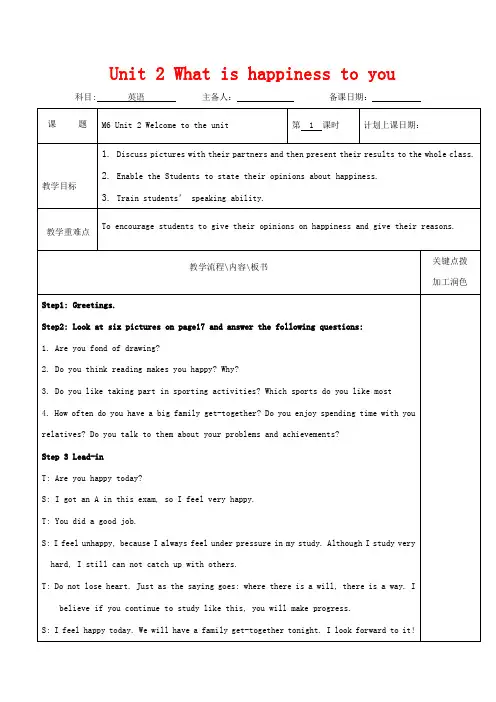
Step 3 Lead-in
T: Are you happy today?
S: I got an A in this exam, so I feel very happy.
T: You did a good job.
S: I feel unhappy, because I always feel under pressure in my study. Although I study very hard, I still can not catch up with others.
T: Do not lose heart. Just as the saying goes: where there is a will, there is a way. I believe if you continue to study like this, you will make progress.
S: I feel happy today. We will have a family get-together tonight. I look forward to it!
T: In your class, some feel happy, while others do not. So what happiness is on the earth, and how to become happy? Have you ever thought about that before?
高中英语Unit2Whatishappinesstoyou教案13牛津译林版选修620170426657.doc
Unit 2 What is happiness to you 科目: 英语主备人:备课日期:的不定式可省略He never stays angry for long.The house was just as she had imagined it. I had imagined her to be older than that. Ilts to return to the labor market.al when the water level drops in the lake.C. have tried; livingA. If you doub le your effortsC. A bit more efforts精美句子1、善思则能“从无字句处读书”。
读沙漠,读出了它坦荡豪放的胸怀;读太阳,读出了它普照万物的无私;读春雨,读出了它润物无声的柔情。
读大海,读出了它气势磅礴的豪情。
读石灰,读出了它粉身碎骨不变色的清白。
2、幸福幸福是“临行密密缝,意恐迟迟归”的牵挂;幸福是“春种一粒粟,秋收千颗子”的收获. 幸福是“采菊东篱下,悠然见南山”的闲适;幸福是“奇闻共欣赏,疑义相与析”的愉悦。
幸福是“随风潜入夜,润物细无声”的奉献;幸福是“夜来风雨声,花落知多少”的恬淡。
幸福是“零落成泥碾作尘,只有香如故”的圣洁。
幸福是“壮志饥餐胡虏肉,笑谈渴饮匈奴血”的豪壮。
幸福是“先天下之忧而忧,后天下之乐而乐”的胸怀。
幸福是“人生自古谁无死,留取丹心照汗青”的气节。
3、大自然的语言丰富多彩:从秋叶的飘零中,我们读出了季节的变换;从归雁的行列中,我读出了集体的力量;从冰雪的消融中,我们读出了春天的脚步;从穿石的滴水中,我们读出了坚持的可贵;从蜂蜜的浓香中,我们读出了勤劳的甜美。
4、成功与失败种子,如果害怕埋没,那它永远不能发芽。
鲜花,如果害怕凋谢,那它永远不能开放。
矿石,如果害怕焚烧(熔炉),那它永远不能成钢(炼成金子)。
高中英语Unit2Whatishappinesstoyou教案8牛津译林版选修620170426666.doc
Unit 2 What is happiness to you 科目: 英语主备人:备课日期:M6 Unit 2 Grammar and usageo exercises.Have students use what they have learned to do即表示发生在谓语动作之后的动作。
如:。
等使役动词后用作宾语补足语的不定式必须省略母亲强迫我喝。
see, h ear, observe, notice, feel, watch后用作宾语补足语的不定式也不带…?之后的不定式不能带To try and fail is better than not to try at all.:is品味人生1、不管鸟的翅膀多么完美,如果不凭借空气,鸟就永远飞不到高空。
想象力是翅膀,客观实际是空气,只有两方面紧密结合,才能取得显着成绩。
2、想停下来深情地沉湎一番,怎奈行驶的船却没有铁锚;想回过头去重温旧梦,怎奈身后早已没有了归途。
因为时间的钟摆一刻也不曾停顿过,所以生命便赋予我们将在汹涌的大潮之中不停地颠簸。
3、真正痛苦的人,却在笑脸的背后,流着别人无法知道的眼泪,生活中我们笑得比谁都开心,可是当所有的人潮散去的时候,我们比谁都落寂。
4、温暖是飘飘洒洒的春雨;温暖是写在脸上的笑影;温暖是义无反顾的响应;温暖是一丝不苟的配合。
5、幸福,是一种人生的感悟,一种个人的体验。
也许,幸福是你风尘仆仆走进家门时亲切的笑脸;也许,幸福是你卧病床上百无聊赖时温馨的问候;也许,幸福是你屡遭挫折心灰意冷时劝慰的话语;也许,幸福是你历经艰辛获得成功时赞赏的掌声。
关键的是,你要有一副热爱生活的心肠,要有一个积极奋进的目标,要有一种矢志不渝的追求。
这样,你才能感受到幸福。
6、母爱是迷惘时苦口婆心的规劝;母爱是远行时一声殷切的叮咛;母爱是孤苦无助时慈祥的微笑。
7、淡淡素笺,浓浓墨韵,典雅的文字,浸染尘世情怀;悠悠岁月,袅袅茶香,别致的杯盏,盛满诗样芳华;云淡风轻,捧茗品文,灵动的音符,吟唱温馨暖语;春花秋月,红尘阡陌,放飞的思绪,漫过四季如歌。
高中英语Unit2Whatishappinesstoyou教案10牛津译林版选修620170426654.doc
Unit 2 What is happiness to you 科目: 英语主备人:备课日期:均可用作定语,且都表示被动意义,其区别在于:to be done去年建的那座房子是家电影院。
In order to catch the train, sheet you.,另外还用于our parents? to dob ening all night.说服或命令某人做某事:her.Why don’t you have your hair c?1000元。
精美句子1、善思则能“从无字句处读书”。
读沙漠,读出了它坦荡豪放的胸怀;读太阳,读出了它普照万物的无私;读春雨,读出了它润物无声的柔情。
读大海,读出了它气势磅礴的豪情。
读石灰,读出了它粉身碎骨不变色的清白。
2、幸福幸福是“临行密密缝,意恐迟迟归”的牵挂;幸福是“春种一粒粟,秋收千颗子”的收获. 幸福是“采菊东篱下,悠然见南山”的闲适;幸福是“奇闻共欣赏,疑义相与析”的愉悦。
幸福是“随风潜入夜,润物细无声”的奉献;幸福是“夜来风雨声,花落知多少”的恬淡。
幸福是“零落成泥碾作尘,只有香如故”的圣洁。
幸福是“壮志饥餐胡虏肉,笑谈渴饮匈奴血”的豪壮。
幸福是“先天下之忧而忧,后天下之乐而乐”的胸怀。
幸福是“人生自古谁无死,留取丹心照汗青”的气节。
3、大自然的语言丰富多彩:从秋叶的飘零中,我们读出了季节的变换;从归雁的行列中,我读出了集体的力量;从冰雪的消融中,我们读出了春天的脚步;从穿石的滴水中,我们读出了坚持的可贵;从蜂蜜的浓香中,我们读出了勤劳的甜美。
4、成功与失败种子,如果害怕埋没,那它永远不能发芽。
鲜花,如果害怕凋谢,那它永远不能开放。
矿石,如果害怕焚烧(熔炉),那它永远不能成钢(炼成金子)。
蜡烛,如果害怕熄灭(燃烧),那它永远不能发光。
航船,如果害怕风浪,那它永远不能到达彼岸。
5、墙角的花,当你孤芳自赏时,天地便小了。
井底的蛙,当你自我欢唱时,视野便窄了。
高中英语 Unit 2《What is happiness to you-Reading》教案 牛津
Unit 2 What is happiness to you?Reading---教案Teaching Aims:Check and enhance students’ reading abilities.Train Ss to gain an overall understanding of the article and learn to adopt different reading strategies.Teaching important points:Help Ss know something about Sang Lan.Help them learn something about “happiness〞.Teaching difficult points:How to read an interview.Teaching methods:Improve the students’ reading prehension.Practice to get the students to master what they’ve learnt.Discussion to make every student work in class.Teaching aids:the multi-media;the blackboard.Teaching procedures:Step 1.lead inSay something about Sang Lan.Encourage the students to share their information they have already know and to express their opinions freely..Step 2. Reading1. Ask Ss to skim the first paragraph to find out the topic of the interview.2. Ask Ss to skim the rest of the interview quickly and answer the questions .1). Who is being interviewed? What is he?2). When and where was Sang Lan born?3. Ask Ss to read the interview for the detailed information1).Why did Dr Brown use Sang Lan as an example ?2).What does Dr Brown really mean by saying “ she had a dedicated junior gymnast for eleven years〞?3). How does Sang Lan find happiness now?4). What was Sang Lan’s best event?5). What did his Sang Lan’s teammates think of her ?6). When and where did Sang Lan hurt herself? And how did she get hurt?7). Was she sad when staying in hospital?8). How did people who went to see her find her?4. Organize them into groups of four and have a petition.5. Get Ss to say something about Sang lan .6. Get Ss to finish E on page 217.Get Ss to discuss two questions.Step 3. Homework..Invent another situation that fits different emotions:。