
语法第一讲
第一讲一、基本句型SVC (subject—verb—subject complement/predictive)Miss Jones is a secretary.SV (subject—verb)The flowers are flowering.SVO (subject—verb—object)Walls have ears.SVOiOd (subject—verb—indirect object—direct object)The mother will buy the girl a dress.SVOCo (subject—verb—object—object complement)The parents consider the child a genius.二、主语(subject)和谓语(predicate)一个句子必须有主语和谓语,但在有些句子中,主语或谓语或其一部分可以省略,例如:(You) Read this story.Who spoke? John (did).What did you buy? (I bought) Some books.1)名词/名词词组作主语Quality matters more than quantity.A poor man is not necessarily unhappy.A friend in need is a friend indeed.The tall boy with blond hair who is locking his bicycle is from Finland.除名词/名词词组外,代词、数词、不定式(短语)、动词-ing形式和名词从句等都可以在句中作主语。
例如:He has burnt his bridges behind him.One is enough.To know the disease is half the cure.Talking mends no holes.Whether or not they will come depends on the weather.The old and the handicapped in the village are taken good care of.2)动词/动词词组及其后续成分作谓语谓语动词(predicate verb)的性质决定其是否跟主语补语、宾语、宾补及状语等后续成分。
如:His sister is a doctor.The crowd cheered.The burnt child fears the fire.The boy gave me a letter.I thought this action necessary.They were sitting before the fireplace.He will have received the letter by now.三、时态与语态1.一般现在时(The Simple Present)第三人称单数变化规则:一般加“-s”,以辅音加y 结尾的词把y 改成i,再加-es(元音加y 结尾则直接加s ),以o,s,x,ch,sh结尾的词加-es。
1)表示习惯、永久性的或反复发生的动作,常often, sometimes, usually, always, twice a month, every week, on Sundays 等状语连用。
Birds fly.She always takes a walk in the evening.2) 表普遍真理、事实,也用在格言中。
The earth moves round the sun.Water boils at 100C.No man but errs.Pride goes before a fall.A bird in hand is worth two in the bush.A stitch in time saves nine.Time and tide wait for no man.3) 在由when, if, after, before, although, as soon as, as, because, even if, in case,though, till, until, unless, so long as, where, whatever, wherever 等引导的状语从句中,用一般现在时代替一般将来时。
I’ll tell her when she comes tomorrow.You will surely succeed if you try your best.Even if it rains this afternoon, I will go there.Whatever happens, you should keep cool-minded.I shall go where you go.4) 报刊标题、体育解说或舞台指导说明。
CHINA HOSTS ASIAN GAMESMoor passes to Charlton; Charlton shoots, it’s a good goal.When the curtain rises, Juliet is sitting at her desk. The phone rings. She picks it up and listens quietly.2.现在进行时(The present progressive)1)正在进行的动作或发生的事。
The kettle is boiling. Shall I make tea?It is snowing outside.She is taking physics this semester.2)表示某个按最近计划或安排将要进行的动作或即将开始的动作。
此类词有:go, leave, come, arrive, land, meet, move, return, start, stay, stop, do, dine, give, have, pay, join, punish, spend, sleep, take 等。
He is meeting the manager tomorrow.I am publishing a book this year.I’m changing my hotel.Imagine I’m seeing the Mona Lisa.3. 一般过去时(The Simple Past)1)过去发生的情况或动作。
The foreign guests visited Nanjing last spring.He never smoked.Jane was here a moment ago.In 1966, sixty-five-year-old Chichester went alone on his voyage round the world. 2)过去的习惯动作,常和never, often, usually等状语连用。
Wherever he traveled in those years, he wrote down what he saw and heard. Barbara usually prepared her lessons in the library.When she was in Chongqing, she often went to Jiefangbei.3)在表示时间或条件等的状语从句中代替过去将来时。
We would not leave until she came back.She told me that she would not go with us if it rained the next day.4)一般过去时、一般现在时和现在完成时的比较。
Her father was a chemist.Her father is a chemist.That’s all I had to say.That’s all I have to say.How did you like the dancing?How do you like the dancing?It was so nice to see you.It is nice to see you.She always was that way.She always is that way.Jane did a lot of work this morning.Jane has done a lot of work this morning.Did you see the film “Othello”?Have you seen the film “Othello”?4. 过去进行时(The past progressive)He was playing table tennis at five yesterday afternoon.It was getting dark.She told me to wake him up if he was sleeping.5. 现在完成时(The Present Perfect)1)过去所发生的动作或事情对现在的影响或产生的结果,常和already, before, inthe past few months, just, so far, this year, up to now, yet等连用。
We have met before.She has lost her money.I haven’t finished reading the book yet, so I can’t return it to the library.In the past fifty years there has been a great increase in the amount of research on the brain.2)表示一个从过去某个时间开始,延续到现在,并可能延续下去动作。
常同表示一段时间的状语连用,如:so far, up to now, since, for a long time, up till now, up to present, for the past (last) few years, these few days 等。
He has worked here for over twenty years.She has lived in this house since 1960.He has always wanted to go back to his hometown these years.3)某些非延续性动词在现在完成时中,不能同表示一段时间的状语连用。
高三英语一轮复习语法第1讲名词的数格构词法考点讲义

高中英语语法第1讲名词1 可数名词(1)可数名词的单、复数规那么变化:为了自己(self)活命(life),小偷(thief)和他的妻子(wife)手里拿着刀子(knife)和一片树叶(leaf)站在架子(shelf)上,把狼(wolf)劈成两半(half)。
(2)不规那么名词的3种复数变化形式一种鱼时,其单复数形式相同。
(2)people指“人们〞时单复数同形;指“民族〞时,其复数为peoples。
(3)合成名词的2种复数形式①假设有中心词,那么把中心词变成复数;假设无中心词,那么把最终一个词变成复数。
passerby→passersby, sisterinlaw→sistersinlaw, grownup→grownups①“man/woman+n.〞变复数时,作定语的man/woman和中心词都要变复数,如women engineers。
对点练1写出以下名词的复数形式①sheep—sheep①dish—dishes①knife—knives①story—stories①tomato—tomatoes2 不行数名词(1)常见的不行数名词一般来说,物质名词和抽象名词是不行数的,因此没有复数形式,一般也不能用a或an修饰。
通常只用作不行数的名词有:milk, music, homework, housework, weather, news, butter, information, bread, advice, progress, orange(橙汁), meat, equipment, fun, luggage, luck, work(工作), traffic, furniture, wealth, word(消息), room(空间), man(人类)等。
[名师点津]word意为“消息〞、room意为“空间〞、man意为“人类〞时,通常不带任何修饰词。
语法讲义第一讲导论

语法讲义第一讲1.语法层次与句子结构、基本句型1-1.语法的定义:语法研究词的变化和句子结构的科学。
研究词变化的部分称为词法.Morphology.如名词的数、格。
动词的时态语态。
研究句子结构的部分称为句法Syntax.如句子的成分、语序、句子的种类。
词法与句法的关系---区别与联系。
语法指遣词造句的规律,但离不开词汇。
语法体现在词汇中,而词汇受语法的制约。
语法层次现代英语语法的内容包括下列七个层次.doc1-2.语法的作用:学习词汇主要是加强感性认识,学语法是要提高理性认识。
在加强语言理解力或使用能力方面语法都可以发挥重要作用。
正确的使用语法是:10%的知识或信息,90%的实践。
第一.词法2-词的分类:要弄清句子成分应由哪类词担任,分清词类非常重要。
如:主语,宾语多有名词担任;谓语多有动词担任;定语常有形容词担任;状语多有副词担任;词分为10大类:2-1.名词:表示人、物或地方等,如:John,teacher;table,pen;London;beauty.2-2.代词:用来代替名词,以避免重复某个名词,如:I,you,it,that,those,them.2-3.形容词:用来修饰或限制某个(些)名词,如:good(man),white(paper),every(book),much(water),被修饰或限制的名词,叫做主体词(head-word)。
2-4.动词:表示行为或状态,如:speak,read,go,think,is,seem.2-5.介词:表示它后面的名词(或代词)跟它前面的动词、另一名词或形容词的关系。
这些名词(或代词)称为介词的宾语。
介词宾语和介词构成介词短语。
The book on the desk is mine.(介词on把名词book和另一名词desk联系起来)He is sure of it.他对此很有把握。
(of联系it和sure.)It is good for you.这对你有好处。
高二英语 语法第一讲
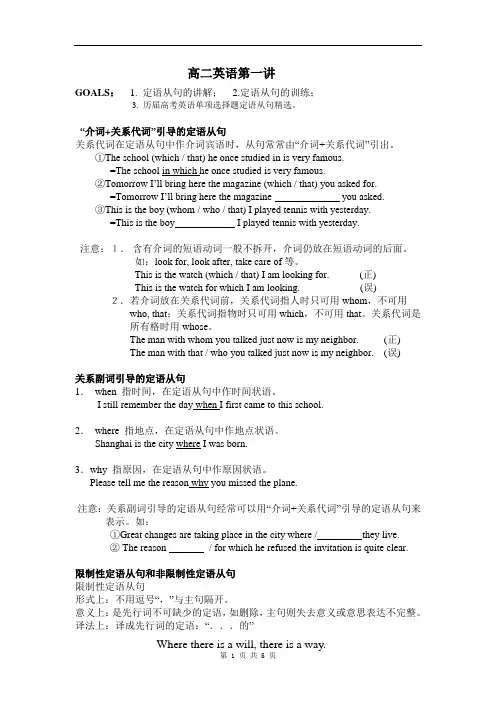
高二英语第一讲GOALS: 1. 定语从句的讲解; 2.定语从句的训练;3.历届高考英语单项选择题定语从句精选。
“介词+关系代词”引导的定语从句关系代词在定语从句中作介词宾语时,从句常常由“介词+关系代词”引出。
①The school (which / that) he once studied in is very famous.=The school in which he once studied is very famous.②Tomorrow I’ll bring here the magazine (which / that) you asked for.=Tomorrow I’ll bring here the magazine you asked.③This is the boy (whom / who / that) I played tennis with yesterday.=This is the boy I played tennis with yesterday.注意:1.含有介词的短语动词一般不拆开,介词仍放在短语动词的后面。
如:look for, look after, take care of 等。
This is the watch (which / that) I am looking for. (正)This is the watch for which I am looking. (误) 2.若介词放在关系代词前,关系代词指人时只可用whom,不可用who, that;关系代词指物时只可用which,不可用that。
关系代词是所有格时用whose。
The man with whom you talked just now is my neighbor. (正)The man with that / who you talked just now is my neighbor. (误)关系副词引导的定语从句1. when 指时间,在定语从句中作时间状语。
雅思语法——第一讲英语基本句子成分和结构

第一讲英语基本句子成分和句子结构一、英语句子成分句子成分的定义:构成句子的各个部分叫句子成分。
句子成分有主要成分和次要成分,主要成分有主语和谓语,次要成分有表语、宾语、定语、状语、补足语、同位语和插入语。
1. 主语:主语是一个句子所叙述的主体,一般位于句首。
但在there be结构、疑问句(当主语不是疑问词时)和倒装句中,主语位于谓语动词、助动词或情态动词后面。
主语可由名词、代词、数词、不定式、动名词、名词化的形容词和主语从句等表示。
例如:Tom is a good boy. (名词)We often speak English in class. (代词)One-third of the students in this class are girls. (数词)To swim in the river is a great pleasure. (不定式)Smoking does harm to the health. (动名词)The rich should help the poor. (名词化形容词)When we are going to have an English test has not been decided. (主语从句)It is necessary to master a foreign language. (it为形式主语,不定式为真实主语)2. 谓语:谓语说明主语所做的动作或具有的特征和状态。
动词在句中作谓语,一般放在主语之后。
谓语的构成如下:(1) 简单谓语:由一个动词或动词短语构成。
例如:He practices running every morning.(2) 复合谓语:由(情态动词或其他助动词+动词原形)构成。
例如:You may keep the book for two weeks.He has caught a bad cold.We are having a quick breakfast.3. 表语:表语用以说明主语的身份、特征和状态,它一般位于系动词(如be, keep, remain, become, get, grow, turn, look, seem, feel, smell, sound, taste等)之后。
剑桥英语初级语法第一讲练习答案
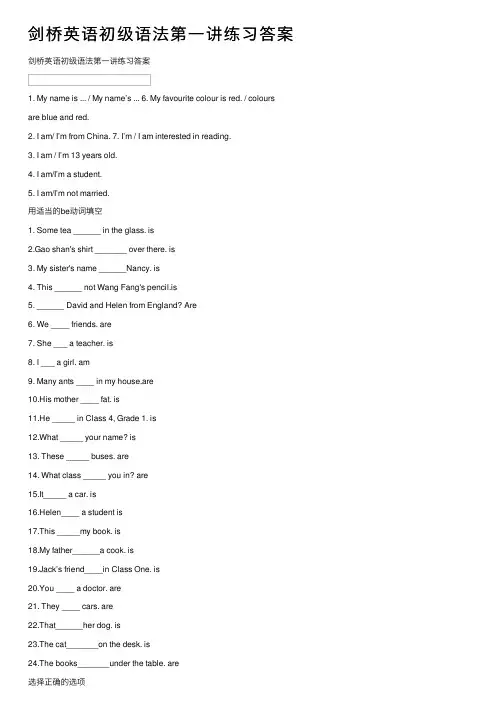
剑桥英语初级语法第⼀讲练习答案剑桥英语初级语法第⼀讲练习答案1. My name is ... / My name’s ... 6. My favourite colour is red. / coloursare blue and red.2. I am/ I’m from China. 7. I’m / I am interested in reading.3. I am / I’m 13 years old.4. I am/I’m a student.5. I am/I’m not married.⽤适当的be动词填空1. Some tea ______ in the glass. is2.Gao shan's shirt _______ over there. is3. My sister's name ______Nancy. is4. This ______ not Wang Fang's pencil.is5. ______ David and Helen from England? Are6. We ____ friends. are7. She ___ a teacher. is8. I ___ a girl. am9. Many ants ____ in my house.are10.His mother ____ fat. is11.He _____ in Class 4, Grade 1. is12.What _____ your name? is13. These _____ buses. are14. What class _____ you in? are15.It_____ a car. is16.Helen____ a student is17.This _____my book. is18.My father______a cook. is19.Jack’s friend____in Class One. is20.You ____ a doctor. are21. They ____ cars. are22.That______her dog. is23.The cat_______on the desk. is24.The books_______under the table. are选择正确的选项C 1.She ______ Miss Hen. A.be B.am C.isB 2.I ______ sorry. A./ B.am C.areA 3.Here ______ my ball. A.is B.are C.amA 4.You ______ number eight. A.are B.is C.amA 5.What_______this? A.is B.are C.beC 6.Helen____ a student. A.be B.am C.isB 7.Those _____oranges. A.is B.are C.amC 8. How old _____your teacher? A.be B.am C.isB 9. Where __ ___ her mother? A.are B.is C.amB 10.The two cups of milk _____ for me. A.is B.are C.be写出下列词适当形式:I’m 1.I am (缩略形式) ______ ‘s 2.is (复数)______We’re 3.we are (缩略形式) ______ aren’t 4.are not(缩略形式) ______ Isn’t 5.is not (缩略形式) ______ can’t 6.can not(缩略形式) ______ She is 7.she's(完整形式) ______ it is 8.it's(完整形式) ______They are 9.they're(完整形式) ______ do not 10.don't(完整形式) ______将下列句⼦变成否定句和⼀般疑问句1.His brother is a teacher.否定句: His brother isn’t / is not a teacher.⼀般疑问句: Is his brother a teacher?2.Those are his parents.否定句: Those aren’t / are not his parents.⼀般疑问句: Are those his parents?3.I’m 14 years old.否定句: I’m not 14 years old.⼀般疑问句: Are you 14 years old?4.The ruler is on the table.否定句: The ruler isn’t / is not on the table. ⼀般疑问句: Is the ruler on the table?5.Tom is my teacher .否定句: Ton isn’t / is not my teacher.⼀般疑问句: Is Tom your teacher?6.My shoes are 20 yuan .否定句: My shoes aren’t / are not 20 yuan. ⼀般疑问句: Are your shoes 20 yuans? 7.This is a pen .否定句: This isn’t / is not a pen.⼀般疑问句: Is this a pen?8.My name is Andy.否定句: My name isn’t Andy.⼀般疑问句: Is your name Andy?9.We are twins.否定句: We aren’t twins.⼀般疑问句: Are you twins?10.He is my brother.否定句: He isn’t my brother. ⼀般疑问句: Is he my brother?。
英语语法专题系列讲座第一讲英语构词法及单词记忆

booklet ringlet (小环) streamlet
leaflet (小叶)
droplet (小滴;飞沫)
rootlet (小根;细根) spongelet (小海绵块)
-like [形容词后缀] 表示“像……似的”、 “有……性质的”之意
childlike godlike womanlike
realization, systemization, normalization, oxidization, Americanization, popularization, democratization, civilization, equalization, dramatization
英语语法专题系列讲座第一讲英语 构词法及单词记忆
forward(s) eastward(s) heavenward(s)
-ize [动词后缀]亦作 -ise。表示“照……样子做”、
“按……方式处理”、“变成……状态”、“使成 为……”、“……化” 等之意,与 [名词后缀] “-ization” 相对应。例词如下: modernize, industrialize, mechanize, realize,
semi-colony semi-feudal semi-official
semifinal semimetal semicircle
semi-liquid semi-diameter (半径)
semiconductor (半导体)
semi-commercial (半商业性/化的)
un- (1) 不
warlike princelike homelike manlike wormlike (像虫一样的)
-ward(s) [形容词及副词后缀] 表“向”之意
统考冲刺 语法 第一讲 动词for teacher
统考冲刺-语法第一讲时态、语态、语气、情态动词、主谓一致一、时态和语态(一)时态◆一般现在时、现在进行时、现在完成时◆一般过去时、过去进行时、过去完成时◆一般将来时◆过去将来时(二)语态◆主动语态◆被动语态●一般现在时1.Every year thousands of lives ______ in road accidents because of carelessdriving.A. loseB. lostC. have lost答案.D2.TodayA. was spoken D. speak答案:B3.A. allowB. allows D. are allowed答案:C4.-Take this medicine twice a day, Peter? -Do I have to take it? It ________ soterrible.A. is tastingB. is tasted D. has tasted答案.C5.A. Can it see C. Can be seeing D. Can see答案:B●现在进行时6.Selecting a mobile phone for personal use is no easy task because technologyB. has been changedC. will have changedD. will change●现在完成时7.John's father ______ mathematics in this school ever since he graduated fromHarvard University.A. taughtB. teaches D. is teaching答案.C8. today.B. already readsD. was already read答案.A9.The youngA. isB. areC. has答案.D一般过去时10.He ______ to me last week.A. is writingB. writes D. is written答案.C11.At that timeA. is C. has been D. is being答案.B12.A long time agoA. had livedB. have lived D. have been living答案.C13.Everyone of them _______ tired and wanted a good rest.A. seemsB. is seemedC. was seemed答案:D14.at the moment.B. was seemedC. is seemingD. is seemed15.yesterday.A. dead C. killed D. was dead答案:B16.A. was inventingC. had inventedD. has invented答案.B17.- Nancy was badly injured in the accident yesterday and she was sent to hospital.B. don't know; will go toC. didn't know; am going toD. haven't known; am going to答案.A18.Tom was watching TV when someone______.A. comesB. come D. has come答案.C19.The garden _______while the Greens were away from home.B. was taken good careD. was taking good care●过去进行时20.When Lily came home at 5 p.m. yesterday, her mother _______ dinner in thekitchen.A. cooked C. cooks D. has cooked答案.B21.while I ________ basketball yesterday.B. am playingC. playD. played答案. A●过去完成时22.I was giving a talk to a large group of people, the same talk I __________to half adozen other groups.A. was givingB. am giving D. have given答案.C●一般将来时23.When the railway is completedA. canB. couldC. are able to答案.D24.when you go to college.A. must C. must to D. have to答案.B25.- Nancy was badly injured in the accident yesterday and she was sent to hospital.B. don't know; will go toD. haven't known; am going to答案.A26.A. goB. are go D. are going to go答案:C27.this afternoon.B. is going to haveC. is going to isD. is going to has28.If Mary _______shopping this afternoon, please ask her to write a shopping listfirst.A. will go C. went D. has gone答案:B29.tomorrow.A. won'tB. isn't D. has答案.C30..A. are sentB. will sendC. have sent答案:D●过去将来时31.- Don't you feel surprised to see George at the meeting?- Yes. I really didn'tA. has beenB. had been D. would have been答案.C32.made it clear that he _____________office soon.A. leaves C. left D. had left答案:B二、情态动词◆must◆ought to, should◆may◆can◆will◆need●must1)必须2)肯定推测must do sth, must have done sth33.The young lady coming over to us _____ our English teacher; the way she walksB. can beC. would beD. could be答案.A34.A. must drop itC. should have dropped it答案.B●ought to, should1)应该ought to do sth, should do sth; ought to have done sth, should have done sth35.He didn't pass the final examination. He _______ it.B. ought to prepare forD. should prepare for答案.C●may1)可以May I use your pencil? 2)也许may do sth, may have done sth36.--____I put my coat here? --Sorry, you ______.A. May; mustn'tC. can; needn't答案. D●can1)可以2)表示惊讶3)否定推测can not have done sth37.How ______ you say that you really understand the whole story if you haveB. mustC. needD. may●will1)表示意愿38.- Write to me when you get home.- OK, I _______.A. mustB. should D. can答案. C●need1)需要39.A. won'tB. mustn't D. shouldn't答案: C40.A. needn't to comeB. don't need come答案:D三、虚拟语气◆宾语从句中的虚拟语气◆定语从句中的虚拟语气◆状语从句中的虚拟语气◆表示条件的从句和表示结果的主句中的虚拟语气●宾语从句中的虚拟语气41.The dean of the Philosophy Department requested that the visiting scholar ____aA. gave C. would give D. had given答案.B42.The doctor suggestedA. stayedB. staying D. to stay答案:C43.I wish everybody ______the meeting tomorrow.A. will attendC. had attended答案.B44.I would rather _______ two weeks earlier.A. you should come hereC. you must come here答案.D●定语从句中的虚拟语气45.It's time we ____ the lecture because everybody has arrived.A. will startB. shall startC. start答案.D46.It’s high timeA. start C. starting D. to start答案.B47.It is high timeA. should stopB. would stop D. stop答案:Cwe ______something to stop road accidents.B.are doingC.will doD.doA●状语从句中的虚拟语气49.The old lady is quarrelling as ifA. wasB. isC. are答案.D●表示条件的从句和表示结果的主句中的虚拟语气50.If you had come five minutes earlier, you _____ the train to Birmingham. But nowyou missed it.A. would catchC. could catchD. should catch答案.B51.Had you come five minutes earlier, you _____ the train to Birmingham. But nowyou missed it.A. would catchC. could catchD. should catch答案.B52.If the doctor had beenA. would not dieC. might not die答案:B四、主谓一致◆可数名词单数作主语,谓语动词一般用单数。
1. 英语语法知识点第1讲:spend,cost,take和pay如何表示“花费”
英语语法知识点第1讲:spend,cost,take和pay如何表示“花费”在英语中,虽然spend,cost,take和pay都能用来表示“花费”,但是它们却各有各的用法,千万不能用错哦!一、spend的主语必须是人,常用于以下结构:(1) spend some time/money on sth. 在某事上花费时间(金钱)。
eg. She spent five pounds on this book. 她花了五个英镑买了这本书。
eg. They spent two weeks on the work. 他们花费了二周时间完成这项工作。
(2) spend some time/money(in)doing sth. 花费时间(金钱)做某事。
eg. She always spends much time (in) watching TV. 她总是花许多时间来看电视。
二、cost的主语必须是是物或某件事,通常翻译为“价值”、“花费”,cost不能用于被动句,并且cost的过去式及过去分词都是cost。
常见用法如下:(1) sth.costs(sb.)+some money,某物花了(某人)多少钱。
eg. This coat cost me fifty yuan yesterday. 昨天我花了五十元钱买了这件外衣。
(2)(doing)sth.costs(sb.)+some time,某物(做某事)花了(某人)多少时间。
eg. The building cost them ten months of hard work. 这幢楼房花费了他们十个月辛劳。
eg. Remembering these new words cost him a lot of time. 他花了大量时间才记住了这些单词。
三、take通常用来表示“花费时间”,一般用it做形式主语,不定式短语做真正的短语,后面常跟双宾语,常见用法有以下几种:(1) It takes sb.+some time+to do sth. 做某事花了某人多少时间。
英语语法完全攻略第一讲 练习部分
第一讲:英语句子结构特点及复合句(见英语语法完全攻略第二节和第七节)英语句子结构特点(红色为考试重点)I. 根据句型结构:①简单句S+V(主+谓)S+V+P(主+谓+表)S+V+O(主+谓+宾)S+V+o+O(主+谓+间宾+直宾)S+V+O+C(主+谓+宾+宾补)②并列句and, but, or③复合句:名词从句(宾,主,表,同)副词从句(状语从句)形容词从句(定语从句)II. 根据功能划分:陈述句疑问句:一般疑问句/特殊疑问句/选择疑问句/反义疑问句/修辞疑问句)祈使句感叹句:what, howIII. 根据句子成分:单个词汇短语从句:名词性从句/形容词性从句/副词性从句一.名词性从句课堂练习:①胜利属于我们,这是十分清楚的。
他能否帮助我们还是一个问题。
会议什么时候开始在黑板上写着。
②我相信他们能够克服困难。
我不知道这些数字是否准确。
这个小男孩想知道为什么海水是咸的。
③给我印象最深的是他们非常热心。
这是我们坚决反对的。
我不敢肯定他们是否尽了最大努力。
这时就产生了一个问题,我们到哪儿去买所需要的机器。
二.定语从句课堂练习1.The girl is happy. She won the race.2.The employees had to retire. They had reached the age ofsixty-five.3.That is the man. His son died in that air crash.4.Jack was fired from his job. That surprised all of his co-workers.5.Monday is the day. We will come on that day.6.This is the house. They put their tools in it.7.April Fool’s Day is that special day of the year. On the day youshould play a jok on someone.8.我昨天买了一本书,该书的作者是一位盲人。
大学生英语语法第一课教案
教学目标:1. 使学生了解英语语法的概念和重要性。
2. 帮助学生掌握英语基本句型结构。
3. 培养学生对英语语法的兴趣,提高语法学习的积极性。
教学对象:大学生教学时间:2课时教学准备:1. 教学PPT2. 语法练习题3. 课堂互动环节所需材料教学过程:第一课时一、导入(10分钟)1. 教师用英语进行简短的自我介绍,并询问学生对英语语法的认识。
2. 引导学生思考英语语法在学习英语中的重要性。
二、讲解英语语法概念(15分钟)1. 解释英语语法的定义:英语语法是研究英语语言结构和规则的学科。
2. 强调英语语法在英语学习中的重要性,如提高英语表达准确性、阅读理解能力等。
三、基本句型结构讲解(20分钟)1. 讲解简单句、并列句和复合句的基本结构。
2. 通过例句演示不同句型的用法。
四、课堂练习(15分钟)1. 学生根据所学内容,完成简单的语法练习题。
2. 教师对学生的练习进行点评和讲解。
五、总结(5分钟)1. 回顾本节课所学内容,强调重点和难点。
2. 布置课后作业,要求学生复习所学知识。
第二课时一、复习导入(10分钟)1. 回顾上节课所学内容,检查学生对基本句型结构的掌握情况。
2. 引导学生分享自己在课后练习中的收获和困惑。
二、语法难点讲解(20分钟)1. 讲解英语语法的难点,如时态、语态、非谓语动词等。
2. 通过例句和练习题,帮助学生理解和掌握难点。
三、课堂互动(15分钟)1. 学生分组进行英语对话练习,运用所学语法知识进行交流。
2. 教师对学生的对话进行点评和指导。
四、总结与布置作业(10分钟)1. 总结本节课所学内容,强调重点和难点。
2. 布置课后作业,要求学生复习所学知识,并完成相关练习题。
教学反思:1. 教师应根据学生的实际情况,调整教学进度和难度。
2. 注重培养学生的语法学习兴趣,提高学生的语法素养。
3. 鼓励学生积极参与课堂互动,提高学生的口语表达能力。
通过本节课的教学,使学生了解英语语法的概念和重要性,掌握英语基本句型结构,为后续的英语语法学习打下坚实基础。