
牛津译林版英语8AUnit8 Natural Disasters Grammar课件PPT
牛津译林版初二英语八年级上册8A Unit 8 Natural disasters课件
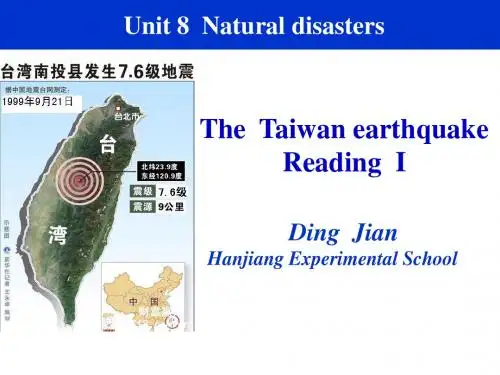
The earthquake hit Yangzhou last summer
Mr Ding’s story
I was sick in hospital last summer. I was lying in bed when earthquake happened, my wife was looking after me, my daughter was watching TV at home with her grandparents. At that time I felt a slight shake, I heard the people outside scream in fear. I saw the people in the street run in all directions through the window. At first I was very nervous , my heart was beating fast . But after a short while, I found everything was OK. I’m not afraid at all, my wife asked me to calm down, because we are still alive, we are safe.
Ⅱ Pre-reading 2
Background of Taiwan Earthquake
There was an earthquake in Taiwan. It happened on 21st September 1999. 12,000 buildings fell down . 1,700 people died. Timmy survived the earthquake. He wrote his story and put it on his home page.
初中英语译林版备课资料8AUnit 8 Natural disasters讲解分析+教案设计+习题设计+单元检测

Unit 8 Natural disasters单元概述单元教材分析:本单元围绕Natural disasters这个话题展开,让学生谈论了解各种自然灾难以及在各种自然灾难中如何自救,并注意从学生自己生活的实际环境出发,拓展了一些自然现象和自然灾害。
“Comic strip”部分通过Eddie和Hobo的对话情境,激发学生对本单元的学习兴趣,引出天气状况,同时初步导入本单元的重要语法——过去进行时。
“Welcome to the unit”部分通过对比自然灾难与人为事故来了解并掌握几种常见的自然灾难的名称,掌握句式:…if…和Was anyone hurt?等;“Reading”部分通过学习了解台湾地震幸存者Timmy的故事,了解台湾地震的基本情况,培养学生根据关键词和语境猜测大意的能力,学习并掌握大量的词汇、词组和句式,理解使用过去进行时的语境,同时培养学生根据已有的阅读材料抓住故事细节和故事情节发展的能力,引导学生运用正确的阅读技巧,全面提高阅读能力,教育学生在自然灾难中的自我保护。
“Grammar”部分介绍了过去进行时的构成和用法,学会“while”“when”和“as”在过去进行时中的具体运用;“Integrated skills”部分让学生通过听录音,从录音材料中提取信息,补全灾难预防提示表,并以“What should we do first?”让学生学会处理一些日常生活中的突发事故,训练学生的听、说、读、写技能;“Study skills”是英语构词教学中的一种,通过把两个独立的英语单词结合到一起构成另外一个单词,也就是“合成法”。
学生通过学会通过两个单词的意思,猜测出它们构成的新词的意思;“Task”部分通过回顾单元基础知识,学习在写作中陈述事实性信息,让学生根据一些要点完成Sandy 的范文,并根据范文设计出一种自然灾难文章的要点提纲,尝试写出相关文章。
训练学生的写作能力,综合运用英语的能力。
牛津译林版八年级上册Unit 8《Natural disasters》(Grammar 2)-课件
科学课件:/kejian/kexue/ 物理课件:/kejian/wul i/
化学课件:/kejian/huaxue/ 生物课件:/kejian/she ngwu/
地理课件:/kejian/dili/
when 后通常加短暂性动词,如:arrive, come in, get up, open, close, finish, begin, come, go, arrive, reach, get to, leave, move, borrow, buy, die, knock 等 While后通常加延续性动词, 如:live, run, stay, clean, play, hold, watch, teach, read, study, teach, eat, drink, write, dance, sing, smoke 等
PPT论坛:
PPT 课件:/k ejian/
语文课件:/kejian/yuw en/ 数学课件:-/kejian/shuxue/
英语课件:/kejian/ying yu/ 美术课件:/kejian/me ishu/
He was taking a shower while his wife was talking on the phone.
while 引 导 的 时 间 状 语 从 句 , 谓 语 动 词 只 能 是 延 续 PPT模板:-/moban/
PPT素材:-/sucai/
PPT背景:-/beijing/
PPT图表:/t程: /powerpoint/
资料下载:/ziliao/
范文下载:-/fanwen/
试卷下载:/shiti/
教案下载:/jiaoan/
历史课件:/kejian/lish i/
牛津译林版八年级上册Unit8《Naturaldisasters》(Grammar)说课稿
牛津译林版八年级上册Unit 8《Natural disasters》(Grammar)说课稿一. 教材分析《Natural disasters》是人教版牛津译林八年级上册的一篇课文,主要介绍了一些自然灾害的成因及应对方法。
通过本节课的学习,学生能够掌握一般现在时的被动语态,提高阅读理解能力,同时增强对自然灾害的防范意识。
二. 学情分析八年级的学生已经具备了一定的英语基础,对一般现在时态和被动语态有所了解。
但部分学生对英语阅读兴趣不高,且对于自然灾害相关知识了解有限。
因此,在教学过程中,需要关注学生的兴趣,引导学生主动参与课堂活动,提高他们的阅读理解能力。
三. 说教学目标1.知识目标:学生能够掌握一般现在时的被动语态,正确运用动词的过去式和被动式。
2.能力目标:学生能够阅读并理解关于自然灾害的英语文章,提高阅读理解能力。
3.情感目标:学生能够增强对自然灾害的防范意识,学会保护自己和他人。
四. 说教学重难点1.重点:学生能够掌握一般现在时的被动语态。
2.难点:学生能够运用一般现在时的被动语态描述自然灾害。
五. 说教学方法与手段1.教学方法:采用任务型教学法,让学生在完成任务的过程中,自然而然地掌握语言知识。
2.教学手段:利用多媒体课件、图片、视频等,激发学生的学习兴趣,提高课堂效果。
六. 说教学过程1.导入:展示一些自然灾害的图片,如地震、洪水等,引导学生谈论对这些灾害的了解和感受。
2.阅读理解:让学生阅读课文《Natural disasters》,回答相关问题,检测学生对文章内容的理解。
3.语法讲解:讲解一般现在时的被动语态,让学生通过例句和实践,掌握这一语法知识。
4.小组讨论:学生分成小组,讨论如何用英语描述一种自然灾害,以及如何防范。
5.展示与评价:每个小组选择一名代表,展示他们的讨论成果,其他同学和老师进行评价。
6.总结与反思:教师引导学生总结课堂所学,让学生反思自己在课堂上的表现,以及如何提高。
译林牛津版八上英语 Unit 8 Natural disasters Grammar教案
Natural disasters课题Grammar 总第课时备课时间上课时间课时Period 4 教具Pictures tapeTo understand when to use the past continuous tense. TeachingaimsTo recognize and use the past continuous tenseTeachingfocusTo recognize and use the past continuous tenseDifficultpointsTeachingTask-based approach,Scene pedagogy and Teaching with humor methodTeaching proceduresSTEP 1 QuestioningSay, ‘Now, I am teaching you. You a re listening to me caref(ask A)What are y ou doing?(ask B)What did A do just now?(ask B)What were you doing whe n A answered my question?(ask C)What were you doing w hen I came in?(ask A)What was C doing at that time?(ask D)What were you doing while I was talking with A,B,C?Step2Design a sceneAs the students are talking about the things they do, writethe structure of past continuous tense ‘was/wer e +doing’on the board.STEP 3 Paying attention to uses of wordsDuring the students describing the pictures, pay attentionto use ‘was’ and ‘were’ to cons olidate the past continuoustense.STEP 4 Describing t he pictureDescribe the picture in general questions and give thempositive and negative answers. Practice in pairs. Write the two kinds of answers on the Bb.Was David cooking at eight yesterday? Yes, he was.Was David having dinner at 8 last night? No, he wasn’t. STEP 5 Practicing the dialogueAfter finishing describing the nine pictures, practice the dialogue like this.T: What was David doing last night at eight last night? Ss: He was doing some cooking.Practice in pairs. Let them choose any picture they want. STEP 6 Completing Part A1Get the students to complete Part A1, Page 99. Check the answers in pairs and in class. Explain the main phrases in the dialogue e.g. ‘discuss … with…’ and ‘plan a tri p to’. Get them to read the dialogue aloud.Ask the students some question to offer them more chance for practice.STEP 7 Finishing the dialogueFinish the dialogue in Part A2, and then check the answers. Explain some the main phrases like ‘see…doing’ an d ‘as usual’.Ask the students to close the book. Ask them some qu estions about this dialogue.STEP8HomeworkDo more exercises about past continous tense。
牛津译林版八年级英语8A Unit8 Natural disasters知识点归纳总结

8A Unit8 Natural disasters一.词汇拓展1.shake v.→shaking (n.) 摇动2.direct v. →direction(n.) 方向3.live v. →alive (adj.) 活着的4.safe adj. →safety(n.) 安全5.fear (n.) →fearful(adj.)可怕的、担心的二.重点短语1. wash away 冲走wash 代词away2. be all wet 全湿了3. start to rain 开始下雨4. wake up 醒来wake代词up wake up+名词5. mop up the water 把水拖干净6. crash into a tree 撞在树上7. start big fire 引起大火8. fall from the tree 从树上掉下来9. a heavy storm with thunder and lightening 伴有雷电的大暴雨10. catch fire 着火11.in the early morning 在清晨12.feel a slight shake 感觉到轻微的晃动13.hear a loud noise like thunder 听到像雷声的噪音14. start to shake 开始摇晃shake hands with sb.15.scream in fear 恐惧地尖叫16. run out of the building 跑出楼房17.try my best to run out 尽我所能的跑出18.begin to calm down 开始平静下来19.say to oneself 自言自语20. calm down 平静下来21. silent silence silently 安静寂静的22. not at all 一点也不23 find one’s way out 找到出路24. hear about the fire 听说火灾hear of 听说hear from收到...的来信25. Was anyone hurt? 有没有受伤?hurt v.adj.26. fear v. fearful fearless 害怕A moment of fear went through my mind. 一丝恐惧掠过我的脑海。
新牛津译林版八年级英语上册Unit8 Grammar 教案
Unit 8 Natural disastersGrammar 教案I. Teaching aims and learning objectivesBy the end of the lesson, students should be able to:1. use the past continuous tense to talk about things that were happening at a particular time in the past;2. use conjunctions of time “when, while, as” to talk about things.II. Teaching contents1. New words and phrases: break down, because of2. New structures: I was sleeping when the earthquake started.Outside, people were running in all directions while pieces of glass and brickswere falling down.Hours later, as I was trying to find my way out, I suddenly heard some noiseabove me.III. Focus of the lesson and predicted area of difficultyIntroduce the structure of the past continuous tense.Tell the differences among “when, while, as”.IV. Teaching proceduresA Past continuous tenseStep 1 Lead-in1. Show some pictures of the Taiwan Earthquake, and ask three questions:What was Timmy doing when the earthquake started?What were people doing while pieces of glass and bricks were falling down?What did Timmy suddenly hear as he was trying to find his way out?2. Watch a video and then answer a questionWhat were people doing when the earthquake happened?【设计意图】有目的、有意义地导入,既复习了阅读部分学习的内容,同时也引导学生思考过去进行时态。
最新牛津译林初中八年级英语上册《Unit 8 Natural disasters Grammar》教案
《Unit 8 Natural disasters Grammar》GrammarTeaching aims and demands:New words: project, discuss, guidebook, terrible, break, break down, snowball, hit Teaching methods: task-based approachTeaching task:1 Further study the past continuous tense.2 Learn “while” and “when” in the past co ntinuous tense.Teaching aids: tape recorderTeaching p rocedures:Task 1 Ask and answer.Ask and answer (Model):A: What was he / she doing?B: Was he / she …?A: No, he/she wasn’t. He/she was ……A: Wha t were they doing?B: Were they …?A: They were ……A: What were they doing?B: We re they swimming?A: Yes, they were.A: What was he doi ng?B: Was he watching TV?A: Yes he was.A: What was she doing?B: Was she playi ng basketball?A: No she wasn’t. She was playing volleyball.Task 2 Oral practice.Task 3 Presentation.Grammar: Using the pastconti nuous Tense运用过去进行时态语法简介:过去进行时态(一)构成was (were) + 动词-in g构成。
08牛津译林版 8A Unit 8 Natural disasters语法知识点
8A Unit 8 Natural disasters语法知识点讲解一【课文重点内容和语法】1 about a person surviving an earthquake 关于地震中的幸存者2 to use the new words to talk about a natural disaster story 用新单词来谈论一次自然灾害中的故事3 to use the past continuous tense 使用过去进行时to use when, while and as 使用when,while,和as4 to create compound words 创造复合词二【重点短语】1 wake up 醒来2 crash into 撞上……3 fall from 从……上跌落下来4 mop up 把……拖干净5 wash away 冲走6 catch fire 着火7 feel a slight shake 感到轻微震动8 run out of 从……中跑出9 in all directions 四面八方10 come down 坍塌11 not…at all 一点也不12 a moment of fear 片刻的恐惧13 calm down 冷静下来14 shout for help 呼救15 move away 移开16 find one’s way out 找到出路17 at last 最后,终于18 break down 出故障,坏掉19 because of 因为,由于20 as…as possible 尽可能三【重点句型】1 Who will mop up the water if I go home without you? 如果你不跟我回家,谁将拖干水呢?2 There was a heavy storm with thunder and lighting. 有一场暴风雨,电闪雷鸣。
牛津译林版8A英语八年级上册Unit 8 Natural disasters Reading I The Taiwan Earthquake 公开课课件
If at home: Hide under a heavy table or bed.
post-reading
8A Unit8 Natural disasters Reading1
If on a road:
1. Use something hard (硬的) to protect your head.
What happens when an earthquake comes?
earthquake
ground
[ ʃeik ]
The ground starts to shake.
a slight shaking not a strong shaking
[bɒm]
The noise is like bombs under the ground.
[də ' rekʃn ]
People run in all directions. 四面八方
Pre-reading
8A Unit8 Natural disasters Reading1
What happens when an earthquake comes?
earthquake
building
The buildings come down . bricks
崩塌,坍塌
[ brɪk ] 砖,砖块
Pieces of glass and bricks fall down.
Pre-reading
8A Unit8 Natural disasters Reading1
What can you see in the earthquake?
fear
F 4. A moment of joy went through uted for help, but no one came.