
外研版(一起)四年级英语下册教案教案Module 7 Unit 1教案
Module 7 Unit 1
What’s the time?
教学模式介绍
探究式教学模式是指在教学过程中,要求学生在教师指导下,通过以“自主、探究、合作”为特征的学习方式对当前教学内容中的主要知识点进行自主学习、深入探究并进行小组合作交流,从而较好地达到课程标准中关于认知目标与情感目标要求的一种教学模式。
其中认知目标涉及与学科相关知识、概念、原理与能力的掌握;情感目标则涉及思想感情与道德品质的培养。
探究式课堂教学模式的教学环节:
创设情境——启发思考——自主(或小组)探究——协作交流——总结提高
设计思路说明
【创设情境】
学生在本部分之中,将欣赏歌曲《What’s the time》,熟悉钟点的表达法看,为下面的学习做下铺垫。
【启发思考】
学生在该部分中将通过观察钟表的方式,学习钟点的提问和表达方式,着重学习整点的表达法。
【自主或小组探究】
本部分中,学生将学习本课中的对话。
通过本部分的学习,学生将可以学习新的单词,运用并熟悉本课表达重点的句型,将运用到实际生活中。
【协作交流】
本节的协作交流内容是根据上部分的对话,进行角色扮演。
通过角色扮演和分角色朗读,熟悉本课的知识。
【总结提高】
本部分的意义在于总结本课所学到的知识,补充学生需要的新知识。
就本课而言,主要是重点的提问和整点时刻的表达。
教材分析
本本单元是外研新标准英语(一年级起点)模块七Unit1 What's the time?教授如何询问
和说明时间,用到的主要句型What’s the time?本部分是对前面知识的延伸与拓展。
同时学生将学习整点在英文中如何表达。
教学目标
【知识与能力目标】
1.学生能理解并正确认读单词cartoon, much
2.能够用句型What’s the time? It’s ...和Is it... now? Yes, it is./No, it isn’t.来询问和说明时间。
【能力目标】
能够用英语谈论时间。
【情感目标】
明白时间一去不复返,学会珍惜时间,养成惜时的好习惯。
教学重难点
【教学重点】
‘能够用句型What’s the time? It’s ...和Is it... now? Yes, it is./No, it isn’t.来询问和说明时间。
【教学难点】
能运用let’s 句型说明计划和打算。
课前准备
1.教具准备:智慧课堂设备、worksheet、图片
2.场景准备:进行合理的分组,将教室布置成适合进行活动的布局。
教学过程
一、创设情境
1.师生问候。
2.播放歌曲《What’s the time》,请学生欣赏。
3.请学生回答我们可以一起做什么。
4.有条件的班级可以尝试一起唱这首歌。
二、启发思考
1.教师拿出一个闹钟,请学生回答这是什么东西,引出本节课要学习的内容。
2.教师转动指针分针,展示不同时刻钟,请学生回答。
T:What’s the time?
S:It’s XX o’clock.
3.学生之间可以利用有钟表的图片进行对话练习,通过图片巩固关于钟点的提问和回答。
三、自主或小组探究
Presentation
T: Our friend has a time problem. Let’s see what happened.
1.picture reading
课件出示图片Who are they?
What are they doing?/talking about ?
2.Listen, ask and answer
Why is Sam so happy?
What is Sam doing at 8 o’clock?
Does Sam like cartoon?
Is Sam watching cartoon at 8 o’clock?
Why is Sam so tired? What did he do?
3.教授新单词cartoon, much.
4.第二次播放录音,学生跟读。
5.请同学上台复述故事。
Practice
1.小组内用英语提问和回答图片上的钟点。
2.老师展示图片,询问学生钟点,完成P40的练习4。
四、协作交流
1.学生分组,自行分配角色。
2.小组内关于课文对话进行操练。
3.小组进行展示,看哪一组的表现比较好。
五、总结提高
1.老师回顾总结本课两个重点句型,并展示本课的例子。
重点句型:--What time is it?
-- It’s XX o’clock.
2.Homework
1.完成畅言教学的配套练习。
2.抄写本课生词三遍,并造句。
教学反思略。
外研版四年级下册英语Module7Unit1-I-helped-Mum教学设计
I helped Mum.教学设计一、教学目标(一)知识目标1•句型:l helped Mum. I cooked noodles. I washed clothes.2.单词:had, phone, cook, really, wash, did, didn' t, computer, love, him(二)能力目标1 .全体学生能理解用V-ed来表达过去的方式,全体学生能理解:had, phone, cook, really, wash, did, didn' t, computer, love, him 以及What about…其中90%的学生能运用cooked, washed,50%的学生能运用phone, really 以及What about---?2.70%的学生能带着问题听录音并找到相应答案。
(三)情感目标1、通过谈论自己的假期,了解合理安排周末时间的重要性。
2、大多数学生在鼓励性评价中能大声说,大胆做,充分体会交流对于英语学习的重要意义。
三、教学重难点1>重点:能口头运用cooked、washed来表达过去的做过的事。
2、难点:能理解用V-ed来表达过去的方式,读准cooked> washed的读音。
四、教学准备L多媒体课件2.词条若干。
3.随堂练习。
五、教学策略(一)情景创设法本课以“谈论holiday”这一线索贯穿全文,引导和启发学生在情境当中感受语言的交际功能,并让他们通过多种游戏和活动,逐步熟练运用所学到的语言,培养和引导学生与同伴互助合作,共同探究学习道路上的困惑,分享成功的喜悦。
(二)任务教学法本课以任务型教学为主,以学习课文了解Amy's holiday-结合图片谈论他人的happy holiday谈论自己的happy holiday这样一条主线,循序渐进地完成教学目标。
(三)利用评价将全班分为两大组,采用小组比赛的方式进行激励性评价。
四年级英语下册 MODULE7 unit1教案 外研版
(外研版)四年级英语下册教案Module7Module 7 Countries 单元分析本单元由Unit1 New York is in the east. Unit2 Beijing is the capital of China. 组成,谈论国家、首都、城市及地理方位等。
同时通过学生查看百科全书或到图书馆、互联网上查阅相关资料,制作一个英语简报,介绍自己最喜欢的国家或城市,贴到班级的板报栏中展示,并和其他同学用英语交流相关信息。
Unit 1 New York is in the east.Teaching aims:Washington D.C .is the capital of the USA.It's in the east.Teaching importance:Direction.Teaching difficulties:CountryTeaching Tools:ReporterTeaching steps:Step one :Warm up1 Sing a song.2 On the board write the words'United States of America'. Show the students a map of the USA or draw a rough map on the board.Ask the students if they know anything about the USA.They may have heard of New York,Hollywood, Disneyland and perhaps the names of some famous people. Write the students' suggestions on the board. Talk about each one briefly or ask the students to give some information about them.3 If the following names are not on the board, write them and indicate the syllables and stress.4 Say the words and get the students to repeat them.Make sure to leave the words on the board for the following activity.Step two: Listen and pointEnsure that the students remember the words'city'and 'country'.Say, 'Is Beijing a city?' Nod your head and prompt the students to answer,'Yes,it is.'Then say,'Is Shanghai a country?'Shake your head and the students should say.'No, it isn't.' Prompt them to continueand add,'It's a city.'Let's play a game: I am goint to call out the name of something and you have to say whether it is a city or a country.OK?Step three:Listen and sayDraw a rough map of the USA and mark the following places on the map:New York, San Francisco and Washington D.C.Allow the students to look at the map for one minute and then erase the names.Leave circles to mark the places you have erased.Now point to a circle and ask,'Which place is here?' The students should respond,'That's [city name].'Step four:Point ,ask and answerShow a map of China or draw one on the board.Mark the compass pointd'east'and'west'if they are not already on the map.Now write the names of some cities that are in the east and some that are in the west. Explain to the students that you are going to call out the name of a city and they have to say if the city is in the east or west.Step five: Homework。
外研版四年级英语下册module7unit1what'sthetime教案2.doc
Module 7 Unit 1 What's the time?教案1新设计1. 学习怎样用英语表达时间,掌握相关单词和句型,并能综合运用新旧知识组织对话,完成一定的交际任务。
2. 培养学生用英语思维的能力,在日常生活中运用所学知识,用英语进行大胆交流。
2教学目标1. 学习怎样用英语表达时间,掌握相关单词和句型,并能综合运用新旧知识组织对话,完成一定的交际任务。
2. 培养学生用英语思维的能力,在日常生活中运用所学知识,用英语进行大胆交流。
3学情分析四年级的学生已经有一定的英语基础,掌握了一些简单的英语句型,对时间表达很了解,对于掌握英语时间的表达有帮助。
课堂以游戏教学为主,提高孩子们的兴趣河学习效率。
4重点难点1. 听懂、会读、会说句子What’s the time?It’s … o’clock.2. 掌握问答整点时间的表达方法。
3. 熟练掌握本课单词及句子,能在实际生活中灵活运用。
4. 创设英语情景,使学生正确询问和回答整点时间。
5教学过程活动1【导入】Step 1.GreetingsGood morning, boys and girls. I’m happy to see you here! I’m Cynthia. I will give you an English class today.Step 2. Warming upSing a song. Ten Little Fingers On My Hands.复习学过的数字活动2【讲授】Presentation1. Guess. I have a good friend. It has a round face. It has two arms. It has no any legs, but it can walk. It can wake me up in the morning.What’s this?解释句子,帮助学生猜测,最后告诉学生:It’s a clock! 板书clock,并问学生钟表能干什么?引出时间time, 并板书,强调time的读音。
外研版小学英语四年级下册 Module7 Unit1 I helped Mum 教学设计
Unit1 I helped Mum教学目标:1、掌握词汇:phone, cook, wash, computer, really, what about, did, did n’t, love, him。
2、掌握句型:I helped Mum and I washed clothes..I cooked noodles yesterday.用I ...yesterday 等句型描述自己昨天做了什么事情。
3、掌握动词过去式的标志后缀-ed。
4、能够正确运用动词过去式来进行描述。
教学重点:1、掌握词汇:phone, cook, wash, computer, really, what about, did, did n’t, love, him。
2、掌握I helped Mum and I washed clothes.. / I cooked noodles yesterday.等句型,并能用I ...yesterday 等句型描述自己昨天做了什么事情;3、掌握动词过去式的标志后缀-ed。
教学难点:1、能够实践练习中熟练运用本节课的新单词和句型。
2、能够正确运用动词过去式来进行描述教学准备:PPT、单词卡片、点读笔、教学光盘教学过程:Step 1: Warm upGreeting.Step 2: Presentation1、说出is, am, are的过去式。
2、读一些学过的动词词组。
(play basketball,play football,play table tennis,row a boat,watch TV,help Mum)3、学习新单词:cook,wash,computer,phone。
新词组:cook noodles,wash clothes,play on the computer,phone my friend。
教师用课件展示自己昨天做的事情,让学生从句子中归类总结出动词过去式的变化方法。
外研版四下Module7Unit1IhelpedMum单元教学设计
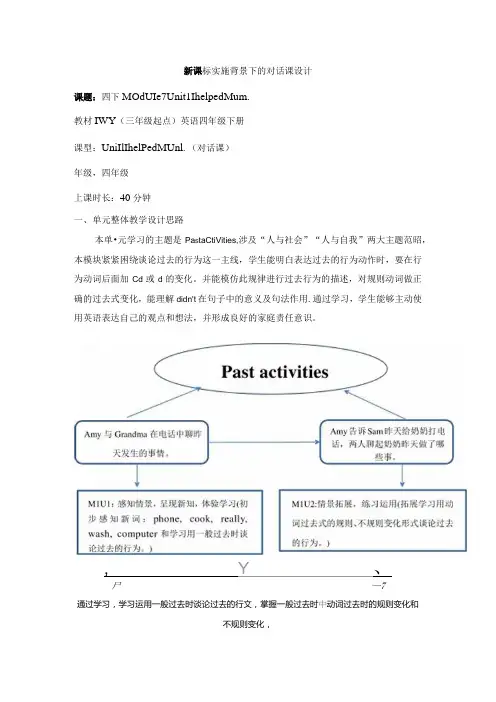
新课标实施背景下的对话课设计课题:四下MOdUIe7Unit1IhelpedMum.教材IWY(三年级起点)英语四年级下册课型:UniIlIhelPedMUnl.(对话课)年级,四年级上课时长:40分钟一、单元整体教学设计思路本单•元学习的主题是Pa S taCtiVities,涉及“人与社会”“人与自我”两大主题范昭,本模块紧紧困绕谈论过去的行为这一主线,学生能明白表达过去的行为动作时,要在行为动词后面加Cd或d的变化。
并能模仿此规律进行过去行为的描述,对规则动词做正确的过去式变化,能理解didn't在句子中的意义及句法作用.通过学习,学生能够主动使用英语表达自己的观点和想法,并形成良好的家庭责任意识。
, Y 、尸—7通过学习,学习运用一般过去时谈论过去的行文,掌握一般过去时中动词过去时的规则变化和不规则变化,二、语篇研读(附图)What l本出课选自外语教学与研究出版社的英语(三年级起点)四年级下册Module7UnilIIhelpedMum.本部分学习的核心语言是运用一般过去时谈论过去的行为。
课文情景是Amy与Grandma在电话中交流了昨天Sam在家玩电脑、看电视,没有帮妈妈:Tbm帮妈妈洗碗,自己帮忙做饭、洗衣的行为,通过对话呈现了过去行为的基本表达方式和动词变化规律。
同时教育孩子们要多参加家务劳动,为家人做力所能及的贡献。
核心语言使用场景为日常生活常见,易于理解且学生感兴趣,对学生的个人生活态度的养成有积极的作用。
Why:本课时通过Amy与Gmndma在电话中交流了昨天发生的事情,学习用一般过去时谈论过去发生的事情“通过创设情景,激发学生的学习兴趣,鼓励学生把所学内容运用到生活实际中。
How:本课时是对话课教学模式,用一般过去时谈论过去发生的事情,同伴之间互动问答,谈论过去发生的事情,强调学生在自主探究、小组合作和多元评价的过程中提高沟通能力和解决问题的能力。
三、教学对黛分析在ModUle5、6中,学生己接到描述过去状态的WasAVCrC陈述、否定、一殷疑间表达形式。
Module 7(教学设计)外研版(一起)英语四年级下册
Module 7(教学设计)外研版(一起)英语四年级下册Part 1: OverviewModule 7 is designed to help students learn the names of different places in the city and how to give directions. Students will also learn how to use simple prepositions of place and some basic sentence structures to ask for and give directions.Part 2: ObjectivesBy the end of this module, students will be able to:•Identify and name different places in the city, such as the park, the supermarket, and the hospital.•Use prepositions of place, such as “in,”“on,” and “near,” to describe the location of various places.•Ask for and give directions in English, using basic sentence structures.Part 3: Teaching Strategies1.Warm-up: Start the lesson with a picture or video that shows different places in the city. Ask students to identify each place in the picture or video, and practice saying the names out loud.2.Vocabulary: Introduce new vocabulary related to different places in the city, such as park, library, museum, etc. Use flashcards, pictures, or videos to help students remember the names and locations of these places.3.Prepositions of Place: Introduce prepositions of place, such as “in,” “on,” and “near.” Use examples to show how to use each preposition correctly.4.Asking for Directions: Teach students how to ask for directions, using questions such as “Excuse me, where is the …?” and “Can you show me the way to the …?” Model the appropriate responses for each question and have students practice asking and answering questions in pairs.5.Giving Directions: Teach students how to give directions using basic sentence structures, such as “Go straight on …,” “Turnleft/right at the …,” and “It’s opposite/near the …”. Havestudents practice giving directions to a partner and using the prepositions of place correctly.6.Reinforcement: Use games, quizzes, and other activities to reinforce the new vocabulary, prepositions of place, and sentence structures learned in this module.Part 4: AssessmentUse various assessment techniques throughout the module. Examples include:1.Observations: Observe students during activities, games, and exercises, and check for understanding.2.Worksheets: Give students worksheets that require them to use the vocabulary, prepositions of place, and sentence structures learned in this module.3.Role-Playing: Have students take turns asking for and giving directions to a partner.4.Vocabulary Quiz: Conduct a vocabulary quiz to check students’ understanding of the new vocabulary words.Part 5: ConclusionBy the end of this module, students will have learned the names of different places in the city, how to use prepositions of place, and basic sentence structures to ask for and give directions. Through various teaching strategies and assessment techniques, students will have a solid understanding of the content covered in this module.。
外研版四年级英语下册Module 7 Unit 1 I helped Mum 教案
Module 7 Unit 1 I helped Mum.教案教学目标:使学生能听、说、认识、口头运用单词:phone, cook, really…能理解并口头运用:I helped mum. I cooked…情感目标:通过本课的学习,激发学生学习兴趣和动力。
教学重点:1、认识新单词三会(会说、会听、会读):phone 电话cook做饭really 真的2、掌握新句子:两会(会听、会说):I helped mum. I cooked…我帮妈妈做______。
教学难点:理解并口头运用:I helped mum. I cooked…知道如何做简要的介绍。
教学流程:Class opening1、Greeting: Hello! /Hi!New Concepts1、利用图片引出对话,并对其进行介绍:I helped mum. I cooked…(说出图片),接着介绍I helped mum. I cooked…,教师可以重复这句话,使学生理解它,如果学生不能明白,教师就多举几个例子,例如:在学生理解句子的含义后教师试着让学生造句:I helped mum. I cooked…反复进行几组后就要放手让学生自己来练习了。
教授单词和句子同上述方法。
设计意图:根据年龄特点,用创设情景的方法,直观的将所学内容展示给学生,生动活泼,使学生容易接受新知。
激发学生的学习兴趣。
2、Listen to the tape, and read after it.设计意图:让学生在模仿练习进一步熟练课文内容,并同时进行听力训练。
3、Play a game.游戏规则:让几名自告奋勇的学生面对全班站在教室的前面,教师站在这一排学生得一端拿着卡片提问。
设计意图:通过游戏使学生能有亲身体验,并激发他们的学习兴趣,在游戏中轻松愉悦地获得新知。
4、Make a dialogue in groups.设计意图:使学生在活动中发散思维,并培养他们的合作创新精神,能够运用所学知识进行简单的口语交流,培养自主学习能力。
外研版四年级英语下册module7unit1what'sthetime教案3
Module 7 Unit 1 What's the time?1教学目标一、教学目标(一)知识目标:掌握并能运用句型“What’s the time , please?” “It’s...”(二)能力目标:能运用所学的语言知识在创设的情境中进行熟练地交际,并在此基础上蒋其运用于日常生活中。
(三)情感目标:激发学生学习英语的兴趣,帮助学生树立学好英语的信心,增强学生的参与意识,引导学生积极与他人合作,共同完成学习任务。
2学情分析二、学情分析四年级的学生活泼好动,对语言的领悟模仿能力很强。
学生已经学了四年英语,听、说能力已经入门,前面已经学习了数字,有了一定的语言基础,基本能够表达出时间。
3重点难点三、教学重点和难点(一)、掌握2个句型:What’s the time , please?It’s ….(二)、熟练运用2个句型参与交际。
4教学过程活动1【导入】What`s the time(一)、Warm up1、Say “Hello” to the students.2、Let’s say the chant.3、Who can make the sente nces with “Let’s ”4、Now let’s watch the cartoon.活动2【讲授】(二)、New Concepts1、What’s the meaning of “cartoon”?2、Teach: cartoon, and write it on the blackboard.3、分层次操练4、Now it’s cartoon time. Let’s watch.5、Who know: What’s the meaning of cartoon time.6、Ok. Write the word on the blackboard.7、How to ask the time.8、Now today let’s learn M7 U1 What’s the time?9、Open your books and turn to page 38, let’s listen to the tape10、It’s ____o’clock.11、Ok. Look at the pictures. What’s the time?12、Turn to page 40. Ask and answer in pairs.13、Now let’s watch the cartoon again and then answer my questions.14、Read the questions one time.15、Play the cartoon and let the students to watch.16、Answer my questions.17、Good. Now let’s read follow the computer.18、Let’s act them.活动3【练习】(三)、Practices1、Now it’s game time.2、First let’s have a look how to play.3、The students watch again.4、When the wolf say” Dinner time”, the sheep must run.5、Good. Now let’s read the text yourselves.6、Now let’s play. Who can act wolf? Who can act sheep?活动4【导入】(四)、HomeworkNow today let’s learnt M7 U1 What’s the time? This is your homework. Ask the students to watch the computer. Do you remember?。
外研版(一起)四年级英语下册教案Module 7 Unit 1教案
Module 7Unit 1 What's the time?本单元是外研新标准英语(一年级起点)模块七Unit1 What's the time?教授如何询问和说明时间,用到的主要句型What’s the time?本部分是对前面知识的延伸与拓展。
【知识目标】1.学生能理解并正确认读单词cartoon, much2.能够用句型What’s the time?It’s ...和Is it... now?Yes, it is./No, it isn’t.来询问和说明时间。
【能力目标】能够用英语谈论时间。
【情感目标】明白时间一去不复返,学会珍惜时间,养成惜时的好习惯。
【教学重点】能够用句型What’s the time?It’s ...和Is it... now?Yes, it is./No, it isn’t.来询问和说明时间。
【教学难点】1.单词cartoon 的发音2.Is it ... now?的一般疑问句。
PPT、时钟、单词卡片Step 1. Warm- up1.Free talk.2. Look and say.(出示视频)数字从一到十er1.one2.two3.three4.four5.five6.six7. seven8.eight9.nine 10.ten 11.eleven 12.twelveStep 2. Preview1.What’s this? (学生的笔、橡皮、铅笔盒…… )T:What’s this? (黑板上方悬挂的时钟)引出clock。
2.课件出示时间,学生快速认读。
Step 3. PresentationT:Our friend has a time problem. Let’s see what happened.1.picture reading课件出示图片Who are they?What are they doing?/talking about ?2.Listen, ask and answerWhy is Sam so happy?What is Sam doing at 8 o’clock?Does Sam like cartoon?I s Sam watching cartoon at 8 o’clock?Why is Sam so tired?What did he do?3.教授新单词cartoon, much.4.第二次播放录音,学生跟读。
四年级下册英语教案-Module 7 Unit 1 What is the time∣外研社(一起)
四年级下册英语教案-Module 7 Unit 1 What is the time∣外研社(一起)一、教学目标1.学习并掌握数字1-12的英文表达方式。
2.学习并掌握日常时间的英文表达方式。
3.练习听、说、读、写四种能力。
二、教学重点1.数字1-12的英文表达。
2.时间的英文表达。
三、教学难点1.时间的英文表达。
2.语音语调的正确发音。
四、教学内容Part 1. 自主学习1.学生自学数字1-12的英文表达方式。
2.学生自学以下句子的意思和发音:–What time is it?–It’s one o’clock.–It’s two o’clock.–It’s three o’clock.–It’s four o’clock.–It’s five o’clock.–It’s six o’clock.–It’s seven o’clock.–It’s eight o’clock.–It’s nine o’clock.–It’s ten o’clock.–It’s eleven o’clock.–It’s twelve o’clock.Part 2. 听说练习1.教师播放音频,学生跟读以下句子:–What time is it?–It’s twelve o’clock.2.教师播放音频,学生听音并在练习本上写下听到的时间。
3.学生之间进行问答练习,练习以下对话:–A: What time is it?–B: It’s three o’clock.Part 3. 语言运用1.学生完成以下句子的填空练习:–_____ time is it?–It’s _____ o’clock.2.学生之间进行对话练习,练习以下对话:–A: What time is it?–B: It’s eight o’clock.3.学生进行模拟情境对话,练习以下对话:–A: What time is it?–B: It’s time for lunch.–A: What time do we have lunch?–B: We have lunch at twelve o’clock.五、教学评估1.学生完成填空、对话和模拟情境对话练习。