
人教版八年级上册英语Unit 1 知识点语法归纳总结
1 / 11 Unit 1 Where did you go on vacation? 1. 短语归纳 ① go on vacation去度假 ② stay at home 呆在家 ③ go to the mountains 上山/进山 ④ go to the beach到海边去 ⑤ visit museums 参观博物馆 ⑥ go to summer camp 去夏令营 ⑦ quite a few 相当多 ⑧ study for为……学习 ⑨ go out 出去 ⑩ most of the time 大部分时间/绝大多数时间 11 taste good 尝起来味道好 12 have a good time玩的开心 13 of course当然可以 14 feel like感觉像……/想要 15 go shopping购物 16 in the past 在过去 17 walk around绕……走 18 too many 太多(可数名词前面) 19 because of 因为 20 one bowl of 一碗…… 21 find out 查出来/发现 22 go on继续 23 take photos 照相 24 something important重要的事情 25 up and down上上下下 26 come up出来 2. 典句必背 ① —Where did you go on vacation? 你到哪里去度假了? —I went to New York City. 我去了纽约城 ② —Did you go out with anyone? 你出去带人吗? —No, No one was here. Everyone was on vacation. 不,没有人在这儿。大家度去度假了。 ③ —Did you buy anything special? 你买了什么特别的东西吗? —Yes, I bought something for my father. 对,我给父亲买了一些东西。 ④ —How was the food? 食物怎么样? —Everything tasted really good.每一样东西真的都好吃。 2 / 11 ⑤ —Did everyone have a good time?大家玩的开心吗? —Oh, yes. Everything was excellent. 对,一切都很精彩。 3. 用法集萃 (1) —Where did you go on vacation? 你去哪里度假了? —I went to the mountains. 我去爬山了。 ❖ Where did you...? 是一般过去时的特殊疑问句,其句式结构为:疑问词+did+主语+动词原形+其他成分?其中did是助动词,没有人称和数的变化,实义动词要用原形。 例:What did you do yesterday afternoon? 你昨天下午干什么了? I played tennis with my friend. 我和我的朋友一起打网球了。 ❖ on vacation意为“在度假”。 例:My family went to Hainan on vacation last year. 我家人去年去海南度假了。 (2) Oh, did you go anywhere interesting? 哦,你去什么有趣的地方了吗? ❖ anywhere是副词,意思是“任何地方;无论何处”,常用于否定句、疑问句或条件状语从句中。 例:I cannot find it anywhere. 我在什么地方都没找到它。 Are you going anywhere tonight? 今晚你要去什么地方吗? If you go anywhere, take me with you. 你要是去什么地方,带我一起去。 ❖ 若是肯定句中说某个地方,应用somewhere。 例:I remember seeing him somewhere. 我记得在哪儿见过他 ❖ somewhere/anywhere有时与修饰语连用,这时候,其修饰语要置于somewhere/ anywhere之后。 例:You can go anywhere interesting if you want. 如果你想,你可以去任何一个有趣的地方。 ❖ 辨析:somewhere,anywhere,everywhere与nowhere somewhere “某处、在某处”,强调在一个地方, 用于肯定句 I remember seeing him somewhere. 我记得在哪儿见过他 anywhere “在什么地方、任何地方”, I cannot find it anywhere. (否定句) 3 / 11 用于否定句、疑问句、条件状语从句中, 在肯定句中表示“随便什么地方” 我在什么地方都没找到它。 Are you going anywhere tonight? (疑问句) 今晚你要去什么地方吗? If you go anywhere, take me with you. (条件状语从句) 你要是去什么地方,带我一起去。 everywhere “到处、处处”,强调多个地方, 用于肯定句 He follows me everywhere. 我无论去哪儿他都跟着我。 nowhere “不在任何地方;任何地方都不”, 和anywhere是反义词,意思相反 He has nowhere to stick up his posters. 他没地方贴海报了。 (3) Did you buy anything special? 你买什么特殊的东西了吗? ❖ anything是复合不定代词,常用于否定句、疑问句及if或whether之后。 例:Do you have anything to say? ❖ 形容词修饰复合不定代词时,要把形容词放在复合不定代词后面。 例:Last night I saw someone strange lying on the ground near my home. 昨晚在我家附近,我看见一个陌生人躺在地上。 If you have anything important to tell me, please call me. 如果你有什么重要的事要告诉我,请给我打电话。 (4) We took quite a few photos there.我们在那里拍了相当多的照片。 ❖ take photos意为“拍照、照相”,take a photo of sb./sth. 意为“给...拍照”。 例:We took many photos on the Great Wall. 我们在长城上拍了很多照片。 ❖ few意思是“很少;几乎没有”,而a few表示“一些”,quite a few表示“相当多的”, 都修饰可数名词。 例:He has few friends here ,s0 he feels lonely. 他在这里几乎没朋友.所以他感觉寂寞。 Quite a few students go to school by bike. 相当多的学生骑自行车上学。 4 / 11 ❖ 辨析:few, a few与little, a little 注解 例句 few 后接可数名词,且要用复数形式,含否定意义 He has few friends. 他朋友很少。 a few 后接可数名词,且要用复数形式,不含否定意义 Please wait for a few minutes.请等几分钟。 little little后接不可数名词,含否定意义 He knows little English. 他几乎不懂英语。 a little a little 后接不可数名词,不含否定意义 There is a little milk in the bottle. 瓶子里有少量的牛奶。 巧记: a few beans有几粒豆子 few beans几乎没有豆子 little milk几乎没有牛奶 a little milk有一点牛奶 (5) How did you like it? 你认为它怎么样? ❖ How do you like...? 意为“你觉得...怎么样?”,用于询问对方的观点或看法, 相当于What do you think of...? 或How do you feel about...? 例:How do you like your new job? = What do you think of your new job? 你觉得你的新工作怎么样? (6) Still no one seemed to be bored. 好像仍然没有一个人感到无聊。 ❖ bored表示“感到厌倦的”,用来说明人的感受; boring表示“令人厌烦的、无趣的”,用来说明事物的特征。 例:She is bored with her job. 她对自己的工作不感兴趣。 The lecture was deadly boring. 那讲座真是乏味极了。 5 / 11 ❖ 以-ed结尾的形容词,通常用来修饰或者描述人,以-ing结尾的形容词,通常用来修饰或者描述物。 类似的形容词还有:interested/ interesting;excited exciting;surprised surprising。 (7) I arrived in Penang in Malaysia this morning with my family. 今天早上我和家人到达了马来西亚槟城。 ❖ 辨析:get, arrive, reach(三者都有“到达”之意,但用法上有所区别) get 不及物动词,其后若跟地点名词,要用get to How does he get to school? 他是怎样到校的? arrive 不及物动词,后面接地点名词时需加介词in或at, 大地点用arrive in,小地点用arrive at。 如果不接地点。则直接用arrive Lisa will arrive in Beijing next week. 莉萨将会于下周到达北京 How did he arrive at the airport? 他是怎样到机场的? reach reach是及物动词,后面可直接跟宾语,般不接地点副词 Please reach the TV station on time. 请按时到电视台 注意:当get, arrive后跟地点副词(如here, there, home等)的时候,其后不必加任何介词 例:We will get/ arrive there at nine. 我们会在九点到达那里 (8) It was sunny and hot, so we decided to go to the beach near our hotel. 天气晴朗且炎热,因此我们决定去我们宾馆附近的海滩。 ❖ decide意为“决定”,既可作及物动词,又可作不及物动词。 ❖ 作及物动词时,后面常接名词、动词不定式、“特殊疑问词+动词不定式”或宾语从句。 例:I can’t decide the date of the meeting. 我决定不了这次会议的日期。 We decided to go there. 我们决定去那里。 We decided that we would not go to the party tonight. 我们决定今晚不去参加聚会 ❖ 作不及物动词时,常与介词on或upon连用,后接可数名词。 例:She decided on the red shoes. 她决定买这双红色的鞋了。 (9) I wonder what life was like here in the past.我想知道这里过去的生活是什么样子的。
八年级英语上册第一单元重点语法汇总(人教版)
八年级英语上册第一单元重点语法汇总(人教版)
重点语法:
heredidugnvaatin?IenttNerit
Didugutithanne?N,NneashereEverneasnvaatin
Didubuanthingspeial?es,Ibughtsethingfrfather
Hasthefd? Everthingtastedreallgd
Didevernehaveagdtie?h,esEverthingasexellent
习惯用法:
busthfrsb/busbsth为某人买某物
taste+ad 尝起来……
nthing…but+V
除了…之外什么都没有
see++ad 看起来
arrivein+大地方
arriveat+小地方到达某地
deidetdsth 决定做某事
trdingsth 尝试做某事
trtdsth 尽力做某事
trne`sbesttdsth尽力做某事
endingsth喜欢做某事
anttdsth 想去做某事 startdingsth开始做某事
stpdingsth停止做某事
stptdsth停下来做某事
l+ad看起来
disliedingsth不喜欢做某事
hntdsth为什么不做……呢?
s+ad+that+从句如此…以至于
tellsbtdsth告诉某人做某事
eepdingsth继续做某事
frgettdsth忘记去做某事
frgetdingsth忘记做过某事
人教版八年级上册英语unit1知识点语法点及课后习题
Unit 1
Key words(重点单词):
anyone, anywhere, wonderful, few, most, something, nothing, everyone, myself, yourself, hen, pig, seem,
bored, someone, diary, enjoyable, activity,decide, try, bird, bicycle, building, trader, wonder, difference, top,
wait, umbrella, wet, below, enough, hungry, as, hill, duck, dislike,
(任何人,在任何地方,精彩的,不多, 最多,某事, 没有什么, 每人, 我自己, 你自己,母鸡,
猪,好像, 厌倦的, 某人, 日记, 有乐趣的, 活动, 决定, 尝试, 鸟,自行车, 建筑物, 商人,
想知道, 差别, 顶部, 等待, 伞,湿的, 在… 下面, 足够的, 饥饿的, 如同, 小山, 鸭, 不喜欢)
语法:一般过去时的用法
1.一般过去时:
概念:一般过去时用来表示过去某一时间内发生的动作或存在的状态以及过去习惯性,反复性的动作。谓语动词要用动词的过去式,常和表示过去的时间状语连用,如yesterday,last night, last week, last year
等。
例句:
Where did you go on vacation
I went to New York City.
(你去哪里度假了我去纽约度假了。)
Did you go out with anyone
No. No one was here. Everyone was on vacation.
八年级上册英语unit1-3知识点及语法
八年级上册英语unit1-3知识点及语法
词汇和语法是英语学习当中最基础也是最重要的部分,下面是小编给大家带来的八年级上册英语unit1-3知识点及语法,希望能够帮助到大家!
八年级上册英语unit1-3知识点及语法
Unit1
1. We had great fun playing in the water. 我们在水中玩得很高兴。
have fun (in) doing sth. 做某事很高兴 = enjoy oneself
We had a lot of fun swimming in the sea.
I have great fun talking with that little girl.
练一练(1) I have a good time on the beach. ( 同义句)
I ______ ________ on the beach.
(2) We have fun ______(sing) and ______( dance).
2. I found a small boy crying in the corner. 我发现一个小男孩在角落里哭。
find sb. doing sth. 发现某人正在做某事
He sat down and watched Wang Wang play with a friend
black cat.
感官动词 see, hear, feel, watch, listen to, look at, find
(1)感官动词+ 宾语+ 动词原形 强调看到/听到整个动作,或整个事件或行为的全过程
(2)感官动词+ 宾语+ 现在分词 强调看到/听到行动或事件正在进行
I saw him cross the street. 我看见他过了马路。(从一边到另一边)
I saw him crossing the street. 我看见他正过马路。(正在马路中间走着)
八年级上册人教版英语unit1知识点

八年级上册人教版英语unit1知识点
在八年级上册的人教版英语中,unit1主要涉及到课文内容的学习,以下是本单元的知识点详解。
一、课文概述
本单元的课文名为“My name’s Gina”,是一篇自我介绍性质的文章,主人公Gina通过这篇文章向大家介绍了自己以及她的家庭、朋友等方面的情况。同时,这篇课文也涵盖了一些常用的英语句型及单词,适合初学者学习。
二、词汇学习
1. 名词
article(文章)、class(课程)、photo(照片)、desk(书桌)、city(城市)、country(国家)、place(地方)、restaurant(餐厅)、friend(朋友)、parent(家长)、brother(兄弟)、sister(姐妹)、name(名字)、age(年龄)等。
2. 动词
be(是)、study(学习)、live(生活)、come(来)、have(有)、like(喜欢)、think(想)、watch(观看)、seem(似乎)等。
3. 形容词和副词
good(好的)、interesting(有趣的)、funny(有趣的)、friendly(友好的)、happy(快乐的)、sad(难过的)、different(不同的)等。
三、语法学习
1. 一般现在时的用法
一般现在时是英语中最基础也是最常用的时态,表示经常发生的事情、某种状态以及一些习惯性的动作等。例如:
- I live in Beijing.(我住在北京。) - He often goes to the library.(他经常去图书馆。)
- She likes playing basketball.(她喜欢打篮球。)
2. be动词的用法
be动词是英语中最常用的动词之一,它表示“是”或“存在”的意思。在一般现在时中,be动词有三种形式,分别是am、is和are,根据主语的不同而变化。例如:
- I am a student.(我是一个学生。)
八年级英语上册unit 1语法说明人教版
1 How often 引导的特殊疑问句
How often do ou do th 意为“你多久做一某事”该句型常用来询问某动作隔多久进行一次,即询问中间隔的时间长度、动作发生的频率。常见的答语是:awa, uua, often, ometime, hard ever,
three time a da, once a wee, ever da 等。 如:
------How often do ou hie with our friend 你隔多久和你的朋友去远足一次
------Ever Frida 每周五。
------How often do ou cean our room 你多长时间打扫一次你的房间
------Often 经常。
2 What do ou/doe he/he do on/in…… 句型
What do ou/doe he/he do on/in…… 你/他/她在……时间做什么这是询问某人在某时通常干什么的句型。答语通常为I/we 动词原形其他成分或He/She动词的第三人称单数形式其他成分。如:
-----What do ou do on Sunda 你在星期天干什么
-----I often cean m houe on Sunda 我星期天经常打扫我的房子。
1. -----What doe our father do after uorning
_____ _____ ou uua ______ in the morning
2. M mother goe to ee m grandonth
_____ _____ _____ our mother _____ to ee our grandarent
答案:1 How often doe 2 How often 3 What doe have 4 What do do
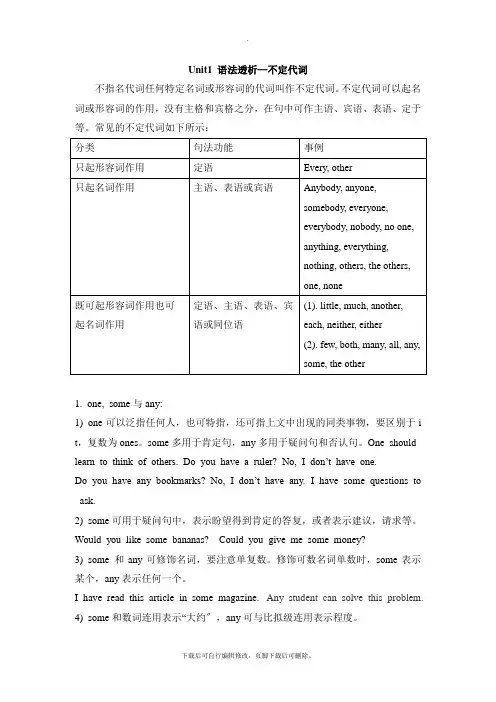
人教版英语八年级上册Unit1 语法透析—不定代词
.
下载后可自行编辑修改,页脚下载后可删除。 Unit1 语法透析—不定代词
不指名代词任何特定名词或形容词的代词叫作不定代词。不定代词可以起名词或形容词的作用,没有主格和宾格之分,在句中可作主语、宾语、表语、定于等。常见的不定代词如下所示:
分类 句法功能 事例
只起形容词作用 定语 Every, other
只起名词作用 主语、表语或宾语 Anybody, anyone,
somebody, everyone,
everybody, nobody, no one,
anything, everything,
nothing, others, the others,
one, none
既可起形容词作用也可起名词作用 定语、主语、表语、宾语或同位语 (1). little, much, another,
each, neither, either
(2). few, both, many, all, any,
some, the other
1. one, some与any:
1) one可以泛指任何人,也可特指,还可指上文中出现的同类事物,要区别于it,复数为ones。some多用于肯定句,any多用于疑问句和否认句。One should
learn to think of others. Do you have a ruler? No, I don’t have one.
Do you have any bookmarks? No, I don’t have any. I have some questions to ask.
2) some可用于疑问句中,表示盼望得到肯定的答复,或者表示建议,请求等。
Would you like some bananas? Could you give me some money?
3) some 和any可修饰名词,要注意单复数。修饰可数名词单数时,some表示某个,any表示任何一个。
八年级上册英语人教版unit1知识点
八年级上册英语人教版unit1知识点
本文将为您详细介绍八年级上册英语人教版Unit 1的知识点,包括单词、语法、口语表达等方面。
一、单词
1. Hobby– n. 爱好
例句:My hobby is playing basketball.
2. Active – adj. 积极的
例句:She is an active member of the club.
3. Lazy – adj. 懒惰的
例句:He is too lazy to do his homework.
4. Exciting – adj. 令人兴奋的
例句:The match was very exciting.
5. Boring – adj. 无聊的
例句:The movie was so boring that I fell asleep.
6. Interesting – adj. 有趣的
例句:The book is very interesting.
7. Tired – adj. 疲劳的
例句:I'm too tired to go to the party.
8. Energetic – adj. 精力充沛的
例句:She is always energetic in the morning.
二、语法
1. 祈使句
祈使句表示命令、请求或建议。用动词原形表示,一般不需要主语。
例句:
— Clean your room, please.
— Have a good trip.
— Let's go swimming.
2. 简单现在时
表示习惯性或经常性的动作、状态或真理等。在第三人称单数时,动词要加-s或-es。
例句:
— She always gets up at six.
— He likes playing basketball.
— Water boils at 100 degrees Celsius.
新人教版八年级上册英语单元语法及知识点归纳
新人教版八年级上册英语单元语法及知识点归纳
Unit1 Where did you go on vacation?
【重点语法】
不定代词:不指名代替任何特定名词或形容词的代词叫做不定代词。
用法注意:
1. some 和any +可数名/不可数名。
some 多用于肯定句,any多用于否定句、疑问句和条件从句 。有些问句中用some,不用any, 问话者希望得到对方肯定回答。
2. 由some, any, no, every 与 body, one, thing构成的复合不定代词作主语时,其谓语动词用三单。
3. 不定代词若有定语修饰,该定语要置于其后:如:something interesting
【重点短语】
1. buy sth for ab./ buy sb. sth 为某人买某物
2. taste + adj. 尝起来……
3. nothing...but + V.(原形) 除了……之外什么都没有
4. seem + (to be) + adj 看起来
5. arrive in + 大地方 / arrive at + 小地方 到达某地
6. decide to do sth. 决定做某事
7. try doing sth. 尝试做某事 / try to do sth. 尽力做某事
8. enjoy doing sth. 喜欢做某事
9. want to do sth. 想去做某事
10. start doing sth. 开始做某事=begin doing sth.
11. stop doing sth. 停止做某事 区分: stop to do sth. 停下来去做某事
12. dislike doing sth. 不喜欢做某事
14. so + adj + that + 从句 如此……以至于……
16. tell sb. (not) to do sth. 告诉某人(不要) 做某事
人教版英语八年级上册unit-1--10知识点
天才来自勤奋
1 新版八年级上册(Units1~10)英语基础知识单元分类
Unit 1 Where did you go on vacation? 一、词组、短语:
1、go on vacation去度假 , 2、stay at home 呆在家, 3、go to the mountains 上山/进山 , 4、go to the beach到海边去, 5、visit museums 参观博物馆, 6、go to summer camp 去夏令营, 7、 quite a few 相当多, 8、study for为……学习, 9、go out 出去, 10、most of the time 大部分时间/绝大多数时间,
11、taste good 尝起来味道好, 12、have a good time玩的开心, 13、of course当然可以, 14、feel like感觉像……/想要, 15、 go shopping购物, 16、in the past 在过去, 17、walk around绕……走, 18、too many 太多(可数名词前面), 19、because of 因为, 20、one bowl of 一碗……, 21、find out 查出来/发现 , 22、go on继续, 23、take photos 照相, 24、something important重要的事情, 25、up and down上上下下, 26、come up出来
二、重要句子
Where did you go on vacation?你到哪里去度假了?I went to New York City.我去了纽约城 Did you go out with anyone? 你出去带人吗? No, No one was here. Everyone was on vacation.不,没有人在这儿。大家度去度假了。 Did you buy anything special?你买了什么特别的东西吗? Yes, I bought something for my father.对,我给父亲买了一些东西。 How was the food? 食物怎么样? Everything tasted really good.每一样东西真的都好吃。
人教版初中英语八年级上册Unit1知识点总结
一、句子默写:
1.好久不见。Long time no see.
2.那里太漂亮了!我们在那照了相当多的照片。
It was wonderful!We took quite a few photos there.(短语:quite a few 相当多)
3.事实上不是,大部分时间我只是呆在家里阅读和放松。
Not really,I just syayed at home most of the time to read and relax.
(短语:most of the time=most time 大部分时间)
4.我买了许多东西给父母,但是没有买我们自己的。
I bought something for my parents,but nothing for myself.
5.你去有趣的地方了吗?Did you go anywhere interesting?
6.我们喂了许多母鸡还看了许多猪宝宝。他们是那么可爱!
We fed some hens and saw some baby pigs.They were so cute!
7.唯一的问题是这里除了读书没有更多的事可做,仍然没有人感到无趣。
The only problem was that there was nothing much to do in the evening but read.Still no one
seemsd to be bored.(短语:在晚上 in the evening)
8.你发现有什么令人愉快的活动了吗?What activities do you find enjoyable?
9.我感觉我像一只鸟。I felt like I was a bird.(短语:feel like ...感觉;感受到)
10.这里有许多新的建筑,但是许多旧建筑仍然在那。
There are a lot of new buildings now,but many of the old buildings are still there.