
621基础英语
杭州电子科技大学
全国硕士研究生入学考试业务课考试大纲考试科目名称:基础英语科目代码:621 一、英语词汇知识
1.英语词汇理解。
2.英语词汇常用搭配。
3.英语词汇辨析。
4.英语常用短语、习惯用法。
二、英语语法知识
1.英语各类词汇用法。
2.英语句子结构、句型。
3.英语各种从句。
4.句子之间和段落之间的衔接手段。
三、英语完型填空
1.记叙文、说明文、应用文、议论文等结构特征。
2.语言知识填空
(1)信息词汇填空。
(2)功能词汇填空
(3)各种语法规则、句型、句式。
(4)篇章的整体布局、上下文段落的衔接
3.其他相关知识。
四、英语阅读
1.一般英美报刊杂志上的社论和书评。
2.英语国家出版的有一定难度的历史传记和文学作品。
3.文章的思想观点、语篇结构、语言特点和修辞手法。
4.文章的主旨和大意、事实和细节。
5.主要信息提炼、归纳和综合表述。
6.阅读速度和阅读技巧。
五、英语写作
1.英语词汇和语法知识综合运用。
2.常用体裁和题材写作。
3.常用文体与修辞的运用。
4.内容充实度,语言通顺度,用词恰当和表达得体性。
5.书面语言运用和交际技巧。
6.作品分析和鉴赏。
参考书目:
杨立民,现代大学英语精读(1-6),外语教学与研究出版社,2012。
巫漪云、黄关福,高级英语(上下),复旦大学出版社,2006。
第1页共1页。
2014年电子科技大学621英语水平测试考研真题
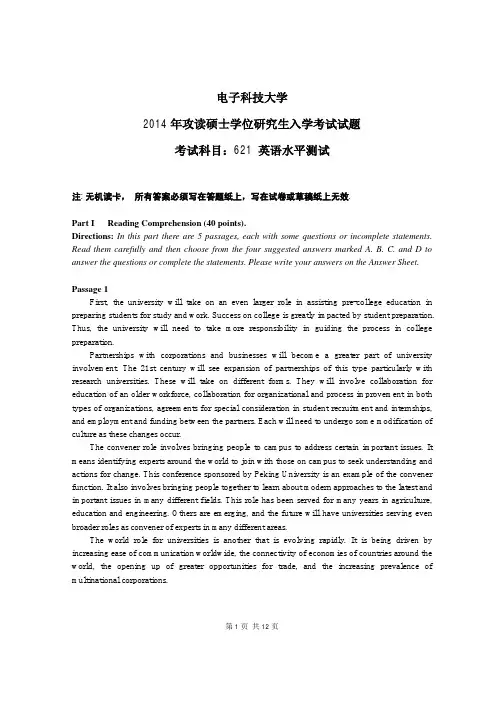
电子科技大学2014年攻读硕士学位研究生入学考试试题考试科目:621 英语水平测试注:无机读卡,所有答案必须写在答题纸上,写在试卷或草稿纸上无效.Part I Reading Comprehension (40 points).Directions: In this part there are 5 passages, each with some questions or incomplete statements. Read them carefully and then choose from the four suggested answers marked A. B. C. and D to answer the questions or complete the statements. Please write your answers on the Answer Sheet.Passage 1First, the university will take on an even larger role in assisting pre-college education in preparing students for study and work. Success on college is greatly impacted by student preparation. Thus, the university will need to take more responsibility in guiding the process in college preparation.Partnerships with corporations and businesses will become a greater part of university involvement. The 21st century will see expansion of partnerships of this type particularly with research universities. These will take on different forms. They will involve collaboration for education of an older workforce, collaboration for organizational and process improvement in both types of organizations, agreements for special consideration in student recruitment and internships, and employment and funding between the partners. Each will need to undergo some modification of culture as these changes occur.The convener role involves bringing people to campus to address certain important issues. It means identifying experts around the world to join with those on campus to seek understanding and actions for change. This conference sponsored by Peking University is an example of the convener function. It also involves bringing people together to learn about modern approaches to the latest and important issues in many different fields. This role has been served for many years in agriculture, education and engineering. Others are emerging, and the future will have universities serving even broader roles as convener of experts in many different areas.The world role for universities is another that is evolving rapidly. It is being driven by increasing ease of communication worldwide, the connectivity of economies of countries around the world, the opening up of greater opportunities for trade, and the increasing prevalence of multinational corporations.第1页共12页1. In what way will the university play a larger role in the future?A. Helping students find jobs.B. Helping students prepare for study and work.C. Arranging the process of college preparation.D. Ensuring every student achieves success in study.2. Which of the following is NOT true of the research universities in the 21st century?A. They will offer education to an older workforce.B. They will make organization and process improvement.C. They will modify the culture they are in.D. They will collaborate with corporations and business in students’ employment and funding.3. The passage is organized by ________.A. making a list of the roles played by the university in the 21st centuryB. comparing and contrasting several roles played by the universityC. introducing a phenomenon first and then analyzing its reasonsD. preparing a problem first and then its solutionsPassage 2Each year in the never-ending cycle of death and regeneration, the rains sweep across southern Asia. Between June and October strange sea winds surge over the land, drenching the earth with torrential downpours. This is the monsoon—a familiar word often taken to mean a violent windstorm, but in fact referring to a tumultuous season of recurring rains.The monsoon is close to the very soul of the people it touches; it permeates the lives of the people and affects everything they do. India is especially dominated by it. For three months before the monsoon rains arrive, the heat is intense, unbearable: the earth itself is dead; farmers cannot work the stone-hard fields; bare subsistence is difficult. With the rains, everything suddenly changes—India bursts into life again; fields that seemed hopelessly barren turn green and grow wildly.The rich new season is one of beauty, but to the peasant it is a beauty shot through with possible disaster. Overflowing with the great rains, the Ganges River moves relentlessly to the sea, hiding beneath its shining but deceptive calm the horror of fields and homes overcome by flood. The horror of flood and cyclone rides always with the monsoon clouds when they come to redeem the land. The peasants have no resource but resignation.4. The monsoon is correctly described as a ________.A. torrential downpourB. violent windstormC. season of recurring rainsD. violent thunderstorm5. The monsoon is said to be “close to the very soul of the people it touches” because ________.A. it plays a significant role in Asian religionsB. it is destructiveC. the people are resigned to itD. it affects all aspects of their lives第2页共12页6. The peasant’s reaction to the monsoon is ________.A. resignationB. hope that the next year will be betterC. JoyD. relief7. Which of the following is implied but not stated?A. India is the only country affected by the monsoon.B. Monsoons seldom affect people in temperate climates.C. After the floods subside, the great heat will begin again.D. The monsoon completely permeates the lives of people.Passage 3A recent history of the Chicago meat-packing industry and its workers examines how the industry grew from its appearance in the 1830s through the early 1890s. Meat- packers, the author argues, had good wages, working conditions, and prospects for advancement within the packing-houses, and did not cooperate with labor agitators since labor relations were so harmonious. Because the history maintains that conditions were above standard for the era, the frequency of labor disputes, especially in the mid. 1880s, is not accounted for. The work ignores the fact that the 1880s were crucial years in American labor history, and that the packing-house workers’ efforts were part of the national movement for labor reform.In fact, other historical sources for the late-nineteenth century record deteriorating housing and high disease and infant mortality rates in the industrial community, due to low wages and unhealthy working conditions. Additional data from the University of Chicago suggest that the packing-houses were dangerous places to work. The government investigation commissioned by President Theodore Roosevelt which eventually led to the adoption of the 1906 Meat Inspection Act found the packing-houses unsanitary, while social workers observed that most of the workers were poorly paid and overworked.The history may be too optimistic because most of its data from the 1880s, at the latest, and the information provided from that decade, is insufficiently analyzed. Conditions actually declined in the 1880s and continued to decline after the 1880s, due to a reorganization of the packing process and a massive influx of unskilled workers. The deterioration in worker status, partly a result of the new availability of unskilled and hence cheap labor, is not discussed. Though a detailed account of work in the packing-houses is attempted, the author fails to distinguish between the wages and conditions for skilled workers and for those unskilled laborers who comprised the majority of the industry’s workers from the 1880s on While conditions for the former were arguably tolerable due to the strategic importance of skilled workers in the complicated slaughtering, cutting, and packing process (though worker complaints about the rate and conditions of work were frequent), pay and conditions for the latter were wretched. The author’s misinterpretation of the origins of the feelings the meat-packers had for their industrial neighborhood may account for the history’s faulty generalizations.The pride and contentment the author remarks upon were, arguably, less the products of the industrial world of the packers—the giant yards and the intricate plants—than of the unity and第3页共12页vibrancy(活跃) of the ethnic cultures that formed a viable community on Chicago’s South Side. Indeed, the strength of this community succeeded in generating a social movement that effectively confronted the problems of the industry that provided its livelihood8. The passage is primarily concerned with discussing ________.A. how historians ought to explain the origins of the conditions in the Chicago meat- packingindustryB. why it is difficult to determine the actual nature of the conditions in the Chicagomeat-packing industryC. why a particular account of the conditions in the Chicago meat-packing industry isinaccurateD. what ought to be included in any account of the Chicago meat-packers’ role in the nationallabor movement9. The author of the passage mentions the “social movement” (in the last paragraph) generated byChicago’s South Side community primarily in order to ________.A. inform the reader of events that occurred in the meat-packing industry after the period oftime covered by the historyB. introduce a new issue designed to elaborate on the good relationship between themeat-packers and Chicago’s ethnic communitiesC. salvage the history’s point of view by suggesting that there were positive developments inthe meat-packing industry due to worker unityD. suggest the history’s limitations by pointing out a situation that the history failed to explainadequately10. According to the passage, the working conditions of skilled workers in the meat-packingindustry during the 1880s were influenced by ________.A. the workers’ determined complaints about the rate and conditions of their workB. the workers’ ability to perform the industry’s complex tasksC. the efforts of social workers to improve sanitation in the packing-housesD. improvements in the industry’s packing process that occurred in the 1880s11. The author of the passage uses the second paragraph to ________.A. summarize the main point of the history discussed in the passageB. explain why the history discussed in the passage has been disparaged by criticsC. evaluate the findings of recent studies that undermine the premises of the history discussedin the passageD. present evidence that is intended to refute the argument of the history discussed in thepassagePassage 4I live in the land of Disney, Hollywood and year-round sun. You may think people in such a glamorous, fun-filled place are happier than others. If so, you have some mistaken ideas about the第4页共12页nature of happiness.Many intelligent people still equate happiness with fun. The truth is that fun and happiness have little or nothing in common. Fun is what we experience during an act. Happiness is what we experience after an act. It is a deeper, more abiding emotion.Going to an amusement park or ball game, watching a movie or television, are fun activities that help us relax, temporarily forget our problems and maybe even laugh. But they do not bring happiness, because their positive effects end when the fun ends.I have often thought that if Hollywood stars have a role to play, it is to teach us that happiness has nothing to do with fun. These rich, beautiful individuals have constant access to glamorous parties, fancy cars, expensive homes, everything that spells “happiness”. But in memoir after memoir, celebrities reveal the unhappiness hidden beneath all their fun: depression, alcoholism, drug addiction, broken marriages, troubled children and profound loneliness.Ask a bachelor why he resists marriage even though he finds dating to be less and less satisfying. If he’s honest, he will tell you that he is afraid of making a commitment. For commitment is in fact quite painful. The single life is filled with fun, adventure and excitement. Marriage has such moments, but they are not its most distinguishing features.Similarly, couples that choose not to have children are deciding in favor of painless fun over painful happiness. They can dine out whenever they want and sleep as late as they want. Couples with infant children are lucky to get a whole night’s sleep or a three-day vacation. I don’t know any parent who would choose the word fun to describe raising children.Understanding and accepting that true happiness has nothing to do with fun is one of the most liberating realizations we can ever come to. It liberates time: now we can devote more hours to activities that can genuinely increase our happiness. It liberates money: buying that new car or those fancy clothes that will do nothing to increase our happiness now seems pointless. And it liberates us from envy: we now understand that all those rich and glamorous people we were so sure are happy because they are always having so much fun actually may not be happy at all.12. Which of the following is true?A. Fun creates long-lasting satisfaction.B. Fun provides enjoyment while pain leads to happiness.C. Happiness is enduring whereas fun is short-lived.D. Fun that is long-standing may lead to happiness.13. To the author, Hollywood stars all have an important role to play that is to ________.A. tell the public that happiness has nothing to do with funB. write memoir after memoir about their happinessC. teach people how to enjoy their livesD. bring happiness to the public instead of going to glamorous parties14. Couples having infant children ________.A. are lucky since they can have a whole night’s sleepB. find fun in tucking them into bed at night第5页共12页C. find more time to play and joke with themD. derive happiness from their endeavor15. If one gets the meaning of the true sense of happiness, he will ________.A. stop playing games and joking with othersB. make the best use of his time increasing happinessC. give a free hand to moneyD. keep himself with his familyPassage 5Working out exactly what students and taxpayers get for the money they spend on universities is a tricky business. Now the Organization for Economic Co-operation and Development (OECD), a Paris-based think-tank for rich countries, is planning to make the task a bit easier, by producing the first international comparison of how successfully universities teach.“Rather than assuming that because a university spends more it must be better, or using other proxy measures for quality, we will look at learning outcomes,”explains Andreas Schleicher, the OECD’s head of education research. Just as the OECD assesses primary and secondary education by testing randomly chosen groups of youngsters from each country in reading and mathematics, it will sample university students to see what they have learned. Once enough universities are taking part, it may publish league tables showing where each country stands, just as it now does for compulsory education. That may produce a fairer assessment than the two established rankings, though the British one does try to broaden its inquiry by taking opinions from academics and employers.There is much to be said for the OECD’s approach. Of course a Nobel laureate’s view on where to study may be worth hearing, but dons may be so busy writing and researching that they spend little or no time teaching—a big weakness at America’s famous universities. And changes in methodology can bring startling shifts. The high-flying London School of Economics, for example, tumbled from 17th to 59th in the British rankings published last week, primarily because it got less credit than in previous years for the impressive number of foreign students it had managed to attract.The OECD plan awaits approval from an education ministers’meeting in January. The first rankings are planned by 2010. They will be of interest not just as a guide for shoppers in the global market, but also as indicators of performance in domestic markets. They will help academics wondering whether to stay put or switch jobs, students choosing where to spend their time and money, and ambitious university bosses wanting a sharper competitive edge for their institution.The task the OECD has set itself is formidable. In many subjects, such as literature and history, the syllabus varies hugely from one country, and even one campus, to another. But OECD researchers think that problem can be overcome by concentrating on the transferable skills that employers value, such as critical thinking and analysis, and testing subject knowledge only in fields like economics and engineering, with a big common core.Moreover, says Mr. Schleicher, it is a job worth doing. Today’s rankings, he believes, do not help governments assess whether they get a return on the money they give universities to teach their undergraduates. Students overlook second-rank institutions in favor of big names, even though the第6页共12页less grand may be better at teaching. Worst of all, ranking by reputation allows famous places to coast along, while making life hard for feisty upstarts. “We will not be reflecting a university’s history,” says Mr. Schleicher, “but asking: what is a global employer looking for?” A fair question, even if not every single student’s destiny is to work for a multinational firm.16. The project by OECD is aimed to ________.A. assess primary and secondary education of each school that subscribe to the serviceB. appraise the learning outcomes of university students as part of their academic performanceC. establish a new evaluation system for universitiesD. set up a new ranking for compulsory education17. The assessment method by OECD is different from the established rankings in ________.A. that its inquiry is broader as to include all the students and staffB. that its samples are chosen randomly based on statistical analysis of methodC. that it attaches more importance to the learning efficiencyD. that it takes opinions from the students to see what they have learnt18. The best universities in the Nobel laureate’s eye are ________.A. those ambitious universitiesB. those of high reputationC. the feisty upstartsD. those high-flying universities19. By the case of London School of Economic, the author wants to show that ________.A. the OECD’s approach is very fairB. the Nobel laureate’s opinion is not worth hearingC. the British rankings pays more attention to the foreign studentsD. different assessment methods may lead to different ranking results20. The OECD’s ranking system will probably be welcomed most by ________.A. those ambitious second-rank institutionsB. the famous collegesC. parents who pay for the children’s secondary educationD. shoppers in the global marketPart II Vocabulary and Structure (20 points)Directions: Beneath each of the following sentences, there are four choices marked A, B, C, and D. Choose the ONE that best completes the sentence. Please write your answer in the Answer Sheet.21. Another big issue ________ the new republic is the problem of the education of its citizens.A. conflictingB. confrontingC. confiningD. confirming22. Telling your doctor about all the medicines you take may help avoid serious drug ________.A. interventionsB. interruptionsC. institutionsD. interactions23. It was Mr. Biden’s first trip to China since taking office. He spoke ________ of his first visit toChina in 1979, when he was a senator.A. nostalgicallyB. melancholyC. calmlyD. skillfully第7页共12页24. His book is the cultural ________ of the year.A. incidentB. accidentC. eventD. affair25. The mountaintop provides a spectacular view of Innsbruck and its ________.A. environmentsB. vicinitiesC. circumstancesD. surroundings26. Finance during marriage ________ is a very big issue particularly with regards to the mortgageand household bills.A. separationB. divisionC. allocationD. detachment27. Ed’s already ________ health deteriorated after he left the hospital.A. invalidB. faintC. fragileD. crisp28. A complete investigation into the causes of the accident should lead to improved standards andshould ________ new operating procedures.A. result inB. match withC. subject toD. proceed with29. If a person talks about his weak points, his listener is expected to say something in the way of________.A. persuasionB. remedyC. encouragementD. compromise30. If we ________ our relations with that country, we’ll have to find another supplier of rawmaterials.A. diffuseB. diminishC. redistributeD. preclude31. During the races there were two accidents to motor-cyclists including one ________ accident.A. fatalB. killingC. deadlyD. deathly32. Business picked up in the stores during December, but ________ again after Christmas.A. dropped outB. dropped onC. dropped overD. dropped off33. His misbehavior and ________ dismissal from the firm was reported in the newspaper.A. improperB. inefficientC. subsequentD. frequent34. Every citizen has the sacred ________ to defend his country.A. rightB. objectiveC. authorityD. obligation35. We need an umbrella on the beach to give us some ________ at midday.A. shedB. shadeC. shadowD. dark36. ________ to the Revolutionary War, the United States was an English colony.A. PriorB. CloseC. EarlierD. Next37. If you are an electrician, you will know the difference between an alternating and a direct________.A. conductorB. circuitC. cableD. current38. The company has the ________ right to print Mr. Dare’s books.A. virtualB. exclusiveC. overallD. flexible39. Digging the foundation is the first ________ of our building project.A. solutionB. processionC. phaseD. achievement40. The curtains have ________ because of the strong sunlight.A. fadedB. dulledC. faintedD. weakened第8页共12页Part III Cloze (20 points)Directions: Fill in each blank with ONE appropriate word to complete the passage.Section A:When a 47-year-old manager at the headquarters of a large companyreturned from a two-week business 41 , he found another man seated in his office, 42 his job. The manager’s boss had been 43 with a new vice president, who had brought 44 his own people.45 six moths to find another job within the company, he went to work for one of the smaller departments. His new job was a demotion, and his pay would be frozen for three years.Learning to cope with career downturns is part of 46 the ladder to success. Virtually all 47 people have experienced major career setbacks. Here are some suggestions for bouncing back:Make the 48 of it. The former manager dug into this new job with the enthusiasm of a person who has been given a new and pleasant life, and within 18 months he was promoted. “I’m happier today as manager of a small, effective 49 than I was working at the headquarters,” he says. “There is 50 pressure, and I’m actually making a bigger contribution.”41. ________42. ________43. ________44. ________45. ________46. ________47. ________48. ________49. ________50. ________Section B:Ever 51 humans have lived on the earth, they have made use of various 52 of communication. Generally, this expression of thoughts and feelings has been in the form of oral speech. When there is a language barrier, communication is completed through sign language 53 which motions 54 for letters, words, and ideas. Tourists and the people 55 to hear or speak have had to turn to this form of expression. Many of these symbols of whole words are very lively and exact and can be used internationally; spelling, 56 , cannot.Body language sends ideas or thoughts by certain 57 , either meaningfully or not. A wink can be a way of showing that the party is only joking. A nod means agreement, while shaking the head indicates 58 .Other forms of nonlinguistic language can be found in Braille (a system of raised dots read with the fingertips), signal flags, Morse code, and smoke signals. Road maps and picture signs also guide and warn people. While language is the 59 common form of communication, other systems and techniques also 60 human thoughts and feelings. 51. ________52. ________53. ________54. ________55. ________56. ________57. ________58. ________59. ________60. ________第9页共12页Part IV Paraphrase (20 points)Directions: Paraphrase the underlined parts.(61) Any industrial manufacturer that has not awakened to the fact that it must become a service business is in serious peril today. Sadly, there are many such businesses—companies that still think of themselves as builders of things and that state their gross margins, operating profits, and other measures of success solely in terms of “the product.”(62) But even their more enlightened competitors, the ones who’ve begun to wrap valuable services around their products and, in some cases, profit directly from those services, are enjoying only a temporary advantage. (63) They may be improving their customer relationships by taking on various burdens such as maintenance and replenishment of supplies, but that will get them only so far. A select group of companies is already upping the ante. Soon, it will not be enough for a company to offer services; it will have to provide “smart services.”Smart services go beyond the kinds of upkeep and upgrades you may be bundling with your products, both in their value to customers and in their cost efficiency to you. (64) To provide them, you must build intelligence—that is, awareness and connectivity—into the products themselves. And you must be prepared to act on what the products then reveal about their use.Consider Heidelberger Druckmaschinen (commonly known as Heidelberg), a maker of high-end printing presses. Throughout its history, the company has offered repair services to its customers. Several years ago, (65) when it developed the ability to monitor its equipment remotely, Heidelberg found that it could provide maintenance much more cost-effectively. Now with its machines communicating continuously over the Internet, relaying information about their status between the print shops and Heidelberg’s regional and global technical support specialists, (66) the company has the access and insight to optimize printing performance in customers’ shops. The total product support that Heidelberg now offers—which extends even to removal and resale of the machines—represents a whole new level of value for buyers. (67) The network context has made the difference for Heidelberg and has allowed the firm to achieve true intimacy with its customers.The rewards of becoming a smart service provider are hard to deny. In our research, we’ve documented organic growth rates in double digits for many of the companies that are following this path. (68) The leaders are establishing the new performance benchmarks for their industries, deriving more than 50% of their revenues and 60% of their margin contributions from services as opposed to product sales. For most management teams in product-centric companies, numbers like these sound like nirvana.Joining the ranks of smart service organizations is not primarily a technical challenge. (69) The necessary technologies, while critical to the task, are well enough established by this point. Rather, in most companies, (70) the biggest challenge is getting senior management to adopt a new perspective on the nature of the business. The companies in the vanguard of smart services think differently about their purpose and how they make their profits–but they have come to that new heading by degrees.第10页共12页。
牛津英语6年级常见错误及练习601-621
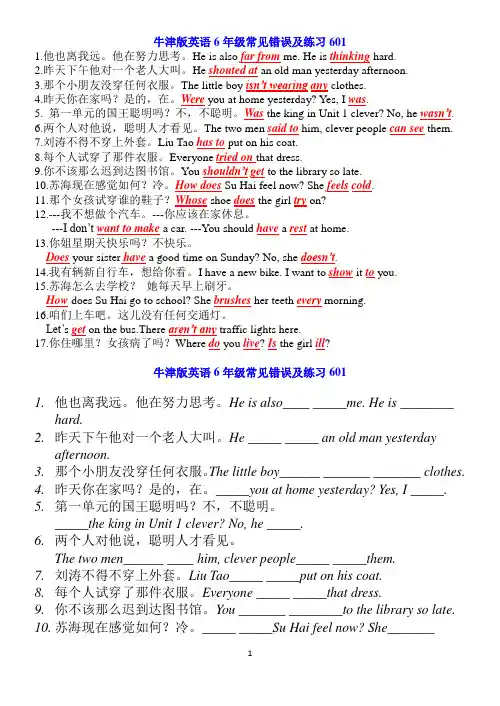
牛津版英语6年级常见错误及练习6011.他也离我远。
他在努力思考。
He is also far from me. He is thinking hard.2.昨天下午他对一个老人大叫。
He shouted at an old man yesterday afternoon.3.那个小朋友没穿任何衣服。
The little boy isn’t wearing any clothes.4.昨天你在家吗?是的,在。
Were you at home yesterday? Yes, I was.5. 第一单元的国王聪明吗?不,不聪明。
Was the king in Unit 1 clever? No, he wasn’t.6.两个人对他说,聪明人才看见。
The two men said to him, clever people can see them.7.刘涛不得不穿上外套。
Liu Tao has to put on his coat.8.每个人试穿了那件衣服。
Everyone tried on that dress.9.你不该那么迟到达图书馆。
You shouldn’t get to the library so late.10.苏海现在感觉如何?冷。
How does Su Hai feel now? She feels cold.11.那个女孩试穿谁的鞋子?Whose shoe does the girl try on?12.---我不想做个汽车。
---你应该在家休息。
---I don’t want to make a car. ---You should have a rest at home.13.你姐星期天快乐吗?不快乐。
Does your sister have a good time on Sunday? No, she doesn’t.14.我有辆新自行车,想给你看。
I have a new bike. I want to show it to you.15.苏海怎么去学校?她每天早上刷牙。
山大考研817专业英语621实践英语2013年真题

山大考研817专业英语+621实践英语2013年真题一.专业英语这部分我尽量按照真题的原貌回忆的,希望能让同学们对真题的格式熟悉些Part One : linguisticsI. Define the following terms (30 points )1. Task-based Approach2. semantic field3. Politeness Principle4. paradigmatic relation5. Interpersonal function6. arbitrariness7. distinctive features8. endocentric constructions9. entailment10.mode of discourseII. Briefly answer the following questions (10 points )1.What distinction would you draw between sense and reference?2.What is the difference between synchronic linguistics and diachronic linguistics?III. Make comments on the following statements. The statement may be true or false. Make judgement first and then explain why you think so.(30 points)1.The cooperative principle proposed by the American philosopher P. Grice aims to explain how speakers perform acts with the utterances they make.2. An important difference between semantics and pragmatics is that the former traditionally studies meaning as an inherent, abstract property of language itself while the latter studies meaning as something concrete, realized in the course of communication.Part Two : English LiteratureI. Identify the writer of the works(10 points)1. The Merchant of Venice2. Samson Agonistes3. Mary Barton4. Mrs Dalloway5. A Tale of Two Cities6. Wuthering Heights7. Lyrical Ballads8. Don Juan9. Moll Flanders10. Jonathan WildII Explain the following literary terms ( 6 points)1. Ottava Rima2. stream of consciousnessIII identify the writer of following text and make a comment on the text(9 points)选自Oliver TwistIV Essay writing (15 points)Comment on the theme of King LearPart Three : American LiteratureI. Identify the writer of the works(10 points)1.The Hairy Ape2. Death of a Salesman3. The Call of the Wild4. Babbitt5. “The Road Not Taken”6. Green Hills of Africa7. Billy Budd8. “The Open Boat”9. Jennie Gerhardt10. SanctuaryII Explain the following literary terms ( 6 points)1. Puritanism2. dramatic monologueIII identify the writer of following text and make a comment on the text(9 points)选自The Great Gatsby (the end of the party)IV Essay writing (15 points)Comment on the artistic features of Emily Dickenson’s poem二.实践英语我这个强迫症患者到底还是变换了无数种关键词组合把两篇翻译原文都搜到了.题量很大,必须抓紧时间做1.十个单选(差不多专四难度,10分)2. 四篇阅读理解(比专八简单很多,都不长,完全没必要担心。
专业代码和名称(1)

河南师范大学2007年硕士研究生招生考试科目参考书目对照表(该表中没有的科目不限参考书或参阅相同科目的参考书目)
音乐学专业复试科目内容及要求
专业主科方向01考试内容:
1.技术性练习曲一首(相当于车尔尼740以上程度);
2.复调乐曲一首(巴赫平均律曲集中任选赋格一首);
3.古典时期奏鸣曲或变奏曲一首(程度相当于贝多芬奏鸣曲快板乐章);
4.中外大型乐曲任选一首。
所有乐曲应为独奏作品,背谱演奏。
专业主科方向02考试内容:
报名时须提交本人撰写的、所报考专业研究方向的论文一篇(大学毕业论文或相当于大学毕业论文)。
同样学力报考者所交的必需是公开发表的论文。
应届普通本科毕业生能够习作(学期论文)替代学位论文。
方向02笔试(含音乐作品听辨)
专业主科方向03考试内容:
演唱四首作品。
中国作品两首(艺术歌曲,歌剧咏叹调或民歌各一首)
外国作品两首(必需唱原文),外国作品必需含一首咏叹调,一首艺术歌曲(不得演唱外国民歌和流行歌曲)。
考试时由主考指定演唱部份或全数曲目。
面试与钢琴演奏:
1.面试:内容含所考专业方面的内容;
2.钢琴:方向01钢琴作品视奏;方向02和03复试钢琴演奏程度:练习曲1首:程度相当于车尔尼299程度的作品;乐曲1首:程度相当于贝多芬奏鸣曲快板乐章作品。
武汉大学年研究生招生目录

学院、专业、研究方向
代码及名称
全日制
招生人数
考试科目
复试科目
同等学力
加试科目
备注
102外国语言文学学院()
82
非全日制0
学术学位
50
050201英语语言文学
英语系不招收翻译方向研究生。翻译方向研究生由翻译系负责招生。
01 (全日制)英语语言学
02 (全日制)英美文学
①101思想政治理论
②243二外俄语或244二外日语或245二外法语或246二外德语
③611基础英语
④801英语综合(语言学、文学)
①听说、写作
①口试
②阅读与写作
050202俄语语言文学
01 (全日制)俄语语言学
02 (全日制)俄罗斯文学
03 (全日制)俄语翻译学
04 (全日制)语言文化学
①101思想政治理论
06 (全日制)媒介经营管理
①101思想政治理论
②201英语一或202俄语或203日语或240法语或241德语
③617综合知识(含法律、经济、中国古代、现当代代表作家的经典作品,以及论说文、记叙文的写作)
④809新闻传播学基础(含新闻理论、新闻业务、传播学基本理论)
①传播理论(01)
②广告传播理论与实务(02)
①101思想政治理论
②201英语一或202俄语或203日语或240法语或241德语
③303数学三
④818经济学基本理论
①政治经济学
①货币银行学
②财政学
020102经济思想史
00 (全日制)不区分研究方向
①101思想政治理论
②201英语一或202俄语或203日语或240法语或241德语
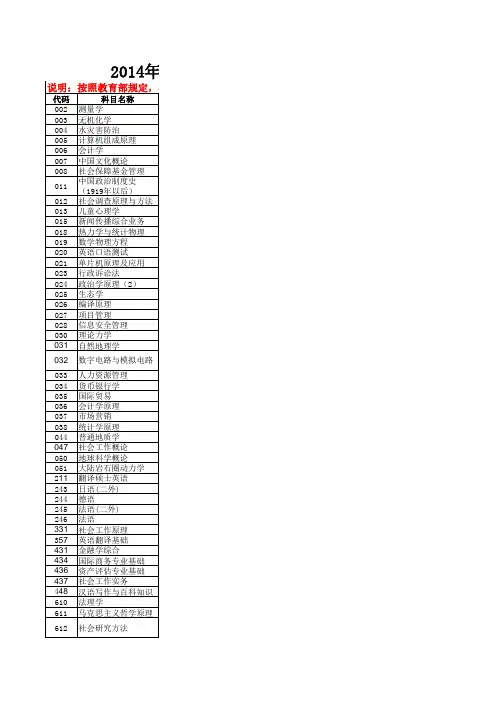
河海大学 参考书目
911 港口、航道工程
912 交通规划
913 海岸动力学
914 土力学
915 岩石力学
916
钢筋混凝土结构和钢 结构
917
污染控制工程及环境 系统规划与管理
918 工程测量学 919 摄影测量与遥感
920 公司法与合同法
922 工程地质学
923
环境生物学、环境地 理学
924 中共党史
925
水力学及河流动力学 综合
013 儿童心理学
015 新闻传播综合业务
018 热力学与统计物理
019 数学物理方程
020 英语口语测试
021 单片机原理及应用
023 行政诉讼法
024 政治学原理(2)
025 生态学
026 编译原理
027 项目管理
028 信息安全管理
030 理论力学
031 自然地理学
032 数字电路与模拟电路
033 人力资源管理 034 货币银行学 035 国际贸易 036 会计学原理 037 市场营销 038 统计学原理 044 普通地质学 047 社会工作概论 050 地球科学概论 051 大陆岩石圈动力学 211 翻译硕士英语 243 日语(二外) 244 德语 245 法语(二外) 246 法语 331 社会工作原理 357 英语翻译基础 431 金融学综合 434 国际商务专业基础 436 资产评估专业基础 437 社会工作实务 448 汉语写作与百科知识 610 法理学 611 马克思主义哲学原理
940 项目管理综合 941 马克思主义哲学史 942 中国传统伦理思想史 943 科学技术学 944 当代中国政治分析 945 社会学综合 946 人口学综合 948 马克思主义原著选读
杭州电子科技大学2022年自命题科目考试大纲 621基础英语
杭州电子科技大学
全国硕士研究生招生考试业务课考试大纲考试科目名称:基础英语科目代码:621 一、英语词汇知识
1.英语词汇理解。
2.英语词汇常用搭配。
3.英语词汇辨析。
4.英语常用短语、习惯用法。
二、英语语法知识
1.英语各类词汇用法。
2.英语句子结构、句型。
3.英语各种从句。
4.句子之间和段落之间的衔接手段。
三、英语完型填空
1.记叙文、说明文、应用文、议论文等结构特征。
2.语言知识填空
(1)信息词汇填空。
(2)功能词汇填空
(3)各种语法规则、句型、句式。
(4)篇章的整体布局、上下文段落的衔接
3.其他相关知识。
四、英语阅读
1.一般英美报刊杂志上的社论和书评。
2.英语国家出版的有一定难度的历史传记和文学作品。
3.文章的思想观点、语篇结构、语言特点和修辞手法。
4.文章的主旨和大意、事实和细节。
5.主要信息提炼、归纳和综合表述。
6.阅读速度和阅读技巧。
五、英语写作
1.英语词汇和语法知识综合运用。
2.常用体裁和题材写作。
3.常用文体与修辞的运用。
4.内容充实度,语言通顺度,用词恰当和表达得体性。
5.书面语言运用和交际技巧。
6.作品分析和鉴赏。
参考书目:
杨立民,现代大学英语精读(1-6),外语教学与研究出版社,2012。
巫漪云、黄关福,高级英语(上下),复旦大学出版社,2006。
第1页共1页。
2021年中山大学考研真题清单汇总
2021年中山大学考研真题汇总【828040238】中山大学历年考研真题211翻译硕士英语(2019-2015年,2011年)中山大学历年考研真题240英语(单考)(2019-2015年,2011年)中山大学历年考研真题241英语(二外)(2019年)中山大学历年考研真题242俄语(二外)(2019-2018年)标题为括号为中山大学考研群中山大学历年考研真题308护理综合(2019年-2015年,2011年)中山大学历年考研真题331社会工作原理(2019-2015年,2011年)中山大学历年考研真题334新闻与传播专业综合能力(2019-2015年)中山大学历年考研真题338生物化学(2019-2015年,2011年)中山大学历年考研真题346体育综合(2019)中山大学历年考研真题347心理学专业综合(2019-2015年)中山大学历年考研真题348文博综合(2019-2015年,2011年)中山大学历年考研真题349药学综合(2019-2015年,2011年)中山大学历年考研真题352口腔综合(2019-2015年,2011年)中山大学历年考研真题353卫生综合(2019-2015年,2011年)中山大学历年考研真题354汉语基础(2019-2015年,2011年)中山大学历年考研真题357英语翻译基础(2019-2015年,2011年)中山大学历年考研真题431金融学综合(2019-2015年,2011年)中山大学历年考研真题432统计学(2019-2015年,2011年)中山大学历年考研真题434国际商务专业基础(2019-2015)中山大学历年考研真题435保险专业基础(2019-2015)中山大学历年考研真题437社会工作实务(2019-2015)中山大学历年考研真题440新闻与传播专业基础(2019-2015)中山大学历年考研真题445汉语国际教育基础(2019-2015年,2011年)中山大学历年考研真题448汉语写作与百科知识(2019-2015年,2011年)中山大学历年考研真题601高等数学(A)(2019-2015年)中山大学历年考研真题602高等数学(B)(2019-2015)中山大学历年考研真题603数学二(单考)(2019-2017)中山大学历年考研真题604高等数学(单考)(2019年,2016-2015年)中山大学历年考研真题610民俗学概论(2019-2015年,2011年)中山大学历年考研真题611文学评论写作(2019-2015年,2011年)中山大学历年考研真题612语言学概论(2019-2015)中山大学历年考研真题613现代汉语与语言学概论(2019-2015年,2011年) 中山大学历年考研真题614文献释读(2019-2015年,2011年)中山大学历年考研真题615文学基础(2019-2015年,2011年)中山大学历年考研真题616作品评论(2019-2015)中山大学历年考研真题617非物质文化遗产学(2019-2016年,2011年)中山大学历年考研真题619历史学基础(A)(2019-2015年)中山大学历年考研真题620西方哲学史(2019-2015年)中山大学历年考研真题621一元微积分(2019-2015)中山大学历年考研真题622逻辑哲学与逻辑史基础知识(2019-2015年)中山大学历年考研真题623中西哲学史(2019-2015)中山大学历年考研真题624中国美学(2019-2015年)中山大学历年考研真题625中外哲学史基础知识(2019-2015年)中山大学历年考研真题626法学理论A卷(2019-2015)中山大学历年考研真题627法律史A卷(2019-2015年)中山大学历年考研真题628宪法与行政法学A卷(2019-2015)中山大学历年考研真题629刑法学A卷(2019-2015)中山大学历年考研真题630民商法学A卷(2019-2015年)中山大学历年考研真题631诉讼法学A卷(2019-2015年)中山大学历年考研真题632经济法学A卷(2019-2015)中山大学历年考研真题633环境与资源保护法学A卷(2019-2015)中山大学历年考研真题635立法学A卷(2019-2017年)中山大学历年考研真题636政治学理论(2019-2015年)中山大学历年考研真题637公共管理学(2019-2015年)中山大学历年考研真题638基础英语(2019-2015年)中山大学历年考研真题639基础法语(2019-2015年)中山大学历年考研真题640基础德语(2019-2015年)中山大学历年考研真题641基础日语(2019-2015)中山大学历年考研真题643新闻与传播学基础(2019-2017)中山大学历年考研真题644视觉传播学(2019-2015)中山大学历年考研真题645信息管理基础(2019-2015年)中山大学历年考研真题646综合英语(2019-2015)中山大学历年考研真题647社会学理论(2019-2015年,2011年)中山大学历年考研真题648人口理论(2019-2015年,2011年)中山大学历年考研真题649人类学概论(2019-2015年,2011年)中山大学历年考研真题651考古学基础(2019-2015)中山大学历年考研真题654政治学原理(2019-2015)中山大学历年考研真题655马克思主义基本原理(含经典著作)(2019-2015)中山大学历年考研真题656心理学研究方法(2019-2016)中山大学历年考研真题657化学(A)(2019-2015)中山大学历年考研真题658岩石学(2019-2015)中山大学历年考研真题660第四纪地质学(2019-2017)中山大学历年考研真题661构造地质学(2019-2015)中山大学历年考研真题662生物化学(一)(2019-2015)中山大学历年考研真题663药分综合(2019-2015年,2011年)中山大学历年考研真题664数学分析(2019-2015)中山大学历年考研真题665综合化学(2019-2015)中山大学历年考研真题666药学综合A(2019-2015年,2011年)中山大学历年考研真题667生物综合(2019-2015)中山大学历年考研真题669化学综合(2019-2015)中山大学历年考研真题670区域分析与规划(2019-2015)中山大学历年考研真题671分析化学(2019-2015)中山大学历年考研真题673海洋生态学(2019-2015)中山大学历年考研真题674生物化学(二)(2019-2016)中山大学历年考研真题675普通地质学(2019-2015)中山大学历年考研真题676生物化学与分子生物学(2019-2017)中山大学历年考研真题677基础医学综合(2019-2015)中山大学历年考研真题678生物医学综合(2019-2017)中山大学历年考研真题679数学分析与高等代数(2019-2015)中山大学历年考研真题680口腔医学综合(2019-2017)中山大学历年考研真题681国际关系史(2019-2015年,2011年)中山大学历年考研真题682数学分析(A)(2019-2015)中山大学历年考研真题687基础中医综合(2019-2015)中山大学历年考研真题688宗教学概论(单考)(2019-2018)中山大学历年考研真题690心理学研究方法(单考)(2019-2015)中山大学历年考研真题801微观经济学与宏观经济学(2019-2015)中山大学历年考研真题802运筹学(2019-2016)中山大学历年考研真题803民间文学概论(2019-2015)中山大学历年考研真题805汉语语言学基础(2019-2015)中山大学历年考研真题806古汉语与古文字(2019-2015年,2011年)中山大学历年考研真题807中国古代文学与批评(2019-2015年,2011年)中山大学历年考研真题808中国现当代文学(2019-2015年,2011年)中山大学历年考研真题809世界文学(2019-2015)中山大学历年考研真题810戏曲与民俗(2019-2016,2011年)中山大学历年考研真题811马克思主义哲学(包括马哲原理和原著)(2019-2015)中山大学历年考研真题813逻辑学概论(2019-2015)中山大学历年考研真题814伦理学基础知识(2019-2018)中山大学历年考研真题815宗教理论(2019-2015)中山大学历年考研真题816科学哲学(2019-2015)中山大学历年考研真题817法学理论B卷(2019-2016)中山大学历年考研真题818法律史B卷(2019-2016)中山大学历年考研真题819交通工程学(2019-2015)中山大学历年考研真题819宪法与行政法学B卷(2019-2015)中山大学历年考研真题820刑法学B卷(2019-2015)中山大学历年考研真题821民商法学B卷(2019-2015)中山大学历年考研真题822诉讼法学B卷(2019-2015)中山大学历年考研真题823经济法学B卷(2019-2015)中山大学历年考研真题824环境与资源保护法学B卷(2019-2016)中山大学历年考研真题825国际法学B卷(2019-2016)中山大学历年考研真题826立法学B卷(2019-2017)中山大学历年考研真题827政治学研究方法(2019-2016)中山大学历年考研真题828政治学(2019-2015)中山大学历年考研真题829公共管理研究方法(2019-2015)中山大学历年考研真题830微观经济学与金融经济学(2019-2017)中山大学历年考研真题831运筹学与管理信息系统(2019-2015)中山大学历年考研真题832微观经济学与管理学(2019-2015年,2011年)中山大学历年考研真题833英语语言文学(2019-2015)中山大学历年考研真题834法语语言文学(2019-2015)中山大学历年考研真题835德语语言文学(2019-2017)中山大学历年考研真题836日语语言文学(2019-2017)中山大学历年考研真题837外国语言学及应用语言学(2019-2015)中山大学历年考研真题838新闻与传播实务及研究方法(2019-2017)中山大学历年考研真题839设计学(2019-2018年,2015-2016年,2011年)中山大学历年考研真题840信息资源组织(2019-2015)中山大学历年考研真题841英语写作与百科知识(2019-2015)中山大学历年考研真题842社会研究方法与社会统计学(2019-2018)中山大学历年考研真题843人口统计学(2019-2015)中山大学历年考研真题844人类学理论与方法(2019-2015)中山大学历年考研真题845民俗学理论与方法(2019-2015)中山大学历年考研真题850中共党史(2019-2015)中山大学历年考研真题851专业综合基础(当代中国马克思主义、思政)(2019-2015) 中山大学历年考研真题852普通心理学(2019-2015)中山大学历年考研真题853材料化学(2019-2016)中山大学历年考研真题854高分子材料(2019-2017)中山大学历年考研真题855材料物理(2019-2016)中山大学历年考研真题857化学(B)(2019-2016)中山大学历年考研真题862地球科学概论(2019-2016)中山大学历年考研真题863细胞生物学(2019-2015)中山大学历年考研真题865遗传学(2019年,2016-2015年)中山大学历年考研真题867高等代数(2019-2015)中山大学历年考研真题868有机化学(2019-2016)中山大学历年考研真题869地理学基础(2019-2016)中山大学历年考研真题870人文地理学理论与方法(2019-2015)中山大学历年考研真题871遥感与地理信息系统(2019-2015)中山大学历年考研真题873全球卫星定位原理(2019-2017)中山大学历年考研真题874环境工程导论(2019-2016)中山大学历年考研真题875环境学导论(2019-2016)中山大学历年考研真题876旅游学概论(2019-2015)中山大学历年考研真题877经济学(含微观和宏观经济学)(2019-2015)中山大学历年考研真题879海洋学导论(2019-2016)中山大学历年考研真题880自然地理学(2019-2015)中山大学历年考研真题881环境科学(2019-2016)中山大学历年考研真题882海洋化学(2019年,2017年,2015年)中山大学历年考研真题883细胞生物学(一)(2019-2016)中山大学历年考研真题884岩石学(A)(2019-2015)中山大学历年考研真题889-细胞生物学(二)(2019-2018)中山大学历年考研真题890国际政治学(2019-2016)中山大学历年考研真题891高等代数(A)(2019-2017)中山大学历年考研真题893普通物理B(2019-2018)中山大学历年考研真题894理论力学(2019-2015)中山大学历年考研真题901大气科学基础(2019-2016)中山大学历年考研真题902普通物理(2019-2015)中山大学历年考研真题903光学(2019-2016)中山大学历年考研真题904微机原理与应用(2019-2015)中山大学历年考研真题908化工原理(2019-2016)中山大学历年考研真题909工科化学(2019-2016)中山大学历年考研真题910光学原理(2019-2017)中山大学历年考研真题911信号与系统(2019-2015)中山大学历年考研真题912普通物理A(2019-2017)中山大学历年考研真题913电子技术(数字和模拟)(2019-2015) 中山大学历年考研真题915水文学(2019-2015)中山大学历年考研真题916工程热力学(2019-2016)中山大学历年考研真题921有机化学(B)(2019-2015)中山大学历年考研真题922生物化学(A)(2019-2015)中山大学历年考研真题923信号与系统(B)(2019-2015)中山大学历年考研真题924普通化学(2019-2015)中山大学历年考研真题925仪器分析(2019-2018)中山大学历年考研真题926佛学思想史(单考)(2019-2018)中山大学历年考研真题930大气科学基础(单考)(2019-2017) 中山大学历年考研真题931土力学与基础工程(2019-2015)。
学科代码及名称
③692缅甸语基础
④892缅甸语专业
(45)语言文学(马来语)
1
①101政治
②241二外英语
③693马来语基础
④893马来语专业
(46)语言文学(印地语)
1
①101政治
②241二外英语
③694印地语基础
④894印地语专业
(47)语言文学(土耳其语)
3
①101政治
②241二外英语
③695土耳其语基础
050209
欧洲语言文学
(39)意大利语语言文学
009
欧语
学院
5
①101政治
②241二外英语
③681意大利语基础
④881意大利语专业
(40)匈牙利语语言文学
3
①101政治
②241二外英语
③682匈牙利语基础
④882匈牙利语专业
(41)保加利亚语语言文学
1
①101政治
②241二外英语
③683保加利亚语基础
④883保加利亚语专业
(42)葡萄牙语语言文学
007
西葡
语系
2
①101政治
②241二外英语
③684葡萄牙语基础
④884葡萄牙语专业
050210
亚非语言文学
(43)翻译理论与实践(老挝语)
010
亚非
学院
3
①101政治
②241二外英语
③691老挝语基础
④891老挝语专业
(44)语言文学(缅甸语)
2
①101政治
9
①101政治
②外国语(201英语、202俄语、203日语、243法语、244德语、246西班牙语,选一)
赣南师范学院2015年研究生招生专业目录及自命题考试科目
赣南师范学院2015年研究生招生专业目录及自命题考试科目主要参考书学院代码、名称、联系人学科名称拟招生人数初试考试科目复试笔试科目同等学力考生加试科目001 文学院舒六英0797-8393 643 050100中国语言文学01文艺学02语言学及应用语言学03中国古代文学04中国现当代文学16①101思想政治理论②201英语(一)③专业科目1:01方向:611文学理论02方向:612汉语基础03方向:613中国古代文学04方向:614中国现当代文学④专业科目2:811作文01、03、04方向:文学评论02方向:语言学概论1.中国历代文学作品选2.中国现当代文学作品选*045103学科教学(语文)不区分研究方向40①101思想政治理论②204英语(二)③333教育综合④911语文课程与教学论语文教学设计1、现代汉语2、写作*135103艺术硕士(戏曲)02戏曲编导5①101思想政治理论②204英语(二)③634艺术概论④901戏曲创作戏曲作品分析1、美学2、作文002新闻与传播学院陈凤至0797-8393 876 040110教育技术学01信息技术教育应用02教育媒体的理论与实践6①101思想政治理论②201英语(一)③615教育学专业基础综合(自命题)教育技术学导论1、大学计算机基础2、远程教育基础0501Z1媒介文化传播01新闻文化传播02广播影视文化传播03广告文化传播6①101思想政治理论②201英语(一)③616传播史论④816媒介实务媒介理论综合1、新闻学概论2、广播电视学概论*045114 现代教育技术不区分研究方向9①101思想政治理论②204英语(二)③333教育综合④925现代教育技术多媒体课件制作1、计算机网络2、数据库技术*135105艺术硕士(广播电视)01广播电视编导02播音与主持艺术12①101思想政治理论②204英语(二)③634艺术概论④01方向:905广播电视实务02方向:906播音主持实务01方向:影视作品分析02方向:播音主持作品分析01方向1、广播电视概论2、视听语言02方向1、节目主持概论2、广播电视概论003政治与法0305Z1马克思主义法学01马克思主义法学哲学6①101思想政治理论②201英语(一) 民事诉讼法1、宪法2、政治经济学律学院陈华0797-8393 646 02中央苏区法制建设03民商法学04行政法学③617马克思主义法理学④817法学综合(民法总论、刑法总论)030301社会学01社会工作与社会管理02政治社会学6①101思想政治理论②201英语(一)③640社会学基础理论④840社会工作基础理论政治学原理1、管理学原理2、社会调查与研究方法*045102学科教学(思政)不区分研究方向30①101思想政治理论②204英语(二)③333教育综合④912思想政治教育学科教学论思想政治教育学原理1、马克思主义哲学原理2、毛泽东思想和中国特色社会主义理论体系概论004马克思主义学院吴少梅0797-8397 850 030500马克思主义理论01马克思主义基本原理02马克思主义中国化研究03思想政治教育15①101思想政治理论②201英语(一)③618马克思主义基本原理④818毛泽东思想和中国特色社会主义理论体系政治学原理1、思想政治教育学原理2、社会学原理005 历史文化与旅游学院袁浅香0797-8393 648 030300社会学01社会学02人类学03民俗学1601方向:①101思想政治理论②201英语(一)③641社会学概论④841社会学研究方法社会学理论1、中国社会学史2、社会心理学02方向:①101思想政治理论②201英语(一)③642人类学理论④842人类学研究方法人类学概论03方向:①101思想政治理论②201英语(一)③643民俗学概论④843中国古代史民俗学理论060300世界史01地区国别史02国际关系史6①101思想政治理论②201英语(一)③645世界通史01方向:世界近现代史02方向:近现代国际关系史1、史学概论2、中国近现代史0602L3专门史01中央苏区与近现代中国02客家与中国文化10①101思想政治理论②201英语(一)③644中国通史中国近现代史1、史学概论2、中国古代史*045109学科教学(历史)不区分研究方向15①101思想政治理论②204英语(二)③333教育综合④913历史教学论中国近现代史1、史学概论2、中国古代史006外国语学院朱永红0797-8393 650 050201英语语言文学01英语文学02英语语言学03翻译12①101思想政治理论②二外(241日语或242法语)③621综合英语(含英汉互译)④821英语写作英语文化综合考试(含英语文学、语言学、翻译等基础知识)1、英语听力2、英语水平考试*045108学科教学(英语)不区分研究方向60①101思想政治理论②204英语(二)③333教育综合④914英语教学理论英语课程教学论1、英语语言学概论2、英语语言测试与试题解析007教育科学学院范春玲0797-8393 655 040100教育学01教育学原理02课程与教学论03高等教育学15①101思想政治理论②201英语(一)③615教育学专业基础综合(自命题)教育科学研究方法1、教育哲学2、中外教育史040202发展与教育心理学01发展心理学02教学心理与教师教育03学校心理学10①101思想政治理论②201英语(一)③622心理学专业基础综合(自命题)心理学研究方法1、认知心理学2、人格心理学*045101教育管理不区分研究方向10①101思想政治理论②204英语(二)③333 教育综合④923教育管理学教育科学研究方法1、学校管理学2、教育政策学*045115小学教育不区分研究方向10①101思想政治理论②204英语(二)③333教育综合④924小学教育学教育科学研究方法1、课程与教学论2、教育心理学008数学计算机科学学院廖冬妮0797-8393 663 070100数学01基础数学02计算数学03应用数学15①101思想政治理论②201英语(一)③623数学分析④823高等代数常微分方程1、近世代数2、实变函数*045104学科教学(数学)不区分研究方向30①101思想政治理论②204英语(二)③333教育综合④915数学教学论数学思想方法与解题1、数学分析2、高等代数009物理与电子信息学院阮红环0797-8393 668070207光学01导波光学02光电子学03光电信号检测与处理6①101思想政治理论②201英语(一)③624高等数学④824普通物理学电动力学1、光学2、固体物理学*045105学科教学(物理)不区分研究方向15①101思想政治理论②204英语(二)③333教育综合④916物理教学论电磁学1、力学2、光学010化学化工学院林慧0797-8393 670 070300化学01无机化学02分析化学03有机化学04物理化学26①101思想政治理论②201英语(一)③01方向:625无机化学02方向:626分析化学03方向:627有机化学04方向:625 无机化学、626分析化学、627有机化学中任选1门④825物理化学综合化学1、无机化学实验2、有机化学实验081704应用化学01 功能分子薄膜设计与应用02 稀土金属材料开发与应用03新型药物与血吸虫防治新技术①101思想政治理论②201英语(一)③302数学(二)(全国统考)④825物理化学综合化学1、有机化学实验2、化工原理*045106学科教学(化学)不区分研究方向15①101思想政治理论②204英语(二)③333教育综合④917化学教学论化学教学论实验1、无机化学2、有机化学011脐橙学院(生命与环境科学学院)郭颖慧0797-8397 7680703Z1化学生物学01.生物种间关系的化学基础02.脐橙化学生物技术03.脐橙资源综合利用10①101思想政治理论②201英语(一)③628生物化学④828分子生物学或829无机及分析化学生物技术1、微生物学2、有机化学*045107学科教学(生物)不区分研究方向10①101思想政治理论②204英语(二)③333教育综合④918普通生物学生物课程教学论1、植物学2、动物学*085227工程硕士(农业工程)01园艺工程与农产品加工工程02农业生物环境与生态修复工程03农业信息技术与自动化8①101思想政治理论②204英语(二)③302数学(二)(全国统考)④01、02方向:907植物生理03方向:908数据库原理01方向:园艺学概论02方向:农业生态工程03方向:C语言程序设计01方向1、植物学2、园艺栽培学或园艺产品贮藏与加工02方向1、植物学2、普通生物学03方向;1、数据结构2、软件工程012地理与规划学院熊琦0797-8393 6480303Z1社会文化地理与规划01区域发展与城乡规划02文化建设与地方发展03生态环境与3S技术6①101思想政治理论②201英语(一)③630人文地理学④830区域经济学经济地理学1、区域分析与区域规划2、中国地理*045110学科教学(地理)不区分研究方向10①101思想政治理论②204英语(二)③333教育综合中国地理1、自然地理学2、人文地理学④919地理教学论013商学院张淑英0797-8393 652120202企业管理01市场营销02财务管理03人力资源管理04物流与供应链管理05企业信息管理06电子商务8①101思想政治理论②201英语(一)③303数学(三)(全国统考)④831管理学企业管理1、微观经济学2、宏观经济学*125300会计硕士01注册会计师02企业财务与会计03投资理财20①199管理类联考综合能力(全国统考)②204英语二财务会计1、成本会计、2、会计学基础014音乐学院吕荤全0797-8393 519 13576797982 *135101艺术硕士(音乐)01作曲02声乐演唱03合唱指挥04钢琴演奏05器乐演奏(含琵琶、古筝、二胡、小号、小提琴)18①101思想政治理论②204英语二③702艺术学基础④902和声与曲式01方向:复调与作曲02至05方向:视唱练耳中西方音乐史音乐美学*135106艺术硕士(舞蹈)01舞蹈表演02舞蹈编导10①101思想政治理论②204英语二③702艺术学基础④903舞蹈艺术概论01方向:舞蹈身体语言02方向:舞蹈编导理论舞蹈名著赏析中国舞蹈发展史*135103艺术硕士(戏曲)01赣南采茶戏表演5①101思想政治理论②204英语二③702艺术学基础④904赣南采茶歌舞戏艺术舞蹈艺术概论舞蹈名著赏析中国舞蹈发展史*045111学科教学(音乐)不区分研究方向8①101思想政治理论②204英语(二)③333教育综合④920音乐教育学基础音乐理论1、视唱练耳2、音乐美学015美术学院张晓梅0797-8393 6581304L1美术学﹙学术型﹚01中国民间美术研究02中国传统建筑装饰研究10①101思想政治理论②201英语(一)③634艺术概论④01方向:834中国民间美术概论02方向:835建筑场景表现01方向:中国美术史02方向:中国建筑史01方向:1、民间美术理论2、图案设计02方向:1、素描2、图案设计*045113学科教学(美术)不区分研究方向8①101思想政治理论②204英语(二)③333教育综合④922美术概论素描1、中国美术史2、美术创作*135107艺术硕士(美术)01中国画02油画8①101思想政治理论②204英语二③634艺术概论④930命题创作(中国画方向)931命题创作(油画方向)01方向:中国水墨人物画写生02方向:油画全身像写生1、中国美术史2、外国美术史*135108艺术硕士(艺术设计)01视觉传达02环境艺术设计03数字媒体艺术04形象设计14①101思想政治理论②204英语二③634艺术概论④01方向:932图形创意02方向:933手绘场景表现03方向:934动画分镜设计04方向:935手绘妆面01方向:招贴设计02方向:环境空间设计表达03方向:动画微短片创作04方向:形象设计1、中国美术史2、外国美术史016体育学院钟厚永0797-8393 672 134797411 18 040300体育学01体育人文社会学02运动人体科学03体育教育训练学15①101思想政治理论②201英语(一)③638体育学专业基础综合(自命题)01方向:体育社会学02方向:运动解剖学03方向:体育概论1、运动训练学2、体育心理学*045112学科教学(体育)不区分研究方向10①101思想政治理论②204英语(二)③333教育综合④921体育教学论学校体育学1、运动生理学2、体育概论说明:1、专业代码前标有“*”的为我校全日制硕士专业学位研究生招生专业。