
外研版(一年级起点)四年级英语上册Module 5 Unit 1 We went to the Great Wall课件
小学英语新外研版(一起)四年级上册M5U1教案
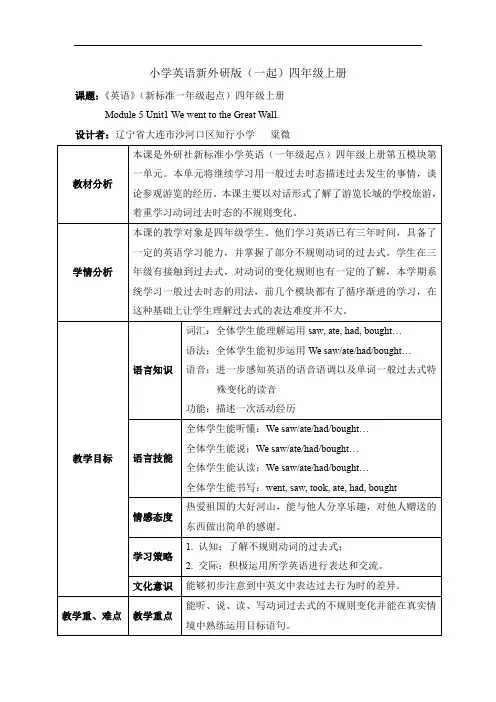
小学英语新外研版(一起)四年级上册
课题:《英语》(新标准一年级起点)四年级上册
Module 5 Unit1 We went to the Great Wall.
设计者:辽宁省大连市沙河口区知行小学 粱微
教材分析 本课是外研社新标准小学英语(一年级起点)四年级上册第五模块第一单元。本单元将继续学习用一般过去时态描述过去发生的事情,谈论参观游览的经历。本课主要以对话形式了解了游览长城的学校旅游,着重学习动词过去时态的不规则变化。
学情分析 本课的教学对象是四年级学生。他们学习英语已有三年时间,具备了一定的英语学习能力,并掌握了部分不规则动词的过去式。学生在三年级有接触到过去式,对动词的变化规则也有一定的了解,本学期系统学习一般过去时态的用法,前几个模块都有了循序渐进的学习,在这种基础上让学生理解过去式的表达难度并不大。
教学目标 语言知识 词汇:全体学生能理解运用saw, ate, had, bought…
语法:全体学生能初步运用We saw/ate/had/bought…
语音:进一步感知英语的语音语调以及单词一般过去式特殊变化的读音
功能:描述一次活动经历
语言技能 全体学生能听懂:We saw/ate/had/bought…
全体学生能说:We saw/ate/had/bought…
全体学生能认读:We saw/ate/had/bought…
全体学生能书写:went, saw, took, ate, had, bought
情感态度 热爱祖国的大好河山,能与他人分享乐趣,对他人赠送的东西做出简单的感谢。
学习策略 1. 认知:了解不规则动词的过去式;
2. 交际:积极运用所学英语进行表达和交流。
文化意识 能够初步注意到中英文中表达过去行为时的差异。
教学重、难点 教学重点 能听、说、读、写动词过去式的不规则变化并能在真实情境中熟练运用目标语句。
教学难点 在具体的情境中较为准确地运用一般过去时语句描述一次活动经历。
五年级上册英语教案-Module4 Unit 1 We're going to tell stories.外研版(一起)

Module 4 Unit 1 We are going to tell stories
【第1课时】
教学目标 1.能听懂、会说、认读listen to , talk about , read , write about ,put on a play ,
short , interesting 。
2.能用“What are we going to do ?”“We are going to …”谈论某人的计划或打算。
重点难点 重点:能听懂、会说、认读listen to , talk about , read , write about ,put on a
play , short , interesting ;能用“What are we going to do ?”“We are going to …”谈论某人的计划或打算;能听懂、会说A部分的对话。
难点:理解be going to 结构的用法。
教具准备 戏剧的场景图片和音乐,单词卡片、教学挂图、教学磁带等
教学过程设计 备注
课题引入 Step 1 Warm-up/Revision
1. Greetings
2. TPR activities
T: We’re going to play a game. Are you ready?
教学过程 Step 2 Presentation
1. New words
(1)学习listen to
①欣赏一小段欢快活泼的音乐,引出listen to的学习
T: Thank you, children. You are working hard. Are you tired? We’re
going to listen to some music. A Chant
Cook, cook, we are going to cook a meal.
Iron, iron, we are going to iron clothes.
【外研版】四年级英语上册(一年级起点)各单元课文翻译

1
【外研版】
四年级英语上册(一年级起点)各单元课文翻译
一、教材目录
Module 1
Unit 1 It was my birthday on Saturday.
Unit 2 I’ve got a new friend.
Module 2
Unit 1 I helped my mum.
Unit 2 Amy painted a picture.
Module 3
Unit 1 She didn’t walk to school yesterday.
Unit 2 I didn’t play football.
Module 4
Unit 1 Chinese people invented paper.
Unit 2 He invented this bicycle.
Module 5
Unit 1 We went to the Great Wall.
Unit 2 I wore warm clothes.
Module 6
Unit 1 It didn’t become gold.
Unit 2 He didn’t come back.
Module 7 2
Unit 1 Did you take Amy’s doll?
Unit 2 Did you see it?
Module 8
Unit 1 When did they come?
Unit 2 Where did you go yesterday?
Module 9
Unit 1 What happened to your head?
Unit 2 I bumped my head.
Module 10
Unit 1 Go to bed early.
Unit 2 Eat vegetables every day.
二、课文翻译
Module 1
四年级英语下册Module5Unit1We’rehavingaparty教案设计外研版(一起)
Module 5 Unit 1 We’re having a party
一、学习目标:
1. 学习新单词old, young, strong, tall, short.
2. 初步认识形容词比较级 taller, shorter, older, younger, stronger.
3. 学会运用形容词比较级句型:甲+be+形容词比较级+than+乙。
4. 培养学生比较和描述两个人差异的能力。
二、重点难点
重点:
1. 形容词及形容词的比较级
2. 句型:Amy’s taller than Lingling.
难点:
1. 用比较级来描述两个人的差异。
2. 学会运用形容词比较级句型。
三、预习学案
1. Greetings
2. Review words:用单词卡复习已学过的形容词,如tall, short, young, fat, thin等。
四、导学案
Step 1(新课呈现)Presentation
(1)教师用两只铅笔举例,学生观察。教师举起左手中的铅笔说:This pencil is ___.(教师可做个手势)学生说出单词long;随后教师将左手中的铅笔与右手中的尺子对比问学生:That pencil is ___(教师引导学生说 longer)同时教师板书单词在黑板上。
Long---longer
教师用形象的物品完成其它形容词比较级单词的学习。
如:short—shorer. old—older. young—younger. strong—stronger. small—smaller.
thin—thinner.fat—fatter. big—bigger.
(2)教师依次教学生认读单词
(3)全班学生大声朗读单词。
(4)听录音学习生词。
(5)教师在班上举例,例如:This apple is big. That apple is bigger.将两个句子品在一起:That apple is bigger than this apple.
外研版(三起点)四年级英语上册Module_1--2单元测试题
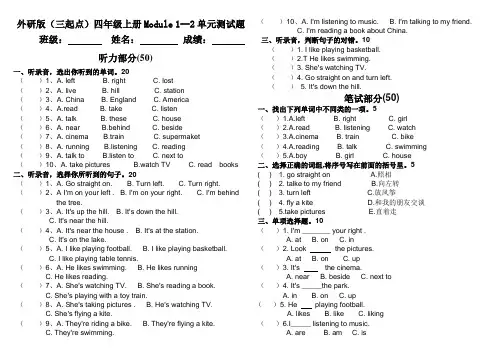
外研版(三起点)四年级上册Module 1--2单元测试题
班级: 姓名: 成绩:
听力部分(50)
一、听录音,选出你听到的单词。20
( )1、A. left B. right C. lost
( )2、A. live B. hill C. station
( )3、A. China B. England C. America
( )4、A.read B. take C. listen
( )5、A. talk B. these C. house
( )6、A. near B.behind C. beside
( )7、A. cinema B.train C. supermaket
( )8、A. running B.listening C. reading
( )9、A. talk to B.listen to C. next to
( )10、A. take pictures B.watch TV C. read books
二、听录音,选择你所听到的句子。20
( )1、A. Go straight on. B. Turn left. C. Turn right.
( )2、A I’m on your left . B. I’m on your right. C. I’m behind
外研版英语小学(一年级起点)四年级上册全套教案

Module1 UNIT1 Lucy lives in London.
课时目标:
1)复习一般过去式和一般现在式第三人称单数的动词变化
2)掌握英文书信的一般格式
3)能够运用Where does she live? She lives in …… .
It was my birthday on Saturday.
We were at Buckingham Palace.
课时重、难点简析:
1) 一般现在式第三人称单数的动词变化+s/es
Where does she live? She lives in …… .
学生对此语法项掌握的不扎实,虽然2-3年级都有学习和复习,但是在实际运用中会忘掉动词的相应变化。
2)What does she/he live?
特殊疑问句和第三人称单数的动词变化放在一起出现,对应学生来说要通过多练习才能掌握。
学生认知分析:
1) 学生对英文书信的格式有了解
2) 对于一般过去式和一般现在式的第三人称单数的动词变化有了解。
3)对于大地点(城市、国家)前用in,在小地点(home/park…)前用at,都学过、练习过。
教学过程 Warm-up
Good morning, boys and girls.
How are you?
Did you have a good summer holiday?
What did you do in summer holiday?
I read some books, watched the film and did many other things.
What about you?
You did so many things in summer holiday. The summer holiday passed. Now we’re
【英语教材】外研版一至六年级英语教材总目录(一年级起点)
外研版一年级英语上册(一年级起点)(义务教育教科书)课本目录如下:
1 外研版一年级英语上册Module 1 ...... 1 Unit 1 Hello! ...... 1 Unit 2 How are you? ...... 4 Module 2 ...... 7 Unit 1 What's your name? ...... 7 Unit 2 I'm a boy. ...... 10 Module 3 ...... 13 Unit 1 Sit down! ...... 13 Unit 2 Point to the window! ...... 16 Module 4 ...... 19 Unit 1 It's red! ...... 19 Unit 2 It's a red dog. ...... 22 Module 5 ...... 25 Unit 1 This is our teacher. ...... 25 Unit 2 That is a yellow cat. ...... 28 Module 6 ...... 31 Unit 1 What's this? ...... 31 Unit 2 It's my ruler. ...... 34 Module 7 ...... 37 Unit 1 Is it a dog? ...... 37 Unit 2 It's a yellow cat. ...... 40
外研版一年级英语上册(一年级起点)(义务教育教科书)课本目录如下:
2 Module 8 ...... 43 Unit 1 How many? ...... 43 Unit 2 How many pink balls? ...... 46 Module 9 ...... 49 Unit 1 How old are you? ...... 49 Unit 2 Happy birthday! ...... 52 Module 10 ...... 55 Unit 1 That is my father. ...... 55 Unit 2 That is his car. ...... 58 Review Module ...... 61 单词表Word List ...... 65 Reading for pleasure ...... 71 It's under the desk ...... 71
外研版一年级起点四年级上M5U1说课稿
外研版一起四年级英语上册说课稿 Module 5 Unit 1
一、说教学内容 今天我说课的内容是新标准英语第7册第5模块第1单元Unit 1 We went to
the Great Wall. 本课情境是Sam在Daming家玩,两人一起向Daming的爸爸介
绍学校昨天去长城的所见所闻,活动的情况。
主要学习表达叙述过去这个主题,使学生学习如何运用含有不规则的动词过
去式的语句说明过去的活动。 二、说教材
本节课是新标准英语一年级起始第七册教材第五模块第一单元.本课是在前
几模块基础上继续学习一般过去时,和前几模块有所不同的是本课涉及到了动词过去式的不规则变化。本课的Activity one 部分通过描述学校旅行的方式来学习新知课文内容贴近学生现实生活,使学生更容易理解和接受。
三、说学生 本单元的学习任务就是谈论假期活动,学生有话可说。四年级的学生他们富
有想象力,对事物充满了好奇,喜欢做游戏,急于得到老师的认可,有一定的语
言表述能力,对英语学习表现出积极性和初步的自信心,但英语学习兴趣不像一二年级学生那么浓厚,因此在教学过程中我努力做到在帮助学生巩固旧知识的同
时,力求创造良好的英语环境,以灵活新颖的教学形式调动学生的积极性,使学
生主动参与英语知识的学习、探索与交际活动,注重培养学生语言交际能力和思维发展能力。
四、说教学目标
在认真分析教材的基础上,我针对学生实际,将本课时的教学目标及重,难点确定如下:
1、语言知识目标
(1)全体学生能听懂,说出,认读,写出go went, see saw, take took, minute, eat ate,candy candies, plant, have had, buy bought 2、语言技能目标:
全体学生能听懂,说出,认读,写出We went to the Great Wall. I wore warm clothes. 全体学生能运用“We went…”等含有不规则动词过去式的语句说明假期
最新外研版(一年级起点)五年级英语上册 Module4Unit1We’regoingtotellstories公开课教案
精品资料,祝您成功。 外研版(一起)五年级英语上册教案
Module 4 Unit 1 We’re going to sing and dance.
一、 教学目标与要求:
1.知识与能力目标
Words: tidy up, invitation
Structures: What are we going to do?
We’re going to have lunch together.
We’re going to sing and dance.
Are you going to have a birthday cake? Yes, I am.
Amy is going to be.
2. 知识目标
(1)学生能够掌握四会单词和句型结构。
(2)根据图片和情境说出单词和句子。
(3)在图文或场景下进行课文的复述。
3. 能力目标
(1)在情景中正确运用英语庆祝生日。
(2)学生能描述将要发生的事情并与别人谈论、问答,表达自己的想法。
4. 情感态度目标
培养能够学生关心他人,积极表达自己的祝福。 精品资料,祝您成功。 培养学生能够按时整理自己的房间及物品的好习惯。
二、 教学重点及难点:
1. What are we going do? We’re going to have lunch together.
2. Are you going to have a birthday cake?
1) 在情景中正确运用英语庆祝生日。
2) 学生能描述将要发生的事情并与别人谈论、问答,表达自己的想法。
三、课前准备:
录音机, CD- Rom, 绘制一张邀请卡,制作相应的课件
四、教学过程:
Step1 Warm-up:
1. 用课件展示一张Daming过生日的图片,并播放“ Happy Birthday!”这首英语歌曲。
2. Free-talk
a. How many children are there? What are they eating?
外研版小学英语(一年级起点)四年级上册【同步练习】Module 5 Unit 2
Module 5
Unit 2 I wore warm clothes.
同步练习
合肥英伦教育 阚娜
( )1. wear 穿
( )2. fall 爬
( )3. hurt 使受伤
( )4. skate 滑冰
( )5. warm 寒冷的
( )6. ice 冰
1. fall over A. 暖和的衣服
2. warm clothes B. 摔倒; 跌倒
3. at first C. 能够
4. go skating D. 起初, 开始时 ◆ 读一读, 连一连 ◆ 判断下列单词与所给汉语意思是(T)否(F)相符 5. be able to E. 去滑冰
1. Yesterday, we ________ (go) on a school trip.
2. Yesterday, we ________ (wear) warm clothes.
3. Yesterday, I ________ (learn) to skate.
4. Yesterday, I ________ (fall) over.
5. Yesterday, we ________ (have) a good time.
1. trip a
school Lucy on went
______________________________________________________________________________.
2. went the wall to Great We
______________________________________________________________________________.