
八年级英语上册仁爱版教案:Unit1Topic2SectionB
⼋年级英语上册仁爱版教案:Unit1Topic2SectionB
⼋年级上册教案设计Unit1 Playing Sports
Topic2We should learn teamwork.
Section B
Ⅰ. Material analysis
Section A and Section B 的内容整合,⽤三个课时上完。
本节课为单元第⼆课和第三课时,⽤两课时上完,主要活动为Section B 的1a和4a, 4b。
通过Maria和Jane平息Kangkang和Michael的争吵,呈现了对话的主题是:One player doesn’t make a team.对话呈现了提建议的三种⽅式:(1)祈使句的肯定句、否定句形式;(2)What about doing sth?(3)sb should do sth.语⾳学习:(1)让学⽣区分元⾳/ e/ 和/ @/ 发⾳的不同,并能掌握各⾃的拼写规则。(2)让学⽣体会清辅⾳的不完全爆破并能正确朗读。本课帮助学⽣学会请求、提建
议、道歉的表达法,通过和他⼈的沟通、合作,将团队合作精神融于对话中。要求学⽣能结合学
过的be going to do,进⼀步谈论有关⾃⼰最喜欢的运动的话题,并能将团队合作精神体现在书⾯
表达中。
Ⅱ. Teaching aims
Knowledge aims:
1.能区分元⾳⾳素/e/和/}/的发⾳,并能正确拼读单词,注意对应的字母组合的拼写规
则;能在句中正确朗读辅⾳的不完全爆破。2.能正确拼读并运⽤单词表中的单词:fight, angry, nothing, finish, grandfather.
3.能正确运⽤以下短语造句:
shout at sb, do one’s best, be angry with sb, talk about sth, keep doing sth.
4.能⾃如地运⽤以下功能性语⾔进⾏交流,表达提建议、道歉:
Don’t shout at me like that.
Please don’t fight.
You should learn teamwork.
What about saying sorry to Michael?
I am sorry for what I said.
It’s nothing.
5. 能对双宾结构进⾏句型转换,理解并能运⽤双宾语结构。
Skill aims:
1.能听懂有关体育活动中团队合作的简单对话和陈述。
2.能正确地⽤英语在团队中提建议、向他⼈道歉。
3.能正确朗读课本的⽂本材料及难度相当的材料。
4.能书⾯表达提建议,道歉等。
Emotional aims:通过对Section A的学习,学⽣能够在团队合作中,学会为他⼈提建议,犯了错误要勇于向他⼈道歉。在谈论运动合作时,强化学⽣在积极参与运动时要主动配合他⼈的意识,将团队精神渗透到学⽣的学习和⽣活中。
Ⅲ.The key points and difficult points
Key points:
对双宾语⽤法的巩固: subject + vt.+indirect object + direct + subject.
能清楚地找出短⽂中的直接宾语和间接宾语。Difficult points:
1.对be sorry for what I said 中what的理解。
2.对不完全爆破读⾳的正确把握。
Ⅳ.Learning strategies
1. 通过再现复习双宾语的⽤法,让学⽣懂得复习也是⼀种学习。
2. 通过模仿录⾳的不完全爆破,让学⽣知道模仿读⾳是纠正⾃⼰读⾳的很好的学习途径。
Ⅴ.Teaching aids
Computer multimedia projector, phonetic syllable cards, word cards
Everyday saying: There’s no “I” in teamwork. 全队的配合不分你我。
Ⅵ.Teaching procedures
Interaction
Student activity Teacher activity Step
pattern
Introduction (8 minutes)1.The whole
classwork
2.The whole class
work
3.Two students’
work
4.Individual work
5. The whole class
1.Focus their attention
on the teacher.
2.Read the saying aloud. If
There’s no “I” in
teamwork
3.The girl and the boy
should try to be the
better one.
A sample:Kangkang’s team is
going to have a soccer
game against Class Five
on Saturday,but one of
his teammatesfalls ill.
So he asks Michael to
join them. Michael
isn’t good at playing
soccer. So Kangkang
and Michael are
practicing on the
playgro und, and they
keep trying it.
4.Students discuss in
groups, and try to answer
the teacher’s questions.
(1)S1: They look unhappy
.
(2)S2: Maybe they
didn’t win the game.
5. Students listen carefully,
1.Greet students ready for
learning.
2.Show everyday saying for
the students.
(one saying a week )
3.Ask a girl and a boy to
retell 1a in Section A.
4.Teacher goes on with the
topic: Kangkang and
Michael’s soccer game is
over. Can you guess:
Didthey win the game?
Teacher shows the pictures of
1a on the screen, l etting thestudents guess: (1) What’s
wrong with Kangkang and
Michael? (2) Why do
Kangkang and
Michael look unhappy?
Presentation (10 minutes) 1. The whole
class work
2.The whole class
work
3.The whole class
work
4.The whole class
work
5. T wo students’
work
6. The whole class
work
7. The whole class
work
1. Students make sure
they understand what
the statements mean.
2. Students try to catch
the general idea of the
dialogue .
3. Students listen and
mark “T” or “F”.
4. Students correct their
answers while
reading.
5. Volunteers write their
answers on the
blackboard.
6.Students finish1c, and
they may discuss itafter finishing writing
the answers in their
books.Three volunteers
show their answers on
the blackboard.
7. Students underline the
important language
points, and they should
know their meanings.
1. Finish1b.Teacher asks the
students to read the
statements in 1b.
2.Teacher plays the recording
for the first timewithout
stopping.
3.Teacher plays the recording
for the second time.
4. Teacher lets students read
1a carefullyand check1b.
5. Check 1b.Teacher asks
two students to write their
answers, and then helps
tocorrect the wrong parts.
6. Teacher asks the students
to finish1c, and then
check their answers.
7. Explanation of the
language points in 1a:
lose- lost
wouldn’t pass the ball
shout at
did his best
learn teamwork
make a team
be angry with sb
仁爱八年级英语Unit 1 Topic2 SectionB(练习题)

Unit1 Topic2 SectionB
一,单词
1. Mary is a good girl. She (完成)her homework on time every day.
2. Lucy (生气)because she lost her pen.
3.They (打一架)because of the lost game. But soon they said
sorry to each other after (打架).
4. (冲...喊叫)others is not polite.(礼貌)
二,单选
( )1.You should not your parents.It is not polite.(礼貌)
A.talk with B.look after C.shout at D.play with
( )2. Mr. Lee because the students forgot to do he homework.
A.is angry B.is angry with C.was angry with D.was angry
( )3. I don’t want to talk the problem you.
A.to , with B.with , with C.about , with D.with , about
( )4.Zhang Ming’s English is not good, but he does his best it well.
八年级英语上册仁爱版教案:Unit1Topic2SectionB
1 / 8 八年级上册教案设计Unit1 Playing Sports Topic2We should learn teamwork. Section B Ⅰ. Material analysis Section A and Section B 的内容整合,用三个课时上完。本节课为单元第二课和第三课时,用两课时上完,主要活动为Section B 的1a和4a, 4b。通过Maria和Jane平息Kangkang和Michael的争吵,呈现了对话的主题是:One player doesn’t make a team.对话呈现了提建议的三种方式:(1)祈使句的肯定句、否定句形式;(2)What about doing sth?(3)sb should do sth.语音学习:(1)让学生区分元音/ e/ 和/ @/ 发音的不同,并能掌握各自的拼写规则。(2)让学生体会清辅音的不完全爆破并能正确朗读。本课帮助学生学会请求、提建议、道歉的表达法,通过和他人的沟通、合作,将团队合作精神融于对话中。要求学生能结合学过的be going to do,进一步谈论有关自己最喜欢的运动的话题,并能将团队合作精神体现在书面表达中。Ⅱ. Teaching aims Knowledge aims:1.能区分元音音素/e/和/}/的发音,并能正确拼读单词,注意对应的字母组合的拼写规则;能在句中正确朗读辅音的不完全爆破。2.能正确拼读并运用单词表中的单词:fight, angry, nothing, finish, grandfather. 3.能正确运用以下短语造句:shout at sb, do one’s best, be angry with sb, talk about sth, keep doing sth. 4.能自如地运用以下功能性语言进行交流,表达提建议、道歉: Don’t shout at me like that. Please don’t fight. You should learn teamwork. What about saying sorry to Michael? I am sorry for what I said. It’s nothing.
仁爱版八年级英语上册UNIT 1 TOPIC 1 Section B教案
UNIT 1 Playing Sports
TOPIC 1 I’m going to play basketball.
Section B
教案
教学重点
1. 在实际情景中运用型What are you going to be? I am going to be an artist/ a cook/ a doctor.
What is your favorite sport? / I like …
2. 知道各种职业的说法。
教学难点
重难点句型:
(1)- What are you going to be when you grow up?
- I am going to be an artist
(2)- What is your favorite sport?
- I like football.
教具准备
(1)各种职业照片
(2)教学PPT
教学过程
热身/复习(Warm-up/Revision)
1. Greetings and free talk
T: Hello, boys and girls. How are you?
S: Hello, Miss. I’m fine, thank you, and you?
T: I’m fine, too. Thank you very much.
(Say hello to the teachers together)
T: Before our class, let’s enjoy a wonderful song, and we can relax.
通过一首歌曲使本课在轻松愉快的气氛下开始,同时教师通过歌曲提问顺利引入新课。 呈现新课
1. Lead in.
T: What a wonderful song! That sounds great. Do you know who sings the song?
Ss: …
仁爱版八年级英语上册UNIT 2 TOPIC 1 Section A教案
UNIT 2 Keeping Healthy
TOPIC 1 You should brush your teeth twice a day.
Section A
教案
【教学重点】
1. 学生学会关于身体状况的表达以及怎样询问他人的身体状况:How are you feeling
now? I feel /don’t feel well.。
2. 能听、说、读、写四会单词: model、runny nose、slight fever、high fever。在学习的过程中培养学生综合运用语言的能力,能用更多的语句来丰富自己的语言,如:Glad /
Sorry to hear that. Take care of yourself.
【教学难点】
1. How are you feeling now? I don’t feel well.本课的核心句子,询问和表达身体的状况。runny nose、slight fever、high fever 三个表示病症的词组。
2. Glad / Sorry to hear that. Take care of yourself.用来丰富学生的语言,重在灵活应用。
【教具准备】
病痛单词学习卡片,随堂PPT
【教学过程】
热身/复习(Warm-up/Revision)
1.Sing an English song :Clap your hands
2.问候,复习旧知
T: Hello boys and girls. How are you today?
Ss: …
T: I’m very well. Because there will be an English party in our school tomorrow. I hope all my
students can enjoy my party. But I’m sorry to hear that some of my students are sick. Now let’s
仁爱版八年级英语上册Unit1 Topic2 Section B 教案设计
仁爱版八年级英语上册Unit1 Topic2 Section B 教案设计
1 / 2 Unit1 Topic2 Section B 优质课教案(湖北省)
一、教学目标
1. Learn some new words and phrases: fight, teamwork, angry, nothing, throw, shout
at sb do one’s best, be angry with sb.
2. Learn some functional sentences to make apologize and response, such as:
I’m sorry for what I said.
It’s nothing.
3. Learn to value the friendship and realize the importance of teamwork.
二、学情分析
这篇课文为新学期开学后的第二个话题而且是关于学生喜欢的运动的内容所以大多数学生比较有学习的兴趣和求知欲
三、重点难点
1. use the verb to make phrases
2. learn how to make apologize to others and response.
四、教学过程
4.1第一学时
4.1.1教学活动
活动1【导入】Step1 Lead in
1. Show students the learning aims and demands.
2. Ss learn new words by themselves first then use the team competition to learn and
remember new words… Next, follow teacher to read, and play a game
3. Share an essay about friends with students Then talk about friends.
仁爱版八年级英语上册Unit1Topic 2 Section B学案
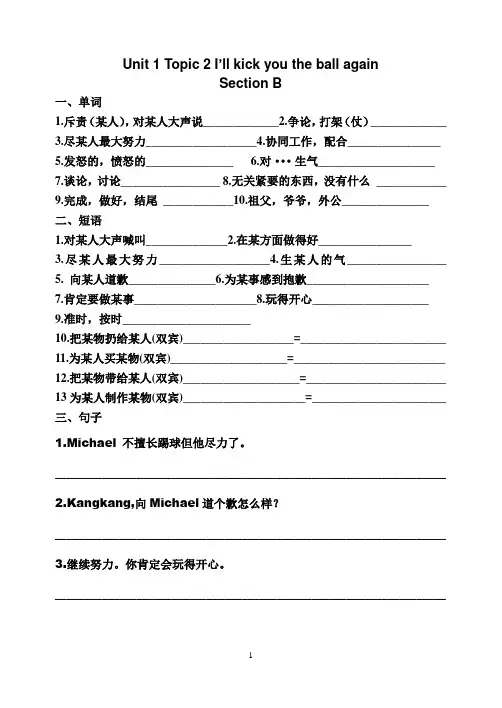
1 Unit 1 Topic 2 I’ll kick you the ball again
Section B
一、单词
1.斥责(某人),对某人大声说_____________2.争论,打架(仗)_____________
3.尽某人最大努力___________________4.协同工作,配合________________
5.发怒的,愤怒的_______________ 6.对···生气____________________
7.谈论,讨论_________________ 8.无关紧要的东西,没有什么 ____________
9.完成,做好,结尾 ____________10.祖父,爷爷,外公_______________
二、短语
1.对某人大声喊叫______________2.在某方面做得好________________
3.尽某人最大努力___________________4.生某人的气_________________
5. 向某人道歉_______________6.为某事感到抱歉_____________________
7.肯定要做某事_____________________8.玩得开心____________________
9.准时,按时______________________
10.把某物扔给某人(双宾)___________________=_________________________
11.为某人买某物(双宾)____________________=__________________________
12.把某物带给某人(双宾)____________________=________________________
13为某人制作某物(双宾)_____________________=_______________________
仁爱英语八年级上册Unit2 Topic1 section A 教案
第1页/共6页 Unit 2 Topic 1 Section A
Ⅰ. Material analysis
Section A 是本话题的第一课时。 Topic1介绍了感冒、头疼等常见病的名称,出现了疾病名称的词:toothache, backache, fever, cough, headache,
stomachache等以及相对应的短语:have a cold, have a fever, have a cough, have a
headache, have a toothache, have a backache, have a stomachache等。
Section A的主要活动为1a和Exercise 2。 1a 通过Kangkang 和Betty的对话,呈现了询问生病情况的对话: “What’s wrong with you?”/ “What’s the
matter with you?”, “I have a … ”等,以及表达关心所提的建议:“You should… ”和 “You shouldn’t…”。本课的语法重点是You should… 和You shouldn’t…。语言功能方面要求学生学会用英语描述疾病并能根据疾病征求他人意见、给他人提建议等。
Ⅱ. Teaching aims
Knowledge aims:
1. 能正确运用以下短语进行书面表达:
have a cold, have a fever, have a cough, have a headache, have a toothache,
have a backache, have a stomachache等。
2. 能正确地运用should, shouldn’t 提建议:
You should drink enough boiled water.
You shouldn’t drink coffee or tea in the evening.
仁爱英语八年级Unit2 Topic1 Section A教案
仁爱英语八年级(上)Unit2 Topic1 Section A教案
Unit 2 Keeping Healthy
Topic 1 You’d better go to see a doctor.
Section A
The main activity is 1a. 本课重点活动是1a。
Ⅰ.Teaching aims and demands 教学目标
1. Learn some new words and phrases:
toothache, dentist, have a cold, cough, take a rest, fever, flu, headache, at night, coffee, tea, plenty,
plenty of, lift
2. Learn some useful sentences:
(1)I have a toothache.
(2)I’m sorry to hear that.
(3)I have a bad cold.
3. Learn the modals for giving advice:
(1)You should see a dentist.
(2)You shouldn’t drink coffee or tea in the evening.
4. Talk about illnesses.
5. Learn to express sympathy for a patient and give some advice to the patients.
Ⅱ. Teaching aids 教具
多媒体课件
Ⅲ.教学模式:学、探、测教学模式
一、学
1. 出示教学目标,明确本节课学习内容。
2.复习总结,导入新课。
1).通过做游戏进入本单元话题,引出本节课的部分单词。
T: Boys and girls, I do, you guess. Can you guess what illness I have? You can speak in Chinese. (学习并掌握新单词, 运用肢体语言,启发学生回答。)
八年级英语上册仁爱版教案:Unit 2 Topic 2 Section A
第1页/共8页 八年级上册教案设计
Unit 2 Keeping Healthy
Topic 2 I must ask him to give up smoking.
Section A
Ⅰ. Material analysis
Section A 是本单元第一课时和第二课时。
主要活动为Section A 的1a和3a。
第二单元谈论如何保持健康,第二话题谈论了影响健康的好习惯和坏习惯,引出了本课的语法重点:情态动词must +动词原形,表示建议、劝告。同时引出了动名词做主语的常用句式:Staying
up late is bad for your health. 通过学习Section A, 让学生能够辨别好习惯与坏习惯,从而帮助他们养成好习惯,戒掉坏习惯。课后要求学生会用动名词做主语造句,能用must提建议。
Ⅱ. Teaching aims
Knowledge aims:
1. 能正确运用动名词短语做主语进行书面表达:Staying up late is bad for your health.
2. 能正确地运用must, mustn’t提建议:
You must have a good rest.
You mustn’t throw litter around.
Skill aims:
1. 能听懂有关影响健康的好习惯和坏习惯的对话。
2. 能熟练地运用must, mustn’t提建议。
3. 能正确朗读有关影响健康的好习惯和坏习惯的对话或文章。
Emotional aims:
通过语言学习,影响学生的自身品格,要学会辨别好习惯与坏习惯,养成好习惯,戒掉坏习惯,保持健康。
Ⅲ. The key points and difficult points
Key points:
look tired, watch a soccer game, go to bed late, put litter into dustbin, throw litter around, keep
八年级英语Unit 1 教案
Unit 1 Where did you go on vacation?
Language Goal
【语言目标】 Learn to talk about past events: in this unit, students learn to talk
about where they went and what things they did in the past.
Knowledge
Goals
【知识目标】 Key Words anyone, anywhere, wonderful, few, most,
something, nothing, everyone, myself,
yourself, seem, bored, someone, decide,
try, wonder, difference, wait, below,
enough, hungry, as, dislike
Key Phrases quite a few, of course, feel like, because of,
on vacation, keep a diary, have a good time
Key Sentences 1. Where did you go on vacation?I went to the
mountains.
2.Did you. . . ?Yes, I did. /No, I didn't.
3.How was your vacation?
Key Grammar 1. “Where”cause of special questions and
answers(where引导的 特殊疑问句及其回答) .
2.The use of indefinite pronouns(不定代词的 用法) .