
八年级英语上册仁爱版教案:Unit2Topic1SectionA
八年级上册教案设计Unit2Keeping HealthyTopic1You should see a dentist.Section AⅠ. Material analysisSection A 是本单元第一课时。
主要活动为Section A 的1a和2。
第二单元谈论如何保持健康。
话题一介绍了感冒、头疼等常见病的名称,出现了疾病名称的词:toothache, backache, fever, cough, headache, stomachache等以及相对应的短语:have a cold, havea fever, have a cough, have a headache, have a toothache, have a backache, have a stomachache等。
通过Kangkang 和Betty的对话,呈现了询问生病情况的对话:What’s wrong with you? I have a …等,以及表达关心所提的建议:You should…和You shouldn’t…。
本课的语法重点是You should…和You shouldn’t…。
语言功能方面要求学生学会用英语描述疾病并能就疾病征求他人意见、给他人提建议等。
要求学生能在课后用英语写一篇描述疾病并提出有益健康的提建议的文章。
Ⅱ. Teaching aimsKnowledge aims:1. 能正确运用以下短语进行书面表达:have a cold, have a fever, have a cough, have a headache, have a toothache,have a backache, have a stomachache等。
2.能正确地运用should, shouldn’t 提建议:You should drink enough boiled water.You shouldn’t drink coffee or tea in the evening.Skill aims:1.能听懂有关日常小病的名称及相关话题。
2.能熟练地运用should,shouldn’t针对日常小病提建议。
3.能正确朗读介绍日常小病的对话或文章。
4.能用should, shouldn’t 结合本单元短语描述日常生活小病并提出有益的建议。
Emotional aims:通过语言学习,影响学生的自身品格,要学会信任他人、关心他人,为我们的健康生活创建友爱、和谐的氛围。
Ⅲ.The key points and difficult pointsKey points:have a cold, have a fever, have a cough, have a headache, have a toothache, have a backache, have a stomachache等短语的理解及运用。
Difficult points:就日常小病用英语提建议。
Ⅳ.Learning strategies1. 培养学生根据图片猜单词意思的能力。
2. 培养学生模仿已有例句造句的能力。
Ⅴ.Teaching aidsCo mputer multimedia projector,pictures of different illnessesEveryday saying: Bitter pills may have wholesome effects. 良药苦口利于病。
Ⅵ.Teaching proceduresInteractionStepStudent activity Teacher activitypatternIntroduction (7 minutes)1.The wholeclasswork2.The whole classwork3.Individual workand the wholeclass work4.Some students’work5.The whole classwork1.Focus their attentionon the teacher.2.Students sing together.3.Monitor gives thereport while theothers listen and try tounderstand.4.Vol unteers answer:(1) He/She wants tobe beautiful;(2) To be strong;(3)To be healthy;5. Students follow whatthe teacher says, andcome into the newtopic unconsciously.1.Greet students ready forlearning.2.Sing a song together.(Clap your hands if youare happy. )Teachershowsthe Chinesewords on the screen.3. Daily report. Teacher asksmonitor of English to givea report about “The BeijingOlympics”.4.Teacher asks a question“Why does … like sports?”5. The teacher leads to thenew topic, “Yes, if weexercise every day, wewill be more beautiful,stronger and healthier. Ifyou don’t take part in anysports activities, you willbe ill like the childrenhere.”Presentation (10 minutes) 1. The wholeclass work2.The wholeclass work3.Pair work4.The wholeclass work5.The wholeclass work6. The whole1. Students read thewords according tothe phonetic symbolsand guess the meaningsaccording to the pictures.2. Students try to use theverb phrases to askand answer together.3. Students ask andanswer in pairs, using“have a cough”, “havea headache”, and“have a toothache”.4. Students look through1b and make sure theyknow what to do.5. Students listen carefullyand finish1b.6. Students say the1.Teacherpresents somepictures about the newwords: fever, cough,headache and stomachache.Guide students to learn thewords with the phoneticsymbols, showing the verbphrases under the pictures.2.Teacher asks and answersabout “have a fever” as amodel for the students toimitate.A: What’s the matter?B: He has a fever.3.Teacher introduces “What’swrong with him/her?”tothe students to do pair work.4. Teacher leads to 1a for thestudents to finish 1b,saying “Betty and Kangkangare talking about illness.Let’s listen and finish1b.First, you should lookthrough 1b and make sureyou know what to do.”5. Teacher plays 1a, and thenchecks the students’ answers.6. Teacher checks the answersConsolidation (10 minutes) 1.The wholeclass work2.The whole classworkandpairwork3. Group work4. The wholeclass work5. The wholeclass work6. The wholeclass work7. The wholeclass work8. The whole1. Students read with therecording, imitating it.2. Students ask and answerin pairs.3. Students do chain practicein groups’ making sureeveryone can say thedialogue correctly.4. Students do chain practicein their groups asquickly as they can.5. Students say theconclusion with theteacher.6. Students look at thepictures and know themeaningsof the newwords, and thenpronouncethe newwordsaccording to thepictures.7. Students catch themeaning while doingexercise2.1. Teacher plays 1a for thestudents to read withoutstopping.2. Teacher asks the studentsto practice “What’s wrongwith you? I have a…” inpairs according to 1c.3. Teacher asks the studentsto ask and answer accordingto 1c in groups.4. T eacher asks the six groups todochain practice, and the firstthree groups will win the game.5.Teacher makes a conclusion,“When we talk about illness,we may use —What’ swrong with …? —…have/has a…”6. Teacher shows pictures of newwords on the screen “coffee,tea, boiled water ” withphonetic symbols.7. T eacher explains the word“lift” by saying its synonym“carry” and asks the studentsto finish2.8. T eacher checks the students’Practice (10 minutes)1.The wholeclass work2.Group workand pair work3.Two students’work4.The wholeclass work5. The wholeclass work6. Twostudents’work1. Students make up newconversations and theymay discuss in groups.2.Students prepare for theperformance in pairs, andtwo representatives willbechosen out.3. The pair should do theirbest to perform well.4. Students know themeanings and the waysto express suggestions.5. Students listen carefullyand finish 3.6. Two volunteers writethe answers on theblackboard.1. Teacher asks the studentsto make up new conversationsaccording to 1c and 2.2. Teacher asks the groupswho have lost the game ofpracticing 1c to practicetheir new conversations inpairs. Each group finishesone pair.3. Teacher asks the best pairto show the conversationto the whole class.4. Teacher shows “Youshould/You shouldn’t…”on the blackboard.5. Teacher plays 3 for thestudents to finish A in 3,and then plays for thesecond time for thestudents to finish B in 3.6. Teacher checks the answers.Production (8minutes) 1. The whole classwork andindividual work2.The wholeclass work3. The wholeclass work4. Individual work1.Each student interviewsone student and writesdown the dialogue.2. Students write theirinterviews down afterclass, preparing forthe report in the nextclass.3.Students summarizeSection A with theteacher by doingexercises shown onthe screen.4. Students do the followingjobs:(1)Memorize thesummary after class.(2) Students write theinterview“What’swrong with you?”after class, and thenprepare for thereport in the nextclass.(3)Students learn toread vocabularywith the help ofrecording and thephonetic symbols,1. Teacher organizes aninterview accordin g to1cand 2, and students will doit in their own groups.2. Teacher asks the studentsto write down theirinterviewsafter class.3.Teacher shows thesummary to the students.(1) Vocabulary(2) the structure: will do4.Teacher assigns homework:(1) Review the summaryafter class.(2) Report their interviewsto the whole classtomorrow.(3) Prepare Section B afterclass.Teaching ReflectionIt’s a little hard for the students to give proper suggestions on illness.They may search more information about this topic after class.Ⅶ. Blackboard designUnit2Keeping HealthyTopic1You should see a dentist.Section AWhat’s wrong with you?have a fever / coughI have a bad cold.have a headache / stomachacheYou should see a dentist. drink enough waterI hope you’ll get well soon. lift heavy things。
仁爱版英语八年级上册Unit 2 topic 1 section A说课稿

仁爱版英语八年级上册Unit2 topic1 You should brush your teeth twice a daysectionA 说课稿尊敬的各位老师:大家好!今天我说课的题目是八年级英语Unit2 topic1 You should brush your teeth twice a day sectionA本次说课我将从四个方面向大家进行介绍,他们分别是:教材分析、教法分析、学法指导以及教学程序,首先让我们来看一下本次说课的第一部分,即教材分析部分。
在教材分析中,我将对教材从1、教材地位和作用,2、教学目标,3、教学重点、难点三个方面进行分析。
一.教材分析1、教材的地位和作用Unit2主要谈论如何保持健康。
第一话题到第三个话题内容层层递进,先是从身体不适谈起,再谈到看病和怎样保持身体健康,最后部分以流行感冒为主题,体现了教材贴近生活的特点。
学生在学习的同时,不仅增长了很多健康知识,并且树立了关爱他人的情感意识,能在别人生病时提供合理的建议。
Topic1 以保持牙齿健康为主题,而sectionA主要以Kangkang和Betty的对话形式介绍了一些感冒、头疼等常见病的名称:toothache, backache, fever, cough, headache, stomachache等以及相对应的短语:have a cold,have a fever, have a cough, have a headache, have a toothache, have a backache, have a stomachache等,还呈现了询问生病情况的对话:What’s wrong with you? I have a …等,以及表达关心所提的建议:You should…和You shouldn’t…。
本课的语法重点是You should…和You shouldn’t…。
由此可见本课的学习为今后的学习打下坚实的基础,在整个知识体系中起着承上启下的作用。
仁爱版英语八年级上册Unit1_Topic2_SectionA优质课教案

Unit1 Topic2 SectionA优质课教案【学习目标】重难点:1a【学习导航】I. Pre—task: 预习检测1. (忆一忆)Review some new words(1)有病的不健康的______________________________. (2)介意/关心______________________________.(3)踢/端______________________________.(4)及格/传球______________________________.(5)当然/确定______________________________.(6)在某处______________________________.(7)扔,投______________________________.(8)患病/病倒______________________________.(9)帮某人一个忙______________________________. (10)在某方面做得好______________________________.2.(说一说)Free Talk(自由对话).Ⅱ. While—task:(学一学)呈现、巩固和练习1.(听一听)Listen to 1a and answer(1)Which class are they going to play against?(2)What’s wrong with Kangkang’s teammate?(3)Would Kangkang mind teaching him?2.(读一读)Read la and complete the sentences.(1)Kangkang and his team are going to have a soccer game against on Saturday. (2)Kangkang asks Michael to join them because a teammate.(3)Michael is not good at but he likes to have a try.(4)Michael and Kangkang are going to for the game.3.(比一比)Work in groups and find out the key points.4.(试一试):(1)Make sentences with the key points(2)Read 1a in roles.ⅢPost—task(说一说)Summary(分享收获)【自我检测】(练一练)(10分)1. Listen to the conversations and number the pictures. (4分)()()()()2. Choose the best answers. (6分)( ) 1.—I’d like to read the book over there. Could you pass ______, please?—Certainly. Here you are.A. me itB. it to meC. me for itD. it for me。
Unit2 Topic1 仁爱版英语八年级上册同步教案
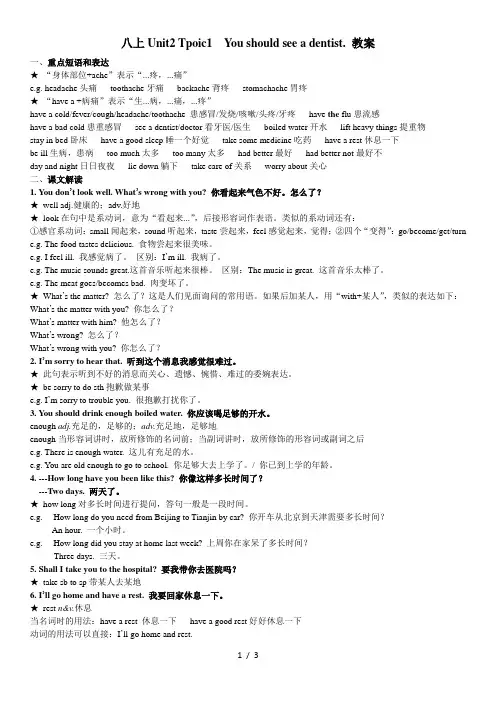
八上Unit2 Tpoic1 You should see a dentist. 教案一、重点短语和表达★“身体部位+ache”表示“...疼,...痛”e.g. headache头痛toothache牙痛backache背疼stomachache胃疼★“have a +病痛”表示“生...病,...痛,...疼”have a cold/fever/cough/headache/toothache 患感冒/发烧/咳嗽/头疼/牙疼have the flu患流感have a bad cold患重感冒see a dentist/doctor看牙医/医生boiled water开水lift heavy things提重物stay in bed卧床have a good sleep睡一个好觉take some medicine吃药have a rest休息一下be ill生病,患病too much太多too many太多had better最好had better not最好不day and night日日夜夜lie down躺下take care of关系worry about关心二、课文解读1. You don’t look well. What’s wrong with you? 你看起来气色不好。
怎么了?★well adj.健康的;adv.好地★look在句中是系动词,意为“看起来...”,后接形容词作表语。
类似的系动词还有:①感官系动词:small闻起来,sound听起来,taste尝起来,feel感觉起来,觉得;②四个“变得”:go/become/get/turne.g. The food tastes delicious. 食物尝起来很美味。
e.g. I feel ill. 我感觉病了。
区别:I’m ill. 我病了。
e.g. The music sounds great.这首音乐听起来很棒。
仁爱版英语八年级上册Unit1Topic2SectionA优秀教学案例
一、案例背景
本案例背景以仁爱版英语八年级上册Unit1Topic2SectionA为主题,主要围绕“询问时间和日期”展开。本节课的主要内容是让学生掌握询问时间和日期的表达方式,如“What time is it? What day is it today? What date is it today?”等,并能够运用这些表达方式进行实际交流。通过本节课的学习,学生能够提高自己的英语听说能力,增强对时间日期表达方式的掌握,为日常生活交流打下基础。
3.鼓励学生进行自主学习,如查阅相关资料、观看英语视频等,提高他们的学习兴趣和能力。
4.教师对学生的作业进行批改,及时给予反馈和指导,帮助学生提高。
五、案例亮点
1.真实情境的创设:通过模拟不同场景下的时间日期交流,让学生身临其境地感受和学习英语,提高他们的语言运用能力和情境交际意识。
2.问题导向与小组合作:设计具有挑战性和思考性的问题,引导学生进行探究式学习,激发学生的思维潜能和团队合作精神。
3.多元化的教学评价:关注学生的全面发展,既注重知识的掌握,也重视能力的培养和个性源自发展,体现了“以人为本”的教育理念。
4.学生为主体的教学模式:充分调动学生的积极性,让他们在自主学习、合作交流中,提高自己的英语水平,培养了他们的独立思考能力和自我管理能力。
5.跨文化交际的培养:在教学过程中,注重让学生了解和感受不同文化背景下的时间日期表达方式,提高他们的跨文化交际意识和能力。
3.设计角色扮演活动,让学生分别扮演不同角色,如酒店前台、火车售票员等,进行realistic conversations,提高他们的口语表达能力。
(二)问题导向
1.设计一系列问题,引导学生思考和探讨时间日期的表达方式及其在实际生活中的重要性,如:“为什么我们需要询问和表达时间日期?”“在不同的场合,我们如何运用时间日期表达方式?”等。
八年级英语上册 Unit2Topic1SectionA课件 仁爱版
3.教学重点
(1)指导学生掌握和熟练运用那些难以理解的词、句 型和句子,如What’s wrong/the matter with him/her? He/She has…,go to see a doctor, take a rest 等
(2)指导学生口头熟练表达就健康和疾病这一话题展 开的对话内容。
(3)提建议的表达方法:You should... You shouldn’t…
3.教学难点
(1)根据不同的疾病提出相应的建议 (2)让学生真正开口讲英语。
二.说教学方法
为了更好的体现新课改理念,突出重难点,我采取 以下教学方法: 1.实行循序渐进和因材施教的教学方法:教学中,因学 生的英语水平参差不齐,对不同程度的学生设置不同的 任务争取提高学生的课堂参与度。 2.实行任务型和合作型教学法:通过小组合作,设置不 同的活动和问题来提高学生参与课堂活动的积极性,通 过任务型教学法来激发学生的创新能力和实际运用能力 3 .直观教学法:借助多媒体,图片,录音机等直观教 具和电化手段创设情景,培养学生直接用英语理解和思 维的能力,提高教学质量。 4.游戏教学法:充分利用学生的积极性,我用游戏活动 贯穿整个教学活动,使他们不停的动脑子将零碎的语言 组织到一起。
3. 角色表演法:例如设计一次去看病的情景,让学生在 具体的语境中体味目标语言的真实性。
四.说教学过程
• Step 1 情景创设,导入新课(时间:5分钟) • 教师和学生进行简单的问候,如: • T:How are you today? • S: I’m fine ,thanks! • T: What’s the motto of the 2008 Olympic Games? • S1: Faster, higher, stronger.
2021年仁爱版初中八年级英语上册全册教案

2021年仁爱版初中八年级英语上册全册教案Unit1Topic1Section AThemain activities are1a and2a.本课重点活动是1a和2a。
Ⅰ.Teaching aims anddemands教学目标1.Learn some useful words and expressions:would,cheer,cheer…on,team,win,bit,quite a bit/a lot,join, club2.Learn future tense with“be going to”:(1)You know I will play in the basketball game between Class Three and our classthis Sunday.(2)Are you going to join the school skating club?Yes,I am./No,I amnot.3.Talk about preference:Which sport do youprefer,skating or skiing?4.Talk about sports and games.Ⅱ.Teaching aids教具录音机/图片/小黑板Ⅲ.Five-finger TeachingPlan五指教学方案Step1Review第一步复习(时间:10分钟)1.T:New term begins.This is thefirst English lesson of this term.Welcome back toschool,boys and girls.Did you enjoy yourselves?What did you do during yourvacation?Did you do sports?I want to know if you had a happy summer holiday.Ss:…T:Which sport did youdo?S1,please.S1:I played…in thesummer holiday.T:Which sport do youlike best?S1:I like…best.T:We all know sportsare good for our health.Now let’sreview some sports we learned before.2.(教师展示一些关于运动的图片,复习学过的运动项目名称。
仁爱英语八年级上册Unit2 Topic1 sectionA (共30张PPT)
Fill in the blanks.
Feeling
Reason
Suggestion
bad have a stomachache
night and went to bed very late.
Jane:
I see. Staying up late is bad for your
health. You should go to bed early and
you’ll feel better tomorrow.
Kangkang: Right! I must have a good rest.
1a Read aloud after the MP3.
Jane:
Kangkang, you look tired. What’s wrong?
Kangkang: I have a headache.
Jane:
I’m sorry to hear that. What caused it?
Kangkang: I watched a soccer game on TV last
A: I feel
because
B: Oh,
is bad for
You must/should
.
Suggestion see a dentist
. .
( Lingling)
look bad
(because)
toothache (will)
eat too much candy (should)
仁爱版英语八年级上册UNIT 2 TOPIC 1 Section A 教案
UNIT 2 Keeping HealthyTOPIC 1 You should brush your teeth twice a day.Section A教案【教学重点】1. 学生学会关于身体状况的表达以及怎样询问他人的身体状况:How are you feeling now? I feel /don’t feel well.。
2. 能听、说、读、写四会单词:model、runny nose、slight fever、high fever。
在学习的过程中培养学生综合运用语言的能力,能用更多的语句来丰富自己的语言,如:Glad / Sorry to hear that. Take care of yourself.【教学难点】1. How are you feeling now? I don’t feel well.本课的核心句子,询问和表达身体的状况。
runny nose、slight fever、high fever 三个表示病症的词组。
2. Glad / Sorry to hear that. Take care of yourself.用来丰富学生的语言,重在灵活应用。
【教具准备】病痛单词学习卡片,随堂PPT【教学过程】热身/复习〔Warm-up/Revision〕1.Sing an English song :Clap your hands2.问候,复习旧知T: Hello boys and girls. How are you today?Ss: …T: I’m very well. Because there will be an English party in our school tomorrow. I hope all my stude nts can enjoy my party. But I’m sorry to hear that some of my students are sick. Now let’s have a look. What’s the matter with them?2. 旧知复习,引入新知出示课件,学生进展问答练习,复习相关的疾病名称:headache、stomachache、toothache What’s the matter with Mike? He has a stomachache. What’s the matterwith John? He has a headache. What’s the matter with May? She has a toothache. T: They are sick. So I’m sorry to hear that. 〔在恰当的情境中引出新句子并讲授更容易让学生们承受。
仁爱版八年级英语上册Unit2Topic1SectionA优秀教学案例
科技集团公司关键绩效指标体系(人力资源管理)北大纵横管理咨询公司目录第一部分导言 ........................................................................................................... 错误!未定义书签。
第二部分关键绩效指标体系................................................. 错误!未定义书签。
一财务方面 .................................................................... 错误!未定义书签。
(001-007)................................................................................... 错误!未定义书签。
(008-014)................................................................................... 错误!未定义书签。
(015-021)................................................................................... 错误!未定义书签。
(022-029)................................................................................... 错误!未定义书签。
(030-036)................................................................................... 错误!未定义书签。
仁爱版八年级上册英语Unit1Topic2教案设计SectionA【精校版】
仁爱版精品英语资料(精校版)八年级上册教案设计Unit 1 Playing SportsTopic 2 We should learn teamwork.Section AⅠ. Material analysisSection A and Section B 的内容整合,用三个课时上完。
本节课为单元第一课和第二课时,用两课时上完。
主要活动为Section A 的1a和2。
通过Kangkang对Michael的邀请,引出对话的主题:合作参加足球比赛。
对话呈现了本课所要学的语法重点:subject + vt + indirect object + direct object。
结合本单元的话题We should learn teamwork.呈现了重点短语:kick the ball to you, pass me the ball, practice doing sth, give me a hand等, 同时在对话中呈现了交际功能用语:Will you …? Would you mind (not) doing sth ? 和Do you mind (not) doing sth? 帮助学生学会请求,提建议的表达法。
通过和他人的沟通、合作,将团队合作精神融于对话中。
要求学生在学会课本语言知识的同时,培养他们的团队合作精神。
督促学生结合学过的句型用be going to do 进一步谈论有关自己最喜欢的运动的话题,并能将团队合作精神体现在书面表达中。
Ⅱ. Teaching aimsKnowledge aims:1. 能正确拼读并运用单词表中的单词: ill, mind, kick, pass, certainly, somewhere, throw.2. 能正确运用以下短语造句:fall ill, give sb a hand, do well in.3. 能自如地运用以下功能句进行交流,表达请求与允许:Would you mind (not) doing sth?Do you mind (not) doing sth?Will you …?4. 能初步感知本话题语法:subject+vt+indirect object+direct object.Skill aims:1. 能听懂有关体育活动中团队合作的简单对话和陈述。