
六年级下册英语教案-Module 4第一课时Unit 1 1~2 外研版
六年级下册英语教案-Module 4第一课时Unit 1 1~2 外研版
课程目标
1. 学习并掌握新单词和短语:table tennis, have a match, after school;
2. 能够听懂并理解有关网球比赛的对话,能够口头表达自己的看法和意愿;
3. 培养学生们对体育运动的兴趣和热爱,提高他们的身体素质。
教学内容
1. 单词和短语:table tennis, have a match, after school;
2. 对话:关于网球比赛的对话;
3. 口语表达:表达自己的想法、打算和意愿;
4. 阅读理解:关于乒乓球比赛的短文。
教学重点和难点
1. 重点:学习掌握新单词和短语;
2. 难点:听懂并理解有关网球比赛的对话。
教学过程
1. Warm-up
1. Greetings and lead-in: Greet students and ask how they are doing.
Ask if anyone likes to play table tennis and if they know any of the
vocabulary words for today’s class.
2. Review of yesterday’s lesson: Have students review the words they
learned in yesterday’s lesson, and ask them if they can give examples
of how to use them in sentences.
2. Presentation
1. Introduce new words: Write the new words on the board, and have
students repeat after you. Explain the meanings of the words and have
students try to use them in sentences.
2. Present the dialogue: Read the dialogue to the students and ask
them to follow along in their textbooks. Have them repeat the dialogue
after you and ask if they have any questions about what they heard.
Encourage students to ask questions and engage with the material. 3. Practice
1. Listening and speaking practice: Play the dialogue again, this
time pausing after each line to allow students to repeat and practice.
Ask one or two students to come to the front of the class and act out
the dialogue. Encourage their creativity and allow them to add their own
lines.
2. Individual speaking practice: Have students break into pairs and
practice the dialogue, switching roles after each practice.
3. Group discussion: Have students discuss with their group whether
they would like to play a game of table tennis after school. Encourage
them to use the new vocabulary words and to express their preferences.
4. Extension
1. Reading comprehension: Have students read the short story about a
table tennis match. Ask them questions about the story, and ask them to
explain the events in their own words.
2. Writing practice: Ask students to write a short paragraph about
their own experiences playing table tennis or about their thoughts on
the sport. Encourage them to use the new vocabulary words and to be
creative with their writing.
5. Summary and Homework
1. Summary: Summarize what was covered in the class and ask if anyone
has any questions or needs clarification.
2. Homework: Assign homework for the next class, which may include
reading a passage, writing a paragraph, or reviewing vocabulary words.
教学评估
1. Observe students during the speaking and listening exercises to
assess their comprehension and ability to use the new words and phrases.
2. Observe students during the group discussion and assess their
ability to express their preferences and opinions.
教学资源
1. Textbook: Module 4, Unit 1, 1~2, 外研版
2. Markers and whiteboard
3. Reading materials 参考资料
1. Module 4, Unit 1, 1~2, Teacher’s Guide, 外研版
2.
外研版英语六年级下册Module 2 Unit 1
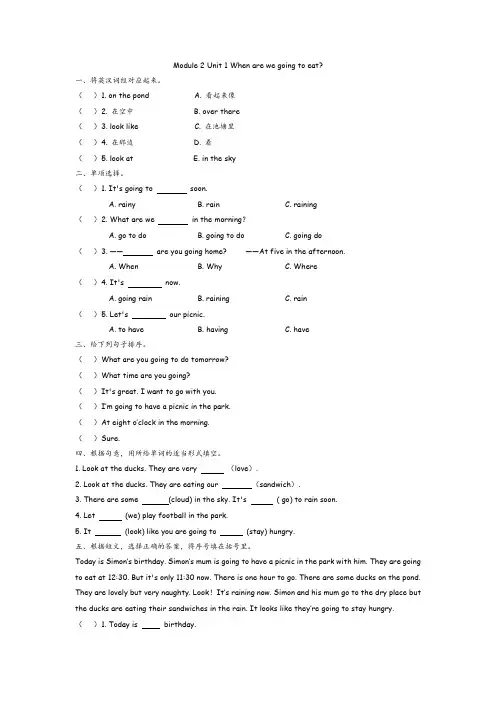
Module 2 Unit 1 When are we going to eat?
一、将英汉词组对应起来。
( )1. on the pond A. 看起来像
( )2. 在空中 B. over there
( )3. look like C. 在池塘里
( )4. 在那边 D. 看
( )5. look at E. in the sky
二、单项选择。
( )1. It's going to soon.
A. rainy B. rain C. raining
( )2. What are we in the morning?
A. go to do B. going to do C. going do
( )3. —— are you going home? ——At five in the afternoon.
A. When B. Why C. Where
( )4. It's now.
A. going rain B. raining C. rain
( )5. Let's our picnic.
A. to have B. having C. have
三、给下列句子排序。
( )What are you going to do tomorrow?
( )What time are you going?
( )It's great. I want to go with you.
外研版(一起)四年级英语下册教案教案Module 1 Unit 2教案
1 Module 1 Unit 2 Don’t feed the fish!
教学模式介绍
探究式教学模式是指在教学过程中,要求学生在教师指导下,通过以“自主、探究、合作”为特征的学习方式对当前教学内容中的主要知识点进行自主学习、深入探究并进行小组合作交流,从而较好地达到课程标准中关于认知目标与情感目标要求的一种教学模式。其中认知目标涉及与学科相关知识、概念、原理与能力的掌握;情感目标则涉及思想感情与道德品质的培养。
探究式课堂教学模式的教学环节:
创设情境——启发思考——自主(或小组)探究——协作交流——总结提高
设计思路说明
【创设情境】
这部分的视频的内容是在公园常见的一些标志,通过这一贴近生活的视频,学生将在潜移默化中了解在公园应该遵守的规则,培养学生讲文明、守规则的品德。
【启发思考】
本部分,师生在上一部分的基础之上,讨论在公园不能做什么事情,教师在这一活动中借助图片引入本课要学习的一些生词短语。
【自主或小组探究】
本部分首先探究本课中展现出的在公园和图书馆的一些标志,通过学生讨论,老师核对等方式,让学生了解在这些场所的规则。之后,通过看图说话的方式,让学生巩固这些知识。
【协作交流】
本课的此部分,学生将从事多种有趣的活动。学生先总结校园的规则,并制作海报,然后,齐声练习本课第四部分出现的歌曲。通过寓教于乐的方式,让学生掌握这些规则。
【总结提高】
本部分的意义在于总结本课所学到的知识,补充学生需要的新知识。就本课而言,主要让学生总结对比祈使句的知识。
教材分析
本本课是一年级起点外研英语第八册模块一第二单元的内容,本单元继续学习祈使句,内容贴近生活,学生较为感兴趣。学生在学完本课之后,不仅能掌握祈使句这一语言知识,
2 也能教学实践中发现遵守规则的必要性。
教学目标
【知识与能力目标】
1. 能够听说认读的单词和短语: feed, grass, shout.
六年级英语下册 Module 8 Unit 1(2)教案 外研版(一起)
外研版一起六年级英语下册教案
Module 8 Unit 1 Helen Keller.
教材分析
语言功能:能够谈论现在和过去所具备和不具备的能力。
语言结构: She was blind. So she couldn‟t see.
She was deaf. So she couldn‟t hear.
But she could learn.
教学目标:
语言知识目标:
学习目标语句 She was blind. So she couldn‟t see.
She was deaf. So she couldn‟t hear.
But she could learn.
语言技能目标:
在完成知识目标的基础上,通过游戏和阅读比赛活动的开展,培养学生的合作能力、竞争意识和综合运
用语言知识的能力。
情感态度目标:
通过学习Helen Keller这位世界上著名身残志坚有志之人的优秀事迹,让学生学有所得,学有所悟,希望她的精神能激励和教育我们的学生在任何时候遇到艰难永不退缩。
教学重、难点:
重点:学生能够用“could,couldn‟t”来描述过去所具备和不具备的能力。
难点:学生能够流利地使用正确时态来描述自己的能力,能够复述Helen Keller的伟大事迹。
学生分析
在六年级学段,大部分学生对英语的学习积极性浓厚,基础知识扎实,学习方法得当,综合运用能力的能力较强;有少部分学生还是没有找到合适的方法,学英语仍旧吃力,针对此种情况,教师应充满耐心,精心备课,在教学中多鼓励他们,帮助他们建立学好英语的自信心。
设计理念
在六年级下学期这一阶段,教学内容主要是复习巩固以前学过的内容和继续扩展学习新的内容。本册的主线是继续和Daming一起了解美国,了解Daming回到中国之后为小学毕业、升入中学学习做的准备。这一学段学生对语言的综合运用能力需要进一步提高,为此,我们在课堂上应尽可能多地运用我们以前学习过的语言,坚持听说训练,同时进行相应的读写训练。
外研版英语六年级下册Module 4 Unit 2 .Module 4 Unit 2 .习题(1)

小学英语外研版(三起)《六年级下》《MODULE 4》《Unit
2 The apples are falling down the stairs》精品专题课后练习【7】(含答案考点及解析)
班级:___________ 姓名:___________ 分数:___________
1. The bike isn’t ____. I think it’s _____.
A. mine, his B. mine, him C. my, his
【答案】
【考点】小学英语知识点》词法》代词
【解析】略
2.—— I don't like milk. —— I don't, _________.
A. too B. neither C. either
【答案】C
【考点】小学英语知识点》词法》形容词和副词
【解析】either用在否定句中,也,而且;根本.句意为:我不喜欢牛奶。我也不喜欢。
3.Her brother sells things. He is a ______.
A. doctor B. salesperson C. cleaner
【答案】B
【考点】小学英语知识点》词法》名词
【解析】从 sells things.可知选B
4.There are many____in our school.
A. tree B. trees C. a tree
【答案】B
【考点】小学英语知识点》词法》名词》名词的数
【解析】句意:我们学校有很多树,tree树,为可数名词;many许多的,为形容词,后接名词的复数形式,故答案选B.
5.Look _____ the picture and talk _____ it.
A.of, in B.at, to C.at, about D.in, about
【答案】C
【考点】小学英语知识点》词法》介词
外研版(一起)四年级英语下册教案-Module 1 Unit 2
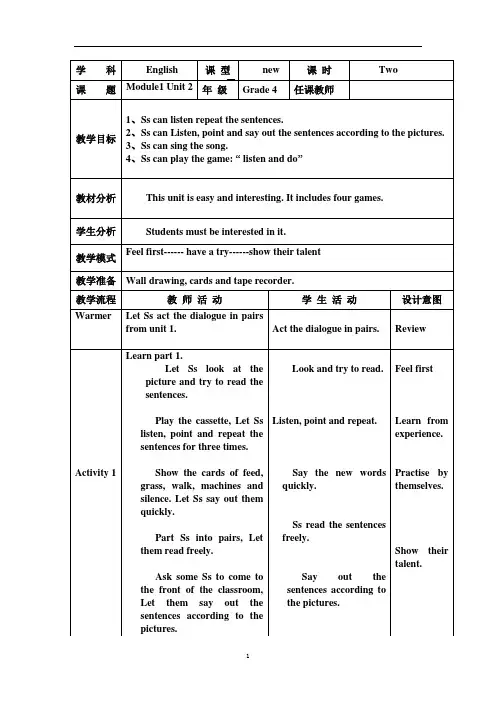
1 学 科 English 课 型 new 课 时 Two
课 题 Module1 Unit 2 年 级 Grade 4 任课教师
教学目标
1、Ss can listen repeat the sentences.
2、Ss can Listen, point and say out the sentences according to the pictures.
3、Ss can sing the song.
4、Ss can play the game: “ listen and do”
教材分析
This unit is easy and interesting. It includes four games.
学生分析 Students must be interested in it.
教学模式 Feel first------ have a try------show their talent
教学准备 Wall drawing, cards and tape recorder.
教学流程 教 师 活 动 学 生 活 动 设计意图
Warmer
Let Ss act the dialogue in pairs
from unit 1.
Act the dialogue in pairs.
Review
Activity 1 Learn part 1.
Let Ss look at the
picture and try to read the
sentences.
Play the cassette, Let Ss
listen, point and repeat the
sentences for three times.
Show the cards of feed,
grass, walk, machines and
silence. Let Ss say out them
六年级英语下册 Module7 unit1(2)教案 外研版
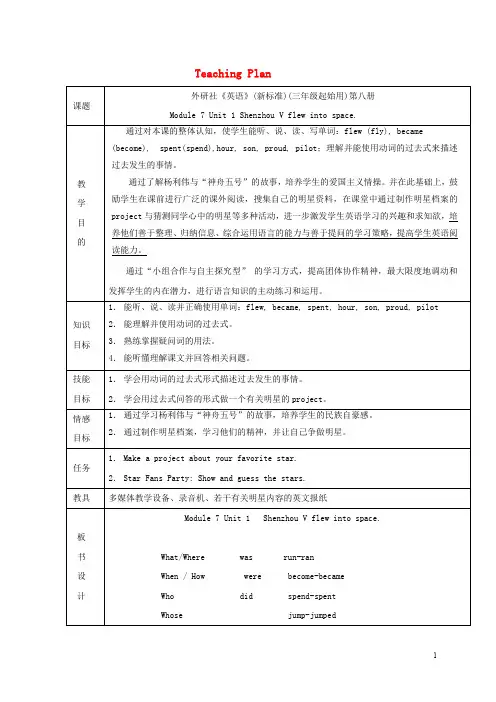
1 Teaching Plan
课题 外研社《英语》(新标准)(三年级起始用)第八册
Module 7 Unit 1 Shenzhou V flew into space.
教
学
目
的 通过对本课的整体认知,使学生能听、说、读、写单词:flew (fly), became
(become), spent(spend),hour, son, proud, pilot;理解并能使用动词的过去式来描述过去发生的事情。
通过了解杨利伟与“神舟五号”的故事,培养学生的爱国主义情操。并在此基础上,鼓励学生在课前进行广泛的课外阅读,搜集自己的明星资料,在课堂中通过制作明星档案的project与猜测同学心中的明星等多种活动,进一步激发学生英语学习的兴趣和求知欲,培养他们善于整理、归纳信息、综合运用语言的能力与善于提问的学习策略,提高学生英语阅读能力。
通过“小组合作与自主探究型” 的学习方式,提高团体协作精神,最大限度地调动和发挥学生的内在潜力,进行语言知识的主动练习和运用。
知识
目标 1. 能听、说、读并正确使用单词:flew, became, spent, hour, son, proud, pilot
2. 能理解并使用动词的过去式。
3. 熟练掌握疑问词的用法。
4. 能听懂理解课文并回答相关问题。
技能
目标 1. 学会用动词的过去式形式描述过去发生的事情。
2. 学会用过去式问答的形式做一个有关明星的project。
情感
目标 1. 通过学习杨利伟与“神舟五号”的故事,培养学生的民族自豪感。
2. 通过制作明星档案,学习他们的精神,并让自己争做明星。
任务 1. Make a project about your favorite star.
2. Star Fans Party: Show and guess the stars.
教具 多媒体教学设备、录音机、若干有关明星内容的英文报纸
六年级英语下册 Module 4 Unit 1(2)教学反思 外研版(一起)
外研版一起六年级英语下册教学反思
Module 4 Unit 1 I can't carry them all.
新课程标准强调从学生的学习兴趣、生活实践和认识水平出发,倡导体验、实践、参与、合作与交流的学习方式和任务型的教学途径达到发展学生对语言的综合运用能力。为了达到教学目标,我采用以活动为主的教学形式,让学生通过参与活动,能够运用所学进行英语交流,培养小组分工合作、自主学习的能力。
本课的教学目标是让学生听懂、会说词组:get up, go to school, have lunch;会说、会用句型:I get up at ___ o’clock. I go to school at __ o’clock. I have lunch at ___ o’clock.并能运用句型进行会话;通过参与教学活动,提高学生的语言运用能力,并培养学生合作、自主学习的能力。教学重点难点是运用所学进行口语会话。
本课首先从歌曲切入,创造一个良好的英语学习氛围。通过谜语来引入时间的表达方式。这样不仅巩固了上一节课所学,而且激发了学生的学习兴趣。接着通过卡片来新授本课的新词组:get up, go to school, have lunch等,不仅激发了学生的兴趣,而且很直观,让学生很快就能掌握这些新词组,为最后的口语对话奠定了基础。
这节课我主要采用了TPR全身反应教学法。用简单明了的动作贯穿全文,方便学生记忆背诵课文、理解课文,可谓一举两得。课中播放了一个动画片,让学生带着问题来看动画片,既是一种放松,又是一种习的方式。另外我设计了一个My day,让学生根据练习说说自己的一天,先说给同桌听,然后再说给全班同学听。通过这个活动,不仅巩固了新句型,拓展了拓展所学新知,而且这样就调动了他们学习英语的积极性,包括那些平时缺少自信的孩子,在分工合作的过程中也能出一份力,在相互的帮助、配合下能积极主动地参与实践活动。而教师在引导学生主动学习的过程中,就好比一个引路人,对于不同层次的学生,我要想使他们都能到达知识大门前,就要根据他们差参不齐的现状,为他们设计不同的道路,不同的道路会有不同的问题等着学生们去学习,去思考,但最终目的是,他们都能从不同道路上走到同一扇知识大门前,并且开启这扇门,从而达到对知识的理解、掌握和运用。
六年级英语下册 Module4 unit1(1)教案 外研版
1 Module 4
Unit 1 I’m making Daming’s birthday card.
第一课时(40分钟)
教学内容:
SB(学生用书)与AB(课堂活动用书)
Unit 1 I’m making Daming’s birthday card.
教学目标:
1. 学习语句:
I’m making Daming’s birthday card.
单词:card, careful, balloon, fly away
2. 能口头运用I’m making Daming’s birthday card.说明自己正在做某事因此不能做另外的事。
3. 识别单词:card, careful, balloon, fly away
书写单词:card, cake
重难点:
1..能口头运用I’m making Daming’s birthday card.说明自己正在做某事因此不能做另外的事。
2.识别单词:card, careful, balloon, fly away
书写单词:card, cake
功能:讲述正在发生的事情;
向他人寻求帮助;
根据客观情况说明自己能否向他人提供帮助。
教学程序:
一、热身复习
1.教师与学生热情问候。复习演唱歌曲“I can’t do it.”
2.教师和学生进行自由交谈,主要运用句型“Can you …?” 以及“Yes, I can../No, I can’t .”
二.任务呈现与课文导入
1.教师告诉学生:“我们每个人在生活中都可能遇到困难,有时我们需要寻求别人帮助,有时我们能帮到别人,但是有时我们也有可能因为这样那样的原因不能给别人提供帮助。今天我们就来学习如何用英语来表达这些。然后,要求大家能运用这些表达来编排一个帮助别人的小短句。” 2 2.教师向学生简单介绍课问的背景。提示学生注意看在Daming 的生日party上发生了什么事。
四年级英语下册 Module 6 Unit 2(1)教学案 外研版
(外研版)四年级英语下册教学案Module 6 MusicUnit 2 Lingling is
better than Daming
一、学习目标
1. 知识目标:
(1)词汇:pop music、Chinese music、 erhu、zither、 guitar、 drums.
(2)句型:a. Lingling is better /worse than Daming.
b. Sam and Amy like the guitar.
c. They can play the erhu.
2. 能力目标:
培养学生进行评价和比较的能力。
3. 情感目标:
a. 培养学生学习英语的兴趣和爱好。
b. 培养学生欣赏美、评价美的能力。
c. 通过创设情境,培养学生大胆开口说英语的能力。
d. 通过小组合作,培养学生的团结协作能力和团队精神。
二、预习学案
乐器:erhu、zither、 guitar、 drums.
三、导学案
热身复习:
我会写:good better bad worse
自主学习:
1. 听本课录音内容2遍,划出生词,试着读一读。
2. 找出课文中出现的乐器,并试着模仿弹奏。
3. 再次听录音,试着把句子翻译成汉语。并把不理解的句子划出来。
合作交流:
1. 小组内讨论解决自主学习中遇到的问题,然后全班交流,教师评析。
2. 小组内找出含有形容词比较级的句子,并背诵。
3. 用课文中出现的形容词比较级造句子。
4. 课本剧表演。
四、课堂检测(火眼金睛)
找出下列句子的错误并改正
1. They can play violin very well.
2. Amy is good than her mother.
3. What music do you like?I like classic music. 4. Xiaoming and Amy can play football. But Amy is worse than Xiaoming.
外研版英语六年级上册-Module 2 Unit 1-(教案)
Module 2 Unit 1 There’s Chinese dancing.
教案
一、 课文分析
本课围绕唐人街和中国传统舞蹈这两大点重点教授There be 句型。学生在四年级有过初步的学习,所以教师通过创设情景,实物举例,让学生能快速了解该句型是“有、存在”的意思。纽约唐人街这一文化背景的铺垫,能够激发学生学习的乐趣,从而快速进入本课知识点的学习中。本课的课堂教学能够带领学生走入西方国家,了解居住在外国华人的生活,通过精讲巧练、由浅入深、由易到难、由已知到未知、循序渐进的方法深化课堂教学内容。
二、导学目标
1、导学分析:
学生在理解There be 结构的基础上用There be句型描述事物,老师用大量的事物引导学生运用句型。
2、学习任务:
There is a Chinatown in New York!
There are lots of Chinese shops and restaurants there.
三、教学目标
1、能掌握新授单词dancing, sometimes, shop, then。能听、说、认、读句型 “There is/
are…”。
2、能熟练掌握并运用句型 “There is/ are…”。
3、培养学生在各种任务中积极与他人合作的良好学习习惯,加深学生对唐人街的了解,培养学生热爱祖国的情感。
四、教学重点和难点
重点:1、单词:dancing, sometimes, shop, then等。
2、句型:“There is/ are…”
难点:用本课所学的基本句型 “There is/ are…”等描述某个地方或某事物的情况。
五、教学方法 情景教学法、任务型教学法、小组合作学习法。
六、教学过程
1、复习上一模块所学知识。
1)让学生说出:长江、黄河、长城的英语名称。
2)复习句型:How long is the Changjiang River? (6300km)