
人教英语 八年级下册 5单元知识点笔记
Unit5 What were you doing when the rainstorm came?
1.过去进行时定义:表示在过去某一时刻或过去某一段时间内正在
进行的动作。
结构:was/were+ v.ing
句型结构:肯定句:主语+was/were+ v.ing…..
否定句:主语+was/were+not+ v.ing….
一般疑问句:Was/Were+主语+v.ing…….?
回答:Yes,主语+was/were.
No, 主语+wasn’t/weren’t.
时间标志词:at this time yesterday, at that time, at nine+过去的时间,when, while等引导的时间状语从句等。
2.When与while的区别:
while引导的时间状语从句只表示时间段,while要与延续性动词、表状态的词或进行时态连用。
While 还可以表示“然而,却”,对比关系。
When既可以与延续性动词连用,也可以与短暂性动词连用。
也可与过去时态和进行时态连用。
但是当两个动作同时发生时用While,不用when。
(I was doing my homework while my sister was playing.)
3.beat与win的区别:
beat意为“打败”,后接比赛的对手、队伍、团体。
过去式beat Win意为“获胜,赢得”,后接比赛、奖品、荣誉等。
过去式won,
4.句型:find it+adj+(for sb)+ to do sth 发现做某事对于某人来说。
Find sb/sth doing sth 发现。
正在做某事。
5.全部否定:当句子含有否定词no, none, nobody, nothing, nowhere,
neither, never等表达绝对否定含义的时候,叫全部否定。
例如:Nobody knows her. 没有一个人认识她。
部分否定:当含有全体意义的代词或副词all, each, every, both,, always ,often,等用于否定式谓语的句子中的时候,构成部分否定。
例如:Not everyone in the Africa is very poor.
在非洲,并非每一个人都非常贫穷。
6. 动词固定搭配:
1.remember to do sth 记得去做某事(还未做)
Remember doing sth 记得做过某事(已做过)
词汇(红色为重要词汇):
1.Go off (闹钟)发出响声
2.Rain heavily 下大雨= rain hard
3.Pick up 接电话;拾起,捡起;采摘;(开车)去接某人
4.At first 起初;起先
5.Fall asleep 进入梦乡;睡着
6.Die down 逐渐变弱;逐渐消失
7.Have a look (at)看一看(…)
8.Make one’s way to…在某人去。
的路上(含有艰难前行之意)
9.In silence 沉默;无声
10.Take down 拆除;往下拽;记录
11.B egin to do sth= begin doing sth 开始做某事
Begin with…以…开始at the beginning of…在。
的开头
12.Bring…close together 使。
靠拢
13.B eat against the window 敲打窗户
14.I n a mess 一团糟
15.B reak…apart 使。
分离
16.I n times of difficulty 在困难的时候
17.H ave meaning to….对。
有意义
重点单词
Begin,heavily,pick up, strange, light, report, beat, against, at fist, fall asleep, die down, fallen, realize, make one’s way to… completely, in silence, recently, take down, date, truth.。
英语八年级下册第五单元笔记

英语八年级下册第五单元笔记一、重点单词。
1. beginning.- 名词,“开始;开端”。
例如:At the beginning of the movie, there was a big explosion.(在电影开始的时候,有一场大爆炸。
)- 其动词形式是begin,begin to do sth.或者begin doing sth.表示“开始做某事”,如:He begins to study/studying English at 7 every day.(他每天7点开始学习英语。
)2. heavily.- 副词,“在很大程度上;大量地;猛烈地”。
常用来修饰动词或形容词。
例如:It rained heavily last night.(昨晚雨下得很大。
)3. strange.- 形容词,“奇特的;奇怪的;陌生的”。
如:There is a strange noise in the room.(房间里有一个奇怪的声音。
)- 其名词形式是stranger,“陌生人”。
例如:Don't talk to strangers.(不要和陌生人说话。
)4. wind.- 名词,“风”,是不可数名词。
如:The wind is blowing strongly.(风刮得很猛。
)- 其动词形式为“wind”,读音为[waɪnd],表示“蜿蜒;曲折前行;缠绕”,例如:The river winds through the mountains.(这条河蜿蜒穿过山脉。
)5. report.- 名词,“报告;报道”。
例如:I read a report about the accident in the newspaper.(我在报纸上读到了一篇关于这个事故的报道。
)- 动词,“报道;公布”。
如:The journalist reported the news on TV.(这位记者在电视上报道了这条新闻。
人教版八年级下册英语Unit 5 知识点语法归纳总结
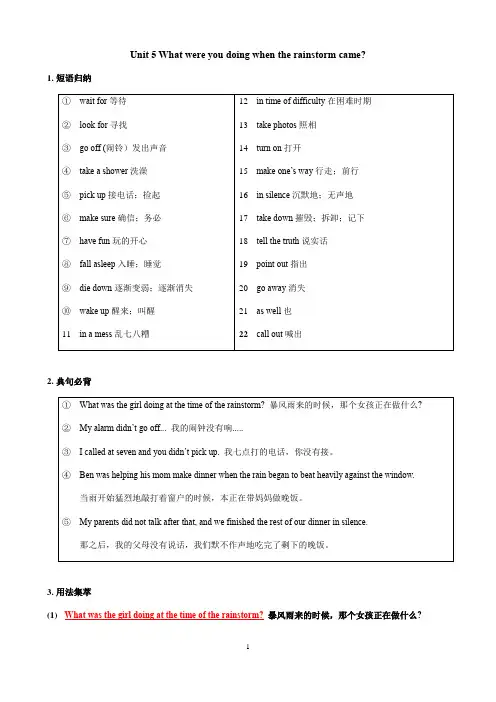
Unit 5 What were you doing when the rainstorm came?1.短语归纳2.典句必背3.用法集萃(1)What was the girl doing at the time of the rainstorm?暴风雨来的时候,那个女孩正在做什么?❖本句是特殊疑问句,时态是过去进行时,结构是“What+was/were+主语+doing+其他?”,用于询问某人在过去的某个时间正在做的事情。
例:—What were you doing at nine o’clock yesterday evening? 昨天晚上九点你正在做什么?—I was watching TV at home. 我正在家里看电视。
❖拓展:过去进行时描述过去某个时刻正在发生的动作或存在的状态,结构是“was/ were+动词的现在分词”。
例:When I got home my mother was cooking. 我到家的时候我妈妈正在做饭(2)My alarm didn’t go off... 我的闹钟没有响.....❖go off意为“(闹钟)发出响声”例:My alarm goes off at six every morning. 我的闹钟每天早晨6点响。
❖归纳:go off还有“离开”和“变质”之意。
例:Bob went off to get a drink. 鲍勃拿饮料去了。
Meat goes off quickly in hot weather. 热天肉变质得快。
❖拓展:go的短语(3)I called at seven and you didn’t pick up. 我七点打的电话,你没有接。
❖pick up意为“接电话”。
pick up有如下含义:(4)I called again at eight and you didn’t answer then either. 我八点再打来,你也没接。
人教版八年级英语第五单元笔记

人教版八年级英语第五单元笔记以下是人教版八年级英语第五单元的笔记:1. 重点词汇:- topic:话题,题目- pollution:污染-prediction:预言,预测- future:未来- environment:环境- planet:行星- earth:地球- part:参与,部分- play a part in:参与......2. 重点短语:- in the future:在将来- live to be:活到......-空闲时间- in danger:处于危险之中- on the earth:在地球上- play a part in doing sth:参与做某事3. 重点句型:- What will the future be like? 未来会是什么样子?- Will people have robots in their homes? 人们家里会有机器人吗?- There will be less pollution. 将会有更少的污染。
- Kids will study at home on computers. 孩子们将在家里通过电脑学习。
- People will live to be 200 years old. 人们将会活到 200 岁。
- Which side do you agree with? 你同意哪一方的观点?- I think there will be more pollution. 我认为将会有更多的污染。
- I don't agree. There will be less pollution. 我不同意。
将会有更少的污染。
4. 语法点:一般将来时- 概念:表示将来某个时间要发生的动作或存在的状态,也表示将来经常或反复发生的动作。
- 结构:主语+will+动词原形;主语+be going to+动词原形- 标志词:tomorrow,next day(week, month, year......),soon,in a few minutes,in the future,in 2025 等。
Unit 5 重点知识归纳+语法 人教版八年级英语下册

Unit 5 重点知识归纳+语法精讲【知识归纳】1. begin v. 开始。
其过去式为began,过去分词为begun。
【拓展】begin to do和begin doing用法辨析(1)begin to do表示一件事情的开端,持续与否不重要。
如:It's beginning to rain. We had better hurry home. 下雨了,我们快回家吧。
(2)begin doing 特别指很强烈的持续性。
如:He began smoking three years ago. 他三年前开始抽烟。
(即开始养成习惯)(3)当出现以下三种情况时必须使用动词不定式:①当主语为物时;①当begin后的动词是表示心理活动的词,如know,think, understand等时;①当begin在句中是“beginning”的形式时。
2. suddenly adv. 突然;忽然。
其形容词形式为sudden(突然的)。
3. strange adj. 奇特的;奇怪的。
其副词形式为strangely, 名词形式为stranger(陌生人)。
常用短语:be strange to… 对……感到陌生。
4. go off (闹钟)发出响声5. pick up (=pick up the phone)接电话【拓展】pick up还有“捡起,拾起,(开车)接某人,学到,获得”等含义。
6. So while you were sleeping,I called Jenny and she helped me. 因此当你睡觉的时候,我给珍妮打了电话,她帮助了我。
while是从属连词,意为“当……的时候”,引导时间状语从句,其谓语动词必须为延续性动词,它强调主句的动作在从句动作的过程中发生,或者主句的动作与从句的动作同时发生。
6. light的用法(1)n. 光;光线;光亮。
不可数名词。
(2)n. 电灯。
可数名词。
人教版英语八下unit5笔记
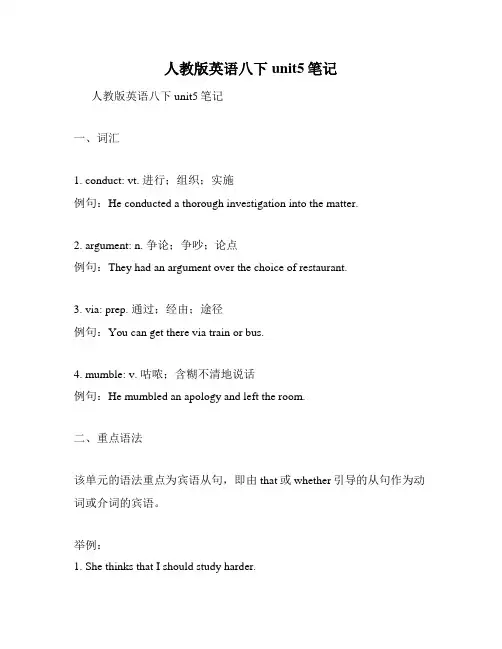
人教版英语八下unit5笔记人教版英语八下unit5笔记一、词汇1. conduct: vt. 进行;组织;实施例句:He conducted a thorough investigation into the matter.2. argument: n. 争论;争吵;论点例句:They had an argument over the choice of restaurant.3. via: prep. 通过;经由;途径例句:You can get there via train or bus.4. mumble: v. 咕哝;含糊不清地说话例句:He mumbled an apology and left the room.二、重点语法该单元的语法重点为宾语从句,即由that或whether引导的从句作为动词或介词的宾语。
举例:1. She thinks that I should study harder.2. He is not sure whether he can make it to the meeting on time.3. The teacher explained that the test would be difficult.需要注意的是,当主句的主语和从句的主语相同时,宾语从句可以省略主语和be动词,例如:I think (that) he is a good student. = I think he is a good student.三、重要知识点该单元的重要知识点为讨论技巧,主要包括争论的步骤和技巧。
争论的步骤:1. 确定争论的问题;2. 阐述各自的观点;3. 提出证据支持自己的观点;4. 回应对方观点的反驳;5. 总结讨论,得出结论。
争论的技巧:1. 保持冷静并尊重对方的意见;2. 清晰准确地表达自己的观点;3. 寻找和展示证据;4. 有效地回应反驳,并提出反驳对方观点的论据;5. 结合事实论证自己的观点;6. 最终解决问题,达成共识。
人教版八年级英语下册第五单元知识点汇总总结
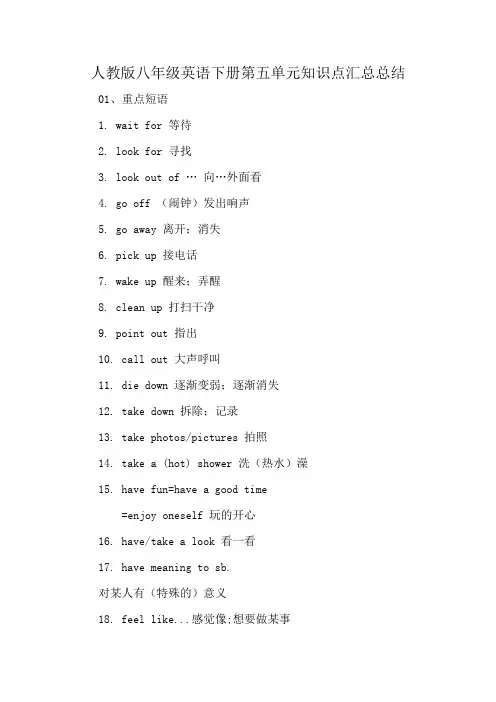
人教版八年级英语下册第五单元知识点汇总总结01、重点短语1. wait for 等待2. look for 寻找3. look out of … 向…外面看4. go off (闹钟)发出响声5. go away 离开;消失6. pick up 接电话7. wake up 醒来;弄醒8. clean up 打扫干净9. point out 指出10. call out 大声呼叫11. die down 逐渐变弱;逐渐消失12. take down 拆除;记录13. take photos/pictures 拍照14. take a (hot) shower 洗(热水)澡15. have fun=have a good time=enjoy oneself 玩的开心16. have/take a look 看一看17. have meaning to sb.对某人有(特殊的)意义18. feel like...感觉像;想要做某事19. make sure 务必,确保20. beat against 敲打21. fall asleep 进入梦乡22. break … apart 使…支离破碎23. turn on打开 (反:turn off关上)24. listen to the radio 听收音机25. get to = arrive in/at 到达26. make one’s way to 前往;费力前行27. to tell the truth 说实话28. walk by 路过29. at the time of …在…的时候30. in a mess 凌乱不堪;乱七八糟31. in times of difficulty 在困难时期32. because of 因为33. in history 在历史上34. in silence 沉默,无声35. at first 起初;起先36. by the side of …在…旁边37. the rest of …剩余的38. each other 互相39. for example 例如40. as well 也02、重点句子Grammar Focus 句子1. What were you doing at eight last night?昨天晚上8点你在做什么?I was taking a shower.我在洗淋浴。
人教版八下英语unit5知识点归纳
八下unit5知识点归纳语法: 过去进行时构成: 主语+was/were+doing时间状语: 1. 过去点时间2. 过去段时间3. when/while引导的时间状语从句一般疑问句,be动词提前。
否定句,在be动词后加not。
eg: I was doing homework at 8:00 yesterday.were you doing homework at 8:00 yesterday?I wasn't doing homework at 8:00 yesterday.知识点:1. go off 发出响声2. begin to do/begin doing 开始做某事eg: We will begin to swim at 8 o'clock.3. heavy adj. 重的heavily adv. 在很大程度上,大量地eg: The box is too heavy, can you help me to carry it?Take an umbrella, it's raining heavily.4. pick up 接电话5. light n. 灯adj. 轻的,浅的v. 点亮6. match n. 火柴,比赛v. 搭配eg: I need some matches to light the candles.我需要一些火柴来点亮这些蜡烛。
Please match the pictures with the words.请把图片和相应的单词搭配。
7. beat 敲打, 打败(常用来指打败对手)win 赢得, 获胜(常用来指赢得比赛、奖品等) eg: Finally, we beat Class Two.Finally, we won the match.8. at first 起初, 起先9. sleep v. 睡觉asleep adj. 睡着fall asleep 睡着, 入睡eg: I usually sleep at 9 o'clock.He fell asleep at 10 o'clock yesterday.10. die down 逐渐变弱, 逐渐消失11. fall v. 跌倒, 落下fallen adj. 倒下的,落下的eg: He fell down and hurt his leg.Keep away from the fallen tree.12. have a look( at...) 看一看...eg: Let me have a look at your new book.13. ice n. 冰icy adj. 冰冷的eg: Please add some ice to my juice.It's dangerous to walk on the icy road.14. kid n. 孩子v. 欺骗eg: I have two kids.Never kid your parents.15. make one's way to... 费力的前进, 前往eg: Wait for a moment, I'm making my way to the meeting.16. silent adj. 沉默的silence n. 沉默, 无声keep silent 保持沉默in silence 沉默无声eg: Can I keep silent?We had lunch in silence.17. date 日期What's the date today? 今天几号?18. true adj. 真的, 真实的truth n. 实情, 事实eg: The news is true.Can you tell me the truth?。
人教版八下英语第五单元笔记(一)
人教版八下英语第五单元笔记(一)人教版八下英语第五单元笔记整理Theme 1 - Holiday activitiesVocabulary1.beach2.sunbathe3.snorkel4.hike5.sightsee6.souvenirGrammarPresent tense•We use present tense to talk about things that are generally true or that are happening now.•Form:–Positive: Subject + verb (infinitive)–Negative: Subject + do/does not + verb (infinitive)–Question: Do/Does + subject + verb (infinitive)Present continuous tense•We use present continuous tense to talk about things that are happening now.•Form:–Positive: Subject + am/is/are + verb (gerund) + object–Negative: Subject + am/is/are not + verb (gerund) + object–Question: Am/Is/Are + subject + verb (gerund) + object?Talking about plans•We use going to + verb (infinitive) to talk about things we have planned to do in the future.•Example: I am going to visit my grandparents next weekend.Theme 2 - Past experiencesVocabulary1.adventure2.backpack3.campfirepass5.mosquito6.trailGrammarPast simple tense•We use past simple tense to talk about things that happened in the past and are now over.•Form:–Positive: Subject + verb (past tense)–Negative: Subject + did not + verb (infinitive)–Question: Did + subject + verb (infinitive)?Irregular verbs•Some verbs in the past simple tense do not follow the regular form of adding -ed to the base form. These arecalled irregular verbs.•Examples:–Go - went–Eat - ate–See - sawTalking about past experiences•We use present perfect tense to talk about things that happened in the past but are still relevant now.•Form:–Positive: Subject + have/has + past participle–Negative: Subject + have/has not + past participle–Question: Have/Has + subject + past participle?Theme 3 - TravelVocabulary1.boarding pass2.customs3.flight attendant4.luggage5.passport6.visaGrammarModal verbs - can, could, may•We use modal verbs can, could, may to talk about ability, permission, possibility and uncertainty.•Examples:–I can speak Spanish. (ability)–Could I borrow your pen? (permission)–It may rain tomorrow. (possibility)Using should•We use should to give advice or make recommendations. •Example: You should pack a warm jacket for your trip to the mountains.Asking for and giving directions•We use prepositions such as at, on, in, across from, next to, between to give and receive directions.•Example: The hotel is on Main Street, next to the post office.Theme 4 - EnvironmentVocabulary1.environment2.pollution3.recycle4.renewable energy5.global warming6.ecosystemGrammarPassive voice•We use passive voice to talk about actions done to the subject, instead of the subject doing the action. •Form:–Passive form: Object + be + past participle (by + subject doing the action)–Example: The cake was made by my mom.Conditional sentences•We use conditional sentences to talk about hypothetical situations and their consequences.•Type 0: If + present simple, present simple•Type 1: If + present simple, will + infinitive•Type 2: If + past simple, would + infinitive•Type 3: If + past perfect, would have + past participleExpressing preferences•We use would rather/sooner to express preferences. •Example: I would rather/sooner watch a movie than go fora walk.Theme 5 - InnovationVocabulary1.innovation2.breakthrough3.technology4.entrepreneur5.invention6.researchGrammarRelative clauses•We use relative clauses to add more information about someone or something.•Form:–Using who, whom, whose, that, which–Example: The man who helped me is my neighbor.Indirect speech•We use indirect speech to report what someone said. •Form:–Reporting verb + that + subject + verb (past tense)–Example: She said that she was going to the store.Expressing opinions and beliefs•We use modal verbs like may, might, could, must, should to express opinions and beliefs.•Example: He must be exhausted after running the marathon.。
最全面人教版八年级下册英语第五单元知识点归纳总结
Unit 5 What were you doing when the rainstorm came?一、词汇与短语◆重点单词A部分1.rainstorm 暴风雨n.2.window 窗;窗户n.3.alarm 闹钟n.4.flashlight 手电筒;火炬n. 5.suddenly 突然;忽然adv.6.match 火柴n.7.strange 奇特的;奇怪的adj.8.against 倚;碰;撞prep. 9.storm 暴风雨n.10.asleep 睡着adj.11.begin 开始v.12.rise 升起;增加;提高v.&n. 13.heavily 在很大程度上;大量地adv.14.fallen 倒下的;落下的adj. 15.wind 风n.16.apart 分离;分开adv. 17.light 光;光线;光亮n.18.icy 覆盖着冰的;冰冷的adj. 19.report 报道;公布v.&n.20.kid 开玩笑;欺骗v.21.area 地域;地区n.22.beat 敲打;打败v.23.wood 木;木头n.B部分1.realize 理解;领会;认识到v.2.recently 不久前;最近adv. 3.passage 章节;段落n.4.terrorist 恐怖主义者;恐怖分子n. 5.pupil 小学生n.6.date 日期;日子n. 7.completely 彻底地;完全地adv.8.tower 塔;塔楼n.9.shocked 惊愕的;受震惊的adj.10.truth 实情;事实n. 11.silence 沉默;缄默;无声n.◆重点短语A部分1.pick up ( = pick up the phone) 接电话2.have a look 看一看3.die down逐渐变弱;逐渐消失4.at the bus stop 在公交车站5.go off (闹钟)发出响声6.wait for 等待7.go to work 去上班8.rain heavily 下大雨9.see sb. doing sth. 看见某人正在做某事10.begin to do sth. 开始做某事11.take a shower 洗淋浴12.at that time 在那时13.so many times 这么多次14.feel like 感觉像15.need help with sth. 需要……(方面)帮助16.make sure 确保17.with no light outside 外面没有灯光18.help sb. (to) do sth. 帮助某人做某事19.put……over……把……覆盖在……上20.make dinner 做晚饭21.put sth. on the table 把某物放在桌子上22.play a card game 玩纸牌游戏23.beat heavily against the windows 猛烈地敲打着窗户24.get to the place of the accident 到达事故发生地25.have fun 玩得愉快26.wake up 醒来;叫醒27.at first 起初;起先28.in times of difficulty 在困难时29.fall asleep 进入梦乡;睡着30.right away 立刻;马上31.go outside with sb. 和某人一起出去32.in the library 在图书馆33.find sth. in a mess 发现……一片狼藉34.on the street 在大街上35.break sth. apart 把某物折断(或分开)B部分1.in silence 沉默;无声2.in history 在历史上3.take down 拆除;往下拽;记录4.remember doing sth. 记得做过某事5.make one's way 前往;费力地前进6.look out of the window 向窗外看7.the school basketball competition 学校篮球比赛8.have meaning to sb.对某人来说有意义9.walk by 从旁边经过10.point sth. out to sb. 向某人指岀某物11.by the side of the road 在路边12.go away 离开13.at the event 在这次活动中14.as well 也15.be late for 迟到16.call out the winner 宣布获胜者17.on this day 在这一天18.10 minutes ago 十分钟前19.on April 4 在四月四日20.be completely shocked 完全震惊了21.an important event 一次重要的事件22.the rest of 其余的23.on the radio 在收音机上◆重点句子A部分1.What were people doing yesterday at the time of the rainstorm?昨天暴风雨来临时人们正在干什么?2.when the rain storm suddenly came, what were you doing?当暴风雨突然来临时,你正在做什么?3.So while you were sleeping, I called Jenny and she helped me.因此在你睡觉的时候,我打电话给珍妮,她帮了我。
八年级下册人教版英语unit5知识点
八年级下册人教版英语unit5知识点Unit 5 Knowledge Points in Grade 8 of People's Education PressUnit 5 in Grade 8 of People's Education Press English textbook covers a variety of topics. In this article, we will explain the key knowledge points of this unit to help you better understand and learn English.Part 1: Grammar1. The present perfect tenseThe present perfect tense is used to describe past actions or experiences that have a connection to the present. It is formed by using "have/has" and the past participle of the main verb. For example:I have played soccer before. (The action of playing soccer happened in the past, but the speaker's experience of playing soccer has a connection to the present.)2. The past perfect tenseThe past perfect tense is used to describe an action that happened before another action in the past. It is formed by using "had" and the past participle of the main verb. For example:She had finished her homework before she watched TV. (Finishing homework happened before watching TV in the past.)3. Passive voiceThe passive voice is used to show that the subject of the sentence is receiving the action, rather than doing the action. It is formed by using "be" and the past participle of the main verb. For example:The cake was made by Tom. (The subject "the cake" is receiving the action of being made by Tom.)Part 2: Vocabulary1. Adjectives for describing personalitiesIn unit 5, you will learn about various adjectives that can be used to describe personalities, such as:- Confident- Responsible- Outgoing- Shy- Friendly- Creative2. Phrasal verbsPhrasal verbs are idiomatic phrases that consist of a verb and one or more prepositions or adverbs. In unit 5, you will learn about some common phrasal verbs, such as:- Look up (to search for information)- Put on (to wear)- Take off (to remove)- Get along (to have a good relationship with someone)Part 3: Reading and Writing1. Writing a narrative paragraphIn unit 5, you will learn how to write a narrative paragraph, which tells a story or an event. A narrative paragraph should have a clear beginning, middle, and end, as well as detailed descriptions and sensory language to engage the reader.2. Reading comprehension strategiesReading comprehension strategies are techniques that help you better understand what you are reading. In unit 5, you will learn about some important strategies, such as:- Predicting- Visualizing- Summarizing- Asking questions- Making connectionsConclusionUnit 5 in Grade 8 of People's Education Press English textbook covers a diverse range of topics, including grammar, vocabulary, reading, and writing. By mastering the key knowledge points of this unit, you will have a better understanding of English and be able to communicate more effectively.。