
(完整word版)西安建筑科技大学课程考试试卷(标准答案).
西安建筑科技大学课程考试试卷(标准答案)
一、名词解释
①水资源:地球上的各种水,如果对人类和地球生物的生存及发展具有直接或间接的使用
价值或经济价值,或者在一定的经济技术条件下有可能被利用的各种形态的水,统称为
水资源,其内涵包括生存利用、生产利用、生态环境利用,外延包括直接利用、间接利
用、以后有可能被利用。
②水体更替周期:某水体的总量全部自然更新一次所需要的时间。
③水质型缺水:某个地区水体总量充足,但是由于水体遭受污染不能被正常利用,致使该
地区水资源不足,称为水质型缺水。
④干旱指数:一个地区的年蒸发量与年降水量的比值。
⑤水系:干流、支流及河流内的湖泊、沼泽彼此相互连接在一起所形成的庞大水系统。
⑥流域:以分水线为界,汇集地表径流和地下径流的区域,称流域。
⑦生态环境需水量:从广义上讲,维持全球生物地理生态系统水平衡(包括水热平衡、水
沙平衡、水盐平衡等)所需用的水量,统称为生态环境需水量。
从狭义上讲,为维持区
域内生态环境不再恶化并逐渐改善,所需要消耗的水资源量,称为生态环境需水量。
⑧水体污染:排入水体的污染物在数量上超过了该物质在水体中的本底含量和自净能力,
即水体的环境容量,从而导致水体的物理特征、化学特征发生不良变化,破坏了水中固
有的生态系统,破坏了水体的功能及在人类生活和生产中的作用。
⑨点污染源和面污染源:所谓点源污染,是指集中产生、并有可能集中排入水体的污染源。
所谓面源污染,是指非集中产生、不可能集中排入水体的污染源,例如人烟稀少的山区、
旷野、农村地带也有自然污染产生,降雨时污染物会随地面径流进入水体,这样的污染
就具有面源的性质。
⑩水资源管理:指人类对水资源的统筹规划、政策指导、协调控制、监督管理。
二、填空
①大循环过程包括海洋蒸发、气流飘移、遇冷降雨、地表地下径流、汇入海洋;小循环过程包括海洋蒸发、遇冷降雨至海洋,地表蒸发、遇冷降雨至地表。
②地球水总量13.86亿km3,陆地水量总计0.48亿km3,陆地淡水总量0.35亿km3,可以直接利用的0.1亿km3,占不足地球总水量的1%或不到淡水总量的25%。
③我国多年平均年降水量62000亿m3,多年平均水资源量28000亿m3,其中河川27000亿m3、地下水1000亿m3,排位于世界第6;河川径流年人均量2220m3/人,为世界人均径流量的1/4 。
④表示径流的参数有径流用径流量、径流总量、径流模数、径流深度、径流系数,影响径流的因素有降水和蒸发、地形特征、地质情况、植被状况、流域的几何形状、温度、湿度、人类活动等。
⑤河流补给类型主要有雨水补给型、地下水补给、冰雪融化补给、混合补给型,渭河属于雨水补给为主、融化水补给、及地下水补给为辅的混合型类型。
⑥水体可利用性评价要素包括水量可利用性,水质可利用性,利用的技术经济可行性,环
境影响性评价 。
⑦区域水量平衡关系式为 调入量+降水量-调出量=可利用量 。
⑧水循环的要素包括 降水 , 径流 , 蒸发 。
三、 回答问题
1.用图表示水的自然循环过程,并分析人类参与循环时的污染途径。
(10分)
图中表示了水的自然循环过程,在这个循环过程中人类为了自身的生存和发展同过取水用水及排放废水也参与了水循环,由于人类的参与,水的自然循环发生了或多或少的变化,最终对水体造成了一定的污染,具体表现在:
(1)人类排放的污水废水中含有的污染物进入到自然水体,污染了地表水、地下水、一些挥发性的污染物随着蒸发进入大气,又通过降水污染地表水体和地下水体,比如酸雨。
(2)人类开采地下水、地表水,造成自然水体的输出量增加,水体的更替周期减小,纳污能力降低,环境容量降低后污染进一步加剧。
2.水资源的特性有哪些?并解释。
(10分) 循环无限性。
水资源与其它固体资源的本质区别在于它具有流动性,是在循环中形成的一种动态资源,具有优良的循环性。
水循环系统是一个庞大的天然水资源系统,水资源在开采利用后,能够得到大气降水的补给,处于不断地开采、补给、消耗、恢复的循环之中,可以不断地供给人类使用和满足生态平衡的需要。
储量有限性。
水资源处于不断的消耗和补充过程中,在某种意义上讲有“取之不尽”的特点,恢复性强。
可实际上地球淡水资源的储量十分有限。
地球淡水占全球总水量的1/4,可以被人类直接利用的淡水占全球总水量的1/125,水循环过程具有无限性,水资源储量具有有限性。
分布不均匀性。
水资源在自然界具有一定的时间和空间分布,时空分布不均匀是水资源的又一
升华
特性。
利用多样性。
水被人类生活、生产、及环境生态平衡广泛利用,各种利用在数量上的需求是不一致的,在质量上的要求也是多种多样的。
利害双重性。
自然界有部分物质可造福于人类,也可危害人类,水资源就是其中之一,它也具有利害双重性。
关键是人类应该如何合理地控制和利用水资源。
3.阐述保护和管理好水资源的重要性。
(10分)
(1)是防灾减灾的需要
新中国成立后,水利建设成绩巨大,主要江河初步建成了蓄泄兼筹的防洪调蓄体系,大部分地区已初步控制了常遇的水旱、洪灾害,只有这样才能长期支持我国的农业、工业、城市的发展。
(2)是人类生存的需要
水作为一种资源,人类的生存离不开她,目前淡水资源短缺的形势不得不使我们清醒,对水资源必须加强保护和科学管理,人类才有可能长期生存和发展。
(3)是社会发展的需要
社会发展的象征是农业发展、工业发展、城市发展,这些无一例外可以不依赖于水资源的利用。
(4)是生态环境修复的需要
由于水资源的匮乏,生态环境已遭受严重破坏,例如发生大洪水、出现大旱、沙漠化加剧、出现沙尘暴、物种减少、气候失衡、病疫滋生等等,因此人类必须加紧修复环境、再造山川秀美的自然环境,必须加强保护和科学管理水资源,包括全球性的工作和地域性的工作。
4.评价我国水资源的特征。
(10分)
①空间分布特征
A. 降水、河流分布的不均匀性
我国水资源空间分布的特征为:降水和河川径流的地区分布不均匀,水土资源组合很不平衡;南方水资源较丰富,北方水资源贫乏,南北相差悬殊。
长江及其以南地区,流域面积占全国总面积的36.5%,却拥有占全国80.9%的水资源总量;西北、内陆等地区,面积占全国总面积的63.5%,拥有的水资源总量却只占全国4.6%。
B. 地下水资源分布的不均匀性
地下水是水资源量的重要组成部分,其分布受地形和主要补给来源降雨量的制约。
我国地域辽阔、地形复杂、多山多河、山区(包括山地、高原、丘陵)约占全国面积的69%,平原和盆地约占31%。
地形特点是西高东低,山脉从横交织,构成了我国地形的基本骨架。
北方分布的大型平原和盆地成为地下水储存的良好场所。
东西向排列的昆仑山—秦岭山脉,成为我国南北方的分界线,对地下水资源的区域分布产生了深刻的影响。
②时间分布特征
我国水资源不仅在地域上分布很不均匀,而且在时间分布上也不均匀,无论年际和年内分配都是如此。
造成时间分布不均匀的原因是受我国区域气候的影响。
③水资源与人口组合不匹配特征
北方地区:人口占全国的40%,水资源占全国的20%,人均水资源量1127m3/人。
南方地区:人口占全国的60%,水资源占全国的80%,人均水资源量3380m3/人。
④水资源与耕地组合不匹配特征
北方地区耕地占全国耕地的60%,水资源占全国的20%,耕地每公顷拥有水量9465m3。
而南方地区耕地占全国耕地的40%,水资源占全国的80%,耕地每公顷拥有水量28695m3。
⑤江河高泥沙含量是我国水资源的又一特征
我国西部地区是长江、黄河、珠江、和众多国际河流的发源地,地形高差大,又有大面积的黄土高原和岩溶山地,自然因素加上长期的人为破坏,很多地区水土流失严重,对当地的水土资源和生态环境造成严重危害,也使江河挟带大量泥沙,这是我国江河的重要特征。
黄河是典型的高泥沙量河流,其含沙量是世界之最。
⑥水资源受气候影响特征
我国近50年来,有20多年呈现北旱南涝局面。
降雨量一直呈减少势态。
由于高山冰川融水调节,各河流在出山口处的水量基本持平,但下游均呈现逐年减少的趋势。
温室效应使表面蒸发量提高,地面径流量减少。
以上6点可以看出,我国水资源利用极不方便,导致发展极不平衡。
5.我国南水北调工程规划线路有哪些?分别说明具体调水线路和用途。
(10分)
要点如下:
东线工程:江苏扬州长江北岸,经山东至天津,1150km。
用于农业及工业、也有生活。
中线工程:丹江口引水,经湖北、河南、河北至北京、天津,1200km。
用于生活、农业及工业。
西线工程:从长江干流通天河及支流雅砻江、大渡河引水至黄河上游,经陕、甘、宁、青、蒙、晋等省区。
解决西北及北方地区农业、工业、生活、生态缺水问题,改善黄河流域水资源不足。
6.说明水资源保护区性质、任务、基本模式。
(10分)
要点如下:
性质:是自然保护区的一种,通过保护水资源修复生态。
任务:保护水源及水质。
基本模式:分3个区,重点保护区是水资源所在地;生态建设区在重点保护区之外,进行生态良性化建设;再外围是缓冲区,限制三废、交通、人口等污染。
西安建筑科技大学考试试卷(共10页).
西安建筑科技大学考试试卷(共10页)2005级大学英语一级期末测试题College English (Band One)答题纸 A 卷注意事项:1. 考试时间为2个小时。
2. 所有答案请务必做到答题纸和答题卡上,做在试题册上的无效。
3. 考试结束后请将答题纸,答题卡和试题册全部交回。
4. 请考生务必在签名单上按学号顺序签名,并注明学院和专业班级。
例如:王开新信控学院自动化05015. 学号共9位数字。
即学生证上的九位数号码。
答题纸和答题卡上须填写的学号均按此要求填写。
6. 请将接收机调至FM86.1.年级院系专业班级姓名 _ __学号:□□□□□□□□□Part I Section B Compound Dictation (10%)1. 2. 3. 4. 5.6. 7.8. .9. .10. . Part IV Word Choices (10%)1. 2. 3. 4. 5.6. 7. 8. 9. 10.Part V Translation (15 points)1.____________________________________________________________________________2.____________________________________________________________________________3.____________________________________________________________________________4.____________________________________________________________________________5.____________________________________________________________________________2005级大学英语一级期末测试题College English (Band One)年级院系专业班级姓名 _ __学号:□□□□□□□□□Part I Listening Comprehension (20%)Section A (10%)Directions: In this section you will hear 10 short conversations. At the end of each conversation, a question will be asked about what was said. The conversation and the question will be spoken only once. After each question there will be a pause. During the pause, you must read the four choices marked A), B), C) and D), and-decide which is the best answer. Then mark the corresponding letter on the Answer Sheet with a single line through the centre.1. A) Britain.B) Japan.C) China.D) America.2. A) 6.B) 13.C) 14.D) 16.3. A) 2.B) 3.C) 4.D) 5.4. A) She likes it.B) It's too hot.C) It's too cold.D) She dislikes it.5. A) $13.B) $39.C) $20.D) $21.6. A) The woman has no dictionary.B) The woman is using her dictionary.C) The man can get one from her desk.D) The man can't use her dictionary.7. A) 7:30.B) 7:20.C) 6:45.D) 7:00.8. A) In his bag.B) In his office.C) He has no radio.D) At his home.9. A) At the bank.B) In the shop.C) At the post office.D) At the railway station.10. A) Drink.B) Meal.C) Weather.D) Fruit.Section B Compound Dictation (10%)Directions: In this section you will hear a passage of about 90 words three times. The passage is printed on your Answer Sheet with about 30 words missing. First, you will hear the whole passage from the beginning to the end just to get a general idea of it. Then, in the second reading, you will hear a signal indicating the beginning of a pause after each sentence, sometimes two sentences or just part of a sentence. During the pause, you must write down the missing words you have just heard in the corresponding space on the Answer Sheet. There is also a different signal indicating the end of the pause. When you hear this signal, you must get ready for what comes next from the recording. You can check what you have written when the passage is read to you once again without the pauses.If you are in a hurry and you want to (1) there is no better place than a (2) restaurant. You (3) the restaurant, pick up a tray, knife, fork, and spoon and queue (4) where the food is on display. You pick out (5) and put it on your tray, which you have to (6) a special rack till you reach the cashier.The cashier will (7) . After paying, you take your tray to any table you like. You can (8) or with another customer. You can have a good meal (9) . And - as there is no waiter you don't (10) .Part II Reading Passages (40%)Section A Fast Reading (Reading Time: 8 1/2 minutes) (10%)Marriage and RomanceIf you are asked, “Why do people marry?” you may answer in anger or surprise. The question seems silly because it is only too natural for people to get married. Divorce, that is, when people end their marriage, on the other hand, is something that should be given serious attention. Yet marriage goes before it as a rule.Why do people marry? People divorce often, as can be seen by the rising divorce rate in the U.S. and elsewhere. But they remarry soon enough after they divorce. Now many of them divorce at a much a younger age than before. It is also found that the young have a big share of divorce. But what many sociologists find difficult to understand is that they seem to be more eager to rush into marriage than get out of it.In the old days there was every reason to marry young—especially among the working class. In Chinese communities, unmarried men and women seemed to be disadvantaged in many ways.Women were in a more difficult position than men since in earlier times, girls were not allowed to be educated. They also did not enjoy social freedom. In the past, women who were not “married off” before they turned 30 were considered to be a problem or a worry for the family. They might have to remain with their families as they could not find jobs, and thus were unable to support themselves. For men, they often led an unpleasant or uncomfortable life as they did not have a wife to do the sewing, cooking, cleaning and taking care of the husband and children. In those days, the family was the cornerstone of society. Both sexes needed marriage for more than now.Is marriage something that people cannot do without? It could be a convenience which people seek. For this reason we find people marrying more than ever and earlier. But is it just convenience that people are after? Why do we find people marrying more than ever and earlier? Why are the young falling so much in love? Why do they show so much attention to each other before marriage? Has the desire for love become so important that people have to marry earlier?Many sociologists believe that the material conveniences that are provided by modern appliances such as refrigerators and washing machines reduce the usefulness of marriage. But such conveniences have also weakened the bonds of family life. Though we seem to be meeting more people, our relationships are few. We are close to crowds but we feel more alone than before. One feels lonely in the midst of crowds. It is just like being at a party where, when left alone, one would feel some sort of emptiness. All of a sudden, one is living in a world one does not understand. Thus one feels the need for somebody that one can be close to! Then one can share body and soul.So this is the promise of marriage. Movies, songs, romance and TV all show a “normal”person must love and therefore marry. As it is, love and marriage are closely connected with each other. The desire for love makes people eager to get married.In the family, children are told that “Love and marriage go together like a horse and carriage.”. They feel that it is only too natural to get married. But alas, nothing could be less so. Love has delighted and worried us. In real life, love and marriage may not go together. Love can be described as a restless horse which would run away, refusing to be put under control. In the end it overturns the carriage. When love runs away the result is a failed marriage. But did it ever occur to us that we can and should keep the horse under control? Once we are in charge of love, it can be with us for the rest of our lives.11. In the old days, it was found that .A) people tended to get married at an early ageB) unmarried people were often better educatedC) working class people enjoyed family life moreD) women were more anxious to get into marriage12. Chinese women who remained unmarried over 30 in the old days .A) became a problem for their familiesB) lived an unpleasant and uncomfortable lifeC) could enjoy more social freedomD) had to do some sewing and cooking for a living13. The material conveniences in modern society are said to .A) weaken the relationships between family membersB) make people feel more lonely in a crowdC) make people think it’s more useful to get marriedD) make family life more convenient but less interesting14. According to the passage, what people are now seeking for in marriages is .A) mutual understandingB) material conveniencesC) the sharing of body and soulD) a companion to kill one’s loneliness15. When people refer to love and marriage as the relationship between horse and carriage, they mean that .A) marriage and divorces are naturalB) love and marriage go togetherC) we have to put love under control before marriageD) when marriage runs away like a horse, love failsSection B Careful Reading (30%)Directions: There are 3 reading passages in this part. Each passage is followed by some questions or unfinished statements. For each of them there are four choices marked A), B), C) and D). You should decide on the best choice and mark the corresponding letter on the Answer Sheet with a single line through the center.Questions 16 to 20 are based on the following passage:No one knows who made the first ice cream. Some people think that water ices and milk ices may have been made by the Chinese between three thousand and four thousand years ago. In time, the dish reached India. The Indians, in turn, may have passed on the secret to the Arabs and the Persians. The Persians called their dish sharbat, from which our word sherbet comes.Marco Polo, and Italian who traveled widely in the thirteenth century, noted that he found the Chinese had long been making ices out of fruit juices and milk. From the fourteenth century on, ices became popular, first in Venice and then throughout Italy.In 1533, when Catherine de Medicis left Italy to marry the future King Henry II of France, she took her cooks with her. They made desserts the French had never tasted before. Among them was “ice cream”. For each day of the wedding festivities Catherine’s cooks prepared a different flavor of her favorite dessert—“ice cream”.At first ice cream was a luxury in France. Only rich people had the money to buy it. Then, in 1660, a young man from Sicily, Francisco Procopio, arrived in Paris. He opened a shop that sold ice cream at prices people could afford. Procopio’s “ice cream parlor”became so popular that other shops were opened.About 1640, King Charles I introduced ice cream to England. He had heard it was the rage in Italy and France. He served ice cream for dessert at a banquet. The surprise dish was a great success. The king ordered his cook to keep the recipe for ice cream a secret. Charles felt that only royalty should serve the dessert. But the secret soon leaked out. Ice cream quickly became the rage in England too.16. This passage is mainly about .A) Marco Polo’s travelB) one of Chinese inventionsC) Catherine’s marriageD) the history of ice cream17. Marco Polo’s remark shows that he traveled in .A) ChinaB) IndiaC) PersiaD) Italy18. Ice cream was unknown in France until .A) 1533B) 1660C) 1640D) 177419. Ice cream was introduced to England by .A) Catherine de MedicisB) Francisco ProcopioC) Charles ID) Marco Polo20. What will be probably discussed in the paragraphs following this passage ?A) Marco Polo’s travel in the world.B) Development of ice cream in France.C) Development of ice cream in England.D) Development of ice cream in America or other countries.Questions 21 to 25 are based on the following passage:No one knows why we sleep, but it is certain that we need to. People who are prevented from sleeping begin to suffer obvious effect after a few days—they think less clearly, and they fall asleep during the working hours. Some may begin to imagine things.There are no rules about sleep. Generally speaking, grown-ups sleep about seven and a half hours each night and probably more than 60 percent get between seven and eight hours. But perhaps eight percent are quite happy with 5 hours or less, and four percent or so find they want ten hours or more. If you feel all right, you are probably getting enough sleep. The important thing is not to worry how much others people get—their needs may be different. Exercise does not seem to increase the need for sleep; office workers, for example, sleep for about as long as people doing physically active work.Children sleep more than grown-ups—perhaps fourteen to eighteen hours soon after birth, going down to grown-up levels by early teen-age. Sleep patterns also tend to be different in the elderly, who may sleep less at night than they did when younger. They find sleep getting more broken, and often make it a rule to sleep during the daytime.21. According to the passage, some people are unable to think clearly because _ .A) they have imaginationB) they feel sleep during the working hoursC) they do not have enough sleepD) they are certain to be kept from going to bed22. Which of the following is TRUE?A) All grown-ups must have at least eight-hour sleep.B) Most of the grown-ups sleep for seven or eight hours.C) Quite a few people need only five hours or less for them to sleep.D) No grown-ups sleep more than ten hours.23. Whether you have got enough sleep is judged by .A) how many hours you have slept.B) how many hours you need to sleep.C) whether you did exercise and physical work.D) whether you feel fresh and energetic.24. According to the passage, a boy of fourteen years old sleeps .A) as many hours as a grown-upB) much more hours than a grown-upC) for fourteen hours each nightD) for less than eight hours per night25. Which of the following is TRUE when the elderly find sleep getting more broken?A) They usually sleep during the daytime.B) They just ignore it.C) They talk about it to their friends.D) They are always complaining about it.Questions 26 to 30 are based on the following passage:A moment’s drilling by the dentist may make us nervous and upset. Many of us cannot stand pain. To avoid the pain of a drilling that may last perhaps a minute or two, we demand the “needle”—a shot of novocaine —that deadens the nerves around the tooth.Now it’s true that the human body has developed its millions of nerves to be highly aware of what goes on both inside and outside of it. This helps us adjust to the world. Without our nerves—and our brain, which is a bundle of nerves—we wouldn’t know what’s happening. But we pay for our sensitivity. We can feel pain when the slightest thing is wrong with any part of our body. The history of torture is based on the human body being open to pain.But there is a way to handle pain. Look at the Indian fakir who sits on a bed of nails. Fakirs can put a needle right through an arm, and feel no pain. This ability that some humans have developed to handle pain should give us ideas about how the mind can deal with pain.The big thing in withstanding pain is our attitude toward it. If the dentist says, “This will hurt a little,” it helps us to accept the pain. By staying relaxed, and by treating the pain as an interesting sensation, we can handle the pain without falling apart. After all, although pain is an unpleasant sensation, it is still a sensation, and sensations are the stuff of life.26. The purpose of this passage is mainly to tell us _ _.A)that pain is good for usB)to stop talking the “needle” at the dentist’sC) how to handle painD) how to avoid torture27. The result of pain is to __ .A) let us know what’s going onB) make us open to tortureC) make us pay for our sensitivityD) help us get more sensations28. The most important thing in handling pain is to __ .A) do what the Indian fakirs doB) welcome itC) know about it in advanceD) treat it as an interesting sensation29. The word “withstanding” in the last paragraph can be best replaced by_ .A) havingB) handlingC) acceptingD) sensing30. The sentence “we pay for our sensitivity” in paragraph 2 most probably means __.A) we suffer because of being sensitiveB) our sensitivity costs us a great dealC) we have to pay the dentist for his making us sensitive to painD) we are lucky to have developed our sensesPart III Vocabulary and Structure (15%)Directions: There are 20 incomplete sentences in this part. For each sentence there are four choices marked A), B), C) and D). Choose the ONE answer that best completes thesentence. Then mark the corresponding letter on the Answer Sheet with a single linethrough the center.31. At first, the professor said something about the problem of pollution in big cities but halfwayin his speech, he suddenly __________ to another subject.A) switched C) transmittedB) challenged D) transformed32. Everything at the party __________ careful planning.A) knew of C) heard ofB) thought of D) spoke of33. No one can function properly if they are _________ adequate sleep.A) done away with C) deprived ofB) deprived D) idled away34. The newcomers found it impossible to __________ themselves to the climate sufficiently tomake permanent homes in the new country.A) suit C) regulateB) adapt D) coordinate35. We feel it our duty to remind you that you should do your utmost to meet the _________ forpayment.A) schedule C) curiosityB) assignment D) deadline36. I could not persuade him to accept it,_______ make him see the importance of it.A) no more than I could C) if only I could notB) nor could I D) or I could not37. I ran _______ an old friend of mine in the library.A) down C) throughB) into D) over38. The great value of school educati on lies not _________ in teaching you what you don’t knowas in teaching you the way of learning.A) the same as C) so muchB) so many D) as39. High IQ students are usually those who are very good at making use of their time to the fullest_________.A) level C) expandB) expense D) extent40. By the end of last month, our factory _________ 30,000 motors.A) produced C) was producingB) was produced D) had produced41. John was late this morning. He must _______ too much time watching TV last night.A) have spent C) have takenB) spend D) take42. He accepted his doctor’s advice and _________ smoking two years ago.A) gave off C) gave inB) gave away D) gave up43. Your advice that she ________ till next week is reasonable.A) will wait C) waitsB) is going to waiting D) wait44. Problems like this _________ every day in our university.A) arise C) riseB) arouse D) raise45. I took _________ of the opportunity to tell him that I should be given a rise in pay.A) benefit C) advantageB) profit D) care46. The reporter claimed that the information came from a ________ source.A) sure C) believableB) confident D) reliable47. Tired _________ she was, I had to disturb her.A) so C) asB) although D) while48. ________ repaired, the walkman worked very well.A) Have C) Having beenB) Having D) Have been49. It is absolutely necessary that he _______ in hospital for another week.A) will stay C) stayB) stays D) would stay50. ________ he graduated from the university did he begin to think of his future.A) Until C) Until notB) Not until D) When51. The scientist_________ the discovery as the most exciting development in this field.A) referred in C) referred asB) referred of D) referred to52. It is necessary to _________ systems that have been out of date.A) do with C) do away withB) do for D) do53. Although she is an amateur (业余的) singer, she can sing as well as a _________trained one.A) occasionally C) professionallyB) painfully D) plentifully54. Bill did not hear the telephone because he was completely _________ in his reading.A) buttoned C) attachedB) tricked D) absorbed55. The more she thought about it, ________.A) the more she became excited C) the more excited did she becomeB) the more excited she became D) she became more excited56. Being a manager, he is keen to _________ relations with those companies that have goodreputation.A) inform C) cultivateB) complete D) account57. I wish the speaker would ____________ himself to the subject.A) confine C) concludeB) confirm D) connect58. She decided to _________ her studies after obtaining her first degree.A) purchase C) persuadeB) pursue D) perform59. This building doesn’t _________ safety regulations; it is dangerous for people to live in.A) compare to C) consider asB) consist of D) conform to60. It is said that girls, in general, ________ to be better in language learning than boys.A) tend C) changeB) suppose D) turnPart ⅣFill in the blanks with the words given below. Change the form where necessary. (答案写在答题纸上.) (10%)1.I don’t think we can solve the problem this way. We should try a different _____________.2.I agree with you that men and women should be equally_______________ for bringing upchildren.3.Although he made a great deal of money, he could never ____________ his feelings ofworthlessness.4.To ______________ his dream of becoming a professional athlete, Tom kept training for threeyears.5.No one else can tell you what is best for you because every ____________ is different.6.When questioned, the children ____________ that their homework remained untouched, asthey had idled away their time doing nothing.7.These young people were so ____________ about things in the U.S. that they thought blacksand whites had always had equal educational opportunities there.8.Technical schools prepare their students for the ____________ of practical skills they learnedin class to their work.9.Have you ever heard that single women tend to live longer than married women,_____________ married men tend to live longer than single men?10.Her written English was first-class, and she had a(n) ___________vocabulary for asophomore.Part V TranslationDirections: Translate the following five sentences into English. (答案写在答题纸上.) (15%)1.在坚强意志的推动下,汤姆终于完成了他承担的任务。
西安建筑科技大学考试试卷标准答案(共6页)A卷评卷人填

西安建筑科技大学考试试卷标准答案(共 6 页)A卷评卷人填写
考试科目:水文学考试时间:
西安建筑科技大学考试标准答案(共 6 页)A卷班级:姓名:学号:。
由t′3到t2的时间段又称为产流历时。
(1分)但河槽集
2
流过程并未停止,它包括雨水由坡面汇入河网,直到全部流经出口断面时为止的整个过程,它的延续时
间最长,比净雨历时和坡地漫流历时都要长得多,一直到t4时刻为止,由这次暴雨产生的洪水过程才算
这段时间称为流域最大汇流时间,以τ表示,即流域最远点A的净雨流到出口断面B所
3 4
西安建筑科技大学考试标准答案(共 6 页)A卷
班级:姓名:学号:
m3(1分)
s
)s
203
0.2
=
⨯(1分)
.
36
m
14
m3(1分)
s
56。
西安建筑科技大学考试试卷

西安建筑科技大学考试试卷(B)(共4页)一、填空题(20分)1. 在水处理工艺中,搅拌器的形式多种多样,应根据工艺要求来选用,常用的搅拌器有:将式搅拌器、推进式搅拌器、涡轮搅拌器等。
2. 膜组件可分为板式膜组件、管式膜组件、螺卷式膜组件和中空纤维膜组件。
此外还有毛细管式膜组件。
3. 改变介质的腐蚀特性一般有两种途径:一种是去除介质中有害成分;另一种是加缓蚀剂。
4. 合金工具钢9SiCr钢表示表示平均含碳量为0.9%,硅和铬的平均含量小于1.5% 。
HSn65-3表示含铜65%、含锡3%的锡黄铜。
5. 机械性能主要指材料的弹性、塑性、强度和韧性。
6. Ni-Mo合金是耐盐酸腐蚀的优异材料。
最有名的哈氏合金(0Cr16Ni57Mo16Fe6W4)能耐室温下所有浓度的盐酸和氢氟酸。
7. 物质的导热系数值不仅因物质的种类、结构成分和密度而异,而且还和物质温度、湿度和压力等因素有关。
8. 腐蚀防护设计除正确选材外,具体还包括防蚀方法选择、防蚀结构设计、防蚀强度设计以及满足防蚀要求的加工方法。
9. 陶瓷的最大缺点是脆性,它是阻碍陶瓷作为结构材料广泛应用的首要问题,是当前的重要研究课题。
10. 焊接的方法很多,大体可分为三大类:即熔化焊、压力焊和钎焊。
11. 机械制造金属机件的基本方法有铸造、压力加工、焊接、切削加工和热处理。
12. 压力加工的基本方式有轧制、拉丝、挤压、自由锻造、模型锻造和薄板冲压。
13. 金属发生应力腐蚀的三个必要条件是:敏感金属、特定介质和一定的静应力。
14. 机械传动的主要方式有齿轮传动、带传动和链传动。
二、判断题(15分,每题1.5分)1、陶瓷和搪瓷均是用粘土类无机材料制成的,组成基本一样。
(ⅹ)2、影响对流换热的因素主要有如下几种 (√ )a.流体的相变b.流体的物理性质c.流体流动的状态d.流体流动的原因e. 换热表面状况 3、“没有金刚钻,就不要揽瓷器活”这句话说明了陶瓷的刚度很大。
2019年西安建筑科技大学07-11年真题结构力学.doc
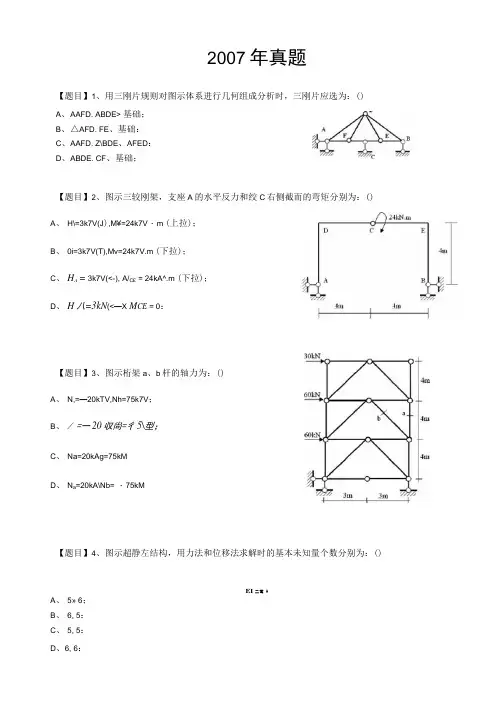
2007年真题【题目】1、用三刚片规则对图示体系进行几何组成分析时,三刚片应选为:()A、A AFD. ABDE> 基础;B、△AFD. FE、基础:C、A AFD. Z\BDE、AFED:D、A BDE. CF、基础;【题目】2、图示三较刚架,支座A的水平反力和绞C右侧截而的弯矩分别为:()A、H\=3k7V(J),M¥=24k7V・m (上拉);B、0i=3k7V(T),Mv=24k7V.m (下拉);C、H A= 3k7V(<-), A/C£ = 24kA^.m (下拉);D、H八=3kN(<—X M CE = 0:【题目】3、图示桁架a、b杆的轴力为:()A、N,=—20kTV,Nh=75k7V;B、/ =一20収尙=彳5\型;C、Na=20kAg=75kMD、N a=20kA\Nb= ・75kM【题目】4、图示超静左结构,用力法和位移法求解时的基本未知量个数分别为:()EI 二常 HA、5» 6;B、6, 5:C、5, 5:D、6, 6:【题目】5、矩阵位移法中,求等效结点荷载时,应用的等效原则是等效结点荷载与原非结点荷载的—相同。
()A、结点位移:B、杆端内力:C、内力:D、应变能;【题目】6、下列叙述正确的是:()A、力矩分配法既可求解连续梁,也可求解一般超静定刚架:B、两刚片规则、三刚片规则和二元体规则是相通的:C、力法的基本结构只能是静定结构;D、位移法是求解超静龙结构的基本方法,不能用来求解静圧结构:【题目】7、用力法汁算图示结构并作弯矩图。
【题目】8、用位移法计算图示结构并作弯矩图。
边长均为【题目】9、用力矩分配法计算图示连续梁并作弯矩图。
已知E/ = 1.8xl04k7V./n,A = k7no【题目】10、利用影响线求图示结构的仇和以的值。
【题目】11、作图示结构的动力弯矩幅值图。
已知EI二常量,0 =2008年真题【题目】1、图示体系的几何组成为:()A、几何不变,有多余约朿:B、几何不变,无多余约束;C、瞬变;D、常变:【题目】2、可接受荷载、可破坏荷载、极限荷载的关系正确的是:()A、可接受荷载W可破坏荷载W极限荷载:B、可接受荷载2可破坏荷载W极限荷载;C、可接受荷载M可破坏荷载M极限荷载:D、可接受荷载£可破坏荷载鼻极限荷载:【题目】3、图示桁架a、b杆的轴力为:()A、Na=-\25kN、Nb=0;B、叫=0,心=-75届収;C、他=75册,必=75册:D、Na=\25kN,Nb=0;【题目】4、图示结构体系的动力自由度n为:()A、不考虑轴向变形时,n=4:B、考虑轴向变形时,n=6:C、考虑轴向变形时,n二&D、不考虑轴向变形时,n=12:【题目】5、已知三较拱的弯矩其中为相应简支梁的弯矩,H为三较拱的水平推 力,图示三较拱的合理拱轴线为:()A 7 1 . A^ y = —x :6 9 小11 ,B 、 V = 2 + —X- — JT ;2 187 1 r 1 JC 、 y = -x--x 2, AC 段;y = 2 + -x- — A 2 t BC 段:6 9 2 18D 、 y = — x ——厂 BC 段:y = 2 + —x ------------- x", AC 段; 6 9 2 1824kN/m16m 1 1 1【题目】6、下列叙述正确的是:()A 、 位移法是求解超静宦结构的基本方法,不能用来求解静左结构:B 、 阻尼使体系的自振频率变大,使自振周期缩短;C 、 阻尼使体系的自振频率变小,使自振周期延长:D 、 力法是求解超静左结构的基本方法,也可以用来求解静立结构:【题目】7、用力法讣算图示对称结构并绘制弯矩图,已知q=16kN/m o【题目】8、用位移法计算图示结构并作弯矩图。
西安建筑科技大学07-11年真题结构力学
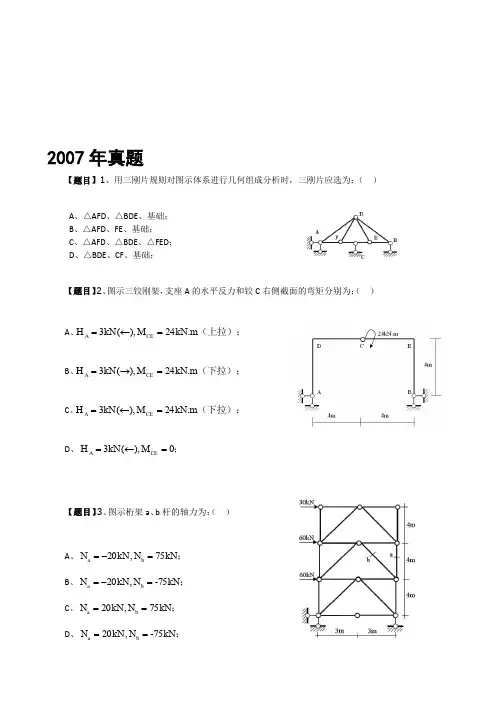
2007年真题【题目】1、用三刚片规则对图示体系进行几何组成分析时,三刚片应选为:( )A 、△AFD 、△BDE 、基础;B 、△AFD 、FE 、基础;C 、△AFD 、△BDE 、△FED ;D 、△BDE 、CF 、基础;【题目】2、图示三铰刚架,支座A 的水平反力和铰C 右侧截面的弯矩分别为:( )A 、(上拉);m .k 24),(k 3N M N H CE A =←=B 、(下拉);m .k 24),(k 3N M N H CE A =→=C 、(下拉);m .k 24),(k 3N M N H CE A =←=D 、;0),(k 3=←=CE A M N H【题目】3、图示桁架a 、b 杆的轴力为:( )A 、;N N N N k 75,k 20b a =-= B 、;N N N N k 75-,k 20b a =-=C 、;N N N N k 75,k 20b a == D 、;N N N N k 75-,k 20b a ==【题目】4、图示超静定结构,用力法和位移法求解时的基本未知量个数分别为:()A、5,6;B、6,5;C、5,5;D、6,6;【题目】5、矩阵位移法中,求等效结点荷载时,应用的等效原则是等效结点荷载与原非结点荷载的__相同。
()A、结点位移;B、杆端内力;C、内力;D、应变能;【题目】6、下列叙述正确的是:()A、力矩分配法既可求解连续梁,也可求解一般超静定刚架;B、两刚片规则、三刚片规则和二元体规则是相通的;C、力法的基本结构只能是静定结构;D、位移法是求解超静定结构的基本方法,不能用来求解静定结构;【题目】7、用力法计算图示结构并作弯矩图。
【题目】8、用位移法计算图示结构并作弯矩图。
边长均为6m。
【题目】9、用力矩分配法计算图示连续梁并作弯矩图。
已知cm m N EI 1,.k 108.14=∆⨯=。
【题目】10、利用影响线求图示结构的K B B Q R M 和、的值。
西安建筑科技大学考试试卷二
西安建筑科技大学考试试卷二西安建筑科技大学考试试卷一、术语解释(共14分,每个问题2分)1.闭合流域:地面分水线与地下分水线重合,流域内的全部降水都通过地面径流与地下径流向河口或出口段2.等流时线:落在线上的净雨通过坡地和河槽流到出口断面所需的汇流时间都相等3.河川径流:地面上的降水由地面和地下汇集到河槽并沿河槽流动的水流统称4.水文现象:地球上的水受太阳辐射和地心引力两种作用而不停运动5.中泓线:河道中沿流向各过水断面上最大水深点的连线6.分水线:流域边界线,即流域四周地面最高点的连线7.水位:某时刻河流过水断面上的水面高程二.填空(共24分,每空1分)1.河流径流的表达方法为2。
河流径流的形成过程主要包括3个方面。
暴雨损失包括4。
降水的三个要素是5。
河流径流分为6个部分。
水面的水平坡度为7。
分界线被分成8条。
洪水资料的抽样方法采用1。
流量、总径流、径流模数、径流深度和径流系数。
2.降水过程和渗蓄过程、边坡溢流、河道浓缩3。
截留损失、蒸发损失、洼地填充损失、渗透损失4。
降水量,降水持续时间,降水强度5。
地表径流、地下径流、固体径流6。
地球自转偏转力,河流弯曲离心力7。
地下水配水线路、地下水配水线路8条。
年最大值法三.简答(共42分)1.皮尔逊III曲线的特点是什么?2.曲线只有一个众数;(1分)曲线呈铃形;(1分)曲线一端或两端以x轴为渐近线3.写出闭式水池的水量平衡方程,并指出方程中各项的含义。
4.X=y+Z+△ U++V(2点)x——流域平均降水量;(1)y——流域平均径流量;(1点)Z——流域的平均蒸发量;(1分)△ U——流域蓄水量的变化;(1点)V——通过地下流入相邻流域的径流(1点)5.图示并说明洪水的三要素。
洪水三要素:洪峰流量;洪水历时;洪水总量1.什么是水循环?分类是什么?水循环:降水、蒸发、渗流和径流的循环变化过程(2分)分为大循环和小循环落入大海后,水蒸发,最后沉入大海(1分)小循环:陆地的水蒸发到空气后又以降水的形式降落到陆地6.延长水位与流量关系(H~Q)曲线高水位的方法有哪些?在每种方法中,应该分别绘制哪些曲线?小循环:陆地上的水蒸发到空气中,然后以降水的形式落到陆地上(1分)。
西安建筑科技大学考试试卷(共 页)
二、试分析后张法生产预应力构件时可能有哪些应损失?如何进行弥补?(10分)四、试计算上图中④、⑤钢筋的下料长度。
(10分)三、某土方工程场地方格网边长为20米,场地设计标高H0=43.73米。
(1).试列式计算各角点的设计标高和施工高度(填入图中);(2). 列式确定零点位置(必须标明与角点的距离),画出零线,并在图中示出填方区及挖方区;(3).若计算出填方量为26700m3,挖方量为29500m3,可松性系数k s=1.30,k s’=1.05,试计算弃土量。
(12分)六、试绘制三层现浇钢筋混凝土楼盖工程的流水施工进度表。
已知t支模=4d,t扎筋=2d,t浇砼=2d,层间技术间歇为2d。
(10分)五、在图上计算下面双代号网络图的节点时参、工序时参、工序时差,并将其转化为时标网络图。
(10分)一简答题(每题6分,共48分)1. 按工作装置不同单斗挖掘机分为:正铲、反铲、拉铲和抓铲。
(2分)正铲挖掘机的工作特点是:土斗自下向上强制切土,随挖掘的进程向前开行。
反铲挖土机的特点是:土斗自上向下强制切土,随挖随行或后退,主要用于开挖停机面以下的土壤,不需设置进出口通道。
拉铲挖土机的工作特点是:利用土斗自重及拉索拉力切土,随挖随行或后退,主要用于开挖停机面以下的土壤。
抓铲挖土机的工作特点:土斗直上直下,借助土斗的自重切土抓取,用于开挖停机面以下的土壤。
(每种特点1分,共4分)2.复打法的适用范围:当要提高单桩承载力(1.5)或消除缩颈等缺陷时(1.5分),扩大桩径等。
复打法的要求:复打施工必须在第一次灌注的混凝土初凝以前全部完成(1.5分),同时前后两次沉管的轴线必须重合(1.5分)。
3.施工缝:如果由于技术上的原因或设备人力的限制,混凝土的浇注不能连续进行,中间的间歇时间需超过混凝土的初凝时间,则应留置施工缝。
(3分)留置原则:尽可能留置在结构剪力较小且便于施工的部位。
(3分)4.①对水泥的要求:冬期施工为了缩短养护时间,一般应选用硅酸盐水泥或普通硅酸盐水泥,用蒸汽直接养护混凝土时,应选用矿渣硅酸盐水泥。
西安建筑科技大学考试试卷标准答案(共6页) A卷评卷人填
( 2 分:公式 1 分、结果 1 分)
停止时,降雨强度逐渐减小到稳渗率的程度,
地面径流逐渐消失,此即净雨终止的时刻 t2。由 t′3 到 t2 的时间段又称为产流历时。(1 分)但河槽集流过 程并未停止,它包括雨水由坡面汇入河网,直到全部流经出口断面时为止的整个过程,它的延续时间最
长,比净雨历时和坡地漫流历时都要长得多,一直到 t4 时刻为止,由这次暴雨产生的洪水过程才算终 止。由 t2 到 t4 这段时间称为流域最大汇流时间,以 τ 表示,即流域最远点 A 的净雨流到出口断面 B 所花 费的时间(图 6.3b、c)。(1 分)
1956~1985 年的资料,能否用乙系列展延甲系列?若可以,对下列年份的流量值进行展延。(经计算: Q乙 = 净雨深为 R1 = 20mm, R2 = 25mm,R3 = 10mm, f1 = 1.5 km2, f 2 = 3.0
520m3/s, Cv乙 = 0.34; Q乙 = 600m3/s, Cv乙 = 0.31, r = 0.98)。
样、
四、是非题(在每小题后的括号内标出 “√ ”或 “× ”, 每小题 1.5 分,共 9 分)
分层随机抽样 、 均匀抽样 和 适时抽样 ,最好采用前三种形式。
1. 由随机现象的一部分试验资料去研究总体现象的数字特征和规律的学科称为概率论。( × )
5. 能够采用数理统计法的水文资料要具有一定的要求,包括 一致性 、 代表性
a. 1/3;
b. 1/8 ;
3. 下渗率总是 d 。
c.3/8 ;
d.1/6
4. 中泓线:河道各横断面表面最大流速点的连线。
5. 等流时线:落在该线上的净降雨通过坡地漫流和河槽集流到出口断面所需的汇流时间都相等, 称此线为等流时线。
西安建筑科技大学理论力学试题答案(全)
理论力学(全)试卷答案及评分标准一、计算题 1. F F F F H I AC EG -===00(5分)2. N G F m 100sin min ==ϕ (5分)3. FaM Fa M Fa M F Y F X z y x 2222222222=-=-==-= (各1分) 4. 虚位移图 (3分)1/2/=C A r r δδ (2分) 5. 设 ()θω+=t A x n sin (1分) 22m a x 43n mA T ω=(1分) 取弹簧原长处为弹性势能零点 2m a x 21kA V =(1分) m a xm a x V T =mkn 32=ω (2分) 二、计算题对于AC 画受力图 (1分)()02202=-=∑L T qL F M CD A得 kN F CD 2= (3分)对于BG 1 G 2D 画受力图 (2分)()00=--=∑L T M M F M CD B B得 m kN M B ⋅=16 (3分) 00==∑B X X (1分)00=-=∑CD B F Y Y 得 kN Y B 2= (2分)对于G 1 D 画受力图 (2分)()0201=--=∑M L F L Y F M CD E G 得 kN Y E 10= (3分) ()002=--=∑M L F L X F M CD E G 得 kN X E 8= (3分)三、计算题 动点:套筒A动系:固连在O 2B 上 (1分) 作速度平行四边形 (3分)r e a V V V += (1分)s cm V a /40=s rad A O /41=ω (2分)s cm V r /320= (1分)2/340s cm a C = (2分)四、计算题2/9/3s m a s m V A A == (2分) s m V sr a d C AC /6/3==ω (3分)s m V s r a d B /26/6==圆ω (3分)作速度矢量图 (2分)nCACA A C a a a a ++=τ (1分) 22/318/318s rad s m a C ==圆α (2分)作加速度矢量图 (2分) 五、计算题()22172410C v P Q gT T +== (4分) h Q P R M W ⎪⎭⎫⎝⎛--=2 (2分) 由动能定理得g PQ Q P R M a C 7222+⎪⎭⎫⎝⎛--=(4分)六、计算题受力图 (3分)()041=+-=∑a mgJ F M A A α ag712=α (3分)∑==00B X X (1分)00=+-=∑IB F mg Y Ymg Y B 74=(3分) 七、计算题 ()B A B A R R m R m R m m T φφφφ 21222222212143241+++=(2分) 取开始位置为重力势能零点()B A R R g m V φφ212--= (2分) V T L -= (1分)由拉格朗日方程得()023022122212222122122121=-+=-++gR m R R m R m gR m R R m R m m A B B A φφφφ (4分)联解得()()22111212232232R m m g m R m m gm BB A A +==+==φαφα (1分)。
西安建筑科技大学考试试卷(共
二、多项选择题(共10题,每题2分,共20分)在每题给出的选项中至少有二个选项是符合题目要求的,请将正确选项前的字母填在题后的括号内。多选、少选、错选均无分。
1.微观经济学的基本假设包括()
A.市场出清B.完全竞争C.完全理性D.完全信息E.收入分配公平
2.供给的变动()
A.是商品本身价格变动所引起的变动
C、位于边际收益曲线的下方;D、向右下方倾斜;
8.三部门经济中,收入的恒等关系可以表示为()
A、I+S=G+T;B、I+G=S+T;C、I+G+X=S+T+M;D、I=S;
9.平均消费倾向与平均储蓄倾向之和()
A、大于1;B、等于2;C、等于1;D、小于1;
10.在下列情况中,乘数最大的是()
A、MPC=0.6;B、MPC=O.7;C、MPC=MPS;D、MPS=0.8;
2.利润最大化的原则是什么?为什么?
3.简述西方经济学的研究对象。
4.简要说明货币政策的主要内容。
5.什么是边际收益递减规律?这一规律有何现实意义?
六.论述题(每题10分,共20分)
1.根据需求弹性理论解释“薄利多销”和“谷贱伤农”这两句话的含义。
2.什么是通货紧缩?试结合宏观经济学相关原理说明解决这一问题的理论依据和政策选择。
9.宏观经济政策的目标是()
A.充分就业B.物价稳定C.经济增长
D.国际收支平衡E.提高社会福利水平
10.在经济萧条时期,政府可以选择的货币政策是()
A.降低法定准备率
B.中央银行在公开市场上买进政府债券
C.中央银行在公开市场上卖出政府债券
D.降低再贴现率
E.提高再贴现率