
译林版七年级上册英语 Unit 2 单元易错知识点总结
译林版七年级上册英语 Unit 2 单元易错知识点总结
1 / 5 Unit 2 Let’s play sports!
Welcome to the unit
1. I walk to my bowl many times a day.
①walking n. 徒步 Eg. go walking 去徒步 walking shoes 徒步鞋
walk n. 散步 Eg. take a walk/go for a walk 去散步
a long walk 长途步行
②walk v. 行走,走 walk to sp. = go/come to sp. on foot
walk home(√) walk to home(×) (此处home是副词,不与介词连用)
walk to his home(√) (此处home是名词)
③many times a day = many times every day 一天多次
就many times a day提问用how often
Eg. He visits his grandpa many times a year.
How often does he visit his grandpa?
④once一次/twice二次/three times 三次/four times 四次……
就many times提问用how many times
Eg. He visits his grandpa many times a year.
How many times a year does he visit his grandpa?
2. I enjoy swimming.
①enjoy sth. 享受某事(enjoy-enjoys-enjoying)
enjoy school 喜欢上学
enjoy a cup of tea 品一杯茶
enjoy life 享受生活
②enjoy doing sth. 喜欢做……
enjoy walking 喜欢徒步
3. I am good at playing tennis. What are you good at doing?
=I do well in playing tennis.
=I play tennis well.
=I am a good tennis player.
Reading
1. Li Hua is 22 years old.
① = Li Hua is a 22-year-old young man.
注意:Li Hua is a 22 years old young man.(×)
Li Hua is 22-year-old.(×)
针对年龄提问:How old is Li Hua? = What’s Li Hua’s age?
②其他类似的用法:
The river is eight kilometers long. = It is an 8-kilometer-long river.
The building is ten meters high. = It is a 10-meter-high building.
The boy is one and a half meters tall. = He is a 1.5-meter-tall boy.
2. He looks strong and plays football very well.
①look linking v. 看起来
look + adj. look strong/young/happy
look v.&n. 看(表示动作) 译林版七年级上册英语 Unit 2 单元易错知识点总结
2 / 5 Eg. look at sth. happily/angrily/carefully 开心地/生气地/仔细地看
have a look at sth./take a look at sth. 看一看,看一下
see v. 看见(表示结果) see sth. clearly 清楚地看见
类似的词有:listen to 听(动作) hear 听见(结果)
look for寻找(动作) find 找到(结果)
②play football very well
= be good at playing football
= be a good football player
3. He is a new member of Huanghe Football Club.
be a member of = be in
Eg. He is a member of the football team. = He is in the football team.
4. In his free time, he studies English.
①in his free time = when he is free 在他的空闲时间
He is free. = He has free time. 他有空。
②study vi,vt.&n. 学习(study-studies/studying)
Eg. study Chinese(study是及物动词)
Eg. Jim studies in No. 1 Middle School.(study是不及物动词)
= Jim is a student in No. 1 Middle School.
Eg. your English study 你的英语学习(study是名词)
5. It makes me happy.
①make sb./sth. +adj.(形容词) 使某人/某物……
Eg. make the room warm 使房间暖和起来
②make sb. do sth. 让某人做……(类似的有let sb. do sth.)
Eg. make him laugh 让他大笑
make me feel great 让我感觉很棒
6. I hope his dream comes true.
①此句中his dream comes true是宾语从句,充当动词hope的宾语;
②sth. come true 实现……
他实现了他的梦想。 His dream comes true.(√)
He comes true his dream.(×)
③hope vt.&n. 希望,期望
hope +从句(一般用将来时)
hope to do sth. 希望做……
Eg. I hope you will come tomorrow.(√)
I hope you to come tomorrow.(×)
I hope so. 我希望如此。
I hope not. 但愿不会。
Grammar
1. 行为动词
①按照作用和用途,动词可分为三类:行为动词、be动词、助动词。
行为动词表示动作;be动词(am, is, are)表示状态;助动词没有实际词意,只起语法作用。
Eg. We go to school every day. (go表示动作,因此是行为动词) 译林版七年级上册英语 Unit 2 单元易错知识点总结
3 / 5 I am a student.(be动词“am”表示状态,强调身份)
I do not know him.(do在这里没有实际意义,只构成否定句,因此它是助动词)
②行为动词是表示动作的动词。分为及物动词(vt.)和不及物动词(vi.)两种。及物动词可以直接跟宾语;不及物动词不可以直接跟宾语。
③行为动词一般现在时须用动词原形表示,但当主语是第三人称单数时,动词词尾须加-s或-es;(构成具体方法见课本P117)
注意:Here comes the bus.这是一句倒装句,the bus是主语,所以come用单数。
④行为动词一般现在时的基本用法:
表示现在经常发生或习惯性的动作或状态;
Eg. We go to school on weekdays.
表示客观事实或普遍真理;
Eg. Light travels faster than sound.
表示主语的特征、性格或能力。
Eg. He is strong.
⑤常与一般现在时搭配使用的时间状语:
every day..., always, often, sometimes, never等;
⑥一般现在时的否定句结构:主语+do not/does not+谓语动词原形……;/主语+be
not+…….
一般现在时的疑问句结构:Do/Does+主语+谓语动词原形……?/Be+主语+……?
注意do既可以是行为动词又可以是助动词
He doesn’t do his homework.(doesn’t是助动词,do是行为动词)
Do you often do shopping with your mother?(第一个do是助动词,第二个do是行为动词)
2. My mum often shops at weekends.
①就often提问用How often
How often does your mum shop at weekends?
②shop v. = do some/the shopping;
Eg. I never shop on Sunday.
③shop n. 商店
④shopping n. 购物
go shopping/do some shopping/shopping malls/shopping centers
⑤at weekends/at the weekend/ on weekends/ on the weekend
⑥weekday(from Monday to Friday) n.工作日 on weekdays
Integrated skills
1. Many of my students likes sports.
①one/many/some/few of my students 我的学生中的一个/很多/一些/很少
many students = many of the students 许多学生
②like sports 喜欢运动
do sport(s) = play sport(s) 做运动
watch sports 看体育节目
2. What else do you like to do?
what else = what other things 别的什么
牛津译林版八年级上册英语Unit 1-Unit 2单元知识点总结
第 1 页 共 14 页 牛津译林版八年级上册英语Unit 1-Unit 2单元知识点总结
Unit 1
1. Can I have something to drink? 我能喝些什么吗?
(1)动词不定式作定语需后置,如:the train to arrive, the person to trust;
(2)作定语修饰复合不定代词的形容词需后置;如:something important, something special;
(3)something, anything, nothing, everything 等复合不定代词作做主语时,谓语动词用单数形式 。
When something worries me, I can always go to her.
(4)Something 常用于肯定句或表示请求、邀请或期盼得到肯定答复的疑问句中,如:
Can I have some juice, Mum?
2. What about some milk? 一些牛奶怎么样?
What about +n/doing=how about + n/doing 意为“……怎么样?……好不好?” ,这个句型可用来提出建议或引出新的话题。
3. Maybe we can share it. 也许我们可以一起分享。
maybe VS may be
maybe: 副词 ,意思是“也许、可能”,在句中作状语,相当于 perhaps,常位于句首 。
may be: 在 may be 中,may 是情态动词,be 是动词原形,两者构成完整的谓语形式,与主语形成系表结构,意为“也许是、可能是”。 maybe 和 may be 可相互转换 ,如:
He may be in the office.= Maybe he is in the office. 他或许在办公室。
You may be right.= Maybe you are right. 你或许是对的。
译林牛津版英语七年级上册期中复习(Unit 1-Unit 5 知识点总结)
第 1 页 共 48 页 译林牛津7 A期中复习(Unit 1-Unit 4 知识点总结)
7 A Unit 1 This is me
【教材内容解析】
1. Comic strip
(1) Now read this book. (P. 6)
该句是祈使句,表示“建议、请求或者命令”的句子成为祈使句,祈使句常用动词原形开头。
Look at the blackboard, please.
(2) How to Look After Your E-dog? (P. 6)
① How to do sth.意为“如何做某事”。
I don’t know how to go there.
The teacher teaches us how to use the computer.
② look after意为“照顾、照看”,相当于take care of。
Please look after the little boy well.
(3) Let’s get to know some of the new students. (P. 6)
get to do sth.表示“逐渐做某事”。
They get to realize their mistakes.
2. Welcome to the unit
(1) Good morning. (P. 7)
Good morning表示“早上好”,回答仍用Good morning。“下午好”用Good afternoon,“晚上好”用Good 第 2 页 共 48 页 evening/Good night。
(2) What’s your name? (P. 7)
“What’s your name?”用来询问对方的姓名的一般用语,答语为“My name is...”。
---What’s your name?
---I’m Mary/My name is Mary.
牛津译林版2019-2020年七年级英语下册 Unit 2 易错知识点练习(含答案)

牛津7下
Unit 2 易错知识点练习
一、单项选择
1. -Will you go to the cinema with me tomorrow?
- Sorry, I skating with Tom.
A. go B. went
C. have goneD. will go
2. People in Beijing PM 2.5 these days.
A. worry
B. are worrying about
C. worries about
D. is worrying
3. -I'm afraid I can't help you your problem.
- Thank you all the same(仍然). I can ask Fiona help.
A. for; for B. for; with
C. with; with D. with; for
4. - Thank you for sharing your skills with me.
- .
A. That's really nice
B. You're welcome
C. That's great
D. All right
5. - your new job?
-I think it's usually full of fun.
A. How do you think of
B. What do you think of
C. How do you think
D. What do you like of
6. -What are you doing?
-I'm reading the newspaper(报纸). There is in it.
牛津译林版七年级英语上册 7A Unit2 短语句子总结
7AUnit2
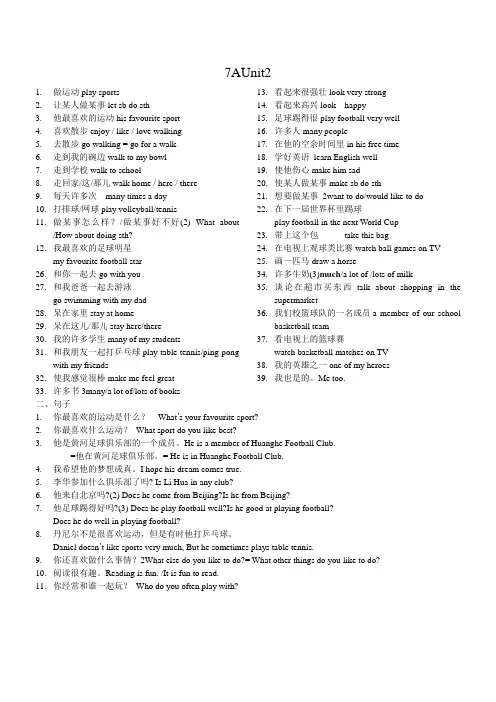
1. 做运动play sports
2. 让某人做某事let sb do sth
3. 他最喜欢的运动his favourite sport
4. 喜欢散步enjoy / like / love walking
5. 去散步go walking = go for a walk
6. 走到我的碗边walk to my bowl
7. 走到学校walk to school
8. 走回家/这/那儿walk home / here / there
9. 每天许多次 many times a day
10. 打排球/网球play volleyball/tennis
11. 做某事怎么样?/做某事好不好(2) What about
/How about doing sth?
12. 我最喜欢的足球明星
my favourite football star 13. 看起来很强壮look very strong
14. 看起来高兴look happy
15. 足球踢得很play football very well
16. 许多人many people
17. 在他的空余时间里in his free time
18. 学好英语 learn English well
19. 使他伤心make him sad
20. 使某人做某事make sb do sth
21. 想要做某事 2want to do/would like to do
22. 在下一届世界杯里踢球
play football in the next World Cup
23. 带上这个包 take this bag
24. 在电视上观球类比赛watch ball games on TV
25. 画一匹马draw a horse
26. 和你一起去go with you
27. 和我爸爸一起去游泳
go swimming with my dad
人教版七年级下册英语Unit7_It's_raining单元知识点总结 2.doc

1 Unit 7 It’s raining
一、短语总结:
take a message 稍口信
leave a message 留言,留个口信
do some cooking 做饭
cook sb sth=cook sth for sb为某人做......
no problem 没问题
on vacation 在度假
go skating 滑冰,溜冰
二、知识点整合
1、rain
① I like walking in the rain.
我喜欢在雨中散步。
②It is going to rain.
要下雨了
rain可用作名词,意为“雨水”,通常用作不可数名词,如例①;也可用作动词,意为“下雨”,通常用it作主语,如例②。
rainy是rain的形容词形式,意为“阴雨的;多雨的”。如:
What do you usually do in the rainy weather?
你通常在阴雨的天气里做什么?
温馨提示:大部分表示自然现象的词都可以通过在词尾加y变为形容词。如:snow雪一snowy下雪的,wind风一windy多风的,cloud云一cloudy多云的,sun太阳—sunny晴朗的,storm暴风雨—stormy有暴风雨的等。
2、How's the weather?
①一How's the weather today?
今天天气怎么样?
一It's cloudy.多云的。
②一How is the weather in Beijing?
北京的天气怎么样?
一lt's raining. 在下雨。
该句型常用来询问天气状况,意为“天气怎么样?”,其后还可接表示时间或地点的短语,如例句所示。其答语通常为“It's + 表示天气状况的形容词或动名词”。表示天气状况的形容 2 词或动名词有:dry,cold,hot,warm,windy,cloudy,raining,snowing等。
牛津英语译林版 七年级上册 Unit 2 单元提优试卷

Unit2提优卷
(满分: 100分考试时间: 60 分钟)
Ⅰ. 单项选择(每小题1分, 共15分)
1. He likes playing ______ basketball, so he wants to buy ______ basketball.
A. a; a B. /; / C. /; a D. the; a
2. We ______ in the School Volleyball Club. We ______ Chinese Women’s Volleyball Team.
A. are all; all like B. all are; all like C. are all; like all D. all are; like all
3. Jeremy Lin plays basketball ______ . He is a ______ basketball player.
A. good; good B. well; well C. good; well D. well; good
4. —How does Sandy ______ ? —She looks tall and slim.
A. like B. look C. look like D. likes
5. He goes to school by bus, but he walks ______ after school.
A. to home B. home C. his home D. the home
6. Lily likes listening to music. It ______ her ______ great.
A. makes; feels B. makes; to feel C. makes; feel D. make; feel
七年级上册英语Unit2 Welcome知识点总结及练习-译林版
Unit 2 Let’s play sports!
Period I: Comic strip & Welcome to the unit
随堂小练习
I. 根据中文提示写单词。
1. He can have three________ (碗) of rice for lunch.
2. His mother plays _________(网球) very well.
3. They all like playing _________ (排球).
4. I _________(喜爱)listening to music.
5. –How many _________(次数) do you play football a week? –Once.
【KEYS】I. 1. bowls 2.tennis 3. volleyball 4. enjoy/love/like 5. times
第一部分 讲解分析
一、 新词的导学与解读
1.walking
【用法】n. 散步,步行
【举例】He was walking up and down the station platform. 他在火车站的月台上走来走去。
He was terribly tired after walking six kilos. 他走了六公里之后就累得不行。
【拓展】walk是v.步行;陪...走;散步;
【举例】I missed the bus and had to walk home.我没赶上公共汽车,只好走回家。
There is something wrong with the car, so we'll have to walk.汽车坏了--我们只好步行。
【实践】翻译句子。晚饭后散步对身体有好处。_________________________________________.
二年级上册英语-知识点总结(unit1-4) 译林版
二年级英语上册(译林牛津2A)知识要点
Unit 1 She’s my aunt
教材分析
本单元主要教学内容为“认识家庭成员”。在教学中,教师要通过扎
实的听说训练,让学生熟练运用This is ... Is this your ...? He’s/She’
s ...来介绍和询问亲属关系并能用形容词回答人物特征。
学情分析
在引入本单元话题时可以充分利用学生已学的知识,让学生自带一些
家庭成员的照片,在课堂上创设生活情景,引导学生产生询问欲望,
鼓励学生积极自主地参与交流。
教学目标要求
1.能听懂、会说、初步认读uncle,cousin,aunt,tall,short这五
个单词,发音正确。
2.能听懂This is ... Is this your ...? 并能根据实际情况用
He`s/She`s…回答。
3.能使用句型Is this your ...?向他人询问和描述某人,发音正确。
4.培养学生对英语的热爱之情并激发学生的英语学习兴趣。
5.培养学生的交际能力和语言的表达能力。
6.会唱歌曲This is my uncle.
教学重点
1.能听懂、会说、初步认读uncle,cousin,aunt,tall,short这五
个单词,发音正确。
2.能听懂This is ... Is this your ...? 并能根据实际情况用
He`s/She`s…回答。
3.能使用句型Is this your ...?向他人询问和描述某人,发音正确。
教学难点
1.能听懂This is ... Is this your ...? 并能根据实际情况用
He`s/She`s…回答。
2.能使用句型Is this your ...?向他人询问和描述某人,发音正确。
Unit 2 I have a rabbit
教材分析:
本单元的话题是“宠物和玩具”,呈现了如何介绍自己拥有的宠
物或动物毛绒玩具,以及如何简单描述其特征。教学重点是句型I have
人教版七年级英语上册Unit1-2知识点总结与练习(精)
新航标教育·清溪分校
1 Unit 1 My name’s Gina.
Section A
【视野聚焦】
重点短语 1. 我的名字 my name 2. 名字 first name 3. 姓氏 last name 经典句型 1. What’s your / his / her name? 你/ 他/ 她叫什么名字? 2. My / His / Her name’s … 我的/ 他的/ 她的名字叫… 3. Nice to meet you! 见到你很高兴! 【学海拾贝】 ◆1.What’s your name? My name’s Gina. (1)两人初次见面互相询问姓名时可用这个句型。后面可加上please,用升调以表示礼貌、客气。如想反问时可说:And you?或者And what’s your name? ●例如:A: Hello. What’s your name? B: My name is Linda. And you?/And what’s your name? (2)回答时还可以说I’m….其中My name’s…是My name is …的缩写。I’m…是I am的缩写。
●例如:我的名字叫玛丽。
My name’s Mary./I’m Mary.
(3)am, is, are叫做联系动词,用来表示人或事物的性质、状态等,在句中起连接主语和表语的作用,基本意思是“是”,有时不译出。其原形是be。
●例如:我的尺子是蓝色的。 My ruler is blue.
方法指津: 巧记am, is, are
我(I)用am, 你(you)用are, is 跟着他(he)、她(she)、它(it),所有复数都用are。
牛津译林版七年级英语下册 Unit2 单元知识点总结
牛津译林版七年级英语下册
7B Unit2 Neighbours
1. Visitor n. 访问者,参观者 可数名词
Visit n/vt. On a visit to … 参观…
2. Like prep. 像,类似 后接名词或代词,构成介词短语
Can you climb the tree like a cat?
Like father, like son.
Like vt. 喜欢
3. Be afraid 恐怕 后接宾语从句
I’m afraid he is out at the moment.
Be afraid of 害怕 后接名词或动名词
The children are afraid of snakes.
I’m afraid of waking him.
Be afraid to do sth. 不敢做某事
The girl is afraid to go there.
口语中,be afraid not 恐怕不,be afraid so 恐怕如此
---Is Amy coming, David?
---I’m afraid not./I’m afraid so.
4. Most of 其中most是代词,前面不用加the。
Most of …做主语时,谓语动词根据宾语确定单复数
Most of the homework is very difficult.
At most 至多,不超过
At least 至少,不少于
There are five books in the bag at most.
5. Skill n. 技巧,技能 可数名词
Skilled adj. 熟练的,有经验的 skillful
Be skilled in doing sth.