
山东省日照市莒县第一中学2019-2020学年高一上学期10月月考英语试卷 含答案
2019级阶段性测试英语试题(满分150分,120分钟)2019.10第Ⅰ卷第一部分听力(共两节, 每小题1.5分,满分30分)第一节(共5小题;每小题1.5分,满分7.5分)听下面5段对话。
每段对话后有一个小题,从每题所给的A、B、C三个选项中选出最佳选项,并标在试卷的相应位置。
听完每段对话后,你都有10秒钟的时间来回答有关小题和阅读下一小题。
每段对话仅读一遍。
1. Where does the conversation probably take place?A. At a bus station.B. At a train station.C. At an airport.2. What present did the woman buy for Edward?A. A shirt.B. A sweater.C. A pair of gloves.3. Who will probably repair the TV set?A. The man.B. The woman.C. The woman’s husband.4. What are the two speakers mainly talking about?A. The man’s job interview.B. The man’s new boss.C. The man’s good behavior.5. How much does the man need to pay for two bottles of orange juice?A. Three dollars.B. Four dollars.C. Six dollars.第二节(共15小题;每小题1.5分,满分22.5分)听下面5段对话或独白。
每段对话或独白后有几个小题,从题中所给的A、B、C三个选项中选出最佳选项,并标在试卷的相应位置。
听每段对话或独白前,你将有时间阅读各个小题,每小题5秒钟;听完后,各小题将给出5秒钟的作答时间。
每段对话或独白读两遍。
听第6段材料,回答第6至7题。
6. How is the woman going to Singapore?A. By plane.B. By train.C. By sea.7. What will the woman do on Tuesday afternoon?A. Pick up Mr. Black.B. Meet a customer.C. Attend a conference.听第7段材料,回答第8至9题。
8. What will the woman do during the summer vacation?A. Find a job.B. Visit her grandparents.C. Stay in the city.9. What does the man like about the countryside?A. Plants.B. Houses.C. Animals.听第8段材料,回答第10至12题。
10. When did the two speakers move here?A. Yesterday.B. Two years ago.C. Four years ago.11. What are the two speakers planning to do?A. Set up a lab.B. Write more papers.C. Work on experiments.12. What do we know about the woman?A. She is working on her degree.B. She is working at the lab.C. She likes her husband’s job.请听第9段材料,回答第13至16题。
13. Why doesn’t the man go to the party?A. He has to finish a paper.B. He isn’t feeling well.C. He doesn't like parties.14. When should the man hand in the paper?A. On Tuesday morning.B. On Thursday morning.C. On Friday morning.15. Why doesn’t the man lend his car to the woman?A. She has no driver’s license.B. She doesn't drive well.C. She has drunk too much.16. How will the woman come back from the party?A. By taxi.B. By bus.C. By subway.听第10段材料,回答第17至20题。
17. What is Mr. Brown?A. A center manager.B. A tour guide.C. A social organizer.18. What can listeners do on Wednesday afternoon?A. See a film.B. Play sports.C. Go sightseeing.19. When are listeners leaving for London?A. On Friday.B. On Saturday.C. On Sunday.20. What is the purpose of the talk?A. To inform listeners of the plans.B. To welcome listeners to the center.C. To tell listeners the rules they should follow.第二部分阅读理解(共两节,满分40分)第一节(共15小题;每小题2分,满分30分)阅读下列短文,从每题所给的A、B、C和D四个选项中,选出最佳选项。
AVolunteering means working for free to help someone else. Mrs. Obama says volunteering is very important. “It should be part of everyone’s life,” she says.Many teens agree. They say that helping others feels great and makes a difference. These days, more teens volunteer than work for pay. Teens clean up parks, walk dogs at animal shelters, visit the elderly, and more.Some cities—including Seattle, Chicago, and Washington, D.C.—require high school students to volunteer. Students must volunteer in order to graduate. The student volunteers learn new skills and help their communities (社区).Many parents subscribe to the idea —they say volunteering helps teens build job skills. But most teens don’t want to be forced to volunteer. They say they are busy. And they say volunteering is only fun if it’s a choice.Read both sides of the debate and decide.Yes●Volunteering can help teens get into college or get a job.●Many cities and towns need help. Volunteers can help keep important programs going.●Not all teens will volunteer if it isn’t required. Schools should require students to do all they can to get ready for adult life.No●Most teens are already very busy with classes, homework, jobs, and sports. Forcing them to do more isn’t fair.●It should be up to each person. Helping out doesn’t feel as good if you have to do it.●Finding a volunteer job isn’t always easy. Students shouldn’t be kept from graduating because of something they can’t control.21. It is known from the text that in Washington, D.C. ______.A. high school students won’t graduate if they don’t volunteerB. everyone would like to volunteerC. finding a volunteer job is not difficultD. volunteering is a must for college school students22.What does the underlined phrase “subscribe to” in Paragraph 4 probably mean?A. Correct.B. Like.C. Devote.D. Revise.23.What does the No side think of volunteer jobs?A. They are not as important as students’ homework.B. They won’t help teens prepare for their adult life.C. Students shouldn’t be stopped from graduation because of them.D. They waste students’ precious(宝贵的)time.24.What does the text mainly talk about?A. Whether volunteering is good for students.B. Who are best to do volunteer jobs.C. What kind of volunteer jobs students should do.D. Whether students should be required to volunteer.BIt is 6:00 a.m. on the first day of the school year. In Cherrybrook Technology High School, mathematics teacher Eddie Woo is already at work.One of the first things before the first bell rings is to set up his tripod(三脚架)and iPad in the middle of the classroom. “I’m Mr. Woo. I record my lessons. I record all of them. In fact, I’m about to record this one,” he explains to his new maths class.He started posting videos online in 2012 for a student who was sick with cancer and missing a lot of school, so he started sharing them across the country and beyond. Wootube now has more than 38,000 subscribers (用户) and has attracted almost 4 million views worldwide.Cherrybrook Technology High School principal (校长) Gary Johnson said Mr. Woo was helping maths teachers in Australia and making maths popular again. “He has an ability to simplify (简化) maths to a level where kids can really understand it.” Mr. Johnson said.12-year-old student Emily Shakespeare said Mr. Woo’s teaching style made maths easy and interesting. “I don’t want tosay it, but he sucked me into maths,”she said. Owen Potter, who attends high school in Cobar agreed. “It’s difficult to understand how someone in Sydney can influence thousands of people across the whole country,” he said.Mr. Woo won the 2017 University of Sydney Young Alumni Award for Outstanding Achievement, and he was one of 12 Australian teachers honored at the Commonwealth Bank Teaching Awards.25. Eddie Woo set up an iPadin the middle of the classroom with the purpose of ________.A. listening to musicB. playing a videoC. recording his classD. showing pictures26. What can we infer from the statistics(数据)in the third paragraph?A. Mr. Woo’s teaching videos online are very popular.B. Mr. Woo had made a lot of money by selling videos.C. Mr. Woo posted videos online helping many adults.D. Mr. Woo created his Wootube in 2012 in Sydney.27. According to Gary Johnson, Mr. Woo’s maths lessons are ________.A. difficult to followB. easy to understandC. simple to handleD. challenging to learn28.What is the main idea of the last paragraph?A. Mr. Woo is the most well-known maths teacher in Australia.B. Mr. Woo graduated from the University of Sydney with honors.C. Mr. Woo won the Commonwealth Bank Teaching Awards.D. Mr. Woo’s contributions to teaching have been recognized.CIf you think that running marathons(马拉松) will help you live a long and healthy life, new research may come as a shock. According to a recent scientific study, people who do a very strenuous workout are as likely to die as people who do no exercise at all.Scientists in Denmark have been studying over 1,000 joggers (慢跑者)and non-joggers for 12 years. The death rates from the sample group indicate that people who jog at a moderate(适度的) pace two or three times a week for less than two and a half hours in total are least likely to die. The best speed to jog at was found to be about 5 miles per hour. The research suggests that people who jog more than three times a week or at higher speeds of over 7 mph die at the same rate as non-joggers. The scientists think that this is because strenuous exercise causes structural changes to the heart and arteries(动脉). Over time, this can cause serious injuries.Peter Schnohr, a researcher in Copenhagen, said, “If your goal is to decrease risk of death and improve l ife expectancy(寿命), jogging a few times a week at a moderate pace is a good way. Anything more is not just unnecessary, and it may be harmful.”The implications (暗示)of this are that moderate forms of exercise such as tai chi, yoga and fast walking may be better for us than “iron man” events, triathlons and long-distance running and cycling. According to Jacob Louis Marott, another researcher involved in the study, “You don’t actually have to do that much to have a good impact on your health. And perhaps you shouldn’t actually do too much”.29. The underlined word “strenuous” in Paragraph 1 is closest in meaning to “______”.A. hardB. regularC. practicalD. flexible30. The author presents some figures in Paragraph 2 to ______.A. suggest giving up joggingB. show risks of doing sportsC. provide supportive evidenceD. introduce the research process31. According to the scientists, why is too much exercise harmful?A. It may injure the heart and arteries.B. It can make the body tired out.C. It will bring much pressure.D. It consumes too much energy.32. What can be inferred from the text?A. No exercise at all is the best choice.B. More exercise means a healthier life.C. Marathons runners are least likely to die.D. Proper exercise contributes to good health.DWhen I lived in Spain, some Spanish friends of mine decided to visit England by car. Before they left, they asked me for advice about how to find accommodation (住所).I suggested that they should stay at ‘bed and breakfast’ houses, because this kind of accommodation gives a foreign visitor a good chance to speak English with the family. My friends listened to my advice, but they came back with some funny stories.“We didn’t stay at bed and breakfast houses, ”they said, “because we found that most families were away on holiday.”I thought this was strange. Finally I understood what had happened. My friends spoke little English, and they thought ‘V ACANCIES’ meant ‘holidays’, because the Spanish word for ‘holidays” is ‘vacaciones’. So they did not go to house where the sign outside said ‘V ACANCIES’, which in English means there are free rooms. Then my friends went to house where the sign said ‘NO V ACANCIES’, because they thought this meant the people who owned the house were not away on holiday. But they found that these houses were all full. As a result, they stayed at hotels!We laughed at this and about mistakes my friends made in reading other signs. In Spanish, the word ‘DIVERSION’ means fun. In English, it means that workmen are repairing the road, and that you must take a different road. When my friends saw the word ‘DIVERSION’ on a road sign, they thought they were going to have fun. Instead, the road ended in a large hole.English people have problems too when they learn foreign languages. Once in Paris, when someone offered me some more coffee, I said ‘Thank you’ in French, I meant that I would like some more. However, to my surprise the coffee pot was taken away! Later I found out that ‘Thank you’ in French means ‘No, thank you.’33. “NO V ACANCIES” in English means _________.A. no free roomsB. free roomsC. not away on holidayD. holidays34. If you see a road sign t hat says ‘DIVERSION’ in London, you will _________.A. fall into a large holeB. find the road blocked by peopleC. have a lot of fun and enjoy yourselfD. have to take a different road35. What did the author really mean when the coffee pot was taken away?A. He would finish drinking his coffee.B. He was expecting another cup of coffee.C. He meant that he didn’t want any more.D. He has already had enough coffee.第二节七选五(共5小题;每小题2分,满分10分)根据短文内容,从短文后的选项中选出能填入空白处的最佳选项。
2019-2020年高一10月月考英语试题 含答案
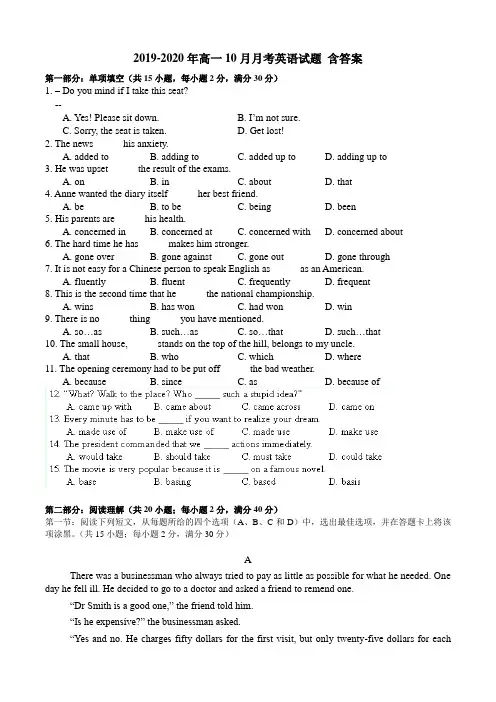
2019-2020年高一10月月考英语试题含答案第一部分:单项填空(共15小题,每小题2分,满分30分)1. – Do you mind if I take this seat?-- ______________A. Yes! Please sit down.B. I’m not sure.C. Sorry, the seat is taken.D. Get lost!2. The news _____ his anxiety.A. added toB. adding toC. added up toD. adding up to3. He was upset _____ the result of the exams.A. onB. inC. aboutD. that4. Anne wanted the diary itself _____ her best friend.A. beB. to beC. beingD. been5. His parents are _____ his health.A. concerned inB. concerned atC. concerned withD. concerned about6. The hard time he has _____ makes him stronger.A. gone overB. gone againstC. gone outD. gone through7. It is not easy for a Chinese person to speak English as _____ as an American.A. fluentlyB. fluentC. frequentlyD. frequent8. This is the second time that he _____ the national championship.A. winsB. has wonC. had wonD. win9. There is no _____ thing _____ you have mentioned.A. so…asB. such…asC. so…thatD. such…that10. The small house, _____ stands on the top of the hill, belongs to my uncle.A. thatB. whoC. whichD. where11. The opening ceremony had to be put off _____ the bad weather.A. becauseB. sinceC. asD. because of第二部分:阅读理解(共20小题;每小题2分,满分40分)第一节:阅读下列短文,从每题所给的四个选项(A、B、C和D)中,选出最佳选项,并在答题卡上将该项涂黑。
2019-2020年高一10月月考英语试题含解析
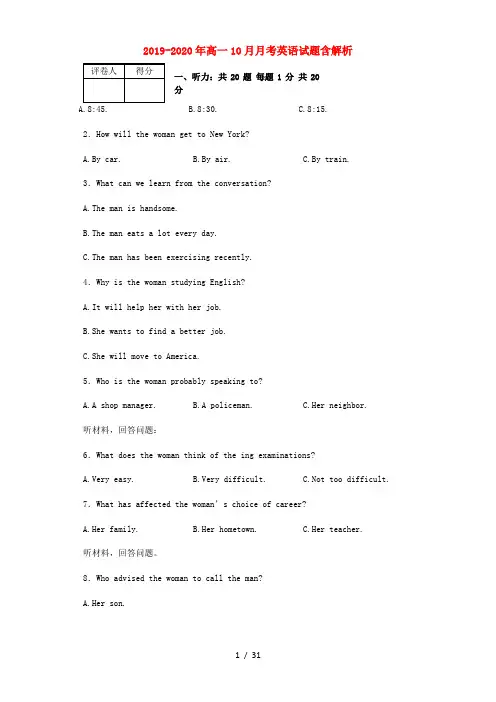
2019-2020年高一10月月考英语试题含解析一、听力:共20题每题1分共20分A.8:45.B.8:30.C.8:15.2.How will the woman get to New York?A.By car.B.By air.C.By train.3.What can we learn from the conversation?A.The man is handsome.B.The man eats a lot every day.C.The man has been exercising recently.4.Why is the woman studying English?A.It will help her with her job.B.She wants to find a better job.C.She will move to America.5.Who is the woman probably speaking to?A.A shop manager.B.A policeman.C.Her neighbor.听材料,回答问题:6.What does the woman think of the ing examinations?A.Very easy.B.Very difficult.C.Not too difficult. 7.What has affected the woman’s choice of career?A.Her family.B.Her hometown.C.Her teacher.听材料,回答问题。
8.Who advised the woman to call the man?A.Her son.B.Her friend Susan.C.Her friend’s son Bobby.9.Why does the woman contact the man?A.She wants to ask something about her son’s studies.B.She wants to give some suggestions to the man.C.She wants to ask for some information on gymnastics.听材料,回答问题。
2019-2020年高一上学期10月月考英语试题含答案
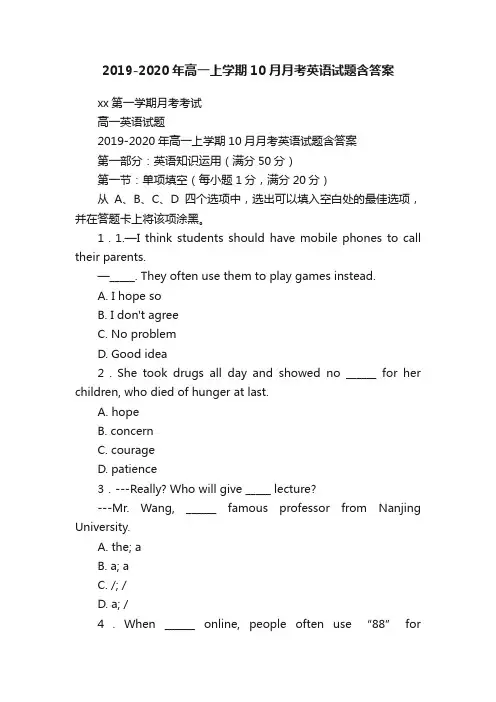
2019-2020年高一上学期10月月考英语试题含答案xx第一学期月考考试高一英语试题2019-2020年高一上学期10月月考英语试题含答案第一部分:英语知识运用(满分50分)第一节:单项填空(每小题1分,满分20分)从A、B、C、D四个选项中,选出可以填入空白处的最佳选项,并在答题卡上将该项涂黑。
1.1.—I think students should have mobile phones to call their parents.—_____. They often use them to play games instead.A. I hope soB. I don't agreeC. No problemD. Good idea2.She took drugs all day and showed no ______ for her children, who died of hunger at last.A. hopeB. concernC. courageD. patience3.---Really? Who will give _____ lecture?---Mr. Wang, ______ famous professor from Nanjing University.A. the; aB. a; aC. /; /D. a; /4.When ______ online, people often use “88” for“goodbye” .A. chatB. chattedC. chattingD. to chatA. by accidentB. on purposeC. for pleasureD. by mistake6.This is the first time that we ______ a film in the cinema as a family.A. seeB. had seenC. sawD. have seen7.This sweater fits me, but I can’t afford to buy ____.I have to choose _____ that is cheap enough for me.A. one; thatB. that; itC. it; oneD. that; the one8.I don’t know if he ______ tomorrow. If he ______, we’ll climb the mountain.A. es, esB. es, will eC. will e, esD. will e; will e9.It _______ have been her to leave her child alone. She isn’tsuch a person.A. couldn’tB. wouldn’tC. mustn’tD. needn't 10.She has _______ a lot since her husband died.A. lived throughB. gone throughC. got throughD. looked through11.Mother’s health is improving quickly,and it won’t be long ______ she fully recovers from the serious illness.A. beforeB. unlessC. whenD. until 12.—Excuse me. I’m looking for Be the Best of Yourself.—Sorry. The book you ask for ______ out.A. is sellingB. has been soldC. was sellingD. will be sold14.This pany has ______ from economic depression(经济萧条) after two years of development.A.escaped B.suffered C.returned D.recovered 15.—Miss Lee, I didn’t catch what you said. Could you tell me ______ again?—OK.A. what should we takeB. where shall we meetC. when we would startD. how we will get there16. ---How nice the weather is!---Yes. It’s _______ that I’d like to take a walk outside.A. so beautiful a dayB. such beautiful a dayC. a such beautiful dayD. a so beautiful day17.—W hat did you get ______ your mother ______ M other’s Day?—A beautiful card and a scarf.A. for; inB. to; forC. for; onD. to; at18. —Good news. We will have a _______ holiday.—I've heard of it. But it's ing in _______.A. three days; three days' timeB. three days'; three days'C. three-day; three daysD. three days; three-day time19. Mr. Smith was _______ of the _______ speech, so he began to read a novel.A. tired ; boredB. tired; boringC. tiring; boringD. tiring; bored20. People are talking about the old houses ______ Jackie Chan bought in Anhui twenty years ago.A. whenB. whereC. whoD. which第二节完形填空(共20小题;每小题1.5分,满分30分)阅读下面短文,掌握其大意,然后从各题所给的四个选项中,选出最佳选项,并在答题卡上将该项涂黑。
2019-2020年高一上学期10月月考英语试题 含答案

2019-2020年高一上学期10月月考英语试题含答案本试卷分为第I卷(选择题)和第II卷(非选择题)两部分。
满分150分,考试时间120分钟。
第I卷(共100分)第一部分:听力(共两节,满分30分)第一节(共5小题:每小题1.5分,满分7.5分)请听下面5段对话。
每段对话后有一个小题,从题中所给的A,B,C三个选项中选出最佳选项,并标在试卷的相应位置。
听完每段对话后,你都有10秒钟的时间来回答有关小题和阅读下一小题每段对话仅读一遍。
1. Where does this conversation probably take place ?A. In a bookstore .B. In a classroom .C. In a library .2. At what time will the film begin ?A. 7:20B. 7:15C. 7:003. What are the two speakers mainly talking about ?A. Their friend Jane .B. A weekend trip .C. A radio program .4. What will the woman probably do ?A. Catch a train .B. See the man off .C. Go shopping .5. Why did the woman apologize ?A. The cake was late .B. She went to the wrong place .C. She couldn’t take the cake back .第二节(共15小题,每小题1.5分,满分22.5分)听下面5段对话或独白。
每段对话或独白后有几个小题,从题中所给的A、B、C三个选项中选出最佳选项,听每段对话或独白前,你将有时间阅读各个小题,每小题5秒钟;听完后,各小题将给出5秒钟的作答时间。
2020届山东省日照市莒县一中高三上学期10月月考英语试卷及答案
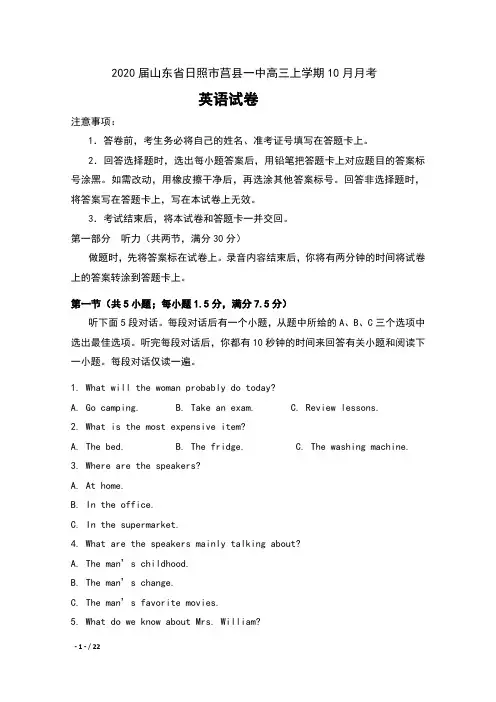
2020届山东省日照市莒县一中高三上学期10月月考英语试卷注意事项:1.答卷前,考生务必将自己的姓名、准考证号填写在答题卡上。
2.回答选择题时,选出每小题答案后,用铅笔把答题卡上对应题目的答案标号涂黑。
如需改动,用橡皮擦干净后,再选涂其他答案标号。
回答非选择题时,将答案写在答题卡上,写在本试卷上无效。
3.考试结束后,将本试卷和答题卡一并交回。
第一部分听力(共两节,满分30分)做题时,先将答案标在试卷上。
录音内容结束后,你将有两分钟的时间将试卷上的答案转涂到答题卡上。
第一节(共5小题;每小题1.5分,满分7.5分)听下面5段对话。
每段对话后有一个小题,从题中所给的A、B、C三个选项中选出最佳选项。
听完每段对话后,你都有10秒钟的时间来回答有关小题和阅读下一小题。
每段对话仅读一遍。
1. What will the woman probably do today?A. Go camping.B. Take an exam.C. Review lessons.2. What is the most expensive item?A. The bed.B. The fridge.C. The washing machine.3. Where are the speakers?A. At home.B. In the office.C. In the supermarket.4. What are the speakers mainly talking about?A. The man’s childhood.B. The man’s change.C. The man’s favorite mo vies.5. What do we know about Mrs. William?A. She is in her thirties.B. She looks younger than she is.C. She had her daughter at the age of 25.第二节(共15小题;每小题1.5分,满分22.5分)听下面5段对话或独白。
山东省日照市莒县第一中学2019-2020学年高一上学期10月月考英语试卷
2019级阶段性测试英语试题(满分150分,120分钟)2019.10第Ⅰ卷第一部分听力(共两节, 每小题1.5分,满分30分)第一节(共5小题;每小题1.5分,满分7.5分)听下面5段对话。
每段对话后有一个小题,从每题所给的A、B、C三个选项中选出最佳选项,并标在试卷的相应位置。
听完每段对话后,你都有10秒钟的时间来回答有关小题和阅读下一小题。
每段对话仅读一遍。
1. Where does the conversation probably take place?A. At a bus station.B. At a train station.C. At an airport.2. What present did the woman buy for Edward?A. A shirt.B. A sweater.C. A pair of gloves.3. Who will probably repair the TV set?A. The man.B. The woman.C. The woman’s husband.4. What are the two speakers mainly talking about?A. The man’s job interview.B. The man’s new boss.C. The man’s good behavior.5. How much does the man need to pay for two bottles of orange juice?A. Three dollars.B. Four dollars.C. Six dollars.第二节(共15小题;每小题1.5分,满分22.5分)听下面5段对话或独白。
每段对话或独白后有几个小题,从题中所给的A、B、C三个选项中选出最佳选项,并标在试卷的相应位置。
听每段对话或独白前,你将有时间阅读各个小题,每小题5秒钟;听完后,各小题将给出5秒钟的作答时间。