
小学英语五年级下册第二模块第二单元
学习目标
1.能认读单词 learnt,taught,studied, hard 及短语work at school,twenty years ago, a good pupil,study very hard, in his class,learn English.
Talk about your trip plan with your friend.(和你的朋友谈
论你的旅行计划)
hard studied a good
study very hard learn English teach Chinese in school his class at
learnt pupil taught
知识拨
1. 过去式:like---liked learn---learnt teach --taught 2. 短语:go to school 去学校 at school 在学校 3. like+动词ing形式
is-----was are-----were can-----could live-----lived talk-----talked learn-----learnt like-----liked watch-----watched
listen to the tape and repeat it.
• 连词成句 1. good, pupil, is, she, a ( . ) She is a good pupil. 2. he, hard, very, studied ( . ) He studied very hard. 3.now, doesn't, teacher, work, my( . ) My teacher doesn't work now. 4. He _____ wrote (write) a book last year. 5. Looking!She is learning ____ (learn) English. teach (teach) Chinese then? 6. Did he ____
listen to the tape and repeat it
study very hard
学习非常努力
Listen to the tape and answer questions:
1.What did Mr Li do twenty years ago? Twenty years ago,Mr Li was a teacher. 2.What did Chen Hai do twenty years ago? Twenty years ago,Chen Hai was a good pupil.
2.能口头运用句型:Mr Li was a teacher . He taught Chinese . Chen Hai is an English teacher . He's teaching Mr Li . 这类语句描述某人过去到现在的变化。
listen to the tape and find out new words .
twenty years ago
Twenty years ago, Mr Li was a teacher. He taught Chinese. Chen Hai was in his class.He was a good pupil. He studied very hard.
课堂小结
• • • • • twenty years ago 二十年以前 过去时 teach Chinese 教语文 in his class 在他的班里 a good pupil 一个好学生 study very hard 学习非常努力
小学英语五年级下册第二单元教案 北京版
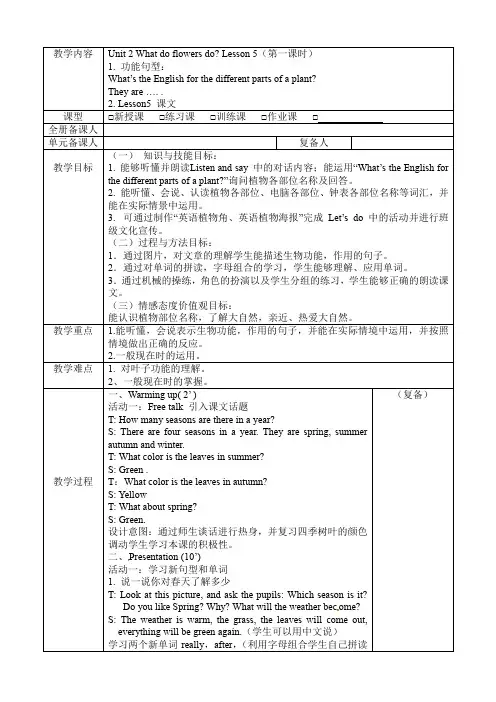
教学内容Unit 2 What do flowers do? Lesson 5(第一课时)1. 功能句型:What’s the English for the different parts of a plant?They are …. .2. Lesson5 课文课型□新授课□练习课□训练课□作业课□ 全册备课人单元备课人复备人教学目标(一)知识与技能目标:1.能够听懂并朗读Listen and say 中的对话内容;能运用“What’s the English for the different parts of a plant?”询问植物各部位名称及回答。
2. 能听懂、会说、认读植物各部位、电脑各部位、钟表各部位名称等词汇,并能在实际情景中运用。
3.可通过制作“英语植物角、英语植物海报”完成Let’s do 中的活动并进行班级文化宣传。
(二)过程与方法目标:1.通过图片,对文章的理解学生能描述生物功能,作用的句子。
2.通过对单词的拼读,字母组合的学习,学生能够理解、应用单词。
3.通过机械的操练,角色的扮演以及学生分组的练习,学生能够正确的朗读课文。
(三)情感态度价值观目标:能认识植物部位名称,了解大自然,亲近、热爱大自然。
教学重点 1.能听懂,会说表示生物功能,作用的句子,并能在实际情境中运用,并按照情境做出正确的反应。
2.一般现在时的运用。
教学难点 1.对叶子功能的理解。
2、一般现在时的掌握。
教学过程一、Warming up( 2’ )活动一:Free talk 引入课文话题T: How many seasons are there in a year?S: There are four seasons in a year. They are spring, summerautumn and winter.T: What color is the leaves in summer?S: Green .T:What color is the leaves in autumn?S: YellowT: What about spring?S: Green.设计意图:通过师生谈话进行热身,并复习四季树叶的颜色调动学生学习本课的积极性。
五年级下册英语单元知识梳理-Unit 2 My favourite season 人教PEP

PEP英语五年级下册Unit 2 知识梳理【单元语音归纳】字母组合发音例词br /br/brown, library, brother, umbrellagr /gr/ green, grapes, grandpa, grow【重点词语盘点】1. spring 春天2. summer 夏天3. autumn 秋天4. winter冬天5. season 季节6. picnic 野餐7. go on a picnic 去野餐8. pick摘;采集9. pick apples 摘苹果10. snowman 雪人11. make a snowman 堆雪人12. go swimming 去游泳13. good job做得好【重点句型再现】1. 询问对方最喜欢哪个季节的句型及答语:—Which season do you like best, Mike? 迈克,你最喜欢哪个季节?—Winter. 冬天。
——句型结构:问句:Which season do you like best?答句:⑴季节. ⑵I like+季节+best.2. 询问对方为什么喜欢某个季节的句型及答语:—Why? 为什么?—Be cause I like summer vacation! 因为我喜欢暑假!——句型结构:问句:⑴Why? ⑵Why do you like+季节(+best)?答句:Because I+动词(短语).【核心知识速记】速记单词(一)春天来,春天来,spring,spring,spring,燕子含泥柳条摆;夏天来,夏天来,summer,summer,summer,青蛙唱歌荷花开;秋天来,秋天来,,autumn,autumn,autumn,农民丰收乐开怀;冬天到,冬天到,winter,winter,winter,树儿树儿带雪帽;这是我们的四季歌,season, season, season, 你最喜欢哪一个?(二)春天阳光真灿烂,我们一起去野餐;Oh, yeah! Go on a picnic.夏天太热没有风,我们一起去游泳;Oh, yeah! Go swimming.秋天果实可真多,我们一起摘苹果;Oh, yeah! Pick apples.冬天外面可真冷,我们一起堆雪人;Oh, yeah! Make a snowman.速记句式1. 询问对方最喜欢哪个季节的句型及答语:句型结构:问句:Which season do you like best?答句:⑴季节. ⑵I like+季节+best.问句是Which引导的特殊疑问句,用于询问对方最喜欢哪个季节,which意为“哪一个”,可以直接回答季节,也可以用“I like+季节+best.”作答。
Unit2Myfavouriteseason(单元解读)五年级英语下册(人教PEP版)
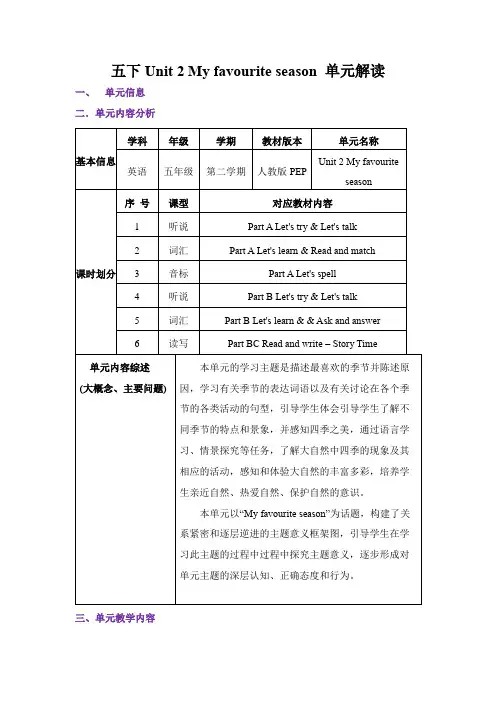
五下Unit 2 My favourite season 单元解读一、单元信息二.单元内容分析三、单元教学内容本单元来自PEP 小学英语五年级下册第二单元,主要围绕话题My favourite season 展开A、B、C 三个板块的教学。
梳理各课时语篇之间的延申与递进,话题之间的内在逻辑关联。
语篇一: 基于Part A Let's talk & Part A Let's learn。
该部分的核心内容是: Koala 来到中国访学,认识了Mike 等很多的新朋友,参观了他们的学校。
在相互了解的过程中,大家交流讨论了各自最爱的季节,并结合四季中各自不同的气候变化特征来说说为什么喜欢这个季节的原因。
通过第一节课初步的谈论,让孩子们了解四季的不同气候变化,感受每一个季节的典型特征与独特魅力,并学会正确表达和分享自己对各个季节的喜好。
语篇二: 基于Let's spell 。
该部分的核心内容是: 教师根据单元整体教学内容设计故事情境: Koala 米到中国访学,认识了很多的新朋友,他参观了朋友们的学校,受邀去斌斌家里做客,并和Zoom、Zip 一起度过特别的圣诞节。
现在,他又开心地和朋友们一起上课,发挥自己的特长,帮助孩子们学习英语语音。
本课以Koalas spelling class 为话题内容展开教学,学习br& gr 的自然拼读、发音规律以及应用。
通过本课的学习,帮助孩子们提升英语素养,借助英语这一语言工具,把中国的文化传统推广给世界更多的人,实现文化交流,展现文化自信。
语篇三: 基于Part B Let's talk & Part B Let's learn。
该部分的核心内容是: Koala 参观和欣赏朋友们的季节主题画展。
通过作品的呈现来了解朋友们对四季的不同点好,并结合四季中可以进行的一些典型而有代表性的活动来延申话题内容,从不同维度表达自己喜爱某个季节以及喜欢的原因。
五年级下册英语第二单元统编版

五年级下册英语第二单元统编版一、单元概述本单元主要介绍了有关“时间”的英语表达方式。
通过学习本单元,学生能够掌握描述时间的常用词汇和句子,培养对时间观念的理解能力,并能够在日常生活中正确、流利地使用英语进行时间的表达。
二、词汇与句型1. 词汇本单元的重点词汇主要包括:•Days of the week: Monday, Tuesday, Wednesday, Thursday, Friday, Saturday, Sunday•Months: January, February, March, April, May, June, July, August, September, October, November, December •Time: hour, minute, second•Expressions: in the morning/afternoon/evening, at night2. 句型本单元的重点句型主要包括:•What day is it today?•What’s the date today?•What time is it?•It’s [time]. / It’s [hour(s)] [minute(s)].•When is your birthday? My birthday is on[date/month].•What do you do on the weekend? On the weekend, I [activity].三、学习目标通过本单元的学习,学生将能够达到以下目标:•掌握描述日期和时间的词汇。
•能够准确运用问日期、时间的句子。
•能够描述自己的日常活动,并运用描述时间的句子。
•培养对时间观念的理解能力,提高对时间的认知。
四、教学方法与过程1. 情境导入通过展示一些与时间相关的图片或视频,以及教师的简短介绍,引导学生进入学习的氛围,激发学生对时间的兴趣。
小学英语五年级下册第二单元分析北京版

Unit2 What do flowers do?教材分析一、本单元内容梳理1.技能目标1)能流利地朗读Lesson 5、Lesson 6和Lesson 7课文,理解对话内容,会表演对话。
2)能够听懂、指认并说出植物各部分名称及表达植物各部分名称作用的词汇并在情景中运用。
3)一般现在时的基本结构和用法。
4)能听、说、读、写本单元的6个单词,认读本单元出现的动词短语。
2. 交际用语和句型1)—What’s the English for the different parts of a plant?—They are …. .2)—What do … do?—They make … .3)—What do …need to…?—… need… , …and … .3 .词汇:掌握:root, stem, leaves, flower, se e d, trunk认读:make seed/ grow up to be plants and trees/hold the trees above the ground/make food/cook dinner/ hold the party4.语音:能够体会辅音字母r及与r组合的字母在单词中的发音,并根据规律尝试拼读单词。
ar, ir, or, ur, er, ir, er, ur, war二、本单元内容在整册教材体系中的作用1.第二单元学习的有关植物各部分的构成以及部分的功能,为第三单元学习树木、植物的生长以及用途做铺垫。
第一单元练习了一般现在时的用法,第二单元进行复现以及巩固。
2. 各课之间的联系:各课都涉及了what 引导的特殊疑问句的用法和一般现在时的用法。
Lesson 5: 呈现了植物功能、作用的句子。
树的各部分的名称以及功能。
以what 引导的一般现在时特殊疑问句的用法。
Lesson 6: 呈现了植物生长所需要的条件。
一般现在时的使用。
Lesson 7:呈现了植物的各部分的名称以及各部分的功能。
人教版PEP五年级英语下册第二单元《My favourite season》教案
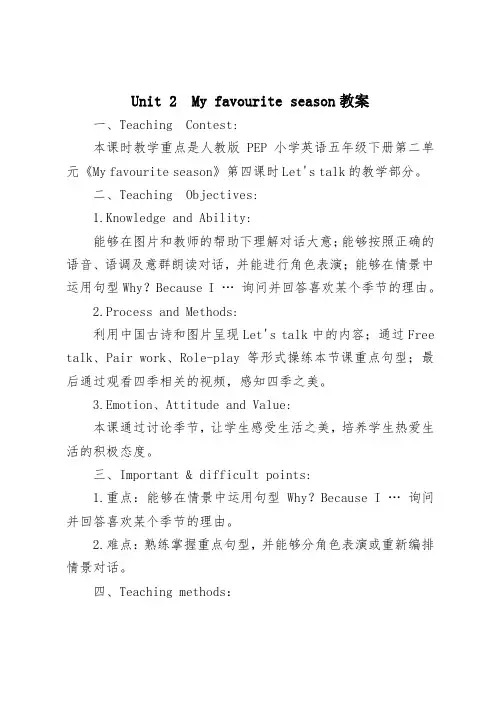
Unit 2 My favourite season教案一、Teaching Contest:本课时教学重点是人教版PEP小学英语五年级下册第二单元《My favourite season》第四课时Let's talk的教学部分。
二、Teaching Objectives:1.Knowledge and Ability:能够在图片和教师的帮助下理解对话大意;能够按照正确的语音、语调及意群朗读对话,并能进行角色表演;能够在情景中运用句型Why?Because I …询问并回答喜欢某个季节的理由。
2.Process and Methods:利用中国古诗和图片呈现Let's talk中的内容;通过Free talk、Pair work、Role-play等形式操练本节课重点句型;最后通过观看四季相关的视频,感知四季之美。
3.Emotion、Attitude and Value:本课通过讨论季节,让学生感受生活之美,培养学生热爱生活的积极态度。
三、Important & difficult points:1.重点:能够在情景中运用句型Why?Because I …询问并回答喜欢某个季节的理由。
2.难点:熟练掌握重点句型,并能够分角色表演或重新编排情景对话。
四、Teaching methods:Free talk、Pair work、Role-play等五、Teaching aids:关于四季季节的图片、诗句、音频和视频六、Teaching procedures:Step 1 Warm up1.--Good morning, class!Today, we'll learn Unit 2 My favourite season.Before the class,let's sing a song about season,OK?--OK...(Teacher&Students sing together.)--Wow,you are so great! Clap hands for yourself.2.Next Let's do a revision.--Which season do you like best?--Spring/Summer/...--Good job? And which season do you like best?--I like summer best.--I like summer, too.Step 2 Presentation and Practice1.Presentation:T:As we know, there are many poems about seasons in China. For example,《春晓》、《春夜喜雨》、《绝句》。
pep(人教)五年级英语下册 unit 2 A let's learn 说课稿.docx
PEP小学五年级下册Unit 2 My favourite season Part A Let’s learn说课稿一、说教材1、说教材地位与作用“My favourite season”是第二单元的核心部分,在整个小学英语知识体系中是不可或缺的。
它不仅贴近学生的实际生活,而且实用、有趣,容易让学生接受并掌握。
学生在前面学习过的“谈论天气”、“谈论食物”等的交际基础上来“谈论季节”,把学过的知识学以致用,体验知识运用的成就感,并为下一步的“谈论月份”打下学习基础。
2、说教学内容与学情本课的教学内容是本单元的第一课时,其中包括Part A的Let’s learn和Let’s find out两个部分,主要包含五个四会单词和一个交际句型。
五年级的学生已经学了两年的英语,具备一定的英语基础知识和基本能力,而且处在这个年龄段的学生可塑性强,对新生事物表现出极大的兴趣,又有较强的接受能力。
再者,学生已在第四册和第五册中学习了“What’s the weather like?”和“What’s your favourite food?”的话题谈论,为本课的教学储备了一定的相关知识。
因此,本课的教学将综合以上情况进行学习和操练,以达到掌握知识、运用知识的目的。
3、说教学目标与重难点《小学英语新课程标准》指出:基础教育阶段英语课程的总体目标是以学生的语言知识、语言技能、情感态度、学习策略和文化意识的发展为基础,培养学生语言综合运用能力。
基于以上认识和对教材的分析,我将本课教学目标确定为以下三维目标:①知识与技能目标:能够听、说、读、写单词season、spring、summer、autumn、winter;能够使用句型What’s your favourite season?进行交际会话。
②过程与方法目标:培养学生良好的英语学习策略和综合运用语言的能力,为学生的终身学习奠定基础。
③情感态度与价值观目标:激发和培养学生学习英语的兴趣,树立学习自信心;培养学生的合作交流能力和健康快乐的学习态度。
五下英语课文m2u2
五下英语课文m2u2In Unit 2 of Module 2 in the fifth grade English textbook, students are introduced to a story called "A Volunteer’s Great Deed." This story details the selfless actions of a volunteer who helps others in need. The story emphasizes the importance of kindness, generosity, and compassion towards others. It serves as a valuable lesson for students about the impact of small acts of kindness in making a difference in the lives of others. 五年级英语教材第二模块第二单元中,学生阅读了一个故事《A Volunteer’s Great Deed》。
这个故事讲述了一名志愿者无私帮助他人的事迹。
故事强调了善良、慷慨和对他人的同情心的重要性。
它为学生们提供了一个宝贵的教训,告诉他们小小的善举对他人生活产生的影响。
The main character in the story is a volunteer who spends his time helping those in need. He shows kindness and compassion towards others without expecting anything in return. His actions inspire those around him to also lend a helping hand to those who are less fortunate. The story highlights the importance of empathy and caring for others, teaching students about the value of selflessness and generosity. 故事中的主人公是一名志愿者,他花时间帮助那些需要帮助的人。
PEP小学英语五年级下册第二单元重点解析
龙文学校个性化辅导教案提纲教师:苏希瑞学生:时间: 年月日时段:一、授课目的与考点分析:Unit 2 My Favourite Season二、授课内容:重点单词spring春天summer夏天fall秋天winter冬天season季节which哪一个best最;极swim游泳fly kites放风筝skate滑冰make a snowman堆雪人plant trees种树why为什么because因为sleep睡觉Halloween 万圣节Thanksgiving 感恩节话题2:季节时态:一般现在时1.——Which season do you like best ? 你最喜欢是什么季节?——I like spring best.(Spring.) 我最喜欢春季。
2.——What is your favourite season? 你最喜爱的季节是什么季节?——My favourite season is Spring.(Spring.) 我最喜爱的季节是春季。
3.——Why do you like summer? 你为什么喜欢夏天?——Because I can swim.(Because it’s warm, windy and sunny.) 因为我可以游泳(因为天气是…) 4.I like summer, because I can swim in the lake. 我喜欢夏天。
因为我可以在湖里游泳。
5.Spring is good ,but fall is my favourite season.春天是好的。
但秋天是我最喜欢的季节。
6.——What’s the weather like in fall in Beijing? 秋天的北京是什么天气?——It’s sunny and cool.是晴朗和凉爽的。
7.——What season is it in March in Beijing? 在北京的三月份是什么季节?——It’s spring.是春天。
广州“PEP”2024年小学五年级下册第二次英语第二单元综合卷[有答案]
广州“PEP”2024年小学五年级下册英语第二单元综合卷[有答案]考试时间:80分钟(总分:100)A卷考试人:_________题号一二三四五总分得分一、综合题(共计100题共100分)1. 选择题:Which of these is a common household pet?A. SnakeB. ParrotC. CatD. Hamster答案:C2. 填空题:My friend has a charming _______ (名词). 它的性格很 _______ (形容词).3. 填空题:The _______ (The Bolshevik Revolution) led to the establishment of a communist government in Russia.4. 听力题:The Sun is a medium-sized star in the ______ galaxy.5. 填空题:The kitten is very ______.6. 选择题:What do you call a group of birds?A. SwarmB. FlockC. PackD. Gaggle答案:B7. 填空题:My friend is ______ (很有创造力).What is the main purpose of a bridge?A. To connect two placesB. To provide shelterC. To store goodsD. To entertain visitors答案:A9. 填空题:At school, I prefer being called ______ by my friends. (在学校,我更喜欢我的朋友叫我。
)10. 听力题:My ______ enjoys hiking in the mountains.11. 选择题:Which animal is famous for its long migrations?A. ElephantB. SalmonC. LionD. Tiger答案: B12. 填空题:The _____ (犀牛) has thick skin and a large horn.13. 填空题:My friend calls me her _______ because we share secrets.14. 选择题:What is 8 - 4?A. 2B. 3C. 4D. 515. 填空题:The ________ (生态系统服务研究) provides insights.16. 选择题:What is the smallest continent?A. EuropeB. AustraliaC. AntarcticaD. Asia答案:BThe fish is _____ around the tank. (swimming)18. 填空题:In autumn, the leaves __________ (变色).19. 听力题:I like to ________ stories.20. 填空题:The __________ (历史的深刻反思) influences decisions.21. 听力填空题:I believe that every person can contribute to their __________.22. 选择题:What do you call a young female cow?A. CalfB. HeiferC. KidD. Lamb答案: B23. 听力题:The Earth's surface is shaped by natural ______.24. 填空题:The ________ (气候适应) is essential.25. 听力题:A compound always has a fixed ______.26. 填空题:I enjoy playing ________ (运动) during the week.27. 听力填空题:I have learned a lot about __________ in school this year.28. 选择题:Which object is used to tell time?A. CalendarB. ClockC. MapD. Book29. n Massacre was a key event leading to the __________ (美国独立). 填空题:The Bost30. 选择题:What is the capital of Norway?A. OsloB. StockholmC. HelsinkiD. Copenhagen31. 填空题:The _______ (Industrial Revolution) began in the 18th century in Britain.32. 选择题:What do we call the time it takes for the Earth to go around the sun?A. DayB. MonthC. YearD. Week答案:C33. 听力题:The capital city of Zambia is __________.34. 填空题:My favorite ice cream flavor is ________ (巧克力). I could eat it every ________ (天).35. 听力题:The __________ is the unit of measurement for energy.36. 填空题:A plant’s ______ (高度) can vary greatly from species to species.37. 填空题:A _____ is an area with high elevation.38. 填空题:Certain plants can ______ (增强) the local economy.39. 听力题:The chemical symbol for scandium is ______.40. 填空题:The _____ (种植者) takes care of the plants.41. 选择题:What is the capital of Tuvalu?a. Funafutib. Nanumeac. Nukufetaud. Niutao答案:a42. 填空题:The puppy is learning new _________. (技巧)43. 听力题:__________ are used in the production of pharmaceuticals.44. 选择题:What is the second planet from the sun?A. EarthB. VenusC. MarsD. Mercury45. 选择题:What do we call a young crab?A. LarvaB. HatchlingC. KitD. Calf答案:B. Hatchling46. 听力题:The ocean is a source of ______ for many organisms.47. 填空题:The invention of the steam engine revolutionized ________ (运输).48. 选择题:Which season comes after summer?A. SpringB. FallC. WinterD. Summer49. 选择题:What do you call the process of removing hair?A. ShavingB. WaxingC. PluckingD. All of the above50. 听力题:They are having a ______ (party) this weekend.51. 选择题:What do we call the act of speaking to an audience?A. SpeechB. LectureC. PresentationD. All of the above52. 填空题:A __________ (绿色化学) aims to reduce environmental impact through sustainable practices.53. 听力题:The chemical symbol for barium is __________.54. 填空题:The chemical formula for table salt is _______. (NaCl)55. 填空题:My friend is __________ (知性的).56. 听力题:A gas can be compressed because its particles are ______ apart.57. 听力题:The __________ can influence local weather patterns.58. 选择题:What is the main purpose of a computer?A. To cookB. To play gamesC. To process informationD. To read books答案: C59. 听力题:The rabbit is ________ carrots.60. 选择题:What is the capital of Botswana?A. GaboroneB. FrancistownC. MaunD. Kasane61. 填空题:The garden is _______ (充满生机的)。