
二上Unit2_Story_Time_教案
Unit2 StoryTime 教学设计教学内容:Unit 2 Boys and Girls Story Time1. 指导依据说明现代外语教育注重语言学习的过程,强调语言学习的实践性,主张学生在语境中接触、体验和理解真实语言,并在此基础上学习和运用语言。
以学生为主体,培养学生思维,感受英语学习的乐趣,引导学生用英语做事。
在真正使用英语的同时,关注英语语言背后的文化内涵和蕴含其中的情感教育。
2. 教学背景分析第一单元学习了家庭成员的称谓,第二单元开始学习单数的人称代词和物主代词。
本单元的核心词汇与句型有friend, class mate, he, she, his, her, Who is…? He/she is …What’s his / her name? His/her name is …在第二单元故事之前已经学习了第三单元,内容为描述朋友外貌特征。
本堂课是借班上课,对学生不是十分了解,也刚好借助这一真实生活情景相互熟悉。
课前调查发现,学生对上述功能句的掌握层级比较明显,所以在课堂上需要适当提供分层的活动空间,让不同层次的学生都有所得。
在与学生交流中发现,近一半的学生对课堂常用语存在理解困难,需要教师尽量使用简单句并适当提供中文翻译;另外学生间同伴合作的能力较弱,需要老师培养学生同伴合作的意识。
3. 教学目标分析1. 能够借助录音、图片、文字及教师的讲解,读懂小故事,尝试合作表演小故事。
2. 在故事情境中复习有关询问和回答人物姓名的功能句:He/she is ... What’s his/her name? His/her name is …;了解What is that? 与Who is he/she? 的使用语境。
初步体会语言在真实情境中的使用,培养学生语言能力。
3. 培养学生观察、想象、预测等思维能力,渗透与人初次交往时的基本礼仪。
4. 教学重点、难点分析1. 教学重点:读懂本课的小故事,初步尝试表演小故事。
2. 教学难点:初步体会语言在情境中的使用。
5. 学习过程设计Step 1: Lead-in1. Rules of the classT: Please listen carefully and speak actively. If you answer a question or show in the class, your group can get a special sticker. At the end of the class, all of your stickers will give you a big surprise.2. CharactersT: Boys and girls, here is a very cute animal. Please guess. Who is it? Miss Rabbit.T: Miss Rabbit has a friend. Who is it? He is yellow. Quack, quack!T: Miss Rabbit and Mr. Duck are good friends. T hey go to play outside. Shush … where are they?Ss: They play in the park/forest.设计意图:用简笔画及语言模仿引出本课的主人公兔子小姐和鸭子先生,鸟语花香的声音将孩子们带入故事发生的地点。
通过充满悬念的评价方式和主人公介绍,在最短时间唤起学生注意力并激发学生兴趣,为后面活动作好铺垫。
Step 2: Story Time1. Learn the picture and the story Pic1.T: Wow, so beautiful! What can you see? (What is that?)T: Elephant? Really? Maybe it is an elephant. What does it look like?S: It is green. It is big and strong, maybe it is a man or boy.T: What does Miss Rabbit say? Who is he? It is very far away from us, you can’t see clearly.T: Can you say it with surprise? If you have no idea at all, you may ask ...What is that?(1) Pic2---Pic5Pic2. T: Look, it is coming. It is near to Miss Rabbit and Mr. Duck. What does Miss Rabbit say? Is he a boy? How does Miss Rabbit feel? Afraid. Can you read with theemotion?Pic3. T: It is close to us. What does Mr. Duck say? Is he a man? How does Mr. Duck feel? A little scared. How do you know that?Pic4. T: What does Miss Rabbit say? Is he a tiger? How do they feel? Scared. If the tiger is coming, what will happen? The tiger may eat us.T: Let’s try to Read P2—P5 quickly with emotion. (1. T: Miss Rabbit, Ss: Mr. Duck; 2. Pair work)Pic5. No! Aagghh! Look, what happened to Mr. Duck? Fall down to the ground. How do they feel? Why? Terribly scared. Safe of dangerous? What do they want to do? (Escape, run for your life.) (If you and your friends are in danger, what should you do?) Please do it with emotion in pair.T: The elephant shakes off the leaves and flowers. Can you shake off something like that?(2) Pic6.T: Actually, who is he? Oh, he’s my friend. The duck is released. How does the elephant feel? How do you know that? Where is the rabbit? (She hides behind the stone. Because the rabbit doesn’t know him, still worried.)(3) Pic7-8.T: She says “What’s his name?” His name is Tiny. Why is Miss Rabbit so surprised? Tiny, that means very small. It is humors.设计意图:1. 将部分图片整合后,学生以不同的节奏观察图片、感知语言、模仿语音,进而理解故事中人物情感,更好地培养了学生的读图能力和预测想象能力。
2. 对于较难的词汇tiny,用图片对比形式,帮助学生理解英美文化中名字特有的幽默感。
2. Read the story (1) Enjoy the cartoon (2) Listen, point and repeat. (3) Enjoy the bookT: Now it’s time for you to enjoy the book by yoursel f. You can read in small voice 2 minutes. Please go ahead!3. Act the story(1) Greeting---Pic8.T: The Elephant meet Miss Rabbit for the first time. She is his new friend, what will the elephant say? Hello, hi, or nice to meet you! How about Miss Rabbit?(2) ModelT: I want to be Miss Rabbit. Who want to be the elephant Tiny? Who want to be Mr. Duck? Would you all be the director?(3) Practice and showT: How many roles are there in the story? Miss Rabbit, Mr. Duck and the elephant Tiny, we also need a director. Four students in a group. Please role play, and you may show for the class later.设计意图:1. 通过预测大象接下来的语言,给学生提供思维的空间,同时渗透认识新朋友时的基本礼仪。
2. 在合作表演的故事情境中,检测并加深对故事的理解,体会如何询问或回答关于人物姓名的问题。
Step 3: Play Time(备选层级活动)1. Let’s guess(1) Friends in the parkT: Miss Rabbi t and Mr. Duck have many friends in the park. Let’s see who they are. Ss: Who is…? What’s his/her name?Ss: That/he/she is… His/he r name is…(2) Friends around usT: Melody has a friend. She is a girl. She is thin. She is pretty. Who is she? Yes. She is Ms. Yin. Who are your friend?2. Big surpriseT: As for your great performance, each group has many cards. Put the cards together in a special order, you will get a surprise—a new friend. Please named it and put your surprise on the blackboard.E.g. Group1: He is a dog. His name is Lucky. He is big. He is very cute, I like it.3. Know more about namesT: In different situation, people ask names in different ways. For examples: May I have your name? Your name! Excuse me, could I have your family name?设计意图:1. 如果学生前半部分掌握较好,可以适当提高难度,进行备选拓展活动。
四上Unit2_Story_Time_ 教案
一、教学内容分析:
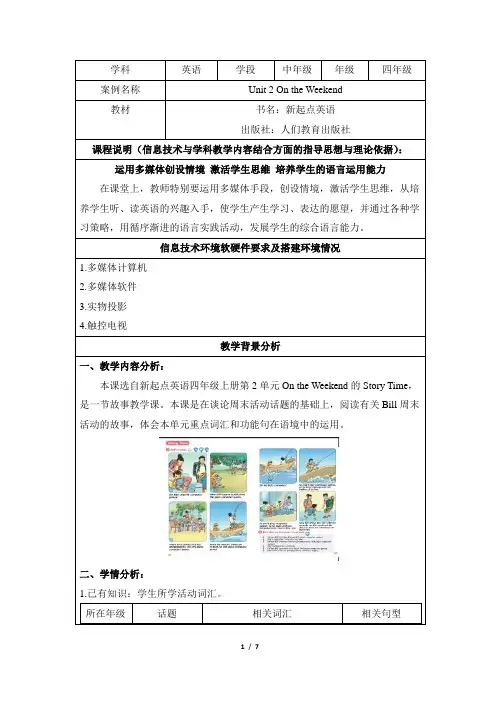
本课选自新起点英语四年级上册第2单元On the Weekend的Story Time,是一节故事教学课。
本课是在谈论周末活动话题的基础上,阅读有关Bill周末活动的故事,体会本单元重点词汇和功能句在语境中的运用。
二、学情分析:
1.已有知识:学生所学活动词汇。
所在年级话题相关词汇相关句型
活动一:阅读前:逐一出示故事图片:
1.第1-4幅画。
T: What do they do on the weekend? How about Bill? 教师出示板书:
2.第5幅图。
What happens?
If you were Bill,
活动二:阅读中:1.提出阅读要求。
2.汇报信息What does Bill do on the weekend?
教师出示板书
3.出示图片
What can Bill do on the weekend?
4.教师板书出示学习单内容,布置任务。
5.核对答案。
人教新起点二年级英语上册《Unit2_Story_Time_名师教案》

教学内容:Unit 2 Boys and GirlsStory Time1.指导依据说明现代外语教育注重语言学习的过程,强调语言学习的实践性,主张学生在语境中接触、体验和理解真实语言,并在此基础上学习和运用语言(英语课程标准,2011)。
以学生为主体,培养学生思维,感受英语学习的乐趣,引导学生用英语做事。
在真正使用英语的同时,关注英语语言背后的文化内涵和蕴含其中的情感教育。
2.教学背景分析第一单元学习了家庭成员的称谓,第二单元开始学习单数的人称代词和物主代词。
本单元的核心词汇与句型有friend,classmate,he,she,his,her,Whois…?He/sheis…What’s his / her name? His/her name is …在第二单元故事之前已经学习了第三单元,内容为描述朋友外貌特征。
本堂课是借班上课,对学生不是十分了解,也刚好借助这一真实生活情景相互熟悉。
课前调查发现,学生对上述功能句的掌握层级比较明显,所以在课堂上需要适当提供分层的活动空间,让不同层次的学生都有所得。
在与学生交流中发现,近一半的学生对课堂常用语存在理解困难,需要教师尽量使用简单句并适当提供中文翻译;另外学生间同伴合作的能力较弱,需要老师培养学生同伴合作的意识。
3.教学目标分析1.能够借助录音、图片、文字及教师的讲解,读懂小故事,尝试合作表演小故事。
2.在故事情境中复习有关询问和回答人物姓名的功能句:He/sheis ...Wha t’shis/hername? His/hername is …;了解What is that?与Who is he/she?的使用语境。
初步体会语言在真实情境中的使用,培养学生语言能力。
3.培养学生观察、想象、预测等思维能力,渗透与人初次交往时的基本礼仪。
4.教学重点、难点分析1.教学重点:读懂本课的小故事,初步尝试表演小故事。
2.教学难点:初步体会语言在情境中的使用。
译林版英语四年级上册_Unit2_Story_time_公开课教案【江苏连云港】

授课教师:江苏省连云港灌南县陈集镇中心小学袁树娟一、教学目标1. 能熟练运用I have…进行表达和交流。
并能学会使用Cool! / Wonderful! / Good! / Great! 来回答。
2. 能掌握7种水果apples, oranges, pears, bananas, mangoes, pineapples, grapes的正确表达并熟练运用。
3. 培养学生富有幽默感,积极乐观向上的性格特点。
二、学情分析1. 学生在三年级已经学过诸如apples, oranges, pears等水果名称,前两节课已经学习bananas, mangoes, pineapples, grapes的表达,本节课重在复习巩固。
2. I have…句型在story time板块已经有接触,本课重在使学生熟练运用“I have…”句型进行表达和交流。
并能学会使用Cool! / Wonderful! / Good! / Great! 来回答。
三、重难点1. 能熟练运用I have…进行表达和交流。
并能学会使用Cool! / Wonderful! / Good! / Great! 来回答。
2. 能掌握7种水果apples, oranges, pears, bananas, mangoes, pineapples, grapes的正确表达并熟练运用。
四、教学准备PPT课件,表演用的服饰道具。
(水果,玩具,文具等)五、教学过程1. Greetings(1) ----Good afternoon, boys and girls.----Good afternoon, Miss Yuan.---- Please sit down, boys and girls.----Thank you.(2) ----Now, boys and girls, look. What’s this?----It’s an apple.提生,----I like apples. Do you like apples, xx?----Yes, I do.----Oh, really? This is for you.----Thank you.2. Presentation(1) ----Now, boys and girls, please look at the blackboard. What’s this?---- It’s a tree.----Yes, but it’s a magic tree. There are many kinds of fruit on it. What fruit? Can you guess? 提生说水果,教师画简笔画。
人教新起点二年级下册英语-Unit 2 Storytime教案
人教新起点二年级下册英语-Unit 2 Storytime教案教学目标1.学习单词:storybook, begin, happy, laugh, cry, park。
2.学习句型:“What’s your favourite storybook? My favourite storybook is ___.”3.能够听懂并理解短对话。
4.能够运用所学单词和句型进行简单的口语交流。
教学重点1.学习单词:storybook, begin, happy, laugh, cry, park。
2.能够顺畅地运用句型:“What’s your favourite storybook? My favourite storybook is ___。
”教学准备1.教师PPT。
2.教材《人教版新起点英语》二年级下册Unit 2。
3.学生课本与练习册。
教学过程Step 1 Warming up1.教师出示图片(乐高玩具、蓝精灵、海绵宝宝等)激发学生兴趣。
2.教师与学生自由交流喜爱的角色(英文),引入本节课的话题。
Step 2 Pre-reading1.教师为学生播放一个蓝精灵的动画短片,带领学生感受角色的情感与行为。
2.教师让学生自由发言,说说他们觉得动画中最有趣和最让人难过或感动的地方。
Step 3 While-reading1.教师布置学生阅读课本Storytime部分并回答相关问题。
2.学生与伙伴进行小组讨论:“What’s your favourite storybook? My favourite storybook is ___。
”并向全班展示。
Step 4 Post-reading1.教师以几组学生组成互动对话,并用本节课的单词进行表述。
2.教师指导学生模仿对话,进行小组表演,并从表演中找出不足或改善之处。
Step 5 Homework1.教师布置学生完成练习册的语法活动(以复述动画故事为例)。
2.鼓励学生回家和家人分享收获的内容,并准备下课的互动话题(如“你最喜欢谁?为什么?”)。
译林版英语六年级上册_Unit2_Story_time_公开课教案【江苏淮安】
六年级上册Unit2 What a day!(story time)淮安小学朱海英说内容:本书是译林版《小学英语》六年级上册Unit2 What a day!的故事板块。
本部分是以日记的形式记录了Yang Ling和朋友们周末一天在公园的活动。
日记通过天气的不断变换,逐步推进活动的发展和人物心理的变化。
说学生:学生对英语学习已有五年多,他们对故事板块的学习都有一定方法。
对于阅读策略和阅读任务都是比较熟悉,能够达到初步理解文本大意和能简单概述文本大意的阅读目标。
说教学方法和手段:情境法,合作法,任务法,竞争法,希沃软件。
说教学程序:一、Pre-reading1.Free talk:What day…? What date …? This weekend is coming.What do you like doing on Saturday and Sunday?What a happy day! What an exciting day! What a / an…day!2.导入日记:Where can we write down these things?Who is he? He is so cute. I like writing diaries about him.Read some short diaries and tell me: What a / an...day!(设计意图:从聊日期到周末喜欢做的事情入手,激活跟主题相关的已有知识,从老师记录孩子的成长的短小日记让学生感受写日记的意义,都给人美好或伤心的记忆,点明主题,并渗透日记的书写格式和特有的动词过去时态形式,给学生初步的过去时态的印象。
)二、While-reading1.Yang Ling’s diary:(1)Who is she? Guess what does she like doing?(2) What does she like writing?(3) Do you know something about diaries?Three parts: date, weather and the special things.2.About the date:(1)Yang Ling has a diary. Can you find the date?(2)Can you read it?3.About the weather:(1)How was the weather? It was…(2)Song about the weather and know more weathers.(3)Find the sentences about the weather and the new words.4.About the special things:(1)It was sunny in the morning. What did they do?(2)What else did they do? 合作完成其他两个天气所进行的活动。
Unit 2 What a day! (Story time)(教案)英语六年级上册
Unit 2 What a day!(Story time)教学设计Teaching contents 教学内容江苏译林版英语三年级起点六年级上册Unit 2 What a day! (Story time)Teaching aims and learning objectives 教学目标知识与技能:1. 学生能初步理解并且会听、会说、会读和会拼写单词短语:cloudy, rainy, sunny, windy和会运用句型:It was sunny/cloudy/windy/rainy.和I/We/He/She brought/saw/flew …。
2. 学生能初步听懂并且会说、会读单词show, interesting, weather, high, honey, ant, bee, cloud, sky, rain。
3. 学生能初步感知动词过去式的不规则变化及读音。
4. 学生能初步感知天气表达的句型。
过程与方法:1. 学生通过学习,增强英语情感朗读的能力。
2. 学生通过竞赛,增强小组合作的能力。
3. 学生通过活动参与,增加自己对于英语文本处理的能力。
4. 学生能够对英语书写日记格式有一定的了解。
情感态度与价值观:1. 希望通过课文学习,增强学生用英语写日记的兴趣。
2. 通过学习,感受五彩斑斓的生活,并养成用语言记录的习惯Focus of the lesson and predicted area of difficulty 教学重点和难点教学重点:1. 学生能初步能理解并且会听、会说、会读和会拼写单词及词组:cloudy, rainy, sunny, windy和会运用句型:It was sunny/cloudy/windy/ rainy.和I/We/ He/She brought/saw/flew …。
2. 学生能初步听懂并且会说、会读单词show, interesting, weather, high, honey, ant, bee, cloud, sky, rain。
四下Unit2_C_Story_time公开课教案
Unit2 C Story time一、学情分析:四年级学生处于英语学习的关键期,对英语学习既感兴趣,又出现了掌握程度的差异。
但学生对于故事教学热情较高,往往经过一个单元的学习,能通过故事配图,大致了解故事的内容,并能根据本单元的语言知识点还原故事内容进行表演。
二、教学目标:根据《英语课程标准》要求,故事教学需要学生在真实、完整的语境中接触、体验、理解语言,故本节课的教学目标设定为:1. 知识与技能目标:根据学生英语学习程度的差异,优等学生需要会读并理解wake up, wait, April Fool’s Day, I’m late for school. 学困生要求理解这些单词短语或句子的意义。
2. 过程与方法目标:(1) 通过情景创设、信息技术手段帮助学生理解故事大意。
(2) 通过自然拼读法尝试读会:wake up, sleep, late。
(3) 通过故事的阅读、跟读复习以及语言输入的加大,巩固本单元所学的语言。
3. 情感态度与价值观:培养学生遵守时间与了解特色文化。
4. 文化渗透点:愚人节的文化。
三、教学重难点:1. 巩固本单元的语言点:What time is it?It’s time for/to ...2. 了解故事的因果关系,体会愚人节文化。
3. 尝试表演故事,达到学以致用的目的。
四、教学准备:PPT,头饰。
五、教学过程:活动一:Warm upT: Hello,boys and girls.Ss:Hello,Miss Lou.T:How are you?Ss:I’m fine,thank you.T:Now,let’s sing a song“What time is it?” Ready?Ss:Go.Sing the song together.【设计意图】通过歌曲的方式进行时间的复习,重拾本单元时间难点,既活跃气氛又复习旧知。
活动二:ReviewT:Now, Look at that clock,What time is it?Ss answer.Use the same method to review another time and things.【设计意图】通过时间和所做事情的复习,打开学生已学旧知,为后面学习做好铺垫。
人教版小学英语二年级上册全册教案
人教版小学英语二年级上册全册教案目录Unit 1 My Family《lesson 1》 (3)Unit 1 My Family《lesson 2》 (8)Unit 1 My Family《lesson 3》 (13)Unit 1 My Family《Review & Rewards》 (17)Unit 1 My Family《Story Time》 (19)Unit 2 Boys and Girls《lesson 1》 (22)Unit 2 Boys and Girls《lesson 2》 (28)Unit 2 Boys and Girls《Review & Rewards》 (32)Unit 2 Boys and Girls《Story Time》 (38)Unit 3 My friends《lesson 1》 (46)Unit 3 My friends《lesson 2》 (51)Unit 3 My friends《lesson 3》 (55)Unit 3 My friends《Story Time》 (60)《Revision 1》 (63)Unit 4 In the Community《lesson 1》 (66)Unit 4 In the Community《lesson 2》 (71)Unit 4 In the Community《lesson 3》 (76)Unit 4 In the Community《Story Time》 (79)Unit 5 In the Park《lesson 1》 (82)Unit 5 In the Park《lesson 2》 (87)Unit 5 In the Park《lesson 3》 (91)Unit 5 In the Park《Review & Rewards》 (95)Unit 5 In the Park《Story Time》 (102)Unit 6 Happy Holidays《lesson 1》 (106)Unit 6 Happy Holidays《lesson 2》 (109)Unit 6 Happy Holidays《lesson 3》 (113)Unit 6 Happy Holidays《Story Time》 (121)《Revision 2》 (124)Unit 1 My Family《lesson 1》1教学目标1 能听懂,会说,会读单词father, mother, sister, bother2 能够在老师的指导下正确的发音,辨认着四个单词。
Unit2 What a day! (Story time)(教案)英语六年级上册
5点击显示按钮,呈现we could not eat our lunch并带读进而为下面情感的渗透估好铺垫。
6Read and fill环节中,调出倒计时,让学生在规定的时间里完成书写并发送的任务,培养学生时间观念及互助意识。
7让学生上台用硬笔书写单词,写错时可及时更改,体现了白板的易操作性。
3插入视频
4聚光灯
5插入声音
【功能分析】
①在规定的时间里猜答案,既可集中注意力又可大大提高学生学习的热情与参与度。
②上课伊始,利用纹理笔刮擦出本课的三类单词weather,引发学生好奇心,集中注意力。
③播放一首天气类的卡通歌曲,让学生提前感知天气类单词,营造唱游娱乐语境,拉近师生间距离,为下面文本的学习做铺垫。
2有利于学生模仿纯正语音
Step3
Post-reading
读后活动
32’47”-
39 ’38”
巩固所学内容,学生能运用所学知识点进行有效的语言输出。
与学生分享一篇老师的日记,并完成两个任务:
1.Talk about Miss Wang’s day.
2.Help Miss Wang with the diary.
cloudy/windy.
We brought/
saw/flew…的表达。
1.呈现一幅老师收集的杨玲的图片,询问学生她在干什么?引出She wrote a diary.揭题
What a day
2.初步感知文本,了解大意,完成两个阅读任务:
(1)Listen and choose.
(2)Read,under-line and order
Unit2 What a day!
人教版二年级英语上册《Unit3Friends》第三单元StoryTime教案
人教版二年级英语上册《Unit3 Friends》第三单元Story Time教案一、教学目标1.掌握本课时重点单词和短语:story, tell, lion,rabbit, bird, animal, scared, brave。
2.能听懂、朗读课文并表述故事情节。
3.能在教师指导下学习运用英语谈论故事情节。
4.能够口头描述故事情节,并能够写出简单的故事梗概或小短文。
二、教学重难点1.重点:story, tell, lion, rabbit, bird, animal,scared, brave。
2.难点:能否听懂、朗读课文,并自己复述故事情节。
三、教学准备1.教师备课PPT或黑板。
2.课本《人教版二年级英语上册》第三单元课文《Story Time》。
四、课前准备1.复习 Unit 3 中的单词、短语及句型。
2.学生可准备一些与故事相关的照片或图片,以便引出学生的讨论和想象力。
五、教学过程Step 1 Warming up.教师先介绍一下今天的课堂主题,今天的主题是关于故事的。
引出以下问题:•大家喜欢听故事吗?•你们家里经常给你们讲故事吗?•你们最喜欢听那种故事呢?学生们自由回答问题,引导学生谈论自己最喜欢的故事,激发学生的学习兴趣。
Step 2 Presentation.教师出示一幅图片,介绍四个角色:lion, rabbit, bird和 animal。
然后教师开始讲故事,讲述一只勇敢的小兔子救了被大雾困住的鸟,并教给大雁如何飞行。
但是故事还未结束,小兔子又遇到了一只贪婪的狮子。
引出以下问题:•故事的主题是什么呢?•小兔子在故事中是一位什么样的英雄?•故事中有哪些其他的动物?•你们喜欢这个故事吗?•这个故事告诉我们什么呢?在学生们回答问题的时候,教师要引导学生学习用英语表述一些常见的故事情节,并激发学生讲述自己听过或看过的故事。
Step 3 Practice.现在学生们要练习用英语复述故事。