
人教英语八年级下册第三单元第二课时
Read the sentences below.Underline the sentences from the reading that mean the same thing. 1.Neither of us did any housework for a week. For one week,she did not do any housework and neither did I. 2.My mom came over as soon as I sat down in front of the TV. The minute I sat down in front of the TV,my mom came over. 3.You’re tired,but I’m tired,too. I’m just as tired as you are!
4....she asked in surprise. 【辨析】in surprise,to one’s surprise,be surprised at (1)in surprise惊奇地,是副词性短语,用来修饰动词,一般放 在修饰的动词后面。 The two girls looked at each other in surprise.那两个女孩 惊奇地相互看着。 (2)to one’s surprise令人惊奇的是,one’s指形容词性物主代 词或所有格,to one’s surprise相当于“主语+ be+ surprised”。 To his surprise,he found the girl was very beautiful. =He was surprised to find the girl was very beautiful.令他 惊奇的是,他发现这个女孩非常漂亮。 (3)be surprised at对……感到惊奇,表示主语对某事或某 物惊奇,surprised可以被very,too等修饰,作表语或定语。 We are very surprised at the news.听到这个消息我们 很诧异。
Could you please take the dog for a walk? OK, but I want to watch one show first. Could you please take out the rubbish? Yes, sure.
Write R for requests and P for permissions. Then match each one with the correct response.
2.My mom came over as soon as I sat down in front of the TV. as soon as一……就……,强调两个动作几乎是连在一起 的,后接从句。 当主句是一般将来时,as soon as引导的 状语从句应用一般现在时;当主句是过去将来时,as soon as引导的状语从句应用一般过去时;主句是过去时,从句 也可以是过去时。 I’ll write to you as soon as I get there.我一到那儿就给 你写信。 As soon as I went in,Katherine cried out with pleasure. 我一进门,凯瑟琳就高兴地叫起来。 【拓展】 as soon as possible 尽快,相当于as soon as sb.can/could。 You have to finish the work as soon as you can. =You have to finish the work as soon as possible.你们得 尽快完成这项工作。
1. Could you take the dog for a walk? (noun)
I walked home from school, (verb)
2. Could I watch one show first?
(noun)
Could you show me your new book? (verb) ____________________________________
Retell the article according to the form.
Decide whether the underlined words in the sentences are verbs or nouns. Then write another sentence using the underlined word in the other form.
Read the passage again and write True (T) or False (F).
1.Nancy’s father asked her to take the dog for a walk. F 2.Nancy’s mother didn’t do the housework for a week. T 3.At last,Nancy understands that each of them needs to share the housework. T
☆教材解读☆ 1.I threw down my bag and went to the living room. throw v.扔;掷。过去式是threw,过去分词是 thrown。throw sth.to sb.=throw sb.sth.将某 物扔给某人;throw sth.at sb.用某物砸某 人;throw away 扔掉,错过(机会等)。 It’s too heavy.Don’t throw it to me! 它太重了。不要把它扔给我! The boys are throwing stones at the dog. 那些男孩在用石头砸狗。 I never throw anything away. 我什么东西都不舍得扔。
八年级英语·下
新目标 [人]
Unit 3
Could you please clean your room?
Section A 3a—4c
Read the article fast and find the general idea of 3a.
The article is talking about A.when to do the chores B.who should do the chores C.how to do the chores B .
【拓展】 (1)“so+助动词/be动词/情态动词 +主语”表示后面的主语“亦如此,也同样”,说明 前面的肯定情况同样也适用后者。表明前面 的主语和后面的主语不是同一个人(物)。 —You watched TV last night. 你们昨晚看了电视。 —So did the children.孩子们也看了。 You can swim.So can I. 你会游泳。我也会。 (2)“so+主语+助动词/be动词/情态动词”意为 “正是那样,确实如此”,表示肯定上面的观点, 前面的主语和后面的主语是同一个人(物)。 —Tom speaks Chinese very well. 汤姆讲汉语讲得很好。 —So he does. 他的确是这样。
(2)neither的反义词是both,意为“两 者都”,所修饰的名词用复数形式。 either意为“两者中任一个”,作形容词 时,所修饰的名词用单数。 【注意】 neither...nor和either...or 在连接两个并列成分作主语时,谓语 动词遵循“就近原则”。 Neither I nor she knows about it. 我和她都不知道那件事。 Either you or I am wrong. 不是你错,就是我错。
3....,she did not do any housework and neither did I. “neither +助动词/be动词/情态动词+ 主语”表示上句否定的情况也适合于 后者。“Neither+助动词/情态动词/be 动词+主语I.”相当于“Me neither.”。 —They didn’t watch TV yesterday. 他们昨天没有看电视。 —Me neither./ Neither did I.我也没 看。 —He is not a doctor.他不是医生。 —Me neither./Neither am I. 我也不是。
Grammar Focus Could I go out for dinner with my friends? Sure, that should be OK.
Could we get something to drink after the movie? No, you can’t.You have a basketball game tomorrow.
☆教材解读☆ 1.Neither of us did any housework for a week. neither 也不;两者都不。作主语时,谓语动词 用单数形式。 Neither of his friends is rich. 他的两个朋友都不富裕。 【拓展】 (1)neither...nor 意为“既不……也 不……”。本短语常连接两个相同的成分,连 接并列主语时,谓语动词和靠近的主语一致。 Neither you nor I am an actor. 你和我都不是演员。 Neither I nor you are an actor. 你和我都不是演员。
Read the article and answer the questions.
1.Why was Nancy’s mom angry with her? Because her mom wanted her to take the dog for a walk,but Nancy didn’t want to do it. 2.Did they solve the problem?How? Yes,they did.Nancy did the housework and she decided to share the housework. 3.What was the first thing Nancy did when she got home? To watch TV. 4.Did Nancy do any housework that day? No, sheall day. (verb) I have to do some work. (noun) ____________________________________ 4. You watch TV all the time. (verb) Your new watch looks nice (noun) ___________________________________ 5. “What happened?” she asked in surprise. (noun) Oh, my god, you surprised me a lot. (verb) ___________________________________
人教版八年级英语下册unit3第二课时导学案
【反馈检测】
一.根据汉语提示完成英语句子。
1.She is(叠衣服) now.
2.I don’t hate(倒垃圾). It’s fun.
3.Miss Kang often(打扫起居室)at weekends.
4.Mr. Wang likes to helps his wife(洗衣服).
导学策略及学法指导(师生互动设计)
反
馈
检
测
教
后
反
思
5.Lucy’s mother asks her(整理床铺)by herself after she gets up in the morning.
二.用所给单词的适当形式填空。
st week everyone was trying(cheer) up Jimmy.
2.He now has 16 bikes(fix) up.
2c Make conversations using the information in 2a and 2b
A: Could I use your computer?
B: Sorry. I’m going to work on it now.
A: Well, could I watch TV?
B: Yes, you can. But first you have to clean your room?
别担心,他会马上来这儿。
The guests are arriving any time now but we’re still not ready.
客人即刻就到,但我们还没有准备好。
We’re expecting them any moment now.
新人教版英语八年级下册第三单元全部课件

clothes and do the dishes?
Brother: So much? Sister: Yes, because Mom will be back from
going to clean the living room.
B: No problem.
➢ Pair work
A: Could you please take out the rubbish? B: Yes, sure. Can you make your bed? A: Well, could you please do them? I'm
sweep the floor (Yes, sure.)
Chain drills
Which group can ask and answer more questions with the verb phrases?
A: Tom, could you please do the dishes? B: Yes, sure. Ann, Could you…? C: Sorry, I can’t. Jim, … D: …
play computer games (I’m going to work on it.)
Could I play computer games? Sorry, you can’t. I’m going to work on it.
Could I listen to music? Yes, you can.
clean”!
人教新目标八年级英语下册第三单元讲学稿Unit 3 What were you doing when the UFO arrived
Unit 3 What were you doing when the UFO arrived ?第一课时Section A (1a——1c) 课型:新授课主备:陆廷叶复备:八年级英语组一、学习目标:1.熟记page18的单词,<UFO barber ,barber shop , bathroom ,bedroom ,kitchen , get out > 2、掌握过去进行时态和when,引导的时间状语从句。
二、预习目标:1、根据音标学习page18的单词,做到“四会”。
2、预习课文。
三、预习检测(一)翻译词组:1、睡过头sleeping 2、get the shower 3、理发4、在图书馆前面5、in the bathroom6、在…前面(二)根据要求写词:1、Sleep(现在分词)2、make(现在分词)3、cut(现在分词)4、take(过去式)5、buy(过去式)6、around(同义词)四、导学:过去进行时:a.过去进行时表示在过去某一时刻正在进行的动作,过去进行时态中的谓语动词是延续性动词。
b.过去进行时的结构为:was(were)+现在分词;was用于主语为第一、三人称单数的句子中,were用于主语为第二人称单数和所有人称为复数的句子中。
c.与过去进行时连用的时间状语this time yesterday 昨天这个时间;at ten o’clock yesterday morning 昨天上午十点;from 6 to 9 yesterday evening 昨天晚上六点到九点;at that time 在那时;those days 那些日子等。
d)过去进行时态的否定句,疑问句及其回答:1)否定句,在was(were)后加not. Was not可缩写为was n’t, were not可缩写为weren’t.eg. He wasn’t washing clothes when his mother got home.. 他母亲到家时他没在洗衣服。
人教版初中英语八年级下册Unit3 Section B(2a-selfcheck)
Sam didn’t get the job, but he’s not unhappy because it didn’t pay well anyway. 萨姆没有得到那份工作, 但他并没有闷闷不乐, 反正薪酬也不算高。
anyway还可用来表示“不管怎样; 无论如何” 之意。例如: It’s just a cold. But anyway, you should still see the doctor. 这只不过是感冒, 但不管怎样, 你还是应该看 看医生。
2. In fact, young people have too much _s_t_re_s_s_ (stress) today.
3. He didn’t mind _h_e_l_p_in_g__(help) me with my English.
4. Mr. Li and Mr. Wang are both my __n_e_ig_h_b_o_r_s (neighbor).
According to Ms. Miller and Mr. Smith,
2c what are the pros and cons about kids
doing chores?
Pros
Cons
Doing chores
Housework is a waste
helps to develop of children’s time.
6. it is not enough to It is not enough to clean up the parks.
7. the earlier…the better The earlier you give up smoking, the better it is for your health.
八年级英语下册(人教版).docUnit3第二课时优秀教学案例
讲授新知是教学过程中的核心环节,学生在这个环节中获取新的知识和技能。在本课时的讲授环节,我会向学生介绍关于不同国家节日的词汇和表达方式,如日期、活动和重要性。我会通过讲解和示例,让学生掌握这些词汇和表达方式的用法。例如,我可以向学生展示一张图片,并解释:“This is a picture of the Chinese New Year celebration. The Chinese New Year, also known as the Spring Festival, is the most important traditional festival in China. People usually celebrate it with their family members, by eating reunion dinner, giving red envelopes, and setting off fireworks.”通过这样的讲授方式,学生可以更好地理解和掌握相关知识。
八年级英语下册(人教版).docUnit3第二课时优秀教学案例
一、案例背景
本案例背景针对的是八年级英语下册(人教版)Unit3第二课时,主要内容围绕着探索不同国家的节日和习俗。这一课时的重要目标是让学生掌握如何描述节日的日期、活动和重要性,并能够对比不同国家的文化习俗。此外,通过本课时学习,学生应能扩展他们的词汇量,提高听说读写技能,并培养对文化差异的敏感性和尊重。
3.情感态度与价值观的培养:本案例在教学过程中注重培养学生的情感态度与价值观。通过对比不同国家的节日习俗,学生学会了尊重和理解文化差异,培养了他们的全球视野和人文素养。
4.教学策略的灵活运用:在本案例中,教师运用了多种教学策略,如情景创设、问题导向、小组合作等,使课堂生动有趣,提高了学生的学习兴趣和积极性。
人教版英语八年级下册 Unit3_SectionA(1a-2d)教案
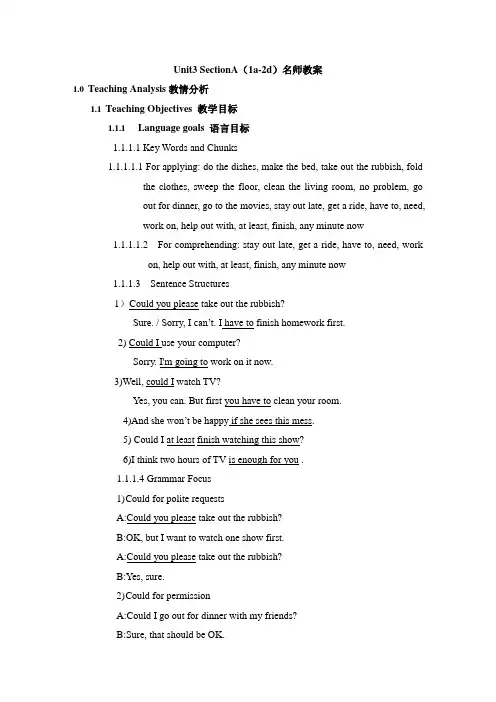
Unit3 SectionA(1a-2d)名师教案1.0Teaching Analysis教情分析1.1Teaching Objectives 教学目标1.1.1Language goals 语言目标1.1.1.1 Key Words and Chunks1.1.1.1.1 For applying: do the dishes, make the bed, take out the rubbish, foldthe clothes, sweep the floor, clean the living room, no problem, goout for dinner, go to the movies, stay out late, get a ride, have to, need,work on, help out with, at least, finish, any minute now1.1.1.1.2 For comprehending: stay out late, get a ride, have to, need, workon, help out with, at least, finish, any minute now1.1.1.3 Sentence Structures1)Could you please take out the rubbish?Sure. / Sorry, I can’t. I have to finish homework first.2) Could I use your computer?Sorry. I'm going to work on it now.3)Well, could I watch TV?Yes, you can. But first you have to clean your room.4)A nd she won’t be happy if she sees this mess.5) Could I at least finish watching this show?6)I think two hours of TV is enough for you .1.1.1.4Grammar Focus1)C ould for polite requestsA:Could you please take out the rubbish?B:OK, but I want to watch one show first.A:Could you please take out the rubbish?B:Yes, sure.2)C ould for permissionA:Could I go out for dinner with my friends?B:Sure, that should be OK.A:Could you get something to drink after the movie?B:No, you can’t. You have a basketball game to morrow.1.1.2Ability goals 能力目标1.1.2.1 教会学生用could礼貌地提出要求和征求许可。
通用版八年级英语下册Unit3 第二课时作业课件新版人教新目标版
二、用括号内所给单词的适当形式填空。 1._F__in_a_l_ly__(final),they took the advice. 2.James didn't say a_n__y_th_i_n_g_(something) when he heard
the news.
3.I __to_o_k____(take) out the rubbish 5 minutes ago. 4.My mother shouted _a_n_g_r_i_ly__(angry) at me. 5 . Helen is going to talk with you as soon as she
Unit 3 Could you please clean your room?
第二课时 Section A (3a-4c)
目录页
基础积累 能力提升
一、根据句意及首字母提示填写单词。 1 . Don't t_h_r_o_w____ the rubbish everywhere.It's
difficult to clean it. 2 . It's rude( 无 礼 的 ) to point your f_in_g_e_r____ at
( B )2.—Excuse me.May I ______ your bike?
—Sorry,I ______ it to Tom yesterday.
A.lend;borrowed B.borrow;lent
C.lend;lent
D.borrow;borrowed
( A )3.—Could you please ______? —Yes,here you are. A.pass me that pen B.pass that pen me C.pass me to that pen D.pass that pen to I
人教八年级下册英语习题课件 Unit 3
三、根据汉语意思完成下列句子。每空一词。 11.我爸爸在家经常饭后洗餐具。 My father usually _____d_o_e_s/_w_a_s_h_e_s_t_h_e_d_i_s_h_e_s after meals at home. 12.妈妈让我不要在外面待到很晚。 My mother asks me not to ____s_ta_y__o_u_t _la_t_e___. 13.下班后我能搭车去超市吗? Could I _____g_e_t _a_r_i_d_e__ to the supermarket after work? 14.迈克放学后总是帮助处理一些家务。 Mike always ______h_e_lp_s__o_u_t __ with some housework after school. 15.当你出去的时候别忘了倒垃圾。 Don't forget to _____t_a_k_e_o_u_t____ the rubbish when you go out.
( )C9.—Many boy students think math is ________ geography. —I agree. I'm weak in geography. A.much difficult than B.as difficult as C.less difficult than D.more difficult than ( )C10.—I won't spend my weekend on computer games. —________.I will help my parents with the housework.(易错题) A.Me,too B.So will I C.Neither will I D.So I will
英语人教版八年级下册Unit 3 Section A 1a-2d 教学设计
新目标八年级下册Unit 3 Could you please clean the room?Section A 1a-2d石家庄第二外国语学校周洁1.教材分析人民教育出版社《Go For It》教材不仅帮助学生学习英语语言知识,同时帮助学生发展语言运用能力,学会用英语表达思想,与人交流,用所学知识来解决问题。
各个单元以不同主题为线索,为学生设计了许多贴近生活、具有交际意义的任务或活动,以此激发学生英语学习的热情,使学生在较为真实的情境中感知语言,应用语言,参与课堂。
Unit3 Could you please clean your room? 以“家务和许可”为主题,以主动帮助家人做家务的实例,引导学生强化劳动观念,学会照顾自己,培养自身独立意识。
2.学情分析在学校分层小班教学的背景下,所教授的小班为A班,学生英语基础相对薄弱,需要夯实基础,稳扎稳打;他们有着极强的表现欲,需要在课堂训练中有更多机会展现自我;他们在英语学习上欠缺自信,需要得到教师的肯定以及自我认同;个别同学欠缺英语学习热情,需要在生动活泼的课堂中感受快乐。
3.教学目标语言知识(Language knowledge)(1)围绕本单元话题,学会准确地读出和使用rubbish, fold, sweep, floor, throw, borrow, lend,chore等词语。
(2)准确把握情态动词could的用法,能够礼貌地向他人用“Could you please…?”提出要求,用“Could I…?”请求许可,并对二者礼貌应答。
语言技能(Language skills)能够熟练应用“Could you please…?”提出要求,应用“Could I…?”请求许可,并能够礼貌回应他人的要求及请求;通过听力和阅读,获取所需细节信息;通过小组合作的方式,对提出要求和请求许可进行巩固训练,实现礼貌而顺畅的沟通。
学习策略(Learning strategies)养成自主预习,自主探究,合作互助的学习习惯;通过提前预览,预测听力所填内容;通过自主感知英语语言,总结规律,并加以应用。
人教版英语八年级下册 Unit 3 课文解读(含单词、短语等)
BSroetchtieorn: FAin(e2.dW) h中a英t d文o you want me to do? Sister: Could you take out the rubbish, fold the clothes and do the dishes?
3. all the time
一直;总是=always 常见的含all的短语: after all 毕竟,终究;all in all 总而言之 all over 遍及;not … at all 一点也不 all of a sudden 突然;first of all 首先 above all 最重要的是;in all 总共,共计
八下Unit 3 Could you please clean your room?
Grace
八下Unit 3 Section A (2d)
Sister: Tony, could you please help out with a few things?
Brother: Could I at least finish watching this show?
Brother: So much?
Sister: Yes, because Mom will be back from shopping any minute now. And she won't be happy if she sees this mess.
Brother: But the house is already pretty clean and tidy!
“Well, I work all day at school, too! I'm just as tired as you are!” I shouted back. “哦,我在学校也学习一天了!我和你一样累!”我大喊着回应道。