
最新牛津译林版初二英语上册Unit5全单元教案.
牛津译林版-英语-八上-5单元 Wild animals task教案
Paragraph5----Danger
2.Then I’ll go on saying:I think everyone must be interested in bears . Before you begin to write the wild animals in danger, you should master the frame/freim / n.框架and when you begin to write , you may use the useful expressions on page 66 . Let’s write the draft/dra: ft / (草稿) first.
4)Show student’s works
Step IV Sample writing (写作样品) / model essay/‘esei / (文章)
Step V Homework
作业设计
1.Rember all the new words , phrases and sentence patterns in this period .
教学设计详案
二次备课内容
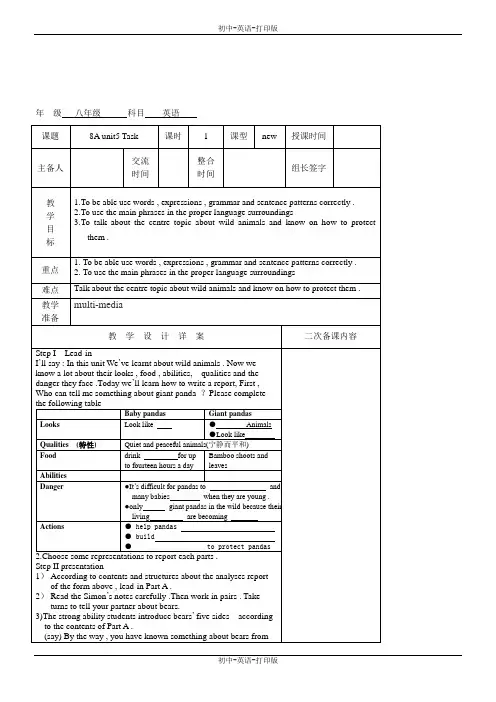
Step I Lead-in
I’ll say : In this unit We’ve learnt about wild animals . Now we know a lot about their looks , food ,abilities, qualities and the danger they face .Today we’ll learn how to write a report, First , Who can tell me something about giant panda?Please complete the following table
牛津译林版八年级英语上册Unit5Reading1教学设计

2.教学过程:
(1)教师提问:“What do you know about space exploration?”引导学生分享他们对太空探索的了解;
(2)学生观看视频,思考太空探索的意义和我国在太空领域取得的成就;
作业评价:
1.教师对书面作业进行批改,及时反馈给学生,指导他们改正错误;
2.口语作业通过课堂展Байду номын сангаас、同学互评等方式,给予评价和鼓励;
3.拓展作业和预习作业的评价以学生的参与度和学习效果为主要标准。
(3)小组合作学习,培养学生团队协作能力和沟通能力。
2.教学过程:
(1)导入:通过展示太空探索的视频,激发学生的兴趣和好奇心,为新课的学习做好铺垫;
(2)阅读:引导学生运用略读、寻读、精读等阅读策略,逐步提高阅读理解能力;
(3)讲解:针对长难句和文章主旨,进行详细讲解,帮助学生理解课文;
(4)巩固:设计小组活动,让学生运用所学知识进行讨论、展示,提高他们的听说能力;
(2)短语:make a contribution to,break down,lose touch with,carry out等;
(3)句型:①—What did Tim do in space? —He carried out several experiments. ②—How do you feel about...? —I think it's...
牛津译林版八年级英语上册Unit5Reading1教学设计
一、教学目标
(一)知识与技能
1.知识目标:通过本节课的学习,使学生掌握牛津译林版八年级英语上册Unit5 Reading1中的生词、短语和句型,并能熟练运用到实际语境中。具体包括:
牛津译林版八年级英语上册Unit5WildanimalsReading教案

Wildanimals教学重难点理解文章大意,掌握语言授课类型新授讲授方法Task-basedteachingmethord教具准备PPT学生提前互动准备动物特征纸条、学生对人类要说的话奖励物品(小熊猫)教学过程及时间主要教学内容教学方法应用PartOnePre-reading 1.Aguessing game2.Presentne wwordsPartTwo While-readi Goodmorning,boysandgirls.Nicetomeetyou.Lastclasswehavelearntmanynamesofanimals.Doyourememberthem?Good.Let’splayaguessinggame,ok? Iwillaskonestudenttosaysthabouthisfa vouriteanimal.Theotherspleaseguesswhatitis.(Good.Let’sclapourhandsforthem) (Congratulationstoyou)Youareveryclever.Doyouwanttoknowmyfa vouriteanimal?Myfavouriteanimalisverylovely.Itisbl学生回答Yes请四位学生描述他最喜欢的动物的特征,其他人猜动物名称。
学生回答Yes请一位学ng1.Presentth ephotosofJa ckyChen2TaskOne Listenandfi ndthemainid ea:3TaskTwo Line1-14The growthofXiW ang4.TaskThree Line15-22Th eproblemsgi antpandasma ymeet5.TaskFour Line23-30Th ackandwhite.ItusuallylivesinChina.It sfavouritefoodisbambooshootsand leaves.Whatisit?(congratulations)(跟学生握手以示祝贺)(显示大熊猫图片)Look.Whatarethey?Look.Itisababypanda.(显示熊猫宝宝图片)Whatdogiantpandaslikeeating?(引出竹子图片)Lookatthepicture.Theyarebamboos.They arebambooleaves.Bambooshoots.Bambooforest.Lookatthispicture.Whoishe?Look.Heiswithapanda.Heistheambassado roflovingpandas.Doyouthinkheisgreat? DoyouwanttobesuchamanlikeJackyChen?I fyouwant,youmustknowthegiantpandasverywell.So,let’slearnastoryofagiantp andacalledXiWang.Openyourbooksontopage60.Firstlet’sl生回答Giantpanda学生回答theyaregiantpandas学生跟读新单词3遍学生回答Jac kyChen学生听录音完成第一个任务学生自行阅读完成表格,请几位学生eactionswec antakePartThreeAf ter-reading 1.Discussi on2.Watchavi deoPartFourHom ework istentothetapewithyourbook.Trytoputt hestoryintothreeparts.Youdidagoodjob. Ifyouwanttobeanambassadoroflovingpandas,youmustknowthegrowthofpandas. SopleasereadPart1byyourselvesandtryt ofinishthetable. NowIthinkyoucanfinishPartCinyourbookeasily.Aregiantpandaslovely? Buttheyhaveproblemsnow.Let’slearnPa rtTwoandseewhatproblemstheyhave. Closeyourbooksandlisten.Trytofillint heblanks.Yes.Thesearetheproblems.Doyouknowany otherproblemsforgiantpandas。
最新牛津译林版初二英语上册Unit 5 全单元教案

课题8A Unit 5 Welcome to this unit 课型New教学目标1. To introduce the topic of the unit and h elp the students focus on ‘Wild animals’2. To learn more about wild animals and express their preference.教学重点To learn how to say something about wild animals in English.教学难点To talk about their favourite animals.教学过程教师内容备课札记Step1.Warm-up1.Create an interest in the issue of sharing the limitednatural resources. Depending on the general interest of theclass, choose one of the following situations:A group of students are stranded on an island. There is notenough food available for everyone to survive.Astronauts are stranded in space. They do not have enoughoxygen for everyone to survive.2 Make a list of people involved in the situation, a list of theresources available (e.g., food, oxygen, water, etc.) and alist of how long everyone is able to survive. Ss have todecide whether they stay alive together sharing what theyhave or they are going to occupy all the resources for theirown survival.3 Ss study the pictures and read the conversation first ontheir own, then in pairs. Ask two more able students torole-play the conversation.Step2. Presentation1). Open your books and turn to page 57 to look at part A.Finish the exercise. Can you name at least three otheranimals? What are they? Give the students more pictures ofanimals2).Now task! make a surveyHave a discussion in groups. Every member should saysome names of animals.a. Each group choose a student as the group leader to writesomething your group get about the names of animals.b. Have a show. And talk about the result of each group.Step3. ListeningSo much for the new words. Now, let’s listen to Hobo andEddie twice. After you listen to them, please answer myquestions,Is Eddie willing to share the food with Hobo? (No.)Step4. ReadingI want to know Hobo and Eddie better. Please help me. Listen again, then read the article by yourselves. Do some True or False exercises.1).The food is very tasty. (T)2).Hobo can live without food. (F)3).Eddie often takes care of Hobo. (T)4).There is enough food for Hobo and Eddie. (F)Now please pay more attention to these two sentences.If you eat my food, I won’t talk to you.If I don’t have food, I will die.Step5. DescribingIn the story Hobo and Eddie need enough food but there isn’t, so they are poor. The word “poor” can describe an animal, can you find some other words to describe an animal? Now let’s play a game “Bingo”!1).It is very clever. Its favorite food is banana.2).It has a long, soft tail and lives in the trees. It can climb trees quickly.3).It is the biggest animals on land. It can lift heavy things.4).It looks like a large fish in warm sea. You can watch them jump in the zoo.5).It’s like a bear, but it has black and white fur.6).It looks like a cat and has yellow fur and black stripes.7).It’s large and heavy with thick(厚)fur. It is very strong.8).It lives in Australia and it has a long strong tail and has strong legs. There is a useful bag for its babyWrite the animal you like best and like least.Step6 WritingStep7 Homework1.To recite the dialogue.2. Finish the Workbook exercises and the exercise paper.板书设计教学反思课题8A Unit 5 Reading (1) 课型New教学目标1.To develop the ability to guess general meaning form context2.To get to know the problems that the giant pandas are facing and then start to think of way to protect the pandas3.To remember and learn to use the new words.教学重点1.To learn about all the information about giant pandas from the text.2.To get to know the importance of animal protecting教学难点To describe the giant pandas.教学过程教师内容备课札记STEP 1 Lead inGet the students to talk about the animals once again. Playthe guessing game. Write something about a kind of animalon pieces of paper. Invite some of the students to chooseand read about the animal and the others try to guess whatanimal it is.STEP 2 Presentation‘hunter’, ‘survive’ and ‘reserve’As students come to ‘giant pandas’, get the students to talkabout whatever they know about giant pandas. As theymention there are few giant pandas now, teach the words‘hunter’, ‘survive’ and ‘reserve’.To arouse the students’ interest, get the students to guesshow heavy giant pandas are at birth. The teacher can alsogive them some choices to choose from. (e.g. 2 jin, 500grams, 100 grams and 1 kilogram)STEP 3 PracticeTell the students the right answer. (They may be amazed atthe information.)Say ‘I have some pictures here. They show how the babygrows into a giant panda. Can you put them into the rightorder?’Show them the following pictures and ask them to put theminto the right orderSTEP 4 PresentationTell the students, ‘Millie has f ound a report about giantpandas. Let’s read it and learn more about the animal. Butfirst let’s listen to the first part of the passage and answerthe following questions.’Who is Xi Wang? (A baby panda.)How old was Xi Wang when the writer first saw her?(10 days old.)What did Xi Wang look like? (A small white mouse.)What does “Xi Wang” mean in English? (Hope.)STEP 5 Getting to know about XiwangSay ‘So it’s really amazing that the baby panda is so small. Do you want to know how it grows into a giant panda? Let’s open your books and read the passage.’ Get the students to read the passage and fill in the following table.STEP 6 Finishing Part CGet the students to finish Part C: the growth of Xi Wang. Look at the pictures and get the students to read the sentences here loudly. This will once again consolidate the students’ understanding of Xi Wang’s growth.THE GROWTH OF XIW ANG (PARA. 1-PARA.3) AGEWEIGHT FOOD At birth (1 day old) 100 grams (100g) her mother’s milk10 days old like a little white mouse 4 months 10 kilograms (10kg) 8 months 35 kilograms (35kg) Bamboo leaves and shoots12 months / 20 months /TIMEWHAT HAPPENED TO XIW ANG At birth (1 day old) be born4 months Start to go outside her home for the first time 6 months /8 months Grow into a healthy young giant pandas 12 months /20 monthsHave to look after her self板书设计教学反思课题8A Unit 5 Reading (2) 课型New教学目标1.To read the passage once again for more details2.To read the passage again and figure our how the writer organize the passage3.To r ead the passage and focus on the language points to improve the students’ fluency and accuracy talking about giant pandas教学重点To d evelop students’ responsibility towards the endangered anima l教学难点To d evelop students’ responsibility towards the endangered anima l教学过程教师内容备课札记STEP 1 Reading the passage aloud togetherGet the students to read the passage aloud together. Invitethem to finish the Part B, Check the answers. (This mayoffer the less able students another time to consolidate thenew words.)STEP 2 Finishing off Part EAsk the students to finish off Part E, Page 62. Use this as arevision to help the students recall what they have learnedlast time.STEP 3 Working out the answersGet the students to read the passage together once again andthen divide the class into groups of 4-5. Ask them to workout the answer to the following question ‘How many partsare there in the passage.’Give the students enough time to talk about it. And theninvite some of them to express their personal opinions.(Students should be encouraged to speak out what theythink.)Part I: The growth of Xi Wang(Line 1- Line 14) (weight and food)Part II: Giant pandas are in danger?(Line 15- Line 29)A: Why are they in danger?(Line 15-21)B: How to protect them?(Line 22-Line 29)STEP 4 Finishing the following exercisesGet the student to talk about Part I. Invite them to talk aboutthe growth of Xi Wang by finishing the following exercises:•When Xi Wang was born, she w________ just 100 grams.•When she was only 10 days old, she l________ like a white mouse.•When she was 4 months old, she w________ about 10 kilograms and s__•When she was 6 months old, sh e b________ to eat bamboo shoots and leWhen she was 12 months old, she g_________ into a healthy young giant•When she was 20 months old, she s_________ to look afte r herself.Then get the students to analyze the sentences: thewhen-clauses in each sentence give us a past time, so themain clauses use Simple Past Tense. (Students may come tothe conclusion through observation.) Then get the student tounderline such sentences in the passage.STEP 5 Finding them out‘During the growth of Xi Wang, Xi Wang had many ‘first-times’ Can you find them out.’ Use the following exercises to help students.1.She started _________(go) outside her home for the first time.2.She began _________ (eat) bamboo shoots and leaves.3.She started _________(look) after herself.In this way, the teacher directs the students attention to the use of ‘to’-infinitives after ‘start’ and ‘begin’.STEP 6 Rewriting sentencesSay ‘Sadly, it is very difficult for giant pandas to survive in the wild.’ and write the sentence on the board. Then try to rewrite the sentence into the following sentences.‘It is dangerous for giant pandas to live on in the wild.’ ‘They arein danger.’These are some very important sentence patterns in the passage. Also it is necessary for the teacher to point out that ‘live on’ has a similar meaning with ‘survive’. This may also help the students to understand that we can use ‘be dangerous’ or ‘be in danger’ to talk about a similar situation.STEP 7Finding out that why they are in dangerGet the students to find out that why they are in danger. To make the task easier, the teacher can show the following before hand.If hunters ______(catch) a giant panda, they _________ (kill) it for its fu If the farmers ______(cut) down trees and forests, giant pandas _____ (hIf people _____ (find) baby pandas alone, they _____(take)them aw ay. As a result, the students’ attention will be easily drawn to the use of ‘if’-clauses. Guide the students to focus on the tense of the subordinate- clauses and main clauses. (I thinkit is OK for some teachers to use ‘主将从现’ to make summary here. At least it may help the students to remember this phenomenon.)Explain the phrases here ‘kill…for…’, ‘cut down’, ‘haven owhere to live’ ‘find sb. adj’ and ‘take…away’.板书设计教学反思课题8A Unit 5 Grammar 课型New教学目标Using may for possibility Using verbs+to-infinitives教学重点Using may for possibility, Using verbs+to-infinitives教学难点Using may for possibility, Using verbs+to-infinitives教学过程教师内容备课札记Grammar Part AUsing may for possibilitySTEP 1 Presentation1. Review information about reading to lead in grammar A.2. Show the picture of pandas and then the teacher says:It’s difficult for giant pandas to live in the wild. They faceserious problems.What do you think may happen to pandas? Lead students toguess:Ss: they may not have a place to live or food to eat.They may disappear from the earth.Hunters may catch them.Teacher sums up:Yes, you’re right.Write the sentences including may on the blackboard.3. Teacher ask students:What will happen to giant pandas ifwe do nothing?Students answer:Soon there may be none left.write theanswer on the blackboard, mark the underlined part withcolorful chalk and tell students:We use may to say thatsomething is possible.STEP 2 Activities1. Present the following five sentences, encourage studentsto think what may happen in the situation in groups offour. Use may to make the second half of each sentence.Choose some students to report the results, accept anyreasonable answer.(1)We need to protect pandas.(2) It is raining.(3) I will be very busy tomorrow.(4) Watch this DVD.(5) We will be happy to see you.2. Let students complete the exercises in page 61, encouragestudents to ask and answer in pairs. Check the answers.STEP 3 Practice朗读下面的句子,然后译成汉语,并试着说出may的用法。
牛津译林版八年级英语上册Unit 5 Task 示范课教学设计
【难点】
1.用调查获取的信息描述野生动物的外貌、主要食物、习性和所面临的危险;
2.正确使用所学结构和表达写一篇有关处于危境中的动物的专题报道。
五、教学活动设计
环节一:创设情境,导入话题,激活已知。(3mins)
教师引导学生观看视频并回答问题。
Unit 5Wildanimals
Period7Task
一、教学内容分析
该板块的活动主题是写一篇有关“处于危境中的动物”的专题报道。以Simon为野生动物俱乐部撰写专题报道为背景,呈现了Simon的笔记和一篇题为“熊处境危险!”的专题报道。
二、学情分析
学生学习本课时已经完成了本单元前面几个板块内容的学习,不但对描述野生动物的外貌、食物、习性、危险及保护措施等的词汇有了一定的储备,还懂得了保护野生动物的重要性。但是对于野生动物的详细描写及专题报道的撰写缺乏认识。
活动层次
迁移创新之想过评估学生的作文,了解学生对知识的掌握情况,并在适当的时候提供指导和帮助。
环节设计意图:通过写作和互评的活动,锻炼学生在新情境中运用所学知识的能力,并培养其用所学知识做事的习惯和意识。
作业与拓展
1. Improve your report.
2. Exchange your report with your friends. Try to figureout more solutions to help protect animals in danger!
6. Students read the notes and answer.
7. Students read and complete the report.
最新牛津译林初中八年级英语上册 Unit 5 Wild animals Period 8 speak up study skills教案
Unit 5Teaching Objectives1. To learn to express one’s own ideas clearly and response to others’ opinion abouta nimals protecting2. To learn to use factual information to support their own opinions and make thei r opinionmore persuasive3. To learn to identify the intonation patterns in conditional sentencesTeaching key points1. To express opinions about protecting wild animals.2. To learn to identify the intonation patterns in conditional sentences3. Grasp important words the phrasesTeaching difficult pointsRead the conditional sentences in correct PronunciationTeaching aidsA recorder pictures etc..Teaching P rocedures预习交流Step1.Free talk and check the preparation out1.Show some pictures to the students. They are tigers, giant pandas, polar bears, wolvesand have a talk between the teacher and the students.e.g T: What will tigers do if they are hungry?S: They will attack people.2. Write the following sentences on the blackboard, then invite the students to read them.1). If tigers are hungry, they will attack people.2). If giant pandas ha ve no food, they will die.3). If a polar bear is hungry, it catches fish from the water.4). What do male wolves do if there is danger? Male wolves will protect their fami lies if there is danger.3. Check out the prepared work..一、词组翻译1.以家庭生存 6.卖象牙2.动物毛皮做的衣服 7.不再3.保护野生动物 8.合适的栖息地4. 开垦新农田 9.穿在我身上很漂亮5.破坏森林建造道路 10.帮助农民做许多事二、用所给中文和句意完成下列各句子1. A g______ of children are go ing to the cinema this evening.2.Many people will lose their_________(生命) because of the flood.3. The zoo wasn't s_______ for animals to live in.4. The farmer t______ his horse to do farm work.5. People build more and more buildings on the f_______.Work in groups to check out the prepared work..Let the students ask some questions.Solve the problems together.展示探究Step2. PresentationShow students some pictures of animal products, for example hats made of fur, scarves made of fur, coats made of fur or skin, things made of elephants’ tusks.1. T: Now, many people like to wear clothes made of animal fur. They think they look smart and modern on clothes like this. And they think they can keep warm on these clothes. Millie’s Mum like clothes made of animal fur, too. What about Millie? Please listen to the dialogue between Millie and her mum, try to answer the following questions.1). Why does Millie’s Mum like to wear clothes made of animal fur?2). Do you think it is right to buy things made of animal fur?3). What does Millie’s mum think about it?4). What does Millie think about it?5). Does Mum agree with Millie at last?Step3 practice1.Ask students to practice the convers ation in pairs and then change roles. Identifyany words or phrases they do not know .2.Then invite some pairs to act out.3. Explain carefully some of the key points here.1. They (The co ats) look lovely on me. VS She looks lovely in the coat.2. Many animals lose th eir lives because people buy furs.(lose one’s lif e)3. Someone else will buy them.(else +疑问代词或疑问副词;else +不定代词)4. If no one buy s furs, then people wo n’t kill wild animals any more.(not…any more)4. Do exercises1. You look nice in the coat.(同义句)The coat _____ ______ ______ you.2. I think it is right.(否定句)I _____ ______ it is right.3. Maybe Tom is at home. (同义句)Tom _____ _____ at home.4. We no more buy clothes made of animal fur. (同义句)We ______ buy clothes made of animal fur ______ _______.5. Many people died because of the fire(同义句).Many people ____ ____ ____ because of the fire.Step4 .ProductionMake a dialogue and act it outT: Animals lose their lives, because people buy animal furs. Animals lose their lives, because people eat their meat, too. For example, some people eat snakes in restaurants and others may drink wine with tiger bones inside. Do you think it is right? Make up a new dialogue to talk about it. Work in pairs, one student tries to ask the other not to eat animals or do other bad things to animals.Give the students 4-5 minutes to prepare, then get some pairs to act their dialogues out. Step5. Presentation1.Reading aloud sentencesAfter the students finish their dialogues write the following sentences on the board and get them to read it paying attention to the intonation patterns.If people don’t buy animal furs any more, no animals wil l lose their lives.If people don’t kill wild animals for food, no animals will die any more.Get the students to focus on the intonations. The teacher reads the sentences and gets the students to repeat. While reading the sentences, draw rising and falling arrows to show the intonation patterns.Get the students to read the sentences for more times until most of the students can read them in a appropriate intonation patterns.2. PracticeListen to Simon’s report on wolves. Pause the tape for the students to repeat focusing on the intonations patterns.Listen to Simon’s report again and ask students to read it with the correct intonation.3.Explaining some of the sentences1. Wolves won’t survive if we don’t give them good areas of forests to live in.2. They will live in family groups and hunt together if they live in the wild.3. If we continue to destroy forests to build roads, they won’t have suitable homes.4. If farmers continue to make new farmland from forest,wild animals won’t get enough food.Step6. PracticePlay the recording of Millie’s report.Ask students to follow and repeat it. Pay special attention to the intonation.Ask Ss to mark where Millie’s voice rises and falls with the correct arrowsCorrect the answers.Explain some of the sentences to them.1. Hunters will make a lot of money if they sell elephants’ tusks. ( make a lot of money; se ll sb.sth./sell sth. to sb.)2. Elephants will help farmers do lots of things if people train them. ( train sb./sth. to do sth.)Tell students to read Millie’s report with the correct intonation.Read the sentences with the correct intonation and read them one by one1. Dogs can help people, if we train them.2. If I go to Beijing zoo, I will learn a lot about animals.3. They live as a family if they have babies.4. I will tell you some stories if I have time.5. If lions are hungry, they will attack people.检测反馈一.句子翻译1.他穿这裤子很好看吗?2. 因为我们买虎骨酒,许多老虎丢了性命.3.昨天你打扫教室的吗?我没有。
牛津译林版英语八年级上册Unit5StudySkills教学设计
(3)语法阶段:结合具体语境,通过例句、练习等形式,让学生明确现在完成时的用法,特别是与一般过去时的区别。
2.教学过程注重学生参与,采用以下教学方法:
(1)小组合作:分组讨论、分享观点,培养学生的合作意识和团队精神。
3.能够运用本单元所学的词汇和句型,如:a great deal of, make a difference, look forward to等,进行日常交流,描述学校生活和个人感受。
4.能够运用所学的语法知识,如:现在完成时,进行准确的英语表达。
(二)过程与方法
1.通过小组合作、讨论交流等方式,培养学生的合作意识和团队精神。
(三)学生小组讨论
1.教学内容:讨论各国学校生活的异同,以及自己的学校生活体验。
2.教学活动:学生分成小组,就以下问题进行讨论:
a. What are the similarities and differences between schools in different countries?
b. Can you share your own experiences of school life?
2.教师提问:What do you think this unit is about? Can you guess what the pictures have in common?
3.学生回答:学生根据图片内容和已有知识,推测本单元可能与学校生活有关。
4.教师总结:确认学生的猜测,并引出本单元的主题——了解不同国家的学校生活。
3.研究性学习:
(1)小组合作,调查并了解其他国家的学校生活,制作一份PPT或手抄报,展示调ቤተ መጻሕፍቲ ባይዱ成果。
牛津译林版英语八年级上册Unit5IntegratedSkills教学设计
_________________________________________________________
2.What special animals live in Yancheng Nature Reserve?(不超过三个单词)
3.Check and ask students to describe them
1.Go through the fact sheets and guess the answer.
2.Listen and complete.
3.Describe them with sentences.
指导学生听前先阅读并猜测,听时用缩写或简写速记单词,听后再补全单词。
通过reading中关于熊猫内容的回顾,再现熊猫的习性和面临的危险,再由此导入其它野生动物,头脑风暴,焕起学生学习意识。
第6到10分钟
Presentation
1.Show pictures of wild animals and present some new words.
anize a competition among students to talk about animals’ looks,abilities,qualities,
结构
课文
a letter
a conversation
教学方法
任务教学法,学生中心教学法,多媒体教学
教学目标
语言知识
能听懂并掌握一些关于野生动物的词汇
语言技能
能听懂关于野生动物的对话并完成保护动物的书信
语言运用
能熟练运用相关野生动物的词汇和句型
牛津译林版-英语-八上-英语八上5单元 Task 教学设计
第36-44分钟
Assessment
1.Show students the writing points and the writing criteria.
2.Have the studentsexchange their reports in the group and give the assessment according to the
语言技能
能仿照课文写一篇呼吁人们保护野生动物的报告,在报告中呈现真实信息并发表自己的观点
语言运用
能利用调查所得信息写一份报告,并对处于危险中的野生动物发表自己的观点
情感态度
理解动物所面临的危险,增强爱护野生动物意识
学习策略
在写作之前积极构思准备
教学重点
仿照课文写一篇报告
教学难点
在nit 5教学设计
教学内容分析
教学内容
《英语》(译林出版社)八年级上册Unit 5 Task
教学对象
初二学生
教学项目
语词
report tail move slowly daytime
结构
a report
教学方法
任务教学法,学生中心教学法,多媒体教学
教学目标
语言知识
能掌握一些描述野生动物外貌、主要食物、习性和所面临的危险的相关词汇
书写干净整洁,尽量没有涂改
格式完整无误
3分
扣分项
Spelling mistakes\ Wrong tense
Grammar mistakes\Punctuation mistake
每小错扣0.5分
加分项
Good sentences and good ideas
八年级英语上册 Unit5精品教学案(Word版共10课时) 牛津译林版
8A Unit 5and long legs. I have black and white feathers. Who am I? (acrane)(3)请各小组选一名代表在全班前表述一种鸟。
(即展示学案的第5项)(4)Ask the students ‘Which is your favorite bird? Why?Practice Part B on Page75 in pairs6. Production(展示学案的第七项)Make up new conversations using Part B as a model and act them out. 7. Presentation1.Say: We love birds. Eddie loves birds, too. Listen to the tape andfind then answers to the following questions.(见学案第三项) (1)What is Eddie going to do? (2)Does he really love birds? (3)What kind of birds does he like best?2.Practice reading in pairs and try to act it out课堂达标检测一、请写出下列鸟类的英文名称。
1.__________2.______________3.________________4. ____________5.________________6._________________二、Complete the conversationHobo: What are you going to ___________ tomorrow?Eddie: I am _________ _____________ at the _____________ .Hobo: At the ___________ ?Eddie: I like the ________ at the market. Beijing _______ and roast __________. Yummy.Hobo: But I think birds are our friends, so we should _________ them.Eddie: Maybe you are right.三、根据句意或首字母提示完成单词。