
定语从句改写
一、把下列每对句子合并成含有定语从句的主从复合句:
1.The fan is on the desk. You want it.
2.The man is in the next room. He brought our textbooks here yesterday.
3.The magazine is mine. He has taken it away.
4.The students will not pass the exam . They don’t study hard.
5.The woman is our geography teacher. You saw her in the park.
6.The letter is from my sister. I received it yesterday.
7.The play was wonderful. We saw it last night.
8.The train was late. It was going to Nanning.
9.The boy is my brother. He was here a minute ago.
10.The tree is quite tall. He is climbing it.
11.Here is the girl. Her brother works in this shop.
12.That’s the child. We were looking at his drawing just now.
13.This is the boy. His sister is a famous singer.
14.I want to talk to the boys. Their homework haven’t been handed in.
15.Is that the woman? Her daughter is in my class.
16.He used to live in a big house. In front of it grew many banana trees.
17.They passed a factory. At the back of the factory there were rice fields.
18.The soldier ran to the building. On the top of it flew a flag.
19.In the evening they arrived at a hill. At the foot of the hill there was a temple.
20. She came into a big room. In the middle of it stood a large table.。
第二套定语从句练习题

定语从句第二套练习题一:用定语从句改写下列句子1.The jewelry was guarded by a policeman.It was very expensive.2.I bought a brochure.It was written by a famous artist.3.A woman is waiting for the bus.She looks angry.4.I saw a student reading a newspaper on the corner.5.A woman is standing near the exit.She is a guard.6.Coats left in the checkroom are rarely lost.7.The coats were hung in the checkroom.They belonged to the tourists.8.A man is using the calculator.He is our accountant.9.A dietitian is cooking the meal. She works for the museum.10.The car was stolen from the square.It was found by the police.11.The Great Wall is very beautiful.We visited yesterday.12.I am waiting for a woman at the gate of the hall.The woman is a friend of my mother's.13.This is a Chinese restaurant.I often go to the Chinese restaurant.14.The lady's necklace was lost the other day.The lady has reported it to the police.15.Mr.Li has only two daughters.Both of them are doctors.16.Li Ming often helps me with my maths.He is very kind of him.17.Do you remember the day?We first met on that day.18.The boss made the workers work late again.That annoyed them. 二:选择题1.The woman_____came yesterday is my mother.A:who B:whom C:whose D:which2.Is the American film____you have seen interesting?A:who B:whom C:that D:when3.Have you found the bike______was lost?A:which B:whose C:when D:where4.The boy_____is singing over there is Li Ming.A:whose B:that C:which D:/5.Do you know the man______our teacher is talking to?A:which B:/ C:when D:whose6.The school______Li Fen is talking about is the best one here. A:whose B:that C:when D:where7.She is the girl with_______I went to Shanghai.A:who B:whom C:which D:that8.Please show me the man______sister is a doctor.A:who B:whose C:whom D:that9.Would you like to give me the book_____cover is green?A:who B:whose C:whom D:whose10.Look at that lady______name is Mary.A:who B:whose C:whom D:that11.The visitors want to live at the hotel_____they lived at last time. A:where B:when C:what D:which12.The visitors want to live at the hotel______they lived last time. A:where B:when C:what D:which13.The visitors want to live at the hotel_______they visited last time. A:where B:at that C:which D:at which14.My friend________we have talked about before will come to see me. A:who B:about whom C:what D:which15.This answering machine_______I bought in low price doesn't work. A:where B:what C:in which D:/16.He found a wallet________there was a lot of money.A:that B:on which C:where D:which17.I will never forget the day______I became a middle-school student. A:which B:where C:when D:on that18.The museum ______we have visited is very old.A:where B:when C:that D:in which19.The house_______the famous writer lived is very old.A:where B:that C:which D:this20.The clothes_______are hanging in the closet have been washed. A:they B:/ C:who D:that21.David thought his cousin was a person_______he could rely on. A:who B:whom C:whose D:which22.Where is the picture______you painted?A:that B:whom C:on which D:where23.Return the tools to______gave them to you.A:whatever B:whichever C:whoever D:whomever24.We must admire someone______has contributed so generously. A:who B:whom C:to whom D:whose25.______are you saving this seat for?A:Who B:Whom C:That D:What26.The exhibit______I enjoyed most was the auto show.A:who B:whom C:what D:that27.Einstein was a man_______influenced our ideas of time and space. A:who B:whom C:whose D:on whom28.The reason_______Mary came here was______she wanted to see me.A:why,because B:why,thatC:that,because D:which,that29.Sometimes the earthquake is so violent that it can destroy the whole city,_____happened in Tangshan,in 1976.A:as B:that C:where D:like30.Mary lost her bike last week.Today she found a young girl rode the same bike______hers.She has decided to tell the policeman.A:as B:that C:which D:when31.Is there anything______I can do to help?A:what B:which C:as D:that32.Professor Li,_______we have long admired,is to have a lecture soon. A:who B:that C:which D:whom33.The Summer Palace,______attracts many tourists,is very old and beautiful.A:where B:what C:that D:which34.I like to go shopping at the weekdays,_______the shop isn't crowded.A:which B:when C:that D:where35.The play won't be played in Beijing this year,_________makes us disappointed.A:that B:when C:what D:which36.Yang Li Wei,________parents are both teachers,is the first man who goes around the earth in China.A:who B:whom C:whose D:who's37.The next Olympics Games are in two years,______I will be a university student.A:on which time B:in which C:by which time D:which38.The castle is the place,_______I most like to be in the summer. A:which B:that C:where D:when39.David helped me clean up,________was very kind of him.A:who B:whom C:which D:that40.The tigers that are in the wild zoo are heavy,________, is more than 200 pounds.A:that B:which C:the biggest D:the biggest of which。
in which定语从句改写回

in which定语从句改写回
“in which”在定语从句中用作关系代词,引导定语从句,修饰先行词,在句中作地点状语。
以下是一些将“in which”定语从句改写回简单句的例子:
- This is the house in which I lived two years ago.(这是我两年前住过的房子。
)改写为:This is the house where I lived two years ago. - The school in which I studied was very large.(我就读的学校很大。
)改写为:The school where I studied was very large.
- We visited the village in which my grandparents lived.(我们参观了我祖父母住的村庄。
)改写为:We visited the village where my grandparents lived.
需要注意的是,在将“in which”定语从句改写回简单句时,“where”通常替换“in which”,并且它在句子中充当地点状语。
但是有时候根据上下文的需要,也可以使用其他的关系词,如“that”、“which”等。
定语从句进阶练习 3 --语篇改写

定语从句进阶练习3 --语篇一. 用定语从句改写:1. Our class is a big family . It consists of 12 girls and 50 boys. Most of them are mainly from the countryside. Zhang Yao is a warm-hearted girl. She is always ready to help others. She is such a good girl that we all like her.2. I see many running creatures. They are made of metal and glass. Their feet are round. They have four eyes. Two of the four eyes are red. Inside I see soft shapes. They can move.”二.用定语从句翻译下列短文1. 杰克来自加拿大,他在我们学校已经学习了3年, 他不仅经常帮助我们学英语,而且中文也讲的很不错。
____________________________________________________________________ ____________________________________________________________________ ____________________________________________________________________ _________________________________(2. 众所周知,英语作为一种国际语言,在交流中起着重要作用。
作为一名高三学生,我们应抓住现在的学习机会努力学好它。
只有这样,才能在高考中取得好成绩,我相信我们一定会有一个光明的未来。
20-21版:Writing—Write a Page in a Wellness Book (步步

Writing—Write a Page in a Wellness Book写作指导本单元的写作任务是写一页健康手册。
此类作文主要围绕以下几个方面写作:1.健康生活的必要性、重要性。
2.指出目前存在的不利于健康的问题。
3.健康生活方式:加强锻炼、注意饮食、均衡营养、养成良好的生活习惯等。
4.如何从自我做起、如何制定计划改变不良生活习惯等。
常用表达1.Having a good diet is very important.2.Eating lots of fresh fruit and vegetables means a lot to our body.3.Doing exercise is another good way to keep healthy/fit.4.Running is the best workout for weight loss because it’s cheap.5.It is important to ask your doctor for a health check once a year.6.Going to bed early and getting up early is also very important.7.To keep healthy,we’d better cut down on fat and sugar in our diets.8.It is bad for your health to stay indoors for a long time.假如你是某杂志健康栏目的主持人Mr Helper,人们经常写信询问健康之道,请你写一封回信,指出健康的重要性,并针对“如何保持健康”给出自己的建议。
信的内容需包含以下信息:1.健康的重要性;2.给出保持健康的方法:如:避免含糖、脂肪高的食物;摒弃不良习惯;多锻炼等。
注意:1.词数80左右;2.开头和结尾已给出,不计入总词数。
定语从句改写为简单句

(一)改用“不定式〞或“不定式短语〞如果定语从句的时态与主句的时态具有同时性(包括谓语有情态动词)或之后性,那么可以用“关系代词或关系副词+不定式〞来简化,或直接用“不定式〞来修饰先行词。
要注意的是,此时的不定式一定要是及物动词,如果是不及物,那么需要在动词后面加上相应的介词,使之成为及物动词短语。
这个结尾的介词可以提前到关系代词前面,也可以继续留在句尾。
前者是正式说法,后者是非正式说法。
例1:We moved to the country so that the children would have a garden in which they could play in.我们搬到了乡下,好让孩子们有个花园在里面玩。
改为:We moved to the country so that the children would have a garden in which to play.或者:We moved to the country so that the children would have a garden to play in.例2:He felt miserable unless he had neighbors (whom)he could quarrel with.他要是没有可以吵架的邻居就难受。
改为:He felt miserable unless he had neighbors with whom to quarrel.或者:He felt miserable unless he had neighbors to quarrel with.例3: The conference which will be held this afternoon is bound to be a great success. 方案在今天下午举行的会议一定会取得成功。
改为:The conference which to be held this afternoon is bound to be a great success.或者:The conference to be held this afternoon is bound to be a great success.12月29日,美国邮政总局局长约翰·E·波特在檀香山从句了农历新年的纪念邮票小型张的揭幕仪式,这枚小型张将于2005年正式发行,它为农历新年的系列纪念邮票写下了完美的结局。
定语从句改写
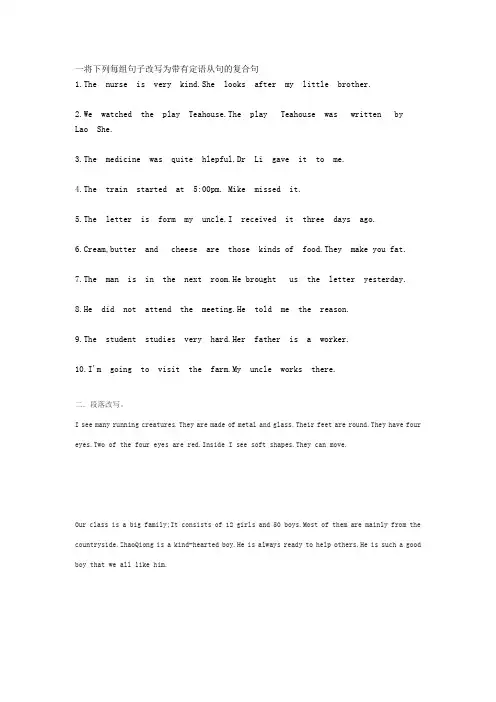
一将下列每组句子改写为带有定语从句的复合句1.The nurse is very kind.She looks after my little brother.2.We watched the play Teahouse.The play Teahouse was written by Lao She.3.The medicine was quite hlepful.Dr Li gave it to me.4.The train started at 5:00pm. Mike missed it.5.The letter is form my uncle.I received it three days ago.6.Cream,butter and cheese are those kinds of food.They make you fat.7.The man is in the next room.He brought us the letter yesterday.8.He did not attend the meeting.He told me the reason.9.The student studies very hard.Her father is a worker.10.I'm going to visit the farm.My uncle works there.二.段落改写。
I see many running creatures.They are made of metal and glass.Their feet are round.They have four eyes.Two of the four eyes are red.Inside I see soft shapes.They can move.Our class is a big family;It consists of 12 girls and 50 boys.Most of them are mainly from the countryside.ZhaoQiong is a kind-hearted boy.He is always ready to help others.He is such a good boy that we all like him.三.短语翻译1.一个叫做Tom的男孩2.教我们英语的老师3.昨天妈妈给我的钱4.矗立在河边的楼房5.一位皮包被偷的女士6.我们在农场工作的开心日子7.她工作的地方8.她没有交作业的原因四.句子翻译1.不努力学习的学生不会通过考试。
高考英语定语从句解题方法
高考英语定语从句解题方法1500字高考英语中,定语从句是一个常见的考点,也是一个相对容易出错的地方。
今天我们就来学习一下如何解答定语从句的相关问题。
一、定语从句的基本概念定语从句是用来修饰一个名词或代词的从句,它充当形容词的作用。
定语从句分为限制性定语从句和非限制性定语从句。
1. 限制性定语从句限制性定语从句是对名词或代词进行限制或修饰,它是整个句子的一个必要部分,如果去掉它,整个句子的意思就会发生改变。
例如:The student who is sitting next to me is from China.在这个句子中,定语从句是“who is sitting next to me”,修饰名词“student”,它限制了“student”的范围,指的是坐在我旁边的学生。
如果去掉定语从句,句子就变成“The student is from China”,意思完全不同了。
2. 非限制性定语从句非限制性定语从句是对名词或代词进行进一步说明或补充,它不是整个句子的必要部分,如果去掉它,整个句子的意思仍然完整。
例如:Mary, who is my best friend, is going to study abroad.在这个句子中,定语从句是“who is my best friend”,修饰名词“Mary”,它对“Mary”进行了进一步的说明,但如果去掉定语从句,整个句子的意思仍然是“Mary is going to study abroad”。
二、解题方法了解了定语从句的基本概念后,我们来学习一下如何解答定语从句的相关问题。
下面以一些常见的题型为例进行讲解。
1. 定语从句的识别首先,我们需要识别出句子中的定语从句。
在英语中,定语从句通常由关系代词或关系副词引导。
常见的关系代词有:who, whom, whose, which, that等;常见的关系副词有:where, when, why等。
用定语从句改写下列句子
定语从句专项练习一、Rewrite the follow ing senten ces.1. Do you know the man He sp oke just now. ________________ The girl is from America. I called her just now. _____________________ I have read the n ews paper. It carries the important n ews. ____________ I showed him the letter. I received it this morning _________________ They ' re talking about the film. I have see n the film. ____________ They ' re talking about the film. I have see n the film. _____________ Jane has borrowed the book. It was writte n by Laoshe. _________________ The girl got first. Her father had give n us a rep ort. ________ That is the new mach ine. The p arts of it are too small to see. _____ 10. This is the factory. I worked in the factory ten years ago. _____ 11. The school is n ear a p ark. My son studies in this school. _____________ 12. We visited the house. Lusun once lived in the house. _____________ 13. They ' ll never forget July 1. Hong Kong retur ned to its motherla nd on July 1. 14. The days are gone forever. We used foreig n oil duri ng those days. ___ 15. There was a time. The bus in essma n lost heart at that time. 2. 3. 4. 5.6. 7. 8. 9. 二、 Choose the best answers: is all I know about the matter. there anything else ____ y ou want last p lace we visited was the Great Wall.D. it7. All of the flowers now raised here have deve loped from those _ in the forest. A. once the grew B. they grew once C. that once grew D. once grew. 8. I don ' t like _____you speak to her. A. the wayB. the way in thatC. the way whichD. the way of which8. He showed a machineparts are too small to be seen.17. I will never forget the day __ we studied together. A. at which B. on that C. at that19. The Second World War ___ millions of people were killed ended in 1945. 9. The weather turned out to be very good, _ was more than we expected. A. what B. which C. that D. it 10. He paid the boy $10 for washing ten windows; most of hadn 'bteen cleaned for ten years. A. which B. that C. what 11. Is this factory ___ some foreign friends visited last Friday A. That B. where C. which D. the one 12. I shall never forget those years __ I live in the farm A. when; where B. which; which you visited last week. C. when; which D. which; where 13. Do you know the reason ___he was late A. for which B. for what C. which D. that 14. May the fourth is the day we Chinese people will never forget. A. which B. when C. on which D. about which 15. Is that thereason A. which 16. I like the second football match ____ you are in favor of the proposal B. what C. why was held last week. D. forthatA. whichB. whoC. thatD. / D. on which18. I should like to use the same TV set ___ is used in yourclassroom. C. as A. which B. who D. whoseA. on whichB. whereC. in that20. I have many books, some of A. Them B. that C. whichare on D. during whichchemistry.D. those21. I don t like A. the way__ you speak to her.B. the way in thatC. the way whichD. the way of which22. Can you tell me the name of the factory ___ you visited last week A. what B. whereC. /D. when23. I can still remember the sitting-room A. whatB. whichmy mother and I C. thatused to sit in the evening.D. where24. It was an exciting moment for these football fans this year, for the first time in years their team won the World Cup. A. that B. whileC. whichD. when三、 Fill in the blanks with who, whom, whose, which and that.1. The man I saw told me to wait.2. The man to3. I know a boy __4. He saw a houseI spoke was a foreigner. father is an acrobat.(杂技演员 )5. All the apples ______ fall are eaten by wild boars.6. Can you think of anyone ______ could look afterhimI know.四、Basic exercise五、Fill in the blanks :n ame is Po chi. I like very much.3. Those pi ctures _________ were draw n by Tom are nice.4. Those ________ will go to the park stay here.5. That was all the money ________I had.6. Tom is the first boy ______ left the room.7. Look at the boy and his dog ________ a re coming this way. 8. You can read any book _________I have. 9. That was the year ________ I went to America. 10. we came to the tow n, ________we stayed for 2 hours.注意:先行词在定从中的不同成分,引导词不同:几种易混的情况he works.we visited last year. he arrived. Do you stillremember the days3. This is the reas onhe went.The reason ____________ he gave us was quite reas on able. 4. I ' ll never forget the days ____________ weworked together. 5. I ' ll neforget the days ____________ we spent together. 6. I went to the place _____________ I worked ten years ago.六、Translation1. 他指给我看他丢钱包的地方。
高考英语作文改写简单句改定语从句
高考英语作文改写简单句改定语从句全文共3篇示例,供读者参考篇1Rewriting Simple Sentences Into Complex OnesHi there! My name is Lily and I'm 10 years old. My teacher Mrs. Johnson gave us a fun homework assignment – we had to take some simple sentences and make them more descriptive and complex by adding relative clauses. A relative clause is a part of a sentence that gives more details about something. It's kind of like adding fun decoration to a plain sentence to make it fancier!Let me give you an example from my homework. One of the simple sentences was "The book is on the table." That's pretty plain and boring, right? Well, by adding a relative clause, I can make it more interesting like this: "The book that I got for my birthday is on the table." See how I added more details about which book it is? The relative clause "that I got for my birthday" describes the book in a more specific way.Another example was the simple sentence "My brother ran in the race." I rewrote it as "My brother who is the fastest runnerin our family ran in the race." Again, the relative clause "who is the fastest runner in our family" gives more details about my brother.At first, I found this assignment really tricky. It was hard for me to take those plain sentences and make them fancier. But Mrs. Johnson showed us lots of examples and we practiced in class. Little by little, I started getting the hang of it.One mistake I made early on was not using the right kind of relative pronoun like "that," "which," or "who." In one sentence I wrote "The girl ran home." I tried to add a relative clause saying "The girl ran home who was scared of the thunderstorm." But Mrs. Johnson showed me that was incorrect. It should be "The girl who was scared of the thunderstorm ran home." See how the relative pronoun "who" needs to come right after "the girl"?Another tricky thing was making sure my relative clauses weren't too longwinded and confusing. Like I couldn't write something silly like "The boy who has red hair and freckles and is the youngest in his family with five siblings ran on the playground that was located behind the school building next to the big oak tree." Phew, that's a mouthful! Mrs. Johnson taught us to try to keep our relative clauses neat and only include the most important details.Overall, I had a lot of fun with this assignment once I started getting the hang of it. It was like a game of taking simple sentences and dressing them up. I felt like a little sentence decorator! Here are some of my favorites that I wrote:"The kitten that was rescued from the tree purred loudly.""My mom, whose cooking is the best, made my favorite meal.""The treehouse which we built last summer is our special hideaway."By adding those relative clauses with "that," "whose," and "which," suddenly those basic sentences have a lot more personality and details, don't they?I also liked being able to combine a few simple sentences into one longer, fancier sentence with multiple relative clauses, like this:"The rollercoaster that I rode at the amusement park, which had lots of loopty-loops and made me feel dizzy, was really fun and exciting."See how I was able to squish a few sentences worth of details into one longer one?Overall, I had a great time with this assignment from Mrs. Johnson and I feel like I learned a lot about how to take plain sentences and pump them up with more vocabulary and details. Writing is a lot more fun for me now that I can make my sentences sound more descriptive and complex. I can't wait to keep practicing and becoming a master sentence decorator! Maybe I'll write a book someday filled with all kinds of crazy long sentences with tons of relative clauses. Who knows? The possibilities are endless when you know how to doll up simple sentences. Thanks for reading my essay! Let me know if you need any help practicing relative clauses too.篇2Rewriting Simple Sentences into Adjective ClausesHi there! My name is Emma, and I'm a 4th grader. Today, I want to talk to you about something that might seem a little complicated at first, but I promise it's not as hard as it sounds. We're going to learn how to rewrite simple sentences into adjective clauses!What's an adjective clause, you ask? Well, it's a group of words that describes a noun, just like an adjective does. But instead of using a single word like "big" or "red," an adjectiveclause uses a whole clause (which is kind of like a sentence) to describe the noun. Pretty cool, right?Here's an example of a simple sentence:"The girl played with her toy."Now, let's turn this into an adjective clause:"The girl who had a red ball played with her toy."See how the adjective clause "who had a red ball" describes the noun "girl"? It tells us more about the specific girl we're talking about.One of the best things about adjective clauses is that they can make your writing more interesting and descriptive. Instead of just saying "the book," you could say "the book that my grandma gave me for my birthday." That extra bit of information helps the reader picture the book more clearly.Let me give you another example. Here's a simple sentence:"The dog barked loudly."Now, let's add an adjective clause:"The dog that belonged to our neighbor barked loudly."By adding "that belonged to our neighbor," we're giving more details about which specific dog we're talking about. It's like we're painting a clearer picture with our words.Sometimes, you might need to use different words to introduce the adjective clause, like "whose," "which," or "that." For instance:"The car whose engine was making a funny noise pulled into the driveway.""The cat which was sleeping on the couch woke up.""The pencil that I found on the floor was blue."These little words help connect the adjective clause to the noun it's describing.Now, let's practice rewriting some simple sentences into sentences with adjective clauses. Here's one:"The boy caught a fish."How about:"The boy who was fishing at the lake caught a big fish."Or:"The boy whose dad taught him how to fish caught a fish."Can you see how adding the adjective clause gives us more information about the boy and the situation?Here's another one:"The teacher read a book."Let's try:"The teacher who loved reading mysteries read a book."Or:"The teacher whose class was well-behaved read a book during recess."By using adjective clauses, we can make our writing much more vivid and detailed.Of course, you don't want to overdo it and add too many adjective clauses to every sentence. That could make your writing sound cluttered and confusing. But when used in moderation, adjective clauses can really bring your writing to life.So, the next time you're writing a story or essay, try sprinkling in a few adjective clauses here and there. See if you can take a simple sentence and turn it into something more descriptive and interesting. Who knows, you might just impress your teacher or friends with your newfound writing skills!Well, that's all I have to say about adjective clauses for now. I hope this has helped you understand what they are and how to use them. Remember, practice makes perfect, so keep an eye out for opportunities to rewrite simple sentences into adjective clauses. Before you know it, you'll be a pro!Happy writing, friends!篇3Changing Simple Sentences Into Fancier OnesHi there! Today we're going to learn something really cool about writing. We're going to take plain, simple sentences and make them sound fancier and more grown-up. How? By adding extras to them called relative clauses!What's a relative clause? It's a part of a sentence that gives more details about something. It starts with words like "who," "whose," "which," "that," or "where." Let me show you an example:Simple sentence: The boy caught a big fish.With a relative clause: The boy who was fishing by the lake caught a big fish.See how we added more details by saying which boy it was? Now it's not just any boy, it's the specific boy who was fishing by the lake. Using relative clauses like this makes your sentences more descriptive and interesting to read.Let's look at some more examples of turning basic sentences into super sentences using relative clauses:The dog barked loudly.→ The dog that was sleeping on the porch barked loudly.I saw a movie last night.→ I saw a movie which had amazing special effects last night.My aunt baked cookies.→ My aunt whose kitchen always smells delicious baked cookies.Tom has a new bicycle.→ Tom, whose old bike was stolen, has a new bicycle.Mrs. Smith is our teacher.→ Mrs. Smith, who makes learning fun, is our teacher.See how adding those little extra details with the relative clauses makes the sentences more vivid and descriptive? It's like adding color to a black and white picture!Now let's look at an example paragraph using relative clauses:Jack, whose favorite subject was science, loved doing experiments. On Monday, he brought a box to school which contained all the materials for an amazing volcano project. The classroom, where the students were working on their projects, filled with excited chatter. Mrs. Roberts, who encouraged creativity, let the students work in teams. Jack's group, which included his friends Emma and Tyler, followed the instructions that were written on the blackboard. After they finished constructing the volcano that bubbled and "erupted" with red lava, the students clapped for each other's projects.See how using relative clauses lets you pack in lots of details to make your writing more compelling and visual? The paragraph is full of rich descriptions thanks to those added clause details.So let's practice adding some relative clauses! Take this basic sentence:The present was wrapped in shiny paper.How could we make it more interesting with a relative clause? Maybe:The present that I got for my birthday was wrapped in shiny red paper.Or:The present, which had a big bow on top, was wrapped in shiny green paper.See how much more descriptive and specific it becomes?The next time you write, try inserting some relative clauses to make your sentences fancier. It's a easy way to level-up your writing skills! Once you get the hang of it, your teachers and parents will be super impressed by your detailed, grown-up sounding sentences.Give it a try and let me know if you have any questions! Happy writing, relative clause masters!。
修改方法简化定语从句使句子更加清晰
修改方法简化定语从句使句子更加清晰定语从句在英语写作中起到了修饰名词或代词的作用,增加了语言的表达力。
然而,长而复杂的定语从句有时会令读者感到困惑,降低文章的可读性。
因此,为了使句子更加清晰明了,我们可以尝试简化定语从句的结构。
本文将介绍一些修改方法,帮助读者更好地理解句子含义。
一、省略关系代词或关系副词定语从句中的关系代词和关系副词可以被省略,这样可以让句子更加简洁。
例如:1. The book that I borrowed from the library is very interesting.可以简化为:The book I borrowed from the library is very interesting.2. The restaurant where we had dinner yesterday was fantastic.可以简化为:The restaurant we had dinner at yesterday was fantastic.二、使用介词短语替换定语从句有时候,可以将定语从句转换为介词短语,以简化句子结构。
以下是一些例子:1. The girl who is wearing a red dress is my sister.可以改写为:The girl in a red dress is my sister.2. The house that is located on the top of the hill has a beautiful view.可以改写为:The house on the top of the hill has a beautiful view.三、使用非限定性定语从句非限定性定语从句可以在不改变句子意思的情况下,使句子更加简明。
以下是一些例子:1. My brother, who is a doctor, lives in New York.可以改写为:My brother, a doctor, lives in New York.2. The movie, which was released last week, received positive reviews.可以改写为:The movie, released last week, received positive reviews.四、倒装结构在定语从句中,我们可以用倒装结构来简化句子。