
Unit 2《English around the world》Reading (II)(人教版)
(3) due to引出造成后果的原因,在句中常作表语、状语。
作状语时与owing to同义,但due to一般不置于句首。
(4) on account of与because of, owing to同义,但语气较为
正式, 可作状语、表语。
(5) thanks to 只能用作状语,可以表达正面意思,“幸
目前我们没有进一步的消息。
The situation for college students is very serious at present.
对于大学生来说现在形势是很严峻的。
【拓展】 at the present time (=for the present) 眼前,暂时 be present at the meeting 出席会议
即should+ do形式,should可省略)。
【即学即练】 1.她在巴黎长大的,所以精通法语。 a good command Since she grew up in Paris, she has _________________ of French.
2. 将军命令士兵尽快撤退。
commanded the soldiers to retreat(撤退) The general _________________________ as soon as possible.
亏”,也可用于讽刺口吻中(近于讽刺口吻的 “感谢”)。
【即学即练】 (1)He arrived at the office late this morning B . A. due to there was a storm B. due to the storm
C. because of there was a storm
present sb. th sth. 把某物赠给/颁发/授予某人
present sth. to sb. (出)某物 present sth. 展现某物 把某物颁发给某人/向某人提交
【即学即练】
(1)出席这次会议的大部分人是科学家。
present at the conference were Most of the people _______________________ scientists. (2)她现在很忙,不能同你说话。
4. __________ be based on 以„„为基础
make full use of 充分利用;充分使用 5. ______________
at present 目前;现在 6. _________
7. even ____________ if/though 即使;尽管 8. communicate ________________ with 与„„交流;通消息;相连
“出来,长出,发芽”。
3.at present 现在;目前 It was based more on German than the English we speak at present ___________.(P 10) 当时的英语更多的是以德语为基础的,而现代英语不是。
We do not have any more information at present.
10. ______ block n. 街区;块 vt. 阻塞;封锁
11. identity n. 12. frequent adj. 13. official adj. 14. voyage n. 15. gradual adj.
本身;本体;身份 ________________ 频繁的;常见的 ________________ 官方的;正式的;公务的 ________________________
到十六世纪末 _____________ 13. move from one place to another 从一个地方搬到另一个地方 _________________________ 比以往任何时候 14. than ever before_______________
Language Points
20. accent n. 口音;腔调 __________
Ⅱ. 重点词组 将下列词组译成英语或汉语。 play a part (in) 扮演一个角色;参与 1. _____________ 2. _______ such as 例如„„;像这种的
up 走近;上来;提出 3. come _______
Unit 2 English around the world
Reading (Ⅱ)
Preview
Ⅰ.单词拼写 根据提示写出英语单词或写出英语单词的汉语意思。
1. command _________ n.& vt. order; control
2. request ________ n.& vt. 要求,请求 actually adv. really; as an actual fact 3. ________ recognize vt. 辨认出;承认;公认 4. _________
航行;航海;海上旅行 ____________________
逐渐的;逐步的 ______________
16. vocabulary n. 词汇;词汇量;词表 ___________________ 电梯;升降机 17. elevator n. ____________
18. apartment n. 公寓住宅 __________ 19. expression n. 词语;表示;表达 ________________
Ⅰ重点单词
1. base vt. 以„„为根据 n. 基部;基地;基础
It was based more on German than the English we speak at present.(P10) 当时的英语更多的是以德语为基础的,而现代英语不是。 There is a door at the base of the tower. 在塔的底部有一扇门。 What are you basing this theory on?
at present and can’t speak to you. She’s busy____________
Ⅲ 典型句式 1.Native English speakers can understand each other even if they don’t speak the same kind of English.(P10) 以英语为母语的人,即使所讲的英语种类不尽相同,他 们也可以互相理解。 even though , 意 为 本 句 中 的 even if 相 当 于 _____________ “即使,尽管 ____________”,引导让步状语从句。even if/though所 引导的让步状语从句可用现在时代替 将来时。
他命令他们每一个人八点到。
【拓展】
command 可用作名词,意为“命令,控制,指挥”,常用
于 短语have a command of … 意为“掌握,运用能力(尤指 对语言) ” ;command 也可用作动词,意为“命令,控制, 管辖” 常用于:command sb. to do sth. 命令某人做某事; command (=order) that 从句“命令„„”(从句用虚拟语气,
fluent adj.流利的; 流畅的 5. _______ 6. _______ native adj. 本国的;本地的 n. 本国人;本地人 straight adj. 直的;正直的 7. ________ adv. 直接;挺直 base vt. 以„„为根据 n. 基础 8. _____ gas n. 汽油;气体;煤气;毒气 9. _____
信不信由你 9. believe it or not __________ 因为;由于 10. because of___________
11. at the end of the 16th century
在十六世纪末 ___________
12. by the end of the 16th century
D. because the storm (2)The open-air celebration has been put off D the bad weather. A. in case of B. in spite of
C. instead of
D. because of
2. come up 走近,上来,提出 I’d like to come up to your apartment.(P10) 我很乐意到你的公寓去。 He came up to me and asked for a light. 他走到我跟前来借火。
后来,在17世纪英国人开始航海征服了世界其他地区。于是,
许多别的国家开始说英语了。
【辨析】
because of, owing to, due to, on account of,
thanks to 这五个短语都有“由于,因为”的意思,都是介
词短语,因此后面不可接从句。
(1) because of意为“由于,因为”,强调因果关系,在句 中一般作状语。 (2) owing to与because of一样,也强调因果关系,作表语或 状语。
(3) They aren’t afraid when they their study.
the difficulties in
【 2012南阳高一检测】
A. come up C. come about B. come to D. come out
【解析】选B。句意:当他们提到学习当中的困难时,他们 不害怕。come up意为“到来,来到”; come to此处意为 “涉及,提到”; come about意为“产生”;come out意为
unit-2-english-around-the-world

5. How is English learned in China? Is it learned as a foreign or a second language?
Summary
English is a ______ ______ all around the world. For more than 375 million people in countries such as a ______and ______, English is their______ ______ . Another 375 million people ______ ______as a second language. However, most people learn English at school as a ______ ______. The English language ______also ______
3.In which countries do we find most native speakers of English? Give the names of five countries.
4. How is English used in countries such as India, Pakistan, Nigeria and Philippines?
by most international organizations as their working language, as well as in international ______and ______. Most foreigners visiting China are either ______or ______. If they cannot speak Chinese, they use ______ to communicate with Chinese people. In global culture, for example the Internet or popular music, English is widely used. In the
高中英语 Unit 2 English around the world Reading The road to modern English教学设计 新人教版必修1

Unit 2 English around the world教材内容分析人教版>必修一第二单元阅读The road to modern English。
本篇阅读课文说明了英语语言的发展、变化和原因,以及它的发展趋势。
通过这篇文章,使学生了解一些关于英语的知识,特别是英语语言的发展变化,了解当代语言的新趋势和新特点,明确为什么除了英国英语和美国英语还会有印度英语、非洲英语等,以后可能还会有中国英语。
本课是高一学生新学年的第二单元,对于培养学生的阅读兴趣和信心以及阅读技能的训练作用重大。
教学目标1.语言技能目标:学完本课之后,学生能够通过标题预测文章内容,通过快速浏览课文、细读课文获取相关信息,并把这些信息内化为己有。
2. 语言知识目标:学完本科之后,学生将掌握以下词汇用法:because of, at present, gradually, be based on, make use of, fluent, such as, come up, voyage把握以下词汇含义:vocabulary, spelling, native, apartment, latter, identity 识得以下词汇:Singapore, Malaysia, Danish3. 学习策略目标:通过学习本课,学生将掌握以下策略交际策略:了解不同国家和地区使用不同的英语,但是以英语为母语的人基本不存在理解方面的障碍。
获取信息的策略:学生学会从因特网获取信息。
4. 情感态度目标:通过学习本课,学生将意识到学习并掌握英语的重要性,并树立学好英语的信心,意识到努力学习是祖国更加强大的必要性,同时把学好外语当成自我发展的一个重要过程。
5. 文化意识目标:通过对本课的学习,学生能认识到学习一门语言不仅仅要学语言本身,与其相关的文化背景、历史背景都是学习的内容。
教学过程Step 1 Warming-up and lead-in (8 mins)(1) 小测试: 对比阅读Robert Burns的诗A Red Red Rose和一首现代诗(4 mins)T: Hello, class. You have all been learning English for at least 3 years. But how good is your English? How much do you know about English? Today, let’s look here and have a test to see how good your English is. Here is a poem by Robert Burns, who was an English poet, or exactly, a Scottish poet. This poem, A Red Red Rose, is one of the most famous in the world. Read it and listen. Let’s see if you have any difficulty in understanding it.A Red Red RoseRobert BurnsO, my Luve's like a red, red roseThat's newly sprung in June;O, my Luve's like the melodie,That's sweetly play'd in tune.As fair art thou, my bonnie lass,So deep in luve am I;And I will luve thee still, my dear,Till a' the seas gang dry.Till a' the seas gang dry, my dear,And the rocks melt wi' the sun;I will luve thee still, my dear,While the sands o' life shall run.And fare thee well, my only Luve!And fare thee well, a while!And I will come again, my Luve,Tho' it were ten thousand mile!T: Did you find it easy or difficult? What about this one? This poem was written by a modern writer.I Am Not YoursI am not yours, not lost in you,Not lost, although I long to beLost as a candle lit at noon,Lost as a snowflake in the sea.You love me, and I find you stillA spirit beautiful and bright,Yet I am I, who long to beLost as a light is lost in light.Oh plunge me deep in love—put outMy senses, leave me deaf and blind,Swept by the tempest of your love,A taper in a rushing wind.T: Why is the first poem difficult to understand while the second one not? (Mainly because of some of the words used in the first poem, which are not often used now. Robert Burns lived in the 18th century while the writer of the second poem is a modern poet.) So we can see people in the past used different words from what is used today.(2) 听一段一位学生和来自澳大利亚的外教的对话(4 mins)T: Now, when one day Qiu Zhensong met our foreign teacher Zak, who is from Australia, what happened? Let’s welcome Zak and Qiu Zhensong.(After the dialogue, the foreign teacher explained.) Did you understand our dialogue? (Ss: No.) What’s the difficulty? (Different words were used in Australia which you do not know in American or British English.) T: So from the two poems and the dialogue we can see people from different countries speak different English and people in different times also use different English. How did the difference come about?[意图说明] 引入话题:不同时代、不同国家所使用的英语有所不同。
英语:Unit2《English around the world》课件-reading(新人教版必修1)
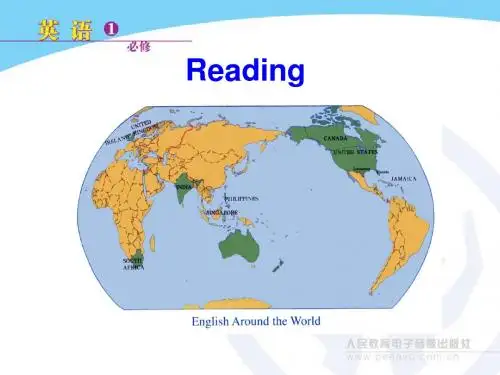
Suggested answer:
1. America, Britain, Canada, Australia, New Zealand, Singapore, Philippines, India 2. For those that speak English as their first language the USA or India must have the largest number of native speakers as they have the largest populations. For those who learn English as their first foreign language China must have the largest number as it has the largest population.
Homework
1. Reread the passage and list the reasons why English is spoken in many countries. 2. Review the words and expressions in the passage and try to use it in the sentences with context.
3. Guess according to the title.
The road to modern English
?
The road Modern English
the development of English language
What kind of English before Modern English?
1. English spoken in some other countries 2. changes of English 3. the change of English speakers 4. different kinds of Englishes
人教版高中英语 必修一 Unit2 《English around the world---Reading》 课件 (共27张ppt).ppt

Conclusion
Language can change with time.
Language can change
time
when cultures
communicate with
each other.
place
Some people say that Chinese is a much more elegant language, so it is more important for us to master it and it is not so necessary to master foreign language. Do you agree with this opinion and why?
Noah Webster Born: October 16, 1758 Died: May 28, 1843 When Noah was 43, he started writing the first American dictionary. He did this because Americans in different parts of the country spelled, pronounced and used words differently.
3 ____ will tell if Chinese English develop its own identity. A time B people
Thinking
Will Chinese English become one of the world Englishes?
“Only time will tell”.
Choose the main idea of the text.
Unit2《English Around the World》Reading课件(新人教版必修1)

Second reading
Make a timetable of the development of English. English was based more During the 5th century AD: on German Between about AD 800 and 1150: English was influenced by Danish and French invades. Shakespeare used a wider voacbulary By the 1600s: than ever before. British setters moved to America in the 1620: “Mayflower.” From the 18th century : British colonized Austrilia
7 native
8 come up 9 because of
19 identity
20 fluent 21 frequent
10 apartment
11 actually
22 usage
23 command
12 at present
24 request
25 dialect 26 expression 27 midwestern 28 African 29 Spanish 30 play a role (in) 31 recognize 32 accent 33 lightning 34 stright 35 block 36 cab
1765-1947 English spoken in India
By 19th century: Dictionaries standardized the spelling of English
人教版高中英语必修一Unit2说课稿

人教版高中英语必修一Unit2说课稿人教版高中英语必修一Unit 2说课稿English around the world Reading部分各位老师:大家好!我说的课题是高中一年级英语上册第2单元English around the world的第三课时Reading。
我说课的内容包括三部分,一是教材分析,二是说教法,三是说教学程序。
一、教材分析1、单元背景分析本单元讨论的话题是“世界英语”介绍了英语在当今世界范围内人们生活中扮演的不同角色及其重要意义。
尤其介绍了英美语言的差异,让学生更进一步了解学好英语的必要性和其重要意义。
促使学生了解英美语言在词汇、拼写、语音等方面的区别。
使学生在认识到学好英语的重要性的同时,更加热爱自己的祖国,从而培养他们的祖国意识。
2、教材内容分析本课是高中一年级英语上册,unit 2 English around the world 中的Reading.w 本单元的中心话题是“世界英语”,具体涉及“英语在当今世界范围内人们生活中扮演的不同角色及其重要意义,以及英美语言的差异”。
本课的语言知识及语言技能主要是围绕“世界英语”这一中心话题进行设计的。
w 本课时主要分为两部分:1)Pre-reading. (读前准备)“读前准备”部分是Reading的前奏,此部分设计了两个问题,诱发学思考。
通过对问题的讨论和比较,让学生明白学好英语的重要性。
2).Reading (阅读)“阅读”部分文体为说明文,全文共分三个段落。
全文阐述了一个鲜明的观点:英语的确是当今世界范围内使用最广泛的一门语言之一,也是联合国的工作语言之一,它的重要作用是其他语言不可替代的。
3)Post-reading(读后)“读后”部分共设计了两类题型:第一部分是和个问题,其中前面两个是细节理解题;第三题是一个开放性题目,鼓励学生把英语学习与现实生活相结合。
第二部分是填空形式,帮助学生梳理文章,掌握文章主要细节,概括中心思想,实为文章的一个纲要。
人教版高一英语必修一《Unit 2 English around the world》评课稿
人教版高一英语必修一《Unit 2 English around the world》评课稿1. 前言•学科名称:英语•教材版本:人教版高一英语必修一•单元名称:Unit 2 English around the world 本篇评课稿旨在对人教版高一英语必修一《Unit 2 English around the world》进行评析,探讨教材的设计与内容,并提供一些教学建议和反馈。
2. 教材概述《Unit 2 English around the world》是高一英语必修一教材中的一个单元,主要目的是帮助学生了解英语在世界范围内的重要性和多样性。
本单元分为四个部分,分别展示了英语在不同国家和地区的应用和特点。
2.1 第一部分:Listening第一部分主要通过听力练习让学生对英语的应用和变体有初步了解。
•学习目标:通过听力训练,学生能够听懂不同地区的英语口音,提高听力理解能力。
•内容概述:学生将听到来自英国、美国、印度等地不同母语人士的英语发音,通过听力练习,学会区分不同英语口音特点。
•教学评价:本部分设置了多样的听力材料,并提供了配套的听力练习,通过多次反复练习,能够帮助学生更好地理解不同的英语口音,从而提高听力水平。
•建议与反馈:为了进一步提高学生的听力理解能力,可以增加一些真实英语对话的听力材料,并提供更多的听力练习题,引导学生进行听力训练。
2.2 第二部分:Speaking第二部分通过讲话和对话的练习,提高学生的口语表达能力以及交际能力。
•学习目标:通过课堂练习,学生能够模仿并正确运用英语口音和语调,并能够进行简单的英语对话和交流。
•内容概述:学生将练习模仿英美人士的英语发音,进行有关英语使用的对话练习,如问路、订购食物等场景。
•教学评价:本部分通过组织学生进行角色扮演和小组对话的方式,有效地锻炼了学生的口语表达能力,激发了学生的兴趣和参与度。
•建议与反馈:为了提高学生的口语表达水平,可以增加一些生活化实用的对话练习,如购物、旅行等场景,让学生更好地应用所学知识。
人教高中英语必修一unit-2-English-around-the-world-单词讲解
latest adj.最新的;最近的;最后的 lately(=recently) adv.最近;近来
选词填空(latter/later/late/lately/latest) ①Here are Tom and David; the _l_a_t_te_r__ is my
04 come up
come up①_上__来__,走__近_②__被__提_出____ ③__发_生__,__出__现___④__发__芽____
英译汉 (1)A foreigner came up to me and asked me the way to the railway station. 一个外国人走到我面前问我去火车站的路。 (2)The grass is just beginning to come up.
(1)vt. 以……为根据
base... on/upon 把……建立在……的基础上 be based on/upon 以……为基础/依据
(2)n.基部;基地;基础 at the base of 以……为基点;在……的底部
1.你不应该把自己的快乐建立在别人的痛苦之上。
You shouldn’t base your happiness on/upon the other’s sadness.
④The koala(考拉) is native ___to____Australia.
____考__拉__原___产__于__澳__大__利__亚__。________________________
请替换文字内容
点击添加相关标题文字,点击添加相关标题文字,点击添加相关标题 文字,点击添加相关标题文字,点击添加相关标题文字。
人教版高中英语必修一教案:Unit2EnglandaroundtheworldReading
必修一 Unit2 English around the worldReadingTeaching goals 教课目的1. Target language目口号言a.要点词汇和短语include, play a role, because of, international, native, come up, culture, actually, present, vocabulary, usage, identity, such as, rapidlyb.要点句子World Englishes come from those countries... P9Native English speakers can understand each other... P9It became less like German, and more like French... P102. Ability goals能力目标Enable the Ss to describe the history of English and know of the differences between American English and Britain English.3. Learning ability goals学能目标Help the students learn how to analyze the way the author describes the history of English.Teaching important points教课要点Retell the history of English according to the chart.Teaching difficult point教课难点Work together with partners and express one ’s opinion on which kind of English one should learn.Teaching methods 教课方法Discussion.Reading.Listening.Cooperative learning.Teaching aids 教具准备A recorder, a projector and some slides.Teaching procedures & ways教课过程与方式Step I Greeting and revisionT:Good morning / afternoon, boys and girls! First I will check the words and expressions you have previewed.(P11-12 Discovering useful words and phrases part 1, 2, 3, and 4)Teacher shows answers on the screen.T: Please look at the screen and check your answer. Do you have any question?S: Are“ such as” and“ for example” the same?T: OK, I’ ll give you two examples:1.He knows five languages, such as Russian, French and Spanish.2.The differences in the spoken language are greater.S: Oh, I see. Such“as” is used to list similar things, while“ for example” is used to prove the speakers w Ss ask any questions and Teacher explains to them in class.Step II Warming upArouse the Ss’interests in reading. Let the students know of world English.T:So much for the words. Can you name some countries in which English is spoken?Ss: Of course. America, Britain, Canada, Australia...Teacher writes American, British, Canadian, and Australian on the Bb. Then add English to these words.T:Are these Englishes the same?S:I think they are the same. They are all called English.S:I don’t think so. As I know BE and AE are different in spelling, pronunciation and so on.T:Well, turn to page 9. Read the warming up. Please answer the questions below.Ss: (scanning) There is more than one kind of English.T:Please go on reading and try to tell AE words from BE words below.After reading the students give their answers.T:Who will show your answer?S: I think um,“m in a team, rubber, petrol” are BE words“mom,.And on a team, eraser, gas” are AE words.T:Can you give them a name?Ss: World English.T:Very good.Step III Pre-readingActivate the Ss ’background knowledge of English.T:From Warming up we know many people speak English in the world. How many people speak English andwhy do so many people speak English? Please discuss with your partners and answer the questions.A few minutes later.S:Maybe 1000 million people speak English today. Because many countries were colonies of England so Englishis spoken as a first or second language in many countries.S:We can ’t get the exact number. More and more people begin to learn English because English is theworking language in the United Nations. Everywhere children go to school to learn English.T: Excellent! About 1500 million people speak English as their first, second or foreign language. But they’tdon speak the same kind of English.Step IV ReadingGet the students to know the history of English and help the Ss to form a good habit of reading.Point to the Bb.T: How did different kinds of English come about? Please read the text“ The Road to Modern English”and pick out the answer.Ss read quickly to find the answer.T: Any volunteer to answer the question?S: I will. English has changed over time. All languages change when cultures communicated with one another.T: Any different ideas?Well, you all have the same answer.Task1 Reading and choose correct answers.T:Turn to page 10. Please read the questions and multiple answers first to know what information we should get,and then read the passage to find the answer.S:I will. English has the most speakers now.T:Good. What ’s the answer to the second?S:Languages change when cultures change.T: Right. How do you know?S:I judge it, according to the second sentence in the third paragraph.T:Good. Can you choose the right answer to question 3 ?S:Yes. From AD 450 to1150 English sounds more like German.T:Excellent. What about question 4?S:Around 1600 ’s.T:Very good. The last one? Let ’s answer ittogether. Ss: China.T:You are quite right.Task2 Read and summarize the main idea of each paragraph. Work in groups of four.T:Read the text and tell the main idea of each paragraph. After reading, discuss your answer in groups of four.After a few minutes.T: What ’s the main idea of the first paragraph?S1: The first paragraph tells us that more and more people speak English.S2: I don’hinktt so. It describes the extension of English in the world.T: Right. The first paragraph describes the extensive of English in the world. What is the main idea of paragraph 2?S: It tells us native speakers can understand each other but not everything.Let the Ss give an example to prove this point.T: Can you tell me what the third paragraph is about?S:All languages change when cultures communicate with one another. It’s the key sentence of the last two paragraphs. This paragraph tells the development of English as native language.T:Quite right. What about the last paragraph?S:English is spoken as a foreign or second language in many countries.T:How many parts can we divide the text into ?S:Two parts. The first paragraph is the first part, and paragraph 2, 3 and 4 can be part 2.Task3 Analyze the text.T:Please read the text again to tell the main idea of each part and the function of each paragraph. Afterreading please fill in the chart below.DiscussionS1: The first part describes the history of English in chronological order: 16th century-the next century— today.S2: It describes the development of English from the angle of its extension in region. Look, England—many other countries — more people than before (China).S3: I agree with S2.S4: In part two, the author first raises the fact: English has changed over time. Then analyze how English haschanged into world English.T:Are you ready? Which group would like to fill the chart? Group 1 please writes down the main idea of each part. Group 2 please write the function of paragraph 1and2. Group3, the last two paragraphs. The other students check their answers.Sample chart (slide)Part Paragraph FunctionPart1:12Part2:34Suggested answersPart Paragraph FunctionPart1:The extension of English1Describe the development ofin the world English from the angle of itsextension in region.England— many othercountries—more people thanbefore (China).Part2:English changes when2Raise the fact: English hasits culture communicate with developed into world Englishothers3Describe the development ofEnglish in English speakingcountries.4Describe the development ofEnglish in countries where it isspoken as a foreign or secondlanguage.Step V Post-readingCheck the Ss’understanding of the text, help the Ss deal with new language points.Task Express one’s own opinion. Work in groups of four.T:There are many kinds of English. Which kind of English are we learning?Ss: Both AE and BE.Show questions on the screen and ask a student to read them.T: Please discuss these questions and tell us your answers.1.Do you think it matters what kind of English you learn? Why?2.Why do you think people all over the world want to learn English?3.Will Chinese English become one of the world English?After a few minutes.T:OK, I ’ ll ask some groups to report their opinions. Group 1, can you tell us your opinion?S:Yes. I think we should learn BE because other kinds of English came from it.T:Any different ideas?S: In my opinion, we can learn any kind of English because people can understand each other even if they don’t speak the same kind of English.T: Wonderful! What about the second question?S:With the development of economy, it is necessary for people from different countries to communicate witheach other. So we need a language to be work language, while English is the most widely used language. So people all over the world want to learn English.T:Very good! What ’s your opinion?S:I think because of the wide use of computer, people have to learn English. Computer plays an important partin the popularity of English.T:OK. Question 3.Yes or no ?S:My answer is “ yes ”A . large number of Chinese especially young people are learning English. English is communicating with Chinese culture. There will be Chinese English.T:Only time will tell. Now we know English is spoken in so many countries and it plays an important part in the world. If we learn English well, we can listen to English song, read English novels, travel in English speaking countries comfortably and communicate with foreigners easily. Also, it is of great help not only to our own development but also to the development of our country. The Olympic Games will be held in Beijing. Let’s work hard and welcome its coming.Question timeT:It ’ s time for you to ask any questions or let me explain the sentences that hinder your understanding of the text. Ss ask questions freely.T:Now let ’s deal with some language points. Turn to page 9. Let ’ s look atthe sentence: However, they may not understand everything. This sentence means that sometimes they can understand each other, but sometimes theyhave difficulty understanding each other. The English spoken between about AD 450 and 1150 was very differentfrom the English spoken today. In this sentence,“ spoken between about AD 450 and 1150” and“are used to describe the English.HomeworkRetell the text according to the chart.Finish exercises1, 2, 3 (Using words and expressions) P49-50.。
unit2_English_around_the_world教案
unit2_English_around_the_world教案Unit 2 English around the worldPeriod 1Warming Up& Pre-readingTeaching aims: To make Ss to get to know some differences between British English and American English.Important and difficult points: To tell and grasp the differences between British English and American English.Teaching procedures:TO arouse the students’ interest and lead in the topic, the teacher can organize some activities. Step1: T:We have learned something about friendship in unit 1. Do you know what problems they will meet if a British boy wants to make friend with an American boy?Step2. Let Ss discuss how many countries use English as their official language and which countries.(教师可通过PPT的形式,借助以英语为官⽅语⾔的国家国旗和世界地图来辅助完成) And do you know that there is more than one kind of English? Ss may list America, Britain, Canada, Australia……Teacher writes “American English, British English, Canadian English, and Australian English……T: Are the Englishes talked around the world all the same? (先让学⽣⾃由讨论,然后⽼师播放⼀段来⾃不同国家的母语为英语的外国⼈的视频)Step3. Get the Ss to discuss in groups about the differences between American English and British English, and give some examples.a. Can you understand the different kinds of English these people are using?Speaker1: Let’s go to the pictures?Speaker2: Ok. But how shall we go to the movies?Speaker1: Why not go by underground?Speaker2: Er, but the subway station is far away.When you hear two native speakers of English, they may still not speak the same kind of English. Situation discussionJack is a British boy. He went to America for a trip in this summer vacation. The first day he went to a restaurant and looked around for a toilet. When he asked the waitress, she told him it is on the second floor. Jack went up two floors only to find empty rooms.Where is the toilet?BSpeaker1: Can you tell me how to spell the word “neighbor”?Speaker2: N-E-I-G-H-B-O-U-R, neighbour.Summary: Main differencesSpelling, pronunciation and vocabularyPeriod 2Reading and ComprehendingTeaching aims:1、To get students to have a general view about the historical development of English.2、To get students to know different kinds of English around the world, especially the differences between British English and American English.3、To i mprove the students’ reading ability.Important points:1、How to improve the students’ reading ability.2、How to make students enlarge their knowledge on English through reading.Difficult points:1、To be able to get the main idea from the text.2、To be able to use the different reading strategies for different purposes.3、Expressing one’s ideas why one should learn English.Teaching procedures:Step1: Lead-in1. Why should we learn English?Step2SkimmingRead quickly to get the main idea of the text.1. The text mainly tells us ___________.A. that old English is different from the English todayB. how Middle English formedC. English and its historyD. that English will keep changing2. The text is developed mainly by ____.A. placeB. timeC. peopleStep3Scanning【答案】 1.England 2.based 3.German 4.vocabulary5.change /doc/5eed1d4e915f804d2b16c193.html cation9.learners10.identityStep4DiscussionWork in groups. Discuss the following question and then ask two groups to report their answers to the class. 1. Why do you think more people in the world now want to learn Chinese?Period 3 Language pointsTeaching aims: To make Ss to know the meanings of the important words and phrases and master their usages. Important and difficult points:To master the important words and phrases.Teaching procedures:1、the road to modern English常与to连⽤的名词:key, answer, entrance, monument……e. g: the key to the bike, the entrance exam to collegeThere stands a Monument to the People’s Heroes on the hill.2、Do you know that there is more than one kind of English?(P9)你知道英语不⽌⼀种吗?more than的⽤法(1)more than ⽤在数字前,意为“⽐…..多;超过……” 意为“不⽌⼀个”(含义为复数,但谓语动词⽤单数)。