
九年级英语13单元教案Unit 13 we’re trying to save the earth!
Peopleare throwinglitter into the river.
The riverused tobe so clean. (Used to )
Everyoneshould helpto clean up the river.(Modal verb)
教学准备பைடு நூலகம்
教学过程
详细内容师生活动
个性彰显
1a. To introduce Ss to the unit goal, talk about pollution and environmental protection.
Picture:
The four pictures show different forms of environmental pollution. The first picture on the left shows anairplane flying over some houses. The airplane seems to be flying a quite a low altitude, so the noise level must be quite high foe the people living in thesehouses. This is considered noise pollution. The second picture shows some vehicles give out exhaust fumes and causing air pollution. In the third picture, we see big chimneys giving off a lo of smoke and polluting the air. The last picture shows a rubbish dump hat pollutes the environment around it.
情感态度:We must be fully aware of the importance of reducing pollution and protecting animals.
教学重点
Target Language
教学难点
How to train students’ listening ability.
Grammar:
Present progressive, modal verbs
Words and expressions;
Curriculum words: coal, ugly, advantage, cost, wooden, plastic, takeaway, bin,
Useful expressions: throw away, in public places, get worried, cut down, lead to过程方法:According to finish some tasks to Train students’ listening ability and speaking ability.
教材章节(单元)分析与设想
单元名称
Unit 13 we’re trying to save the earth!
主要内容
介绍知识
结构框架
本单元以“环境保护”为话题,通过讨论大气污染、水污染和废弃物污染等造成的原因以及我们如何做去改善环境,着重复习时态和语态等语法知识。
单元教学
目标
1.语言知识目标
基本词汇:
情感态度:Everyone should keep our rivers clean.
教学重点
Target Language
教学难点
1.How to train students’ listening ability.
2.How to train students’ communicative competence.
课时安排
约需6课时
课题名称
Unit 13we’re trying to save the earth!
Section A 1a~ 1c
小课时数
第1课时
主备教师
合作教师
授课类型
fresh
教学目标
知识技能:
Target language: We’re tryingto save the earth.
Peopleare throwinglitter into the river.
◈rubbish (British English)- things that people throw away
◈trash/ garbage (American English)- thingsthat people throw away
◈waste- rubbish and unwanted materials left behind after we have used something, e.g. industrial waste
1c. To give Ss guided practice in using the target language to talk about pollution and environmental protection.
Review of used to and should.
板书设计
Unit 13 we’re trying to save the earth! Section A 1a~ 1c
litter, advantage, bottom, fisherman, coal, ugly, cost, wooden, plastic, takeaway, bin, shark, fin, method, cruel. Harmful, chain, ecosystem, industry, law, scientific, afford, reusable, transportation, recycle, napkin, upside, gate, bottle, president, inspiration, iron, work, metal, creativity,
2b. To give Ss further practice in listening for specific information.
Vocabulary
Focus on some words used to talk about the things that are thrown away.
基本词组:
be harmful to, at the top(of sth.), take part in, turn off, take action, throw away, put sth. to good use, pull… down, bring back
基本句型:
We’re trying to save the earth!
教学准备
教学过程
详细内容师生活动
个性彰显
2a. To give Ss practice in learning for specific information.
Culture Focus: Throwaway society
In the conversation, Susan identifies “too much rubbish and waste” as a serious environmental problem.
People are littering in public places.
To cut down air pollution, we should take the bus or subway instead of driving.
Our actions can make a difference and lead to a better future.
What other things cause pollution?
Ask Ss to complete the activity as a class, then work in pairs to think of more words to add to the lists for each column.
The riverused tobe so clean.
Everyoneshould helpto clean up the river.
1.Grammar: Present progressive, used to, modal verbs
2.Words and expressions;
Curriculum words: litter, bottom, fisherman
◈litter- things that people have thrown away and left on the ground in public places
2c. To give Ss practice in using the targetlanguage in conversations.
Useful expressions: be full of, put…into, throw…into, clean up, play a part in, close down
过程方法:According to designingsome tasks, to train students’ listening ability and to train students’ communicative competence.
教学过程
教学过程
详细内容师生活动
九年级英语unit13教案
九年级英语unit13教案【篇一:九年级英语第十三单元教案unit 13 we】unit 13 we’re trying to save the earth!一、教学目标:1. 语言知识目标基本词汇:litter, advantage, bottom, fisherman, coal, ugly, cost, wooden, plastic, takeaway, bin,shark, fin, method, cruel. harmful, chain, ecosystem, industry, law, scientific, afford,reusable, transportation, recycle, napkin, upside, gate, bottle, president, inspiration,iron, work, metal, creativity,基本词组:be harmful to, at the top(of sth.), take part in, turn off, take action, throw away, put sth.to good use, pull… down, bring back基本句型:we’re trying to save the earth! the river used to beso clean.the air is badly polluted. no scientific studies have showedthat shark fins are good for health.we should help save the sharks.2. 技能目标: 能正确运用现在进行时,现在完成时,被动语态,情态动词和used to 句型。
3. 情感目标: 有环境危机意识,学会关注环境保护环境。
二、教学重难点:1. 教学重点:(1)能正确运用现在进行时,现在完成时,被动语态,情态动词和used to 句型。
人教版九年级英语Unit 13 We're trying to save the earth! 全单元教案
Unit 13We're trying to save the earth!本单元围绕环境保护的话题,并用主题图片表现噪音污染、空气污染、水污染等内容,目的是为了让学生对环境的破坏有一个直观的认识,从而激发学生强烈的社会责任感和对未来发展的思考。
Section A的重点是让学生掌握与环境污染和环境保护相关的词汇和句型,同时引导学生关爱动物、保护环境。
教学难点是让学生学会正确使用连词和结合生活实际讲述如何保护环境。
Section B在Section A所学的基础上,进一步谈论如何保护环境。
教学重点是让学生了解环境保护的方式,并落实到积极的行动当中,同时还有阅读策略和写作技巧的训练。
教学难点是让学生在阅读2a文章之后,根据所给词根找出衍生出的不同词汇,并理解前缀和后缀的不同用法。
The First Period—Section A(1a-2d)Teaching Important Points【教学重点】Key words & phrases:litter,bottom,fisherman,coal,ugly,advantage,cost,wooden,plasticnoise pollution,air pollution,water pollution,be full of,play a part in,turn…into,cut down air pollutionKey sentences:1.Even the bottom of the river was full of rubbish.2.It used to be so clean.3.Everyone in this town should play a part in cleaning it up.4.The air is badly polluted because there are more cars on the road these days.5.The air has become really polluted around here.6.We're trying to save the earth.Key structure:should+do;used to+do;have/has+done;be+done;be+doinge.g.Everyone should help to clean up the river.The air has become really polluted.I used to be able to see stars in the sky.The air is badly polluted.Teaching Difficult Points【教学难点】★Practice the structures to talk about pollution and environmental protection.Teaching Aids【教学工具】A tape recorder,CAI or multimedia courseware.Teaching Steps【教学过程】★Step 1Leading in【新课导入】1.Greeting2.Discussion and reviewDiscuss with the students,like this:T:What kinds of pollution are there these days?S:…T:What causes the pollution?S:…3.Review the words and expressions about the topic.★Step 2Cooperative inquiry【合作探究】1.Finish the task in 1a①Show pictures or play videos about pollution and talk about the pollution.②Read these phrases in 1a.Look at the pictures in 1a and say what they see in the pictures.Write down the words and add more words.③Ask students to say out their words in each kind of pollution.2.Finish the task in 1b①Read the instructions.Get the students to read the contents in the chart and think of what they will fill in the blanks.②Play the recording for the first time.Students listen and fill in the words.③Play the recording a second time.Ask them to check the answers.Then ask the questions.Students answer with full sentences.④Ask more questions to help students learn more details.Then play the recording for the students to role-pay the conversation.3.Finish the task in 1c①Show the key words of the conversation.Ask students to retell the contents in the chart.Like this:What:dirty;bottom,rubbish;fishWhy:littering,putting wasteHow:write to,close down;help to clean up②Read aloud the model dialogue in 1c.Then in pairs,do the oral practice with more words.③Ask two pairs to perform in class.4.Finish the tasks in 2a-2b①Use PPT or pictures to show the four kinds of pollution.Get the groups of students to havea competition to say words about the pollution one by one.land pollution:…air pollution:…noise pollution:…water pollution:…②Get the students to write down these words in their notebooks.③Play the recording for the first time.Students listen and circle the kinds of pollution.Check answers with the class.④Read the sentences in 2b.Predict the contents they will fill in.Play the recording.Students listen and complete the sentences.⑤Play the recording again.Check the answers with the whole class.5.Finish the task in 2c①Read the sample conversation in 2c.Then Read the listening materials and discuss in pairs what causes the two kinds of pollution.②Students work in pairs,making dialogues.③Ask three pairs to role-play their conversations to the class.6.Finish the task in 2d①Talk about the picture in 2d.Ask:What are your ideas for solving the air pollution/waste pollution problem?Present the new words in the conversation.Such as,coal,advantage,wooden,plastic,takeaway,bin,…②Read the conversation in 2d quickly.Find out the problems about environmental pollution in the dialogue.③Read the conversation again.Ask the students to find the ways to solve the problems of air and waste pollution.④Read aloud the conversation by the recording.⑤Learn the useful expressions:What are your ideas for doing…To cut down air pollution,we should…So together,our actions can make a difference and…⑥Role-play or read the conversation in pairs until fluently.★Step 3Homework1.What are your ideas for solving the waste pollution problem?2.Write the words about the four kinds of pollution.3.Translate the following sentences into English.(1)我们正在想办法拯救地球。
九年级英语全册《Unit 13 We’re trying to save the earth(第2课时)》教案 (新版)人教新目标版
情境教学法;任务型教学法
二、【教学流程】
环节
师生活动
二次备课
I.复习
热身
1、检查生词预习。
(1)先通过PPT呈现本课的单词,教师领读,学生跟读,并帮助学生正音。
(2)做题巩固。根据句意和首字母提示写出所缺的单词。
①This method is not only c_______, but also harmful to the environment.
3.学会使用以下句型:
(1)Do you realize that you’re killing a whole shark each time you enjoy a bowl of shark’s fin soup?
(2)When people catch sharks, they cut off their fins and throw the shark back into the ocean.
④Many have heard of shark’s f_______ soup.
⑤If their numbers drop too low, it will bring d_______to all ocean life.
答案:①cruel②ecosystem③industry④fin⑤danger
③Many think that sharks are too strong to be endangered, _______they are wrong.
Unit 13 We’re trying to save the earth!
Section A3a—3c
一、【教材分析】
教
学
目
标
人教版新目标版九年级英语全册Unit 13 We’re trying to save the earth教案
Unit 13 We’re trying to save the earth!知识导航语言目标谈论污染和环境保护。
Section A 重点单词1. litter v.乱扔n.垃圾2. bottom n.底部3. coal n.煤4.ugly adj.丑陋的 5. cost v.花费n.花费 6. wooden adj.木制的 (wood n.木材) 7. plastic adj.塑料的n.塑料 8. method n.方法 9. cruel adj.残酷的 10. harmful adj.有害的 (harm n.害处) 11. industry n.工业 12. law n.法律 13. afford v.承担得起重点短语1.make a difference 起作用;有影响2. take part in 参加3. turnoff 关掉4. pay for 付费;付出代价5. cut down 减少6. lead to 导致7.hear of 听说 8. cut off 切除重点句型1.We’re trying to save the earth. 我们在努力拯救地球。
2. The rive used to be so clean. 这河流过去是如此的清澈。
3. The air is badly polluted. 空气被严重污染。
4. The method is not only cruel, but also harmful to theenvironment. 这种方法不仅残酷,而且对环境也有害。
Section B +Self Check 重点单词1. recycle v.回收利用2. gate n.大门3. bottle n.瓶子4.president n. 负责人 5. work n.作品 6. metal n.金属重点短语1. throw away 扔掉2. put sth. to good use 好好利用3. put …down 拆下 4. upside down 上下颠倒 5. bring back 恢复重点句型1. And the gate in front of her house is made of rocks and oldglass bottles. 她房子的前门是由岩石和旧玻璃瓶子制成的。
人教版九年级英语Unit 13 We’re trying to save the earth 教案
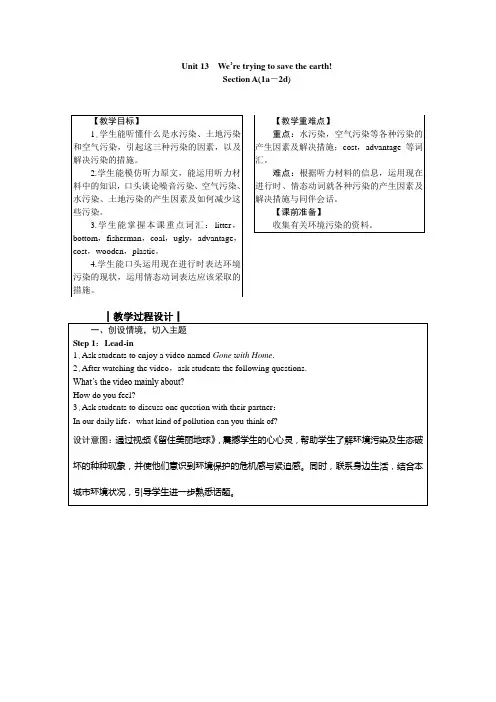
Unit 13We’re trying to save the earth!Section A(1a-2d)┃教学小结┃【板书设计】Unit 13We’re trying to save the earth!Section A(Section A(3a-4c)┃教学小结┃Section B(1a-1e)┃教学小结┃Section B(2a-2e)设计意图:读前预测,为学生在接下来的阅读中获取文章大意作准备。
思维导图可以帮助学生理清文章脉络。
Step 5:Use pictures to teach the new words.When students think about the questions in Step 3,the teacher can write down the new words on the blackboard.And teach them the new words.设计意图:适时呈现词汇,可以减轻学生的阅读压力。
While readingStep 6:Fast reading1.Ask students to look through the article quickly and find out the answer to each question.How many people are mentioned in the passage?Who are they?2.The teacher adds information to the mind-map.设计意图:扫读整篇文章,获取大意,帮助学生把握文章的整体性。
Step 7:Careful reading(Paragraph 2)1.Ask students to read Paragraph 2 carefully and fill in the chart.2.Check answers.3.The teacher adds the information to the mind-map.Step 8:Careful reading(Paragraph 3)1.Ask students to read Paragraph 3 carefully and fill in the chart.2.Check answers.Name What did she make?What materials did she use?Jessica Wong bags old clothes,especially old jeans3.The teacher adds the information to the mind-map.Step 9:Careful reading(Paragraph 4)1.Ask students to read Paragraph 4 carefully and fill in the chart.2.Check answers.Name What did he make?What materials did he use?Wang Tao beautiful art pieces iron and other materials from old cars3.The teacher adds the information to the mind-map.Which things can be done by common people every day?Which things have to be done by governments and organizations?Common people Governments Organizations2.Ask several groups to give a report.设计意图:教师让学生对所学的保护环境的措施进行归纳和分类,培养学生分析问题和解决问题的能力。
人教版九年级英语全册Unit13We'retryingtosavetheearth!优秀教学案例

(三)情感态度与价值观
1.学生能够通过本节课的学习,树立环保意识,认识到保护地球的重要性,并能够在日常生活中采取实际行动,如节约用水、减少废物等。
2.学生能够理解和尊重不同文化背景下的环保观念和实践,培养全球视野和跨文化交际能力。
(四)反思与评价
1.教师引导学进行自我反思,评估自己在环保知识掌握和技能运用方面的进步,培养他们的自我监控和自我调整能力。
2.学生通过互评和小组评价,相互借鉴和学习,提高自己的环保意识和语言运用能力。
3.教师对学生的学习过程和成果进行综合评价,关注他们的全面发展,鼓励他们的创新和实践精神。同时,根据评价结果调整教学策略,提高教学效果。
2.学生通过完成作业,进一步巩固本节课所学内容,提高他们的语言运用能力。
3.教师对学生的作业进行评价,关注他们的全面发展,鼓励他们的创新和实践精神。同时,根据评价结果调整教学策略,提高教学效果。
五、案例亮点
1.创新的情景创设:本节课通过多媒体手段,如图片、视频等,为学生创设了丰富的环保情境,使学生身临其境地感受到环保问题的紧迫性。这种创新的情景创设方式不仅激发了学生的学习兴趣,而且提高了他们的参与度和学习效果。
四、教学内容与过程
(一)导入新课
1.教师通过展示一张地球的照片,引导学生关注地球的美丽和脆弱,引出本节课的主题——环保。
2.教师提问:“你们对环保有什么了解和看法?”让学生分享自己的知识和观点,激发他们的学习兴趣和参与欲望。
3.教师播放一段关于环保问题的新闻报道,让学生了解全球环保形势的严峻性,引出本节课的学习目标——提高环保意识,学习英语表达环保观点。
4.反思与评价的全面评估:教师引导学生进行自我反思,评估自己在环保知识掌握和技能运用方面的进步。同时,教师对学生的学习过程和成果进行综合评价,关注他们的全面发展。这种反思与评价的方式有助于培养学生的自我监控和自我调整能力,提高他们的批判性思维和创造性思维。
人教版英语九年级全册Unit13We'retryingtosavetheearth!优秀教学案例
4.对小组合作进行评价,关注学生的参与度、贡献度和团队合作效果。
(四)反思与评价
1.引导学生进行自我反思,思考自己在学习过程中的优点和不足,培养自我评价和自我改进的能力。
2.组织学生进行同伴评价,鼓励他们互相提供反馈和建议,培养评价能力和批判性思维。
3.创设问题情境,让学生面临真实的环保问题,如水资源浪费、垃圾分类等,引导学生主动思考和寻找解决方案。
4.利用多媒体技术,如视频、音频、动画等,营造生动有趣的学习氛围,激发学生的学习兴趣和积极性。
(二)问题导向
1.设计有挑战性的问题,引导学生深入思考环保问题的本质和影响。
2.通过提问和讨论,引导学生自主探究和解决问题,培养他们的批判性思维和问题境的影响。
3.总结本节课的主要内容和知识点,确保学生对环保知识有一个全面而准确的理解。
(五)作业小结
1.布置相关的作业,如研究报告、行动计划等,让学生将所学知识运用到实际生活中去。
2.要求学生在作业中提出自己的观点和解决方案,培养他们的创新思维和批判性思维能力。
3.引导学生关注环保问题的多样性和复杂性,培养他们的分析和综合能力。
4.鼓励学生提出自己的问题,激发他们的好奇心和探索精神。
(三)小组合作
1.组织学生进行小组讨论和合作,鼓励他们分享自己的观点和想法,培养合作能力和团队精神。
2.设计小组活动,如共同完成一篇关于环保的文章、策划一次环保活动等,让学生实际行动起来,提高实践能力。
3.鼓励学生在作业中积极表达自己的想法,注重培养他们的写作能力和表达能力。
4.对学生的作业进行认真批改和评价,提供及时的反馈和建议,帮助学生巩固所学知识,提高他们的学习效果。
九年级英语全册《Unit 13 We’re trying to save the earth》教案
II. 把下面的短语与汉语意思搭配。
1. make a difference A. 参与2. cut down B. 充满3. lead to C. 减少4. be full of D. 起作用5. play a part in E. 导致【重点讲练】1.⑴多指身份、职位等的变化.它强调变化的过程已经完成.后面可接名词或形容词。
er. 他成了一名老师。
⑵get多用于口语.表示一种变化过程.强调的是“渐渐变得”.后常接形容词的比较级形式。
In winter the days get shorter. 冬季白天变得较短。
⑶ turn指在颜色和性质等方面与以前的完全不同.强调变化的结果。
Leaves turned brown in the mountains. 山里的树叶已变成了棕色。
① Her mother ____ angry when she heard the news.②It’s _____ darker and darker outside.③ The milk has _____ bad.2. To cut down air pollution, we should take the bus or subway instead of driving. 为了减少空气污染.我们应该乘坐公共汽车或者地铁.而不是开车。
cut down意为“减少”;是“动词+副词”结构的短语.所带的宾语为名词时.宾语可位于down的前面或后面;为代词时.只能位于down前面。
You’d better cut the article down to about 2,000 words.你最好能把这篇文章压到两千字左右。
【拓展】cut down 还可表示“砍倒”的意思。
T hey cut down the big tree. 他们砍倒了这棵大树。
cut切断;切除off把……切成……cutintocut up 切碎cut in 插队【小试牛刀】单项选择—Did you tell it to Jack?—Yes, but we were ____ in the middle of our telephone conversation.A. cut downB. cut offC. cut upD. cut into3. It’s good for health and it doesn’t cost anything!它对身体有好处并且不会花费任何东西。
人教版九年级英语全册Unit13We’retryingtosavetheearth!教学设计
(3)海报制作:让学生分组制作环保海报,运用所学词汇和表达方式。
4.课后作业:
(1)要求学生撰写一篇关于环保的短文,巩固写作能力;
(2)鼓励学生参与环保活动,记录自己的行动和感受,提高实践能力。
5.评价与反馈:
(1)教师针对学生在课堂活动中的表现,给予及时、具体的评价;
-播放一段关于环保行动的听力材料,学生听后回答相关问题。
-教师引导学生总结听力材料中的关键信息,帮助学生提高获取、处理和运用信息的能力。
(三)学生小组讨论
1.教师将学生分成小组,每组选择一个环保主题,如:节约用水、减少塑料污染等。
2.小组内讨论以下问题:
- What are the main environmental problems related to your topic?
人教版九年级英语全册Unit13We’retryingtosavetheearth!教学设计
一、教学目标
(一)知识与技能
在本章节的学习中,学生将通过对Unit 13 "We’re trying to save the earth!"的学习,掌握以下知识与技能:
1.能够理解并运用与环保相关的词汇,如:recycle, reusable, global warming, pollution, conservation等;
1.完成课本练习册中与本课相关的练习题,特别是词汇填空、语法填空和听力练习,以加深对环保词汇和语法的掌握。
2.结合课堂所学,制作一份关于环保的海报,内容包括:环保主题、现状介绍、具体措施和建议。要求设计新颖,语言表达清晰,图文并茂。
3.撰写一篇短文,以“我的环保行动”为主题,描述自己在日常生活中实施的环保措施,以及对环保的认识和体会。字数在100-120词左右,要求使用一般现在时和现在进行时描述。
人教版英语九年级全册Unit13We'retryingtosavetheearth单元优秀教学案例
3.问题导向教学,培养批判性思维
本案例采用问题导向的教学策略,引导学生围绕环保问题展开思考、讨论和分析。这种教学方式有助于培养学生的批判性思维,使他们学会独立思考问题,形成自己的观点。
-结合课本对话和文章,让学生在实际语境中学习语法。
3.通过听力练习,让学生熟悉与环保相关的新闻报道、故事和对话,提高他们的听力水平。
-播放听力材料,引导学生完成相关练习,并针对难点进行讲解。
(三)学生小组讨论
1.将学生分成小组,每组选择一个环保主题,如:气候变化、水资源保护等,进行资料收集和讨论。
-要求学生用英语记录关键信息,为后续的展示做准备。
1.设计反思性问题,如:“在本章节的学习中,你学到了哪些环保知识?”“你认为自己在环保方面有哪些改变?”等,引导学生进行自我反思。
2.组织学生进行同伴评价,让他们互相提出建议,共同进步。
3.教师对学生进行综合评价,关注学生在知识、技能、情感态度与价值观等方面的表现,鼓励他们持续进步。
四、教学内容与过程
人教版英语九年级全册Unit13We'retryingtosavetheearth单元优秀教学案例
一、案例背景
随着社会的快速发展,环境问题已经成为全球关注的焦点。在这样的背景下,人教版英语九年级全册Unit13"We're trying to save the earth"单元,以环境保护为主题,旨在培养学生对环境问题的关注和责任感。本案例将结合课本内容,通过多元化的教学活动,提高学生对环境保护的认识,激发他们积极参与环保行动的热情。在教学过程中,注重运用教育专业用词,以人性化的语言引导学生进行思考与讨论,使他们在掌握英语知识的同时,也能够关注到地球的可持续发展。